

Geothermal Heat Pumps Market Size and Forecast – 2026 to 2033
Geothermal Heat Pumps Market is estimated to be valued at USD 14.02 Bn in 2026 and is expected to reach USD 23.87 Bn in 2033, exhibiting a compound annual growth rate (CAGR) of 7.9% from 2026 to 2033.
Key Takeaways
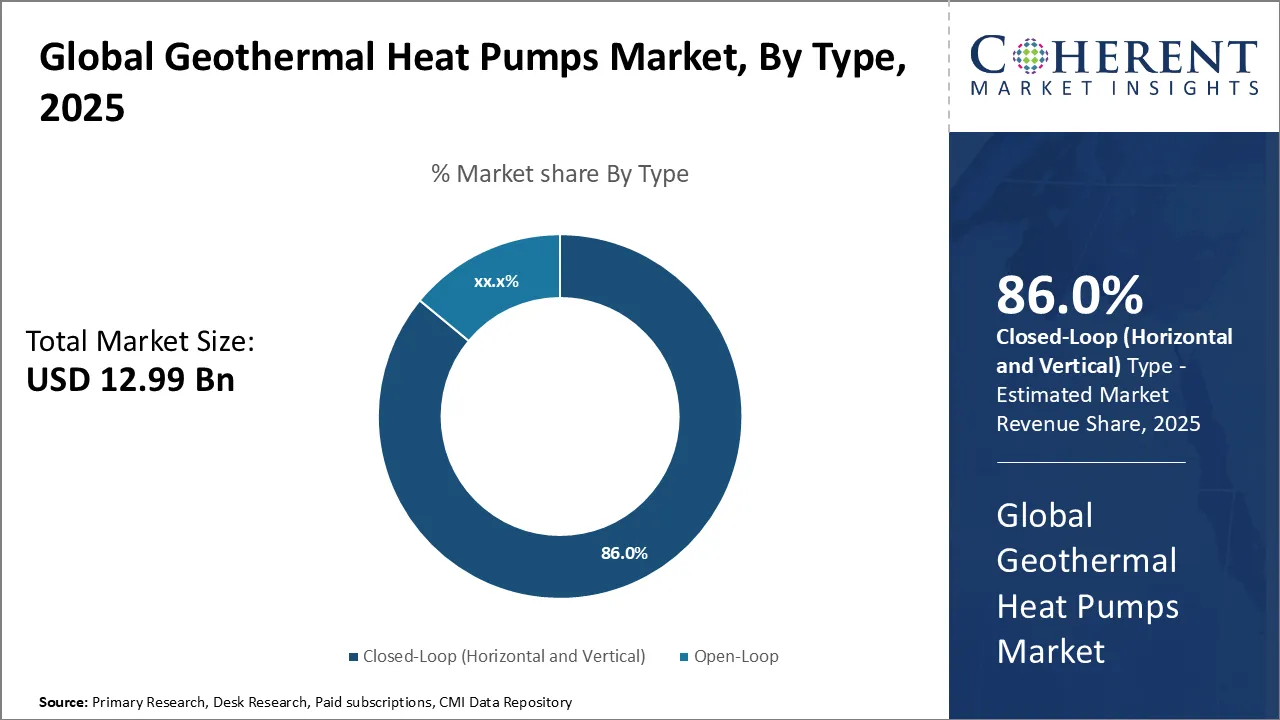
- By Type, Closed Loop hold the largest market share of 87% in 2026 owing to the Energy efficiency and cost savings.
- By Application, Residential expected to hold largest market share in 2026 owing to its growing environmental & sustainability concerns.
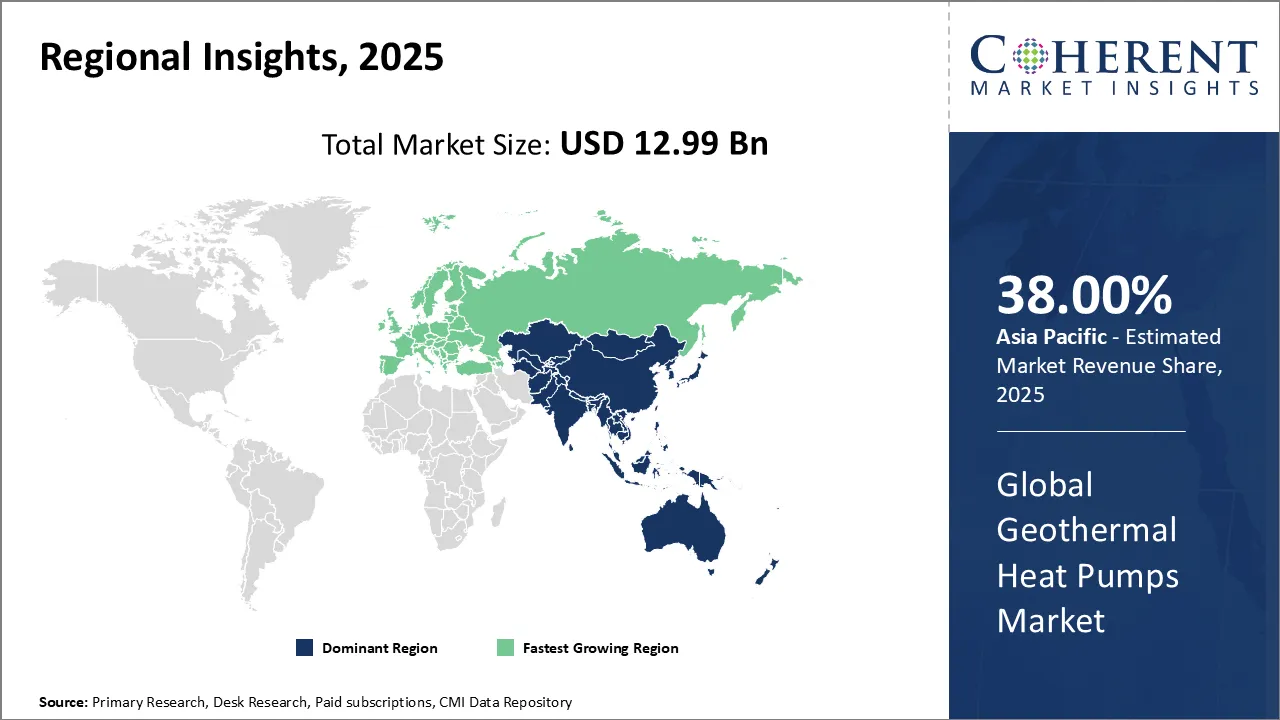
- By Region, Asia Pacific dominates the overall market with an estimated share of 38% in 2026 owing to the rapid urbanization, infrastructure expansion and construction boom.
Market Overview
The Geothermal Heat Pumps (GHP) market is steadily expanding as businesses and homeowners increasingly adopt them for energy-efficient heating and cooling in residential, commercial, and industrial settings. Rising energy costs, environmental concerns, and supportive government policies drive this adoption, as GHPs provide sustainable, reliable indoor climate control by harnessing stable ground temperatures. Technological innovations, including advanced heat exchangers and smart controls, boost system efficiency and simplify installation. Growing awareness of long-term cost savings and the push for low-carbon infrastructure further accelerate global market uptake.
Current Events and Its Impact on the Geothermal Heat Pumps Market
Current Events | Description and its impact |
Geopolitical Shifts in Energy Policy |
|
Economic Inflation and Supply Chain Disruptions |
|
Regional Energy Market Transitions |
|
Segmental Insights
- Current Industry Events of 2026
- Market Size Estimation
- Regional Breakdown
- Competitive Landscape
- Customer Intelligence
- Segmental Analysis
- Pricing Analysis
- Key Market Drivers, Challenges & Future Trends
- Customized Insights Section
Geothermal Heat Pumps Market Insights, By Type: Closed Loop contribute the highest share of the market owing to its growing demand from residential, commercial & urban developments.
Closed Loop hold the largest market share of 87% in 2026. The closed-loop segment of the Geothermal Heat Pumps market is attracting attention as users increasingly rely on its consistent energy efficiency and low maintenance needs. These systems circulate a sealed fluid through underground loops, providing reliable heating and cooling without depending on external water sources. Government incentives, rising environmental awareness, and advancements in loop design and installation drive their growing popularity. Homeowners and commercial developers also recognize their long-term cost savings, durability, and ability to maintain stable indoor comfort throughout the year.
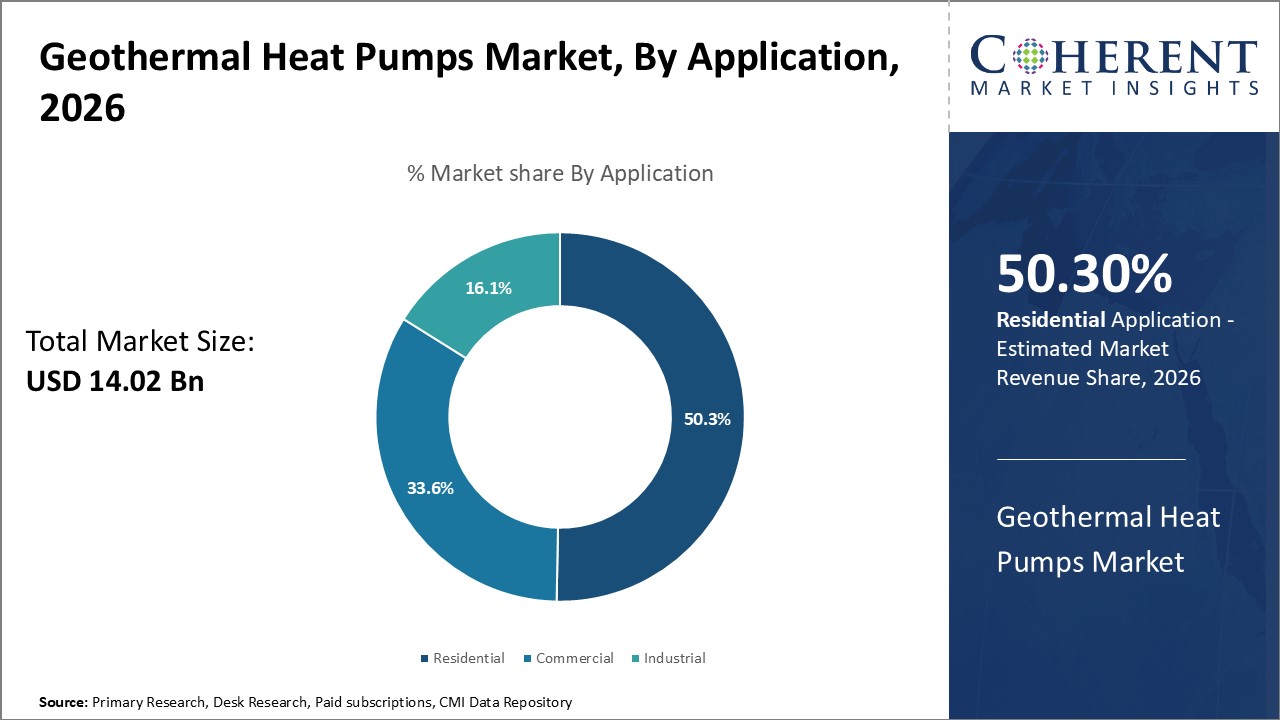
Geothermal Heat Pumps Market Insights, By Application: Residential contribute the highest share of the market owing to its technological progress making systems more practical for homes.
The residential segment of the Geothermal Heat Pumps market is growing as homeowners actively seek energy-efficient, comfortable, and cost-saving heating and cooling solutions. Rising electricity costs and environmental concerns motivate households to switch to sustainable systems. Supportive government incentives and policies further encourage adoption, while advancements in compact designs and smart controls simplify installation. Homeowners also appreciate the consistent indoor climate, low maintenance, and reduced carbon footprint that geothermal heat pumps provide, making them a preferred choice for modern homes. For instance, in July 2025, Germany’s Ait Group launched residential ground-source heat pumps using under 150 grams of propane, delivering up to 6 kW of heating with a seasonal performance coefficient of 5.14, compatible with renewable sources like geothermal probes, groundwater, wastewater, ice storage, and PVT collectors.
Regional Insights
Asia Pacific Geothermal Heat Pumps Market Trends
Asia Pacific dominates the overall market with an estimated share of 38% in 2026. The Asia‑Pacific region is actively adopting geothermal heat pumps as rapid urbanization and rising living standards boost demand for efficient heating and cooling in new residential and commercial buildings. Governments across the region promote clean energy and enforce stricter energy-efficiency regulations, encouraging the use of sustainable HVAC solutions. Advances in ground-loop drilling, hybrid systems, and smart energy controls make installations more practical and cost-effective. Builders and consumers increasingly favor geothermal heat pumps due to growing environmental awareness and the drive for low-carbon infrastructure.
Europe Geothermal Heat Pumps Market Trends
The Europe geothermal heat pump market is growing rapidly as countries actively work to decarbonize heating and achieve climate‑neutrality goals. Governments across the region implement strong regulations and offer incentives that promote renewable heating, increasing the adoption of geothermal and ground‑source heat pumps. Advances in ground-loop technology, installation techniques, and system efficiency make these solutions easier to implement. Rising demand for sustainable, energy-efficient heating in new residential and commercial buildings drives market growth, while awareness of cost savings and carbon reduction encourages wider adoption across Europe. For instance, in June 2026, CTC, a European heating product manufacturer with over 100 years of experience, will showcase its UK-first ground source technology at InstallerSHOW 2026 in partnership with Go Geothermal.
India Geothermal Heat Pumps Market Trends
The India geothermal heat pump market is gaining momentum as consumers and businesses increasingly turn to clean HVAC solutions in response to rising energy costs, unreliable grid power in some regions, and growing environmental awareness. The government actively promotes ground‑source heat pump installations through incentives, tax breaks, and regulatory support under its National Policy on Geothermal Energy. Technological improvements, including advanced drilling methods, compact system designs, and integration with renewable energy infrastructure, make geothermal solutions more practical and accessible for urban and semi‑urban projects.
United Kingdom Geothermal Heat Pumps Market Trends
The United Kingdom (UK) geothermal heat pump market is expanding as the government actively promotes a shift from gas-based heating to low-carbon solutions. Policy measures, including grants through the Boiler Upgrade Scheme and technical incentives, make geothermal heat pumps more affordable and appealing to homeowners and developers. At the same time, increasing awareness of renewable energy and growing demand for energy-efficient heating in new construction and retrofit projects are driving broader adoption of ground-source heat pumps across the country.
End-user Feedback and Unmet Needs in the Geothermal Heat Pumps Market
- High Upfront Costs: Many users appreciate the long-term savings of geothermal heat pumps but find the initial installation expense prohibitive. Homeowners and small businesses often struggle with financing, delaying adoption. Flexible financing options and cost-reduction strategies in materials and installation could help address this persistent barrier to wider market penetration.
- Installation Complexity and Time: End-users report that installation requires specialized knowledge, ground-loop drilling, and permits, making the process complex and time-consuming. Delays in project execution or lack of skilled installers can frustrate customers. Streamlined installation processes, better training, and modular designs could significantly improve user experience.
- Limited Awareness and Education: Many potential users lack understanding of geothermal technology, benefits, and long-term savings. Misconceptions about maintenance or suitability for different climates reduce adoption. Educational campaigns, demonstrations, and professional consultations could enhance awareness and foster confidence in geothermal solutions.
Geothermal Heat Pumps Market Trend
Growing Focus on Energy Efficiency and Sustainability
Growing concerns about climate change and energy consumption are pushing homeowners, businesses, and policymakers toward cleaner, eco‑friendly heating and cooling solutions. Geothermal heat pumps — which tap Earth’s stable underground temperature — offer a low‑emission alternative to fossil‑fuel‑based HVAC systems, reducing greenhouse‑gas emissions and cutting energy bills. As governments and consumers prioritize sustainable infrastructure and carbon‑footprint reduction, demand for geothermal systems increases steadily.
Integration with Smart, Hybrid and Modular Systems
Manufacturers and installers are increasingly combining geothermal heat pumps with smart home controls, energy‑management systems, and other renewables (e.g. solar) to create hybrid solutions. This trend enhances flexibility and overall system efficiency: users get optimized heating/cooling, better energy-use tracking, and often reduced operating costs. Prefabricated or modular geothermal units also simplify installation — especially in dense urban or retrofit projects — making the technology more accessible and practical.
Geothermal Heat Pumps Market Opportunity
Integration with Smart & Hybrid Energy Systems
Growing demand for “smart” homes and buildings presents a major opportunity: geothermal heat pumps can integrate with IoT‑enabled controls, energy‑management platforms, and renewable energy (like solar or storage) to deliver optimized heating and cooling. This convergence makes GHPs more appealing to tech‑savvy homeowners and developers aiming for efficient, interconnected energy systems — especially in smart‑city and sustainable‑building projects.
Market Report Scope
Geothermal Heat Pumps Market Report Coverage
| Report Coverage | Details | ||
|---|---|---|---|
| Base Year: | 2025 | Market Size in 2026: | USD 14.02 Bn |
| Historical Data for: | 2020 To 2024 | Forecast Period: | 2026 To 2033 |
| Forecast Period 2026 to 2033 CAGR: | 7.9% | 2033 Value Projection: | USD 23.87 Bn |
| Geographies covered: |
| ||
| Segments covered: |
| ||
| Companies covered: | STIEBEL ELTRON GmbH & Co. KG, Ingersoll Rand, Vaillant Group, Viessmann Group, Glen Dimplex, and Daikin Industries, Ltd. | ||
| Growth Drivers: |
| ||
| Restraints & Challenges: |
| ||
Geothermal Heat Pumps Market News
- In June 2025, Enertech Global, a leading manufacturer of ground-source and air-to-water heat pumps, has launched the WV, a next-generation variable-speed hydronic heat pump designed for maximum flexibility, performance, and easy installation.
- In June 2025, Manitoba has launched the Affordable Home Energy Program to promote ground-source heat pump adoption in electrically heated homes, offering no-upfront-cost options that could save households up to CAD 1,000 ($730) per year.
- In February 2024, Subterra Renewables and Enercare have launched a program to provide Canadian homes with a fully integrated geothermal heating and cooling solution.
Analyst Opinion (Expert Opinion)
- The current trajectory of the Geothermal Heat Pumps (GHP) market reveals compelling opportunities — especially as industry stakeholders seek scalable, efficient, and climate‑aligned heating and cooling solutions. For example, global data indicate that in 2024 about 1.7 million GHP units were installed worldwide, with closed‑loop systems comprising roughly 68% of those installations, highlighting strong demand for robust, reliable underground‑loop technologies.
- One major opportunity arises from the increasing emphasis on energy efficiency and decarbonization mandates across multiple regions. As jurisdictions tighten emissions standards and retrofit building codes, there is growing institutional and residential demand for systems that reduce reliance on fossil‑fuel boilers. GHPs — which harness stable ground temperatures to provide year‑round heating and cooling — are finding favor precisely because they align with long-term sustainability agendas.
- Technological maturity and evolving engineering practices also open the door for broader deployment. Improvements such as advanced ground-loop designs, efficient thermal‑exchange materials, and modular, space‑efficient systems make geothermal installations more viable even in dense urban environments or retrofit scenarios. This reduces one of the traditional barriers — complexity and land‑use constraints — thereby expanding the addressable market beyond new constructions to existing buildings.
- Apart from this, hybridization and smart‑system integration present a sizeable growth frontier. There is rising interest in pairing geothermal heat pumps with renewable energy sources (e.g., solar or wind), storage systems, and intelligent energy‑management platforms. Such hybrid systems enhance overall energy resilience and allow building owners — whether residential, commercial, or institutional — to optimize operating costs while minimizing environmental impact. This convergence of clean energy technologies and automated controls creates a compelling value proposition for future GHP adoption.
Speak to the analyst
Want personalized insights?
Take the findings above to one of our principal consultants, or have the report rebuilt around the segments, geographies and competitors you actually track.
Market Segmentation
- Global Geothermal Heat Pumps Market, By Type
- Closed-Loop
- Horizontal
- Vertical
- Open-Loop
- Closed-Loop
- Global Geothermal Heat Pumps Market, By Application
- Residential
- Commercial
- Industrial
- Regional Insights (Revenue, USD Bn, 2021 - 2033)
- North America
- U.S.
- Canada
- Latin America
- Brazil
- Argentina
- Mexico
- Rest of Latin America
- Europe
- Germany
- U.K.
- Spain
- France
- Italy
- Russia
- Rest of Europe
- Asia Pacific
- China
- India
- Japan
- Australia
- South Korea
- ASEAN
- Rest of Asia Pacific
- Middle East
- GCC Countries
- Israel
- Rest of Middle East
- Africa
- South Africa
- North Africa
- Central Africa
- North America
- Key Players Insights
- STIEBEL ELTRON GmbH & Co. KG
- Ingersoll Rand
- Vaillant Group
- Viessmann Group
- Glen Dimplex
- Daikin Industries, Ltd.
Sources
Primary Research interviews
- Interviews with HVAC engineers and consultants specializing in geothermal systems
- Discussions with facility managers implementing geothermal solutions
- Conversations with equipment manufacturers’ technical teams
- Feedback from project developers and construction companies
Databases
- U.S. Energy Information Administration (EIA)
- International Energy Agency (IEA)
- National Renewable Energy Laboratory (NREL)
- Eurostat Energy Statistics
- OpenEI (Open Energy Information)
Magazines
- Renewable Energy World
- HVACR Business
- Energy Manager Today
- Geo-Heat Center Quarterly Bulletin
Journals
- Renewable Energy Journal
- Energy and Buildings
- Geothermics
- Applied Thermal Engineering
Newspapers
- The New York Times – Energy Section
- The Guardian – Environment & Energy
- Financial Times – Energy Sector
- Local/regional newspapers covering renewable energy projects
Associations
- International Ground Source Heat Pump Association (IGSHPA)
- Geothermal Resources Council (GRC)
- European Heat Pump Association (EHPA)
- American Society of Heating, Refrigerating and Air-Conditioning Engineers (ASHRAE)
Public Domain sources
- Government reports on renewable energy policies
- Publicly available project case studies and technical reports
- Census and energy consumption statistics
Proprietary Elements
- CMI Data Analytics Tool
- Proprietary CMI Existing Repository of information for last 8 years
Get access to 250+ pages report
Every segment, forecast, competitor profile and data table behind the analysis above — available for instant download.
- ESOMAR Member
- ISO 9001:2015 Certified
- D-U-N-S Registered
- GDPR & CCPA Compliant
Missing comfort of reading report in your local language? Find your preferred language:
Transform your Strategy with Exclusive Trending Reports
Frequently Asked Questions
The Geothermal Heat Pumps Market is estimated to be valued at USD 14.02 Bn in 2026, and is expected to reach USD 23.87 Bn by 2033.
The CAGR of the Geothermal Heat Pumps Market is projected to be 7.9% from 2026 to 2033.
Growing construction activities worldwide and increasing demand for energy-efficient solution are fuelling growth of the market.
The Closed-loop segment is the leading component segment in the market.
High cost is the major factors restraining growth of the market.
STIEBEL ELTRON GmbH & Co. KG, Ingersoll Rand, Vaillant Group, Viessmann Group, Glen Dimplex, and Daikin Industries, Ltd.