

Agrivoltaics Market Analysis & Forecast - 2026 to 2033
Agrivoltaics Market is estimated to be valued at USD 5.10 Bn in 2026 and is expected to reach USD 9.18 Bn in 2033, exhibiting a compound annual growth rate (CAGR) of 8.7% from 2026 to 2033.
Key Takeaways
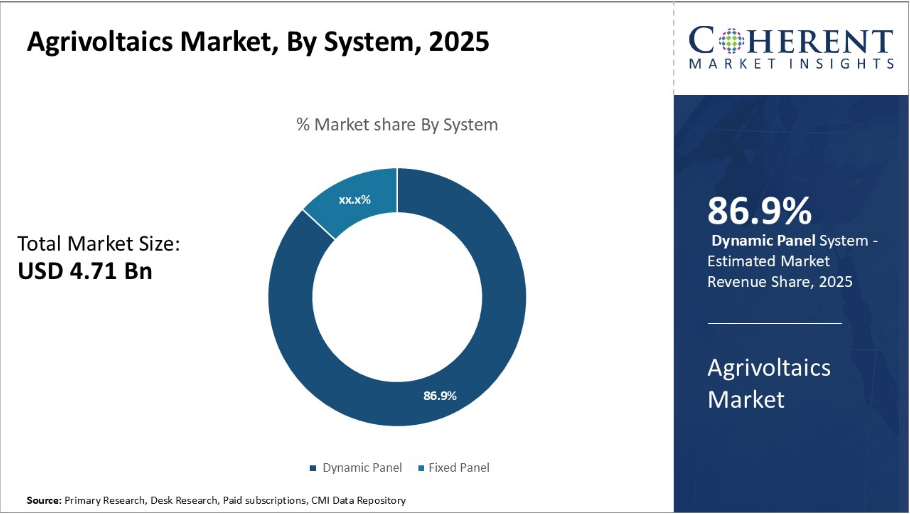
- According to System, The Dynamic Panel System category is anticipated to account for the largest share of 87.9% for the Agrivoltaics market in 2026. Dynamic solar panels, sometimes referred to as tracking or adjustable panels, track the sun’s movement all day long using single or dual axis tracking technologies.
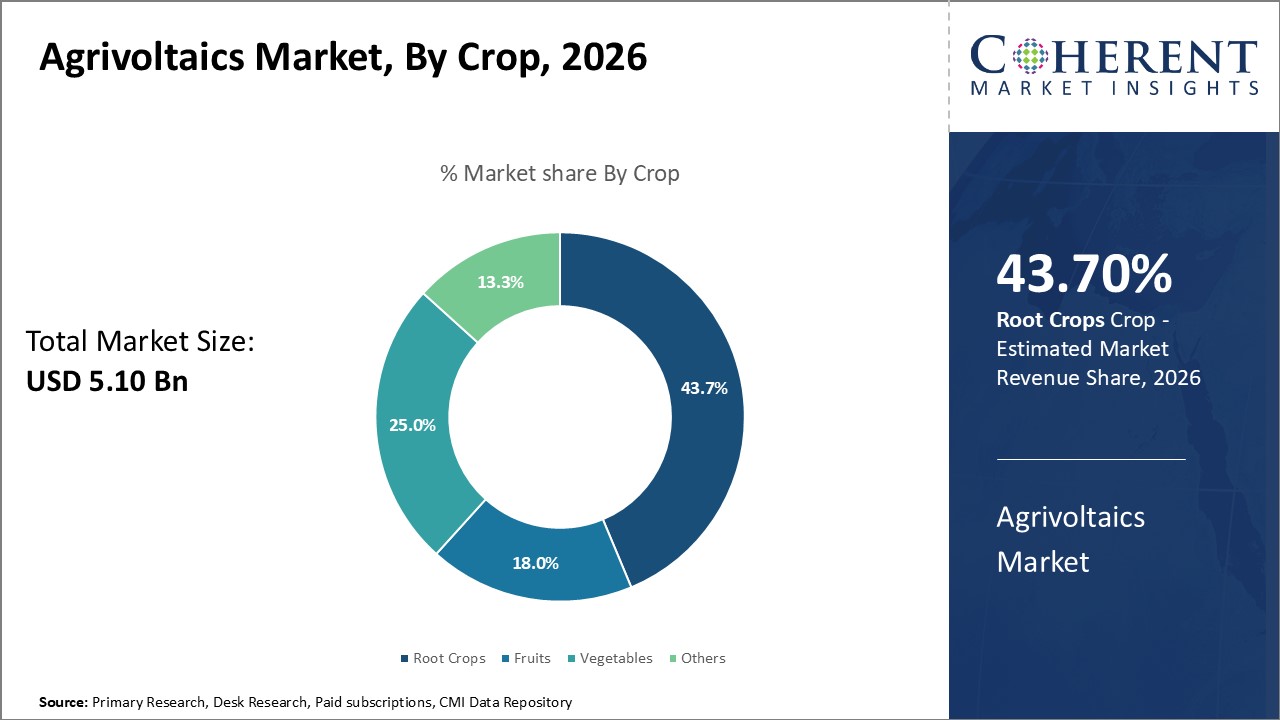
- According to crop, the mid-range segment is anticipated to hold major share of 43.7% in the Agrivoltaics market in 2026.
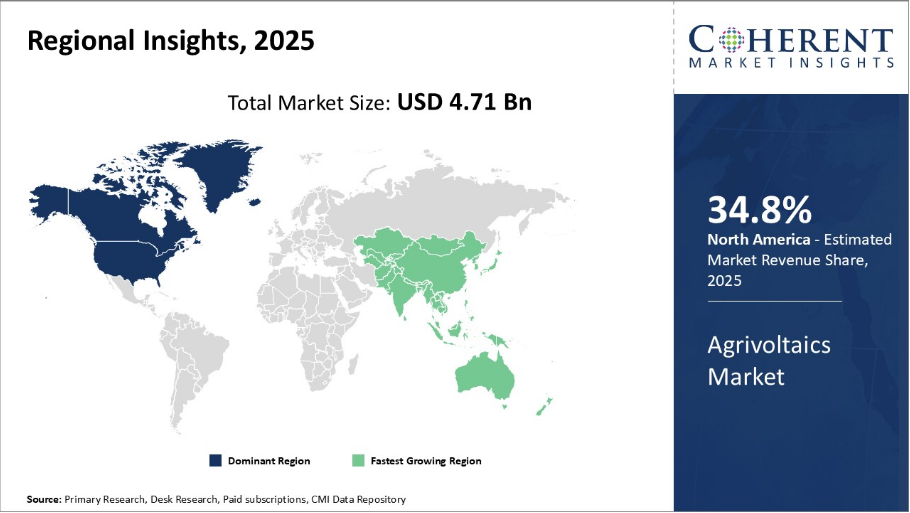
- According to region, North America holds the largest market share of 34.8% for Agrivoltaics market growth by 2026.
Market Overview
The Agrivoltaics Market Size is fueled by the growing need for renewable energy, land-use efficiency, and sustainable agriculture, as well as by favorable government and technology developments. The Agrivoltaics Market Size is fueled by the growing need for renewable energy, land-use efficiency, and sustainable agriculture, as well as by favorable government and technology developments. The growing need for dual use of land for energy production and agriculture is expected to drive the demand for agrivoltaics.
For instance, in April 2025, Trinasolar, a global provider of smart photovoltaic (PV) and energy storage solutions, has partnered with Lodestone Energy to bring one of New Zealand’s latest and largest agrivoltaics farms, Te Herenga o Te Rā, into operation this year. Located along the Waiotahe River in the Ōpōtiki District, the project has been developed on a former dairy farm and aims to deliver clean, renewable energy to the region while maintaining the land’s agricultural use through sheep grazing beneath the solar modules.
Current Events and Its Impact on the Agrivoltaics Market
Event | Description and Impact |
Italy’s first national agricultural PV tender |
|
Growing use of Power Purchase Agreements (PPAs) for Agri-PV financing |
|
Segmental Insights
- Current Industry Events of 2026
- Market Size Estimation
- Regional Breakdown
- Competitive Landscape
- Customer Intelligence
- Segmental Analysis
- Pricing Analysis
- Key Market Drivers, Challenges & Future Trends
- Customized Insights Section
Agrivoltaics Market Insights, By System
Dynamic panel systems are contributing significantly to growth in the Agrivoltaics market owing to their unique ability to optimize solar energy generation and crop yields with 87.9% share in 2026. Traditional fixed panel structures provide consistent shade but also cast shadows that can inhibit photosynthesis in some plant varieties. Dynamic panels overcome this challenge through adjustable designs that track the sun's movement throughout the day and position the solar arrays to maximize sunlight exposure for crops below.
This tracking functionality allows for more efficient energy harvesting from the sun while also permitting flexible light and shade conditions tailored to specific crop needs. Many vegetable, fruit, and root crops have been shown to thrive under the intermittent sunlight pattern created by dynamic panels as they tilt and rotate above the agricultural area. Researchers continue working to refine control algorithms that optimize both solar energy output and crop growth for different plant varieties through precision adjustments of panel positioning. As dynamic technology advances, upfront hardware costs are decreasing while power outputs and positioning accuracy improve. Additional studies demonstrate reduce water requirements for some crops grown beneath dynamic as opposed to fixed panels.
This dual benefit of energy production and enhanced crop yields is driving expanded adoption of dynamic panel systems, especially for commercial operations seeking increased revenue potential per acre. Ongoing R&D also focuses on dynamic panel durability and integration with advanced soil sensors, irrigation systems, and data analytics to maximize the Agrivoltaics value proposition over the long term.
Agrivoltaics Market Insights, By Crop
Root crops such as potatoes, carrots, beets and radishes have emerged as a strong contributor to the expanding Agrivoltaics market based on crop type with 43.7% share in 2026. These subterranean edible plant varieties are well-suited to cultivating beneath solar panel structures, which provide optimized sunlight levels through flexible shading conditions.
Root crops require less direct sunlight exposure compared to many leafy vegetable or fruit varieties and have shown good yields when grown under partial or intermittent shade. Their subterranean habitat also means roots are less susceptible to overheating risks that can impact some above-ground crops under full solar exposure.
Additionally, the physical positioning of root crop harvests beneath the soil makes them less visually impacted by overhead solar panel shadows versus aerial plant parts. As Agrivoltaics research intensifies, root vegetable cultivation is under study as a promising application with dual benefits. In addition to solar energy generation, preliminary studies indicate potential water savings along with weed suppression from groundcover effects compared to traditional root crop growing methods.
Regional Insights
North America Agrivoltaics Market Analysis and Trends
North America has dominated the agrivoltaics market for many years owing to strong government support through incentives and policies promoting renewable energy adoption and is estimated to account for 34.8% share in 2026. The U.S. is the largest market in the region supported by the presence of major players along with developing solar supply chains and infrastructure.
States such as California, Massachusetts, and New York have pioneered agrivoltaics projects through regulatory frameworks facilitating investment in this area. Leading agrivoltaics installation companies partner with large farms to deploy solutions tailored for their crops and operations.
The incentive programs significantly lowering installation and procurement costs have encouraged commercialization. Moreover, land availability is abundant and farmers are open to newer techniques enhancing their revenue streams without disrupting agricultural production.
Asia Pacific Agrivoltaics Market
The Asia Pacific region has emerged as the fastest growing market for agrivoltaics globally. Incentives and targets to strengthen farm-based renewable capacity have accelerated business opportunities. Countries like China, Japan, South Korea and India are at the forefront due to expanding agricultural output and rising demand for renewable power.
Farmers in densely populated countries seek methods to utilize limited arable land more productively. The government of China has announced large investments to promote agrivoltaics as part of its agri-technology innovation drive. This helps domestic manufacturers rapidly scale up production to serve lucrative domestic and overseas markets.
India too is investing in rural electrification programs merging solar energy generation with agriculture across its vast terrain. Projects in northern states have showcased the feasibility of cultivating crops below solar panels, high uptake is expected going forward.
Agrivoltaics Market In Europe
Europe's agrivoltaics sector is expanding rapidly as the continent works to meet its goals for sustainable agriculture and renewable energy. Because it can maximize land usage, improve food and energy security, and give farmers alternative revenue streams, agrivoltaics—the simultaneous use of land for solar photovoltaic energy generation and agricultural production—is becoming more and more popular.
Agrivoltaics Market Dominating Countries
U.S Agrivoltaics Market
The National Renewable Energy Laboratory (NREL) has identified over 314 locations suitable for agrivoltaic production, with a combined capacity exceeding 2.8 GW. Key drivers in the U.S. include the dual-use revenue potential for farmers, regulatory incentives, and the integration of smart farming practices.
India Agrivoltaics Market
India’s agrivoltaics market is expanding rapidly, fueled by the country’s need to balance food security with renewable energy generation. The rising demand for agricultural land, as evidenced by a 15% increase in Rabi crop planting area in recent years, is making dual-use solutions like agrivoltaics increasingly attractive.
Agrivoltaics Market In China
China is a dominant force in the global agrivoltaics market, leveraging its vast agricultural landscapes and abundant sunlight. The country has implemented large-scale agrivoltaics projects, particularly in provinces like Shandong, where the fishery sector alone accounts for nearly 11.5% of China’s aquaculture production.
Market Report Scope
Agrivoltaics Market Report Coverage
| Report Coverage | Details | ||
|---|---|---|---|
| Base Year: | 2025 | Market Size in 2026: | USD 5.10 Bn |
| Historical Data for: | 2020 To 2024 | Forecast Period: | 2026 To 2033 |
| Forecast Period 2026 to 2033 CAGR: | 8.7% | 2033 Value Projection: | USD 9.18 Bn |
| Geographies covered: |
| ||
| Segments covered: |
| ||
| Companies covered: | Ombrea, SunAgri, SunSeed APV Private Limited, JA Solar Holdings Co. Ltd., Enel Green Power Spa, Mirai Solar, Namaste Solar, BayWa AG, Next2Sun Technology GmbH, and Insolight SA | ||
| Growth Drivers: |
| ||
| Restraints & Challenges: |
| ||
Agrivoltaics Market: Growth Drivers
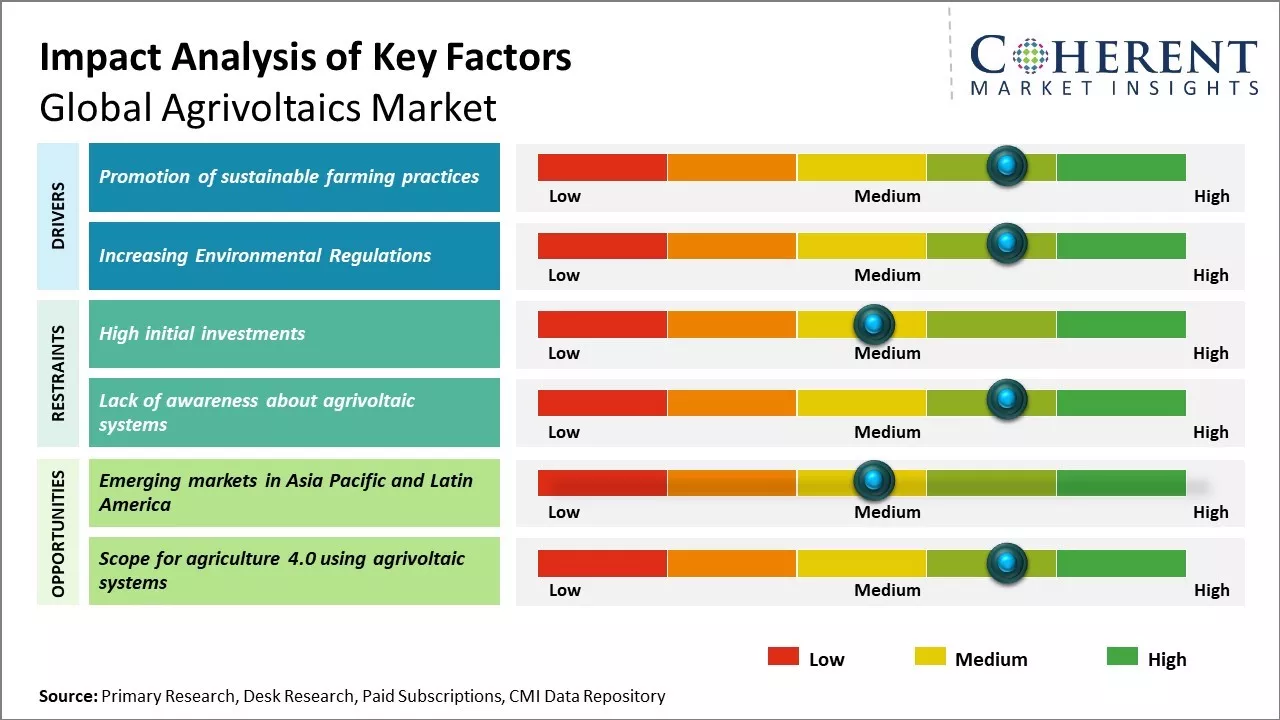
- Promotion of sustainable farming practices
Rising global temperatures and changing weather patterns have made conventional farming more challenging in many parts of the world. Farmers are struggling with increased occurrences of droughts, floods, and other climate-related disruptions which damage crops and reduce farm yields.
At the same time, the agricultural sector remains a significant contributor to greenhouse gas emissions that cause global warming. There is a growing need to adopt renewable energy-powered farming techniques that are less dependent on climate variations and are more environmentally sustainable.
Agrivoltaic systems which involve setting up solar panels above crop fields have emerged as a promising solution. The partial shading from solar panels creates the ideal microclimate for many crops to grow by reducing evapotranspiration and moderating temperature fluctuations. It allows more efficient use of available land resource for combined power and food production.
Farmers can supplement their income from solar power sales while continuing farming under the panels. The dual use of land helps optimize land utilization and preserves agricultural areas that otherwise would be converted to large-scale solar installations. Many governments around the world are promoting agrivoltaics to make agriculture greener.
Farmers are incentivized to install agrivoltaic systems through financial subsidies and policy support in order to optimize resource use as well as generate renewable energy. As more studies demonstrate the agronomic and climate adaptation benefits of this practice, agrivoltaics is likely to grow in popularity among farmers.
- Maximizing Self-consumption of Solar Power
A key driver for the adoption of agrivoltaic systems by farmers and landowners is its ability to maximize self-consumption of on-site solar power generation. Farms and agricultural landholding areas are often located in remote regions with poor access to central electricity grids.
Transporting power over long distances results in transmission and distribution losses, making grid electricity costly for rural consumers. Agrivoltaic systems help farmers and rural establishments meet a major part of their energy demand through direct self-consumption of solar energy, reducing dependence on expensive diesel generation or unreliable grid power. Any surplus power generated can be fed into the grid or used for local community needs or agricultural processing activities like cold storage, packaging, etc.
This significantly enhances the economic feasibility of investments in solar projects for agricultural applications compared to regular ground-mounted installations or rooftop projects with low self-consumption.
Agrivoltaics Market: Trends
In order to customize agrivoltaic solutions to particular regional needs and crop varieties, farmers, energy corporations, research institutes, and local communities are working together more and more. This partnership is increasing market adoption and stimulating innovation.
Agrivoltaic systems are also becoming more affordable due to the decreasing cost of solar panels and installation, and there are major socioeconomic advantages such as better working conditions and revenue diversification for farmers.
Agrivoltaics Market: Opportunities
- Emerging markets in Asia Pacific and Latin America
The agrivoltaic market has strong growth prospects in emerging economies across Asia Pacific and Latin America. These regions have ideal geographic and climate conditions to implement agrivoltaic solutions at scale. Countries like India, China, Brazil and Mexico have enormous potential for agricultural production but face challenges of lack of electricity access in rural areas and effects of climate change like erratic rainfall patterns.
Agrivoltaic systems offer a sustainable solution by generating solar power while providing partial shading for crops below the panels. This helps increase yield by protecting crops from excessive heat and moisture loss, ensuring year-round harvest. The dual benefit of energy generation and enhanced crop productivity makes agrivoltaics highly appealing for these markets.
According to United Nations World Food Programme, an estimated 18 million hectares of agricultural land in India lies abandoned each year due to lack of adequate irrigation facilities. Agrivoltaic projects integrated with micro-irrigation solutions have the potential to revitalize millions of hectares of abandoned farmland, empower smallholder farmers and boost rural incomes levels. Successful pilot projects in India and China have demonstrated agrivoltaics enhancing crop yields by 15-25% compared to conventional farming techniques.
Agrivoltaics Market: Key Developments
- April 2025, The Italian Ministry of the Environment and Energy Security (MASE) has launched a new agrivoltaics (agriPV) tender. Held by Italy’s energy management agency Gestore dei Servizi Energetici (GSE), the tender will allocate €323 million (US$349 million) to fund agriPV projects. This is due to the funds – €1.7 billion – from the previous auction not being completely allocated.
- April 2025, Japanese solar company Takamiya has launched a vertical mounting system for PV applications. The system has a height of 4,343 mm and a length of 5,000 mm. It can host bifacial modules with dimensions of 2,278 mm x 1,134 mm and 3.5 mm, according to the manufacturer, which also noted that a height of 2 m can be set for the bottom of the panels to prevent third parties from easily touching the panels and the other system components.
- August 2024, Agrivoltaics, or harvesting crops and solar energy from the same plot of land, has been around in India for over a decade, but scalability remains a challenge. In the National Capital Region and Maharashtra, innovations related to land spacing are making agricultural activities such as ploughing and harvesting more feasible alongside solar installations.
- June 2024, Soltec, a vertically integrated company dedicated to the manufacturing of solar tracking solutions worldwide, has signed a strategic partnership with TSE, a key player in the field of agrivoltaics in France, for the co-development of agrivoltaic products aimed at the French market.
- May 2024, IEA-PVPS started a new format for expert engagement: an Action Group on Agrovoltaics; a collaborative effort to harness the synergy between agriculture and solar energy generation. Through international cooperation and interdisciplinary engagement, the group aims to unlock the potential of agrivoltaics, optimizing land use efficiency, enhancing agricultural resilience to climate change, and fostering social consensus towards solar energy development.
Analyst Opinion
- The ability to generate solar power while maintaining agricultural productivity is a major driver for the increased adoption of agrivoltaic systems.
- Farmers are able to generate additional revenue from leasing out their land for solar installations while still using the land for crops or livestock grazing. This dual-use of land provides an attractive value proposition compared to traditional land-based solar farms.
- High initial installation costs remain a key restraint to widespread adoption. The use of more efficient bifacial solar modules and floating solar installations could help reduce costs. Storage integration is another area that needs more focus to optimize the energy production profile.
Speak to the analyst
Want personalized insights?
Take the findings above to one of our principal consultants, or have the report rebuilt around the segments, geographies and competitors you actually track.
Market Segmentation
- By System (Revenue, USD Bn, 2021 - 2033)
- Fixed Panel
- Dynamic Panel
- By Crop (Revenue, USD Bn, 2021 - 2033)
- Vegetables
- Fruits
- Root Crops
- Others
- By Region (Revenue, USD Bn, 2021 - 2033)
- North America
- U.S.
- Canada
- Latin America
- Brazil
- Argentina
- Mexico
- Rest of Latin America
- Europe
- Germany
- U.K.
- Spain
- France
- Italy
- Russia
- Rest of Europe
- Asia Pacific
- China
- India
- Japan
- Australia
- South Korea
- ASEAN
- Rest of Asia Pacific
- Middle East
- GCC Countries
- Israel
- Rest of Middle East
- Africa
- South Africa
- North Africa
- Central Africa
- Company Profiles
- Ombrea
- SunAgri
- SunSeed APV Private Limited
- JA Solar Holdings Co. Ltd.
- Enel Green Power Spa
- Mirai Solar
- Namaste Solar
- BayWa AG
- Next2Sun Technology GmbH
- Insolight SA
Sources
Primary Research interviews
- Agricultural Equipment Manufacturers
- Solar Panel Manufacturers
- Solar Farm Developers
- Agrivoltaic Project Operators
- Agricultural Extension Officers
- Policy Makers in Renewable Energy
Databases
- ScienceDirect
- Web of Science
- AGRICOLA
- SpringerLink
- National Renewable Energy Laboratory (NREL) Database
Magazines
- PV Tech
- Solar Power World
- Renewable Energy World
- AgriBusiness Global
- Modern Farmer
- Solar Today
Journals
- Renewable Energy
- Applied Energy
- Journal of Cleaner Production
- Agronomy for Sustainable Development
- Solar Energy
- Agricultural Systems
Newspapers
- The Hindu – Business Line (Agri & Energy sections)
- The Economic Times – Energy/Environment
- The Guardian – Environment
- New York Times – Climate & Energy
- Financial Times – Renewable Energy
- The Times of India – Energy
Associations
- International Renewable Energy Agency (IRENA)
- Solar Energy Industries Association (SEIA)
- International Solar Energy Society (ISES)
- American Solar Energy Society (ASES)
- Indian Ministry of New and Renewable Energy (MNRE)
Proprietary Elements
- CMI Data Analytics Tool
- Proprietary CMI Existing Repository of information for last 8 years
*Definition The Agrivoltaics Market involves incorporating solar panels into agricultural landscapes to maximize land productivity. It delivers renewable energy through photovoltaic panels mounted above crops or livestock to prevent shading. This dual-use approach for agricultural lands optimizes space by generating solar power while allowing crops to continue growing below. Agrivoltaics provides an innovative solution for agricultural producers to earn additional revenue from solar installations without losing valuable acreage for crop cultivation.
Get access to 250+ pages report
Every segment, forecast, competitor profile and data table behind the analysis above — available for instant download.
- ESOMAR Member
- ISO 9001:2015 Certified
- D-U-N-S Registered
- GDPR & CCPA Compliant
Missing comfort of reading report in your local language? Find your preferred language:
Transform your Strategy with Exclusive Trending Reports
Frequently Asked Questions
The Agrivoltaics Market size is estimated to be valued at USD 5.10 Bn in 2026, and is expected to reach USD 9.18 Bn by 2033.
The CAGR of the global Market is projected to be 8.7% from 2026 to 2033.
Promotion of sustainable farming practices and increasing environmental regulations are the major factor driving the growth of the global agrivoltaics industry.
High initial investments and lack of awareness about agrivoltaic systems are the major factors hampering the growth of the global agrivoltaics industry.
In terms of System, Dynamic Panel is estimated to dominate the market revenue share in 2026.
Ombrea, SunAgri, SunSeed APV Private Limited, JA Solar Holdings Co. Ltd., Enel Green Power Spa, Mirai Solar, Namaste Solar, BayWa AG, Next2Sun Technology GmbH, and Insolight SA are the major players.
North America is expected to lead the global market.