

Cutting Equipment Market Size and Trends - 2026 to 2033
The Cutting Equipment Market is estimated to be valued at USD 38.4 Bn in 2026 and is expected to reach USD 58.2 Bn by 2033, growing at a compound annual growth rate (CAGR) of 6.1% from 2026 to 2033.
Key Takeaways
- Based on Equipment Type, the Mechanized Segment is expected to lead the market with 66.20% share in 2026, due to increasing industrial automation.
- Based on Technology Type, the Laser Cutting segment is expected to hold 54.80% share of the market in 2026, owing to its ability to offer high precision.
- Based on End-user Industry, the Automotive segment is expected to hold 39.20% share of the market in 2026, driven by mass production of intricate vehicle components.
- Based on Region, North America is set to lead the market with 32.50% share in 2026. While, Asia Pacific is anticipated to be the fastest growing region.
Market Overview
The cutting equipment market provides advanced material processing systems and automated fabrication technologies mainly for large-scale industrial manufacturing and high-precision metalwork. This market includes sophisticated fiber laser systems, high-definition plasma cutters, water jet machines, and CNC controlled oxy-fuel systems. These are integrated with automated material handling units, industrial IoT (IIoT) sensors, and cloud-based predictive maintenance platforms to minimize downtime.
The global demand for operational efficiency and material precision is speeding up, driven by the need for rapid production cycles in the automotive, aerospace, and construction sectors. Manufacturers are increasingly moving toward end-to-end automation to combat rising labor costs and a shortage of specialized technicians. Modern regulatory frameworks and environmental standards now emphasize energy efficiency and waste reduction, making high-efficiency fiber lasers and abrasive recycling water jets a standard for sustainable industrial operations.
Current Events and Its Impacts on the Cutting Equipment Market
Current Event | Description and the Impact |
Technological Advancements and Industry 4.0 Integration |
|
Regional Industrial Growth and Infrastructure Development |
|
Role Of Artificial Intelligence (AI) In Cutting Equipment Market
Artificial intelligence is transforming the Cutting Equipment industry by converting traditional machinery to autonomous, self-optimizing systems. These intelligent platforms monitor the interaction between tools and materials in real time, thus instantly adjusting power levels and feed rates to maintain high precision. The machine learning models analyze thermal and acoustic data to predict component failure, which allows manufacturers to perform maintenance before a breakdown occurs. In addition, AI driven nesting software calculates the most efficient part layouts to minimize the material waste as well as reduce energy consumption. By embedding expert knowledge directly into the machine interface, this technology empowers operators of all skill levels to execute complex designs with high accuracy and minimal oversight.
For instance, in April 2025, TRUMPF unveiled a new Cutting Assistant application that uses artificial intelligence to assist users in improving the quality of laser-cut edges. The application demonstrates how AI-enabled tools can tackle challenges related to skilled labor shortages while simultaneously improving efficiency and lowering costs.
- Current Industry Events of 2026
- Market Size Estimation
- Regional Breakdown
- Competitive Landscape
- Customer Intelligence
- Segmental Analysis
- Pricing Analysis
- Key Market Drivers, Challenges & Future Trends
- Customized Insights Section
Segmental Insights
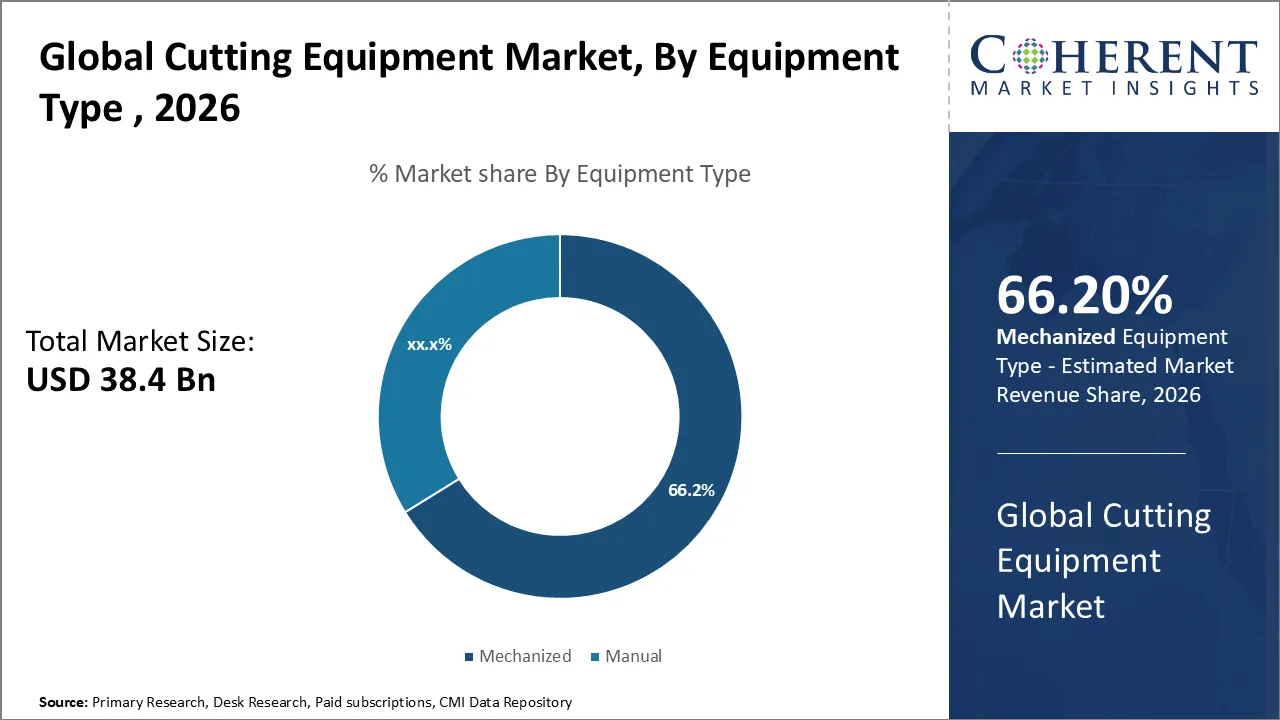
Cutting Equipment Market Insights By, Equipment Type - Surging Industrial Automation and Labor Efficiency Drives Preference for Mechanized
In terms of equipment type, the mechanized segment contributes the highest share of 66.20% in 2026 of the market owing to the increasing demand for high-volume production and operational consistency. These automated systems utilize computer numerical control to guide plasma torches and saws with extreme accuracy, which effectively eliminates the human error found in manual fabrication. Manufacturers prioritize this segment to overcome rising labor costs and a shortage of specialized technicians in heavy industrial sectors. By integrating automated material handling, these machines ensure high-quality results and also significantly reduce production downtime.
For instance, in October 2025, Prima Power introduced Laser Next Core, an innovative 3D laser cutting system that integrates cost-effectiveness, versatility, and a compact footprint for workshops and flexible manufacturing environments. The company provides innovative, comprehensive fully automated 3D laser solutions driven by its Robotics Integration Unit to ensure seamless and adaptable production workflows.
Cutting Equipment Market Insights By, Technology Type - Laser Cutting Leads with High Precision and Fiber Laser Adoption
In terms of technology type, the laser cutting segment contributes the highest share of 54.80% in 2026 of the market. The high-speed fiber lasers provide clean, sharp edges on thin components as well as thick structural plates. Industries prioritize this technology because it requires no physical contact, which eliminates mechanical wear and prevents material distortion during the fabrication process. The modern laser systems also integrate artificial intelligence in order to optimize cutting paths and power consumption, thus making them the most efficient choice for complex geometries and sustainable manufacturing initiatives across the globe.
For instance, in November 2024, Bodor Laser unveiled the U10 Laser Cutting Machine, a comprehensive system engineered to meet the changing demands of contemporary manufacturing. The U10 integrates sheet, tube, and profile processing within a single robust platform, serving as a critical tool for industries aiming to enhance efficiency, lower costs, and optimize production workflows.
Cutting Equipment Market Insights By, End-user Industry - Automotive Leads Owing to Mass Production of Intricate Vehicle Components
In terms of end-user industry, the automotive segment contributes the highest share of 39.20% in 2026 of the market. The industry's transition to lightweight vehicle designs and electric powertrains is driving a continual demand for high-precision fabrication. Companies depend on advanced cutting equipment to work with high-strength aluminum and specialized alloys needed for contemporary chassis and battery enclosures. Robotic cutting cells deliver the high-volume production required for global vehicle demand without compromising strict safety tolerances. As carmakers move toward digitalized factories, they increasingly invest in automated solutions that allow for rapid prototyping.
For instance, in June 2025, HSG Laser revealed its newest laser cutting technologies, the GH V2.0 sheet metal and TS2 tube cutting machines, at its Düsseldorf showroom. This illustrates its dedication to the European market by employing advanced technology and providing localized services.
Regional Insights
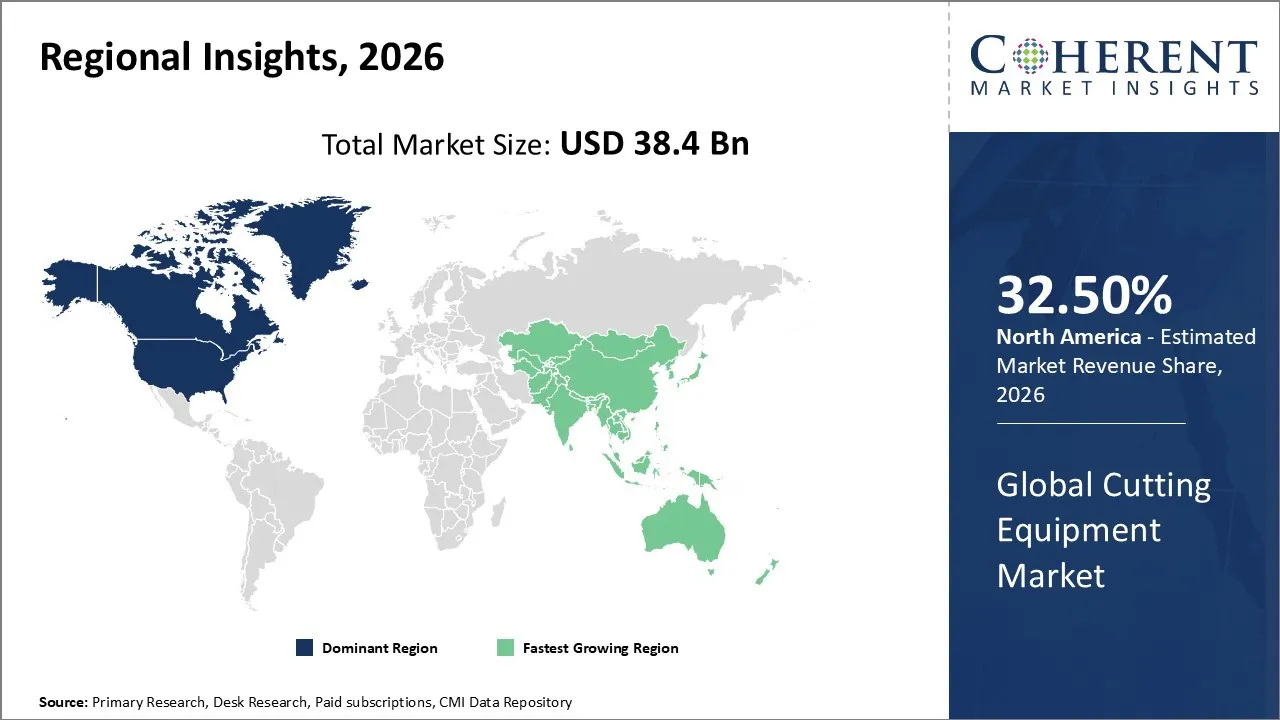
North America Cutting Equipment Market Analysis & Trends
North America has remained the dominant region with 32.50% in 2026 of the global Cutting Equipment Market over the past decade. Europe’s leadership in the market is owing to its
North America maintains a leading position in the global Market by integrating high-end automation and smart manufacturing into industrial fabrication. The high spending in the aerospace and defense sectors is propelling the demand for ultra-precise fiber laser and waterjet systems capable of processing cutting-edge alloys.
The manufacturers in the countries of the US and Canada are increasingly adopting industrial IoT and artificial intelligence in order to mitigate labor shortages and improve production efficiency. These intelligent systems allow operators to monitor tool wear in real time and execute predictive maintenance, thus ensuring continual uptime. The regional focus on sustainability also pushes companies to favor energy-efficient cutting technologies that minimize material waste.
For instance, in November 2025, Coherent Corp., a worldwide leader in photonics, announced the official release of the EDGE CUT20 OEM Cutting Solution, which combines the new CUT20 laser cutting head with our EDGE FL20 fiber laser. This solution provides exceptional precision, control, and process expertise for precise sheet-metal cutting.
Asia Pacific Cutting Equipment Market Analysis & Trends
The Asia Pacific region experiences rapid transformation as massive infrastructure projects and expanding automotive manufacturing accelerate the adoption of industrial cutting tools. The countries of China and India are leading this growth. This is achieved by modernizing production facilities with high-speed CNC machinery and robotic cutting arms to meet global export standards. Rapid urbanization fuels a surge in demand for heavy-duty plasma and oxy-fuel equipment used in steel fabrication and construction. In addition, the flourishing electronics sector in Taiwan and South Korea requires specialized high-precision laser cutting for intricate component assembly. The government incentives for local industrialization also promote small and medium enterprises to transition from manual tools to automated cutting solutions.
For instance, in December 2025, Samach, a prominent leader in the industrial machinery industry, launched its new advancement in metal processing technology: the Model RLC-1530 CNC Fiber Laser Cutting Machine. This advanced high-performance machine establishes a new benchmark for accuracy, speed, and adaptability in the international market and addresses the changing requirements of contemporary manufacturing.
Cutting Equipment Market Outlook Country-Wise
The US Cutting Equipment Market Trends
The US leads the global market with its strong commitment to high-precision automation and integration of artificial intelligence. The manufacturers in the country prioritize fiber laser and waterjet cutting technologies to support exacting standards of the aerospace, defense, and automotive sectors. This focus on high-end fabrication helps businesses in overcoming the persistent skilled labor shortages by automating complex machine tasks. In addition, federal incentives for domestic manufacturing promote facilities to upgrade to energy-efficient, smart cutting systems, which maximize throughput as well as reduce material waste.
China Cutting Equipment Market Trends
China maintains its position as the largest producer and consumer of cutting equipment by rapidly modernizing its vast industrial base. The government actively promotes digital transformation via strategic initiatives that encourage factories to use high-end CNC machinery and robotic cutting arms. While domestic manufacturers lead the high-volume segments for construction and heavy machinery, they also spend heavily on research to replace imported high-end technology with local alternatives. The rapid urbanization and massive expansion of the electric vehicle supply chain also speed up the demand for versatile high-speed plasma and laser cutting solutions.
Market Report Scope
Cutting Equipment Market Report Report Coverage
| Report Coverage | Details | ||
|---|---|---|---|
| Base Year: | 2025 | Market Size in 2026: | USD 38.4 Bn |
| Historical Data for: | 2020 To 2024 | Forecast Period: | 2026To 2033 |
| Forecast Period 2026 to 2033 CAGR: | 6.1% | 2033 Value Projection: | USD 58.2 Bn |
| Geographies covered: |
| ||
| Segments covered: |
| ||
| Companies covered: | Robert Bosch GmbH, Stanley Black & Decker, Inc., Makita Power Tools India Pvt. Ltd., ICS Cutting Tools, Inc. , Hitachi Koki Co., Ltd. , J.C. Bamford Excavators Limited, Klein Tools, Inc., Snap on, Otto Baier GmbH, and Hilti Corporation, | ||
| Growth Drivers: |
| ||
| Restraints & Challenges: |
| ||
Cutting Equipment Market Drivers
High demand for automation and advanced, high-precision cutting solutions
The high demand for automated and advanced high-precision cutting solutions is the primary driver of growth for the cutting equipment industry. The manufacturers across the automotive, aerospace, and electronic sectors are adopting these sophisticated technologies with an aim to achieve strict tolerances and superior edge quality. With the integration of computer numerical control and robotic systems, businesses can eliminate human error and significantly speed up production cycles. These solutions also assist in optimizing material usage via intelligent nesting software, which reduces costly scrap and supports sustainable manufacturing goals. As global competition intensifies, the shift toward autonomous high-precision machinery ensures that businesses maintain high productivity while meeting the complex design requirements of modern industrial components.
For instance, in March 2025, Xphotonics launched the XLASERLAB X1/X1Pro, an all-in-one system that seamlessly integrates welding, cutting, cleaning, and corrosion removal. This system provides superior performance and is easy to use, making it ideal for precision manufacturing and metal processing.
Analyst Opinion (Expert Opinion)
The cutting equipment market is expanding steadily, supported by sustained demand from automotive, aerospace, metal fabrication, construction, and industrial manufacturing sectors. Industry data indicates that metal cutting machinery represents a significant portion of global machine tool consumption, with a growing number of fabrication facilities transitioning from conventional cutting methods to CNC-enabled systems to improve accuracy and throughput. Automation adoption continues to rise, with a large share of newly installed cutting equipment now integrated with CNC controls and digital monitoring systems.
Laser cutting technologies are gaining strong traction, particularly in thin-to-medium gauge material applications, due to improved cutting speed, precision, and energy efficiency. Manufacturing statistics show increasing installation of fiber laser systems across electronics, electrical components, and medical device production lines. Plasma cutting remains widely deployed in heavy-duty and structural steel applications, where high cutting thickness capability and operational robustness are critical. Waterjet cutting systems maintain relevance in applications requiring cold cutting and minimal material distortion, such as aerospace composites and specialty metals.
Digital integration is reshaping operational performance across end-use industries. IoT-enabled cutting equipment improves equipment utilization, predictive maintenance scheduling, and material yield optimization. Regionally, Asia-Pacific continues to account for a substantial share of equipment shipments, driven by expanding manufacturing capacity, while Europe and North America show consistent replacement demand focused on productivity upgrades.
Overall, data trends indicate that cutting equipment is a core enabler of precision manufacturing, with technology advancement and automation driving long-term industry value creation.
Speak to the analyst
Want personalized insights?
Take the findings above to one of our principal consultants, or have the report rebuilt around the segments, geographies and competitors you actually track.
Cutting Equipment Industry News
- In December 2025, HSG Laser, a manufacturer of metal cutting equipment and solutions, revealed the inauguration of its new manufacturing plant in Jinan, China. This marks a major milestone in its global production and supply plan.
- In September 2025, LaserPecker, a prominent innovator in portable laser engraving technology, made an announcement of its forthcoming release of its newest product, the LaserPecker LX2. The LX2 is engineered to revolutionize high-efficiency bulk processing and large-format laser cutting and engraving within a desktop-scale framework.
- In July 2025, Bystronic and SSAB formed a joint venture to enhance its laser cutting and bending technologies. This initiative focuses on innovative materials for the sheet metal industry, such as alloying concepts, recycled metals, and fossil-free steel.
- In March 2025, Bystronic introduced its new 3D fiber laser tube cutting system. The ByTube Star 330 is unique in its ability to autonomously process tubes and open sections within a diameter range of 19 to 305 mm, eliminating the need for setup time.
- In October 2024, nLIGHT, Inc., a prominent provider of fiber lasers utilized in the industrial, microfabrication, aerospace, and defense sectors, unveiled two new products named n finity and ProcessGUARD. These are engineered specifically to address the growing demands for advanced metal fabrication.
Market Segmentation
- Equipment Type Insights (Revenue, USD Bn, 2026 - 2033)
- Manual
- Mechanized
- Technology Type Insights (Revenue, USD Bn, 2026 - 2033)
- Carbon Arc Cutting
- Laser Cutting
- Oxy-fuel Cutting
- Plasma Cutting
- Waterjet Cutting
- End-User Industry Insights (Revenue, USD Bn, 2026 - 2033)
- Automotive
- Construction
- General Metal Fabrication
- Heavy Equipment Fabrication
- Shipbuilding & Offshore
- Others
- Regional Insights (Revenue, USD Bn, 2026 - 2033)
- North America
- U.S.
- Canada
- Latin America
- Brazil
- Argentina
- Mexico
- Rest of Latin America
- Europe
- Germany
- U.K.
- France
- Italy
- Russia
- Rest of Europe
- Asia Pacific
- China
- India
- Japan
- Australia
- South Korea
- ASEAN
- Rest of Asia Pacific
- Middle East
- GCC
- Israel
- Rest of Middle East
- Africa
- North Africa
- Central Africa
- South Africa
- Key Players Insights
- Robert Bosch GmbH
- Stanley Black & Decker, Inc.
- Makita Power Tools India Pvt. Ltd.
- ICS Cutting Tools, Inc.
- Hitachi Koki Co., Ltd.
- C. Bamford Excavators Limited
- Klein Tools, Inc.
- Snap on
- Otto Baier GmbH
- Hilti Corporation
Sources
Primary Research Interviews
- Cutting Equipment Manufacturers (Plasma, Laser, Waterjet, Mechanical)
- CNC Machine Tool Manufacturers
- Metal Fabrication & Sheet Metal Processing Companies
- Automotive & Aerospace Component Manufacturers
- Construction & Infrastructure Equipment Suppliers
- Industrial Automation & Robotics Integrators
- Tooling & Industrial Engineering Consultants
- Others
Databases
- Bloomberg Terminal
- Thomson Reuters Eikon
- Others
Magazines
- Cutting Tool Engineering Magazine
- Metalworking World
- Manufacturing Today
- Industry Week
- Machine Design
- The Fabricator
- Others
Journals
- Journal of Manufacturing Processes
- CIRP Annals – Manufacturing Technology
- International Journal of Advanced Manufacturing Technology
- Journal of Materials Processing Technology
- Precision Engineering Journal
- Others
Newspapers
- Financial Times
- The Wall Street Journal
- Reuters
- Bloomberg News
- The Economic Times
- Others
Associations
- Association for Manufacturing Technology (AMT)
- International Federation of Robotics (IFR)
- Fabricators & Manufacturers Association (FMA)
- European Machine Tool Industry Association (CECIMO)
- Indian Machine Tool Manufacturers’ Association (IMTMA)
- Others
Public Domain Sources
- U.S. Bureau of Labor Statistics (BLS)
- U.S. Department of Commerce – Manufacturing Data
- European Commission – Industry & Manufacturing Directorate
- World Bank Open Data
- International Trade Administration (ITA)
- Others
Proprietary Elements
- CMI Data Analytics Tool
- Proprietary CMI Existing Repository of Information for the Last 8 Years
Definition: The cutting equipment market uses advanced thermal, mechanical, and abrasive technologies to shape and fabricate industrial materials. This sector focuses on integrating computer numerical control (CNC) systems and robotics to execute high-precision tasks such as laser, plasma, and water jet cutting. These systems are essential in heavy manufacturing plants and metal fabrication facilities where speed, repeatability, and structural integrity are critical components of modern production. Specialized industrial equipment and automated cutting tables can help in minimizing material waste as well as reducing the reliance on manual labor for complex shaping tasks before components are sent for assembly. The demand for these solutions comes from the automotive, aerospace, and construction industries that must comply with strict engineering tolerances and safety rules.
Get access to 250+ pages report
Every segment, forecast, competitor profile and data table behind the analysis above — available for instant download.
- ESOMAR Member
- ISO 9001:2015 Certified
- D-U-N-S Registered
- GDPR & CCPA Compliant
Missing comfort of reading report in your local language? Find your preferred language:
Transform your Strategy with Exclusive Trending Reports
Frequently Asked Questions
The Cutting Equipment Market is estimated to be valued at USD 38.4 Bn in 2026, and is expected to reach USD 58.2 Bn by 2033.
The CAGR of the Cutting Equipment Market is projected to be 6.1% from 2026 to 2033.
Growing demand for automatic cutting equipment in the manufacturing sector is one of the major factors driving the growth of the Cutting Equipment Market.
The high initial costs and a lack of skilled workforce are the major factors hampering the growth of the Cutting Equipment Market.
In terms of equipment type, mechanized segment is estimated to dominate the market revenue share in 2026.
Robert Bosch GmbH, Stanley Black & Decker, Inc., Makita Power Tools India Pvt. Ltd., ICS Cutting Tools, Inc. , Hitachi Koki Co., Ltd. , J.C. Bamford Excavators Limited, Klein Tools, Inc., Snap on, Otto Baier GmbH, and Hilti Corporation are the major players.
North America is expected to lead the Cutting Equipment Market in 2026.