

Industrial Motors Market Size & Trends
Industrial Motors Market is estimated to be valued at USD 3,949.7 Mn in 2026 and is expected to reach USD 5,107.2 Mn in 2033, exhibiting a compound annual growth rate (CAGR) of 3.7% from 2026 to 2033.
Key Takeaways
- Based on Type of Motor, Alternating Current (AC) Motors segment leads the market holding the largest share of 39.9% in 2026, owing to their efficiency, durability, and cost-effectiveness.
- Based on Voltage, the High Voltage segment is projected to leads the market with a highest share in 2026, due to their essential role in powering large-scale, energy-intensive industrial operations.
- Based on End User, the Oil and Gas Power segment is estimated to capture the greatest share of the market in 2026, due to its need for reliable, high-performance motors.
- Based on Region, Asia Pacific, holding a share of 32% in 2026, is estimated to lead the industrial motors market growth. While, North America is anticipated to be the fastest growing region during the forecast period.
Market Overview
The industrial motors market is growing steadily, driven by rising automation, energy efficiency needs, and expanding manufacturing. Industrial motors are crucial in sectors like oil & gas, chemicals, food & beverage, and automotive. There's strong demand for energy-efficient and variable-speed motors to reduce costs and meet environmental norms.
Asia Pacific, especially China and India, is witnessing increased industrial activity, boosting industrial motors market demand. The push for Industry 4.0 and smart factories is fueling adoption of intelligent motor systems for real-time monitoring and predictive maintenance. Electrification, renewable energy projects, and retrofitting older systems with efficient models are further accelerating the industrial motors market demand.
Current Events and their Impact on the Industrial Motors Market
Current Event | Description and its Impact |
US-China Trade Relations and Critical Material Dependencies |
|
Global Energy Efficiency Regulations and Green Transition |
|
Implementation Of Industrial Motors in Industrial Automation and Industry 4.0 Acceleration
The implementation of industrial motors plays a central role in driving Industrial Automation and the acceleration of Industry 4.0. These motors power critical automation components such as conveyors, robotic arms, CNC machines, and smart assembly lines. With the rise of intelligent manufacturing, there is a growing demand for smart, energy-efficient motors integrated with sensors, real-time monitoring, and predictive maintenance capabilities. These motors enable seamless communication within cyber-physical systems and support continuous operations with minimal downtime. In Industry 4.0 environments, IE4/IE5-rated motors combined with IoT, AI, and edge computing enhance productivity, reduce energy usage, and ensure scalable automation, making them essential for factories transitioning to fully digital, interconnected ecosystems.
- Current Industry Events of 2026
- Market Size Estimation
- Regional Breakdown
- Competitive Landscape
- Customer Intelligence
- Segmental Analysis
- Pricing Analysis
- Key Market Drivers, Challenges & Future Trends
- Customized Insights Section
Segmental Insights
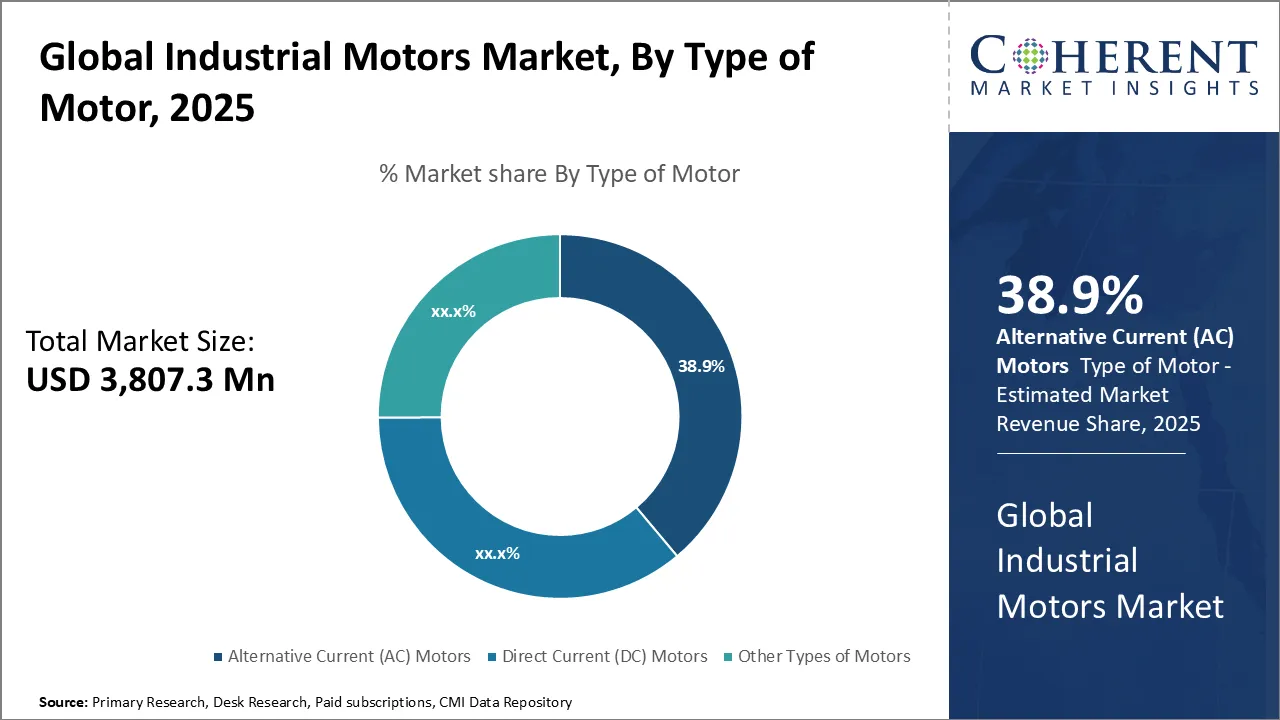
Industrial Motors Market Insights, By Type of Motor: Alternating Current (AC) Motor Dominates the market on account of its Efficiency and Durability
In terms of type of motor, the alternating current (AC) motors segment dominated the global industrial motors market with the largest share of 39.9% in 2026, owing to their efficiency, durability, and cost-effectiveness. They are well-suited for a wide range of industrial applications such as pumps, compressors, conveyors, and fans, which are commonly used in manufacturing, HVAC, oil & gas, and water treatment sectors.
Their simple design allows for lower maintenance, while advancements in variable frequency drives (VFDs) have improved speed control and energy efficiency. Industries aiming to reduce operational costs and energy consumption prefer AC motors for their long-term reliability and compatibility with automation and smart factory systems.
For instance, in April 2025, Nidec Traction inaugurated a high‑capacity, auto‑winding AC motor production line at its Mexico facility. Capable of manufacturing 100,000 units annually, the new line enhances Nidec’s ability to deliver localized, high‑quality motor solutions with shorter lead times and greater flexibility for global customers.
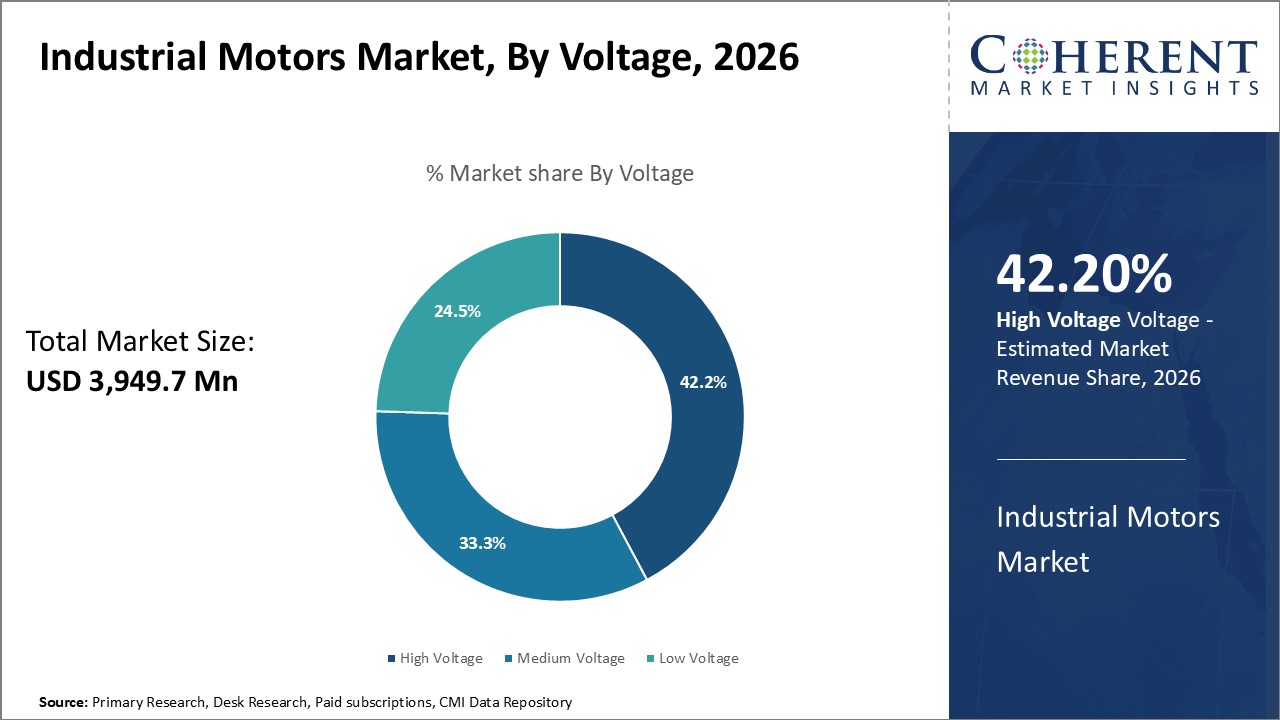
Industrial Motors Market Insights, By Voltage: High Voltage Holds the most prominent share
In terms of voltage, the high voltage segment is expected to dominate the global industrial motors market with highest share in 2026, due to their essential role in powering large-scale, energy-intensive industrial operations. Industries such as oil & gas, mining, power generation, and manufacturing rely on high-voltage motors (typically rated above 1 kV) to operate heavy machinery like compressors, pumps, and conveyors efficiently. These motors draw lower current for the same power output, which helps reduce energy transmission losses and allows for smaller, cost-effective electrical infrastructure. Additionally, they offer higher reliability and durability under extreme industrial conditions, making them ideal for continuous operations. With global regulations tightening around energy efficiency and the rise of industrial automation, the adoption of high-voltage motors is expected to grow steadily, making them a critical driver of industrial motors market growth.
For instance, in October 2024, JSW MG Motor India, in collaboration with Vision Mechatronics under its “Project Revive,” unveiled India’s first high‑voltage second‑life battery equipped with a domestically developed Battery Management System (BMS). The battery will first serve as a UPS backup solution at an industrial facility in Pune, showcasing scalable large‑scale energy storage potential.
Industrial Motors Market Insights, By End User: Oil and Gas Power segment holds the largest share
In terms of end user, the oil and gas segment is expected to hold the greatest share in the global industrial motors market in 2026, due to its need for reliable, high-performance motors across upstream, midstream, and downstream operations. Motors are essential for powering equipment like pumps, compressors, and drilling rigs in harsh and hazardous environments. As exploration moves into deeper and more remote locations, the industry requires explosion-proof, energy-efficient, and durable motors that ensure operational continuity and safety.
Additionally, with rising global energy demand and a strong focus on automation, refineries and offshore platforms are investing in advanced motor systems for enhanced productivity, reduced downtime, and compliance with environmental and safety regulations. This makes oil and gas one of the most significant end-users driving industrial motors market demand.
For instance, in June 2025, Wolong Electric America launched a groundbreaking addition to its Quantum series: high‑power, low‑voltage motors tailored for horizontal pumping applications in oil and gas operations. The new Quantum LMV models deliver up to 1,500 HP at 460 V with performance typically seen only in medium‑voltage machinery, while fitting within the standard WPII 580 frame footprint.
Regional Insights
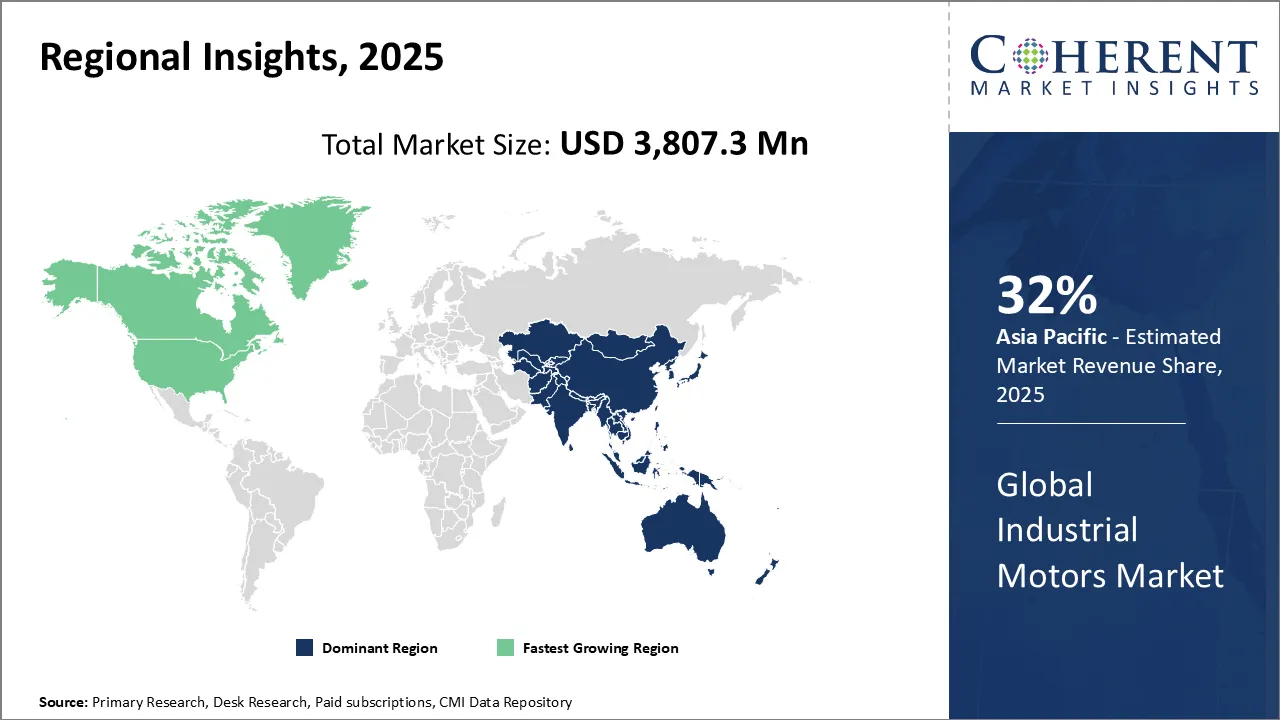
Asia Pacific Industrial Motors Market Analysis & Trends
Asia Pacific has established itself as the dominant region in the global industrial motors market with an estimated market share of 32% in 2026. This can be attributed to rapidly transforming manufacturing industry in China, as the country is evolving in its production capabilities from producing low-cost goods to developing highly advanced products. Furthermore, rise in smart manufacturing initiatives in countries such as Japan are also driving the adoption of industrial motors in the region. These factors are thus expected to augment growth of the global industrial motors market across the region.
For instance, in July 2024, Hyundai Motor Group and LG Energy Solution officially inaugurated Indonesia’s first electric vehicle battery cell plant in West Java, delivering an annual production capacity of 10 GWh, enough to power approximately 150,000 EVs per year. The facility is part of a broader USD 9.8 billion investment plan to build a domestic EV supply chain in Indonesia, leveraging its rich nickel and copper reserves.
North America Industrial Motors Market Analysis & Trends
North America is anticipated to show substantial growth in the global industrial motors market during the forecast period, owing to rise in demand for industrial motors as the region is witnessing industrial revolutions across various sectors including aerospace, automotive, and defense among others. Moreover, continuously growing economy of Canada, and the U.S., the manufacturing sector of this country is likely to show significant growth in the near future. This in turn is expected to drive growth of the global industrial motors market in North America during the forecast period.
For instance, in June 2026, ITT Inc. unveiled its VIDAR motor at “VIDAR Unveiled” in Houston. VIDAR is a compact industrial motor with embedded variable‑speed intelligence, up to 60 percent smaller than traditional systems, offering over 50 percent energy savings and about $20,000 in annual cost reductions in field trials. Aimed at applications in pumps and fans across downstream and chemical sectors, VIDAR replaces external variable frequency drives while improving reliability and reducing carbon emissions.
Industrial Motors Market Outlook Country-Wise
China Industrial Motors Market Trends
China leads the global industrial motors market, accounting for over one-third of Asia-Pacific demand. This is driven by its massive manufacturing output and strong government initiatives like “Made in China 2026”, which promote industrial automation and energy-efficient motor upgrades. The push for carbon neutrality and smart factory development is accelerating the adoption of high-efficiency motors and intelligent motor systems. China's growing focus on replacing outdated equipment and integrating IoT-enabled motors makes it a key driver of global industrial motor demand.
For instance, in July 2026, MOTOR CHINA 2026, Asia’s premier motor‑industry event, opened at the Shanghai New International Expo Centre under the theme “Innovation‑driven, Intelligent Future.” Now in its 27th edition, the expo features nearly 1,000 leading exhibitors including Siemens, ABB, CRRC Group and Fuji across a 40,000 m² exhibition area of 15% larger than in 2024. Highlights include breakthroughs in high‑efficiency silicon carbide motor platforms, AI‑based predictive maintenance systems, and digital twin production lines. A dedicated new‑energy vehicle motor zone showcases integrated electric drive systems and 800 V platforms.
The U.S. Industrial Motors Market Trends
The U.S. leads North America’s industrial motors market, accounting for around 88% of the region’s demand. This is driven by major investments in Industry 4.0, rising adoption of IE3/IE4 energy-efficient motors, and strong demand from sectors like oil & gas, aerospace, and utilities. Supportive green manufacturing policies and smart factory upgrades are accelerating the shift toward efficient, intelligent motor systems. With a focus on sustainability and digital transformation, the industrial motors market demand in the U.S. is expected to remain strong.
For instance, in December 2024, the U.S. Navy has awarded five contracts, totaling $60 million, to X‑Bow Systems Inc. to modernize and automate critical solid rocket motor (SRM) facilities at Naval Surface Warfare Center Indian Head Division (NSWC IHD). As part of a 15‑year, $2.7 billion modernization plan, the contracts fund the design, development, and procurement of long‑lead equipment to upgrade inert preparation, propellant casting, automated ingredient feeding, live motor processing, and prototype slurry operations.
Market Report Scope
Industrial Motors Market Report Coverage
| Report Coverage | Details | ||
|---|---|---|---|
| Base Year: | 2025 | Market Size in 2026: | USD 3,949.7 Mn |
| Historical Data for: | 2020 To 2024 | Forecast Period: | 2026 To 2033 |
| Forecast Period 2026 to 2033 CAGR: | 3.7% | 2033 Value Projection: | USD 5,107.2 Mn |
| Geographies covered: |
| ||
| Segments covered: |
| ||
| Companies covered: | Menzel Elektromotoren GmbH, General Electric Company, ATB Austria Antriebstechnik AG, ABB Ltd., Fuji Electric Co. Ltd., Allen-Bradly Co. LLC (Rockwell Automation Inc.), Franklin Electric Co. Inc., Siemens AG, Maxon Motor AG, Amtek Inc., Nidec Corporation, Arc Systems Inc., Toshiba International Corporation, Johnson Electric Holdings Limited, and Emerson Electric Co. | ||
| Growth Drivers: |
| ||
| Restraints & Challenges: |
| ||
Global Industrial Motors Market Drivers
- Rising Inclination Toward Smart Motors to Augment the Market Pace
The market for industrial motors is witnessing strong growth in recent years. As the emergence of smart technology is growing, the design and deployment of traditional motors have changed majorly. This factor is thus supporting growth of the market. With increasing technological advancements, industrial motors are becoming smarter and more flexible through computer technology. Such smart motors enable predictive diagnosis of machine, which further decreases the downtime, as it optimizes the process. Thus, inclination towards smart motors is increasing all over the world, which is expected to drive growth of the global industrial motors market during the forecast period.
For instance, in July 2025, Panasonic unveiled its next‑generation MINAS E7 servo motor series, described as a compact, intelligent platform designed to enhance smart automation capabilities for Indian OEMs. Built around Panasonic’s upgraded A7 core control algorithm, the system delivers ultra‑fast auto‑tuning in under a minute, thanks to its “TUNINGLESS” feature.
Global Industrial Motors Market Opportunities
The emergence of Industry 4.0 is set to create significant growth opportunities for the global industrial motors market over the forecast period. As industries increasingly adopt smart technologies, particularly in the utility and energy sectors, the demand for intelligent and efficient motor systems is rising. Additionally, global regulatory initiatives aimed at reducing energy consumption and carbon emissions are encouraging the deployment of energy-efficient industrial motors. These trends are expected to accelerate market growth. Furthermore, increasing investments in power plant developments are poised to unlock additional avenues for expansion. Overall, these factors strongly support the industrial motors market forecast for sustained growth in the coming years. For instance, in May 2025, CLASP and SAMA‑Verte unveiled the second phase of their Industry Accelerator Program in Gujranwala, Pakistan, aimed at enhancing energy efficiency in electric motor manufacturing.
Global Industrial Motors Market Trends
- Growing adoption of automation in food industry is a growing trend in the market
There is an increase in adoption of automation by manufacturers in the food industry to adhere to the regulations and guidelines that are set by the industry associations in order for maintaining the product quality. For instance, the Food Safety Modernization Act from the Food and Drug Administration implemented regulations necessitating major food manufacturer to meet preventative controls. Moreover, motors utilized in the food and beverage sector are in demand in segments such as meat, fish, poultry, and baking goods, along with applications such as mixers, conveyors, and grinders. Thus, with increasing automation of the food industry, industrial motors market demand is likely to increase, which in turn is expected to fuel growth of the market.
Analyst Opinion (Expert Opinion)
The Industrial Motors Market value is undergoing a notable transformation, shaped by the evolving priorities of end-use industries, especially in manufacturing, oil & gas, water treatment, and electric vehicles.
Energy efficiency regulations are no longer just compliance checkboxes—they are strategic imperatives. For instance, the European Union’s tightening of its Ecodesign Directive (Regulation 2019/1781), which mandates IE3 minimum efficiency levels for motors between 0.75 kW to 1000 kW, is pushing OEMs and end users toward high-efficiency motor technologies such as permanent magnet synchronous motors (PMSMs) and synchronous reluctance motors (SynRMs). This regulatory push is not limited to Europe. India’s BEE Star Ratings and the U.S. DOE’s EISA standards are also triggering CAPEX upgrades across brownfield plants. Buyers are now increasingly asking not “how much horsepower?” but “how many kilowatt-hours saved over 5 years?”
Moreover, the convergence of industrial motors with automation systems is deepening. In the food and beverage sector, for instance, modular and hygienic servo motors are being paired with smart sensors and PLCs to enable predictive maintenance and real-time torque adjustments. In high-throughput bottling plants, where downtime can cost upwards of $15,000 per hour, motors with built-in diagnostics are now preferred over legacy asynchronous systems. The motor is no longer a passive element; it is becoming an intelligent, communicative node in the IIoT (Industrial Internet of Things) grid.
The automotive industry, particularly the EV supply chain, is a catalyst for segment-specific motor innovation. While most attention is placed on traction motors, what’s often missed is the parallel demand boom for specialized industrial motors in EV component manufacturing from robotic arms handling battery modules to high-torque motors in CNC machinery for aluminum casing production. This convergence is quietly but materially reshaping the torque, precision, and thermal management specs demanded of new motors.
Speak to the analyst
Want personalized insights?
Take the findings above to one of our principal consultants, or have the report rebuilt around the segments, geographies and competitors you actually track.
Global Industrial Motors Market: Key Developments
- In June 2025, ABB launched its new AMXE Marine Motor, targeting greater vessel efficiency and sustainable propulsion. Purpose-built for small to mid‑sized electric and hybrid vessels, as well as open‑deck applications, the compact, water‑cooled motor delivers the highest power density in ABB’s marine portfolio, helping ship operators maximize output in minimal space.
- In March 2025, CG Power and Industrial Solutions Ltd has unveiled its advanced Fluxtron series of medium‑voltage induction motors, promoting sustainable industrial operations through superior energy efficiency. Engineered for reliability, durability, and minimal maintenance, the Fluxtron lineup boasts seamless compatibility with Variable Frequency Drives for precise speed and torque control.
- In April 2024, Brazilian electrical manufacturing giant WEG launched the W23 Sync+Ultra, which is the most energy-efficient industrial motor. The new model surpasses the previous IE5 benchmark by achieving IE6 and even higher through a remarkable 20 % reduction in energy losses compared to the IE5 standard.
Market Segmentation
- Global Industrial Motors Market, By Type of Motor (Revenue, USD Mn, 2021 - 2033)
- Alternating Current (AC) Motors
- Direct Current (DC) Motors
- Other Types of Motors
- Global Industrial Motors Market, By Voltage (Revenue, USD Mn, 2021 - 2033)
- High Voltage
- Medium Voltage
- Low Voltage
- Global Industrial Motors Market, By End User (Revenue, USD Mn, 2021 - 2033)
- Oil and Gas Power
- Generation
- Mining and Metals
- Water and Wastewater Management
- Chemicals and Petrochemicals
- Discrete Manufacturing
- Other End users
- Global Industrial Motors Market, By Geography (Revenue, USD Mn, 2021 - 2033)
- North America
- U.S.
- Canada
- Latin America
- Brazil
- Argentina
- Mexico
- Rest of Latin America
- Europe
- Germany
- U.K.
- Spain
- France
- Italy
- Russia
- Rest of Europe
- Asia Pacific
- China
- India
- Japan
- Australia
- South Korea
- ASEAN
- Rest of Asia Pacific
- Middle East
- GCC Countries
- Israel
- Rest of Middle East
- Africa
- South Africa
- North Africa
- Central Africa
- Industrial Motors Market Companies
- Menzel Elektromotoren GmbH
- General Electric Company
- ATB Austria Antriebstechnik AG
- ABB Ltd.
- Fuji Electric Co. Ltd.
- Allen-Bradly Co. LLC (Rockwell Automation Inc.)
- Franklin Electric Co. Inc.
- Siemens AG
- Maxon Motor AG
- Amtek Inc.
- Nidec Corporation
- Arc Systems Inc.
- Toshiba International Corporation
- Johnson Electric Holdings Limited
- Emerson Electric Co.
Sources
Primary Research Interviews from the following stakeholders
Stakeholders
- Interviews with industrial motor OEMs, electrical equipment distributors, automation solution providers, plant managers, maintenance heads, and procurement officers in key end-use sectors.
Specific Stakeholders
- Production and maintenance heads at manufacturing plants (e.g., Tata Steel, Toyota Manufacturing, Bosch)
- Procurement officers and plant engineers in oil & gas (e.g., ADNOC, ExxonMobil, ONGC)
- Automation and controls lead in water and wastewater treatment utilities (e.g., Veolia, Thames Water, NTPC)
- Facility and operations managers in commercial and industrial HVAC systems
- Engineers and project managers in mining and cement companies (e.g., LafargeHolcim, Rio Tinto, JSW Cement)
- Product developers and motor designers at electric motor component suppliers (e.g., rotor, stator, insulation materials)
Databases
- International Energy Agency (IEA) Industrial Energy Efficiency Statistics
- UNIDO Industrial Development Statistics
- World Bank – Manufacturing Value Added Database
- U.S. Energy Information Administration (EIA) – Industrial Use Reports
- Eurostat – Energy and Industrial Equipment Data
- India Energy Portal – Industrial Efficiency and Motor Usage Reports
- China Statistical Yearbook – Equipment Manufacturing
- Japan METI – Industrial Machinery Reports
Magazines
- Plant Engineering Magazine
- Machine Design
- Automation World
- Modern Pumping Today
- Drives & Controls Magazine
- Powder & Bulk Solids
- Processing Magazine
- Control Engineering
Journals
- IEEE Transactions on Industrial Electronics
- International Journal of Electrical Machines & Drives
- Energy Efficiency Journal (Springer)
- Applied Energy (Elsevier)
- Industrial Engineering Journal
- Journal of Manufacturing Processes
Newspapers
- The Economic Times – Energy and Manufacturing Sections
- Business Standard – Engineering & Capital Goods
- Financial Times – Global Industry & Energy Reports
- Nikkei Asia – Industrial Machinery and Automation
- Shanghai Daily – Industrial Equipment and Manufacturing
- The Hindu Business Line – Manufacturing and Infrastructure Coverage
Associations
- National Electrical Manufacturers Association (NEMA)
- International Electrotechnical Commission (IEC)
- International Energy Agency – Electric Motor Systems Efficiency Group (EMSE)
- European Committee of Manufacturers of Electrical Machines and Power Electronics (CEMEP)
- Association of Electrical and Mechanical Trades (AEMT)
- Indian Electrical & Electronics Manufacturers’ Association (IEEMA)
- Japan Electrical Manufacturers’ Association (JEMA)
Public Domain Sources
- U.S. Department of Energy (DOE) – Advanced Manufacturing Office
- Ministry of Heavy Industries, Government of India
- National Institute of Standards and Technology (NIST) – Smart Manufacturing Reports
- Ministry of Economy, Trade and Industry (METI), Japan – Electrical Equipment Sector
- Reserve Bank of India (RBI) – Industrial Output and Investment Data
- Eurostat – Manufacturing Technology and Capital Goods
- Energy Management Centre Kerala – Industrial Motor Retrofit Projects
- India Investment Grid – Heavy Engineering and Automation Projects
Proprietary Elements
- CMI Data Analytics Tool
- Proprietary CMI Existing Repository of information for last 8 years
Get access to 250+ pages report
Every segment, forecast, competitor profile and data table behind the analysis above — available for instant download.
- ESOMAR Member
- ISO 9001:2015 Certified
- D-U-N-S Registered
- GDPR & CCPA Compliant
Missing comfort of reading report in your local language? Find your preferred language:
Transform your Strategy with Exclusive Trending Reports
Frequently Asked Questions
The Industrial Motors Market is estimated to be valued at USD 3,949.7 Mn in 2026, and is expected to reach USD 5,107.2 Mn by 2033.
The CAGR of the Industrial Motors Market is projected to be 3.7% from 2026 to 2033.
Government regulations driving the demand for energy efficiency and rising inclination toward smart motors are fuelling the growth of market.
The high voltage is the leading segment in the market.
Portability issues of industrial motors and High cost are the major factors restraining growth of the market.
Menzel Elektromotoren GmbH, General Electric Company, ATB Austria Antriebstechnik AG, ABB Ltd., Fuji Electric Co. Ltd., Allen-Bradly Co. LLC (Rockwell Automation Inc.), Franklin Electric Co. Inc., Siemens AG, Maxon Motor AG, Amtek Inc., Nidec Corporation, Arc Systems Inc., Toshiba International Corporation, Johnson Electric Holdings Limited, and Emerson Electric Co.