

Switchgear Market Analysis & Forecast: 2026-2033
Switchgear Market is estimated to be valued at USD 131.5 Mn in 2026 and is expected to reach USD 200.0 Mn in 2033, exhibiting a compound annual growth rate (CAGR) of 6.2% from 2026 to 2033.
Key Takeaways
- Based on Voltage, the Low Voltage segment is expected to lead the market with largest share in 2026, due to its widespread use in residential, commercial, and distribution networks.
- Based on Insulation, the Gas Insulated Switchgear (GIS) segment is expected to hold the highest market share in 2026, due to its compact, reliable design suited for urban environments.
- Based on Installation, the Indoor segment is projected to account for the greatest market share in 2026, driven by smart buildings, data centers, and modern infrastructure projects.
- Based on Application, the Industrial segment is projected to capture 46% share of the market in 2026, fueled by heavy industries and automation needs.
- Based on Region, Asia Pacific is set to lead the switchgear market with 41% share in 2026. While, Europe is projected to be the fastest growing region.
Market Overview
Switchgear market is projected to witness significant growth during the forecast period, driven by the rising energy demand, growing urbanization, and industrialization. The market is also expected to grow due to increased investment in renewable energy and increasing construction and expansion of new industrial infrastructure. The growing population and aging infrastructure will drive the market growth in Asia Pacific region.
Current Events and Its Impacts on the Switchgear Market
Current Event | Description and its Impact |
Global Energy Transition and Renewable Integration |
|
Regulatory Changes and Environmental Policies |
|
Segmental Insights
- Current Industry Events of 2026
- Market Size Estimation
- Regional Breakdown
- Competitive Landscape
- Customer Intelligence
- Segmental Analysis
- Pricing Analysis
- Key Market Drivers, Challenges & Future Trends
- Customized Insights Section
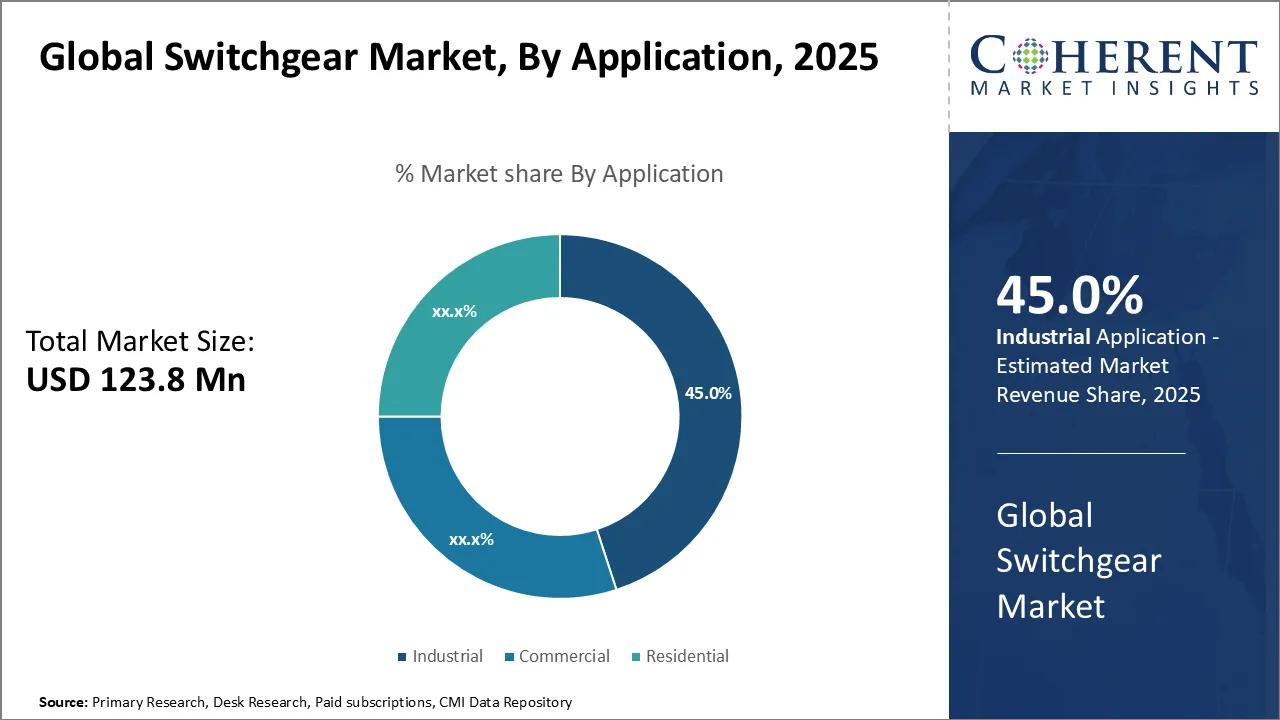
Global Switchgear Market Insights, By Application: Industrial Leads Is Fueled by Heavy Industries and Automation Needs
In terms of application, the industrial segment is projected to account the dominate share with 46% of the market in 2026. Power distribution systems that are strong and dependable are needed by heavy industries like manufacturing, oil and gas, mining, and chemicals to keep their operations going without interruption. The push for automation, electrification of processes, and the use of renewable energy sources has made the need for advanced switchgear in industrial settings even greater.
The commercial sector, which includes offices, hospitals, and stores, is the second-largest contributor. This is because service-based economies are growing and cities are getting bigger. As more people get electricity and smart homes, the demand for electricity in homes is steadily rising. However, it is still smaller than the demand for electricity in businesses and factories.
For instance, in November 2025, Schneider Electric released its SF₆-free primary switchgear technology, which is a big step toward more environmentally friendly industrial power solutions. The new technology makes India's transmission infrastructure better by giving them small, portable high-voltage solutions that are easier to set up and work better. The milestone is a big step toward being able to use advanced power technologies on your own.
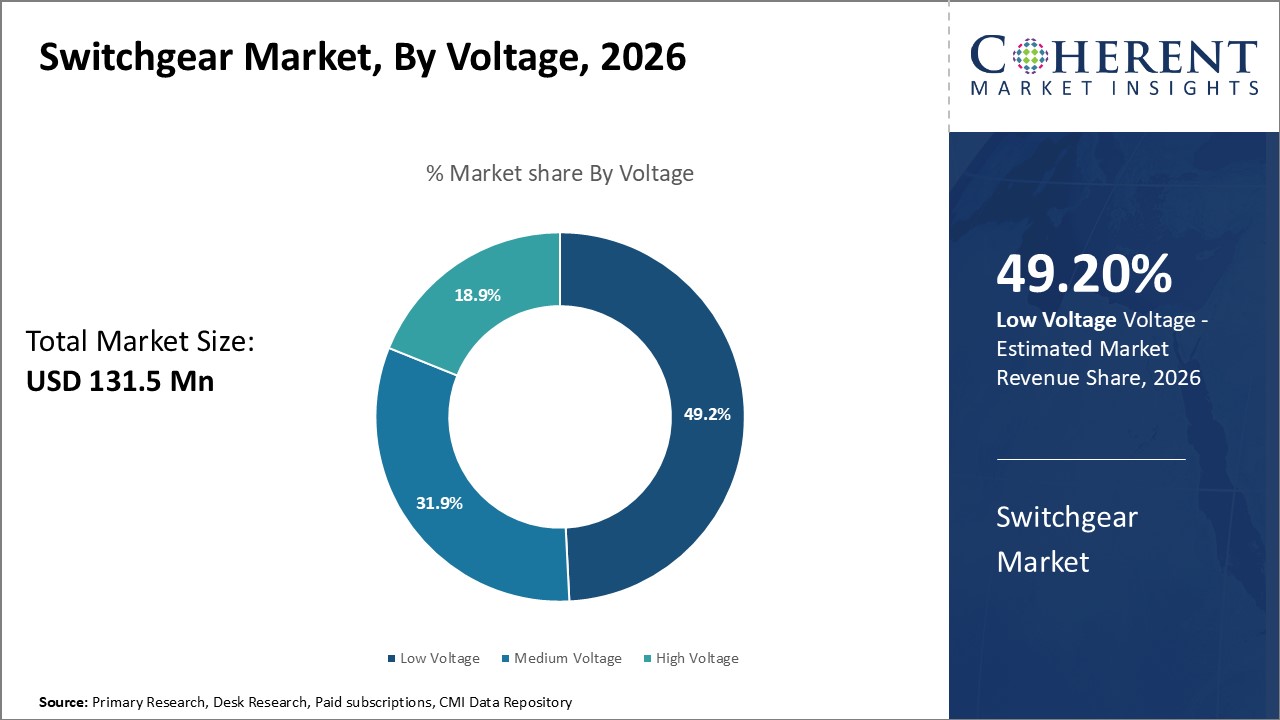
Global Switchgear Market Insights, By Voltage: Low Voltage Dominates Due To Its Widespread Use in Residential, Commercial, And Distribution Networks
In terms of voltage, the low voltage segment is expected to hold the largest share of the market in 2026, due to the fact that is used a lot in residential complexes, commercial buildings, and distribution networks where electricity needs to be managed safely and efficiently at lower voltages. The fast growth of cities, along with the growth of smart cities and new infrastructure projects, has led to a rise in demand for low voltage systems.
Medium voltage switchgear is also becoming more popular, especially in large-scale renewable energy projects and factories. High voltage switchgear is still important for transmission networks, but it makes up a smaller part of overall demand than low voltage switchgear.
For instance, in October 2025, ABB launched its next-generation low-voltage power solution made for data centers that are ready for AI. The launch shows that ABB is focused on making sure its products are reliable, small, and easy to monitor digitally so they can handle the growing energy needs of AI workloads. The solution is part of its low-voltage switchgear portfolio and is meant to make modern data center infrastructure more scalable, efficient, and resilient.
Global Switchgear Market Insights, By Insulation: Gas insulated switchgear (GIS) Leads Due To Its Compact, Reliable Design Suited for Urban Environments
In terms of insulation, the gas insulated switchgear (GIS) segment is expected to lead the market with the highest share of the market in 2026, due to it is small, very reliable, and can work in cities where there is not much space, which would make traditional air-insulated systems impractical. Its sealed design also makes it stronger against things like pollution and humidity, which is very important in cities with a lot of people.
While air insulated switchgear (AIS) continues to be used in rural and cost-sensitive projects due to its lower upfront cost, GIS is increasingly preferred for modern infrastructure. As GIS and AIS become more popular, other types of insulation, like oil or vacuum, are becoming less useful and less common.
For instance, in October 2025, Power Grid Corporation of India and Toshiba worked together to create the first 220kV mobile Gas Insulated Switchgear (m-GIS) system in India. The new technology improves India's transmission infrastructure by providing compact, portable high-voltage solutions that can be set up quickly and are more reliable. The milestone is a big step toward being able to rely on advanced power technologies on your own.
Global Switchgear Market Insights, By Installation: Indoor Installations Prevail, Driven by Smart Buildings, Data Centers, And Modern Infrastructure Projects
In terms of installation, the indoor segment is projected to capture the greatest share of the market in 2026. This trend is taking place due to there are growing numbers of smart buildings, data centers, and commercial complexes that need reliable and compact switchgear solutions in controlled environments. It's easier to keep up with indoor systems, they're safer for workers, and they work better with new monitoring technologies.
Outdoor installations are still needed for substations and utility networks, especially in rural or industrial areas. But most of the work is done indoors because urban infrastructure projects are getting bigger.
For instance, in April 2025, Schneider Electric introduced its new EasySET medium-voltage air-insulated indoor switchgear to India. The solution is for commercial and industrial buildings that need more power. It is made to safely, reliably, and efficiently send power to these buildings. The launch shows how serious Schneider is about making smart infrastructure better by making small, digitally enabled indoor switchgear that works well in modern cities and factories.
Regional Insights
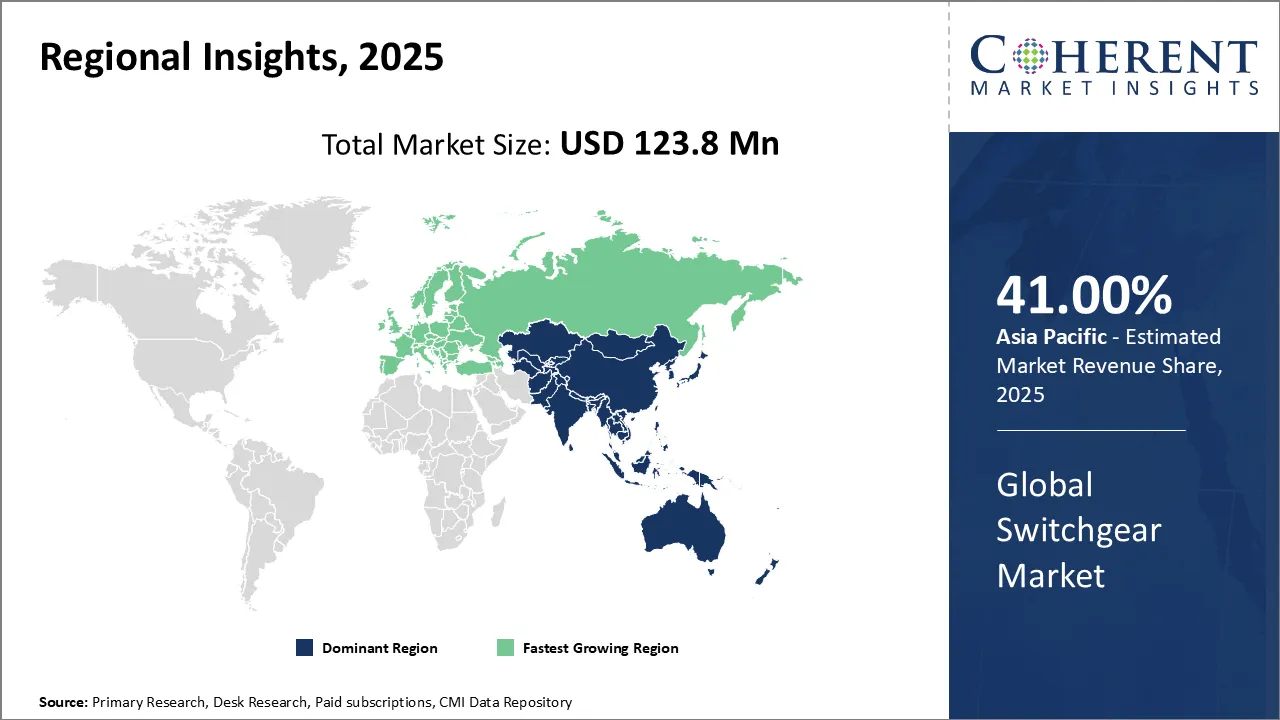
Asia Pacific Switchgear Market Analysis & Trends
Asia Pacific is expected to lead the switchgear market with 41% share in 2026, due to increase in demand for renewable energy sources leading rise in power generation capabilities in the region. Countries across this region are shifting towards revolutionized generation of energy for embracing cleaner, high-efficiency digital technologies. For instance, as per the International Energy Agency (IEA), by 2024, China will have 40% share in the global renewable capacity. Thus, the market is likely to witness robust growth across the region.
For instance, in August 2026, Bajaj Electricals added the Secura Switchgear line to its line of electrical solutions in India. The product line is meant to make homes and businesses safer, more reliable, and better at what they do. With this launch, Bajaj wants to become a bigger player in the switchgear market and help meet the needs of modern infrastructure.
Europe Switchgear Market Analysis & Trends
Europe is projected to be the fastest growing region, driven by strict environmental rules, the need to modernize old grids, and the quick adoption of SF₆-free technologies. More money is going into integrating renewable energy, building smart infrastructure, and making transportation more electric. Compact GIS and indoor solutions are more popular in cities.
For instance, in September 2026, HD Hyundai Electric released its new eco-friendly switchgear in Finland, which shows how serious the company is about using renewable energy sources. The new technology is meant to have less of an effect on the environment while still making sure that modern power systems work well. This launch shows how much Hyundai cares about green technologies and helps the company get a bigger share of Europe's changing switchgear market.
Switchgear Market Outlook Country-Wise
China Switchgear Market Trends
In 2026, China's switchgear market is very competitive because of rapid urbanization, industrial growth, and huge investments in power infrastructure. The country's push for smart grids, renewable energy integration, and electrification of transportation fuels has created a lot of demand for GIS and indoor solutions. China is the largest switchgear market in the Asia-Pacific region, and government efforts to modernize transmission networks make this even stronger.
For instance, in October 2026, ABB Beijing Switchgear has been working with customers in China for 30 years. To mark the occasion, they showed off new products. The event marks a major step forward for ABB's long-term commitment to China's power sector. It also shows off new switchgear technology that is meant to be reliable and last a long time. The party strengthens ABB's role in helping China's energy infrastructure grow and making it easier for customers to work together.
Germany Switchgear Market Trends
The switchgear market in Germany is expected to be driven by the modernization of the grid, the use of renewable energy, and strict EU rules on sustainability in 2026. To make sure that wind and solar power are reliable and efficient, the country needs to use advanced GIS and SF₆-free technologies. Germany is a major player in Europe's switchgear sector because of the growing demand caused by industrial growth and smart infrastructure projects.
For instance, in July 2026, Hitachi Energy and E. ON agreed to a deal worth up to $700 million to improve Germany's important grid infrastructure. The goal of the partnership is to make energy more secure and resilient by using cutting-edge technologies throughout the transmission network. This milestone shows that Germany is serious about updating its power systems and helping the switch to renewable energy.
Market Report Scope
Switchgear Market Report Coverage
| Report Coverage | Details | ||
|---|---|---|---|
| Base Year: | 2025 | Market Size in 2026: | USD 131.4 Mn |
| Historical Data for: | 2020 To 2024 | Forecast Period: | 2026 To 2033 |
| Forecast Period 2026 to 2033 CAGR: | 6.2% | 2033 Value Projection: | USD 200.0 Mn |
| Geographies covered: |
| ||
| Segments covered: |
| ||
| Companies covered: | ABB Ltd., Fuji Electric Co. Ltd., Havells India Ltd., Powell Industries, Mitsubishi Electric Corporation, CG Power and Industrial Solutions Limited, Schneider Electric, Hitachi Ltd., Siemens AG, Meidensha Corporation, Eaton Corporation PLC, and Toshiba International Corporation (Toshiba Corporation) | ||
| Growth Drivers: |
| ||
| Restraints & Challenges: |
| ||
Global Switchgear Market Drivers
Growing infrastructure of smart electricity grid to drive the market growth
Electric infrastructure is aging in several countries and burden on this infrastructure is also growing. The global power generation and transmission sectors are adopting modernization of the grid in order to make it more resilient and smarter with the use of advanced technologies, controls, and equipment. Smart grids are capable of communicating and working together to deliver electricity more reliably and efficiently. Using these grids can offer vast reduction in the duration and frequency of power outages, storm impacts, and it can restore services at faster pace, whenever there are power outages. Thus, adoption of smart electricity grid infrastructure is growing all over the world, which is expected to drive growth of the market.
Increasing government initiatives to boost the market growth
Growing governments around the world are working to improve existing power generation infrastructure and use more renewable energy sources. This shift around the world is increasing the need for modern electrical equipment, which is making the switchgear market size much bigger. This is because countries are investing in reliable, efficient, and sustainable grid solutions to meet their growing energy needs.
Global Switchgear Market Opportunities
Growing adoption of switchgear intelligence is expected to bring growth opportunities in the global switchgear market over the forecast period. The inherent intelligence is growing in switchgear systems, which allows predictive maintenance for minimizing the failure and downtime in the electric grid sites. Digitization has become the next revolution in the switchgear industry, which is driving the demand for low voltage switchgear industry. Thus, the global market is likely to witness lucrative opportunities in the global switchgear market during the forecast period.
Increasing penetration of advanced technologies such as Internet of Things (IoT) and Smart technologies in switchgear industry is anticipated to generate business opportunities in the global switchgear market over the forecast period. The penetration of such advanced technologies is transforming the operation of medium-voltage switchgear systems. The usual lifespan of this equipment is 15 to 30 years, or longer. However, technology and equipment standards continue to change at faster pace. The technological advancements in switchgear systems are enhancing the offerings such as increased lifespan, due to which demand for these systems is growing, which in turn is driving the switchgear market growth.
Global Switchgear Market Trends
Decentralizing activities in administration of buildings and services is a recent trend
The decentralize activities in administration of services by a medium-sized industrial plants or a building have increased in recent years. The increase in connectivity is offering more visibility of the facilities and increased control over health of operations. Moreover, the edge control capabilities are now a possibility for making proper decisions at needed times in order for improving operational efficiency and uptime. Thus, this trend is likely to drive growth of the global switchgear market during the forecast period.
Increasing inclination toward SF6 free switchgear is a new trend
There is a growing shift toward SF6 free switchgear, specifically in the EU countries. Despite the small percentage contributed by SF6 to greenhouse gases, the percentage seems to be increasing, owing to extensive use of SF6.
Analyst Opinion (Expert Opinion)
The global switchgear market value keeps growing owing to significant modifications to the grid, more power use, and faster electrification in all industries. There is a lot of demand for low-, medium-, and high-voltage switchgear. Low-voltage systems are the most common because they are used in commercial, residential, and industrial distribution networks. Gas-insulated switchgear is still a fast-growing subsegment, thanks to urban substations, underground distribution projects, and ultra-high-voltage transmission systems.
Data-driven indicators show that utilities and hyperscale data center developers are buying more and more. Large electrical OEMs have said that they have won a lot of contracts for switchgear that is built into power architectures that are critical to their missions. The need for smart switchgear with advanced protection relays, digital monitoring, and automated fault-response capabilities is growing even more because of electrification of transportation, integration of renewable energy, and distributed generation.
On the supply side, big companies are increasing their production capacity, updating their assembly lines, and putting money into small, SF₆-free technologies. The price of raw materials, utility budget cycles, and long lead times are still big problems. Overall, the market shows steady structural demand, which is helped by ongoing changes in the energy and industrial sectors.
Speak to the analyst
Want personalized insights?
Take the findings above to one of our principal consultants, or have the report rebuilt around the segments, geographies and competitors you actually track.
Global Switchgear Market: Key Developments
- In November 2025, IEEMA opened the 11th edition of SWICON, India's biggest technical forum for switchgear and controlgear. The event brings together leaders, experts, and innovators from the power systems industry to talk about new technologies, sustainability, and future trends. SWICON 2025 shows how India is paying more and more attention to modern electrical infrastructure and the changing switchgear market.
- In October 2025, CG Power confirmed that it plans to spend ₹748 crore to build a new switchgear factory in western India. The goal of the project is to increase the country's production capacity, support the growth of infrastructure, and meet the growing demand for high-tech electrical equipment. This strategic move strengthens CG Power's position in India's growing switchgear market and fits with the country's goals for industrial growth.
- In February 2025, Lauritz Knudsen Electrical and Automation, which used to be called L&T Switchgear, showed off its full range of switchgear automation solutions at ELECRAMA 2025. The launch shows off cutting-edge technologies that are meant to make power distribution safer, more efficient, and more reliable. This move helps the company get more business and meets India's growing need for modern electrical infrastructure solutions.
Market Segmentation
- Global Switchgear Market, By Voltage (Revenue, USD Mn, 2021 - 2033)
- Low Voltage
- Medium Voltage
- High Voltage
- Global Switchgear Market, By Insulation (Revenue, USD Mn, 2021 - 2033)
- Gas Insulated Switchgear (GIS)
- Air Insulated Switchgear (AIS)
- Other Insulation Types
- Global Switchgear Market, By Installation (Revenue, USD Mn, 2021 - 2033)
- Indoor
- Outdoor
- Global Switchgear Market, By Application (Revenue, USD Mn, 2021 - 2033)
- Commercial
- Residential
- Industrial
- Global Switchgear Market, By Geography (Revenue, USD Mn, 2021 - 2033)
- North America
- U.S.
- Canada
- Latin America
- Brazil
- Argentina
- Mexico
- Rest of Latin America
- Europe
- Germany
- U.K.
- Spain
- France
- Italy
- Russia
- Rest of Europe
- Asia Pacific
- China
- India
- Japan
- Australia
- South Korea
- ASEAN
- Rest of Asia Pacific
- Middle East & Africa
- GCC Countries
- Israel
- Rest of Middle East & Africa
- North America
- Key Companies Insights (Revenue, USD Mn, 2021 - 2033)
- ABB Ltd.
- Fuji Electric Co. Ltd.
- Havells India Ltd.
- Powell Industries
- Mitsubishi Electric Corporation
- CG Power and Industrial Solutions Limited
- Schneider Electric
- Hitachi Ltd.
- Siemens AG
- Meidensha Corporation
- Eaton Corporation PLC
- Toshiba International Corporation (Toshiba Corporation)
Sources
Primary Research Interviews
- Switchgear Manufacturers
- Transmission & Distribution (T&D) Utilities
- Electrical Component & Protection Relay Suppliers
- Power System Engineers & Grid Planners
- EPC Contractors (Substation & Industrial Power Projects)
- Smart Grid Technology Providers
- Industrial Electrical Maintenance Experts
- Others
Databases
- Bloomberg Terminal
- Thomson Reuters Eikon
- IHS Markit (T&D Equipment & Power Systems Database)
- Euromonitor International
- S&P Global Market Intelligence
- EMIS Database
- Others
Magazines
- Power Engineering Magazine
- Electrical World Magazine
- T&D World
- EE Publishers – Transmission & Distribution Review
- Energy Business Review
- Others
Journals
- IEEE Transactions on Power Delivery
- IEEE Transactions on Dielectrics and Electrical Insulation
- Electric Power Systems Research Journal
- International Journal of Electrical Power & Energy Systems
- Energy Policy Journal
- Others
Newspapers
- Financial Times
- The Wall Street Journal
- Reuters
- Bloomberg News
- The Economic Times (Power & Energy Section)
- Others
Associations
- IEEE Power & Energy Society (PES)
- International Electrotechnical Commission (IEC)
- CIGRE – International Council on Large Electric Systems
- Electrical Apparatus Service Association (EASA)
- International Energy Agency (IEA)
- Others
Public Domain Sources
- International Energy Agency (IEA)
- U.S. Energy Information Administration (EIA)
- European Commission – Energy Directorate
- Ministry of Power (India) – CEA Reports
- World Bank Open Data
- International Renewable Energy Agency (IRENA)
- Others
Proprietary Elements
- CMI Data Analytics Tool
- Proprietary CMI Existing Repository of Information for the Last 8 Years
Definition: Switchgear is a type of electrical equipment that uses fuses, switches, relays, potential transformers, and lightning arrestors for controlling and isolating an electric power system. It is a component of an electrical supply system that connects to the low and high voltage of the power transformer.
Get access to 250+ pages report
Every segment, forecast, competitor profile and data table behind the analysis above — available for instant download.
- ESOMAR Member
- ISO 9001:2015 Certified
- D-U-N-S Registered
- GDPR & CCPA Compliant
Missing comfort of reading report in your local language? Find your preferred language:
Transform your Strategy with Exclusive Trending Reports
Frequently Asked Questions
The Switchgear Market is estimated to be valued at USD 131.5 Mn in 2026, and is expected to reach USD 200.0 Mn by 2033.
The CAGR of the Switchgear Market is projected to be 6.2% from 2026 to 2033.
Growing infrastructure of smart electricity grid and increasing government initiatives are fuelling the market.
The industrial segment is leading the application segment in the market.
Stringent regulations towards safety and environment and functional disadvantages of switchgear systems are the major factors restraining growth of the market.
ABB Ltd., Fuji Electric Co. Ltd., Havells India Ltd., Powell Industries, Mitsubishi Electric Corporation, CG Power and Industrial Solutions Limited, Schneider Electric, Hitachi Ltd., Siemens AG, Meidensha Corporation, Eaton Corporation PLC, and Toshiba International Corporation (Toshiba Corporation)