

Smart Grid Data Analytics Market Size and Share Analysis - 2026 To 2033
The Smart Grid Data Analytics Market size is anticipated to grow at a CAGR of 12.3% with USD 9 Bn in 2026 and is expected to reach USD 20.2 Bn in 2033. The primary drivers for the market are predominantly linked to the rapid digitization and modernization of electricity grids globally. The increasing integration of renewable energy sources like solar and wind, and the expansion of smart metering infrastructure are generating strong demand for advanced analytics to manage load forecasting, energy efficiency, and grid stability. The rising electricity demand due to electrification and the growth of data centers is also pushing utilities to adopt real-time monitoring and predictive analytics solutions. In addition, the government-backed initiatives and grants for grid hardening and resilience like the U.S. Department of Energy’s Grid Resilience Utility and Industry Grants program allocating USD 2.5 Bn through FY2026, are speeding up the deployment of smart grid analytics technologies.
Key Takeaways
- The cloud-based segment is likely to dominate the market with 60.8% in 2026. The segment’s growth is owing to the utilities’ rising need for scalable storage, real-time grid visibility, AI/ML model deployment, and lower dependence on heavy on-premise infrastructure for AMI, DER, outage, and customer analytics. In 2024, the U.S. DOE announced USD 7.5 million for grid reliability and resilience projects using data analytics and sensor technologies.
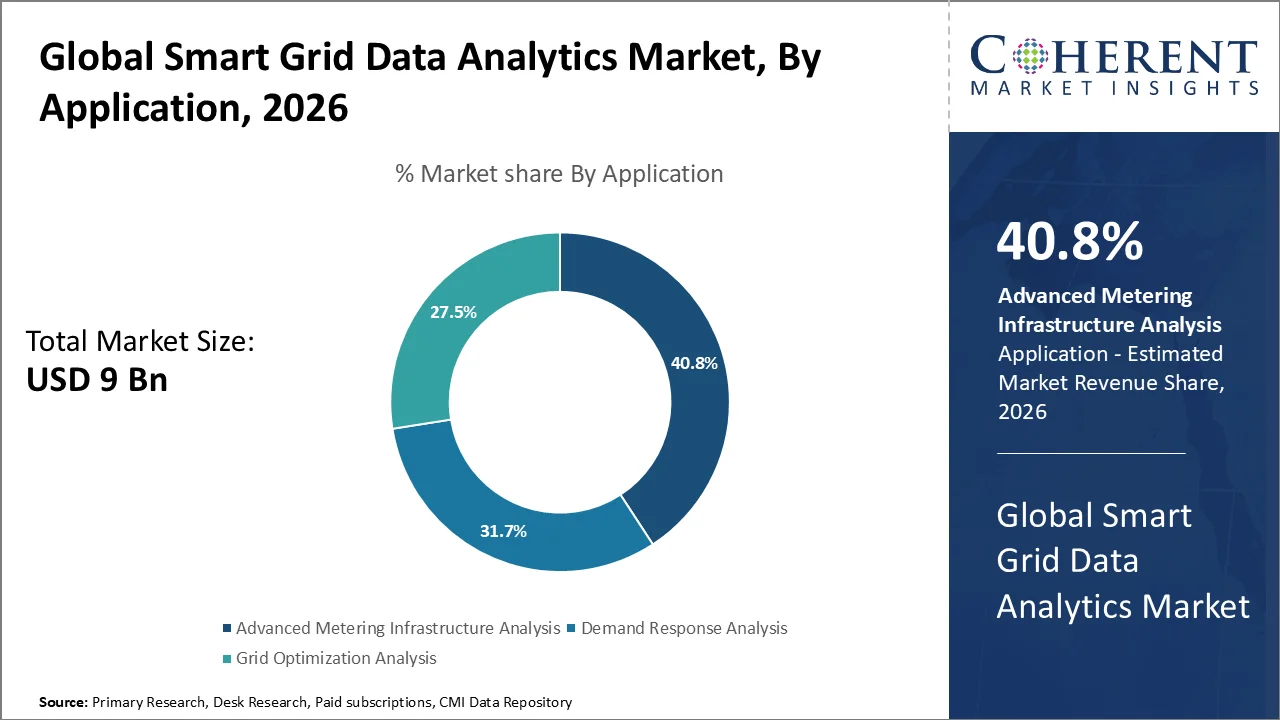
- The advanced metering infrastructure analysis segment is set to lead with 40.8% in 2026. The segment’s growth is owing to the expanding smart meter rollouts, interval-based consumption data, theft detection, billing automation, demand forecasting, and customer load profiling. The U.S. EIA recorded 123.0 million AMI meters in 2024, showing the scale of meter-data analytics demand.
- The transmission and distribution (T&D) network analytics segment is set to lead with 47.5% in 2026. The segment’s growth is owing to the aging grid infrastructure, outage reduction needs, DER integration, voltage optimization, and asset-health monitoring.
- The private sector (SMEs and large enterprises) segment is set to lead with 66.5% in 2026. The segment’s growth is owing to the strong adoption by investor-owned utilities, commercial energy users, industrial facilities, data centers, and power retailers for demand response, predictive maintenance, energy-cost optimization, and customer analytics. FERC reported advanced meter penetration of 69.3% for commercial customers and 68.5% for industrial customers in 2022.
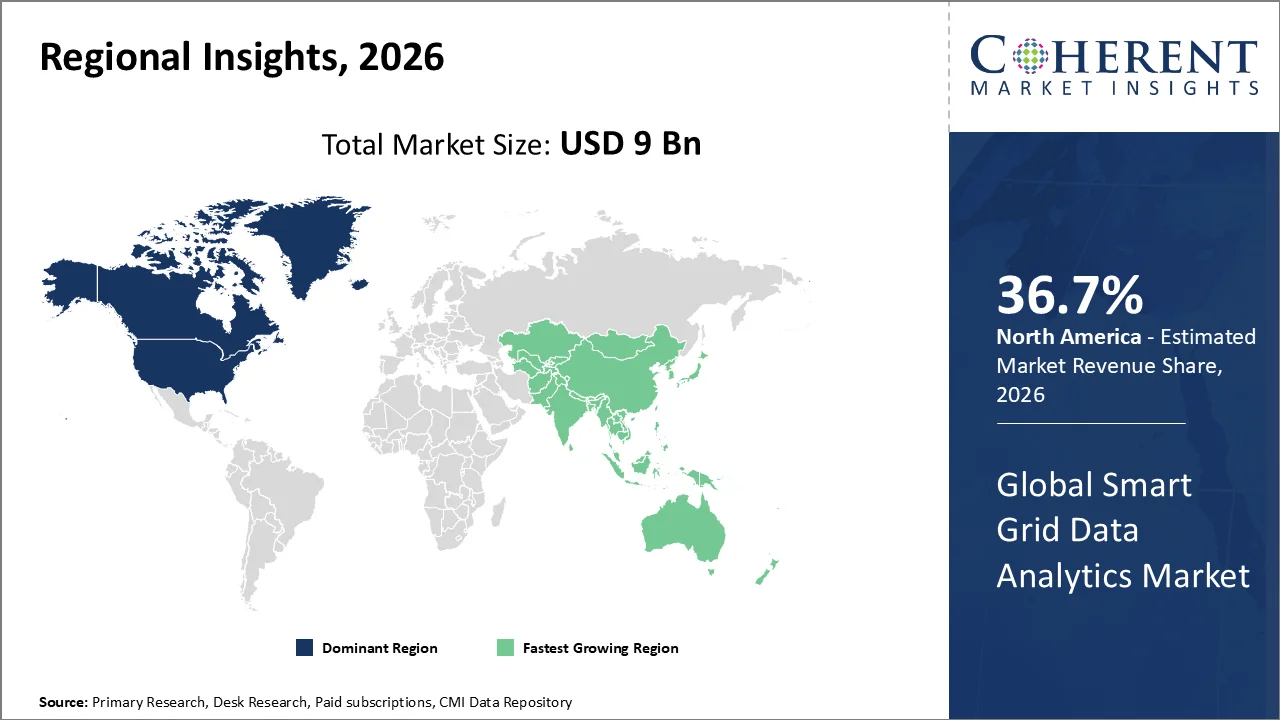
- North America is expected to acquire the prominent share of 36.7% in 2026. The region’s growth is owing to the high smart meter penetration, strong utility digitalization, grid modernization funding, outage resilience programs, and advanced demand response adoption across the U.S. and Canada. The AMI installations increased from 127.76 million in 2023 to 140.49 million in the region in 2024. In 2022, U.S. electric utilities had about 119 million smart (AMI) meters installed, accounting for 72 % of total electric meters.
Segmental Insights
Why is Cloud-based Acquiring the Largest Share?
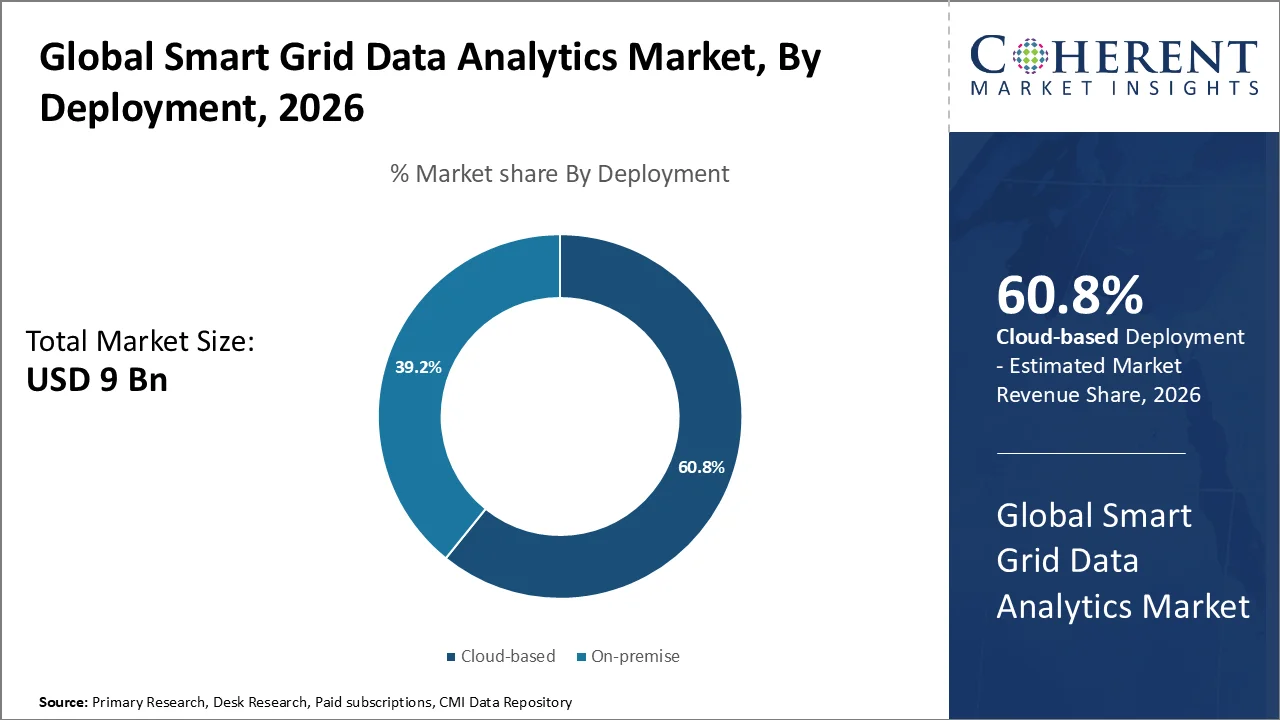
On the basis of deployment, the cloud-based segment is projected to account for the largest Smart Grid Data Analytics Market share of 60.8% in 2026. The segment’s growth is owing to its ability to process high-volume AMI, DER, substation, and grid-edge sensor data without utilities building heavy on-premise infrastructure. Cloud platforms support real-time ingestion, outage prediction, load forecasting, asset-health monitoring, and secure data sharing between distribution and transmission teams.
The European Commission reported that nearly 54% of European households had smart electricity meters, with 13 EU member states achieving over 80% penetration by the end of 2022, thereby highlighting the extensive incorporation of cloud-compatible infrastructure.
In July 2024, the U.S. DOE highlighted VELCO-PNNL-ORNL projects converting grid models, meter, substation, and grid-edge sensor data into CIM and combining them in a cloud-based research environment, thus validating cloud analytics for transmission-distribution.
- Current Industry Events of 2026
- Market Size Estimation
- Regional Breakdown
- Competitive Landscape
- Customer Intelligence
- Segmental Analysis
- Pricing Analysis
- Key Market Drivers, Challenges & Future Trends
- Customized Insights Section
Advanced Metering Infrastructure Analysis hold the Largest Market Share
On the basis of application, the advanced metering infrastructure analysis segment lead with a major 40.8% share in 2026. The segment’s growth is owing to the utilities’ rising dependence on smart-meter data for load forecasting, outage detection, billing accuracy, demand response, theft identification, and customer-level consumption analytics.
In the U.S., the Energy Information Administration reported 140,491,981 AMI meters in 2024, up from 127,764,365 in 2023, showing rapid expansion of interval-data availability for analytics platforms.
Residential AMI deployment is especially important, as 123,019,799 residential AMI meters were recorded in 2024, creating large volumes of granular household electricity-use data for demand-side optimization.
A relevant development is the U.S. Department of Energy’s Smart Grid Grants program, which supports up to USD 3 billion, including USD 600 million per year during FY2022–FY2026, for grid resilience technologies and solutions. This is promoting the utility investments in smart grid analytics as well as AI-based distribution planning in large, regulated electric networks.
Market Drivers
AI-Driven Grid Optimization and Automation is Transforming the Smart Grid Data Analytics Market in the US
AI‑Driven grid optimization and automation are fundamentally transforming the Smart Grid Data Analytics Market in the United States by accelerating grid modernization and enabling more efficient, reliable energy management. According to the U.S. Department of Energy (DOE), smart grid investments have deployed millions of sensors and advanced meters that generate massive datasets requiring analytics for real‑time monitoring and control, a core foundation for AI‑based grid solutions.
According to federal grid instrumentation audits, the DOE has backed the deployment of synchro phasors and wide-area measurement systems at more than 2,500 locations across the U.S. bulk power footprint. This hardware produces continuous streams of high-resolution time-series data crucial for deep learning models.
In October 2025, Smart Grid Analytics raised USD 3.3 million to scale its AI‑enabled Solvyn platform. This is expected to propel renewable asset optimization, product innovation, and expansion in MENA, Europe, as well as North America, with deployments in 20 countries.
Smart Meter Data Analytics and AMI 2.0: A Major Breakthrough in the Market
The market is witnessing a substantial breakthrough with smart meter data analytics and AMI 2.0. This is owing to government-backed deployments along with advanced analytics integration.
In December 2025, India had installed more than 5 crore smart meters nationwide including 3.90 crore under the government-supported Revamped Distribution Sector Scheme (RDSS). These installations provide high-resolution consumption and grid performance data, thereby enabling utilities to optimize load forecasting, minimize Aggregate Technical & Commercial (AT&C) losses, and enhance predictive maintenance.
In March 2026, GNA Energy launched GNAi, a cloud-based power intelligence platform which integrates smart meter, grid, and weather data. The platform allows the electricity sector stakeholders to optimize demand and price forecasting, battery dispatch, procurement planning, and overall grid operations through data-driven insights.
Current Events and Their Impact on the Smart Grid Data Analytics Market
Current Event | Description and its Impact |
U.S. DOE SPARK Funding for Advanced Transmission and Smart Grid Technologies |
|
European Commission–ACER Push for Forward-Looking Electricity Network Planning |
|
Smart Grid Data Analytics Market Trends
- The growing adoption of smart meters, distribution automation, and IoT sensors is propelling the demand for advanced analytics platforms that process high-frequency grid data for real-time monitoring and control.
- The growing deployment of smart meters and Advanced Metering Infrastructure (AMI 2.0) enables high-resolution data collection, thereby supporting predictive load management, real-time monitoring, and efficient energy distribution. Under the Revamped Distribution Sector Scheme (RDSS), the Government of India has sanctioned 20.33 crore smart meters nationwide, thus accelerating AMI deployment.
- The integration of AI-driven analytics platforms like GNA Energy’s GNAi launched in March 2026 enables the demand forecasting, price optimization, battery dispatch, and grid reliability improvements, thereby boosting operational efficiency for utilities and industrial consumers.
- The expansion of renewable energy sources, including solar and wind, increases variability in power generation, thereby driving the demand for advanced analytics to maintain grid stability, optimize storage, and forecast load accurately.
- Regulatory incentives and modernization programs are speeding up the smart grid adoption globally. The Indian government’s RDSS program, with gross budgetary support of ₹97,631 crore, incentivizes DISCOM modernization, including smart meters and grid automation, to reduce losses and improve efficiency.
Regional Insights
North America Dominates Owing to the Extensive Grid Modernization Investments and Advanced Metering Infrastructure
The North America region accounts for 36.7% of the market share in 2026. The region’s growth is owing to the by the widespread deployment of Advanced Metering Infrastructure (AMI), the modernization of aging electricity networks, and strong government-backed investments in grid digitalization.
The growing volume of real-time data generated from smart meters, substations, and grid-edge devices is accelerating the demand for advanced analytics solutions. According to the U.S. Energy Information Administration (EIA), the utilities had invested USD 5.1 billion in customer-side infrastructure like smart meters and rooftop-solar-related assets in 2023, thereby representing a 25% increase from 2022.
Worldwide, grid upgrades are expected to cost about USD 5.8 trillion from 2026 to 2035, with around USD 700 billion allocated to digital grid technologies. In the U.S. alone, investments of about USD 1 trillion are projected over the next ten years.
In March 2025, Schneider Electric announced plans to invest over USD 700 million in U.S. operations through 2027, supporting AI-driven energy infrastructure, manufacturing expansion, smart grid modernization, and automation demand while creating over 1,000 jobs across several U.S. manufacturing facilities nationwide.
Asia Pacific Smart Grid Data Analytics Market Trends
Asia Pacific is expected to witness strong growth in Smart Grid Data Analytics Market over the forecast period. The region’s growth is owing to the accelerated digital grid modernization and the widespread deployment of smart meters under government‑led programmes. In India, the Revamped Distribution Sector Scheme (RDSS) has catalyzed this shift, with 5.28, crore smart meters installed nationwide as of December 2025, according to official Ministry of Power data, generating voluminous real‑time data essential for advanced analytics and grid optimization.
Across the Asia‑Pacific, regulatory emphasis on real‑time monitoring and efficient power distribution is reinforced by significant infrastructure investments such as the Asian Development Bank USD 70 billion programme for energy and digital infrastructure, which includes grid interconnectivity and data‑centric upgrades.
In October 2025, the Maharashtra State Electricity Distribution Company Limited (MSEDCL) partnered with the Global Energy Alliance for People and Planet (GEAPP) to integrate AI and machine learning‑based load forecasting and predictive analytics into grid operations in Maharashtra.
Federal Grid Modernization Investments and AI-Led Energy Innovation are Accelerating the Smart Grid Data Analytics Market in the United States
The United States Smart Grid Data Analytics Market is experiencing growth. This is owing to the federal investment and grid modernization priorities. According to the U.S. Department of Energy, the U.S. electric grid comprises more than 600,000 miles of transmission lines and over 9,200 generating units, thereby highlighting the scale of data analytics needed for reliability as well as planning.
In March 2025, National Grid Partners committed USD 100 million to AI startups advancing energy innovation like Amperon. The investment aims to improve grid efficiency, resilience, forecasting, reliability, energy security, and smart grid deployment across National Grid’s U.S. and U.K. operations.
China Smart Grid Data Analytics Market Trends
China’s Smart Grid Data Analytics Market is driven by targeted government action to modernize its electricity infrastructure. In December 2025, the National Energy Administration and National Development and Reform Commission issued guidance aiming to build a grid capable of over 420 GW westsupporting renewables integration and intelligent dispatch systems.
In April 2026, Wasion Group Limited secured major contracts from the State Grid Corporation of China for approximately 827,000 smart meters and intelligent data collection terminals, enhancing data acquisition infrastructure for analytics platforms.
Who are the Major Companies in Smart Grid Data Analytics Industry
Some of the major key players in Smart Grid Data Analytics Market are Becton, Dickinson and Company, Fujifilm SonoSite Inc., Medtronic Plc, Dragerwerk AG & Co. KGAA, Cooper Surgical, Getinge AB, Natus Medical Incorporated, GE Healthcare, Siemens Healthcare GmbH, ArjoHuntleigh, Inc., Neoventa Medical, Koninklijke Philips N.V., Analogic Corporation, Spacelabs Healthcare Inc., Smiths Medical, and Masimo.
Key News
- In June 2026, Siemens Energy launched an accelerated €1 billion share buyback and acquired a smart-grid monitoring specialist, signaling confidence in grid technology growth while balancing investor returns with investments tied to rising data center-driven power-demand growth and market confidence.
- In May 2026, Tantalus launched AI-enabled TRUGrid Verify and TRUGrid Advantage to help utilities modernize distribution grids. The solutions identify hidden GIS and AMI data errors, strengthen reliability and transformer analytics, and support proactive maintenance, outage management, and grid insights.
Market Report Scope
Smart Grid Data Analytics Market Report Coverage
| Report Coverage | Details | ||
|---|---|---|---|
| Base Year: | 2025 | Market Size in 2026: | USD 9 Bn |
| Historical Data for: | 2020 To 2024 | Forecast Period: | 2026 To 2033 |
| Forecast Period 2026 to 2033 CAGR: | 12.3% | 2033 Value Projection: | USD 20.2 Bn |
| Geographies covered: |
| ||
| Segments covered: |
| ||
| Companies covered: | Sensus USA Inc. (Xylem Inc.), Siemens AG, Amdocs Corporation, Itron Inc., Oracle Corporation, AutoGrid Systems Inc., Schneider Electric SE, General Electric Company, Uptake Technologies Inc., IBM Corporation, Landis & Gyr Group AG, SAP SE, Uplight Inc., Tantalus System Corp., Hitachi Ltd., and SAS Institute Inc. | ||
| Growth Drivers: |
| ||
| Restraints & Challenges: |
| ||
Analyst Opinion
- The Smart Grid Data Analytics Market growth is driven by structural demand from utilities and private energy providers for efficient grid management. According to the U.S. Energy Information Administration (EIA), the electricity demand in North America is projected to rise by 1.3% annually through 2026, thereby emphasizing the need for data-driven grid optimization. This indicates that the adoption will remain resilient as utilities implement advanced metering infrastructure (AMI), predictive load balancing, as well as real-time network monitoring to improve reliability and reduce operational costs.
- Advanced metering infrastructure (AMI) analytics is critical, with over 80 million smart meters deployed in the U.S. as of 2026 (EIA). This proliferation creates large volumes of granular consumption data, enabling utilities to optimize demand response, energy forecasting, and outage management. The high penetration of smart meters highlights the market’s structural demand, thereby supporting the continual investment in cloud-based analytics, edge computing integration, and predictive network solutions.
- Private sector enterprises like industrial and commercial energy consumers are adopting smart grid analytics to enhance energy efficiency and sustainability compliance. In 2025, the U.S. Department of Energy reported that the energy management programs leveraging real-time analytics delivered cost savings of up to 8% annually for participating companies. This demonstrates that the market is not only expanding owing to technology trends but also due to measurable operational benefits, regulatory incentives, and growing corporate sustainability commitments across both mature and emerging regions.
Speak to the analyst
Want personalized insights?
Take the findings above to one of our principal consultants, or have the report rebuilt around the segments, geographies and competitors you actually track.
Market Segmentation
- By Deployment (Revenue, USD Bn, 2021-2033)
- Cloud-based
- On-premise
- By Application (Revenue, USD Bn, 2021-2033)
- Advanced Metering Infrastructure Analysis
- Demand Response Analysis
- Grid Optimization Analysis
- By Solution (Revenue, USD Bn, 2021-2033)
- Transmission and Distribution (T&D) Network Analytics
- Metering Customer Analytics
- Others
- By End-User Vertical (Revenue, USD Bn, 2021-2033)
- Private Sector (SMEs and Large Enterprises)
- Public Sector
- By Region (Revenue, USD Bn, 2021-2033)
- North America
- U.S.
- Canada
- Latin America
- Brazil
- Mexico
- Argentina
- Rest of Latin America
- Europe
- Germany
- U.K.
- France
- Italy
- Spain
- Russia
- Rest of Europe
- Asia Pacific
- China
- India
- Japan
- Australia
- South Korea
- ASEAN
- Rest of Asia Pacific
- Middle East
- GCC
- Israel
- Rest of Middle East
- Africa
- South Africa
- Central Africa
- North Africa
- North America
Sources
Primary Research Interviews
- Smart Grid Analytics Solution Providers
- Advanced Metering Infrastructure (AMI) Technology Providers
- Grid Optimization Software Vendors
- Transmission & Distribution Utility Operators
- Demand Response and Energy Management Consultants
- Distribution Automation Engineers
- Electric Utility IT and Data Analytics Heads
- Smart Meter Manufacturers and System Integrators
- Others
Databases
- Bloomberg Terminal
- Thomson Reuters Eikon
- International Energy Agency (IEA) Data
- U.S. Energy Information Administration (EIA)
- Others
Magazines
- Power Engineering Magazine
- Smart Energy International
- Utility Dive
- T&D World Magazine
- Energy Digital Magazine
- Renewable Energy World
- Others
Journals
- IEEE Transactions on Smart Grid
- IEEE Transactions on Power Systems
- Electric Power Systems Research
- Applied Energy
- Energy Reports
- International Journal of Electrical Power & Energy Systems
- Others
Newspapers
- Financial Times
- The Wall Street Journal
- Reuters
- Bloomberg News
- The Economic Times
- Business Standard
- Others
Associations
- IEEE Power & Energy Society
- Smart Electric Power Alliance (SEPA)
- GridWise Alliance
- International Energy Agency (IEA)
- European Network of Transmission System Operators for Electricity (ENTSO-E)
- National Association of Regulatory Utility Commissioners (NARUC)
- Others
Public Domain Sources
- U.S. Department of Energy (DOE) – Office of Electricity
- U.S. Energy Information Administration (EIA)
- International Energy Agency (IEA)
- European Commission – Energy Directorate
- National Renewable Energy Laboratory (NREL)
- World Bank Open Data
- India Ministry of Power
- Central Electricity Authority (CEA), India
- Others
Proprietary Elements
- CMI Data Analytics Tool
- Proprietary CMI Existing Repository of Information for the Last 10 Years
Get access to 250+ pages report
Every segment, forecast, competitor profile and data table behind the analysis above — available for instant download.
- ESOMAR Member
- ISO 9001:2015 Certified
- D-U-N-S Registered
- GDPR & CCPA Compliant
Missing comfort of reading report in your local language? Find your preferred language:
Transform your Strategy with Exclusive Trending Reports
Frequently Asked Questions
The Smart Grid Data Analytics Market is expected to reach USD 20.2 Bn in 2033.
Major players operating in the global Smart Grid Data Analytics Market include Becton, Dickinson and Company, Fujifilm SonoSite Inc., Medtronic Plc, Dragerwerk AG & Co. KGAA, Cooper Surgical, Getinge AB, Natus Medical Incorporated, GE Healthcare, Siemens Healthcare GmbH, ArjoHuntleigh, Inc., Neoventa Medical, Koninklijke Philips N.V., Analogic Corporation, Spacelabs Healthcare Inc., Smiths Medical, and Masimo.
The high initial capital expenditures, concerns over cybersecurity, and legacy system integration issues are the key factors hampering growth of the market.
The urgent need to modernize aging infrastructure, the massive influx of data from smart meters, and the rising complexity of integrating distributed renewable energy is boosting the demand for Smart Grid Data Analytics solutions.
The Smart Grid Data Analytics Market is anticipated to grow at a CAGR of 12.3% between 2026 and 2033.
Among regions, North America is expected to account for a largest market share in the global Smart Grid Data Analytics Market over the forecast period.
AI enables predictive modeling, anomaly detection, optimization of energy dispatch, load balancing, and fault detection, helping utilities make data-driven decisions faster and more accurately.