

Advanced Metering Infrastructure Market Size and Forecast — 2026-2033
The Global Advanced Metering Infrastructure Market size is estimated to be valued at USD 20.44 billion in 2026 and is expected to reach USD 44.35 billion by 2033, exhibiting a compound annual growth rate (CAGR) of 11.7% from 2026 to 2033.
Overview
Advanced Metering Infrastructure (AMI) systems enable two-way communication between utilities and consumers for efficient energy monitoring and management. AMI consists of smart meters, communication networks, and data management systems that provide real-time insights into energy consumption. These solutions support dynamic pricing, demand response, and grid optimization. Increasing adoption of smart grids and renewable integration has positioned AMI as a key component of modern energy infrastructure.
Key Takeaways
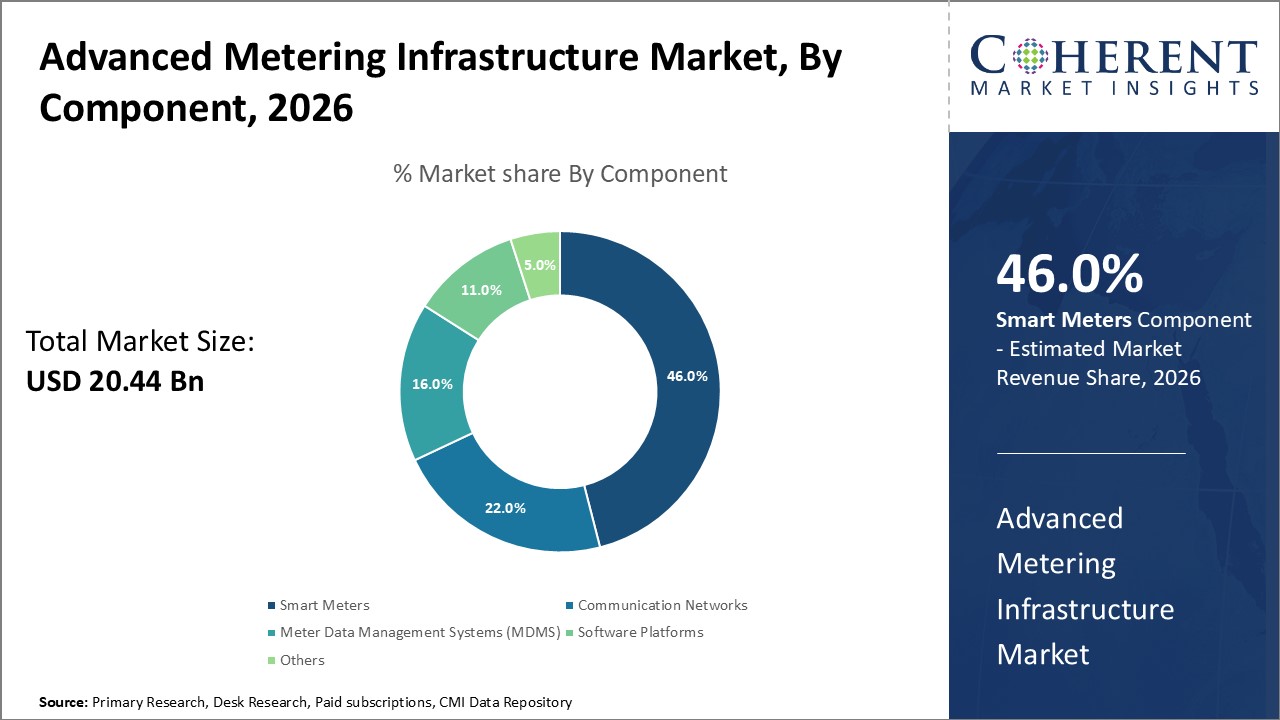
Smart Meters segment leads the Advanced Metering Infrastructure market, accounting for 46% of market share due to rapid adoption driven by their reliability and ease of integration across sectors. Cellular communication is emerging as the fastest growing technology subsegment, favored for its scalability and lower latency.
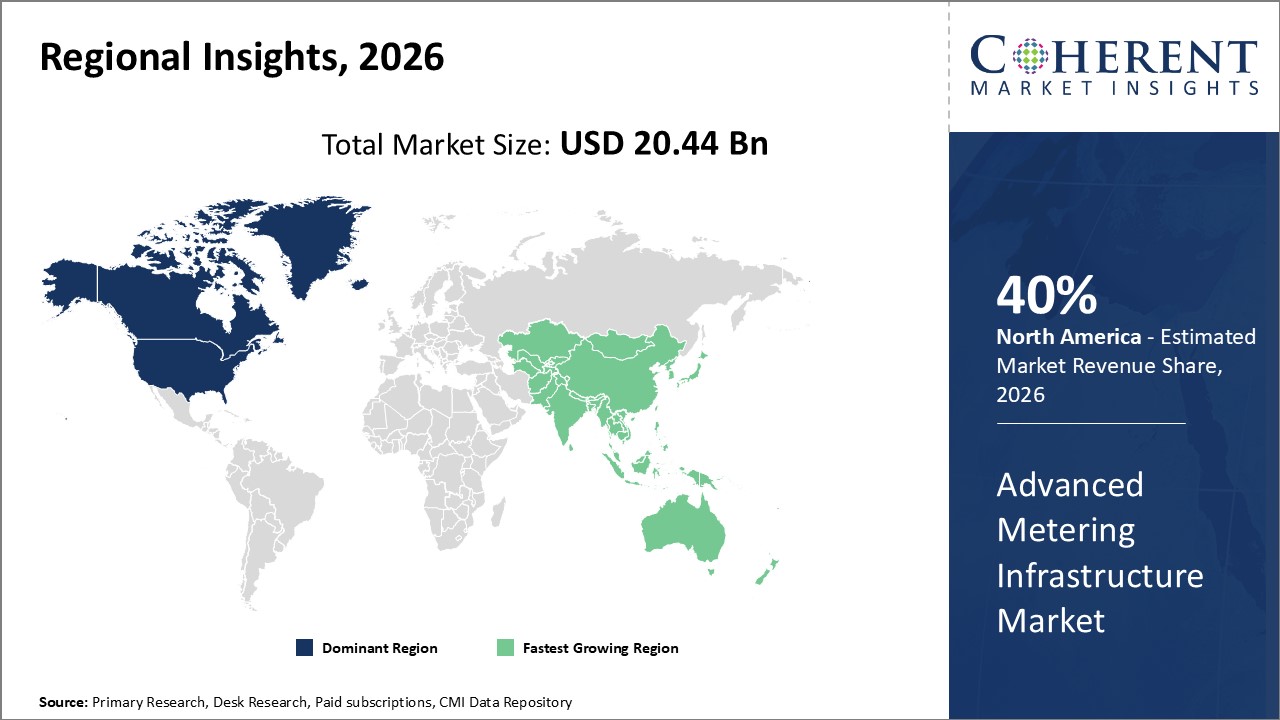
In regional terms, North America dominates with over 40% market share, supported by proactive government policies and a mature utility ecosystem. Asia Pacific is the fastest growing region, buoyed by rapid urbanization, digitalization efforts, and increasing investments in smart grid infrastructure.
Utility sector end-users show the highest growth potential by effectively leveraging AMI for grid automation and energy theft prevention. Residential users are adopting AMI driven by smart home energy management trends.
Advanced Metering Infrastructure Market Segmentation Analysis
Advanced Metering Infrastructure Market Insights, By Component
Smart Meters dominate the market share due to their critical role in data collection and real-time monitoring, facilitating consumer engagement and efficient energy distribution. Their capability to support two-way communication and remote reading makes them indispensable in advanced power grid management. The fastest growing subsegment under components is Software Platforms, fueled by increasing investments in data analytics, predictive maintenance, and customer engagement solutions that enhance decision-making.
Advanced Metering Infrastructure Market Insights, By Application
RF Mesh dominates the market share due to its flexibility, scalability, and cost-effectiveness, supporting utility operations across urban and suburban landscapes. Its self-healing network capability ensures reliable communication, a critical factor in maintaining market share. The fastest growing communication technology subsegment is Cellular, valued for its rapid deployment ability and high bandwidth, especially in remote and rural areas where traditional infrastructure is challenging.
Advanced Metering Infrastructure Market Insights, By End User
The Utilities segment holds the largest market revenue share, driven by large-scale AMI deployments aimed at modernizing grids, reducing energy theft, and improving operational efficiency. Utilities benefit most from aggregated data analytics and demand response programs enabled by AMI systems. The fastest growing subsegment is Residential, stimulated by rising consumer awareness of energy management solutions and smart home integrations promoting energy conservation.
Advanced Metering Infrastructure Market Trends
Market trends indicate a strong push towards integrated smart grid solutions that combine advanced metering with energy storage and DER management.
For instance, in 2026, pilot projects in California showed that combining AMI with solar PV integration reduces peak loads by up to 19%, demonstrating the shift towards sustainability and efficiency.
Additionally, the adoption of AI-driven analytics for predictive maintenance is reducing downtime and operational costs, as observed in European utilities.
Advanced Metering Infrastructure Market Insights, By Geography
North America Advanced Metering Infrastructure Market Analysis and Trends
In North America, the dominance in the Advanced Metering Infrastructure market is driven by stringent regulatory frameworks such as the U.S. Energy Independence and Security Act, promoting smart meter deployment. Utilities like Pacific Gas and Electric have invested heavily in AMI infrastructure, accounting for North America’s commanding 40% market share. Advanced analytics and smart grid initiatives further strengthen the region's position.
Asia Pacific Advanced Metering Infrastructure Market Analysis and Trends
Meanwhile, Asia Pacific exhibits the fastest growth owing to urbanization, government subsidies, and large-scale infrastructure projects in countries like China and India. The region is witnessing a CAGR surpassing 14%, propelled by proactive digitalization and expanding utility networks. Companies like Wasion Group and Tata Power-DDL are significant contributors in this dynamic market.
Advanced Metering Infrastructure Market Outlook for Key Countries
USA Advanced Metering Infrastructure Market Analysis and Trends
The USA’s market benefits from widespread smart grid modernization programs backed by federal incentives. Utilities are actively upgrading legacy systems to reduce grid losses and enhance demand response capabilities. For example, Pacific Gas and Electric has installed over 10 million smart meters by 2026, improving outage management and yielding operational cost savings. The focus on cybersecurity and interoperability is facilitating business growth, prompting investments in advanced data analytics and communication technologies.
China Advanced Metering Infrastructure Market Analysis and Trends
China’s market is driven by aggressive government mandates under its “Smart Grid Development Strategy.” The rapid expansion of urban centers and renewable energy integration has accelerated AMI implementation across provincial grids. Companies like Wasion Group are pioneering cellular and PLC communication technologies tailored for the varied Chinese topography, helping decrease non-technical losses significantly. Their technology adoption in 2025 alone increased grid efficiency by over 12%, positioning China as a rapidly evolving market with substantial revenue potential.
Analyst Opinion
Enhanced smart meter deployment is a primary indicator driving market revenue, with global shipment of smart meters reaching approximately 150 million units in 2025, reflecting a 21% increase year-on-year. This volume directly correlates with increased Advanced Metering Infrastructure market share in key regions.
Demand-side factors such as rising industrial energy consumption transparency have led to a 14% annual growth in demand for AMI solutions in manufacturing and commercial sectors, particularly in Asia Pacific markets where energy efficiency regulations tighten.
The cost optimization through grid automation has resulted in reduced operational expenditures by up to 25% in utilities adopting AMI systems, as reported by several utility companies in Europe in 2026, influencing market dynamics and business growth.
The integration of IoT-enabled devices with AMI systems increases data analytics capabilities, improving grid resilience and predictive maintenance. For instance, recent pilot projects in the US demonstrated a 31% reduction in outage time, boosting market confidence and growth strategies in the infrastructure segment.
- Current Industry Events of 2026
- Market Size Estimation
- Regional Breakdown
- Competitive Landscape
- Customer Intelligence
- Segmental Analysis
- Pricing Analysis
- Key Market Drivers, Challenges & Future Trends
- Customized Insights Section
Market Scope
| Report Coverage | Details | ||
|---|---|---|---|
| Base Year: | 2025 | Market Size in 2026: | USD 20.44 billion |
| Historical Data for: | 2020 To 2024 | Forecast Period: | 2026 To 2033 |
| Forecast Period 2026 to 2033 CAGR: | 11.7% | 2033 Value Projection: | USD 44.35 billion |
| Geographies covered: |
| ||
| Segments covered: |
| ||
| Companies covered: | Itron, Landis+Gyr, Siemens AG, Honeywell International Inc., General Electric, Schneider Electric, Kamstrup A/S, Sensus (Xylem), Hitachi Energy, Elster Group (Honeywell), Toshiba Corporation, Tata Power-DDL, S&C Electric Company, Huawei Technologies Co., Ltd. | ||
| Growth Drivers: |
| ||
Advanced Metering Infrastructure Market Growth Factors
Industry trends reveal that government mandates for energy efficiency standards have accelerated AMI adoption, with over 60% of utilities in North America achieving regulatory compliance via AMI upgrades by 2026. Digital transformation initiatives within utilities, including grid modernization and IoT integration, are core growth drivers, helping reduce electricity theft and non-technical losses by up to 30%, as seen in Latin American deployments. Growing consumer demand for real-time energy usage data and dynamic pricing models has spurred investments in advanced analytics platforms, increasing market revenue from software components by 18% in 2025.
Advanced Metering Infrastructure Market Development
In February 2026, EDF India and the investment firm Actis launched a joint venture (JV) with a ~USD 200 million investment to establish an Advanced Metering Infrastructure Service Provider (AMISP) in India. This JV aims to deploy smart meters under India's National Smart Metering Project (Revamped Distribution Sector Scheme - RDSS), which seeks to improve billing accuracy, reduce energy losses, and strengthen the financial stability of DISCOMs (power distribution companies). The partnership combines EDF's energy solution expertise with Actis's infrastructure investment capabilities to support the country's energy transition and provide reliable power supply.
In February 2025, Sagemcom launched its SICONIA® ANSI Advanced Meter Platform (part of the SONIA family) for residential and commercial use in North America. This system uses edge intelligence and AI to process raw meter data, transforming it into actionable insights for utilities and consumers. The platform supports smooth, future-proof system connectivity and aims to help utilities manage infrastructure, reduce operational costs, and improve service reliability.
Key Players
Leading companies in the market:
Itron
Siemens AG
Honeywell International Inc.
General Electric
Schneider Electric
Kamstrup A/S
Sensus (Xylem)
Hitachi Energy
Elster Group (Honeywell)
Toshiba Corporation
Tata Power-DDL
S&C Electric Company
Huawei Technologies Co., Ltd.
Several market players have adopted advanced digital transformation strategies, such as Siemens AG’s integration of AI-powered analytics in their AMI solutions, leading to a 15% boost in operational efficiency for utility clients in Europe in 2025. Honeywell International Inc. expanded its portfolio through strategic acquisitions of IoT startups enhancing their meter data management systems, thereby increasing their market footprint and providing business growth avenues.
Advanced Metering Infrastructure Market Future Outlook
The future of the Advanced Metering Infrastructure Industry will be defined by enhanced interoperability, cybersecurity, and integration with renewable energy systems. As utilities move toward decentralized energy generation, AMI will become critical for real-time energy balancing and predictive maintenance. Growing investments in smart cities and grid modernization projects will further drive adoption across electricity, water, and gas utilities. Additionally, next-generation AMI solutions with edge analytics and AI-based forecasting are expected to empower consumers and utilities alike to make data-driven energy decisions.
Advanced Metering Infrastructure Market Historical Analysis
The Advanced Metering Infrastructures have seen remarkable growth as utilities around the world shifted from traditional metering systems to intelligent, connected networks. Early implementations focused primarily on improving billing accuracy and reducing manual meter reading costs. Over time, advancements in communication networks and data analytics expanded AMI’s role to include real-time consumption monitoring, outage management, and demand response capabilities. Governments and regulatory bodies played a key role by promoting smart grid initiatives and energy efficiency programs. The integration of wireless communication, IoT, and database management software marked a major milestone in the modernization of utility infrastructure.
Sources
Primary Research interviews:
Utility Engineers
Smart Grid Technologists
Energy Analysts
Power Distribution Managers
Databases:
U.S. Energy Information Administration (EIA)
International Energy Agency (IEA)
Smart Energy Analytics Database
World Bank Energy Data
Magazines:
Power Engineering International
Smart Energy International
Electric Light & Power
Utility Dive
Journals:
IEEE Transactions on Smart Grid
Energy Reports
Renewable & Sustainable Energy Reviews
International Journal of Electrical Power & Energy Systems
Newspapers:
The Economic Times (Energy)
The Hindu Business Line (Power Sector)
Reuters Energy
Financial Times (Energy)
Associations:
Smart Electric Power Alliance (SEPA)
GridWise Alliance
International Smart Grid Action Network (ISGAN)
Institute of Electrical and Electronics Engineers (IEEE)
Get access to 250+ pages report
Every segment, forecast, competitor profile and data table behind the analysis above — available for instant download.
- ESOMAR Member
- ISO 9001:2015 Certified
- D-U-N-S Registered
- GDPR & CCPA Compliant
Missing comfort of reading report in your local language? Find your preferred language:
Transform your Strategy with Exclusive Trending Reports
Frequently Asked Questions
The market is dominated by companies such as Itron, Landis+Gyr, Siemens AG, Honeywell International Inc., and Schneider Electric, who have robust portfolios and strategic initiatives shaping market growth.
The market is projected to reach USD 44.35 billion by 2033, growing steadily with a CAGR of 11.7% from 2026 to 2033.
The utilities sector presents the largest growth opportunity due to its pivotal role in grid modernization and energy management.
Integration of IoT, hybrid communication technologies, and blockchain-based data security will be critical market trends pushing efficiency and adoption.
Competitive players focus on innovation and strategic acquisitions to enhance solutions; key challenges remain around interoperability and high initial installation costs.
Market players are adopting partnerships with telecom providers, investing in R&D for next-generation meters, and expanding service portfolios to include analytics and cybersecurity solutions.