

Global Steel Fabrication Market Size and Forecast – 2026-2033
The Global Steel Fabrication Market is estimated to be valued at USD 14.11 Bn in 2026 and is expected to reach USD 19.72 Bn by 2033, exhibiting a compound annual growth rate (CAGR) of 4.9% from 2026 to 2033.
Key Takeaways of the Steel Fabrication Market
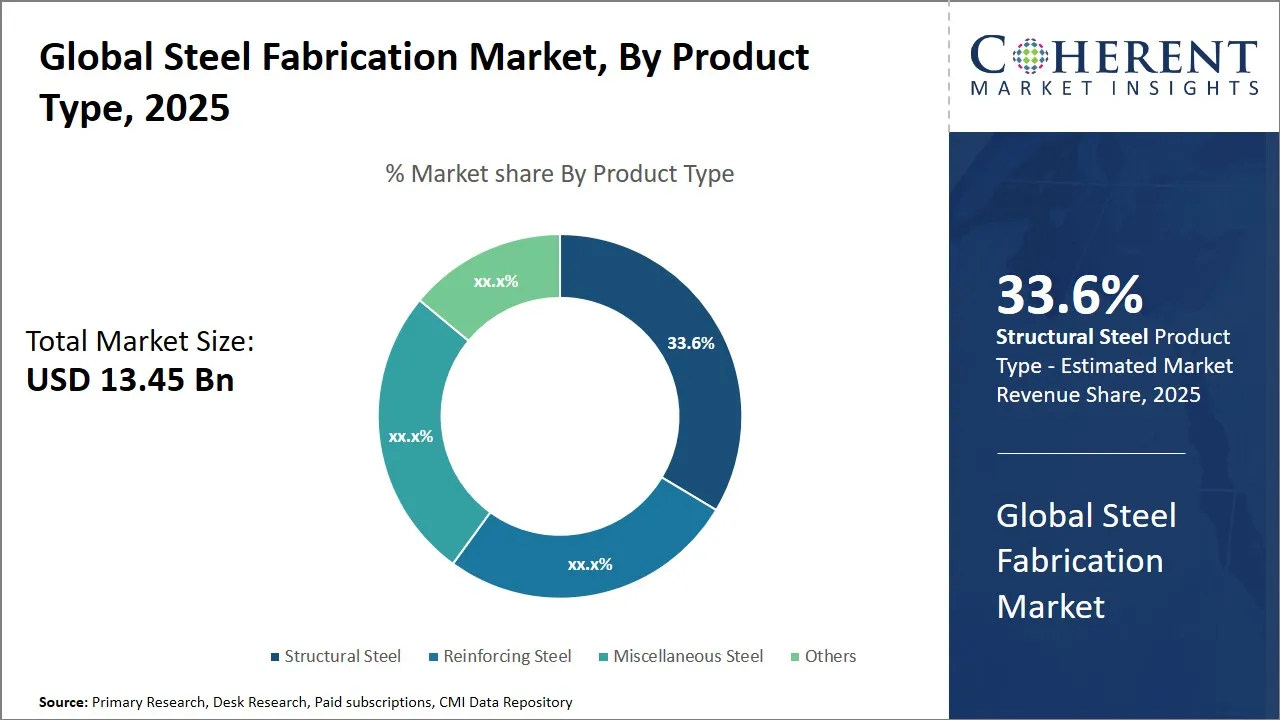
- The structural steel segment is projected to account for 34.6% of the global steel fabrication market share in 2026.
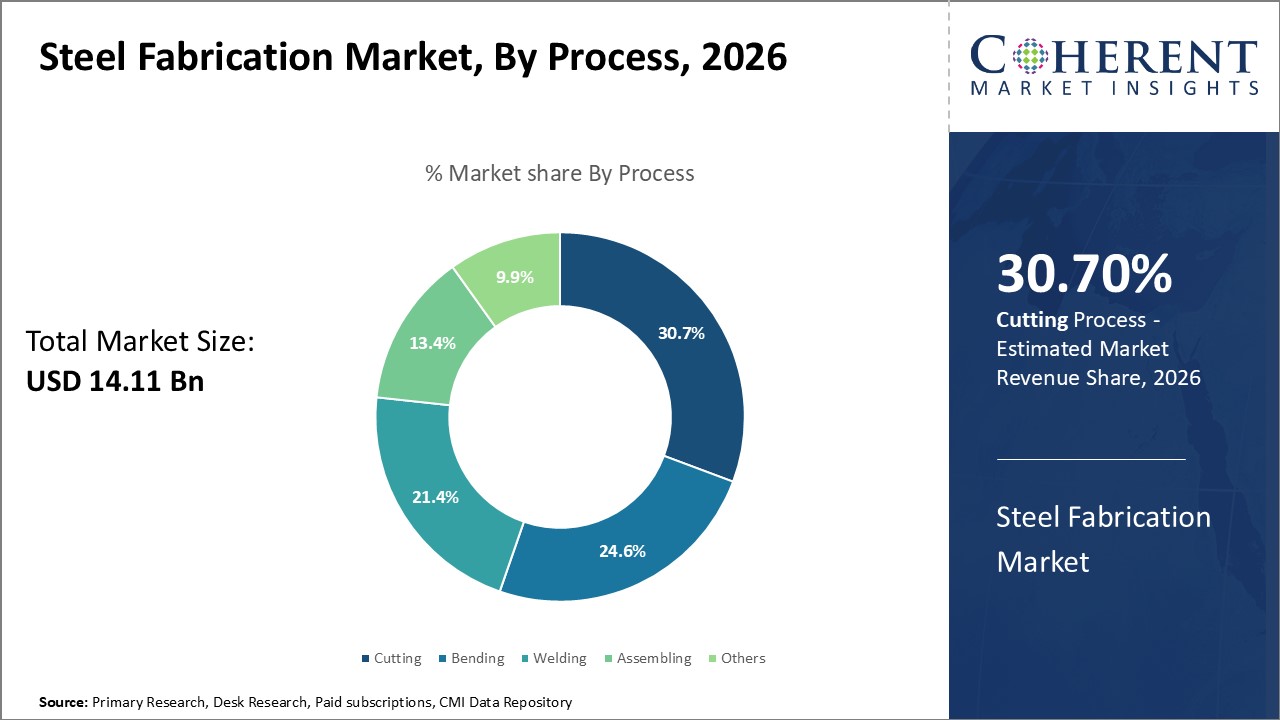
- The cutting segment is expected to hold 30.7% of the global steel fabrication market share in 2026.
- The construction segment is accounts for 32.7% share in 2026.
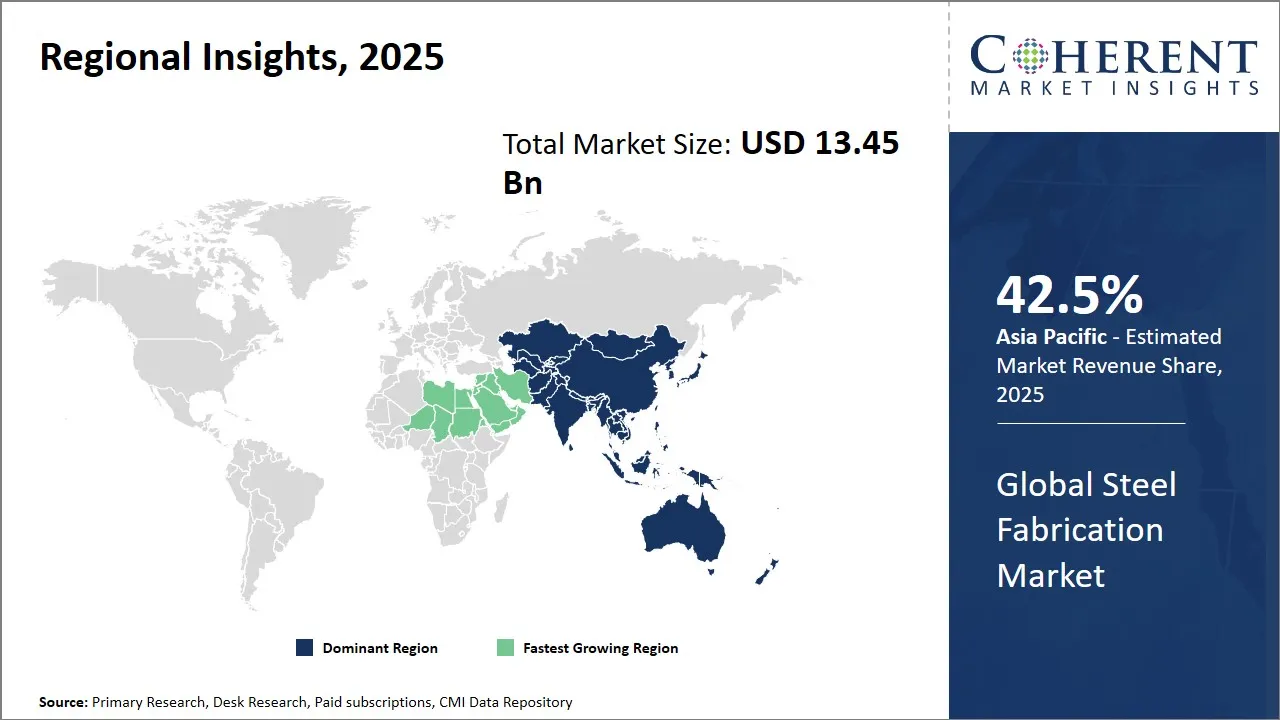
- Asia Pacific is projected to dominate the global steel fabrication market in 2026 with a 42.5% share. The Middle East, with a 19.5% share, will be the fastest-growing region.
Market Overview
Current market trends highlight a shift towards automation and digital integration in steel fabrication processes, enhancing precision and reducing production time. Additionally, sustainable steel production methods and lightweight fabrication materials are gaining traction as industries focus on environmental regulations and cost efficiency. These trends are poised to transform the competitive landscape and fuel innovation across the steel fabrication market.
Current Events and Its Impact
Current Events | Description and its Impact |
U.S. raises steel import tariffs to 50 % under Section 232 |
|
Proposed U.S. “Foreign Pollution Fee Act” (carbon-intensity tariff) |
|
Segmental Insights
- Current Industry Events of 2026
- Market Size Estimation
- Regional Breakdown
- Competitive Landscape
- Customer Intelligence
- Segmental Analysis
- Pricing Analysis
- Key Market Drivers, Challenges & Future Trends
- Customized Insights Section
Steel Fabrication Market Insights, By Product Type - Structural Steel Segment Dominates Driven by Versatility and Fundamental Role in Construction
Structural steel segment is expected to contribute 34.6% share of the global steel fabrication market in 2026, due to its versatility and the necessity in the modern construction and infrastructure projects. Structural steel refers to beams, columns and structures that provide support to the foundation of buildings, bridges and massive infrastructures. The strength to weight ratio of the materials enables the building designers and engineers to construct more high-rise buildings, strong, and less expensive than the conventional materials such as concrete or timber. This has seen structural steel being the choice of construction in urban development, where space and safety are the key factor.
Steel Fabrication Market Insights, By Process – Cutting Segment Dominates Due to Growing Innovation and Precision in Fabrication
Cutting segment is projected to command 30.7% share of the global steel fabrication market in 2026, mostly because of its crucial position in developing the steel fabrications and the unending development of cutting technology. Something that happens first in steel fabrication is that the raw steel is converted into the desired shapes and sizes, which then prepares it to be undergo further processing through either bending or welding. The accuracy and speed of the cutting processes directly influence the quality, fit and finish of fabricated steel products and therefore is a major concern to the manufactures.
Steel Fabrication Market Insights, By End-use Industry – Construction Segment Dominates Fueled by Urbanization and Infrastructure Development
Construction segment is projected to hold 32.7% share in the global steel fabrication market in 2026, driven predominantly by ongoing urbanization and the global emphasis on infrastructure enhancement. The extensive application of steel fabrication in the construction industry is explained by the fact that the material provides structural reliability, low costs and simplicity of construction, which are crucial in addressing the needs of the contemporary urbanization.
Regional Insights
Asia Pacific Steel Fabrication Market Analysis and Trends
The Asia Pacific region is projected to lead the market with a 42.5% share in 2026, due to its well-established manufacturing infrastructure and rapidly expanding industrial sector. The dominance of the regions is enhanced by the fact that the leading steel producing states which include China, Japan, India, and South Korea have large downstream fabrication industries to satisfy the demands of the construction, automotive, shipbuilding and heavy machinery industries.
Other government policies aimed at infrastructure building and modernization of the industry, particularly, Chinas Made in China 2026 plan, Indias Made in China promotion of smart cities and manufacturing development, also stimulate the use of steel fabrication services. This advantage of the regions is supplemented by the well-integrated ecosystem of supply chain with rich sources of raw materials. Some of the top firms like Chinas Baosteel Group, Japan Nippon Steel Corporation and Indias Tata steel have well established fabrication departments which help them grow the industry through innovation and implementation of big scale projects.
Middle East Steel Fabrication Market Analysis and Trends
The Middle East region is expected to exhibit the fastest growth in the market contributing 19.5% share in 2026, driven by heightened infrastructure investments, urbanization, and industrial diversification. The Gulf Cooperation Council (GCC) nations are currently engaging in the diversification of their economies such as the Saudi Arabia Vision 2030, which focuses on the development of industrial zones, transport system and energy projects that require large amounts of steel fabrication services.
The area has the advantage of being strategically geographically placed, which enables trade with Europe, Asia, and Africa and a comparatively young population that makes the housing needs in the urban areas. Despite the fact that the market ecosystem in MEA is not as mature, capacity enhancement is being accelerated by increased foreign direct investments, joint venture and technology transfer agreements with foreign steel fabricators around the world. Strategic players like Emirates Steel (U.A.E.), SABIC (Saudi Arabia), and ArcelorMittal South Africa are strategic participants, growing the fabrication capacity and regional areas penetration.
Global Steel Fabrication Market Outlook for Key Countries
China Steel Fabrication Market Trends
The steel fabrication environment of China is strong, with a foundation of its huge building and infrastructure industry. The leading steel engine producers in the country such as Baosteel and Wuhan Iron and Steel Corporation have vertically integrated fabrication plants, which provide mega construction projects, such as high-speed rail systems and mega urban constructions. Government assistance on self-sufficiency in steel production and fabrication technologies have promoted investments made on automation and smart fabrication methods. The export manufacturing also makes China trade in fabricated steel components at the global market strengthening its leadership role.
U.S. Steel Fabrication Market Trends
The steel fabrication market in the U.S. steel industry is dominated by the presence of a mature fabrication industry that has high technological acceptance and high standards. Nucor Corporation, Steel Dynamics, and AISC (American Institute of Steel Construction) members are among the companies that pioneer the innovation when it comes to customized steel fabrication, which is used in various fields such as aerospace, automotive, and commercial constructions. The steadily growing demand of steel fabrication is being generated by federal infrastructure spending programs and renewable energy projects. Another advantage of the U.S. is an effective regulatory system that promotes sustainable and safety-conforming fabrication standards that improve the credibility of the market.
India Steel Fabrication Market Trends
India steel fabrication market is growing swiftly, propelled by infrastructure expansion, affordable labor costs, and increasing industrialization. Tata Steel and JSW Steel are prominent fabricators playing critical roles in constructing bridges, highways, and industrial plants. Government campaigns focusing on ‘Make in India’ and smart cities development stimulate demand for localized steel fabrication solutions. The country’s growing emphasis on mechanized fabrication techniques along with adoption of international quality standards is attracting foreign collaborations and investment, accelerating market evolution.
Germany Steel Fabrication Market Trends
Germany continues to lead Europe steel fabrication sector, recognized for precision engineering and strong automotive and machinery industries. Corporations such as thyssenkrupp and Salzgitter Gruppe emphasize advanced fabrication technologies and sustainability practices to cater to high-value manufacturing clients. Export-driven fabrication enterprises leverage Germany’s central location and trade agreements within the European Union to expand the market outreach.
Saudi Arabia Steel Fabrication Market Trends
Saudi Arabia’s evolving steel fabrication market is driven by megaprojects in energy, infrastructure, and urban development aiming to diversify away from oil dependency. The government’s Vision 2030 reform strategy underpins heavy investments in industrial cities like NEOM and Red Sea Development, requiring large-scale steel fabrication inputs. Emirates Steel and SABIC’s local fabrication initiatives help reduce import dependence and build regional supply chain resilience.
Macro and Micro Economic Factors Impacting Steel Fabrication Market Growth
Macro-Economic Factors
- Infrastructure and Urbanization: Large investments in construction, smart city projects, and infrastructure upgrades are primary macro drivers. Emerging regions such as Asia-Pacific, the Middle East (GCC), and North America are especially prominent due to national infrastructure initiatives and urban expansion programs.
- Government Policies and Stimulus: Infrastructure stimulus (e.g., the U.S. Infrastructure Investment and Jobs Act) sustains high baseline steel demand and encourages multi-year procurement deals.
- Global Trade Dynamics: Tariffs, trade actions, and supply chain disruptions—particularly involving U.S.-China relations and changes in trade agreements—impact input costs and market access by increasing the volatility of raw material prices and equipment availability.
- Energy Prices and Supply: Fluctuations in global energy costs and the push towards decarbonization influence production expenses and industry investment, affecting profitability and structural shifts within steel markets.
- Regional Demand Divergence: Stronger demand growth in ASEAN and MENA contrasts with stagnant or declining demand in China and developed OECD economies.
- Population Growth and Urban Migration: Continual population growth and migration toward urban areas boost ongoing demand for steel-intensive construction projects and fabricated components.
Micro Economic Factors
- Input Costs and Raw Material Price Volatility: Variable costs for inputs like iron ore, scrap, and energy, plus global and regional fluctuations, affect margin stability for fabricators. This is notably challenging in regions reliant on imports, like the GCC and APAC.
- Technological Innovation: Adoption of advanced fabrication technologies—including CNC machining, prefabrication, AR/VR, and IoT for process automation—raises efficiency and product customization, helping companies differentiate in competitive markets.
- Quality and Safety Standards: Rising emphasis on international safety and quality certification standards increases compliance costs but enhances customer trust for premium segments.
- Production Shifts Toward Sustainability: Growing demand for decarbonized and low-carbon steel has led firms to adopt new production technologies (like EAFs, hydrogen-ready modules, specialist alloys) as end customers and regulators prioritize greener practices.
Market Players, Key Development, and Competitive Intelligence
Key Developments
- In March 2025, Pacific Steel Group (PSG) commenced constructing a steel melting and rolling micro mill in California's Mojave Desert. PSG will transform scrap steel into an annual output of 380,000 tons of rebar and spooled coils.
- In March 2025, ArcelorMittal, Nippon Steel India Private Limited (AM/NS India), a key subsidiary of Nippon Steel Corporation, announced its land acquisition of 2,200 acres in Andhra Pradesh, southern India, to establish an integrated steel mill boasting an annual production capacity of 7 million tons of crude steel.
Top Strategies Followed by Global Steel Fabrication Market Players
- Established Players: The industry is dominated by established companies which heavily invest on research and development (R&D) in order to innovate on high performance steel products that meet the changing demands of the customers. Such companies have focused on developing superior and high level of materials and manufacturing processes that have high levels of durability, strength, and customization features and stand out because of the intense competition in the market.
- For example, Nippon Steel is a firm that undertakes extensive strategic R&D throughout the world making it one of the strongest research engines in steel.
- In mid-level players of the steel fabrication market, the strategy is more focused to a more precise approach which is centered on providing quality and affordability in a balanced approach. By understanding that it is a good idea to serve price-sensitive markets like small firms and medium-sized construction projects, these companies maximize operational efficiencies in order to provide competitive rates without affecting the required standards in performance.
- For example, ArcelorMittal also introduced their XCarb green steel program to create low-carbon fabricated steel, which can be used in infrastructure and automotive products, combining electric arc furnace (EAF) technology and digital fabrication.
- Small-scale steel fabricators carefully cut niches with a focus on more specialized features or new lines of products that satisfy a specific customer need unmet by larger competitors. Such companies are also likely to be responsive and swift to new technologies including automation and digital fabrication techniques, which can help them stay relevant despite their limited resources.
- For example, Civmec introduced an integrated fabrication and assembling of mining and energy projects in Western Australia that achieved the balance between the cost and structural integrity. These companies are aimed at medium-sized construction companies, transportation hubs, and local infrastructural development projects, in which competitiveness in prices and the rapidity of delivery are essential.
Market Report Scope
Steel Fabrication Market Report Coverage
| Report Coverage | Details | ||
|---|---|---|---|
| Base Year: | 2025 | Market Size in 2026: | USD 14.11 Bn |
| Historical Data for: | 2020 To 2024 | Forecast Period: | 2026 To 2033 |
| Forecast Period 2026 to 2033 CAGR: | 4.9% | 2033 Value Projection: | USD 19.72 Bn |
| Geographies covered: |
| ||
| Segments covered: |
| ||
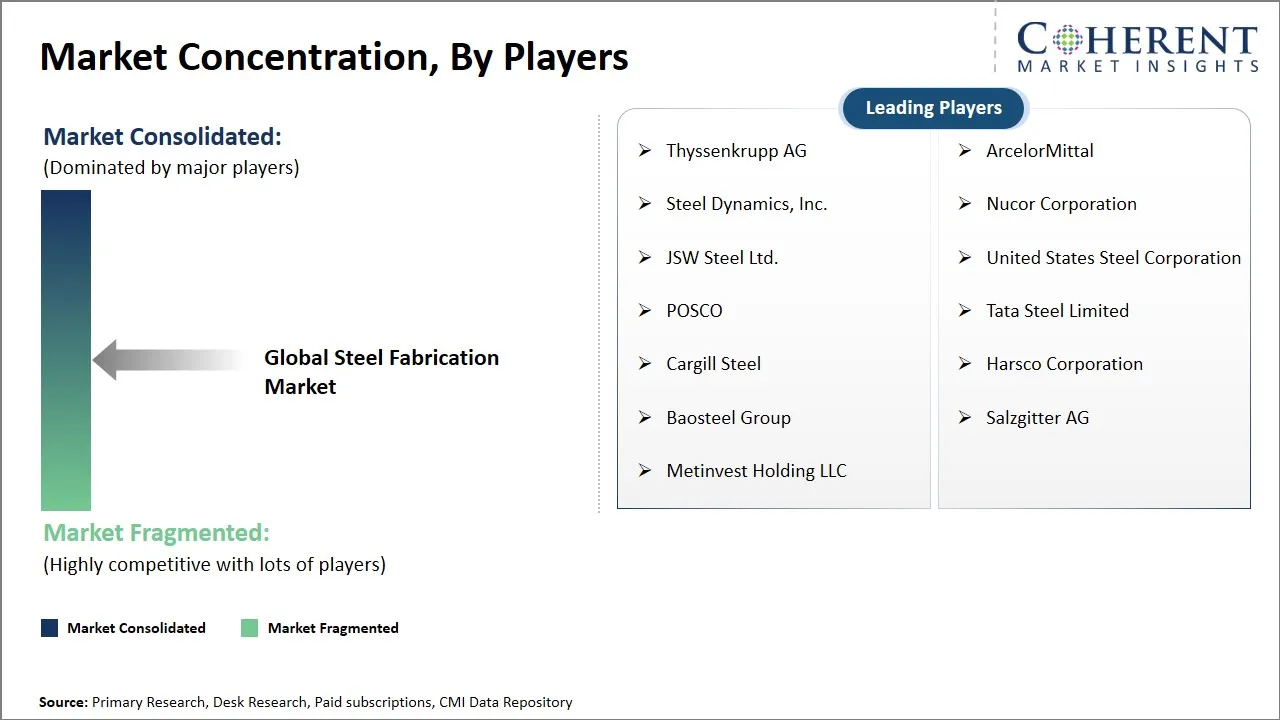
| Companies covered: | Thyssenkrupp AG, ArcelorMittal, Steel Dynamics, Inc., Nucor Corporation, JSW Steel Ltd., United States Steel Corporation, POSCO, Tata Steel Limited, Cargill Steel, Harsco Corporation, Baosteel Group, Salzgitter AG, and Metinvest Holding LLC | ||
| Growth Drivers: |
| ||
| Restraints & Challenges: |
| ||
Steel Fabrication Market Dynamics
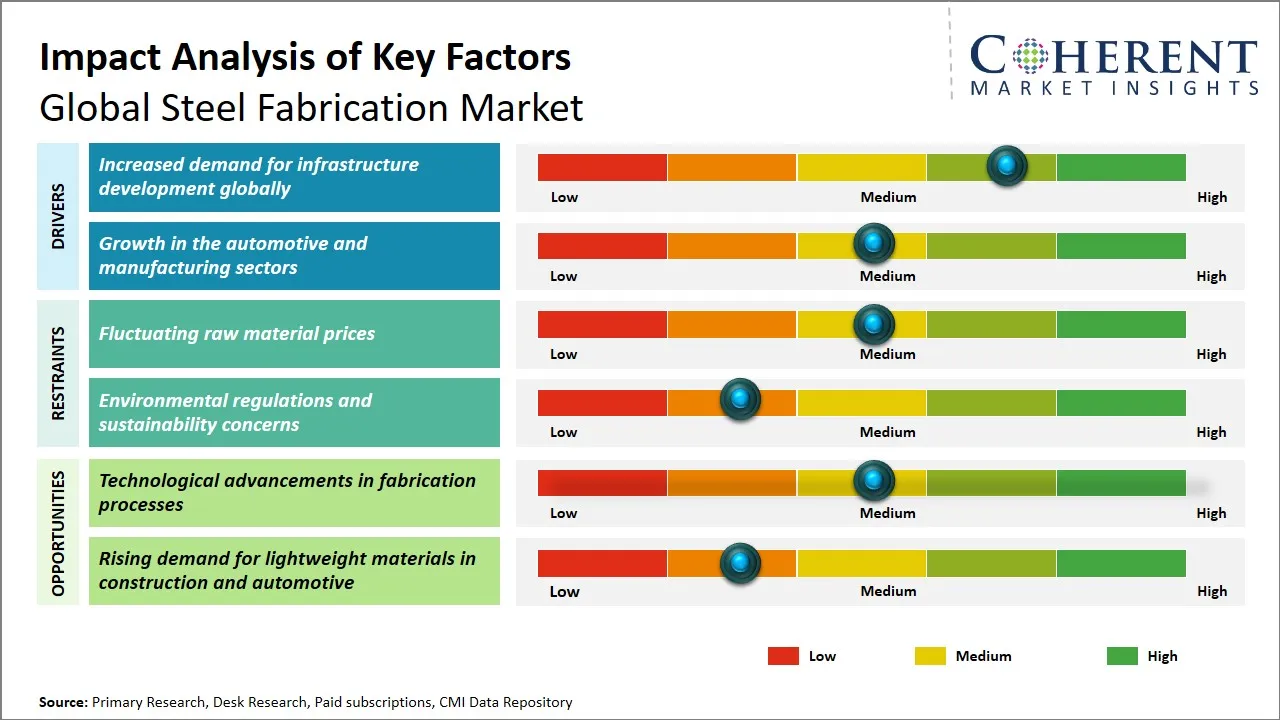
Steel Fabrication Market Driver - Increased Demand for Infrastructure Development Globally
This growing requirement to build strong infrastructures across the world is largely driving the demand of the steel fabrication. In an effort to promote urbanization and economic growth, governments and the business sectors of both emerging and developed economies are laying importance on large scale projects that include transportation networks, commercial complexes, residential buildings and energy facilities. There is no other material that is as strong, durable and flexible in design, as steel fabrication and hence its use in building bridges, highways, railways, and high-rise buildings that are in line with the modern safety and sustainability requirements.
As an example, the highest rail arch bridge in the world is The Chenab Rail Bridge in Jammu & Kashmir. It employed 28,660 tons of steel in its arch construction which has concrete filled steel boxes as stability.
Steel Fabrication Market Opportunity - Technological Advancements in Fabrication Processes
The current technological developments in the fabrication processes have a great potential of benefitting the global steel fabrication market because the new technology is opening a big potential of increased productivity, accuracy, and economic advantage. Automation, robotics, and computer-aided manufacturing (CAM) are all innovation in the fabrication industry that is transforming old techniques of fabrication allowing manufacturers to perform complex designs with higher precision and with shorter lead times. Additive manufacturing (3D printing) is becoming an important technology enabling to produce complex structural steel products with a minimum of waste materials. The further optimization of fabrication workflows by Artificial Intelligence (AI) and Internet of Things (IoT) technologies through real-time monitoring, predictive maintenance, and quality control reduces the downtime and operational costs.
Analyst Opinion (Expert Opinion)
- The steel fabrication market environment in the world is still moving in the path of strong development because of the growing need in infrastructure and the development of construction technologies. The findings of the Steel Innovations Forum (2023) and the Fabricators and Manufacturers Association Conference (2022) shed some light on the current trends, with such firms as Tata Steel and Steel Dynamics being the first to resort to automation and digital fabrication methods.
- The latest move that Tata Steel undertook to purchase robots to provide precision fabrications shows that the company is progressive and thriving in efficiency and minimization of waste. Conferences at these meetings pointed towards the need to be sustainable and manufacturers of fabrics felt the pressure to be environmentally friendly and minimize carbon footprints. Though, the issues like unstable prices of the raw materials and disruptions in the supply chain have been often pointed out as possible obstacles to expansion.
- Firms that are more concentrated on innovation and invest in sustainable business as they adopt digital transformation will probably prosper. Also, competitiveness may be improved through strategic alliances with technology suppliers. Finally, the development of the global steel fabrication market will be premised on the capacity to respond to the dynamic industry requirements, take advantage of the improvements in technology and fulfill the sustainability expectations.
Speak to the analyst
Want personalized insights?
Take the findings above to one of our principal consultants, or have the report rebuilt around the segments, geographies and competitors you actually track.
Market Segmentation
- Product Type Insights (Revenue, USD Bn, 2021 - 2033)
- Structural Steel
- Reinforcing Steel
- Miscellaneous Steel
- Others
- Process Insights (Revenue, USD Bn, 2021 - 2033)
- Cutting
- Bending
- Welding
- Assembling
- Others
- End-use Industry Insights (Revenue, USD Bn, 2021 - 2033)
- Construction
- Automotive
- Aerospace
- Energy
- Others
- Regional Insights (Revenue, USD Bn, 2021 - 2033)
- North America
- U.S.
- Canada
- Latin America
- Brazil
- Argentina
- Mexico
- Rest of Latin America
- Europe
- Germany
- U.K.
- Spain
- France
- Italy
- Russia
- Rest of Europe
- Asia Pacific
- China
- India
- Japan
- Australia
- South Korea
- ASEAN
- Rest of Asia Pacific
- Middle East
- GCC Countries
- Israel
- Rest of Middle East
- Africa
- South Africa
- North Africa
- Central Africa
- North America
- Key Players Insights
- Thyssenkrupp AG
- ArcelorMittal
- Steel Dynamics, Inc.
- Nucor Corporation
- JSW Steel Ltd.
- United States Steel Corporation
- POSCO
- Tata Steel Limited
- Cargill Steel
- Harsco Corporation
- Baosteel Group
- Salzgitter AG
- Metinvest Holding LLC
Sources
Primary Research Interviews
- Production Director – Leading Steel Fabricator (Structural & Modular)
- Operations Manager – Major Infrastructure EPC Company
- Procurement Lead – Large Construction Equipment OEM
- Innovation & Automation Head – Leading Steel Service Center
- Sustainability Officer – International Structural Steel Certification Body
Stakeholders
- Manufacturers
- End-use Sectors
- Construction (Buildings, Bridges, Civil Infrastructure)
- Oil & Gas (Refineries, Rigs, Pipeline Components)
- Power & Energy (Transmission Towers, Renewable Energy Structures)
- Automotive (Frames, Parts, Bodies)
- Industrial Machinery & Heavy Equipment
- Regulatory & Certification Bodies
- E-commerce & Industrial Distribution Platforms
- Automation & Digital Integration Providers (CNC, Robotics, MES, IoT, PLM)
Databases:
- UN Comtrade Database
- India Import Export (EXIM) Database
- U.S. International Trade Commission (USITC) DataWeb
Magazines
- Metal Fabrication News – Steel fabrication industry news and process trends
- Fabricator Magazine – Advances in cutting, welding, bending, and steel finishing
- Construction Week – Structural steel project updates, infrastructure trends
- Steel Times International – Global steel industry developments and market shifts
Journals
- Journal of Constructional Steel Research – Advanced applications and engineering
- Materials Performance – Corrosion, protection, and durability of fabricated steel
- International Journal of Steel Structures – Trends in structural steel fabrication and use
- Welding Journal – New techniques and process efficiency in steel joining
Newspapers
- Financial Times – Infrastructure and construction sector steel trends
- The Economic Times – India steel supply chain, export-import policy
- Global Construction Review – Project pipelines and steel demand outlook
- Nikkei Asia – Steel fabrication in Asia-Pacific regions
Associations
- World Steel Association (worldsteel)
- American Institute of Steel Construction (AISC)
- Steel Fabricators Association of North America (SFAN)
- European Convention for Constructional Steelwork (ECCS)
- Indian Institute of Welding (IIW)
Public Domain Sources
- U.S. Department of Commerce – Steel import monitoring, tariffs, and fabrication policy
- European Commission – Construction Products and Steel Regulation
- Bureau of Indian Standards (BIS) – IS codes for fabricated steel products
- ASTM International – Steel fabrication specifications
Proprietary Elements
- CMI Data Analytics Tool, Proprietary CMI Existing Repository of information for last 8 years.
Get access to 250+ pages report
Every segment, forecast, competitor profile and data table behind the analysis above — available for instant download.
- ESOMAR Member
- ISO 9001:2015 Certified
- D-U-N-S Registered
- GDPR & CCPA Compliant
Missing comfort of reading report in your local language? Find your preferred language:
Transform your Strategy with Exclusive Trending Reports
Frequently Asked Questions
The global steel fabrication market is estimated to be valued at USD 14.11 Bn in 2026 and is expected to reach USD 19.72 Bn by 2033.
Emerging innovations in steel fabrication include automation, robotic welding, AI-driven design optimization, additive manufacturing, and IoT-enabled smart monitoring systems.
The CAGR of global steel fabrication market is projected to be 4.9% from 2026 to 2033.
Increased demand for infrastructure development globally and growth in the automotive and manufacturing sectors are the major factors driving the growth of the global steel fabrication market.
Fluctuating raw material prices and environmental regulations and sustainability concerns are the major factor hampering the growth of the global steel fabrication market.
In terms of product type, the structural steel is estimated to dominate the market revenue share in 2026.
Thyssenkrupp AG, ArcelorMittal, Steel Dynamics, Inc., Nucor Corporation, JSW Steel Ltd., United States Steel Corporation, POSCO, Tata Steel Limited, Cargill Steel, Harsco Corporation, Baosteel Group, Salzgitter AG, and Metinvest Holding LLC are the major players.