

Global N-Hexane Market Size and Share Analysis – Growth Trends and Forecasts (2026-2033)
The N-Hexane Market size is valued at USD 2.81 Bn in 2026 and is expected to reach USD 3.75 Bn by 2033, growing at a compound annual growth rate (CAGR) of 4.2% from 2026 to 2033.
Key Takeaways
- Based on Grade, Oil Extraction Grade n-Hexane holds the largest market share at 43.4%. This is due to its widespread use in the solvent extraction of vegetable oils from seeds like soybeans, sunflower, and canola.
- Asia Pacific dominated the market and accounted for the largest revenue share of 40.80% in 2026. This is due to rapid industrialization coupled with expanding healthcare facilities is expected to fuel the regional market.
Market Overview
The N-Hexane industry is driven by its wide usage as a solvent in various industrial operations, including the processing of edible oils, rubber manufacturing, pharmaceuticals production, and adhesive manufacturing. The need is most severe in the food industry where N-Hexane is utilized as a solvent to remove vegetable oils from seeds like soybeans and canola. Its satisfactory solvency properties, comparatively low price, and high evaporation rate make it the preferred choice for selection in the chemical and manufacturing industries.
In 2026, HexaSol Chemicals launched EcoHex™, an improved form of N-Hexane with increased purity levels and lower volatile organic compound (VOC) emissions, specifically targeted for the pharmaceutical and food processing industries.
Current Events and Its Impact on N-Hexane Market
Current Events | Description and its impact |
U.S. Electronics Maker Reverts Back to N-Hexane for Precise Cleaning |
|
Slovenia Suggests REACH Listing of N ‑ Hexane |
|
Pricing Analysis for N-Hexane Market
N-Hexane prices are influenced by several factors including feedstock prices (principally crude oil and natural gas), domestic supply-demand conditions, environmental regulations, and freight costs. As a petrochemical by-product, N-Hexane's market price is influenced directly by movements in global crude oil prices. Rising crude oil prices over the recent years, supplemented by geopolitical concerns and supply chain disturbances, have driven cost unpredictability in the N-Hexane market.
Geographically, the usage of N-Hexane is dominated by Asia-Pacific, dominated by China and India's massive edible oil processing and rubber sectors. Market prices there are typically lower as production costs are low and there are negligible environmental regulations. Europe and North America, however, have experienced relatively higher prices due to stringent environmental regulation, higher compliance costs, and a need for higher purity grades in pharmaceuticals and food processing.
The pressure to go greener has also affected cost. Firms making investments in cleaner technology and reconstituted solvents, such as low-VOC or food-grade N-Hexane, are passing on the higher production cost to buyers. Logistics problems such as shipping delays and increasing freight costs have also driven global prices upward.
In 2025, prices will remain slightly more stable compared to previous years as a result of improved worldwide supply chains and low crude oil prices. Ongoing regulatory pressures and rising demand for specialty-grade hexane can, however, sustain a modest increasing pattern in pricing, especially within high-purity application segments including drugs and food extraction.
- Current Industry Events of 2026
- Market Size Estimation
- Regional Breakdown
- Competitive Landscape
- Customer Intelligence
- Segmental Analysis
- Pricing Analysis
- Key Market Drivers, Challenges & Future Trends
- Customized Insights Section
Role of Latest Technologies in N-Hexane Market
Technological innovation is at the forefront of reshaping the N-Hexane market into a more efficient, clean, and green industry. One of the most significant innovations is the integration of sophisticated distillation and purification technologies, which allow manufacturers to create high-purity N-Hexane for high-requirements applications in the pharmaceutical and food sectors. Such technologies have little or no residue and impurities and pass strict regulatory and safety tests.
Catalytic reforming and isomerization processes have also emerged with the capability of producing N-Hexane with optimized yield and reduced energy consumption. Advanced process automation and computerized control systems further improve operational efficiency, reduce human error, and lower production costs. Predictive maintenance and real-time monitoring technologies help to maintain minimum downtime, enhance plant reliability and throughput.
Another critical technology trend is the development of environmentally friendly manufacturing processes. Companies are spending capital on low-emission technologies and solvent recovery units to comply with volatile organic compound (VOC) legislation, particularly in Europe and North America. Bio-based alternatives to conventional hexane are also being researched, with the aim of offering sustainable alternatives without compromising performance.
For example, GreenChem Industries introduced a semi-synthetic mixture of N-Hexane in 2025 from bio-feedstocks coupled with advanced molecular refining techniques. This innovation paved the way for a shift toward greener solvent options without compromising industrial utility.
The acceptance of the latest technologies in the N-Hexane sector ensures product quality enhancement, allows regulatory compliance, enhances cost-effectiveness, and paves the way for more environmentally friendly production and usage practices. These technological advancements are crucial for competing and catering to evolving consumer and environmental needs.
N-Hexane Market Drivers
- Widely used as solvent in industrial cleaning and degreasing applications
N-Hexane is increasingly being used as an effective solvent in industrial cleaning and degreasing processes across many industries. Its low cost and evaporation properties make it suitable for removing oils, greases, dirt, and other impurities from metal parts during manufacturing.
N-hexane providers are actively promoting its cleaning capabilities. Major players have successfully demonstrated to key industries how using n-hexane can help achieve superior degreasing performance compared to alternatives, thereby improving production efficiency.
In 2024, a leading U.S.-based automotive parts manufacturer adopted high-purity n-hexane as the primary solvent for degreasing engine and transmission components. The switch was made to improve cleaning efficiency on high-precision metal parts used in electric vehicle (EV) assemblies.
- Growing consumption in adhesive production
The use of adhesives in various end-use industries has seen tremendous growth in the past few years. Adhesives are increasingly being used for bonding different types of materials together in applications ranging from construction to automotive sector.
N-hexane plays a crucial role as a key ingredient in the production of many adhesives that are popularly used across different industries. The higher consumption of adhesives driven by increased infrastructure development and automotive production has led to a rise in the demand for N-hexane as well.
Many countries are undertaking large public infrastructure projects such as bridges, roads, rail networks, etc. to boost economic recovery. This has augmented the use of adhesives for applications like gluing beams together, flooring, etc., thereby raising the requirement for N-hexane in adhesive production.
N-Hexane Market Opportunities
- Focus on developing bio-based and eco-friendly hexane products
The demand for more sustainable and environment-friendly products has been steadily increasing across many industries. The N-hexane market is well positioned to capitalize on this trend by innovating new bio-based and eco-friendly hexane products.
Hexane is widely used as an extraction solvent for edible oils from plants and seeds. However, traditional hexane is produced from petroleum sources and poses hazards to human health and the environment if not handled properly. Developing bio-based hexane extracts sourced from renewable feedstock such as agricultural waste could provide a greener alternative for the food industry that aligns with consumers growing demand for sustainable options.
Investing in R&D to create bio-based hexane products extracted from crops already in production would allow hexane manufacturers to tap into existing biomass resources. For instance, according to the U.S. Department of Agriculture (USDA), U.S. farmers produce over 700 million tons of corn stover and wheat straw annually, but only a small fraction of this feedstock is currently utilized.
- Potential in emerging economies owing to industrialization
Emerging economies across Asia pacific, Africa, and Latin America are expected to see significant industrialization and infrastructure development over the next decade. Countries like India, Bangladesh, Indonesia, Egypt, Vietnam, and others are making large investments and policy pushes to boost their manufacturing sectors.
As industrial activities proliferate across sectors in the developing world, the need for specialized chemicals in various manufacturing processes will also increase rapidly. N-hexane extracts are extensively used as thinners in the paints, coatings, and inks industries. With more factories, plants and construction sites coming up, consumption of these end-use products and thereby N-hexane extracts is projected to have strong growth trajectories over the medium term.
Countries like India have launched ambitious programs to boost domestic manufacturing like 'Make in India'. Successful implementation of these state-led initiatives will pull massive investments in setting up new production facilities for diverse industries over the coming years. This is likely to create sustained demand drivers for industrial intermediaries and inputs like N-hexane in these emerging markets.
For instance, according to the Indian government data, India aims to raise the manufacturing sector's contribution to 25% of the GDP by 2025 from the current 15-16% through initiatives like the Make in India program and production linked incentives.
N-Hexane Market Trends
- Strategic alliances between manufacturers and end users
Strategic alliances between N-hexane manufacturers and end-user industries are having a significant impact on the market. Many manufacturing companies are forming partnerships with companies that consume N-hexane as a feedstock or solvent. This allows both parties to gain insight into each other's operations and needs.
As a result, manufacturers are better able to tailor their product offerings and production processes to meet the specifications required by end users. For example, pharmaceutical manufacturers have been collaborating with N-hexane suppliers to develop purer, more consistent grade products that ensure quality and safety standards are met for drug applications. This type of collaboration leads to mutual benefit as manufacturers improve products and end users to secure a reliable supply customized for their processes.
- Technological innovations in hexane production processes
Technological innovations in hexane production processes are having a significant impact on the N-hexane market. Traditionally, n-hexane has been produced primarily through the hydrocarbon cracking of petroleum refining products. However, newer technologies are now enabling alternative production methods that are more sustainable and efficient.
One such innovative process being adopted by some major manufacturers involves the catalytic reforming of vegetable oils. Through specialized catalysts and conditions, long-chain alkanes derived from palm or corn oil can be converted to produce n-hexane on an industrial scale. Not only does this provide a renewable source for the compound, it also reduces greenhouse gas emissions compared to traditional refinery methods.
Another significant technological advancement impacting the market is the development of bio-based anaerobic fermentation techniques. Recent research studies from the National Renewable Energy Laboratory showed certain bacteria are capable of producing n-hexane and other short-chain alkanes when breaking down biomass substrates. Some companies are now commercializing this bio-engineered process as a means for sustainable hexane manufacturing.
Segmental Insights
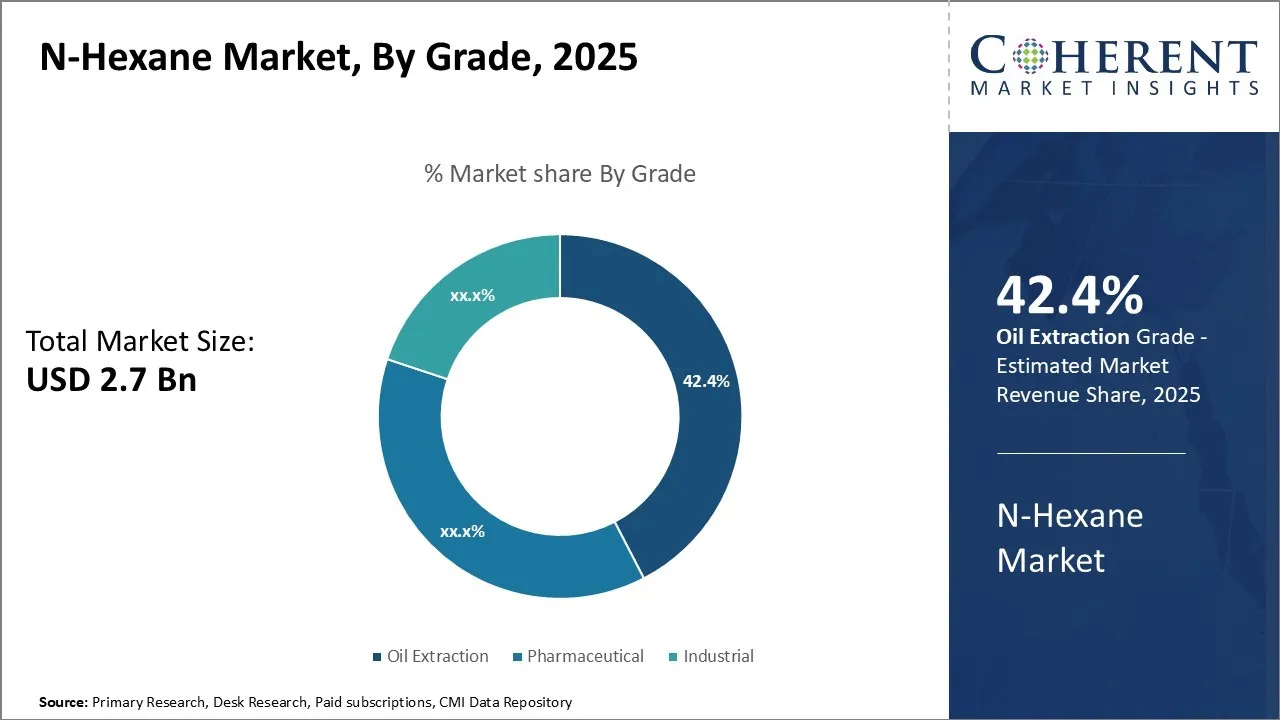
N-Hexane Market Share Insights, By Grade
Oil Extraction Grade n-Hexane holds the largest market share at 43.4% due to its widespread use in the solvent extraction of vegetable oils from seeds like soybeans, sunflower, and canola. This grade offers high purity and excellent solvency, making it ideal for efficient oil recovery. Its low boiling point allows for easy removal from the final product, ensuring food safety.
Growing global demand for edible oils, especially in Asia-Pacific, continues to drive its dominance. Additionally, cost-effectiveness and regulatory approvals in many regions support its large-scale industrial use.
N-Hexane Market Regional Insights
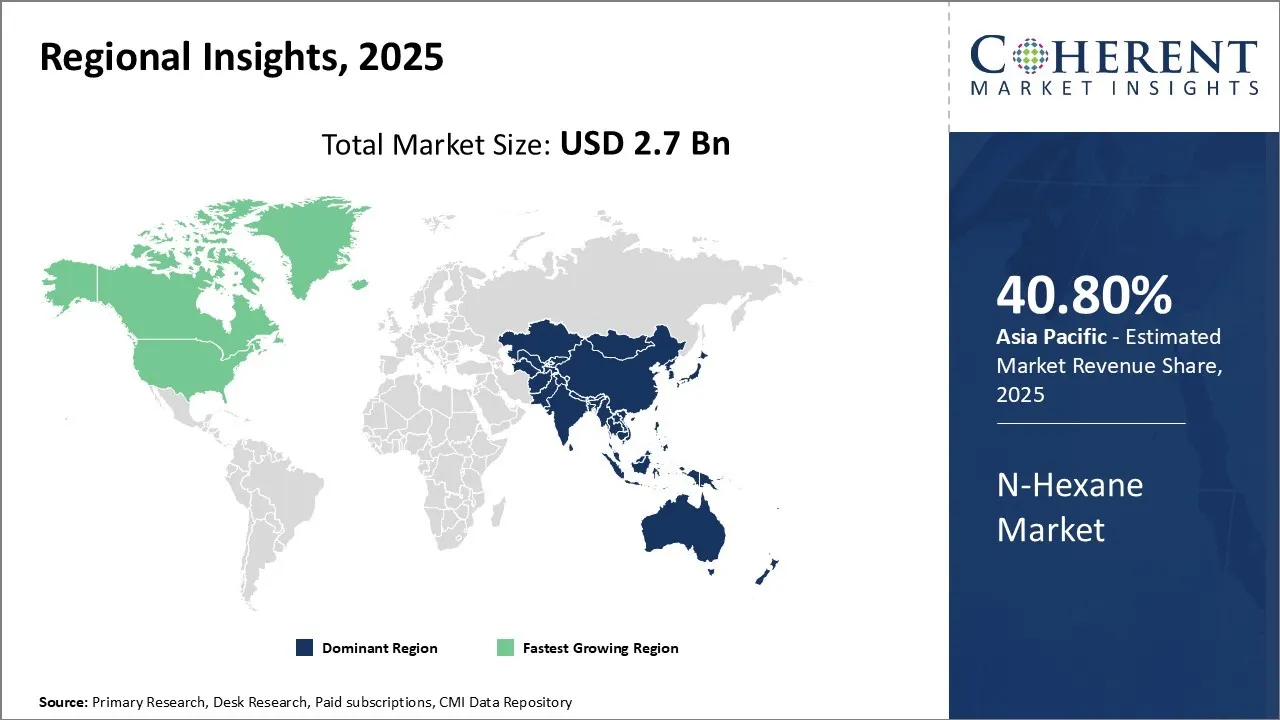
- Asia Pacific dominated the market and accounted for the largest revenue share of 40.80% in 2026. Increasing demand from the extraction application is expected to foster the market growth over the forecast period. Rapid industrialization coupled with expanding healthcare facilities is expected to fuel the regional market. The Asia Pacific dominated the global N-Hexane Market owing to the rising economies in countries such as India, China, and South Korea. In addition, various industry players are venturing into the region on account of factors such as political support and low labor cost.
- North America market is expected to grow at a CAGR of 3.56 % over the forecast period on account of dwindling industrial production and high penetration of hexane applications in various industries such as food industry, pharmaceuticals, chemical industry, and rubber processing. The North American N-Hexane Market is perceiving restrained progress on expenses of deteriorating industrial production and high penetration consequently leading to a comparatively established economy.
N-Hexane Market – Dominating Countries
China N-Hexane Market Analysis and Trend
China is the largest producer and consumer of N-Hexane, encouraged by its gigantic edible oil extraction industry and expanding industrial base. China's low-cost manufacturing base, strong demand within the food processing sector, and rapidly expanding pharmaceutical manufacturing make it a dominant market force globally.
India N-Hexane Market Analysis and Trend
India is one of the most likely to succeed with its enormous vegetable oil industry, which relies heavily on N-Hexane for extraction. Growing industrialization, growing pharmaceuticals industry, and increasing food product exports further enrich the country with increased N-Hexane demand.
United States N-Hexane Market Analysis and Trend
The American market is dominant with strong demand for high-purity N-Hexane for pharmaceutical, adhesives, and n-Hexane usage in laboratories. Stringent environmental regulations have spurred investments in cleaner technologies and solvent recovery systems, making the market more specialized and value-added.
Germany N-Hexane Market Analysis and Trend
As one of Europe's biggest bases for manufacturing chemicals, Germany is located at the core of the market for N-Hexane, especially for applications in specialty chemicals and drugs. The country's regulatory climate is forcing innovation in low-VOC and eco-friendly N-Hexane products.
Market Report Scope
N-Hexane Market Report Coverage
| Report Coverage | Details | ||
|---|---|---|---|
| Base Year: | 2025 | Market Size in 2026: | USD 2.81 Bn |
| Historical Data for: | 2020 To 2024 | Forecast Period: | 2026 To 2033 |
| Forecast Period 2026 to 2033 CAGR: | 4.2% | 2033 Value Projection: | USD 3.75 Bn |
| Geographies covered: |
| ||
| Segments covered: |
| ||
| Companies covered: | ExxonMobil Corporation, Royal Dutch Shell PLC, Indian Oil Corp. Ltd., Chevron, Phillips Chemical Company LLC, Bharat Petroleum Corp. Ltd., Rompetrol Rafinare S.A., Hindustan Petroleum Corporation Limited, Dongying Liangxin petrochemical company, Liaoning Yufeng Chemical Co., Ltd., DHC Solvent Chemie GmbH, and Sak Chaisidhi Company Limited | ||
| Growth Drivers: |
| ||
| Restraints & Challenges: |
| ||
Recent Developments
- In May 2024, Chandra Asri Capital and Glencore formed CAPGC Pte Ltd to acquire Shell’s stake in the Singapore Energy & Chemicals Park, securing significant n-hexane production and distribution assets—strengthening Southeast Asia’s solvent supply infrastructure.
- In 2024, Bharat Petroleum Corporation Limited (BPCL) expanded the production capacity of its industrial-grade hexane to serve increasing local demand in food processing and industrial cleaning applications to minimize import dependence and aid India's booming edible oil extraction industry.
Analyst View
- The market for N-hexane illustrates strong fundamentals underpinned by its imperative position as an extractant in vegetable oil processing and industrial uses. A key growth driver comes from the growing food processing industry, especially in emerging economies, and there is increased adoption of hexane-based extraction processes by manufacturers for higher efficiency in oil yields. Increasing demand from the pharmaceuticals and adhesives industries further improves market prospects since N-hexane's high dissolving capabilities make it absolutely essential for many chemical processes.
- But strict environmental regulations prove to be a major hindrance, as N-hexane's status as a hazardous air pollutant has led the regulatory agencies to enforce stringent emission levels. Health hazards arising from long-term exposure and possible neurological impacts present additional market constraints, compelling manufacturers to spend a lot of money on safety gear and workplace protection systems.
- Asia-Pacific accounts for the majority in the marketplace, owing to high industrialization rates, increasing agricultural processing capacities, and cheap manufacturing facilities. Consumption trends are led by countries such as China and India, with high edible oil production and increasing chemical production industries.
- Growing opportunities exist in creating environmentally friendly substitutes and using advanced recovery systems with reduced environmental footprint but efficient operations. Growing emphasis on sustainable extraction technologies offers market transformation potential, inviting innovation in recycling technologies and cleaner production methods. Strategic collaborations between chemical producers and end-user industry businesses can open up novel application fields, especially in developing countries where industrialization is still fast-tracking.
Market Segmentation
- N-Hexane Market, By Grade (Revenue, USD Bn, 2021 - 2033)
- Oil Extraction,
- Pharmaceutical
- Industrial
- N-Hexane Market, By Application (Revenue, USD Bn, 2021 - 2033)
- Oil Extraction
- Polymerization
- Pharmaceutical
- Adhesives & Sealants
- Industrial Cleaning
- Degreasing,
- Rubber Processing
- Others
- N-Hexane Market, By Region (Revenue, USD Bn, 2021 - 2033)
- North America
- U.S.
- Canada
- Latin America
- Brazil
- Argentina
- Mexico
- Rest of Latin America
- Europe
- Germany
- U.K.
- Spain
- France
- Italy
- Russia
- Rest of Europe
- Asia Pacific
- China
- India
- Japan
- Australia
- South Korea
- ASEAN
- Rest of Asia Pacific
- Middle East
- GCC Countries
- Israel
- Rest of Middle East
- Africa
- South Africa
- North Africa
- Central Africa
- North America
- Top Companies in the N-Hexane Market
- ExxonMobil Corporation,
- Royal Dutch Shell PLC
- Indian Oil Corp. Ltd.
- Chevron
- Phillips Chemical Company LLC
- Bharat Petroleum Corp. Ltd.
- Rompetrol Rafinare S.A.
- Hindustan Petroleum Corporation Limited
- Dongying Liangxin petrochemical company
- Liaoning Yufeng Chemical Co. Ltd.
- DHC Solvent Chemie GmbH
- Sak Chaisidhi Company Limited
Sources
Primary Research Interviews
- Chemical manufacturers and producers
- Oil extraction equipment suppliers
- Pharmaceutical and food processing companies
- Industrial solvent distributors
- Others
Databases
- Chemical Industry Database (CID)
- Global Trade Information Services (GTIS)
- Petrochemical Market Intelligence Database
- Industrial Solvents Database
- Others
Magazines
- Chemical Engineering Magazine
- Hydrocarbon Processing Magazine
- Chemical Week Magazine
- Industrial Chemistry Magazine
- Others
Journals
- Journal of Chemical Engineering
- Industrial & Engineering Chemistry Research
- Chemical Industry Journal
- Others
Newspapers
- Chemical Industry News
- Petrochemical Times
- Industrial Chemical Reporter
- Global Chemical News
- Others
Associations
- American Chemistry Council (ACC)
- International Council of Chemical Associations (ICCA)
- Chemical Manufacturers Association
- Petrochemical Industry Association
- Others
Public Domain Sources
- U.S. Environmental Protection Agency (EPA)
- European Chemicals Agency (ECHA)
- International Labour Organization (ILO)
- World Health Organization (WHO)
- Others
Proprietary Elements
- CMI Data Analytics Tool
- Proprietary CMI Existing Repository of information for last 8 years
*Definition: N-hexane is an organic compound and a straight-chain alkane with six carbon atoms, having the molecular formula C6H14. It is a colorless liquid with a petroleum-like odor, less dense than water, and insoluble in water. Its boiling point is approximately 69 °C (156 °F). N-hexane is widely used as a cheap, relatively safe, largely unreactive, and easily evaporated non-polar solvent, and modern gasoline blends contain about 3% hexane. It is also used as a denaturant for alcohol, cleaning agents in the textile, furniture, and leather industries, and in the printing industry.
Get access to 250+ pages report
Every segment, forecast, competitor profile and data table behind the analysis above — available for instant download.
- ESOMAR Member
- ISO 9001:2015 Certified
- D-U-N-S Registered
- GDPR & CCPA Compliant
Missing comfort of reading report in your local language? Find your preferred language:
Transform your Strategy with Exclusive Trending Reports
Frequently Asked Questions
The N-Hexane Market size is estimated to be valued at USD 2.81 Bn in 2026, and is expected to reach USD 3.75 Bn by 2033.
Availability of substitutes like sodium hydroxide and isopropyl alcohol and Health hazards associated with n-hexane are some factors that can hamper the growth of the market.
Used as solvent in industrial cleaning and degreasing applications and growing consumption in adhesive production are some factors driving the market growth over the forecast period.
The oil extraction segment accounted for the largest share of the N-Hexane industry.
ExxonMobil Corporation, Royal Dutch Shell PLC, Indian Oil Corp. Ltd., Chevron, Phillips Chemical Company LLC, Bharat Petroleum Corp. Ltd., Rompetrol Rafinare S.A., Hindustan Petroleum Corporation Limited, Dongying Liangxin petrochemical company, Liaoning Yufeng Chemical Co., Ltd., DHC Solvent Chemie GmbH, and Sak Chaisidhi Company Limited are some of the major key players operating in the global market.
Yes, n-Hexane is used as a solvent in coatings and paints due to its excellent solvency and fast evaporation properties.
Yes, upcoming regulatory changes—such as the EU’s proposal to classify n-Hexane as a Substance of Very High Concern (SVHC)—could restrict its use and impact market dynamics.