

Aluminum Extrusion Market Analysis & Forecast: 2026-2033
Aluminum Extrusion Market is estimated to be valued at USD 1,00,731.9 Mn in 2026 and is expected to reach USD 1,67,228.0 Mn in 2033, exhibiting a compound annual growth rate (CAGR) of 5.1% from 2026 to 2033.
Key Takeaways
- Based on Type, the Mill-Finished Aluminium Extrusions segment is expected to dominate the market, holding 50.1% share in 2026 owing to their cost-effectiveness, wide availability, and suitability across diverse applications.
- Based on Shape, the Angles, Channels, and Beams segment acquires the dominant share.
- Based on Alloy Type, the 6000 Series Aluminum Alloy segment holds the largest aluminum extrusion market.
- Based on Process, the Hot Extrusion segment dominates the overall market.
- Based on End-use Industry, the Construction and Infrastructure segment acquires the most prominent share.
- Based on Region, Asia Pacific is projected to lead the global aluminium extrusion market in 2026, fuelled by rapid industrialization, urbanization, and strong demand from automotive, construction, and electrical industries.
Market Overview
The aluminium extrusion market is witnessing robust growth, driven by rising demand in automotive, construction, and machinery sectors. Expanding applications in electrical, energy, and industrial equipment are fuelling market adoption. North America holds a significant share due to strong industrial infrastructure and technological advancements, while Asia Pacific leads in industrialization and urbanization. Innovations in product finishing, lightweight materials, and supportive government policies are expected to further propel global market growth.
Current Events and Its Impact
Current Events | Description and its impact |
Sustainable Manufacturing & Eco-Friendly Production |
|
AI-Powered Process Optimization in Extrusion Manufacturing |
|
Rising Demand for Lightweight Automotive & EV Applications |
|
Technological Innovation in Aluminum Extrusion Market
Technological advancements in aluminium extrusion have significantly enhanced efficiency, precision, and product quality across the industry. Innovations such as high-speed billet extrusion, advanced die design, automation, and real-time process monitoring have streamlined operations while reducing energy consumption and material waste. The integration of AI and IoT technologies allows for predictive maintenance and improved process control, ensuring consistent output and reduced downtime.
Vedanta Aluminium Business, India’s leading producer of aluminium and value-added products, has introduced High-Speed Billets tailored for the global extrusion industry. The launch took place during a virtual event attended by members of the downstream and extrusion sectors. During the event, the company's global billet extrusion experts also highlighted various initiatives under its Customer Technical Service cell, aimed at delivering an exceptional customer experience.
- Current Industry Events of 2026
- Market Size Estimation
- Regional Breakdown
- Competitive Landscape
- Customer Intelligence
- Segmental Analysis
- Pricing Analysis
- Key Market Drivers, Challenges & Future Trends
- Customized Insights Section
Segmental Insights
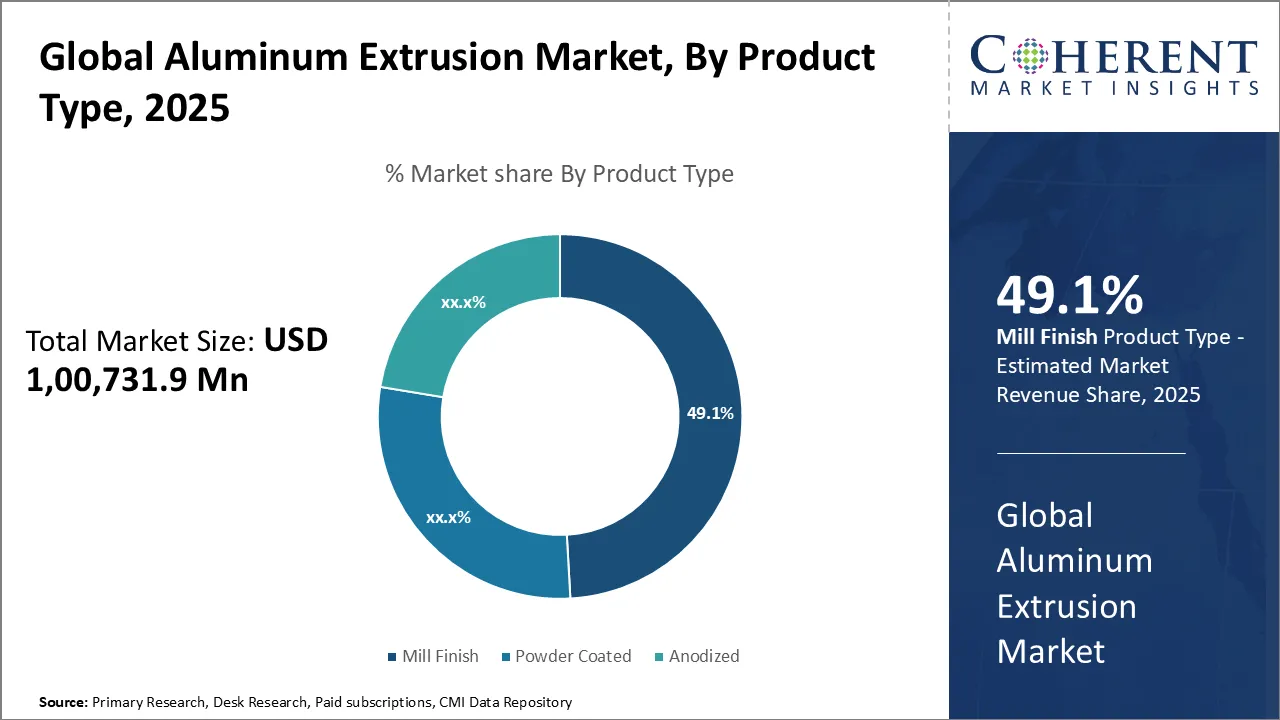
Aluminium Extrusion Market Insights, by Product Type – Mill-Finished Extrusions Lead Due to Cost-Effectiveness and Versatility Across Automotive, Construction, and Machinery Applications.
In terms of product type, mill-finished aluminium extrusions held the largest share of 50.1% in 2026, supported by their affordability, wide availability, and adaptability across automotive, construction, and machinery sectors. Their simple processing requirements and suitability for both structural and functional applications make them the preferred choice. Growing adoption in mass-market applications is expected to reinforce demand for mill-finished extrusions.
In June 2025, Constellium announced trials of lightweight aluminum alloys and expanded recycling initiatives aimed at strengthening its position in future single-aisle aircraft programs. The company emphasized that advanced alloys and friction stir welding could deliver up to 20% weight savings in aircraft wings, while its recycling processes save up to 95% in energy compared to primary aluminum.
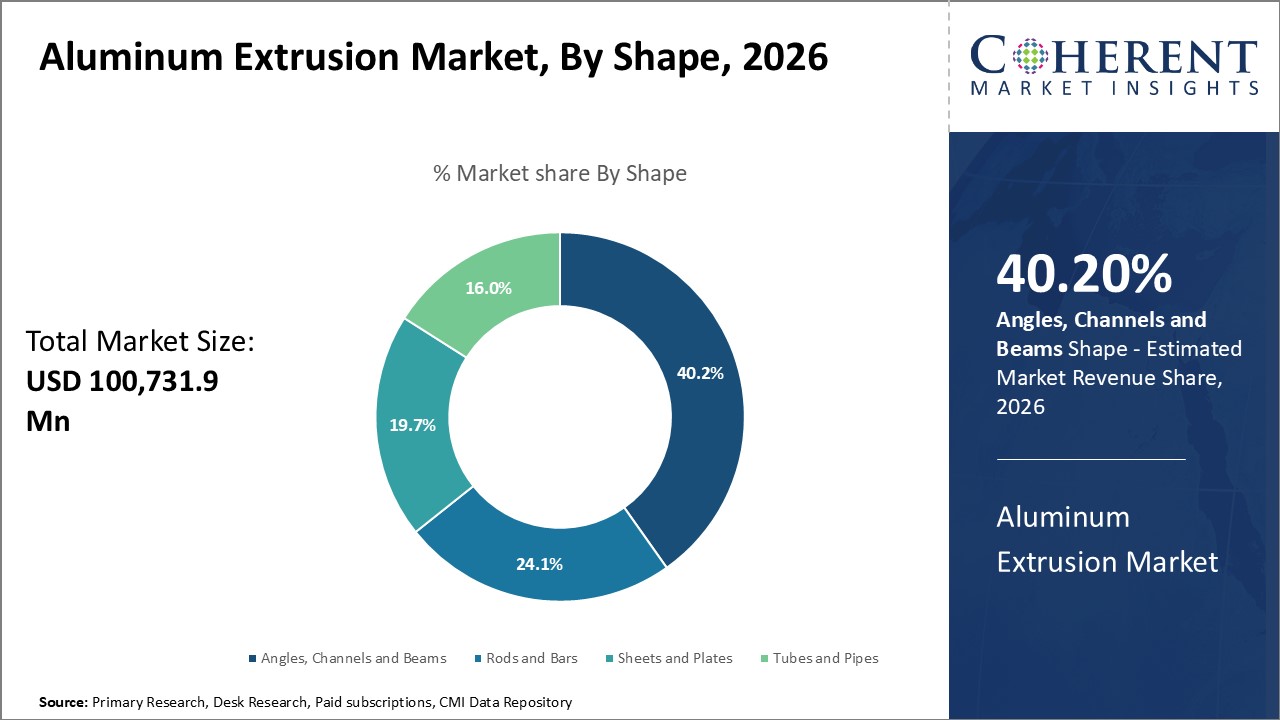
Aluminium Extrusion Market Insights, By Shape - Extension use in Structural and Architectural application Drives the growth for Angles, Channels and Beams
In terms of shape, the angles, channels and beams segment is expected to hold he largest share of the market in 2026, as they serve as the backbone for structural and architectural applications. Their strength, durability, and lightweight properties make them indispensable in construction and infrastructure projects, including residential complexes, commercial buildings, bridges, and industrial facilities. These shapes provide load-bearing capacity, stability, and ease of assembly, which reduces construction time and costs.
Moreover, aluminum extrusions in these forms are corrosion-resistant and recyclable, aligning with the growing emphasis on sustainable and green building practices. With governments pushing for smart cities, metro expansions, and large-scale infrastructure investments, the demand for angles, channels, and beams continues to dominate over other extrusion profiles like rods or tubes.
For instance, in January 2025, HIWIN introduced a new closed, stiffened aluminum extrusion for its HB bridge-axes, engineered to deliver exceptional bending and torsional resistance in high-precision dynamic applications. The linear module supports payloads up to 350 kg and offers ten times the torsional stiffness of standard table axes.
Aluminium Extrusion Market Insights, By Alloy Type - 6000 Series Aluminum Alloy Dominance is Driven by Its Exceptional Balance Of Strength, and Corrosion Resistance
In terms of Alloy Type, the 6000 Series Aluminum Alloy segment is expected to capture the highest market share in 2026, due to its exceptional balance of strength, corrosion resistance, machinability, and weldability. Comprising mainly of magnesium and silicon, this series (especially alloys like 6061 and 6063) offers excellent extrudability, making it ideal for producing complex shapes and profiles used across diverse industries.
In the construction and infrastructure sector, 6000 series extrusions are widely used in window frames, curtain walls, roofing, bridges, and structural components because of their durability and ability to withstand harsh environments. In automotive and aerospace, their lightweight yet strong properties contribute to vehicle weight reduction, improved fuel efficiency, and structural reliability. Moreover, the alloy’s surface finishing quality makes it suitable for architectural applications where aesthetics is critical.
Aluminium Extrusion Market Insights, By Process - Hot Extrusion Segment Dominates As it unables Production of Complex and Large Cross-section Profiles
In terms of process, the hot extrusion segment is expected to hold the greatest share of the market in 2026, as it enables the production of complex and large cross-sectional profiles with excellent surface finish and mechanical properties. The process involves heating aluminum billets to high temperatures, which reduces their resistance to deformation and allows manufacturers to shape them into intricate designs that are difficult to achieve with cold extrusion or machining.
This makes hot extrusion particularly important for industries such as construction and infrastructure (for window frames, curtain walls, and structural components), automotive (lightweight chassis, crash management systems), and aerospace (aircraft fittings and structural parts). Additionally, hot extrusion supports high-volume production while maintaining uniformity and strength, meeting the rising demand for lightweight yet durable materials in sustainability-driven markets.
Aluminium Extrusion Market Insights, By End-Use Industry - Construction and Infrastructure Segment Acquires the dominant share
In terms of end-use industry, the construction and infrastructure segment is expected to contribute the maximum share of the market in 2026, as aluminium offers a unique mix of lightweight strength, durability, and corrosion resistance, making it highly suitable for modern building applications. Rapid urbanization and increasing investments in residential, commercial, and public infrastructure projects are fueling demand. Aluminium extrusions are widely used in window frames, curtain walls, roofing systems, bridges, flyovers, and tunnels, where their design flexibility and ability to support energy-efficient construction provide a significant advantage.
For instance, in June 2025, Jindal Aluminium inaugurated a state-of-the-art, eco-friendly powder coating facility aimed at enhancing its offerings for architectural and industrial applications. The facility boasts a daily coating capacity of up to 25 metric tonnes and utilizes advanced GEMA Swiss spray guns for uniform application. Employing non-chromate pre-treatment and sealed environments, the process minimizes toxic chemical use, ensuring environmental safety. The plant supports extrusions up to 7.5 meters and offers a range of finishes, including glossy, matte, and metallic.
Regional Insights
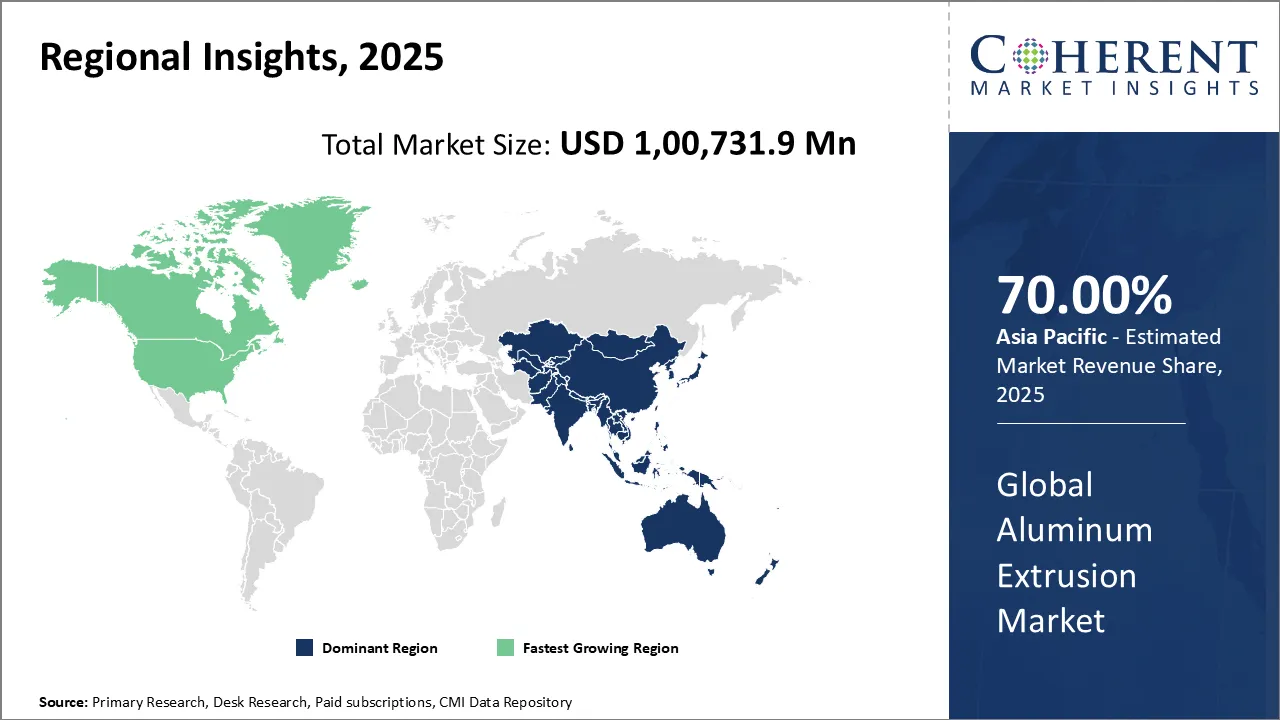
Asia Pacific Aluminum Extrusion Market Trends
Asia Pacific is expected to lead the global aluminium extrusion market with 70% share in 2026, supported by rapid industrialization, urbanization, and increasing demand from automotive, construction, and electrical industries. China dominates regional growth with large-scale production and strong infrastructure investments, while India and Japan are witnessing significant expansion in automotive and industrial applications. Favourable government policies, rising renewable energy adoption, and expanding manufacturing bases ensure that Asia Pacific remains the fastest-growing and largest contributor to the global aluminium extrusion market. In 2024, Jindal Aluminium set a new production milestone with 115,920 MT of aluminium extruded products a remarkable 10% year-on-year increase. The firm, operating advanced plants in Bengaluru, Dabaspet (Karnataka), and Bhiwadi (Rajasthan), boasts a combined extrusion capacity of 160,000 TPA and total manufacturing capability of 235,000 TPA, which includes flat-rolled products.
North America Aluminum Extrusion Market Trends
North America accounted for 11.4% of the global aluminium extrusion market in 2026, with the United States driving regional demand. Strong industrial infrastructure, technological advancements, and robust adoption in the automotive and construction sectors are key factors supporting growth. The U.S. leads in deploying high-strength and lightweight extrusions for electric vehicles and sustainable building solutions, while Canada is witnessing rising adoption in construction and energy-efficient applications, creating opportunities for regional expansion. In July 2024, Taber Extrusions, an aluminum fabricator based in Russellville, Arkansas, announced plans to invest $60 million in expanding its facility. This expansion will introduce the largest direct-extrusion press in North America and is expected to generate 70 new jobs.
Aluminum Extrusion Market Dominating Countries
United States Aluminum Extrusion Market Analysis and Trend
The United States holds a leading position in the North American aluminium extrusion market, supported by strong industrial infrastructure, advanced manufacturing technologies, and robust demand from the automotive and construction sectors. Extrusions are widely utilized in EV light weighting, sustainable building solutions, and electrical systems, reflecting the country’s focus on efficiency and carbon reduction. Backed by innovation, R&D, and strong industry participation, the U.S. continues to shape regional and global aluminium extrusion trends. In March 2026, Trump announcement of planned 25% tariffs on aluminium imports caused U.S. physical market price premiums to surge to record highs, nearly 60% since early 2026. This substantially raised costs for extrusion buyers and added pressure on domestic producers.
India Aluminium Extrusion Market Analysis and Trend
India is emerging as a key market for aluminium extrusions in Asia Pacific, supported by rapid urbanization, infrastructure development, and growth in the automotive and electrical industries. Favourable government initiatives such as “Make in India” and investments in renewable energy are accelerating adoption. Rising demand for lightweight and cost-effective materials in transportation, building, and energy projects positions India as one of the fastest-growing contributors to the global aluminium extrusion market.
India has announced the launch of ALUMEX India 2026, the country’s first dedicated expo and conference for the aluminium extrusion industry. Scheduled to be held from September 11 to 13 at Bharat Mandapam, New Delhi, the event aims to spotlight India’s growing strength in sustainable manufacturing and innovation on the global stage.
Market Report Scope
Aluminum Extrusion Market Report Coverage
| Report Coverage | Details | ||
|---|---|---|---|
| Base Year: | 2025 | Market Size in 2026: | USD 1,00,731.9 Mn |
| Historical Data for: | 2020 To 2024 | Forecast Period: | 2026 To 2033 |
| Forecast Period 2026 to 2033 CAGR: | 5.1% | 2033 Value Projection: | USD 1,67,228.0 Mn |
| Geographies covered: |
| ||
| Segments covered: |
| ||
| Companies covered: | ALUPCO, Arconic, Hindalco Industries Ltd., Norsk Hydro ASA, Jindal Aluminium Limited | ||
| Growth Drivers: |
| ||
| Restraints & Challenges: |
| ||
Market Dynamics
Aluminium Extrusion Market: Growth Drivers
- Increasing demand for efficient gas storage and separation technologies
The Global Aluminium Extrusion Market is experiencing robust growth, fuelled by rising demand for efficient gas storage and separation technologies. Aluminium extrusions provide lightweight strength, corrosion resistance, and design flexibility, making them highly suitable for modern energy, transportation, and industrial applications. Their role in developing cost-effective and sustainable storage systems enhances operational efficiency while meeting stringent environmental regulations. Additionally, industries are increasingly shifting toward aluminium over traditional materials due to recyclability and performance benefits, further accelerating market expansion worldwide.
Aluminium Extrusion Market: Opportunity
Rising Adoption in Electric Vehicles (EVs)
The rapid transition toward electric mobility presents a major opportunity for the aluminium extrusion market. Automakers are increasingly utilizing aluminium extrusions for lightweight vehicle structures, battery enclosures, and heat dissipation components to improve energy efficiency and extend driving range. With governments worldwide pushing EV adoption through incentives and emission regulations, demand for lightweight, durable, and recyclable materials is set to rise significantly. This shift positions aluminium extrusion as a critical enabler in the sustainable automotive ecosystem. In June 2025, Hindalco Industries announced plans to expand its aluminium extrusion capacity in India, focusing on high-end extrusions for electric vehicles, renewable energy infrastructure, and smart city projects. The company emphasized that domestic demand growth is being driven by government-led infrastructure investments and EV adoption.
Key Developments
- In Aug 2025, India's National Aluminium Company Limited (Nalco) reported a 77% YoY surge in Q1 FY 2025–26 net profit and highlighted its pivot toward the UK market, citing its duty-free status with India. The company is also planning a large-scale expansion in Odisha including a bauxite mine, refinery, smelter, and captive power plant to bolster domestic extrusion input security.
- In August 2025, ANB Metal Cast an aluminium extrusion manufacturer based in Rajkot, India made its stock market debut on the NSE SME platform, listing at a 5% premium to its IPO price of ₹164 per share. The company's initial public offering saw a solid investor response, being subscribed 2.22 times overall.
- In May 2025, Emirates Global Aluminium (EGA) unveiled plans to invest $4 billion in constructing a new primary aluminum smelter at the Tulsa Port of Inola, northeast Oklahoma. The facility projected to become the first primary aluminum plant built in the U.S. in 45 years would yield approximately 600,000 tons of aluminum annually, doubling the nation’s current output.
Analyst Opinion
- The aluminium extrusion market is undergoing a strategic transformation, driven less by cyclical demand fluctuations and more by innovations in material engineering, production processes, and application-specific design. The current trajectory reflects a pivot toward lightweight, high-strength, and corrosion-resistant aluminium extrusions, qualities increasingly demanded across automotive, aerospace, construction, and electrical industries.
- A notable trend is the automotive sector’s intensified adoption of aluminium extrusions to meet stringent emission and efficiency regulations. For instance, the use of extruded aluminium in EV chassis and body structures has grown by over 25% in Europe and North America over the past five years, particularly in premium EV models such as the Tesla Model Y and Audi e-tron. Aerospace demand remains robust, with 2xxx and 7xxx series extrusions maintaining dominance in fuselage, wing, and interior applications, while next-generation alloys with higher fatigue resistance are seeing accelerated certification processes.
- In construction and electrical sectors, aluminium extrusions are increasingly replacing heavier metals in structural, façade, and energy distribution components. This substitution is performance-led rather than cost-led, highlighting market preference for strength-to-weight optimization, durability, and enhanced conductivity in high-performance applications.
- Regionally, Asia-Pacific’s market dominance is no longer solely a function of production capacity; innovation hubs in China, Japan, and South Korea are developing proprietary extrusion profiles tailored for high-speed rail, 5G infrastructure, and renewable energy applications. For example, aluminium extrusions are being widely adopted in solar panel frames, EV battery housings, and wind turbine components, offering both structural stability and energy efficiency benefits.
Speak to the analyst
Want personalized insights?
Take the findings above to one of our principal consultants, or have the report rebuilt around the segments, geographies and competitors you actually track.
Market Segmentation
- Product Type Insights (Revenue, USD Mn, 2021 - 2033)
- Mill Finish
- Powder Coated
- Anodized
- Shape Insights (Revenue, USD Mn, 2021 - 2033)
- Rods and Bars
- Sheets and Plates
- Tubes and Pipes
- Angles, Channels, and Beams
- Others (T-slots, etc.)
- Alloy Type Insights (Revenue, USD Mn, 2021 - 2033)
- 1000 Series Aluminum Alloy
- 2000 Series Aluminum Alloy
- 3000 Series Aluminum Alloy
- 5000 Series Aluminum Alloy
- 6000 Series Aluminum Alloy
- 7000 Series Aluminum Alloy
- Process Insights (Revenue, USD Mn, 2021 - 2033)
- Hot Extrusion
- Cold Extrusion
- End-use Industry Insights (Revenue, USD Mn, 2021 - 2033)
- Construction and Infrastructure
- Residential Buildings
- Commercial Buildings
- Bridges & Flyovers
- Other such as Tunnels
- Automotive
- Commercial Vehicles
- Trucks
- Pick Ups
- Tractors
- Passenger Vehicles
- Other like Semi-Trailers
- Commercial Vehicles
- Aerospace
- Aircraft Structures
- Components and Fittings
- Consumer Goods
- Electronic Appliances
- Furniture
- Others (Sporting Goods, etc.)
- HVAC System
- Industrial
- Commercial
- Residential
- Packaging
- Food & Beverages
- Containers
- Pharmaceutical Packaging
- Shipbuilding Structures
- Railroads
- Machinery & Equipment
- Industrial Machinery
- Robots
- Others (Conveyor Systems, etc.)
- Others (Energy Sector, etc.)
- Construction and Infrastructure
- Regional Insights (Revenue, USD Mn, 2021 - 2033)
- North America
- U.S.
- Canada
- Latin America
- Brazil
- Argentina
- Mexico
- Rest of Latin America
- Europe
- Germany
- U.K.
- Spain
- France
- Italy
- Russia
- Rest of Europe
- Asia Pacific
- China
- India
- Japan
- Australia
- South Korea
- ASEAN
- Rest of Asia Pacific
- Middle East
- GCC Countries
- Israel
- Rest of Middle East
- Africa
- South Africa
- North Africa
- Central Africa
- North America
- Key Players Insights
- ALUPCO
- Arconic
- Hindalco Industries Ltd.
- Norsk Hydro ASA
- Jindal Aluminium Limited
Sources
The Stakeholders Consulted
- Industrial plant managers and aluminum processing engineers
- Manufacturers and suppliers of aluminum extrusions and alloy products
- Automotive OEMs and component manufacturers
- Construction contractors, architects, and real estate developers
- Electrical & energy equipment manufacturers and industrial designers
- Regulatory bodies overseeing metals, construction, and automotive industries
- Research institutions focused on materials science, metallurgy, and lightweight materials
- Government infrastructure and industrial development agencies
- End-users across sectors such as automotive, building & construction, machinery, and electrical industries
Databases Opened
- U.S. Geological Survey (USGS) – Minerals & Metals Data
- International Aluminium Institute (IAI) – Global Aluminium Statistics
- Eurostat – Metals, Manufacturing, and Construction Data
- Ministry of Mines (India) – Aluminium and Non-Ferrous Metals Statistics
- World Bank Open Data – Metals, Manufacturing, and Infrastructure Metrics
- UNIDO (United Nations Industrial Development Organization) – Industrial Statistics Database
- ScienceDirect, SpringerLink – Materials Science and Metallurgy Journals
Magazines & Trade Publications
- Light Metal Age Magazine
- Aluminium International Today
- Modern Metals Magazine
- Automotive World – Lightweight Materials Section
- Construction Week – Building Materials Section
- Manufacturing.net – Metals & Fabrication Section
Scientific and Industry Journals
- Journal of Materials Processing Technology
- International Journal of Lightweight Materials and Manufacture
- Journal of Alloys and Compounds
- Materials Science and Engineering A
- Construction and Building Materials Journal
- Journal of Manufacturing Processes
Newspapers & Media Outlets
- The Wall Street Journal – Industry & Metals
- Bloomberg – Global Metals and Manufacturing News
- Reuters – Industrial Materials and Infrastructure Markets
- The Economic Times – Metals & Infrastructure Sector
- Business Standard – Aluminium and Manufacturing Sector
Associations and Regulatory Bodies
- International Aluminium Institute (IAI)
- Aluminium Association (U.S.)
- Bureau of Indian Standards (BIS) – Metals and Construction Division
- European Aluminium Association
- Bureau of Energy Efficiency (BEE), India
- U.S. Environmental Protection Agency (EPA) – Sustainable Materials Management
Public Domain Sources
- U.S. Energy Information Administration (EIA) – Industry & Energy Data
- European Commission – Construction and Industrial Materials Reports
- World Bank – Manufacturing & Infrastructure Development Reports
- International Renewable Energy Agency (IRENA) – Sustainable Materials in Infrastructure
- OECD – Industrial Metals and Raw Materials Reports
Proprietary Research Elements
- Proprietary Repository of Market Data (covering past 8 years), Expert Interviews and Transcripts (focused on aluminum extrusions, construction, automotive lightweighting, and industrial applications).
Get access to 250+ pages report
Every segment, forecast, competitor profile and data table behind the analysis above — available for instant download.
- ESOMAR Member
- ISO 9001:2015 Certified
- D-U-N-S Registered
- GDPR & CCPA Compliant
Missing comfort of reading report in your local language? Find your preferred language:
Transform your Strategy with Exclusive Trending Reports
Frequently Asked Questions
The Aluminium Extrusion Market size is estimated to be valued at USD 1,00,731.9 Mn in 2026, and is expected to reach USD 1,67,228.0 Mn by 2033.
Yes, aluminium extrusion involves high energy consumption and generates greenhouse gas emissions, though recycling aluminium significantly reduces environmental impact and energy use.
Pricing varies depending on alloy type, extrusion shape, finishing process, and raw aluminium costs. Customized, high-strength extrusions generally command higher prices.
The CAGR of the Aluminium Extrusion industry is projected to be 5.1% from 2026 to 2033.