

Feldspar Market Size and Forecast: 2026-2033
The Feldspar Market is estimated to be valued at USD 2.7 Bn in 2026 and is expected to reach USD 3.6 Bn by 2033, exhibiting a compound annual growth rate (CAGR) of 6.1% from 2026 to 2033.
Key Takeaways
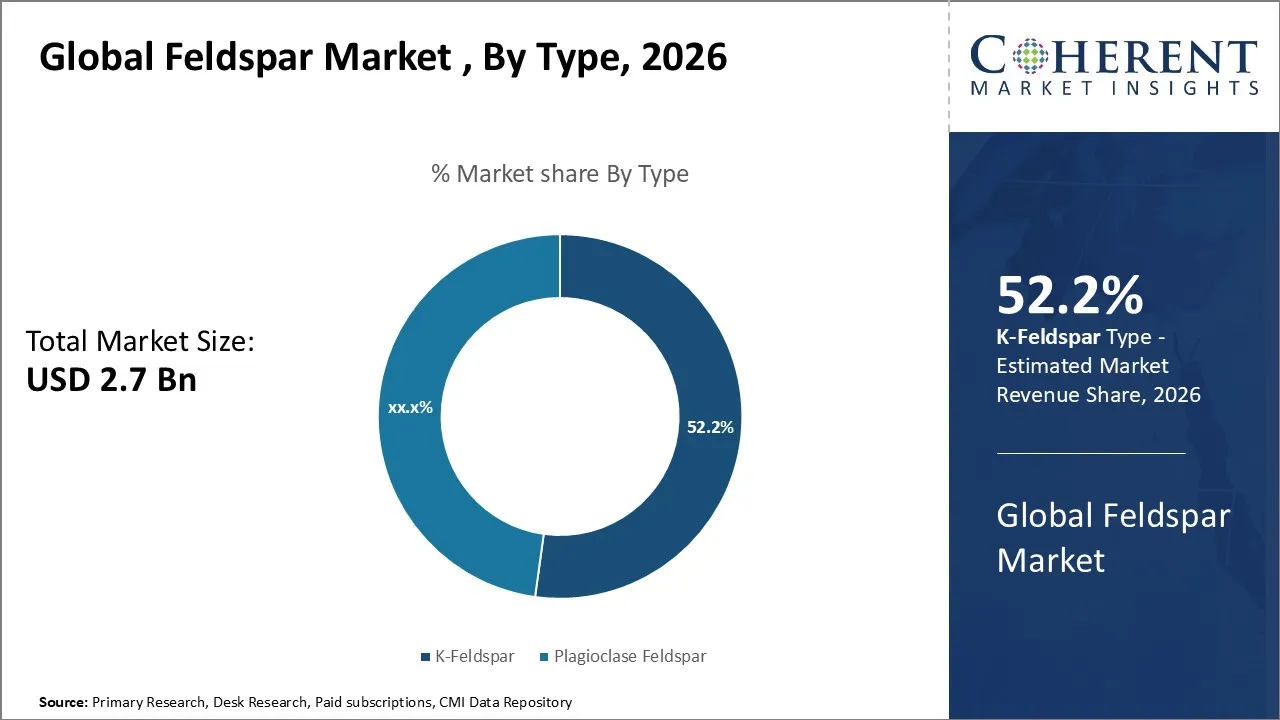
- By Type, K-Feldspar hold the largest market share of 52.2% in 2026 owing to the growth in glass manufacturing.
- By End Use, Glass expected to hold largest market share of 36.8% in 2026 owing to its essential fluxing agent in glassmaking.
- By Region, North America dominates the overall market with an estimated share of 41.2% in 2026 owing to the strong demand from glass manufacturing.
Market Overview
Strong demand from glass and ceramics manufacturers drives the feldspar market, as producers use feldspar as a key fluxing agent to enhance melting efficiency and improve product strength. Expanding construction, infrastructure projects, and rapid urbanization increase the consumption of tiles, sanitaryware, and architectural glass. Manufacturers also broaden its use in fillers, paints, and plastics, diversifying overall demand. Asia-Pacific dominates both production and consumption, while North America and Europe sustain steady demand through advanced manufacturing capabilities and continuous technological innovation.
Current Events and their Impact on the Feldspar Market
Current Events | Description and its impact |
Geopolitical Tensions in Key Feldspar-Producing Regions |
|
Technological Advances in Mineral Processing |
|
Environmental Regulations and Sustainable Mining Initiatives |
|
Segmental Insights
- Current Industry Events of 2026
- Market Size Estimation
- Regional Breakdown
- Competitive Landscape
- Customer Intelligence
- Segmental Analysis
- Pricing Analysis
- Key Market Drivers, Challenges & Future Trends
- Customized Insights Section
Feldspar Market Insights, By Type - K-Feldspar contribute the highest share of the market owing to its construction & infrastructure expansion
K-Feldspar hold the largest market share of 52.2% in 2026. Growing demand for premium ceramics and high-quality glass drives the K-feldspar segment of the feldspar market. Manufacturers choose K-feldspar for its high potassium content, which improves vitrification, enhances surface finish, and increases product strength. Expanding residential construction and evolving interior design trends raise the use of tiles and sanitaryware, thereby boosting consumption. Improved mineral processing techniques deliver consistent purity and controlled particle size for specialized applications. Producers also adopt K-feldspar to improve furnace efficiency and lower energy and operating costs.
Feldspar Market Insights, By End Use - Glass contributes the highest share of the market owing to its urbanization & infrastructure expansion
Glass expected to hold largest market share of 36.8% in 2026. Growing production of flat, container, and specialty glass drives demand for feldspar in the glass segment. Manufacturers use feldspar to provide alumina and alkali content that stabilizes melts, strengthens durability, and increases chemical resistance. According to an article published by Minerals Education Coalition, in glassmaking, feldspar acts as a flux, a substance that reduces the melting point of the materials it is combined with. Expanding investments in commercial construction, automotive glazing, and renewable energy projects boost overall glass output. Consumers increasingly prefer sustainable and recyclable packaging, which encourages container glass production. Glassmakers also upgrade furnace technologies and refine raw material blends, sustaining consistent demand for high-quality feldspar.
Regional Insights
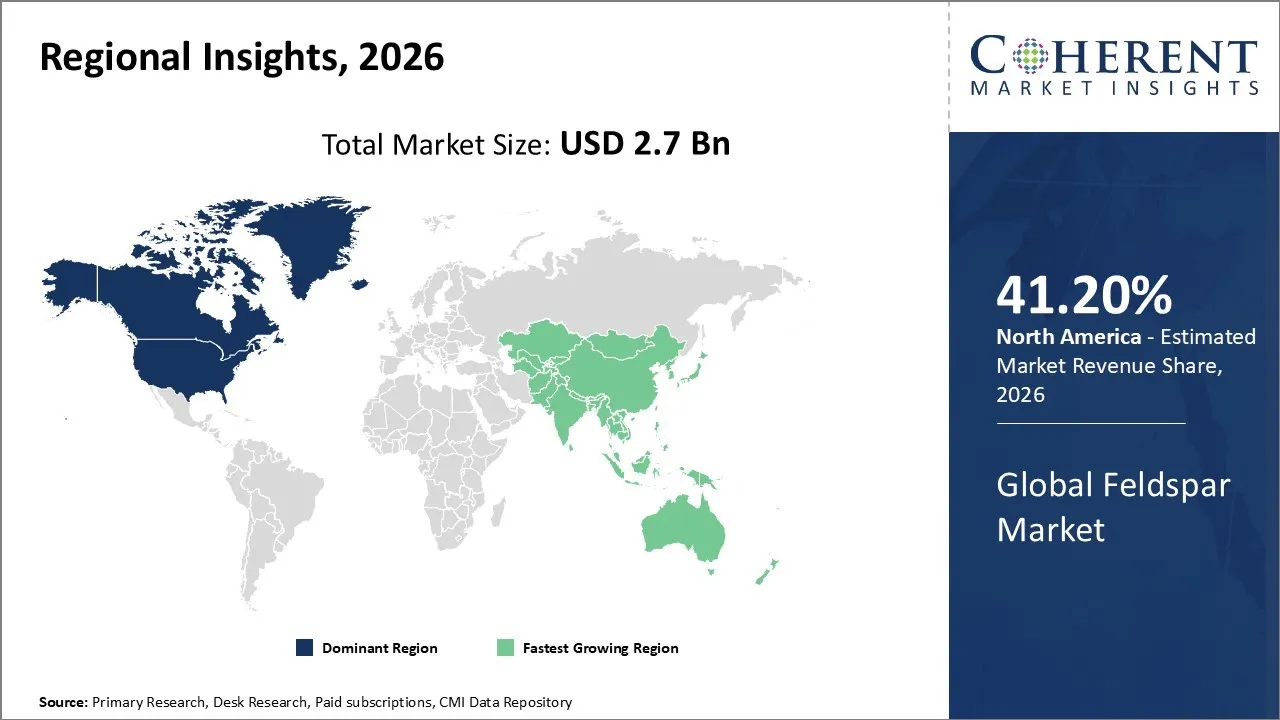
North America Feldspar Market Trends
North America dominates the overall market with an estimated share of 41.2% in 2026. Modernized glass and ceramics manufacturing drives steady growth in the North America feldspar market across the United States and Canada. Producers prioritize high-purity feldspar to meet strict quality standards for architectural glass, engineered tiles, and specialty applications. Mining companies implement automation and process optimization to ensure consistent supply and control costs. Increasing focus on sustainable construction materials and energy-efficient production influences purchasing choices. Manufacturers also expand feldspar use as a functional filler in paints, coatings, and plastics, gradually diversifying regional demand.
Asia Pacific Feldspar Market Trends
Booming construction, rapid urbanization, and expanding glass and ceramics industries drive dynamic growth in the Asia Pacific feldspar market. Manufacturers use high-quality feldspar to improve strength, surface finish, and durability in tiles, sanitaryware, and specialty glass. Local production and mining infrastructure ensure a steady supply, while advances in beneficiation technology maintain consistent purity and particle size. Companies also expand feldspar applications as fillers in paints, plastics, and coatings, further diversifying demand and strengthening the region’s position as a leading player in the global market.
United States Feldspar Market Trends
Rising demand from glass, ceramics, and specialty material manufacturers drives steady growth in the United States feldspar market. Producers prioritize high-purity feldspar to meet strict quality standards for architectural glass, advanced tiles, and technical ceramics. Domestic mining and processing operations provide a reliable supply, while technological improvements in beneficiation enhance efficiency and consistency. Manufacturers increasingly adopt energy-efficient production methods and sustainable construction materials, influencing purchasing decisions. They also expand feldspar applications as fillers in paints, coatings, and plastics, creating broader market opportunities.
China Feldspar Market Trends
Robust construction, rapid urbanization, and a growing ceramics and glass manufacturing sector drive rapid growth in China’s feldspar market. Manufacturers use high-grade feldspar to enhance strength, durability, and surface finish in tiles, sanitaryware, and specialty glass products. Advanced mining operations and beneficiation technologies provide a steady supply of high-quality raw material. Companies also expand feldspar applications as fillers in paints, plastics, and coatings, while ongoing industrial modernization and infrastructure projects continue to fuel consistent regional demand.
End-user Feedback and Unmet Needs in the Feldspar Market
- Demand for Higher Purity Grades: End-users in glass and ceramics consistently highlight the need for feldspar with higher alumina and potassium content. Impurities can affect melting behavior, product clarity, and surface finish. Manufacturers seek consistent high-purity sources to improve process efficiency, reduce defects, and maintain quality in premium tiles, specialty glass, and advanced ceramic products.
- Supply Consistency and Reliability: Industries report challenges with irregular feldspar supply, especially in regions dependent on imports. Interruptions or fluctuating availability impact production planning, raw material blending, and cost management. End-users prioritize suppliers with stable production, robust logistics, and transparent sourcing practices to minimize downtime and maintain continuous manufacturing workflows.
- Particle Size and Granularity Control: End-users often require specific particle size distributions for optimized melting and glazing. Variations in granularity can lead to uneven surface finish, firing inconsistencies, and increased waste. Manufacturers request feldspar with controlled particle size and uniformity, ensuring better process efficiency, higher product quality, and reduced energy consumption in glass and ceramic production.
Feldspar Market Trend
Expansion in Glass and Ceramics Industries
The feldspar market trends upward as glass and ceramics manufacturers increasingly integrate high-quality feldspar into production. Glassmakers rely on its alumina and alkali content to stabilize melts, improve clarity, and enhance durability, while ceramics producers use it to achieve better vitrification, surface finish, and thermal resistance. Rising urbanization, construction activity, and demand for premium tiles and specialty glass drive manufacturers to prioritize reliable feldspar sources for consistent product performance and operational efficiency.
Technological Advancements in Processing
Innovations in mining and beneficiation are shaping feldspar market trends. Advanced crushing, grinding, and purification technologies improve particle size control and chemical purity, meeting the needs of high-end glass and ceramic applications. Automated and optimized operations increase yield, reduce waste, and lower energy consumption. These technological developments allow manufacturers to tailor feldspar grades for specialty uses, including paints, plastics, and coatings, enhancing product versatility and competitiveness in both regional and global markets.
Feldspar Market Opportunity
Growing Construction and Infrastructure Projects
Expanding residential, commercial, and industrial construction worldwide creates significant opportunities for feldspar use in tiles, sanitaryware, and architectural glass. As urbanization accelerates, manufacturers can capitalize on the rising demand for durable and aesthetically appealing building materials. Feldspar suppliers that offer consistent quality and tailored particle sizes can position themselves as preferred partners, enabling growth in regions with large-scale infrastructure initiatives and boosting adoption across both conventional and high-end construction projects.
Market Report Scope
Feldspar Market Report Coverage
| Report Coverage | Details | ||
|---|---|---|---|
| Base Year: | 2025 | Market Size in 2026: | USD 2.7 Bn |
| Historical Data for: | 2020 To 2024 | Forecast Period: | 2026 To 2033 |
| Forecast Period 2026 to 2033 CAGR: | 6.1% | 2033 Value Projection: | USD 3.6 Bn |
| Geographies covered: |
| ||
| Segments covered: |
| ||
| Companies covered: | I-Minerals Inc., Quarzwerke GmbH, Eczacibasi Esan, Micronized Group, Imerys Minerals, Sibelco Nordic, The Quartz Corp., Adolf Gottfried Tonwerke GmbH, LB MINERALS, Ltd., and Sun Minerals. | ||
| Growth Drivers: |
| ||
| Restraints & Challenges: |
| ||
Feldspar Market News
In December 2024, a new Centre of Excellence for Ceramics was launched in Rajasthan. The centre was established to strengthen the ceramics industry through exploration, mining, processing, and advanced research. The state government sought support from academicians, technical experts, and industry representatives to enhance its initiatives and add value to its work.
Analyst Opinion (Expert Opinion)
- The feldspar market’s dynamics over the past year reflect a material poised at the intersection of advanced manufacturing demands and structural supply constraints rather than casual industrial usage. Production data show global feldspar output reached nearly 31.8 million metric tons in 2024, and glassmaking alone accounted for more than half of that demand about 18.7 million tons illustrating the mineral’s non‑negotiable role in optics‑critical manufacturing such as float and specialty glass production. This underscores that feldspar is not interchangeable with generic industrial inputs; its alkali and alumina chemistry directly influences melt viscosity and end‑product performance in sectors where clarity, durability, and thermal resistance are mission‑critical.
- Market behavior further reveals structural quality scarcity rather than pure volumetric demand as a central constraint. Only a minority of mined feldspar meets the strict compositional and particle size specifications required by high‑end glass and advanced ceramics manufacturers, forcing buyers to blend or source from multiple regions with divergent geology. This quality bottleneck inflates procurement costs and incentivizes vertical integration or beneficiation investment; a strategic shift supplier is pursuing to retain industrial customers.
- Meanwhile, the rising incorporation of recycled glass cullet in industrial furnaces above a quarter of global glass output according to independent recycling statistics is gradually reducing reliance on virgin feldspar inputs, especially in mature markets that prioritize circularity. This trend is not a headwind in the traditional sense; rather, it highlights an evolving competitive landscape where feldspar’s value must be justified by performance enhancements rather than baseline supply.
Speak to the analyst
Want personalized insights?
Take the findings above to one of our principal consultants, or have the report rebuilt around the segments, geographies and competitors you actually track.
Market Segmentation
- By Type
- Plagioclase Feldspar
- K-Feldspar
- By End-use
- Glass
- Ceramics
- Fillers
- Others
- By Regional Insights
- North America
- U.S.
- Canada
- Latin America
- Brazil
- Argentina
- Mexico
- Rest of Latin America
- Europe
- Germany
- U.K.
- Spain
- France
- Italy
- Russia
- Rest of Europe
- Asia Pacific
- China
- India
- Japan
- Australia
- South Korea
- ASEAN
- Rest of Asia Pacific
- Middle East
- GCC Countries
- Israel
- Rest of Middle East
- Africa
- South Africa
- North Africa
- Central Africa
- North America
- Key Players Insights
- I-Minerals Inc.
- Quarzwerke GmbH
- Eczacibasi Esan
- Micronized Group
- Imerys Minerals
- Sibelco Nordic
- The Quartz Corp.
- Adolf Gottfried Tonwerke GmbH
- LB MINERALS, Ltd.
- Sun Minerals
Sources
Primary Research interviews
- Conversations with feldspar mine operators and plant managers
- Interviews with industrial mineral traders and distributors
- Discussions with ceramic and glass manufacturers using feldspar
Databases
- U.S. Geological Survey (USGS) Mineral Commodity Summaries
- World Mineral Statistics Database
- National Mineral Resource Databases of India, China, and Brazil
Magazines
- Industrial Minerals Magazine
- Ceramic Industry Magazine
- Glass International Magazine
Journals
- Minerals Engineering Journal
- Journal of the American Ceramic Society
- International Journal of Mineral Processing
Newspapers
- The Financial Times (commodities section)
- Mining Weekly
- The Economic Times (industry and mining coverage)
Associations
- International Mineralogical Association (IMA)
- American Ceramic Society (ACerS)
- The World Mining Congress (WMC)
Public Domain sources
- Government mining reports and white papers
- Trade and export statistics from UN Comtrade
- Industry publications and press releases
Proprietary Elements
- CMI Data Analytics Tool
- Proprietary CMI Existing Repository of information for last 8 years
Get access to 250+ pages report
Every segment, forecast, competitor profile and data table behind the analysis above — available for instant download.
- ESOMAR Member
- ISO 9001:2015 Certified
- D-U-N-S Registered
- GDPR & CCPA Compliant
Missing comfort of reading report in your local language? Find your preferred language:
Transform your Strategy with Exclusive Trending Reports
Frequently Asked Questions
Global feldspar market was valued at around USD 3.6 Bn in 2033.
Increasing usage of glass and ceramics in the automotive, electronics, and construction industries will continue to catapult the demand for feldspar. Moreover, demand from manufacturers of ceramic tiles and other ceramic titles would remain the market.
Robust developments in the residential and commercial construction sectors will accelerate the sales of feldspar. moreover, application as a fluxing agent in manufacturing of glass products continues to bolster demand for feldspar in market.
Mining cost, recycling of glass and ceramics, and volatile logistics are some of the major restraints that are poised to hamper the market.
Major players operating in the market include I-Minerals Inc., Quarzwerke GmbH, Eczacibasi Esan, Micronized Group, Imerys Minerals, Sibelco Nordic, The Quartz Corp., Adolf Gottfried Tonwerke GmbH, LB MINERALS, Ltd., and Sun Minerals.
The market is estimated to grow at around 6.1 % CAGR in the forecast period.