

Fluorescence Guided Surgery Systems Market Size and Share Analysis: 2026 - 2033
The fluorescence guided surgery systems market was valued at USD 146 Mn in 2026 and is forecast to reach a value of USD 428 Mn by 2033 at a CAGR of 16.2% between 2026 and 2033.
Key Takeaways
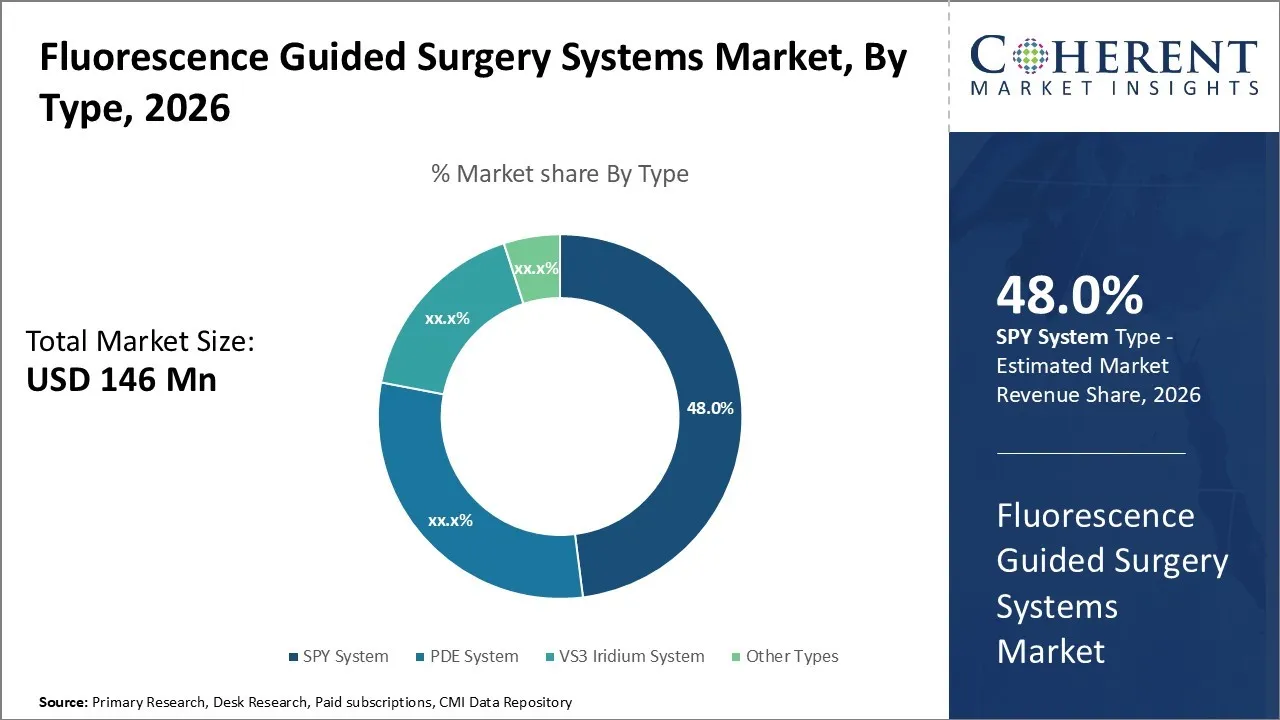
- Based on type, the SPY system segment is expected to hold 48.2% share of the market in 2026.
- Based on surgery, the open surgery segment is projected to account for 60% share of the market in 2026.
- Based on application, the cancer surgeries segment is expected to lead the market with 66.4% share in 2026.
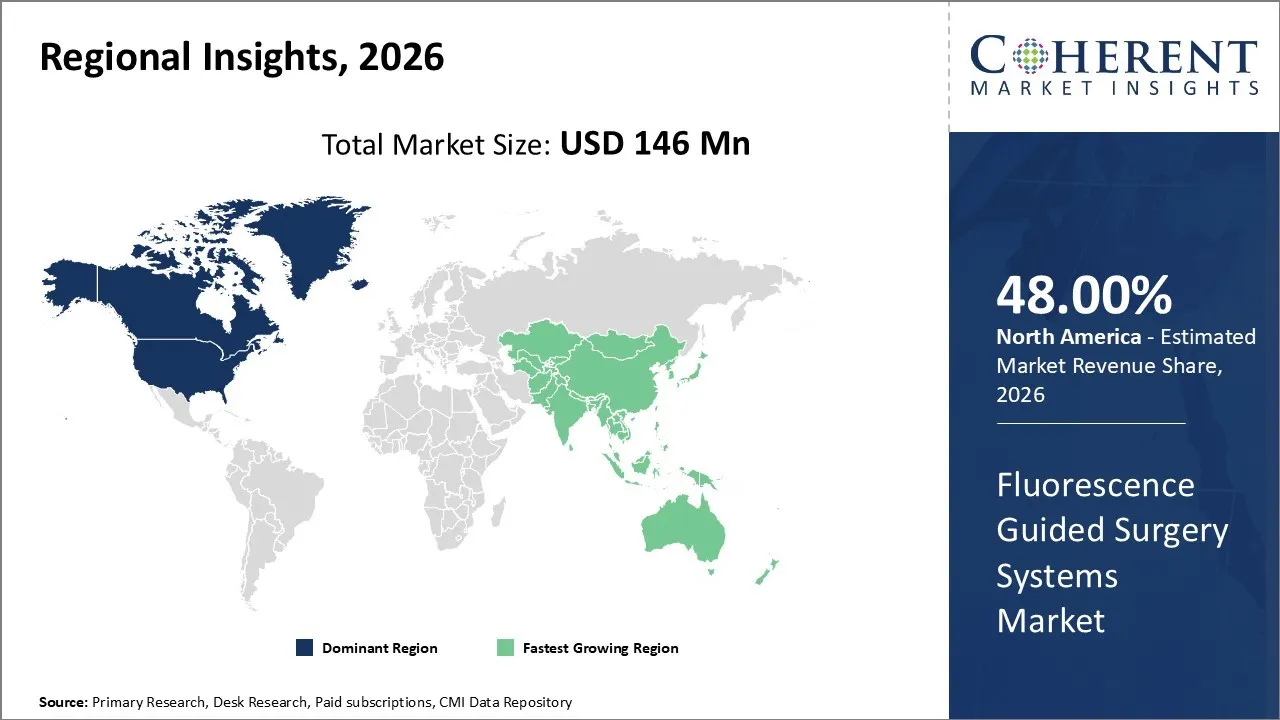
- Based on Region, North America is set to lead the fluorescence guided surgery systems treatment market with 48% share in 2026. While, Asia Pacific is anticipated to have the fastest growing region.
Market Overview
The fluorescence guided surgery systems market is experiencing strong growth due to the increasing prevalence of chronic disease across the globe and rise in usage of advanced imaging techniques. Moreover, increasing number of surgical procedures for target diseases is expected to boost growth of the market. However, factors such as stringent regulatory approval, side effects associated with fluoroscopy, and lack of skilled professionals expected to hamper growth of the global fluorescence guided surgery systems market.
Current Events and their Impacts on the Fluorescence Guided Surgery Systems Market
Current Event | Description and its Impact |
FDA Fast Track and Regulatory Approvals for Fluorescent Imaging Agents |
|
New Product Launches along with Technology Advancements in Surgical Imaging Platforms |
|
Segmental Insights
- Current Industry Events of 2026
- Market Size Estimation
- Regional Breakdown
- Competitive Landscape
- Customer Intelligence
- Segmental Analysis
- Pricing Analysis
- Key Market Drivers, Challenges & Future Trends
- Customized Insights Section
Fluorescence Guided Surgery Systems Market Insights, By Type - SPY system represents the largest share
In terms of type, the SPY system segment is expected to lead the market with 48% share in 2026, owing to its extensive adoption in clinical settings, strong brand recognition, and comprehensive technological integration. The SPY System, developed and broadly popularized by companies such as Stryker Corporation, has become synonymous with fluorescence-guided surgery owing to its proven efficacy in improving surgical outcomes across multiple specialties such as cardiovascular, plastic, and oncologic surgeries.
The system has very clear imaging and an easy-to-use design, so surgeons prefer it to reduce problems like leaks and tissue failures. Its major clinical validation, evidenced by numerous peer-reviewed studies highlighting advanced postoperative outcomes, adds to its dominant market presence.
Fluorescence Guided Surgery Systems Market Insights, By Surgery - Open surgery dominates the market
In terms of surgery, the open surgery segment is expected to hold 60% share of the market in 2026. Open Surgery contributes the highest share in the market, owing to multiple factors that reinforce its dominance. Open surgery, as a traditional and widely practiced surgical approach, remains the preferred method in a considerable number of clinical scenarios owing to its accessibility and versatility when operating on complex or extensive anatomical structures.
Open surgery lets surgeons see and reach the area easily, helping them use special imaging agents that make the operation clearer. Fluorescence guidance in open surgery improves real-time delineation of vital structures such as blood vessels, lymph nodes, as well as tumors, directly impacting surgical outcomes by reducing inadvertent damage and improving resection margins.
Fluorescence Guided Surgery Systems Market Insights, By Application - Cancer Surgeries leads the market
In terms of application, the Cancer surgeries segment is projected to account for 66.4% share of the market in 2026. This is due to the critical need for precision in oncological procedures, as FGS allows surgeons to clearly distinguish cancerous tissues from healthy tissues in real time.
For instance, OECD data shows that age‑standardized cancer mortality rates have decreased from 204 deaths per 100,000 population in 2019 to 191 deaths per 100,000 in 2023, highlighting the ongoing global emphasis on improving cancer outcomes.
Regional Insights
North America Fluorescence Guided Surgery Systems Market Analysis & Trends
North America is expected to dominate the fluorescence guided surgery systems market with 48% share in 2026, due to multiple region-specific factors that establish the United States and Canada as pivotal hubs of medical innovation and healthcare infrastructure. A dominant driver in this region's leadership is its highly developed healthcare system integrated with utilization adoption of advanced surgical technologies.
For instance, in March 2026, Olympus Corporation launched the VISERA ELITE™ III surgical imaging system in the U.S. This system aids surgeons see better during operations, makes surgery faster and easier, and can be used in different types of surgeries. It is the third major product developed by SONY Olympus Medical, a joint venture started in 2013.
Asia Pacific Fluorescence Guided Surgery Systems Market Analysis & Trends
Asia Pacific is expected to exhibit the fastest growth, propelled by a combination of increasing healthcare infrastructure investments, growing surgical volumes, and rising awareness about minimally invasive surgical technologies. Countries like China, India, Japan, South Korea, and Australia have experienced rapid modernization of their healthcare delivery ecosystems that directly adds to the burgeoning demand for fluorescence-guided surgery solutions.
For instance, in December 2025, HKU used a new infrared fluorescence imaging system for the first time in patients. This helps surgeons see blood flow during esophagus surgery.
Fluorescence Guided Surgery Systems Market Outlook Country-Wise
The U.S. Fluorescence Guided Surgery Systems Market Trends
The U.S. subsegment contributes the highest share in the Fluorescence Guided Surgery (FGS) Systems market in North America, owing to its advanced healthcare infrastructure, extensive adoption of cutting-edge surgical technologies, as well as favorable reimbursement policies that encourage innovation in surgical care. The U.S. healthcare system is marked by a concentration of world-renowned medical institutions and research centers that actively engage in the development as well as clinical implementation of fluorescence imaging techniques during surgeries.
For instance, in July 2025, Vanderbilt Health is using fluorescence imaging to help surgeons see nerves more clearly during head and neck surgery. The study sought to evaluate the safety of bevonescein, a synthetic peptide-dye conjugate thought to be applicable for intraoperative nerve-specific fluorescence imaging.
China Fluorescence Guided Surgery Systems Market Trends
China contributes the highest share in the Fluorescence Guided Surgery (FGS) Systems market in the region owing to its vast healthcare infrastructure developments, increasing governmental support for advanced surgical technologies, and a growing volume of surgical procedures that rely on imaging guidance. China's commitment to modernizing its healthcare delivery, particularly in oncology and minimally invasive surgeries, has significantly driven the adoption of fluorescence-guided systems.
Market Report Scope
Fluorescence Guided Surgery Systems Market Report Coverage
| Report Coverage | Details | ||
|---|---|---|---|
| Base Year: | 2025 | Market Size in 2026: | USD 146 Mn |
| Historical Data for: | 2020 To 2024 | Forecast Period: | 2026 To 2033 |
| Forecast Period 2026 to 2033 CAGR: | 16.2% | 2033 Value Projection: | USD 428 Mn |
| Geographies covered: |
| ||
| Segments covered: |
| ||
| Companies covered: | Irillic Pvt. Ltd., Karl Storz, PerkinElmer, Curadel LLC, Gentige (Fluoptics), OnLume Inc., Medtronic PLC, Hamamatsu Photonics KK, Stryker Corporation, Shimadzu Corporation, and Olympus Corporation (Quest Medical Imaging), among others | ||
| Growth Drivers: |
| ||
| Restraints & Challenges: |
| ||
Fluorescence Guided Surgery Systems Market Driver
Increasing adoption of minimally invasive surgical procedures
The increasing adoption of minimally invasive surgical (MIS) procedures is significantly driving the growth of the Fluorescence Guided Surgery (FGS) Systems market by enhancing surgical precision, reducing patient recovery time, and improving overall outcomes. MIS techniques, such as laparoscopic and robotic-assisted surgeries, rely heavily on advanced imaging technologies to compensate for the limited visual field and access compared to traditional open surgeries.
Rising prevalence of cancer and other chronic diseases
The rising prevalence of cancer and other chronic diseases is significantly propelling the demand for Fluorescence Guided Surgery (FGS) systems globally. Cancer remains one of the leading causes of death worldwide, with the World Health Organization (WHO) reporting approximately 10 million cancer-related deaths in 2020 alone, making it the second highest cause of mortality after cardiovascular diseases. The complexity of cancer surgeries, especially in cases involving brain tumors, head and neck cancers, and breast cancer, demands highly precise resection techniques to ensure maximal removal of malignant tissues while sparing healthy structures.
Fluorescence Guided Surgery Systems Market Opportunity
Development of novel fluorescent probes and contrast agents
The development of novel fluorescent probes and contrast agents represents a significant opportunity within the Fluorescence Guided Surgery (FGS) Systems market, primarily due to their potential to drastically enhance surgical precision and patient outcomes. Traditional fluorescence agents often face limitations such as low specificity, rapid photobleaching, and suboptimal tissue penetration, which constrain their utility in complex surgical environments.
Analyst Opinion (Expert Opinion)
- The Fluorescence Guided Surgery (FGS) Systems market is witnessing significant traction, driven primarily by the increasing demand for precision in surgical procedures. These systems enhance visualization of critical anatomical structures, thereby reducing surgical risks and improving patient outcomes.
- A major driver is the high prevalence of cancer and other complex diseases where precise tumor margin identification is crucial. Additionally, technological advancements in fluorescence imaging as well as the integration of artificial intelligence are further bolstering market growth by enabling more accurate as well as real-time intraoperative guidance.
- However, the high cost of FGS systems along with the need for specialized training for surgeons serve as major restraints, potentially limiting widespread adoption, especially in developing regions. Nonetheless, the growing emphasis on minimally invasive surgeries and rising preference for image-guided procedures present lucrative opportunities. Expansion in emerging economies, supported by increasing healthcare expenditure as well as government initiatives to improve surgical outcomes, also offers substantial growth potential.
- Regionally, North America continues to dominate the market due to well-established healthcare infrastructure, high utilization of advanced surgical technologies, along with extensive R&D activities. Meanwhile, the Asia Pacific region is coming as the fastest-growing market, fueled by expanding healthcare infrastructure, growing awareness about advanced surgical techniques, as well as high prevalence of chronic diseases. Overall, the FGS systems market is poised for robust advancement as surgical precision becomes paramount in improving clinical efficacy as well as patient safety worldwide.
Speak to the analyst
Want personalized insights?
Take the findings above to one of our principal consultants, or have the report rebuilt around the segments, geographies and competitors you actually track.
Global Fluorescence Guided Surgery Systems Market: Key Developments
- In March 2026, the U.S. FDA gave Fast Track status to FG001, a fluorescent imaging agent from FluoGuide A/S. This agent will help surgeons see tumors during surgery for high-grade glioma. After the FDA approved the investigational new drug in February 2026, the company can start a U.S. Phase 2 trial in the second quarter of 2026.
- In November 2025, Madrid hosted the 2025 European Chapter Meeting of the International Society for Fluorescence Guided Surgery (ISFGS), the leading global society in this field.
Market Segmentation
- By Type
- SPY System
- PDE System
- VS3 Iridium System
- Other Types
- By Surgery
- Open Surgery
- Laparoscopy/Endoscopy
- By Application
- Cancer Surgeries
- Cardiovascular Surgeries
- Other Applications
- By Region
- North America
- U.S.
- Canada
- Latin America
- Brazil
- Argentina
- Mexico
- Rest of Latin America
- Europe
- Germany
- U.K.
- Spain
- France
- Italy
- Russia
- Rest of Europe
- Asia Pacific
- China
- India
- Japan
- Australia
- South Korea
- ASEAN
- Rest of Asia Pacific
- Middle East & Africa
- GCC Countries
- Israel
- Rest of Middle East & Africa
- North America
- Key Players
- Irillic Pvt. Ltd.
- Karl Storz
- PerkinElmer
- Curadel LLC
- Gentige (Fluoptics)
- OnLume Inc.
- Medtronic PLC
- Hamamatsu Photonics KK
- Stryker Corporation
- Shimadzu Corporation
- Olympus Corporation
Sources
Primary Research Interviews
- Fluorescence Guided Surgery Device Manufacturers
- Healthcare Professionals/Surgeons
- Hospital Procurement Managers
- Industry Experts
- Others
Databases
- FDA Medical Device Database
- PubMed/MEDLINE
- Others
Magazines
- Medical Device and Diagnostic Industry (MD+DI)
- Surgical Products Magazine
- HealthCare Business News
- Others
Journals
- Journal of Biomedical Optics
- Surgical Endoscopy
- Journal of Fluorescence
- Others
Newspapers
- The Wall Street Journal Healthcare Section
- Reuters Health News
- The Financial Times Healthcare
- Others
Associations
- The International Society for Fluorescence Guided Surgery (ISFGS)
- Medical Device Manufacturers Association (MDMA)
- American Association of Neurological Surgeons (AANS)
- Others
Public Domain Sources
- U.S. Food & Drug Administration (FDA) Website
- World Health Organization (WHO) Publications
- National Institutes of Health (NIH) Reports
- Centers for Disease Control and Prevention (CDC) Publications
- Others
Proprietary Elements
- CMI Data Analytics Tool
- Proprietary CMI Existing Repository of Information for the Last 8 Years
Get access to 250+ pages report
Every segment, forecast, competitor profile and data table behind the analysis above — available for instant download.
- ESOMAR Member
- ISO 9001:2015 Certified
- D-U-N-S Registered
- GDPR & CCPA Compliant
Missing comfort of reading report in your local language? Find your preferred language:
Transform your Strategy with Exclusive Trending Reports
Frequently Asked Questions
The global fluorescence guided surgery systems market size was valued at USD 146 Mn in 2026 and is expected to reach USD 428 Mn in 2033.
Major players operating in the market include Irillic Pvt. Ltd., Karl Storz, PerkinElmer, Curadel LLC, Gentige (Fluoptics), OnLume Inc., Medtronic PLC, Hamamatsu Photonics KK, Stryker Corporation, Shimadzu Corporation, and Olympus Corporation (Quest Medical Imaging), among others
Among type, the SPY system segment estimated significant revenue in 2026.
Increasing prevalence of chronic disease and increase in usage of advanced imaging techniques is fueling the growth of the market.
The market is estimated to exhibit a CAGR of 16.2% till 2033.
Among region, North America is expected to witness significant growth over the forecast period.