

Life Science Microscopy Devices Market Size and Share Analysis- Growth Trends and Forecasts (2026-2033)
The global life science microscopy devices market is valued at USD 2,521.2 Mn in 2026 and is expected to grow till USD 4,012.4 Mn in 2033, witnessing a CAGR of 6.8% over the forecast period (2026–2033), driven by rising R&D in drug discovery, advanced imaging for diagnostics, and expanding applications in biotechnology and nanoscience.
Key Takeaways in the Life Science Microscopy Devices Market
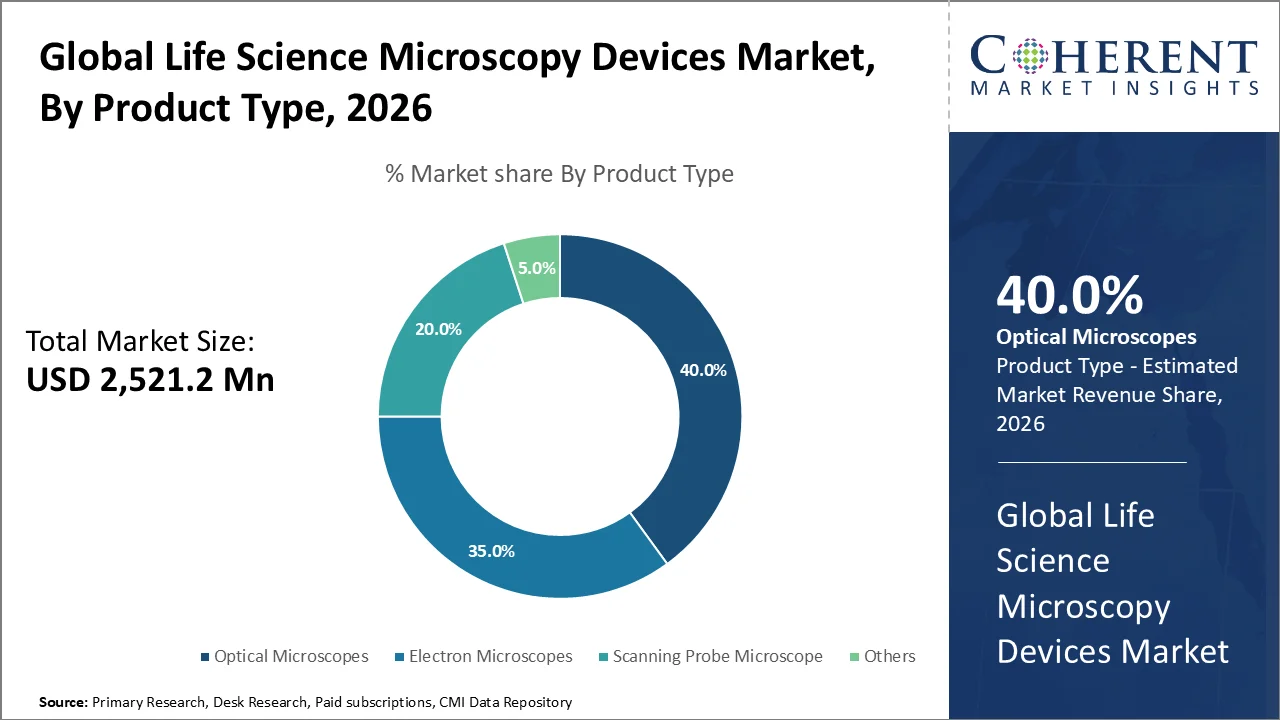
- The optical microscopes segment is expected to dominate the market with 40% share in 2026, driven by versatility, affordability, and advanced imaging for cell biology, pathology, and drug discovery. In NVIDIA’s 2025 survey, 71% of respondents in medical technology prioritized imaging, and 51% of all respondents expect advanced imaging to be the biggest driver of healthcare impact. Life Sciences Survey of 600+ Professionals: How AI Drives 81% Revenue Growth and 73% Cost Savings.
- The research laboratories and institutes segment is estimated to hold the dominant market share of 46% in 2026, owing to extensive adoption of the life sciences in teaching, fundamental research and innovation. NEJM describes 1219 patients with coronary artery disease, 5-year survival and mortality rates that inform cardiology research, education and clinical care.
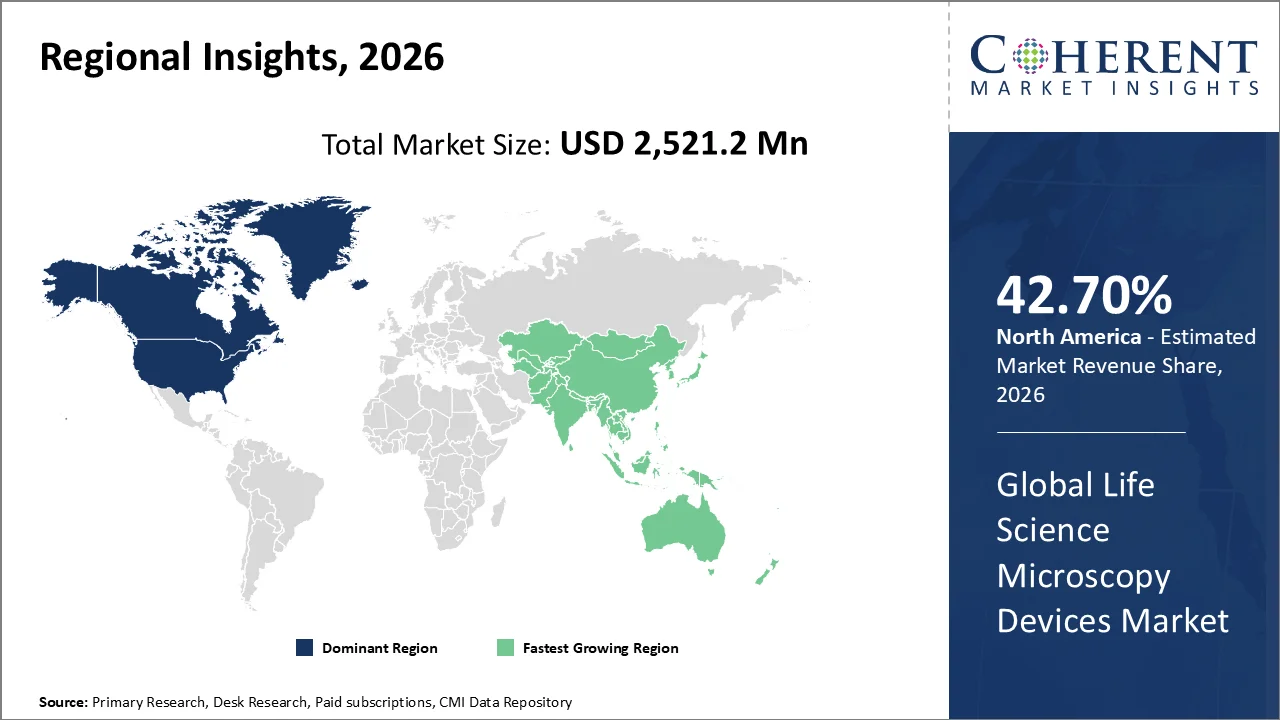
- North America is anticipated to dominate the life science microscopy devices market with a share of 42.7% in 2026 owing to high R&D expenditure and advanced healthcare infrastructure. According to Deloitte’s survey the drug delivery market is expected to hit $1.45 trillion by 2028, with over 435,000 clinical trials and 91% of organizations investing in R&D innovation worldwide.
- Asia Pacific is expected to be the fastest growing region driven by biotech hubs, government funding and pharmaceutical expansion. Nature’s 2025 Analysis Confirms Government Funding in Life Sciences: U.S. $48.3B (2023), Europe $35.3B, Asia $29.2B. South Korea (9%) and Singapore (7%) are among the growth leaders and are driving biomedical innovation globally.
Drug Discovery with Microscopy Devices
Region | Focus Area | Example Initiative |
North America | Neuroscience & Pharma | U.S. UM-MIND received $2.9M to build advanced microscopy for neuroscience drug discovery. |
Europe | Medical Imaging & Diagnostics | Germany’s ZEISS Ventures invests in AI-powered microscopy for ophthalmology; Italy’s IIT develops smart microscopes for diagnostics. |
Asia | Healthcare & Materials | China’s PolyU/NSFC funds 65 projects in healthcare and materials; Singapore commits S$800M to semiconductor R&D impacting drug testing. |
Australia | Biomedical & Biodiversity | WA Govt invests $10.5M + $19.1M co-investment in microscopy facilities supporting biomedical imaging and biodiversity research. |
Canada | Critical Minerals & Pharma | McMaster’s CCEM expands with $15.5M CFI grant, supporting electron microscopy for materials and pharmaceutical pipelines. |
Using AI to Revolutionize Microscopy in Life Sciences
AI microscopy is the combination of machine learning and advanced imaging systems to revolutionize life sciences It automates image analysis, thus removing human bias and speeding up workflows. The algorithms boost the resolution, enabling scientists to see structures at the nanoscale with a clarity never before achieved. AI improves predictive diagnostics by spotting disease markers and subtle changes in cells earlier than traditional methods can. It is used in drug discovery, neuroscience and structural biology with lower costs & higher reproducibility. Scientists are using AI to guide microscopes in real-time to gain a deeper understanding of cellular dynamics, protein interactions, and tissue health, paving the way for precision medicine and faster biomedical advancements.
For example, the SenseAI upgrade – announced in March 2026 – added AI to Australia’s national microscopy capability. It is installed on the Hitachi HF5000 electron microscope at the University of Queensland and is capable of achieving atomic-scale resolution with real-time imaging. AI boosts 4D STEM and 2D STEM experiments, strengthening Microscopy Australia’s network and accelerating research in materials science, nanotechnology and biomedical imaging. SenseAI turns microscopy into a predictive and adaptive technology, automating workflows and delivering live feedback to accelerate discovery and enhance Australia’s global leadership in advanced imaging.
- Current Industry Events of 2026
- Market Size Estimation
- Regional Breakdown
- Competitive Landscape
- Customer Intelligence
- Segmental Analysis
- Pricing Analysis
- Key Market Drivers, Challenges & Future Trends
- Customized Insights Section
Current Events and their Impacts
Current Event | Description and its Impact |
AI and Machine Learning Integration in Microscopy Technology |
|
European Union's Digital Single Market and Medical Device Regulations |
|
Segmental Insights
Optical Microscopes drive research demand with their versatile imaging capabilities?
In terms of product type, the Optical microscopes segment is the dominant segment in the market in 2026 accounting for almost 40% of the market. Cell biology, pathology and drug discovery research around the world is increasingly reliant on them due to their versatility, low cost and advanced imaging capabilities. In May 2026, Araceli Biosciences launched Endeavor Live Cell, enabling ultra-high-throughput kinetic imaging across 1536-well plates, delivering rapid, consistent live-cell data for AI-driven drug discovery and dynamic biology applications.
For instance, in February 2026, Nikon’s new ECLIPSE LV150NA LED, LV150N LED and MA200 LED optical microscopes feature new technology LED illumination, with 50,000-hour lamp life, better imaging and versatility for industrial inspection and research applications.
Research Laboratories And Institutes drives market share due to teaching needs?
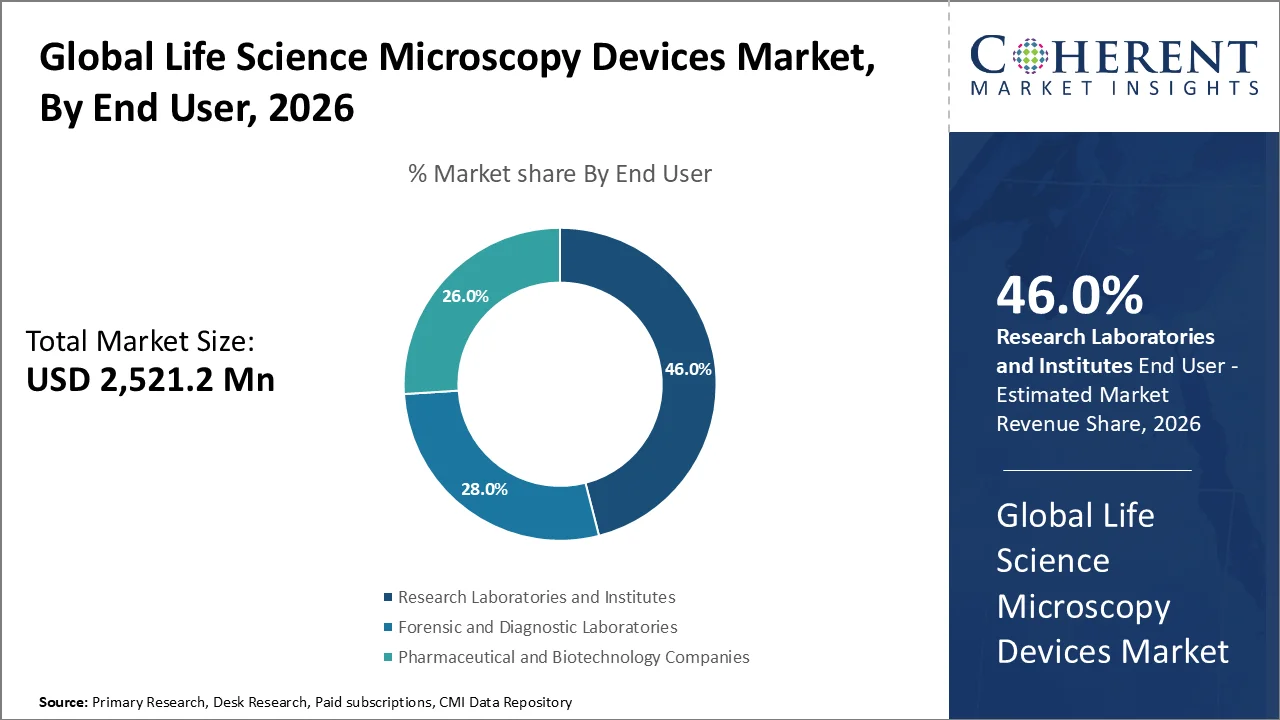
In terms of end user, the research laboratories and institutes segment is expected to lead the market with 46% share in 2026. The demand is driven by wide adoption for teaching, basic research and innovation in life sciences, with universities and laboratories ensuring steady growth and sustainable market leadership. In May 2026, the University of Maryland School of Medicine received USD 2.9 million in federal funding in 2026 to acquire advanced microscopy systems, strengthening universities and laboratories’ role in accelerating neuroscience discoveries through life science microscopy devices.
For instance, in March 2026, Leica commercialised Imperial College London’s Oblique Plane Microscopy (OPM), patented in 2008 and launched commercially in March 2026. The SCAPE microscope enables imaging of up to 15 organoids simultaneously, supporting academic institutes in advancing life science microscopy research.
Regional Insights
North America Microscopy Market: Leading by R&D Expenditure
The North America is estimated to account for 42.70% of the global life science microscopy devices market in 2026. Presence of leading microscopy companies including Thermo Fisher, Danaher and Zeiss, healthcare infrastructure and high R&D expenditure is expected to drive the growth of the microscopy market U.S. R&D spending in FY 2024 was USD 117 billion, with life sciences accounting for roughly 57% ($67 billion) of the total, according to the NSF NCSES report. It’s another sign that life sciences are king of the hill in US research investment, spurring innovation in biotech, pharmaceuticals and advanced microscopy.
Thermo Fisher Scientific opened a Cryo-EM Drug Discovery Center in the US in March 2026 to speed up life science microscopy tools. Now achieving better than 3 Ångström resolution, cryo-electron microscopy is transforming structural biology and accelerating pharmaceutical research, cementing microscopy’s role in drug discovery and academic-industry partnerships.
Asia Pacific Fastest Growth Fueled by Biotech Hubs
Asia Pacific is the fastest growing region with highest projected CAGR Expanding biotech centers in China, India and Japan, big government funding and more pharmaceutical research are driving growth. This surge positions Asia Pacific as a key frontier for innovation and adoption in life science microscopy. The India’s PIB mentions R&D expenditure in life sciences sector, investment of around 0.64 - 0.66% of GDP, new funding mechanisms, fellowships, foreign collaborations and infrastructure upgrades through DST, DBT, CSIR, strengthening biotechnology, pharmaceuticals and advanced research facilities across the country.
For example, Shimadzu announced in March 2025 the launch of the SuperScan SS-4000 scanning electron microscope in two versions with enhanced image quality and usability. These SEMs are important life science microscopy tools for high resolution visualization of cells, tissues and biomaterials.
Life Science Microscopy Devices Market Outlook by Country Worldwide
Strong healthcare infrastructure, advanced R&D and a growing US
The U.S. not only the world leader in the life sciences with an advanced R&D capacity and a strong health care infrastructure, but also the world leader in microscopy manufacturing with companies like Thermo Fisher and Bruker. Strong academic institutions, government funding and private investment drive innovation, making the U.S. the largest demand center for cutting edge biomedical technologies. U.S. show insights from Deloitte 2026 Healthcare infrastructure in life sciences evolving with digital health, AI and consumer trust USD 54.5B risk to healthcare infrastructure’s bottom line from limited virtual care capabilities USD 114.1B risk to biopharma revenues without direct-to-consumer strategies
For example, Stanford’s 2026 breakthrough in interferometric image scanning microscopy (iISM) is directly tied to life science microscopy devices, reaching 120 nanometer resolution in living cells without fluorescent labels in March 2026. This innovation allows real time drug uptake studies, plant microbe interaction analysis and malaria infection research advancing biomedical imaging and next generation cellular research infrastructure.
China’s Biotech Hubs, Pharma Boom, Government Funding
China's life sciences market is the fastest-growing, with growing biotech hubs, massive government funding, and a booming pharmaceutical research industry. China is emerging as a global leader in biomedical innovation. Rapid infrastructure development, international collaborations, and rising domestic demand are spurring growth across diagnostics, therapeutics, and advanced imaging technologies. China’s biotech hubs are booming with CNY 8.5B (~US$1.2B) annual funding, 7,100+ clinical trials (2024), 23% of global drug pipeline and 1,500+ new drugs, making China a global biopharma powerhouse.
For instance, in September 2025, Beijing biotech startup Shuimu BioSciences launched China’s developed cryo-electron microscope device. The ¥35M–¥46.6M (US$4.9M–6.5M) Totem 300 offers 300 kV resolution and 50% of the hardware is sourced domestically reducing the import dependence and strengthening China’s life science microscopy infrastructure ahead of a planned 2027 Hong Kong IPO.
Key News
- In January 2026, Goethe University Frankfurt unveiled €5.6M cryo plasma-FIB scanning electron microscope with nanomanipulator for nanobiopsies at nanometer scale. This life science microscopy instrument facilitates research in Alzheimer’s disease, cancer and proteins, thus strengthening Germany’s biomedical infrastructure and advancing high-resolution imaging of living cells in the SCALE Cluster of Excellence.
- In July 2025, Thermo Fisher Scientific unveiled breakthrough electron microscopes at M&M 2025 in Salt Lake City, advancing life science microscopy devices. The Scios 3 FIB-SEM boosts productivity with automation, while the Talos™ 12 TEM at 120kV enhances biological research, pathology, and drug discovery, championing accessibility and innovation in advanced microscopy.
Who are major players in the Global Life Science Microscopy Devices Market
Key players operating in the global life science microscopy devices market include Olympus Corporation, Thermo fisher Scientific, Inc., Nikon Corporation, Carl Zeiss AG, Keyence Corporation, JEOL Ltd., Bruker, Hitachi High-Technologies Corporation, Leica Microsystems, and F. Hoffman-La Roche Ltd.
Market Report Scope
Life Science Microscopy Devices Market Report Coverage
| Report Coverage | Details | ||
|---|---|---|---|
| Base Year: | 2025 | Market Size in 2026: | USD 2,521.2 Mn |
| Historical Data for: | 2020 To 2024 | Forecast Period: | 2026 To 2033 |
| Forecast Period 2026 to 2033 CAGR: | 6.8% | 2033 Value Projection: | USD 4,012.4 Mn |
| Geographies covered: |
| ||
| Segments covered: |
| ||
| Companies covered: | Olympus Corporation, Thermo fisher Scientific, Inc., Nikon Corporation, Carl Zeiss AG, Keyence Corporation, JEOL Ltd., Bruker, Hitachi High-Technologies Corporation, Leica Microsystems, and F. Hoffman-La Roche Ltd. | ||
| Growth Drivers: |
| ||
| Restraints & Challenges: |
| ||
Global Life Science Microscopy Devices Market Trends
Advanced Imaging Demand
High-resolution imaging is increasingly vital in biomedical and pharmaceutical research, enabling precise visualization of cellular structures, disease mechanisms, and drug interactions, driving innovation in diagnostics and therapeutic development worldwide. GE HealthCare introduced NVIDIA-powered imaging solutions, processing 50x more CT data, reducing MRI scan times by 80%, and accelerating workflows. With $19.7B revenue, these advanced imaging systems strengthen pharmaceutical research, diagnostics, and drug discovery globally.
Nanotechnology & Structural Biology
Nanotechnology applications expand microscopy’s role in molecular biology, virology, and material sciences. Devices enable atomic-level imaging of proteins, viruses, and nanomaterials, advancing structural biology and next-generation therapeutic design. The Great Unified Microscope of the University of Tokyo combines phase microscopy with interferometric scattering, detecting signals over 14x wider intensity range. It images structures from >100 nm features down to proteins, thus advancing nanotechnology and structural biology.
Digital & AI Integration
AI-driven microscopy enhances imaging diagnostics and predictive analytics. Machine learning algorithms improve resolution, automate analysis, and recognize subtle cellular changes, improving research efficiency and clinical decision-making. The ORNL-led AI-enabled microscopy program launched in March 2026, combining automation and cutting-edge imaging. It allows for autonomous workflows, adaptive measurements, and efficient nanoscale data handling, speeding up discoveries in quantum materials, nanotechnology, and structural biology.
Analyst Opinion
- The life science microscopy devices market is entering a period of rapid technological change from 2024 to 2026 driven by nanotechnology, AI integration and advanced imaging modalities. The trend is toward intelligent and multi-dimensional analysis platforms that are moving away from traditional visualization.
- Nanotech and super-resolution imaging: Super-resolution microscopy techniques are expected to reach sub-10 nanometer resolution by 2025, enabling the visualization of protein interactions at the molecular level. Cryo-electron microscopy is expected to advance to the point where we can obtain atomic-level structural maps of complex biomolecules with a 40% improvement in throughput over 2023. In 2026, hybrid optical-electron systems will allow researchers to image live cell dynamics with their ultrastructural details simultaneously, revolutionizing drug discovery and cellular biology research.
- AI-enabled automation and intelligent integration: From 2024 to 2026, microscopy instruments will be embedded with AI-based image recognition and predictive analytics, reducing the time for manual analysis by more than 50%. Automation of sample handling and adaptive imaging algorithms are expected to improve reproducibility for clinical and research workflows. By 2026, the combination of connected microscopy platforms and cloud-based bioinformatics pipelines will allow real-time collaboration between laboratories across the globe, and facilitate large-scale projects such as precision medicine and synthetic biology.
Speak to the analyst
Want personalized insights?
Take the findings above to one of our principal consultants, or have the report rebuilt around the segments, geographies and competitors you actually track.
Market Segmentation
- By Product Type (Revenue, USD Mn, 2021-2033)
- Optical Microscopes
- Stereo Microscopes
- Phase Contrast Microscopes
- Fluorescence Microscopes
- Confocal Scanning Microscopes
- Others
- Electron Microscopes
- Transmission Electron Microscope
- Scanning Electron Microscope
- Scanning Probe Microscope
- Atomic Force Microscope
- Scanning Tunneling Microscope
- Others
- Optical Microscopes
- By End User (Revenue, USD Mn, 2021-2033)
- Research Laboratories and Institutes
- Forensic and Diagnostic Laboratories
- Pharmaceutical and Biotechnology Companies
- By Region (Revenue, USD Mn, 2021-2033)
- North America
- U.S.
- Canada
- Latin America
- Brazil
- Mexico
- Argentina
- Rest of Latin America
- Europe
- U.K.
- France
- Germany
- Italy
- Spain
- Russia
- Rest of Europe
- Asia Pacific
- China
- India
- Japan
- ASEAN
- Australia
- South Korea
- Rest of Asia Pacific
- Middle East
- GCC Countries
- Israel
- Rest of Middle East
- Africa
- South Africa
- North Africa
- Central Africa
- North America
- Key Players
- Olympus Corporation
- Thermo fisher Scientific, Inc.
- Nikon Corporation
- Carl Zeiss AG
- Keyence Corporation
- JEOL Ltd.
- Bruker
- Hitachi High-Technologies Corporation
- Leica Microsystems
- F. Hoffman-La Roche Ltd.
Sources
Primary Research Interviews
- Biomedical Researchers
- Clinical Pathologists
- Microscopy Device Manufacturers
- Hospital Laboratory Directors
- Pharmaceutical R&D Scientists
- University Life Science Professors
- Diagnostic Imaging Specialists
- Procurement Heads in Research Institutes
- Histology and Cytology Experts
- Others
Databases
- Bloomberg Terminal
- Thomson Reuters Eikon
- S&P Global Market Intelligence
- PubMed / NCBI Database
- ClinicalTrials.gov
- FDA Medical Device Database
- European Medicines Agency (EMA) Device Database
- USPTO / EPO Patent Databases
- Others
Magazines
- Microscopy Today
- Laboratory Equipment Magazine
- BioTechniques
- Scientific American – Life Sciences
- Nature Biotechnology News Section
- The Scientist
- Lab Manager
- Others
Journals
- Journal of Microscopy
- Nature Methods
- Journal of Biomedical Optics
- Cytometry Part A
- Analytical Cellular Pathology
- Histochemistry and Cell Biology
- Clinical Imaging
- The Lancet – Medical Technology Section
- Others
Newspapers
- Reuters
- Bloomberg News
- The Wall Street Journal – Health & Science
- Financial Times – Healthcare & Technology
- The New York Times – Science Section
- The Guardian – Health Section
- STAT News
- BioPharma Dive
- Others
Associations
- Royal Microscopical Society (RMS)
- American Society for Cell Biology (ASCB)
- European Microscopy Society (EMS)
- International Society for Advancement of Cytometry (ISAC)
- Society for Neuroscience (SfN)
- Federation of European Biochemical Societies (FEBS)
- American Association for Clinical Chemistry (AACC)
- International Society for Optics and Photonics (SPIE)
- Others
Public Domain Sources
- U.S. Food and Drug Administration (FDA) – Medical Devices Database
- National Institutes of Health (NIH)
- Centers for Disease Control and Prevention (CDC) – Laboratory Science
- European Medicines Agency (EMA)
- World Health Organization (WHO) – Laboratory Technology
- National Center for Biotechnology Information (NCBI)
- European Commission – Medical Technology
- International Organization for Standardization (ISO) – Microscopy Standards
- Others
Proprietary Elements
- CMI Data Analytics Tool, and Proprietary CMI Existing Repository of information for the last 10 years
Get access to 250+ pages report
Every segment, forecast, competitor profile and data table behind the analysis above — available for instant download.
- ESOMAR Member
- ISO 9001:2015 Certified
- D-U-N-S Registered
- GDPR & CCPA Compliant
Missing comfort of reading report in your local language? Find your preferred language:
Transform your Strategy with Exclusive Trending Reports
Frequently Asked Questions
The global life science microscopy devices market is estimated to surpass US$ 2,521.2 Million by 2026.
Maintenance of these systems is expensive and requires more time and effort and these are some of the major factors that are expected to hamper growth of the market over the forecast period.
Rapid development activities for the launch of technologically advanced and cost-effective quality products such as robotic visualization systems is one of the major factors that is expected to propel growth of the market over the forecast period.
The global life science microscopy devices market is estimated to exhibit a CAGR of 6.8% over the forecast period.
Among regions, North America is estimated to hold dominant position in the market over the forecast period.
Major players operating in the global life science microscopy devices market include Olympus Corporation, Thermo fisher Scientific, Inc., Nikon Corporation, Carl Zeiss AG, Keyence Corporation, JEOL Ltd., Bruker, Hitachi High-Technologies Corporation, Leica Microsystems, and F. Hoffman-La Roche Ltd.