

Deep Brain Stimulation Devices Market Size and Trends Forecast: 2026 - 2033
The deep brain stimulation devices market is estimated to be valued at USD 1.84 Bn in 2026 and is expected to reach USD 3.80 Bn by 2033, exhibiting a compound annual growth rate (CAGR) of 10.9% from 2026 to 2033.
Key Takeaways of the Deep Brain Stimulation Devices Market
- By product type, the single-channel DBS devices segment is expected to contribute the highest share of the market with 53.6% in 2026.
- By end user, hospitals contribute the highest share of the market with an estimated share of 41.6% in 2026.
- North America to expected to top the global market with 38. 9% share, followed by Asia Pacific with 28.2% share in 2026.
Market Overview
The deep brain stimulation devices market is witnessing positive trends with major players continuously innovating and launching new products with enhanced features. Technological advancements have allowed improved targeting abilities and battery lives in these devices. This is anticipated to boost the adoption of deep brain stimulation especially for neurological conditions.
However, the high cost of Deep Brain Stimulation (DBS) therapy, coupled with the complexity and potential risks associated with DBS implantation, is expected to pose challenges to the growth of the deep brain stimulation devices, deep brain stimulation devices market.
Current Events and Their Impact on the Deep Brain Stimulation Devices Market
Current Events | Description and its impact |
Clinical Trial Advancements for New Indications |
|
Market Consolidation and Competitive Shifts |
|
Market Trends
Increasing Aging Population Worldwide
The global demographic shift toward an aging population is fundamentally reshaping the healthcare landscape, with profound implications for the Deep Brain Stimulation (DBS) devices market. As populations age, the prevalence of neurological disorders that benefit from DBS therapy increases dramatically, creating substantial demand for these sophisticated medical devices.
For instance, according to a report by the World Health Organization (WHO), by 2030, 1 in 6 people in the world will be aged 60 years or over. At this time the share of the population aged 60 years and over will increase from 1 billion in 2020 to 1.4 billion, underscoring the growing need for targeted neurological interventions like DBS.
- Current Industry Events of 2026
- Market Size Estimation
- Regional Breakdown
- Competitive Landscape
- Customer Intelligence
- Segmental Analysis
- Pricing Analysis
- Key Market Drivers, Challenges & Future Trends
- Customized Insights Section
Segmental Insights
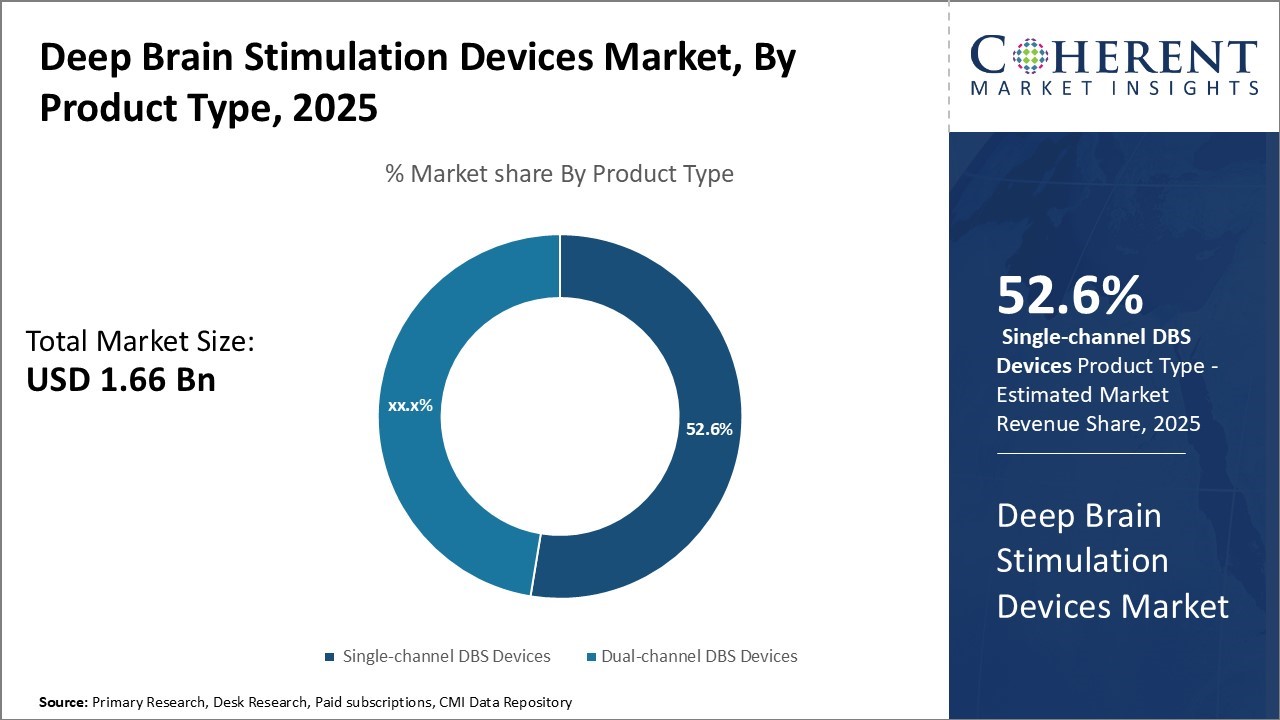
Deep Brain Stimulation Devices Market Insights, By Product Type: Affordability and Effectiveness Drive Adoption of Single-channel DBS Devices
In terms of Product Type, Single-channel DBS Devices segment is estimated to contribute the highest market share with 53.6% in 2026, owing to their affordable price point and proven effectiveness.
As hospitals, clinics, and other healthcare providers aim to treat more patients while managing costs, single-channel devices have emerged as an attractive option. Their simpler, single lead design allows for lower production expenses which are passed on to customers. This has made deep brain stimulation therapy accessible to a wider population grappling with neurological conditions.
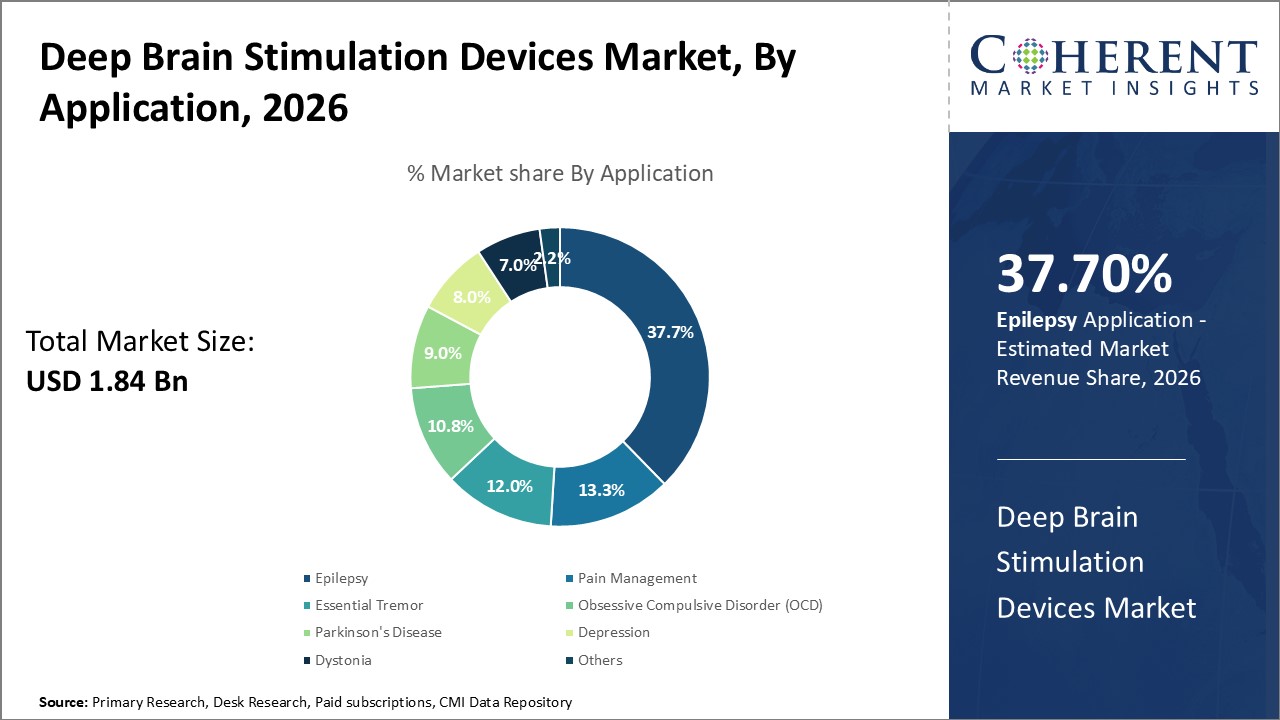
Deep Brain Stimulation Devices Market Insights, By Application: Expanding Use of Deep Brain Stimulation Device in Pain Management
In terms of Application, Pain Management segment is estimated to contribute the highest market share of 37.7% in 2026. Though Deep Brain Stimulation was first approved to treat movement disorders like Parkinson's disease, its use has rapidly expanded into new therapeutic areas.
Chronic pain affects millions and poses a major global health challenge due to limited treatment options and side effects of medication. As a result, neurological centers have actively evaluated deep brain stimulation as an alternative approach for pain syndromes. Studies show DBS can significantly reduce intensity and interference of various types of pain including those related to trauma, arthritis, and neurological damage.
Deep Brain Stimulation Devices Market Insights, By End User: Hospitals Lead as the Major End User Due to Infrastructure and Expertise
In terms of End User, Hospitals segment is estimated to contribute the highest market share of 41.6% in 2026, owing to their advanced infrastructure and multidisciplinary teams.
Deep brain stimulation requires sophisticated operating rooms, specialized imaging equipment, and coordinated care by neurosurgeons, neurologists, nurses, and technicians. It also demands comprehensive follow-up support for optimal therapeutic effect. While some clinics have capability for DBS, hospitals are best equipped to cater to the entire integrated process from patient selection to long-term management.
Emerging Innovations in the Deep Brain Stimulation Devices Market
- Directional Leads and Current Steering
- One of the notable innovations in DBS is the introduction of directional leads or segmented electrodes. Unlike traditional ring-shaped electrodes that stimulate all brain tissues around the lead equally, directional leads can steer the electrical current towards specific neuronal targets while avoiding unwanted side effects. This precision reduces adverse symptoms such as speech difficulties or muscle contractions and maximizes therapeutic benefits.
- Closed-Loop or Adaptive DBS Systems
- These advanced systems utilize real-time brain signal monitoring, such as local field potentials (LFPs), to automatically modulate stimulation parameters based on neural feedback. This dynamic approach tailors therapy to fluctuating symptoms, enhancing efficacy and reducing side effects compared to conventional open-loop systems that provide continuous stimulation without feedback. For example, in Parkinson’s disease patients, adaptive DBS may reduce tremors more effectively by increasing stimulation only when pathological neural activity crosses a threshold.
Impacts of Artificial Intelligence (AI) on the Deep Brain Stimulation Devices Market
Artificial Intelligence (AI) is reshaping the landscape of the Deep Brain Stimulation (DBS) devices market by enhancing the precision, adaptability, and overall effectiveness of neurological therapies.
- Boston Scientific, a leading player in the neurostimulation market, has incorporated AI into its Central Nervous System (CNS) portfolio. Its approach uses AI-driven data analytics to better understand patient-specific neural responses and fine-tune DBS therapy dynamically, which can reduce side effects and improve symptom management. This integration illustrates how AI is transitioning from experimental models to core operational strategies in medical device firms.
- Abbott Laboratories provides a compelling example of AI-enhanced DBS through their Infinity DBS System, which integrates advanced motion sensors and data-driven analytics. The AI component analyzes patient movement and neural feedback to personalize stimulation settings, offering a more responsive and user-friendly experience. Patients benefit from improved symptom control and fewer stimulation-induced side effects, leading to better quality of life. Furthermore, clinicians gain valuable insights from AI-generated data, enabling more informed decision-making and refined treatment protocols.
Regional Insights
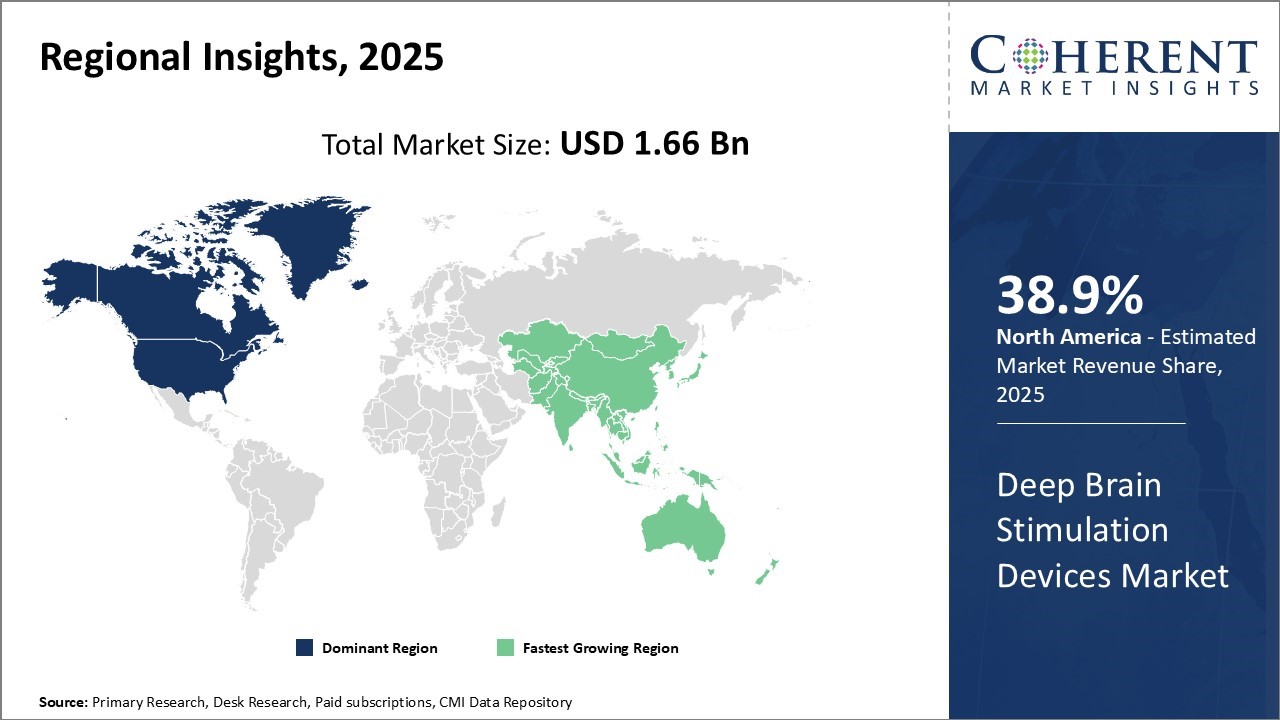
North America Deep Brain Stimulation Devices Market Analysis and Trends
North America dominates the deep brain stimulation devices market with an estimated share of 38.9% in 2026. This can be attributed to factors such as the presence of major industry players, availability of reimbursements, growing aging population susceptible to neurological disorders, and technical advancements.
In May 2026, the 77th American Academy of Neurology (AAN) Annual meeting that took place in San Diego, CA, and online, brought together neurologists and neuroscience professionals to discuss the latest advances in the understanding and treatment of a variety of neurological disorders. With over 14,500 experts in neurological health from 110 countries and all 50 U.S. states, the AAN 2026 Annual Meeting boasted the best of this expertise. The gathering transcended borders to expand, build on, and strengthen knowledge in research and clinical practice.
Asia Pacific Deep Brain Stimulation Devices Market Analysis and Trends
The Asia Pacific region exhibits the fastest growth with an estimated share of 28.2% in 2026 and is expected to rise at a considerable rate over the forecast period. This can be credited to the improving healthcare infrastructure, increasing medical tourism, growing prevalence of neurological disorders due to changing lifestyle habits, rising disposable incomes, and supportive government policies focused on strengthening the medical devices industry across countries in the region.
For instance, as per a report by the Global Wellness Institute, among the world’s top 25 wellness markets, Thailand ranked #1 in wellness market growth from 2022 to 2023, with 28.4% growth, according to GWI’s latest Wellness Economy Monitor. Thailand’s wellness market grew from USD 31.6 billion in 2022 to USD 40.5 billion in 2023. Globally, Thailand is ranked as the 24th largest wellness economy, 9th in the Asia-Pacific region, and 15th worldwide for wellness tourism.
Global Deep Brain Stimulation Devices Market Outlook for Key Countries
U.S Deep Brain Stimulation Devices Market Analysis and Trends
The U.S. deep brain stimulation devices market is anticipated to lead globally during the forecast period, driven by the rising prevalence of neurological disorders such as Parkinson's disease, dystonia, and essential tremors, along with an increasing number of clinical trials targeting psychiatric disorders. Technological advancements in DBS, including improved lead designs, implantable pulse generators, and remote monitoring capabilities, are enhancing the therapy's effectiveness and safety in the U.S.
In February 2026, the U.S. Food and Drug Administration approved the first adaptive, or self-adjusting, deep brain stimulation (DBS) system for Parkinson’s — the Medtronic Percept.
Japan Deep Brain Stimulation Devices Market Analysis and Trends
The deep brain stimulation devices market in Japan is experiencing substantial growth, fueled by the rising demand for innovative treatments for neurological disorders. DBS is approved in Japan for treating Parkinson's disease, and the market has shown steady expansion in recent years. The increasing prevalence of neurological disorders, driven by the country's aging population, has significantly boosted the demand for DBS devices.
Germany Deep Brain Stimulation Devices Market Analysis and Trends
Germany's robust healthcare system supports the demand for deep brain stimulation devices, with significant investments in medical technology. Boston Scientific Corporation has received CE Mark and launched the fourth-generation vercise genus deep brain stimulation (DBS) system in Germany. The system, featuring full-body MRI compatibility and Bluetooth capabilities, is designed to treat Parkinson's disease, essential tremor, and dystonia through precise brain stimulation for optimal symptom relief.
In January 2026, Medtronic achieved CE Mark approval for BrainSense adaptive deep brain stimulation and Electrode Identifier, a groundbreaking advance in personalized, sensing-enabled care for people with Parkinson's through innovative brain-computer interface technology.
U.K. Deep Brain Stimulation Devices Market Analysis and Trends
The U.K.'s National Health Service (NHS) has been integrating advanced deep brain stimulation technologies to address neurological disorders. In November 2022, the NHS adopted new DBS systems with enhanced MRI compatibility, improving treatment accessibility and patient safety. These developments highlight the global expansion and acceptance of DBS devices, driven by technological innovations and supportive healthcare policies.
Pricing Analysis of the Deep Brain Stimulation Devices Market
- Implantable Pulse Generator (IPG)
- Single-channel systems are rare but may be observed in specialized use cases. Prices start from around USD 12,000, but these are largely obsolete or limited in function.
- Multi-channel IPGs (4+ electrodes) are standard for most DBS applications.
- Rechargeable models tend to be priced higher (up to USD 40K).
- Non-rechargeable are less expensive but incur replacement surgeries approx. every 3-5 years.
- Leads/Electrodes
- Approximate pricing per lead ranges between USD 4,000 to USD 7,000.
- Directional leads which allow precise current steering cost 20-30% more.
- Typical implantation requires 2 leads → USD 8,000 – USD 14,000.
- Extensions
- The extension wires cost between USD 1,000 – USD 3,000 depending on length and features
- Surgery and Ancillary Costs
- In the U.S., total surgical + hospital charges are approximately USD 50,000 to USD 70,000.
- European countries range between USD 22,000 USD – USD 55,000 USD
- Emerging markets offer lower costs, sometimes below USD20,000 for surgery (excluding device cost).
- Programming and follow-up: Costs may vary based on insurance coverage but typically add USD 1,000 – USD 5,000 per year.
Market Report Scope
Deep Brain Stimulation Devices Market Report Coverage
| Report Coverage | Details | ||
|---|---|---|---|
| Base Year: | 2025 | Market Size in 2026: | USD 1.84 Bn |
| Historical Data for: | 2020 To 2024 | Forecast Period: | 2026 To 2033 |
| Forecast Period 2026 to 2033 CAGR: | 10.9% | 2033 Value Projection: | USD 3.80 Bn |
| Geographies covered: |
| ||
| Segments covered: |
| ||
| Companies covered: | Abbott, Medtronic, Boston Scientific Corporation, Neuropace Inc., LivaNova Plc, Renishaw Plc, Aleva Neurotherapeutics S.A., Beijing Pinchi Medical Equipment Co. Ltd, Nexstim, St. Jude Medical (now part of Abbott), Cyberonics (now part of LivaNova), EBR Systems, IntraPace, Nevro Corp, and Stimwave Technologies | ||
| Growth Drivers: |
| ||
| Restraints & Challenges: |
| ||
Deep Brain Stimulation Devices Industry News
- In February 2025, Medtronic plc, a global leader in healthcare technology, announced U.S. Food and Drug Administration (FDA) approval of BrainSense Adaptive deep brain stimulation (aDBS) and BrainSense Electrode Identifier (EI).
- In March 2025, the Advanced Therapies in Movement Disorders (ATMD) team at the University of Colorado School of Medicine’s Movement Disorders Center completed the first deep brain stimulation programming using new electrode identifier (EI) and adaptive deep brain stimulation (aDBS) technology now available to patients with Parkinson’s disease.
- In March 2025, Newronika announced the preparation for the commercial launch of AlphaDBS — a next-generation adaptive deep brain stimulation (DBS) system for treating Parkinson’s disease — at selected markets in Europe this year, following CE Mark approval in the European Union.
- In March 2025, Hackensack Meridian Neuroscience Institute first in New Jersey to implant deep brain stimulation 16 contact led device to improve outcomes for patients with complex symptoms.
Analyst View
- The Deep Brain Stimulation (DBS) devices market is poised for significant advancements driven by the rising prevalence of neurological disorders such as Parkinson’s disease, essential tremor, and dystonia. Increasing awareness among patients and healthcare providers about the efficacy of DBS in managing these conditions is a key growth driver.
- Technological innovations, including the development of rechargeable and MRI-compatible devices, are enhancing patient outcomes and expanding the potential use cases of DBS therapy. However, the high cost of DBS devices and the invasive nature of the procedure continue to pose challenges, limiting adoption in cost-sensitive markets.
- North America currently dominates the market, supported by a well-established healthcare infrastructure, presence of major device manufacturers, and favorable reimbursement scenarios. Meanwhile, the Asia Pacific region is undergoing rapid growth, driven by improving healthcare access and increasing incidence of neurological diseases.
- Regulatory approvals and favorable policies will further facilitate market penetration globally. Nevertheless, ethical concerns and the complexity of surgical procedures necessitate continued training and improved patient selection criteria.
- Overall, the DBS devices market presents encouraging prospects, balancing innovative opportunities with carefully managed clinical challenges to address unmet medical needs in neuromodulation therapy.
Market Segmentation
- Product Type Insights (Revenue, USD Bn, 2021 - 2033)
- Single-channel DBS Devices
- Dual-channel DBS Devices
- Application Insights (Revenue, USD Bn, 2021 - 2033)
- Epilepsy
- Pain Management
- Essential Tremor
- Obsessive Compulsive Disorder (OCD)
- Parkinson’s Disease
- Depression
- Dystonia
- Others
- End User Insights (Revenue, USD Bn, 2021 - 2033)
- Hospitals
- Neurology Clinics
- Ambulatory Surgical Centers
- Research Centers
- Others
- Regional Insights (Revenue, USD Bn, 2021 - 2033)
- North America
- U.S.
- Canada
- Latin America
- Brazil
- Argentina
- Mexico
- Rest of Latin America
- Europe
- Germany
- U.K.
- Spain
- France
- Italy
- Russia
- Rest of Europe
- Asia Pacific
- China
- India
- Japan
- Australia
- South Korea
- ASEAN
- Rest of Asia Pacific
- Middle East
- GCC Countries
- Israel
- Rest of Middle East
- Africa
- South Africa
- North Africa
- Central Africa
- Key Players Insights
- Abbott
- Medtronic
- Boston Scientific Corporation
- Neuropace Inc.
- LivaNova Plc
- Renishaw Plc
- Aleva Neurotherapeutics S.A.
- Beijing Pinchi Medical Equipment Co. Ltd.
- Nexstim
- Jude Medical (now part of Abbott)
- Cyberonics (now part of LivaNova)
- EBR Systems
- IntraPace
- Nevro Corp
- Stimwave Technologies
Sources
Primary Research Interviews
- Neurosurgeons
- Neurologists
- Medical Device Manufacturers
- Hospital Procurement Managers
- Others
Magazines
- Medical Device and Diagnostic Industry (MD+DI)
- Neurology Today
- Neuroscience News
- Biomedical Instrumentation & Technology
- Others
Journals
- Journal of Neurology
- Neurosurgery & Psychiatry
- Neuromodulation Technology at the Neural Interface
- Brain Stimulation
- Others
Newspapers
- The New York Times (Health Section)
- The Guardian (Health & Science)
- Financial Times (Healthcare Section)
- The Wall Street Journal (Health Industry)
- Others
Associations
- International Neuromodulation Society (INS)
- American Academy of Neurology (AAN)
- Medical Device Manufacturers Association (MDMA)
- European Association of Neurological Societies (EANS)
- Others
Public Domain Sources
- World Health Organization (WHO)
- U.S. Food and Drug Administration (FDA)
- Centers for Disease Control and Prevention (CDC)
- ClinicalTrials.gov
- Others
Proprietary Elements
- CMI Data Analytics Tool – Deep Brain Stimulation Devices Market
- CMI Existing Repository of Information for the Last 8 Years
*Definition: The Deep Brain Stimulation (DBS) Devices Market refers to the global industry involved in the research, development, production, and commercialization of implantable medical devices used to deliver electrical stimulation to specific areas of the brain. These devices are primarily used to treat neurological and psychiatric disorders, such as Parkinson’s disease, essential tremor, dystonia, epilepsy, and obsessive-compulsive disorder (OCD).
Get access to 250+ pages report
Every segment, forecast, competitor profile and data table behind the analysis above — available for instant download.
- ESOMAR Member
- ISO 9001:2015 Certified
- D-U-N-S Registered
- GDPR & CCPA Compliant
Missing comfort of reading report in your local language? Find your preferred language:
Transform your Strategy with Exclusive Trending Reports
Frequently Asked Questions
The deep brain stimulation devices market is estimated to be valued at USD 1.84 Bn in 2026, and is expected to reach USD 3.80 Bn by 2033.
The CAGR of the Deep Brain Stimulation Devices Market is projected to be 10.9% from 2026 to 2033.
Increasing prevalence of neurological disorders and advancements in DBS technology enhancing safety and efficacy are the major factors driving the growth of the global deep brain stimulation devices market.
High cost of DBS devices and surgical risks associated with DBS procedures are the major factors hampering the growth of the global deep brain stimulation devices market.
In terms of product type, single-channel DBS devices segment is estimated to dominate the market revenue share in 2026.
Abbott, Medtronic, Boston Scientific Corporation, Neuropace Inc., LivaNova Plc, Renishaw Plc, Aleva Neurotherapeutics S.A., Beijing Pinchi Medical Equipment Co. Ltd, Nexstim, St. Jude Medical (now part of Abbott), Cyberonics (now part of LivaNova), EBR Systems, IntraPace, Nevro Corp, and Stimwave Technologies are the major players in the deep brain stimulation devices market.
North America is expected to lead the global deep brain stimulation devices market in 2026.