

Pulmonary Artery Catheters Market Size and Forecast — 2026 - 2033
The Global Pulmonary Artery Catheters Market size is estimated to be valued at USD 520 million in 2026 and is expected to reach USD 780 million by 2033, exhibiting a compound annual growth rate (CAGR) of 5.8% from 2026 to 2033.
Overview
Key drivers of the Pulmonary Artery Catheters Market include the rising prevalence of cardiovascular and critical care conditions such as heart failure, shock, and pulmonary hypertension, which increase demand for advanced hemodynamic monitoring. Growth in surgical procedures and ICU admissions further fuels adoption of pulmonary artery catheters for real‑time cardiovascular assessment. Technological advancements improving catheter accuracy and safety enhance clinical utility. Additionally, expanding healthcare infrastructure and increased healthcare expenditure in emerging markets support market growth. Awareness among clinicians regarding the importance of precise hemodynamic data for optimizing treatment outcomes also contributes to higher utilization of pulmonary artery catheters globally.
Key Takeaways
Hemodynamic monitoring dominates the Pulmonary Artery Catheters Market, accounting for nearly 65% of the market share due to its extensive use in intensive care units and advanced cardiovascular monitoring applications.
Hospitals represent the leading end-user segment, contributing significantly to market revenue because of the high volume of cardiac surgeries, critical care admissions, and complex cardiovascular disease management procedures.
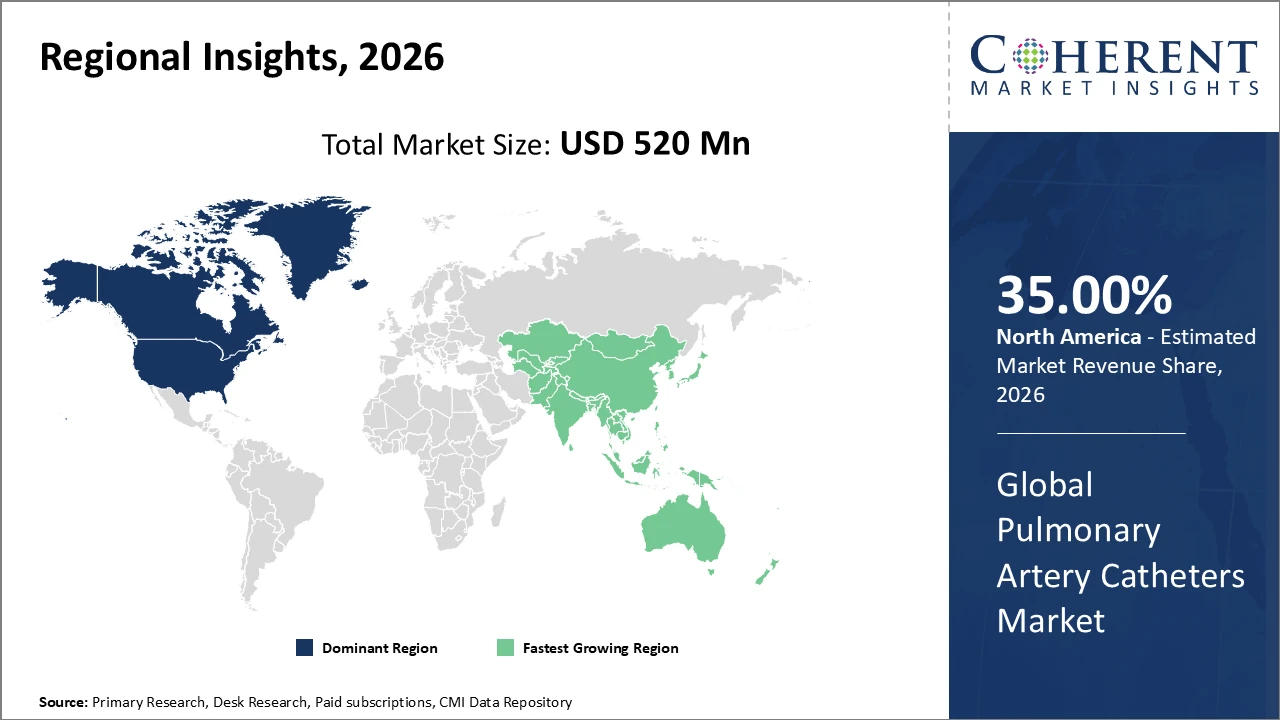
North America holds more than 35% of the global Pulmonary Artery Catheters Market share, supported by advanced healthcare infrastructure, strong reimbursement systems, and widespread adoption of critical care monitoring technologies.
Asia Pacific is the fastest-growing regional market, driven by expanding healthcare infrastructure, rising cardiovascular disease prevalence, and increasing adoption of advanced catheter-based monitoring systems in countries such as China and India.
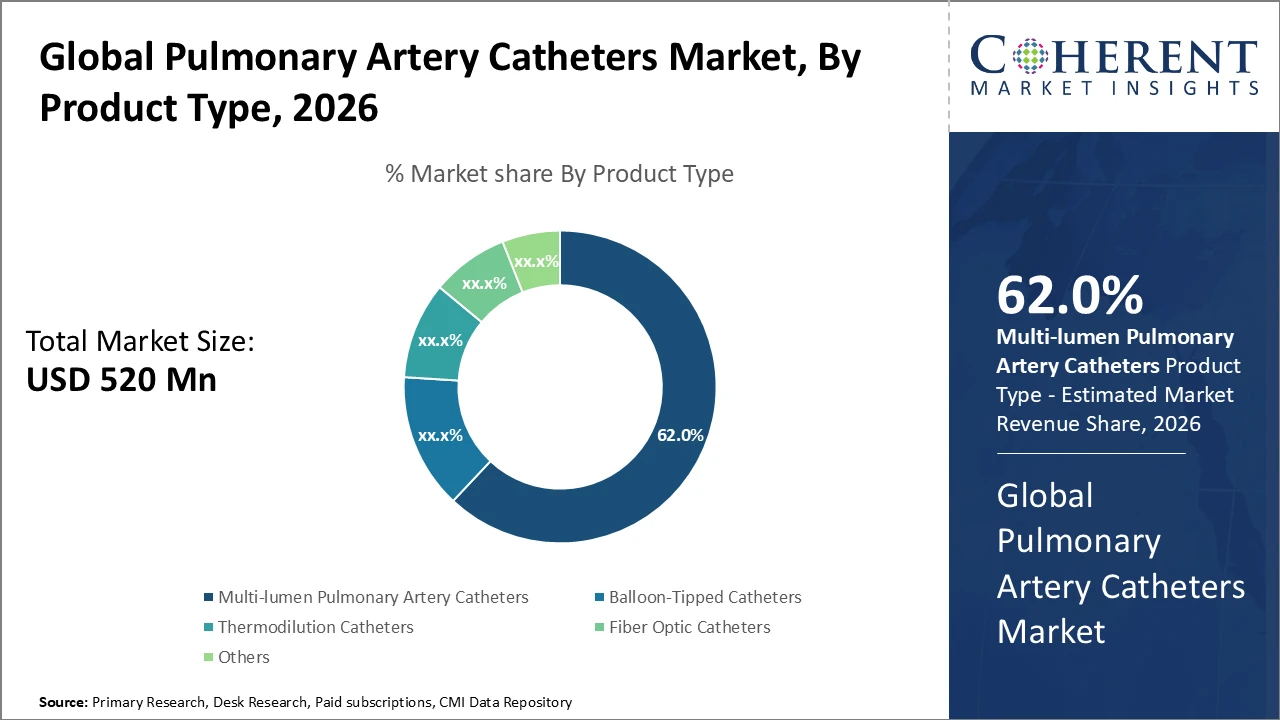
Multi-lumen pulmonary artery catheters lead the product type segment with approximately 62% market share due to their superior diagnostic accuracy, multifunctional monitoring capabilities, and versatility in critical care and cardiac surgery applications.
Pulmonary Artery Catheters Market Segmentation Analysis
Pulmonary Artery Catheters Market Insights, By Product Type
Multi-lumen pulmonary artery catheters dominate the Pulmonary Artery Catheters Market with a share of 62% due to their ability to perform simultaneous hemodynamic monitoring, pressure measurement, and drug administration in critical care settings. Their widespread use in cardiac surgery and intensive care units is supported by technological advancements that improve monitoring accuracy and reduce procedural complications. Balloon-tipped catheters remain essential for pulmonary artery wedge pressure monitoring in heart failure management. Thermodilution catheters are the fastest-growing subsegment because of their precise cardiac output measurement capabilities and integration with advanced monitoring systems. Fiber optic catheters offer enhanced waveform accuracy for specialized applications, while other niche catheter types serve limited but clinically important monitoring needs.
Pulmonary Artery Catheters Market Insights, By Application
Hemodynamic monitoring dominates the Pulmonary Artery Catheters Market, accounting for nearly 65% of total market revenue due to the increasing need for continuous cardiac output and circulatory monitoring in conditions such as heart failure, septic shock, and critical illness. Technological advancements improving catheter accuracy and real-time data analysis continue to strengthen this segment. Postoperative care applications are also expanding as pulmonary artery catheters help detect hemodynamic instability following major surgical procedures and support improved patient outcomes. Critical care applications maintain strong demand within intensive care units for fluid management and circulatory assessment in patients with multi-organ dysfunction. Additional niche applications include pulmonary hypertension diagnosis and specialized clinical research activities.
Pulmonary Artery Catheters Market Insights, By End User
Hospitals dominate the Pulmonary Artery Catheters Market, contributing nearly 71% of total market revenue due to the high concentration of intensive care units, cardiac surgery centers, and advanced critical care facilities. Large procedural volumes and increasing demand for sophisticated hemodynamic monitoring systems continue to support widespread catheter adoption in hospitals. Ambulatory surgical centers represent a growing segment as minimally invasive monitoring procedures gain popularity for outpatient care and cost-efficient treatment approaches. Cardiac care units remain an important niche segment focused on high-risk cardiovascular patient monitoring and disease management. Research institutes contribute through innovation and clinical trials, while specialty clinics and emergency care units maintain limited but clinically significant catheter usage.
Pulmonary Artery Catheters Market Trends
The Pulmonary Artery Catheters Market is increasingly adopting digital and wireless monitoring technologies to improve hemodynamic monitoring precision, patient management efficiency, and real-time data transmission within intensive care settings.
In 2026, healthcare providers in the United States significantly increased the use of wireless telemetry-enabled pulmonary artery catheters, enhancing ICU monitoring capabilities and supporting improved patient outcomes in critical care environments.
Growing focus on infection prevention and hospital safety following the COVID-19 pandemic has accelerated demand for disposable pulmonary artery catheter variants, contributing to notable market revenue growth across European healthcare systems during 2025.
Emerging markets are witnessing increased development of cost-effective locally manufactured pulmonary artery catheters, particularly in countries such as India, reducing import dependency and improving access to advanced critical care monitoring technologies.
Pulmonary Artery Catheters Market Insights, By Geography
North America Pulmonary Artery Catheters Market Analysis and Trends
North America holds approximately 35% of the global Pulmonary Artery Catheters Market share, supported by advanced healthcare infrastructure, strong reimbursement frameworks, and a high prevalence of cardiovascular diseases requiring intensive monitoring and critical care management. The region benefits from widespread adoption of advanced hemodynamic monitoring technologies across hospitals, cardiac surgery centers, and intensive care units. Companies such as Edwards Lifesciences and Abbott Laboratories have played a major role in market expansion through continuous innovation in pulmonary artery catheter systems and integrated monitoring technologies. Increasing investments in critical care modernization further strengthen regional market growth and technological leadership.
Asia Pacific Pulmonary Artery Catheters Market Analysis and Trends
Asia Pacific is the fastest-growing region in the Pulmonary Artery Catheters Market, projected to expand at a CAGR exceeding 7% due to rapid healthcare infrastructure development, increasing cardiovascular disease prevalence, and rising demand for advanced critical care monitoring solutions. Countries such as China and India are significantly expanding intensive care unit capacities and investing heavily in modern cardiac care facilities. Growing awareness regarding cardiovascular health and early disease diagnosis is also supporting market growth. In addition, the presence of emerging regional medical device manufacturers and supportive government healthcare initiatives are accelerating the adoption of pulmonary artery catheters and advanced hemodynamic monitoring technologies across the region.
Pulmonary Artery Catheters Market Outlook for Key Countries
USA Pulmonary Artery Catheters Market Analysis and Trends
The United States remains a key market within the Pulmonary Artery Catheters industry due to its advanced healthcare ecosystem, high prevalence of heart failure and chronic respiratory diseases, and continuous innovation in critical care technologies. Increasing investments in intensive care infrastructure and adoption of smart catheter systems contributed to notable market revenue growth in 2026. Hospitals and healthcare providers are increasingly implementing advanced hemodynamic monitoring solutions to support precise clinical decision-making and improve patient outcomes. Major companies such as Edwards Lifesciences and Abbott Laboratories continue collaborating with hospitals and research institutions to accelerate innovation and expand the adoption of next-generation pulmonary artery catheter technologies across the country.
Germany Pulmonary Artery Catheters Market Analysis and Trends
Germany’s Pulmonary Artery Catheters Market is witnessing steady growth due to the rising prevalence of cardiovascular diseases, increasing demand for advanced hemodynamic monitoring, and expanding adoption of minimally invasive critical care procedures. The country benefits from a highly developed healthcare infrastructure, specialized cardiac surgery centers, and strong clinical expertise in intensive care management. Advanced pulmonary artery catheters with thermodilution and continuous cardiac output monitoring capabilities are gaining wider acceptance in hospitals and tertiary care centers. Germany’s aging population and growing incidence of heart failure further support market demand. In addition, continuous technological innovation and strict medical quality standards continue to strengthen market expansion across the country.
Analyst Opinion
The increasing adoption of minimally invasive pulmonary artery catheter technologies is significantly improving patient safety, reducing procedural complications, and supporting faster post-operative recovery rates across hospitals and critical care facilities.
Expansion of intensive care unit capacities and the growing number of cardiac surgeries worldwide continue to drive demand for pulmonary artery catheters, particularly for advanced hemodynamic monitoring and cardiovascular management applications.
Regional pricing structures and reimbursement policies strongly influence market revenue growth, with supportive government healthcare initiatives improving accessibility and adoption of critical care catheter technologies in several emerging healthcare markets.
Emerging economies such as India and Brazil are witnessing rapid market penetration due to rising healthcare infrastructure investments, increasing cardiovascular disease prevalence, and expanding critical care and intensive care monitoring capabilities.
- Current Industry Events of 2026
- Market Size Estimation
- Regional Breakdown
- Competitive Landscape
- Customer Intelligence
- Segmental Analysis
- Pricing Analysis
- Key Market Drivers, Challenges & Future Trends
- Customized Insights Section
Market Scope
| Report Coverage | Details | ||
|---|---|---|---|
| Base Year: | 2025 | Market Size in 2026: | USD 520 million |
| Historical Data for: | 2020 To 2024 | Forecast Period: | 2026 To 2033 |
| Forecast Period 2026 to 2033 CAGR: | 5.8% | 2033 Value Projection: | USD 780 million |
| Geographies covered: |
| ||
| Segments covered: |
| ||
| Companies covered: | Abbott Laboratories, Smith Medical, Medtronic PLC, Cook Medical, Terumo Corporation, Philips Healthcare, Vygon SA, BD Medical, Olympus Corporation, Teleflex Incorporated | ||
| Growth Drivers: |
| ||
Pulmonary Artery Catheters Market Growth Factors
The Pulmonary Artery Catheters Market is primarily driven by the increasing prevalence of cardiovascular diseases, heart failure, and acute respiratory disorders requiring advanced hemodynamic monitoring and intensive care management. Rising investments in critical care infrastructure, particularly across developing economies, are supporting broader adoption of advanced catheter technologies in hospitals and cardiac surgery centers. The growing geriatric population, which faces a higher risk of cardiac complications and chronic illnesses, continues to increase demand for precise circulatory monitoring devices. In addition, continuous technological advancements focused on improving catheter safety, accuracy, and minimally invasive functionality are strengthening clinical confidence and expanding the use of pulmonary artery catheters in complex surgical procedures and intensive care environments globally.
Pulmonary Artery Catheters Market Development
In November 2025, Dynarex Corp introduced the Resp-O₂ Vortex 72 Closed Suction Catheter, designed for safer and more efficient airway management in ventilated patients.
Key Players
Leading Companies of the Market
Abbott Laboratories
Cook Medical
Medtronic PLC
Smith Medical
Philips Healthcare
Terumo Corporation
Vygon SA
BD Medical
Olympus Corporation
Teleflex Incorporated
Several leading companies in the Pulmonary Artery Catheters Market are strengthening their competitive positions through strategic collaborations, regional expansion, and continuous product innovation. For instance, Edwards Lifesciences expanded its critical care portfolio in 2026 by introducing advanced balloon-tipped multichannel pulmonary artery catheters designed for enhanced hemodynamic monitoring accuracy and patient management. Teleflex increased its market presence through aggressive expansion strategies across Asia Pacific during 2025, supporting substantial sales growth in emerging healthcare markets. Additionally, Abbott Laboratories strengthened market penetration by implementing customized pricing strategies tailored to developing economies, improving accessibility to advanced catheter technologies and expanding its global market footprint.
Pulmonary Artery Catheters Market Future Outlook
The Pulmonary Artery Catheters Market is expected to witness steady growth in the coming years due to the increasing prevalence of cardiovascular diseases, rising critical care admissions, and growing demand for advanced hemodynamic monitoring technologies. Continuous advancements in catheter design, minimally invasive monitoring techniques, and real-time cardiac output measurement systems are expected to improve clinical outcomes and expand adoption across intensive care units and cardiac surgery centers. Hospitals are increasingly integrating advanced pulmonary artery catheters with digital monitoring platforms to enhance patient management and decision-making. Expanding healthcare infrastructure in emerging economies and rising investments in critical care services will further support long-term market expansion globally.
Pulmonary Artery Catheters Market Historical Analysis
The Pulmonary Artery Catheters Market has experienced gradual growth over the past decade due to the increasing burden of cardiovascular diseases, rising critical care requirements, and advancements in hemodynamic monitoring technologies. Initially, pulmonary artery catheters were primarily adopted in intensive care units and cardiac surgery procedures for monitoring cardiac output and pulmonary pressure. Over time, technological improvements introduced enhanced safety features, continuous monitoring capabilities, and minimally invasive catheter designs that improved clinical efficiency and patient outcomes. North America historically dominated the market because of advanced healthcare infrastructure and high adoption of critical care technologies, while Europe followed with strong cardiac care systems. Recently, Asia Pacific has emerged as a growing market driven by healthcare modernization and rising cardiovascular disease incidence.
Sources
Primary Research Interviews:
Cardiologists, intensivists, cardiac surgeons, and critical care specialists utilizing pulmonary artery catheters for hemodynamic monitoring, cardiac output measurement, and intensive care management.
Supply chain executives, medical device manufacturers, and procurement specialists responsible for sourcing catheter materials, pressure monitoring systems, and advanced critical care components.
Market analysts, R&D directors, and regulatory experts involved in cardiovascular device innovation, minimally invasive monitoring technologies, and critical care equipment development.
Magazines:
Cardiac Interventions Today – Updates on cardiovascular monitoring technologies, catheter innovations, and critical care procedures.
Medical Device and Diagnostic Industry – Insights into medical device advancements, catheter technologies, and healthcare manufacturing trends.
Critical Care Nurse – Coverage of intensive care practices, hemodynamic monitoring advancements, and patient management technologies.
Journals:
Journal of the American College of Cardiology – Studies on cardiovascular monitoring, pulmonary artery catheter applications, and cardiac care outcomes.
Critical Care Medicine – Research focused on intensive care monitoring, hemodynamic assessment, and critical care technologies.
The Annals of Thoracic Surgery – Research on cardiac surgery procedures, pulmonary artery catheter usage, and perioperative monitoring techniques.
Newspapers:
Financial Times – Coverage of healthcare investments, medical technology innovation, and hospital infrastructure developments.
Reuters – Reporting on catheter product launches, medical device approvals, and developments in cardiovascular healthcare sectors.
Bloomberg – Insights into mergers, acquisitions, R&D investments, and strategic developments within the medical device and critical care industries.
Associations:
American College of Cardiology – Clinical guidelines, cardiovascular research, and advancements in cardiac monitoring technologies.
Society of Critical Care Medicine – Critical care standards, hemodynamic monitoring insights, and intensive care research developments.
European Society of Cardiology – Research updates, conferences, and innovation trends related to cardiovascular care and catheter-based monitoring systems.
Get access to 250+ pages report
Every segment, forecast, competitor profile and data table behind the analysis above — available for instant download.
- ESOMAR Member
- ISO 9001:2015 Certified
- D-U-N-S Registered
- GDPR & CCPA Compliant
Missing comfort of reading report in your local language? Find your preferred language:
Transform your Strategy with Exclusive Trending Reports
Frequently Asked Questions
Leading companies in the Pulmonary Artery Catheters Market include Medtronic PLC, Abbott Laboratories, Becton, and Teleflex, all recognized for driving innovation through advanced catheter technologies and critical care monitoring solutions.
The Pulmonary Artery Catheters Market is projected to grow from USD 520 million in 2026 to USD 780 million by 2033, supported by rising cardiovascular disease prevalence and expanding critical care infrastructure globally.
Hospitals represent the largest growth opportunity due to increasing ICU admissions, rising cardiac surgeries, and growing demand for advanced hemodynamic monitoring technologies in critical care settings.
Future market trends will focus on minimally invasive pulmonary artery catheter systems, smart monitoring technologies integrated with digital healthcare platforms, and increasing adoption of disposable catheter products to improve infection control and patient safety.
The market remains highly competitive with companies emphasizing technological innovation, regional expansion, and product differentiation, while major challenges include strict regulatory requirements, pricing pressure, and cost sensitivity in emerging healthcare markets.
Common market strategies include strategic partnerships, customized regional pricing models, expansion into emerging economies, and continuous product innovation focused on improving clinical safety, monitoring accuracy, and procedural efficiency.