

Smart Hospitals Market Analysis & Forecast: 2026-2033
Smart hospitals market is likely to surpass USD 72.21 Bn in 2026 and will reach USD 272.65 Bn in 2033, exhibiting a compound annual growth rate (CAGR) of 20.9% from 2026 to 2033.
Key Takeaways
- Based on Component, Software System segment is likely to hold 43% shares in the global market in 2026.
- By Technology, Cloud Computing division will lead the global market in 2026.
- By Application, Medical Connected Imaging division will hold dominant position in the global market in 2026.
- Based on Connectivity, Wireless segment will lead the global market in 2026.
- North America is likely to hold dominating position with 47.1% shares in 2026.
Current Events and its Impact on the Smart Hospitals Market
Current Event | Description and its Impact |
AI and Machine Learning Regulatory Framework Evolution |
|
Cybersecurity Threats and Healthcare Data Protection |
|
Impact of Artificial Intelligence on the Global Smart Hospitals Market
Hospitals are becoming smart with new software and devices. This change helps reduce costs and increase profits. It also improves patient care. Technologies like AI and the Internet of Things (IoT) are driving this growth. Wireless connectivity further boosts the smart hospital market worldwide.
For instance, in July 2025, KIMS Hospitals, Thane, launched the Thane region’s first AI-integrated 5G Smart Ambulance with Medulance. The system marked a big step in emergency care. It combined AI with real-time 5G connectivity. It helped improve pre-hospital patient management.
- Current Industry Events of 2026
- Market Size Estimation
- Regional Breakdown
- Competitive Landscape
- Customer Intelligence
- Segmental Analysis
- Pricing Analysis
- Key Market Drivers, Challenges & Future Trends
- Customized Insights Section
Segmental Insights
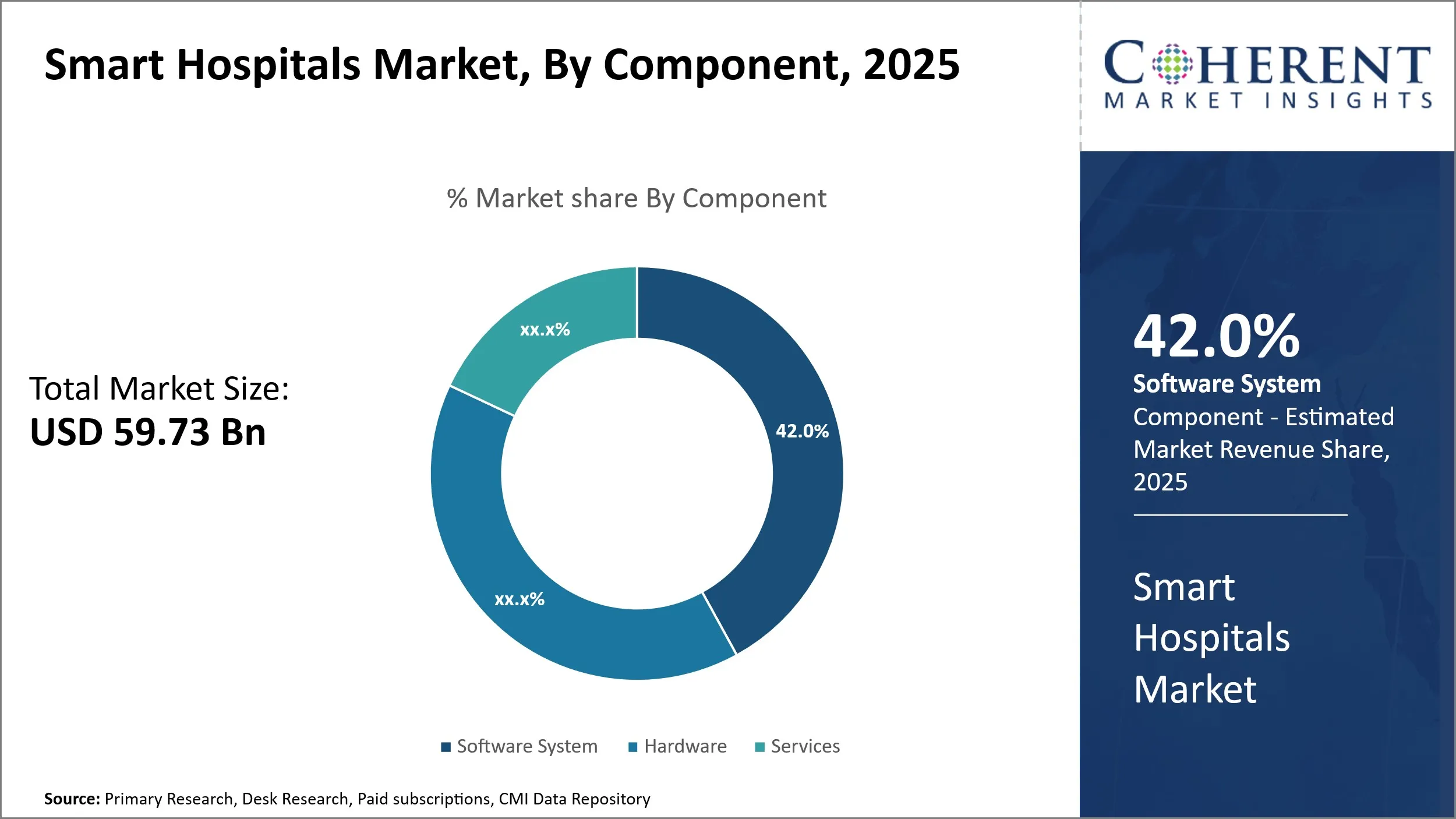
Global Smart Hospitals Market Insights, Based on Component
The software systems segment will dominate the global smart hospitals market with 43.0% shares in 2026. This is due to the increasing adoption of various growth strategies. Major key players are launching innovative products to expand their market share.
For instance, in March 2022, Intuitive MB (Intuitive Medical Buildings) announced the release of its medical building operating system. It used IoT, AI, and Machine Learning technologies. The system created smart hospitals and medical office buildings.
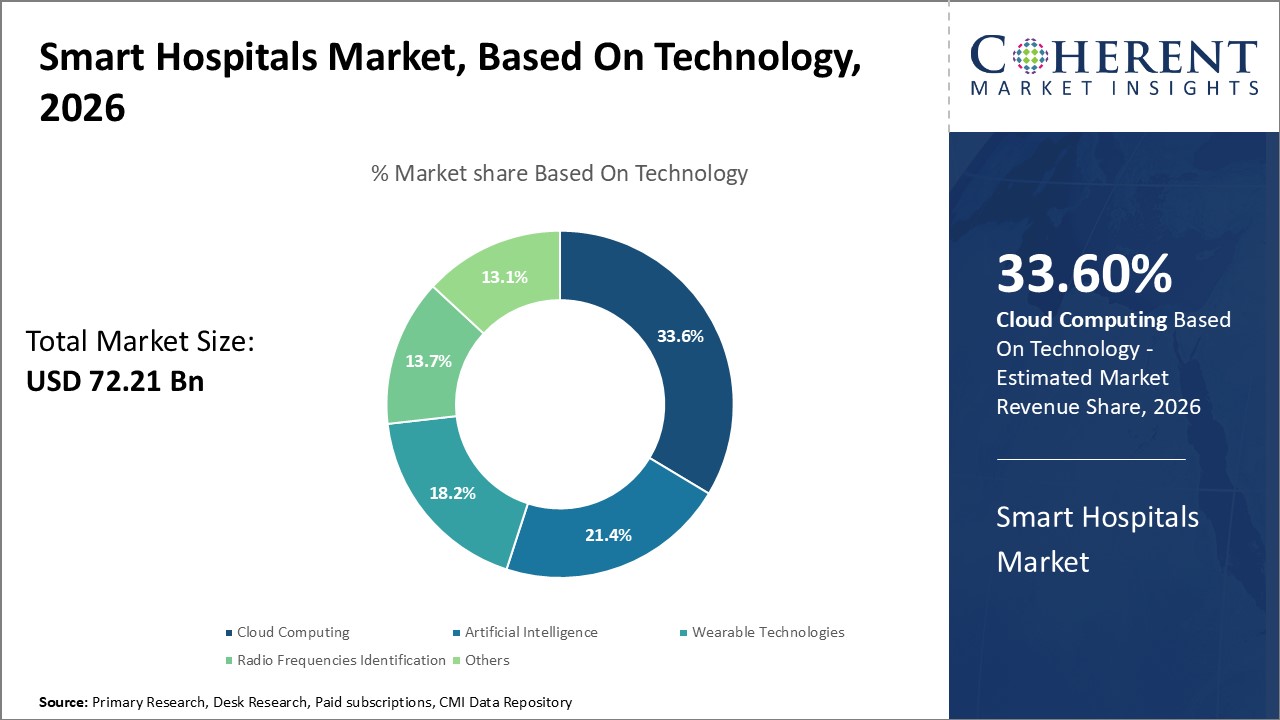
Global Smart Hospitals Market Insights, Based on Technology
The cloud computing segment is likely to dominate the market in 2026. This is due to increasing growth strategies such as partnerships for eHealth software by key market players.
For instance, in March 2023, Fujitsu announced the launch of a new cloud-based platform. It let users to collect and use health data. The platform supported digital transformation in healthcare.
Global Smart Hospitals Market Insights, Based on Application
The medical connected imaging segment will dominate the market in 2026. This is due to increasing growth strategies such as product launch and approval.
For instance, in August 2026, Samsung worked with NeuroLogica, a Samsung subsidiary. They announced the launch of their next-generation mobile CT product portfolio in India.
Global Smart Hospitals Market Insights, Based on Connectivity
The wireless segment will hold lions share in the global market in 2026. This is due to the increasing use of wireless technologies in smart hospitals.
For instance, in March 2023, Amala Hospital launched a new smart ward with wearable wireless technology. The ward had advanced tools for continuous
Regional Insights
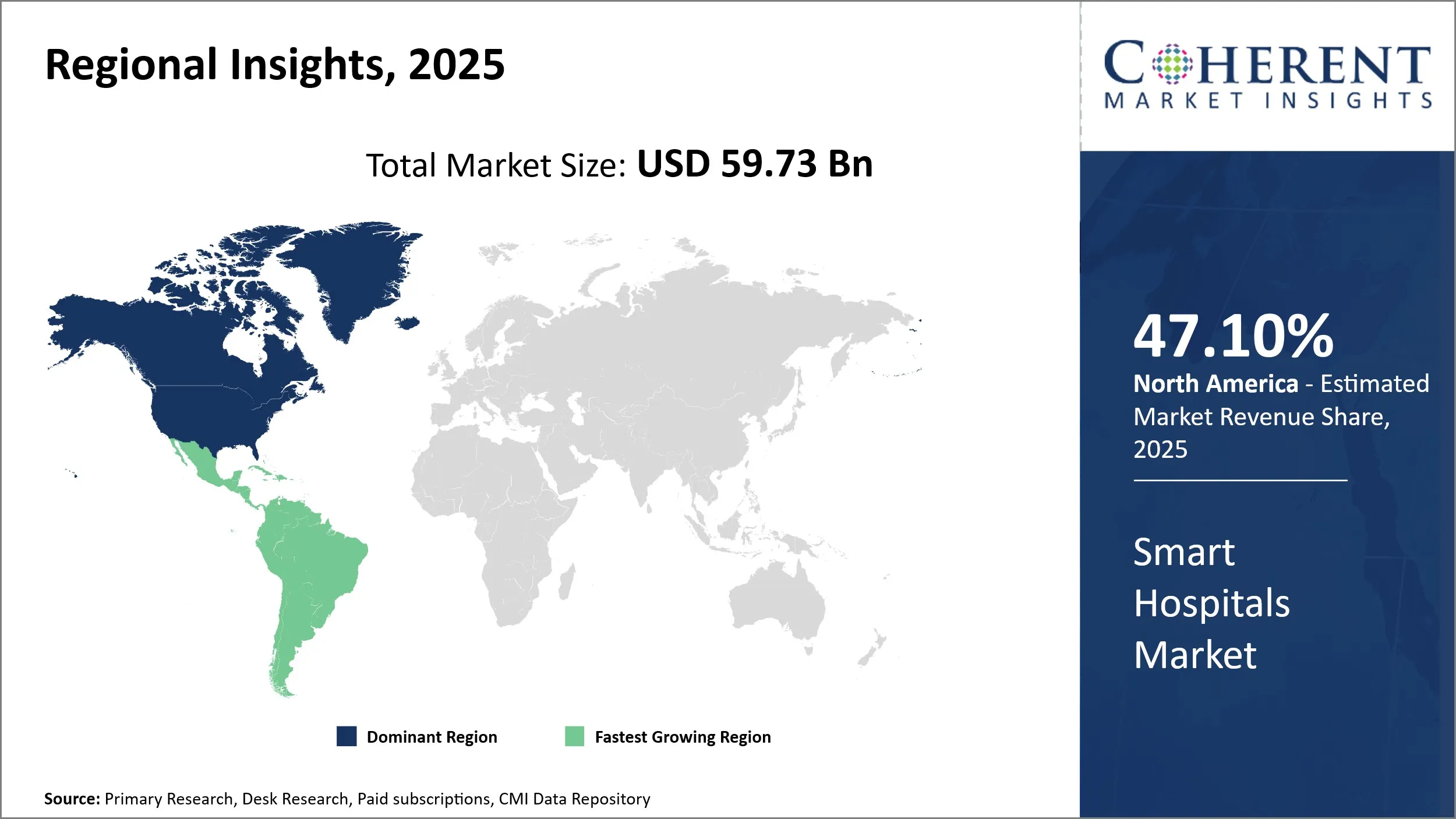
North America Smart Hospitals Market Analysis and Trends
North America will dominate the global smart hospitals market with 47.10% shares in 2026 owing to the increasing inorganic growth strategies.
For instance, in March 3, 2022, Intuitive MB (Intuitive Medical Buildings) announced the U.S. release of its “Smart Hospital” system. The system managed medical building operations. It aimed to improve hospital efficiency.
Latin America Smart Hospitals Market Analysis and Trends
Latin America is likely to lead the global smart hospital market during the forecast period. This is owing to rising investments in healthcare infrastructure. Rapid adoption of digital technologies will also lead to growth. Increasing demand for efficient patient care, along with the expansion of telemedicine drive demand.
For instance, in February 2026, Hospital Angeles Pedregal (Mexico) reached a major milestone. It installed the first Copan WASPLab® in Latin America. This move reinforced its commitment to advanced diagnostic technology. It also strengthened its focus on patient care.
Global Smart Hospitals Market – Dominating Countries
The U.S. Smart Hospitals Market Analysis and Trends
The U.S. will hold lion’s share in the global smart hospitals market during the forecast period. This is due to advanced healthcare infrastructure. Strong investment in medical technology and high adoption of AI and IoT solutions. Rising demand for efficient patient care and supportive government initiatives will fuel growth.
For instance, in July 2024, Get Well announced eight new smart patient room projects. They supported new construction initiatives. The projects were across the U.S. and globally.
China Smart Hospitals Market Analysis and Trends
China is likely to dominate the global market during the forecast period. This is owing to its large manufacturing base and strong labor force. China is investing in new technology and benefits from government support. These factors boost its global competitiveness.
For instance, in May 2026, China launched fully AI-powered hospital—Agent Hospital. It was a virtual medical facility. It was entirely staffed by artificial intelligence.
Analyst Opinion ( Expert Opinion)
The global smart hospital market is driven by digital transformation and rising healthcare costs. Trends such as AI-powered diagnostics and IoT-enabled monitoring is driving growth. Robotic surgery, and advanced data analytics are reshaping how hospitals operate.
North America is dominating due to strong healthcare infrastructure and high technology adoption. With government support and an increasing focus on patient-centered care. The region continues to set the pace for innovation in smart healthcare systems worldwide.
Speak to the analyst
Want personalized insights?
Take the findings above to one of our principal consultants, or have the report rebuilt around the segments, geographies and competitors you actually track.
Global Smart Hospitals Market: Key Developments
- In June 2024, Kardham Digital, the first Digital Services Company (DSC) launched Smart Hospital. It was a smart building and smart workplace solution for healthcare facilities.
- In October 2024, Siemens Smart Infrastructure partnered with Kantonsspital Baden (KSB) in Switzerland. It deployed technologies and digital services from the Siemens Xcelerator portfolio. Together, they created one of the country’s smartest hospitals.
Market Report Scope
Smart Hospitals Market Report Coverage
| Report Coverage | Details | ||
|---|---|---|---|
| Base Year: | 2025 | Market Size in 2026: | USD 72.21 Bn |
| Historical Data for: | 2020 To 2024 | Forecast Period: | 2026 To 2033 |
| Forecast Period 2026 to 2033 CAGR: | 20.9% | 2033 Value Projection: | USD 272.65 Bn |
| Geographies covered: |
| ||
| Segments covered: |
| ||
| Companies covered: | Medtronic Plc, Koninklijke Philips N.V., GE Healthcare, Stanley Healthcare, Siemens Healthineers AG, Athenahealth, Allscripts Healthcare Solutions, Inc., Microsoft Corporation, SAP SE, Samsung Healthcare, Honeywell International Inc., Qualcomm Technologies, Inc., Itrex Group, CitiusTech Inc., and TERSO SOLUTIONS, INC. | ||
| Growth Drivers: |
| ||
| Restraints & Challenges: |
| ||
Global Smart Hospitals Market – Driver
- Increasing Prevalence of Chronic disorder: The increasing prevalence of chronic diseases. The usage of radiological image tracking will drive market growth. RIS (radiology information system) is used for tracking radiology imaging orders and billing information. It is used along with PACS (picture archiving and communication systems) and VNAs (vendor neutral archives). It helps in managing image archives, record-keeping, and billing.
Market Segmentation
- Component Insights (Revenue, USD Bn, 2021 - 2033)
- Hardware
- Software System
- Services
- Technology Insights (Revenue, USD Bn, 2021 - 2033)
- Cloud Computing
- Artificial Intelligence
- Wearable Technologies
- Radio Frequencies Identification
- Others
- Application Insights (Revenue, USD Bn, 2021 - 2033)
- Remote Medicine Management
- Medical Connected Imaging
- Medical Assistance
- Electronic Health Record
- Outpatient Vigilance
- Connectivity Insights (Revenue, USD Bn, 2021 - 2033)
- Wired
- Wireless
- Regional Insights (Revenue, USD Bn, 2021 - 2033)
- North America
- U.S.
- Canada
- Latin America
- Brazil
- Argentina
- Mexico
- Rest of Latin America
- Europe
- Germany
- U.K.
- Spain
- France
- Italy
- Russia
- Rest of Europe
- Asia Pacific
- China
- India
- Japan
- Australia
- South Korea
- ASEAN
- Rest of Asia Pacific
- Middle East
- GCC Countries
- Israel
- Rest of Middle East
- Africa
- South Africa
- North Africa
- Central Africa
- North America
- Global Smart Hospitals Market- Key Players
- Medtronic Plc
- Koninklijke Philips N.V.
- GE Healthcare
- Stanley Healthcare
- Siemens Healthineers AG
- Athenahealth
- Allscripts Healthcare Solutions, Inc.
- Microsoft Corporation
- SAP SE
- Samsung Healthcare
- Honeywell International Inc.
- Qualcomm Technologies, Inc.
- Itrex Group
- CitiusTech Inc.
- TERSO SOLUTIONS, INC.
Sources
Primary Research Interviews
- Hospital CIOs and IT Directors
- Healthcare Technology Solution Providers
- Hospital Administrators and Operations Managers
- Medical Device Manufacturers
- Others
Databases
- Healthcare Market Research Database (HMR)
- Global Health Observatory (GHO) Database
- Medical Device Database (MDD)
- Healthcare Information Technology Database
- Others
Magazines
- Healthcare IT News
- Modern Healthcare Magazine
- Hospital & Health Networks (H&HN)
- Healthcare Financial Management Magazine
- Healthcare Informatics Magazine
- Others
Journals
- Journal of Medical Internet Research (JMIR)
- International Journal of Medical Informatics
- Healthcare Management Forum
- Others
Newspapers
- Healthcare Finance News
- FierceHealthcare
- Health Data Management
- MedCity News
- Healthcare Business & Technology
- Others
Associations
- Healthcare Information and Management Systems Society (HIMSS)
- American Hospital Association (AHA)
- Healthcare Financial Management Association (HFMA)
- American Organization for Nursing Leadership (AONL)
- International Association for Healthcare Social & Health Management
- Others
Public Domain Sources
- World Health Organization (WHO) Reports
- U.S. Department of Health and Human Services Publications
- Centers for Medicare & Medicaid Services (CMS) Data
- National Center for Health Statistics
- European Centre for Disease Prevention and Control Reports
- Others
Proprietary Elements
- CMI Data Analytics Tool
- Proprietary CMI Existing Repository of information for last 8 years
*Definition: A smart hospital is a medical center that optimizes, redesigns, or builds new clinical processes, management systems, and infrastructure enabled by a digitized network. These smart hospitals maximize productivity, provide greater patient satisfaction, offer more flexibility, and reduce ever-increasing costs. Some of the key characteristics of a smart hospital include hyperconnected, anthropocentric, high reliability, interoperability, participatory. Smart hospitals provide benefits such as real-time access to data, data security, connected care, sustainability, etc. Smart hospitals of the future can leverage technology to transform care, patient experience, staff management, operations, or facility infrastructure design.
Get access to 250+ pages report
Every segment, forecast, competitor profile and data table behind the analysis above — available for instant download.
- ESOMAR Member
- ISO 9001:2015 Certified
- D-U-N-S Registered
- GDPR & CCPA Compliant
Missing comfort of reading report in your local language? Find your preferred language:
Transform your Strategy with Exclusive Trending Reports
Frequently Asked Questions
The Smart Hospitals Market is estimated to be valued at USD 72.21 Bn in 2026, and is expected to reach USD 272.65 Bn by 2033.
The CAGR of the Smart Hospitals Market is projected to be 20.9% from 2026 to 2033.
Increasing prevalence of chronic disorder, increasing organic and inorganic growth strategies to drive the market growth.
By component, software system segment is leading the global market in 2026.
Cyber-attacks associated with software system such as RIS and PACS and high cost of eHealth software to hinder market growth.
Major players operating in the market include Medtronic Plc, Koninklijke Philips N.V., GE Healthcare, Stanley Healthcare, Siemens Healthineers AG, Athenahealth, Allscripts Healthcare Solutions, Inc., Microsoft Corporation, SAP SE, Samsung Healthcare, Honeywell International Inc., Qualcomm Technologies, Inc., Itrex Group, CitiusTech Inc., and TERSO SOLUTIONS, INC.