

Healthcare Supply Chain Management Market Size and Share Analysis- 2026 To 2033
The Healthcare Supply Chain Management Market size is anticipated to grow at a CAGR of 8.2% with USD 45 Bn in 2026 and is expected to reach USD 78 Bn in 2033. The primary drivers are defined by the rising hospital procurement complexity, drug shortage management, need for real-time inventory visibility, cold chain monitoring, DSCSA serialization compliance, and adoption of AI-enabled supply chain platforms. The U.S. healthcare system spent USD 5.3 trillion in 2024, while hospital expenditure reached USD 1,634.7 Bn. This supports the higher demand for cost-control and supply chain optimization solutions.
Key Takeaways
- The make-to-stock segment is likely to dominate the market with 50.2% in 2026. The segment’s growth is owing to high demand for standardized medical supplies, pharmaceuticals, and consumables that require continuous availability across hospitals and clinics to avoid stockouts and treatment delays.
- The inventory management and procurement segment is set to lead with 31.8% in 2026. The segment’s growth is owing to the rising need for cost control, supplier coordination, and real-time stock visibility. The CMS data shows the hospital care accounts for about USD 1.6 trillion in annual spending, thereby making procurement optimization a critical cost-control lever in the healthcare systems.
- The software segment is set to lead with 52.6% in 2026. The segment’s growth is owing to the increasing adoption of analytics, automation, ERP integration, and demand forecasting tools to manage drug shortages, procurement delays, as well as complex supplier networks in a efficient manner.
- The cloud-based segment is set to lead with 52% in 2026. The segment’s growth is owing to the scalability, remote accessibility, lower infrastructure burden, and ability to provide real-time inventory and procurement visibility across multi-location healthcare networks.
- The healthcare providers segment is set to lead with 35% in 2026. The segment’s growth is owing to the high procurement volumes across hospitals, clinics, and health systems. Supplies, pharmacy, and purchased services can represent 30% to 40% of a typical health system’s cost base.
- North America is expected to acquire the prominent share of 39.5% in 2026. The region’s growth is owing to the advanced healthcare infrastructure, high digital adoption, and strong healthcare spending. CMS reports U.S. healthcare spending represents 18% of GDP (2024), reinforcing the region’s high-scale procurement and supply chain infrastructure requirements.
Segmental Insights
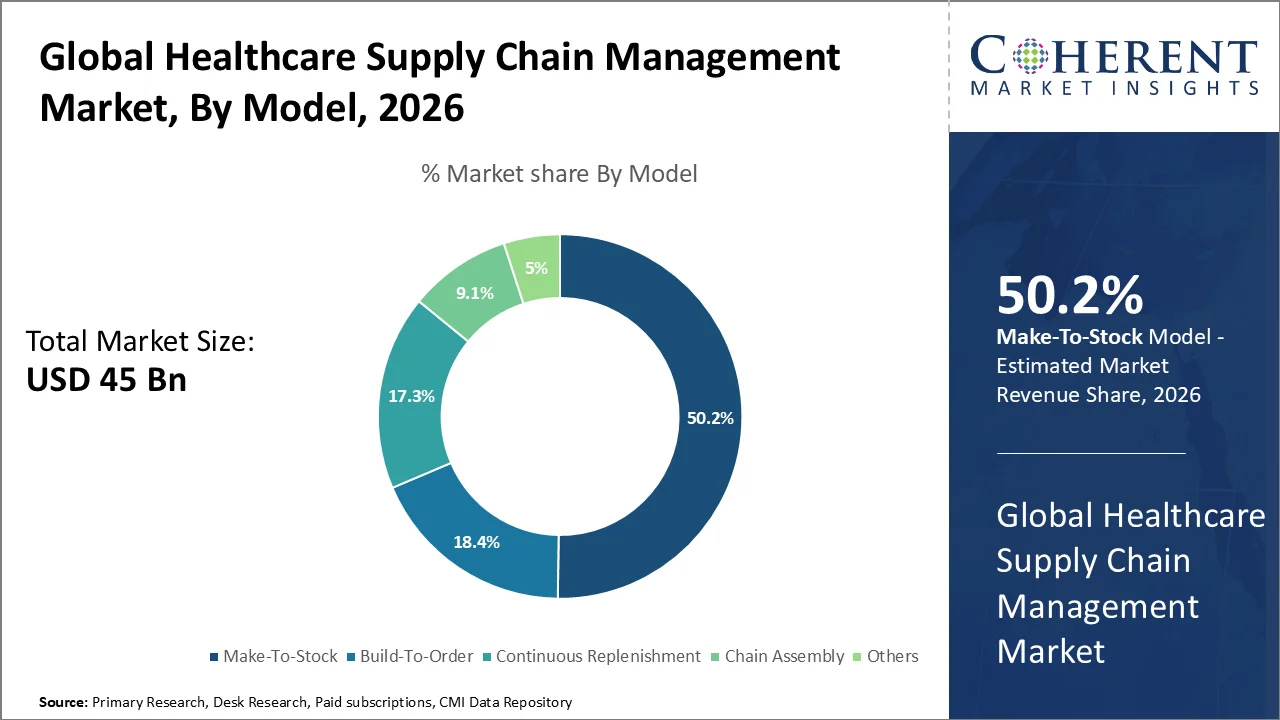
Why is Make-To-Stock Segment Acquiring the Largest Share?
On the basis of model, the make-to-stock segment is projected to account for the largest Healthcare Supply Chain Management Market share of 50.2% in 2026. The segment’s growth is owing to its suitability for high-volume healthcare demand, particularly pharmaceuticals, consumables, and emergency care products requiring continuous availability.
CMS also reports that prescription drug spending grew 7.9% in 2024, reinforcing stable and predictable consumption patterns supporting make-to-stock supply chains.
In May 2026, Medline launched the AI-powered Mpower digital control tower to help healthcare providers predict, respond to, and resolve supply chain disruptions before they impact patient care. The platform combines predictive analytics, real-time visibility, and workflow automation to improve inventory management efficiency and strengthen the supply chain resilience in the healthcare systems.
- Current Industry Events of 2026
- Market Size Estimation
- Regional Breakdown
- Competitive Landscape
- Customer Intelligence
- Segmental Analysis
- Pricing Analysis
- Key Market Drivers, Challenges & Future Trends
- Customized Insights Section
Inventory Management and Procurement hold the Largest Market Share
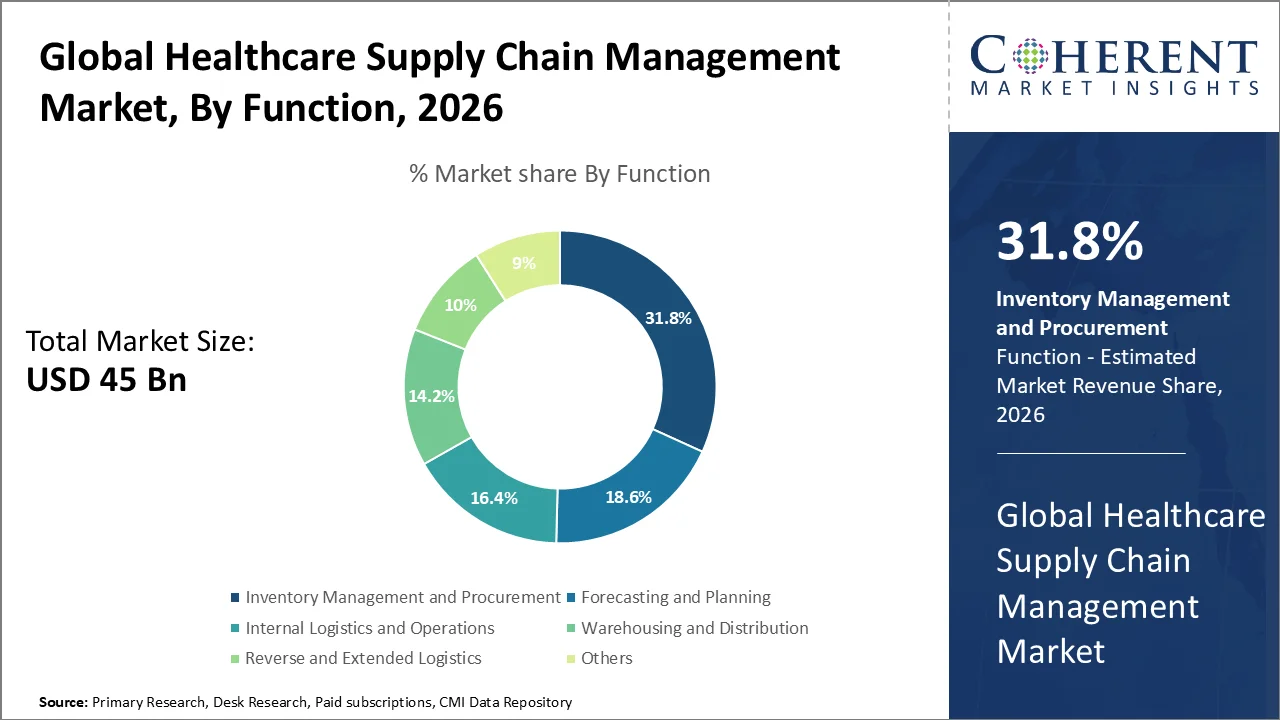
On the basis of function, the inventory management and procurement segment lead with a major 31.8% share in 2026. The growth is owing to the rising drug shortage prevention efforts and increasing regulatory oversight across healthcare systems.
According to the U.S. FDA, there were 55 new drug shortages in 2023. This reinforces the need for real-time inventory visibility in hospitals.
In September 2024, Owens & Minor announced a partnership with Google Cloud to enhance its QSight platform using AI as well as cloud technology for the hospital inventory management. The collaboration aims to improve real-time visibility, optimize management of medical supplies and implants, and enable future innovations that minimize costs and improve supply chain efficiency in the healthcare systems.
Market Drivers
AI-based Supply Chain Resilience are Transforming the Healthcare Supply Chain Management Market in US
AI-based supply chain resilience is becoming critical for the U.S. Healthcare Supply Chain Management Market as hospitals, distributors, and manufacturers face persistent medicine availability risks.
According to USP analysis of FDA shortage data, nearly 75 drugs were in shortage at the end of 2025. Thus highlighting the ongoing vulnerabilities in medicine availability across both critical care as well as specialty therapeutics.
In May 2026, Global Healthcare Exchange (GHX) launched an AI-powered orchestration layer to help healthcare supply chain leaders detect disruptions early, coordinate decisions faster, and act proactively. The platform aims to reduce workflow inefficiencies by connecting data, automating processes, and improving collaboration between providers and suppliers to strengthen the supply chain resilience.
Advanced Transaction Integrity Through 8-way EDI Matching: A Major Breakthrough in Healthcare Supply Chain Management Market
Advanced transaction integrity through 8-way EDI matching is emerging as a major breakthrough in the Healthcare Supply Chain Management Market. The hospitals are seeking tighter control over purchase orders, contracts, receipts, invoices, rebates, and item-master data.
The need for stronger transaction validation is further reinforced by the scale of federally regulated drug purchasing systems. According to the U.S. Health Resources and Services Administration (HRSA), the 340B covered entities purchased a record USD 81.4 billion in outpatient drugs in 2024. This highlights the growing complexity of pricing, rebate reconciliation, as well as the contract compliance in the healthcare procurement networks.
In January 2026, Veradigm and Meperia announced an industry-first 8-way match EDI platform to improve the healthcare supply chain integrity. The cloud-based solution enhances data accuracy, contract compliance, and transaction transparency by automatically validating healthcare purchases against multiple records, thereby minimizing errors and preventing overpayments.
Current Events and Their Impact on the Healthcare Supply Chain Management Market
Current Event | Description and its Impact |
DSCSA Electronic Drug Traceability Implementation in the U.S. |
|
FDA Quality Management System Regulation Effective in 2026 |
|
Healthcare Supply Chain Management Market Trends
- AI-powered digital control towers are improving real-time inventory visibility, disruption prediction, substitution planning, and faster procurement decisions.
- Cloud-based supply chain platforms are gaining adoption as hospitals seek centralized procurement, automated workflows, supplier coordination, and lower operational burden.
- Rising drug shortages and product availability risks are strengthening demand for resilient inventory management, safety stock planning, and supplier diversification. As of 2026, ASHP reported 223 active drug shortages, while FDA-related GAO data showed 102 shortages were being tracked as of July 31, 2024.
- Increasing hospital cost pressure is pushing providers to optimize purchasing, reduce wastage, and improve spend analytics. In 2024, U.S. hospitals spent around USD 202 billion on supplies and USD 144 billion on drugs, together representing 22% of total hospital costs.
- Advanced recall management, product traceability, and data-driven spend monitoring are becoming key priorities. In April 2026, ECRI spun out Staritas to support healthcare spend management and recall intelligence through AI-powered supply chain insights.
Regional Insights
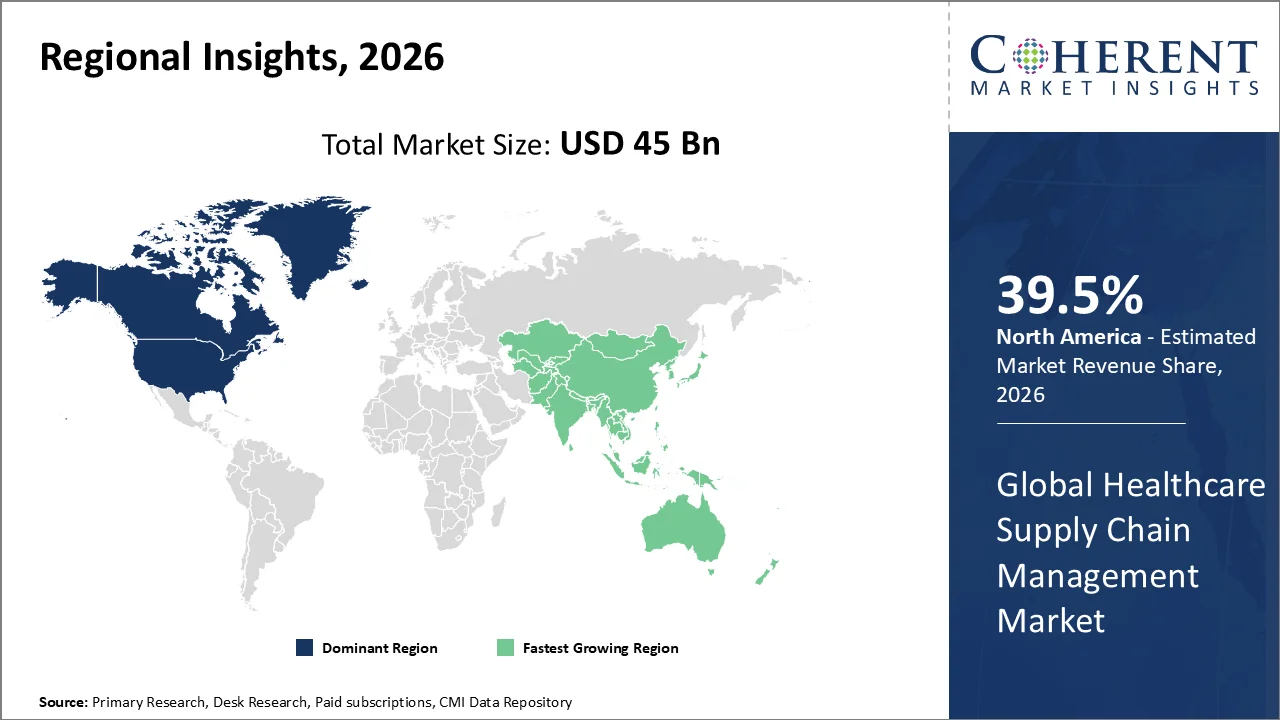
North America Dominates Owing to the Supply Continuity Pressure and Digital Procurement Adoption
The North America region accounts for 39.5% of the market share in 2026. The region’s growth is owing to persistent drug shortages, strong regulatory oversight, and rapid digitalization of procurement systems across hospitals and distributors.
The American Society of Health-System Pharmacists documented 270 active drug shortages in March 2025. This highlights the the need for stronger inventory visibility, demand forecasting, as well as supplier-risk monitoring.
Canada also reported 2,588 new drug shortage reports in 2024–25, with 1,772 reports still active by year-end, thereby strengthening the demand for digital supply continuity tools.
In November 2025, Diversis Capital announced a merger of Genesis Automation Healthcare, Meperia, and Kermit to create an end-to-end healthcare supply chain and inventory management platform. The combined platform aims to unify procurement, inventory, and analytics systems, reducing waste, improving contract compliance, and delivering over $1 billion in annual procurement savings across hospitals and health systems.
Asia Pacific Healthcare Supply Chain Management Market Trends
Asia Pacificis expected to witness strong growth in Healthcare Supply Chain Management Market over the forecast period. The region’s growth is owing to the large public medicine-distribution networks, shortage-management pressure, and rapid digitization of drug logistics.
In India, PMBJP had opened 16,912 Jan Aushadhi Kendras by 30 June 2025, with a basket of 2,110 medicines and 315 surgicals/medical consumables/devices, creating strong demand for centralized procurement, warehouse management, batch tracking, and distributor visibility.
Australia also shows the need for resilient systems: TGA reported that manufacturing issues accounted for 63% of shortage reasons in 2023, while sponsors must report shortage dates, reasons, stock situation, expected impact, and proposed management actions.
A key development is India’s end-to-end IT-enabled PMBJP supply chain, including one central warehouse, four regional warehouses, 39 distributors, and regular monitoring of 400 fast-moving products, supporting real-time availability and last-mile access across hospitals, pharmacies, public health centers, and rural access points.
Shortage Visibility and Supply Resilience are Accelerating the Healthcare Supply Chain Management Market in United States
The United States Healthcare Supply Chain Management Market is driven by supply resilience, shortage visibility, and domestic manufacturing initiatives. The FDA’s 2024 Drug Shortages Report recorded 1,459 potential drug and biological product shortage notifications from 151 manufacturers. This highlights the need for real-time inventory tracking, supplier-risk monitoring, demand forecasting, as well as automated shortage-response workflows.
In March 2026, HHS-ASPR awarded an additional USD 8.3 million to API Innovation Center to expand U.S. API manufacturing capacity for propofol and metoprolol, thus aiming to build the first end-to-end domestic metoprolol supply chain in decades. Such actions push hospitals, distributors, and manufacturers toward integrated supply-chain platforms.
China Healthcare Supply Chain Management Market Trends
China is expected to show strong growth in the Healthcare Supply Chain Management Market. The trend is driven by tighter drug traceability, insurance-fund supervision, and rising need for compliant inventory visibility across hospitals, pharmacies, distributors, and device importers. In 2025, Chinese authorities used drug-tracking codes to inspect 124,700 medical and pharmaceutical institutions and punished 39,100 violators, showing rapid adoption of digital monitoring in healthcare logistics.
In January 2026, HTDK supported the China launch of STAAR Surgical’s EVO+ ICL (V5) with regulatory-compliant distribution, import-export, inventory management, after-sales service, and nationwide supply-chain operations, strengthening demand for integrated SCM platforms.
Who are the Major Companies in Healthcare Supply Chain Management Industry
Some of the major key players in Healthcare Supply Chain Management Market are Oracle, SAP SE, Infor., McKesson Corporation, Tecsys Inc., Global Healthcare Exchange, LLC., Cardinal Health, Epicor Software Corporation, LLamasoft Inc., Manhattan Associates, Jump Technologies, Inc., Blue Yonder Group, Inc., Cerner Corporation, Logi-Tag Systems, Picis Clinical Solutions, Inc., Premier, HYBRENT, INC, and Arvato Supply Chain Solutions SE.
Key News
- In May 2026, Medline launched the AI-powered Mpower platform to strengthen healthcare supply chain resilience through predictive analytics and workflow automation. The cloud-based system provides real-time inventory visibility, identifies supply risks early, and streamlines substitution decisions, improving efficiency and reducing operational burden for healthcare providers.
- In September 2025, Oracle announced new AI-powered capabilities in its Fusion Cloud Applications to enhance the healthcare supply chain operations. The upgrades improve inventory visibility, automate procurement workflows, optimize stock levels, as well as reduce costs while supporting more efficient patient care delivery through the real-time data integration.
Market Report Scope
Healthcare Supply Chain Management Market Report Coverage
| Report Coverage | Details | ||
|---|---|---|---|
| Base Year: | 2025 | Market Size in 2026: | USD 45 Bn |
| Historical Data for: | 2020 To 2024 | Forecast Period: | 2026 To 2033 |
| Forecast Period 2026 to 2033 CAGR: | 8.2% | 2033 Value Projection: | USD 78 Bn |
| Geographies covered: |
| ||
| Segments covered: |
| ||
| Companies covered: | Oracle, SAP SE, Infor., McKesson Corporation, Tecsys Inc., Global Healthcare Exchange, LLC., Cardinal Health, Epicor Software Corporation, LLamasoft Inc., Manhattan Associates, Jump Technologies, Inc., Blue Yonder Group, Inc., Cerner Corporation, Logi-Tag Systems, Picis Clinical Solutions, Inc., Premier, HYBRENT, INC, and Arvato Supply Chain Solutions SE | ||
| Growth Drivers: |
| ||
| Restraints & Challenges: |
| ||
Analyst Opinion
- Healthcare supply chain management market growth is driven by cost pressure and care continuity. In the U.S., hospital expenditures reached USD 1,634.7 billion in 2024, while prescription drug spending reached USD 467.0 billion, showing how procurement, inventory control, and supplier management directly influence healthcare operating efficiency.
- Shortages are a major growth driver for this market. The FDA reported 113 ongoing biological product shortages as of December 31, 2024. This makes real-time visibility, demand forecasting, and risk-based supplier tracking essential for hospitals as well as distributors.
- The healthcare supply chains are also becoming a patient-safety issue, not just a logistics function. The WHO states that at least 1 in 10 medicines in low- and middle-income countries are substandard or falsified, costing countries around USD 30.5 billion annually. This supports stronger adoption of traceability, serialization, cold-chain monitoring, and compliance-focused supply chain platforms.
Speak to the analyst
Want personalized insights?
Take the findings above to one of our principal consultants, or have the report rebuilt around the segments, geographies and competitors you actually track.
Market Segmentation
- By Model (Revenue, USD Bn, 2021-2033)
- Make-To-Stock
- Build-To-Order
- Continuous Replenishment
- Chain Assembly
- Others
- By Function (Revenue, USD Bn, 2021-2033)
- Forecasting and Planning
- Inventory Management and Procurement
- Internal Logistics and Operations
- Warehousing and Distribution
- Reverse and Extended Logistics
- Others
- By Component (Revenue, USD Bn, 2021-2033)
- Software
- Hardware
- Services
- By Delivery Mode (Revenue, USD Bn, 2021-2033)
- On-premise
- Web-based
- Cloud-based
- By End User (Revenue, USD Bn, 2021-2033)
- Healthcare Manufacturers
- Healthcare Providers
- Distributors
- Logistics
- By Region (Revenue, USD Bn, 2021-2033)
- North America
- U.S.
- Canada
- Latin America
- Brazil
- Mexico
- Argentina
- Rest of Latin America
- Europe
- Germany
- U.K.
- France
- Italy
- Spain
- Russia
- Rest of Europe
- Asia Pacific
- China
- India
- Japan
- Australia
- South Korea
- ASEAN
- Rest of Asia Pacific
- Middle East
- GCC
- Israel
- Rest of Middle East
- Africa
- South Africa
- Central Africa
- North Africa
- North America
Sources
Primary Research Interviews
- Healthcare supply chain managers
- Hospital procurement heads
- Pharmaceutical distributors
- Medical device distributors
- Group purchasing organizations (GPOs)
- Healthcare logistics providers
- Inventory management and warehouse managers
- Hospital administrators
- Healthcare IT solution providers
- Key opinion leaders (KOLs) in healthcare supply chain and procurement
Databases
- World Health Organization (WHO)
- Centers for Disease Control and Prevention (CDC)
- National Institutes of Health (NIH)
- Organisation for Economic Co-operation and Development (OECD)
- U.S. Food and Drug Administration (FDA)
- Centers for Medicare & Medicaid Services (CMS)
- World Bank Health Data
- Global Health Observatory
Magazines
- Healthcare IT News
- Healthcare Finance News
- Medical Economics
- Supply Chain Management Review
- Modern Healthcare
- Pharmaceutical Commerce
Journals
- Journal of Healthcare Management
- International Journal of Healthcare Management
- Journal of Pharmaceutical Policy and Practice
- BMJ Global Health
- Health Affairs
- Journal of Medical Systems
- International Journal of Logistics Management
Newspapers
- The New York Times
- The Guardian
- The Wall Street Journal
- Financial Times
- Reuters
- Bloomberg
Associations
- Association for Health Care Resource & Materials Management
- Healthcare Supply Chain Association
- International Hospital Federation
- American Hospital Association
- Healthcare Information and Management Systems Society
- Pharmaceutical Research and Manufacturers of America
- International Federation of Pharmaceutical Manufacturers & Associations
Public Domain Sources
- Company Annual Reports And Investor Presentations
- Government Health Ministry Publications
- Hospital Procurement And Tender Documents
- Clinical Trial Registries Such As ClinicalTrials.Gov
- Public Healthcare Expenditure Databases
- Regulatory Filings And Press Releases
- White Papers From Healthcare Technology And Logistics Companies
Proprietary Elements
- CMI Data Analytics Tool
- Proprietary CMI Existing Repository of Information for the Last 10 Years
Get access to 250+ pages report
Every segment, forecast, competitor profile and data table behind the analysis above — available for instant download.
- ESOMAR Member
- ISO 9001:2015 Certified
- D-U-N-S Registered
- GDPR & CCPA Compliant
Missing comfort of reading report in your local language? Find your preferred language:
Transform your Strategy with Exclusive Trending Reports
Frequently Asked Questions
The Healthcare Supply Chain Management Market is expected to reach USD 78 Bn in 2033.
Major players operating in the global Healthcare Supply Chain Management Market include Oracle, SAP SE, Infor., McKesson Corporation, Tecsys Inc., Global Healthcare Exchange, LLC., Cardinal Health, Epicor Software Corporation, LLamasoft Inc., Manhattan Associates, Jump Technologies, Inc., Blue Yonder Group, Inc., Cerner Corporation, Logi-Tag Systems, Picis Clinical Solutions, Inc., Premier, HYBRENT, INC, and Arvato Supply Chain Solutions SE.
The prohibitive upfront implementation costs, complex integration with legacy systems (such as EHR/ERP disconnects), data security/cybersecurity risks, and a lack of awareness or skilled IT personnel are the key factors hampering growth of the market.
The stricter global regulations, the shift toward transparent workplace cultures, and the growing need for secure, anonymous reporting methods is boosting the demand for Healthcare Supply Chain Management.
The Healthcare Supply Chain Management Market is anticipated to grow at a CAGR of 8.2% between 2026 and 2033.
Among regions, North America is expected to account for a largest market share in the global Healthcare Supply Chain Management Market over the forecast period.
Healthcare Supply Chain Management (SCM) is the strategic coordination of the procurement, tracking, and distribution of medical products.