

Pharmaceutical Traceability Market Size and Forecast – (2026 to 2033)
The Pharmaceutical Traceability Market is estimated to be valued at USD 7.42 Bn in 2026 and is expected to reach USD 22.5 Bn by 2033, exhibiting a compound annual growth rate (CAGR) of 18.4% from 2026 to 2033.
Key Takeaways
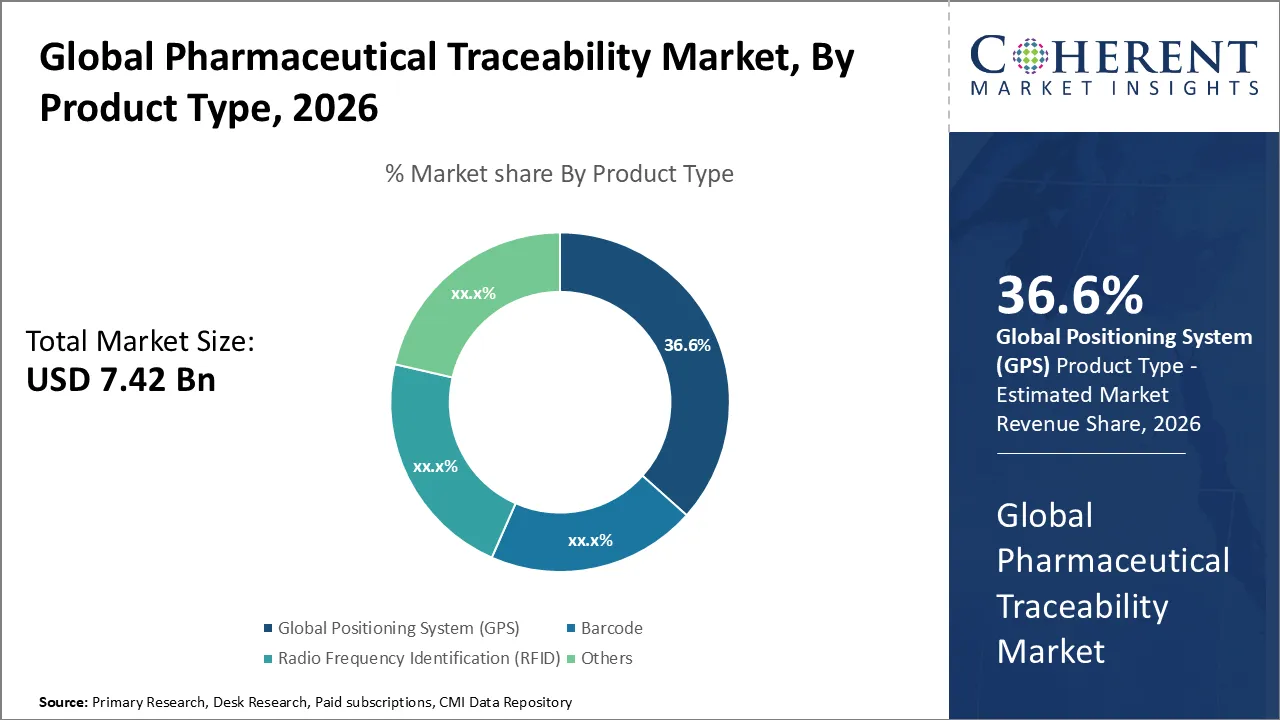
- By Product Type, Global Positioning System (GPS) hold the largest market share of 36.6% in 2026 owing to the regulatory compliance and legal mandates.
- By End Users, Hospitals acquired the prominent market share of 34.6% in 2026 owing to its patient safety & medication error reduction.
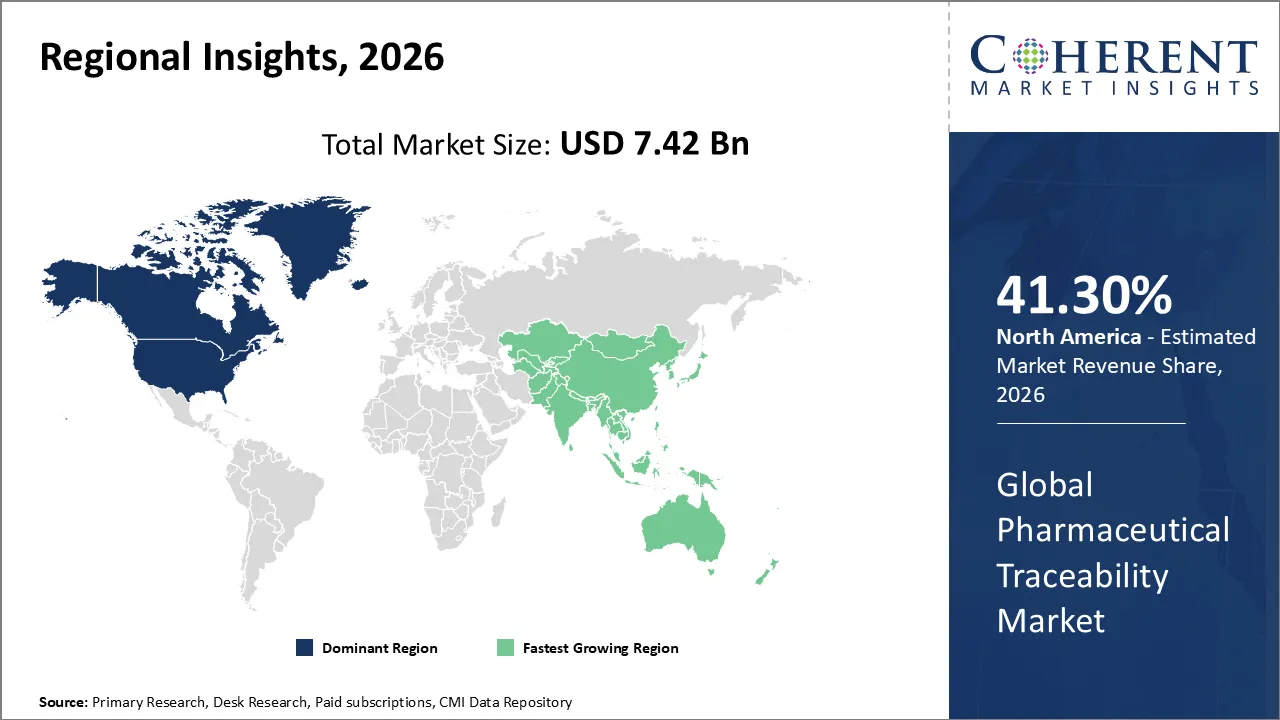
- By Region, North America dominates the overall market with an estimated share of 41.3% in 2026 owing to the stringent regulatory environment.
Market Overview
The pharmaceutical traceability market enables companies to actively track and verify medicines throughout the supply chain, from manufacturing to dispensing. Industry players adopt these systems to enhance patient safety, combat counterfeit drugs, and meet regulatory requirements. Technologies such as serialization, barcoding, RFID, and integrated software platforms provide real-time visibility, streamline recalls, and improve inventory control. Increasing supply chain complexity, ongoing digital transformation, and stricter regulatory oversight continue to drive global market growth.
Current Events and Its Impact on the Pharmaceutical Traceability Market
Current Events | Description and its impact |
Regulatory Advances in Pharmaceutical Serialization |
|
Technological Innovations in Traceability Solutions |
|
Economic Pressures and Healthcare Reforms |
|
Segmental Insights
- Current Industry Events of 2026
- Market Size Estimation
- Regional Breakdown
- Competitive Landscape
- Customer Intelligence
- Segmental Analysis
- Pricing Analysis
- Key Market Drivers, Challenges & Future Trends
- Customized Insights Section
Pharmaceutical Traceability Market Insights, By Product Type - Global Positioning System (GPS) contribute the highest share of the market owing to its rise of global trade & e-commerce in pharmaceuticals.
Global Positioning System (GPS) hold the largest market share of 36.6% in 2026. The pharmaceutical traceability market increasingly relies on Global Positioning System (GPS) technology to enable real-time shipment monitoring and stronger logistics control. Stakeholders use GPS to actively track the precise location of pharmaceutical products during transit, minimizing risks such as theft, diversion, and delays. GPS also improves coordination across complex distribution networks, reinforces cold-chain integrity, and enables faster responses to disruptions, enhancing overall supply chain reliability, transparency, and efficiency.
The Tripura government unveiled 21 e-hospitals and deploy 50 life-support ambulances equipped with GPS tracking systems as part of its efforts to modernize healthcare services across the state.
Pharmaceutical Traceability Market Insights, By End Users - Hospitals contribute the highest share of the market owing to its integration with digital health systems
Hospitals acquired the prominent market share of 34.6% in 2026. Hospitals actively fuel the pharmaceutical traceability market by focusing on safe medication practices and streamlined clinical operations. They use traceability systems to track drug movement within their facilities, confirm product authenticity before administration, and minimize medication errors. These systems also enable precise inventory monitoring, better expiration control, and quick identification of recalled products. As hospitals expand the use of digital health records and automated pharmacy solutions, traceability tools enhance workflow efficiency, accountability, and patient care quality. For instance, in August 2025, LSPedia has partnered with Spring Bio Solution to strengthen pharmaceutical traceability in India. Through this collaboration, Spring Bio Solution will support LSPedia’s global expansion and accelerate adoption of its compliance, serialization, and supply chain software solutions.
Regional Insights
North America Pharmaceutical Traceability Market Trends
North America dominates the overall market with an estimated share of 41.3% in 2026. Strong regulatory frameworks actively drive North America’s pharmaceutical traceability market, prompting companies to adopt advanced tracking technologies across the supply chain. Businesses increasingly integrate digital solutions such as IoT, blockchain, and cloud-based platforms to improve visibility and enable seamless data sharing. Healthcare providers and manufacturers focus on anti-counterfeiting measures and real-time monitoring to safeguard patient safety. By collaborating across the industry and investing in automation, stakeholders actively enhance traceability practices and boost operational efficiency throughout the region.
In June 2025, Loma Systems has launched the X5DE Dual Energy X-ray Inspection System in North America, offering manufacturers enhanced confidence and control through features such as reject confirmation, automatic image archiving, and full digital traceability.
Asia Pacific Pharmaceutical Traceability Market Trends
Regulators and industry players in the Asia Pacific actively advance the pharmaceutical traceability market by emphasizing supply chain transparency and drug safety. Countries including China, India, Japan, and Southeast Asian nations enforce stronger serialization and tracking requirements to meet global standards and prevent counterfeit medicines, driving adoption of digital technologies such as RFID, cloud platforms, and blockchain. Rapid pharmaceutical manufacturing, expanding healthcare infrastructure, and growing e‑commerce actively promote the deployment of traceability solutions throughout the region. For instance, in October 2025, the Central Drugs Standard Control Organisation launched a digital tracking system to monitor the supply chain and quality of high-risk pharmaceutical solvents, including diethylene glycol.
United States Pharmaceutical Traceability Market Trends
U.S. stakeholders actively shape the pharmaceutical traceability market by implementing the Drug Supply Chain Security Act (DSCSA), driving widespread serialization and end-to-end tracking across manufacturers, distributors, and pharmacies. Companies deploy digital solutions such as cloud-based platforms, RFID, and real-time tracking to improve supply chain transparency and prevent counterfeit drugs, while healthcare providers integrate traceability with patient safety systems. Ongoing innovation and regulatory oversight actively promote the adoption of advanced tracking practices across the nation. For instance, in December 2025, SMX PLC has expanded its industrial rubber traceability platform to include latex and rubber gloves used across healthcare, laboratory, pharmaceutical, food-handling, industrial, and consumer sectors.
India Pharmaceutical Traceability Market Trends
Manufacturers and regulators in India are actively advancing the pharmaceutical traceability market by emphasizing drug safety, authenticity, and supply chain transparency. The government mandates QR codes on key drug formulations and expands serialization to APIs and other products, promoting digital tracking across the supply chain. Companies implement smart packaging, barcoding, and integrated systems to comply with domestic and international standards, prevent counterfeit medicines, and strengthen global market access for Indian pharmaceuticals.
End-user Feedback and Unmet Needs in the Pharmaceutical Traceability Market
- Demand for Real-Time Visibility: End-users seek systems that provide instant, end-to-end visibility of pharmaceutical products across the supply chain. Many report delays or gaps in tracking, limiting their ability to respond quickly to disruptions, recalls, or theft. They emphasize the need for integrated platforms that deliver accurate, real-time data for better decision-making.
- Integration with Existing Systems: Hospitals, pharmacies, and distributors highlight challenges in integrating traceability tools with existing ERP, inventory, and healthcare management systems. Users desire seamless interoperability that avoids manual data entry, reduces errors, and enhances workflow efficiency, allowing traceability solutions to fit naturally within current operations without disrupting daily processes.
- Counterfeit Detection and Drug Authentication: End-users stress the importance of robust anti-counterfeit features. Despite current serialization and verification measures, gaps remain in detecting fake or diverted drugs. Users call for enhanced authentication technologies, such as blockchain or IoT-enabled monitoring, that can reliably confirm drug integrity at every stage of the supply chain.
Pharmaceutical Traceability Market Trend
Digital Transformation and IoT Integration
The pharmaceutical traceability market is increasingly driven by digital technologies, including IoT sensors, cloud platforms, and mobile applications. Companies deploy these solutions to monitor shipments, environmental conditions, and inventory in real time. IoT integration allows automated data collection, reduces human error, and supports predictive analytics, enabling stakeholders to make faster, data-driven decisions. This trend enhances transparency, strengthens cold-chain management, and streamlines operations, positioning digital-enabled traceability as a critical enabler of modern pharmaceutical supply chains.
Blockchain Adoption for Security and Transparency
Blockchain technology is emerging as a major trend, offering secure, immutable records of pharmaceutical product movement. By recording transactions at each supply chain stage, blockchain reduces the risk of counterfeiting and diversion while providing stakeholders with verifiable product history. Pharmaceutical companies increasingly implement blockchain to meet regulatory demands, ensure patient safety, and improve trust across distributors, hospitals, and pharmacies. This technology supports automated verification and audit processes, making traceability more transparent and reliable.
Pharmaceutical Traceability Market Opportunity
Integration with Advanced Technologies
The market offers opportunities for integrating traceability with advanced technologies such as IoT, AI, blockchain, and cloud computing. These integrations provide real-time monitoring, predictive analytics, and secure data sharing, improving efficiency and decision-making across the supply chain. Companies that develop platforms combining multiple digital technologies can offer end-to-end traceability, reduce operational risks, enhance compliance reporting, and provide superior value to manufacturers, distributors, and healthcare providers, driving adoption across global pharmaceutical networks.
Market Report Scope
Pharmaceutical Traceability Market Report Coverage
| Report Coverage | Details | ||
|---|---|---|---|
| Base Year: | 2025 | Market Size in 2026: | USD 7.42 Bn |
| Historical Data for: | 2020 To 2024 | Forecast Period: | 2026 To 2033 |
| Forecast Period 2026 to 2033 CAGR: | 18.4% | 2033 Value Projection: | USD 22.5 Bn |
| Geographies covered: |
| ||
| Segments covered: |
| ||
| Companies covered: | Optel Ltd., The Healthcare Distribution Alliance (HDA) Inc., Bureau Veritas, Adents, Logista Pharma, rfxcel Corporation, Movilitas Consulting AG, Trace Link Inc., Avery Dennison Corporation, Pharmalutions Pte Ltd., and Cognex Corporation. | ||
| Growth Drivers: |
| ||
| Restraints & Challenges: |
| ||
Pharmaceutical Traceability Market News
- In February 2025, Systech, part of Markem-Imaje and Dover, launched UniSecure artAI™, an AI-powered authentication solution designed to protect brands, ensure packaging quality, and enhance patient safety.
- In August 2024, Avery Dennison launched AD Minidose U9XM UHF RFID high-memory inlays and tags to identify small pharmaceutical and healthcare items such as syringes, vials, and packaging, supporting source tagging, end-to-end traceability, and product authentication.
Analyst Opinion (Expert Opinion)
- The pharmaceutical traceability landscape has evolved from being a compliance-driven initiative to a strategic imperative, reshaping how life sciences companies manage risk, visibility, and authenticity across global supply chains. What was once regarded as a regulatory checkbox is now recognized within industry circles as fundamental to supply chain integrity and brand protection — a shift underscored by the fact that over 11.2 billion prescription drug packages were serialized globally in response to tightening mandates such as the U.S. Drug Supply Chain Security Act and the EU Falsified Medicines Directive. Firms that delay or under‑invest in traceability are not merely risking fines; they are exposing themselves to operational blind spots that competitors with mature systems have already begun to exploit.
- However, industry practitioners also acknowledge that fragmentation in global standards and interoperability remains a stubborn barrier. Despite broad adoption of GS1 formats, a significant proportion of multinational manufacturers still grapple with disparate national requirements, leading to bespoke integration work and data silos that undermine traceability objectives. The uneven readiness for serialization compliance — where only a fraction of firms report being “very prepared” for core regulatory deadlines — signals that strategic alignment across manufacturing, IT, and distribution functions is still lagging.
- Technological innovation is another locus of differentiated performance. Early adopters of blockchain‑enabled and AI‑augmented traceability platforms are beginning to operationalize real‑time anomaly detection and tamper‑proof audit trails, moving the market beyond static tracking toward predictive supply chain intelligence. Furthermore, the expansion of RFID in specialty pharmaceuticals and smart sensor‑integrated IoT solutions reflects a clear prioritization of quality assurance in high‑value, temperature‑sensitive therapies, where traditional barcoding fails to provide sufficient granularity.
- From a strategic standpoint, traceability is now inseparable from risk mitigation and recall management. Next‑generation systems that tie serialized data directly into recall workflows enable highly targeted actions instead of broad, brand‑damaging withdrawals — an operational capability that has become indispensable in maintaining stakeholder trust. In parallel, the consolidation of capabilities through mergers and platform expansions — such as the integration of serialization hardware with cloud‑native software stacks — indicates that end‑to‑end traceability capabilities are consolidating around fewer, more capable providers with global reach.
Speak to the analyst
Want personalized insights?
Take the findings above to one of our principal consultants, or have the report rebuilt around the segments, geographies and competitors you actually track.
Market Segmentation
- By Product Type (Revenue, USD Bn, 2026 - 2033)
- Barcode
- Radio Frequency Identification (RFID)
- Global Positioning System (GPS)
- Others
- By End User (Revenue, USD Bn, 2026 - 2033)
- Hospitals
- Pharmacies
- Pharmaceutical Factories
- Others
- By Regional Insights (Revenue, USD Bn, 2026 - 2033)
- North America
- U.S.
- Canada
- Latin America
- Brazil
- Argentina
- Mexico
- Rest of Latin America
- Europe
- Germany
- U.K.
- Spain
- France
- Italy
- Russia
- Rest of Europe
- Asia Pacific
- China
- India
- Japan
- Australia
- South Korea
- ASEAN
- Rest of Asia Pacific
- Middle East
- GCC Countries
- Israel
- Rest of Middle East
- Africa
- South Africa
- North Africa
- Central Africa
- North America
- Key Players Insights
- Optel Ltd.
- The Healthcare Distribution Alliance (HDA) Inc.
- Bureau Veritas
- Adents
- Logista Pharma
- rfxcel Corporation
- Movilitas Consulting AG
- Trace Link Inc.
- Avery Dennison Corporation
- Pharmalutions Pte Ltd.
- Cognex Corporation.
Sources
Primary Research interviews
- Pharmaceutical manufacturers
- Contract manufacturing organizations (CMOs)
- Packaging and labeling solution providers
- Supply chain and logistics managers in the pharmaceutical industry
- Regulatory compliance officers
- Technology solution providers for serialization and track-and-trace
Databases
- PubMed
- ClinicalTrials.gov
- FDA Drug Database
- EMA (European Medicines Agency) Database
- USP (United States Pharmacopeia) Database
- WHO (World Health Organization) Global Surveillance Database
Magazines
- Pharmaceutical Technology
- Pharmaceutical Commerce
- Pharma Manufacturing
- BioPharm International
- Drug Development & Delivery
Journals
- Journal of Pharmaceutical Innovation
- International Journal of Pharmaceutical and Healthcare Marketing
- International Journal of Pharmaceutics
- Regulatory Toxicology and Pharmacology
- Pharmaceutical Development and Technology
Newspapers
- The New York Times – Health & Science Section
- The Guardian – Science Section
- Financial Times – Healthcare & Pharma Section
- Reuters Health News
- Bloomberg – Pharma & Life Sciences News
Associations
- International Society for Pharmaceutical Engineering (ISPE)
- Pharmaceutical Research and Manufacturers of America (PhRMA)
- Drug Information Association (DIA)
- International Federation of Pharmaceutical Manufacturers & Associations (IFPMA)
- European Federation of Pharmaceutical Industries and Associations (EFPIA)
Public Domain sources
- FDA Regulatory Guidelines & Updates
- WHO Reports on Drug Safety and Supply Chain
- EMA Regulatory Guidelines
- Government health portals (e.g., CDC, NIH)
- National pharmacovigilance reports
Proprietary Elements
- CMI Data Analytics Tool
- Proprietary CMI Existing Repository of information for last 8 years
Get access to 250+ pages report
Every segment, forecast, competitor profile and data table behind the analysis above — available for instant download.
- ESOMAR Member
- ISO 9001:2015 Certified
- D-U-N-S Registered
- GDPR & CCPA Compliant
Missing comfort of reading report in your local language? Find your preferred language:
Transform your Strategy with Exclusive Trending Reports
Frequently Asked Questions
The Pharmaceutical Traceability Market is estimated to be valued at USD 7.42 Bn in 2026 and is expected to reach USD 22.5 Bn by 2033.
The CAGR of the Pharmaceutical Traceability Market is projected to be 18.4% from 2026 to 2033.
Major drivers include the U.S. Drug Supply Chain Security Act (DSCSA), the EU Falsified Medicines Directive (FMD), and similar mandates in countries such as India and China.
Serialization, aggregation, and verification are foundational, but cloud platforms, RFID, blockchain, IoT sensors, and AI-based analytics are increasingly deployed.
Key obstacles include global standard fragmentation, high integration costs, legacy system incompatibility, and the need for cross-functional collaboration among IT, manufacturing, and distribution teams.