

Global Supply Chain Security Market Size and Forecast: 2026-2033
The Global Supply Chain Security Market is estimated to be valued at USD 2.95 Bn in 2026 and is expected to reach USD 6.35 Bn by 2033, exhibiting a compound annual growth rate (CAGR) of 11.6% from 2026 to 2033.
Key Takeaways of the Supply Chain Security Market
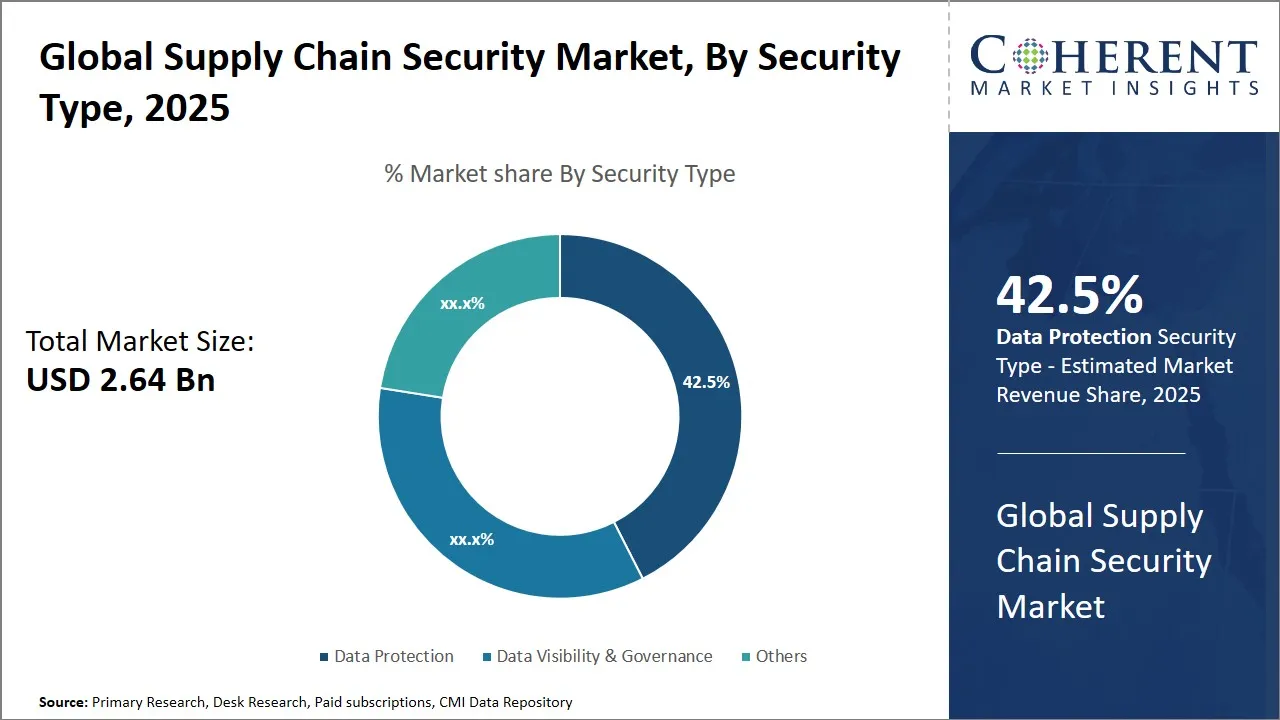
- The data protection segment leads the market holding an estimated share of 43.5% in 2026.
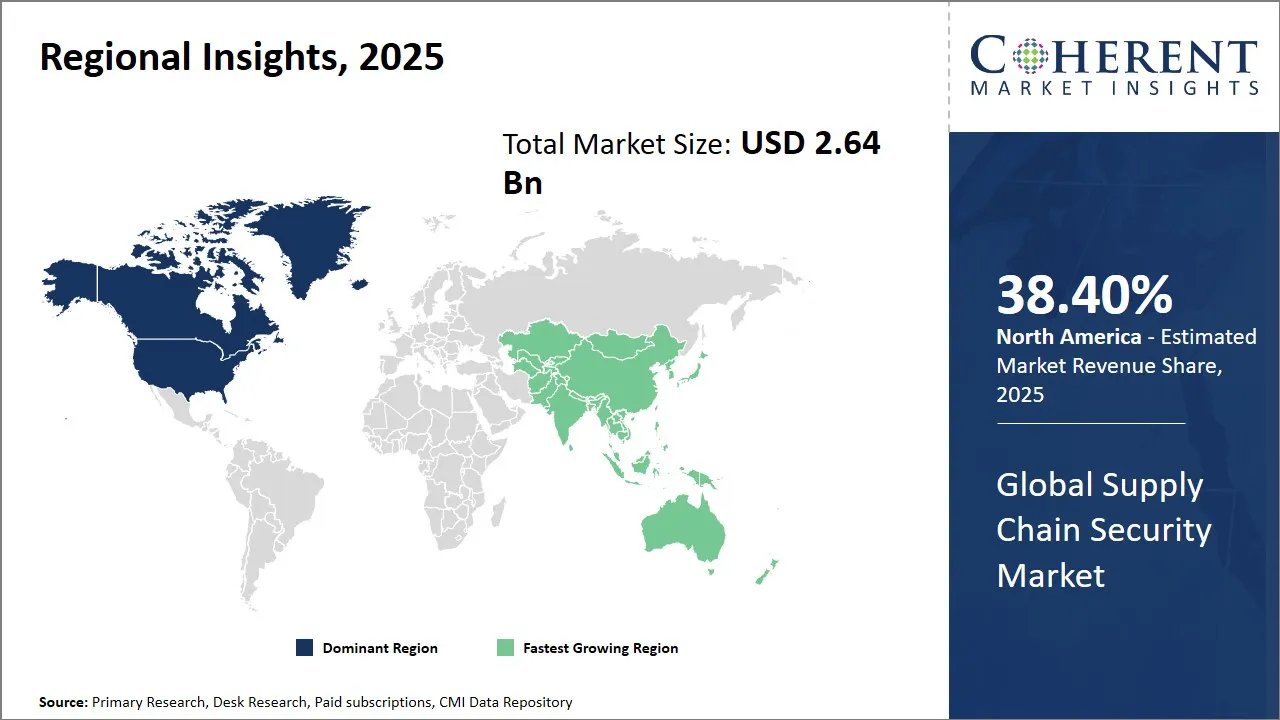
- North America is estimated to lead the market with a share of 38. 4% in 2026.
- Asia Pacific, holding a share of 23. 2% in 2026, is projected to be the fastest growing region.
Market Overview
The market is seeing the use of emerging technologies such as Blockchain, AI, and IoT to create strong and transparent supply chains. These technologies help in real-time tracking, risk assessment, and fraud prevention, which are very important in today's globalized economy. Also, regulatory pressures and rising cyber threats push organizations to invest heavily in security solutions, fostering advancements in automation and predictive analytics within supply chains, adding to market expansion.
Current Events and their Impact
Current Events | Description and its impact |
Government & Regulatory Developments |
|
Market Investments & Partnerships |
|
Segmental Insights
- Current Industry Events of 2026
- Market Size Estimation
- Regional Breakdown
- Competitive Landscape
- Customer Intelligence
- Segmental Analysis
- Pricing Analysis
- Key Market Drivers, Challenges & Future Trends
- Customized Insights Section
Global Supply Chain Security Market Insights, By Security Type – Rising Importance of Data Protection in Safeguarding Global Supply Chains
Data protection is expected to contribute the highest share of 43.5% in the market in 2026. As organizations increasingly rely on digital platforms, cloud-based systems, and interconnected devices, the volume of data generated and exchanged throughout supply chains has surged exponentially. Protecting this data from cyber threats, unauthorized access, and breaches has become paramount, driving robust demand for advanced data protection solutions.
Threat actors exploit vulnerabilities in software, communication channels, and third-party partners to infiltrate systems, which can lead to significant operational disruptions and financial losses. Consequently, companies are prioritizing the adoption of encryption technologies, secure access controls, and robust authentication mechanisms to shield critical supply chain information.
Regulatory compliance also plays a crucial role in propelling the emphasis on data protection. Stringent data privacy regulations, such as GDPR, CCPA, and other regional data security mandates, require organizations to implement comprehensive protective measures to avoid penalties and reputational damage. This regulatory landscape compels supply chain stakeholders to invest heavily in data protection tools and protocols.
Moreover, the need to maintain transparency and trust among partners and consumers encourages businesses to adopt secure data-sharing frameworks. Ensuring that proprietary information, customer details, and transactional data remain confidential fosters stronger collaboration and enhances overall supply chain resilience.
Impact of Artificial Intelligence (AI) on the Supply Chain Security Market
Artificial Intelligence (AI) is fundamentally transforming supply chain security by enabling real-time threat detection, predictive risk analytics, and automated incident response. By continuously monitoring supply chain networks—both digital and physical—AI systems can identify abnormal patterns, flag suspicious supplier behavior, and assess vulnerabilities long before they escalate into actual threats. This is particularly critical as supply chains become more complex and globally distributed, increasing exposure to cyberattacks, counterfeit goods, and logistical disruptions. AI-driven tools also assist in mapping supplier dependencies and evaluating third-party risk based on dynamic data sources such as geopolitical events, ESG metrics, and cyberattack footprints.
IBM’s AI-powered Supply Chain Intelligence Suite, launched in 2024, helps manufacturers identify and mitigate ransomware threats by detecting irregular data transmission patterns.
Regional Insights
North America Supply Chain Security Market Analysis and Trends
North America, holding a share of 38.40% in 2026, is expected to dominate the global supply chain security market, driven by a mature market ecosystem characterized by advanced technological infrastructure, strong cybersecurity regulations, and substantial investments in supply chain risk management. The presence of numerous multinational corporations and global trade hubs such as the U.S. and Canada further bolster demand for robust supply chain security solutions.
Government initiatives emphasizing homeland security, trade compliance, and anti-counterfeiting measures have catalyzed adoption of sophisticated supply chain security frameworks. Additionally, North American companies like IBM, Cisco Systems, and Honeywell have been pioneers in integrating Blockchain, IoT, and AI-based security technologies to augment transparency and resilience in supply chains.
Asia Pacific Supply Chain Security Market Analysis and Trends
The Asia Pacific, holding a share of 23.2% in 2026, is expected to exhibit the fastest growth in the global supply chain security market, fueled by rapid industrialization, expanding manufacturing bases, and increasing cross-border trade within and beyond the region. Countries, such as China, India, Japan, and South Korea, are investing heavily in upgrading their supply chain infrastructure, driven by rising concerns over product authenticity, regulatory compliance, and digital threats.
Governments across the Asia Pacific region are enacting stricter policies and frameworks related to export controls, customs security, and data privacy, which, in turn, propels market growth. The surge in e-commerce and smart logistics solutions also contributes significantly to heightened supply chain security demands. Notable companies like Huawei, Samsung SDS, and NEC in Japan are actively innovating and deploying advanced supply chain security mechanisms—ranging from AI-driven threat analytics to blockchain-based traceability platforms.
Supply Chain Security Market Outlook for Key Countries
U.S. Supply Chain Security Market Analysis and Trends
The U.S. leads due to its advanced manufacturing and logistics ecosystem, coupled with stringent federal regulations such as the Customs-Trade Partnership Against Terrorism (C-TPAT). Key players including IBM, Honeywell, and Cisco have been instrumental in embedding cutting-edge technologies like AI, machine learning, and Blockchain into supply chain security frameworks. The presence of critical infrastructure sectors and a strong security-conscious corporate culture help maintain robust demand for comprehensive supply chain protection solutions.
China Supply Chain Security Market Analysis and Trends
China is rapidly evolving as the country expands its position as the global manufacturing hub. Government support through initiatives aimed at strengthening export controls and combating counterfeit goods directly impacts supply chain security adoption. Major technology firms, such as Huawei and ZTE, are innovating supply chain security solutions that address both domestic and international market needs.
Germany Supply Chain Security Market Analysis and Trends
Germany continues to lead in Europe due to its strong industrial base, particularly in automotive and manufacturing sectors, where supply chain integrity is paramount. German companies, such as Siemens and SAP, play a pivotal role in offering integrated supply chain security solutions that emphasize compliance with European Union regulations like GDPR and customs security frameworks.
India Supply Chain Security Market Analysis and Trends
India is witnessing significant momentum driven by a rapidly expanding manufacturing and logistics sector, coupled with increasing government emphasis on trade facilitation and security. Key players like Tata Consultancy Services (TCS) and Infosys contribute by developing AI-powered and blockchain-enabled supply chain security platforms tailored to local market nuances.
Japan Supply Chain Security Market Analysis and Trends
Japan’s mature market is characterized by a focus on advanced technological integration within supply chains to combat sophisticated security threats. Companies such as NEC and Fujitsu are prominent providers of supply chain security solutions that leverage AI, robotics, and IoT to enhance supply chain visibility and risk mitigation. Government policies emphasize cyber resilience and counter-terrorism efforts, which create a conducive environment for sustained investments in supply chain protection technologies.
Market Players, Key Development, and Competitive Intelligence
Key Developments
- In July 2025, Palo Alto Networks, the global cybersecurity leader, and CyberArk, the global leader in Identity Security, entered into a definitive agreement under which Palo Alto Networks will acquire CyberArk. This strategic combination will mark Palo Alto Networks' formal entry into Identity Security, establishing it as a core pillar of the company's multi-platform strategy.
- In March 2025, Google LLC signed a definitive agreement to acquire Wiz, Inc., a leading cloud security platform, for USD 32 billion. This acquisition represents an investment by Google Cloud to accelerate two large and growing trends in the AI era: improved cloud security and the ability to use multiple clouds (multicloud).
- In January 2025, Darktrace, a global leader in AI for cybersecurity, announced the proposed acquisition of Cado Security, a U.K.-based cyber investigation and response solution provider for the hybrid and multi-cloud world. Cado Security delivers broad support across multi-cloud, container, serverless, SaaS, and on-premises environments, eliminating blind spots in incident response.
- In December 2024, Mastercard completed its acquisition of Recorded Future. Mastercard’s suite of cybersecurity services focuses on assessing cyber risk exposure, providing AI and other technology-driven innovations to protect the digital ecosystem and making continuous advancements to organize trust for people and businesses around the world. Recorded Future will add to these capabilities, providing opportunities to serve different customer sets with beneficial intelligence and actionable insights.
Top Strategies Supply Chain Security Market Players
- Established companies dominate the landscape by heavily investing in research and development (R&D) to drive innovation in high-performance products.
- IBM invested over USD 6 billion into AI and cybersecurity R&D between 2023–2025, including its AI-powered Supply Chain Intelligence Suite, which uses predictive analytics to detect disruptions and cyber threats in global supply networks.
- Mid-level players in the supply chain security market adopt a more cost-conscious yet effective approach to maintain competitiveness.
- Sangfor Technologies offers a modular supply chain cybersecurity platform tailored for mid-sized logistics companies in Southeast Asia, offering affordable subscription-based services for threat detection and vendor risk monitoring.
- In contrast, small-scale players in the global supply chain security market carve out distinct niches by focusing on specialized features or innovative products that address particular market needs.
- Lineaje specializes in software supply chain integrity, helping organizations secure open-source components and comply with Software Bill of Materials (SBOM) mandates.
Market Report Scope
Supply Chain Security Market Report Coverage
| Report Coverage | Details | ||
|---|---|---|---|
| Base Year: | 2025 | Market Size in 2026: | USD 2.95 Bn |
| Historical Data for: | 2020 To 2024 | Forecast Period: | 2026 To 2033 |
| Forecast Period 2026 to 2033 CAGR: | 11.6% | 2033 Value Projection: | USD 6.35 Bn |
| Geographies covered: |
| ||
| Segments covered: |
| ||
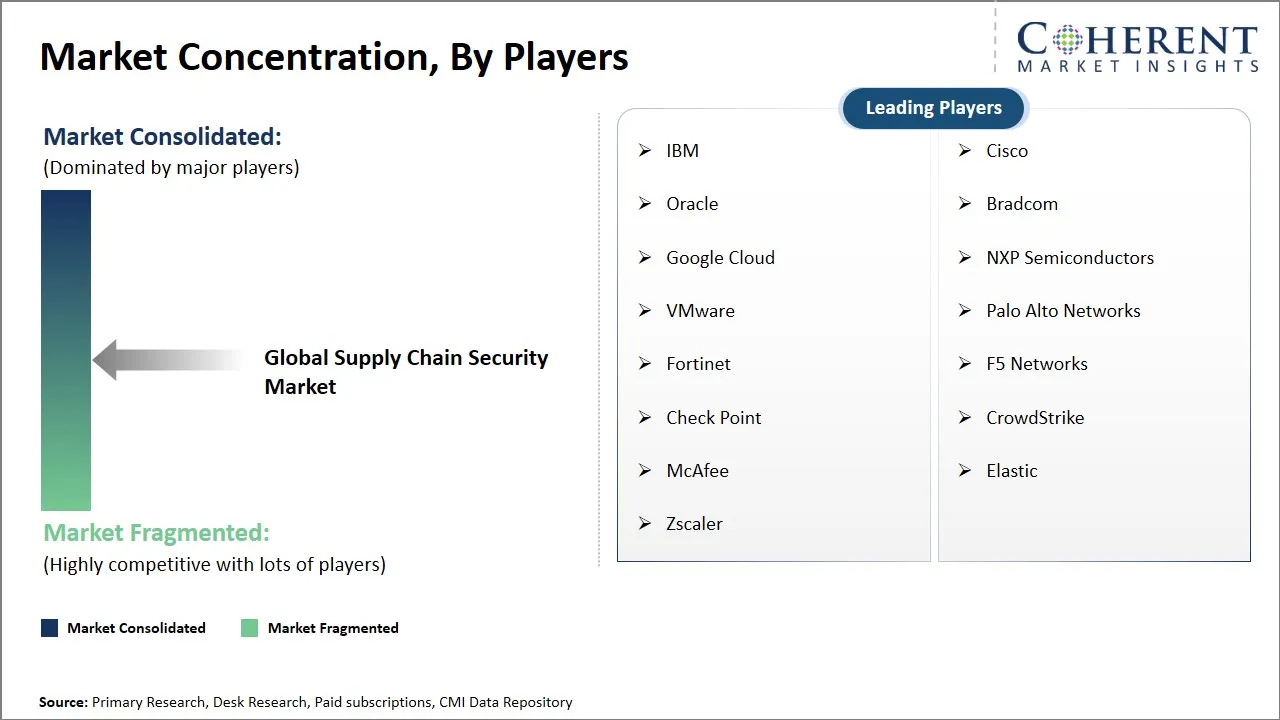
| Companies covered: | IBM, Cisco, Oracle, Bradcom, Google Cloud, NXP Semiconductors, VMware, Palo Alto Networks, Fortinet, F5 Networks, Check Point, CrowdStrike, McAfee, Elastic, and Zscaler | ||
| Growth Drivers: |
| ||
| Restraints & Challenges: |
| ||
Market Dynamics
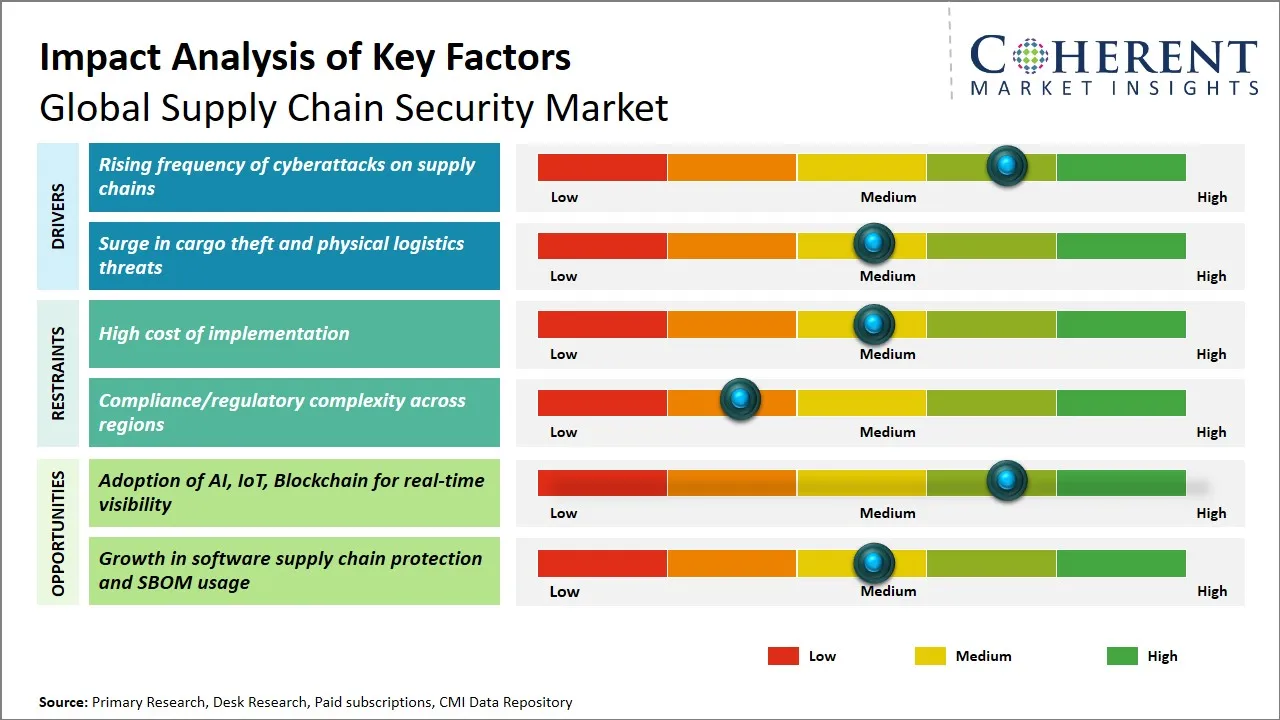
Global Supply Chain Security Market Driver – Rising Frequency of Cyberattacks on Supply Chains
As supply chains become increasingly digitized and interconnected, vulnerabilities across various points—from suppliers and manufacturers to distributors and retailers—have expanded the potential attack surface. Cybercriminals are exploiting these weak links to launch ransomware attacks, data breaches, and intellectual property theft, disrupting operations and causing substantial financial and reputational damage. For instance, in 2024, U.K. retail giant, Marks & Spencer (M&S) suffered a massive ransomware attack that infiltrated its systems through a third-party logistics vendor. The complexity and global nature of modern supply chains make detecting and mitigating these threats particularly challenging, prompting organizations to invest heavily in robust security frameworks, including real-time monitoring, advanced encryption, and threat intelligence platforms.
Global Supply Chain Security Market Opportunity – Adoption of AI, IoT, and Blockchain for Real-Time Visibility in the Global Supply Chain Security Market
The integration of advanced technologies such as Artificial Intelligence (AI), Internet of Things (IoT), and Blockchain is emerging as a significant opportunity within the global supply chain security market. These technologies collectively enable unprecedented real-time visibility and transparency across complex supply chain networks. AI-powered analytics facilitate the early detection of anomalies and potential security breaches by continuously monitoring vast datasets and identifying unusual patterns, thereby enhancing risk mitigation efforts. IoT devices, including sensors and GPS trackers, offer end-to-end tracking of goods, assets, and shipments, providing granular insights into the condition, location, and movement of products at every stage.
Blockchain technology further complements this by creating a decentralized and immutable ledger of transactions, thereby securing data integrity and enabling trust among diverse stakeholders such as manufacturers, logistics providers, and retailers. Maersk, one of the world's largest shipping and logistics firms, implemented TradeLens, a Blockchain-powered platform (developed with IBM), to digitally track shipments, authenticate documents, and provide real-time visibility into cargo movements. The combined use of these technologies addresses longstanding challenges related to transparency, traceability, and accountability in global supply chains.
Analyst Opinion (Expert Opinion)
- With mandates like the U.S. Executive Order on Improving the Nation’s Cybersecurity (which requires Software Bill of Materials – SBOMs) and EU’s Digital Operational Resilience Act (DORA), organizations are under pressure to secure their digital supply chains end-to-end. These regulations are accelerating the integration of secure coding practices, third-party risk assessments, and continuous compliance monitoring into supply chain processes.
- Emerging technologies such as AI for anomaly detection, IoT for real-time cargo tracking, and blockchain for data immutability are being embraced not just for efficiency but to meet compliance standards. Regulatory bodies increasingly favor technology frameworks that offer auditability, transparency, and traceability, making these technologies key enablers for compliant and resilient supply chains.
- In sectors like healthcare, finance, and defense, supply chain security is tightly governed by region-specific laws such as HIPAA, GDPR, and ITAR. These rules are not only pushing organizations to monitor vendors rigorously but also to invest in specialized solutions—for example, zero-trust architectures in pharma logistics or blockchain-enabled chain-of-custody tracking for defense equipment.
Speak to the analyst
Want personalized insights?
Take the findings above to one of our principal consultants, or have the report rebuilt around the segments, geographies and competitors you actually track.
Market Segmentation
- Security Type Insights (Revenue, USD Bn, 2021 - 2033)
- Data Protection
- Data Visibility & Governance
- Others
- Regional Insights (Revenue, USD Bn, 2021 - 2033)
- North America
- U.S.
- Canada
- Latin America
- Brazil
- Argentina
- Mexico
- Rest of Latin America
- Europe
- Germany
- U.K.
- Spain
- France
- Italy
- Russia
- Rest of Europe
- Asia Pacific
- China
- India
- Japan
- Australia
- South Korea
- ASEAN
- Rest of Asia Pacific
- Middle East
- GCC Countries
- Israel
- Rest of Middle East
- Africa
- South Africa
- North Africa
- Central Africa
- North America
- Key Players Insights
- IBM
- Cisco
- Oracle
- Bradcom
- Google Cloud
- NXP Semiconductors
- VMware
- Palo Alto Networks
- Fortinet
- F5 Networks
- Check Point
- CrowdStrike
- McAfee
- Elastic
- Zscaler
Sources
Primary Research Interviews
Stakeholders
- Chief Information Security Officers (CISOs) from logistics and manufacturing firms
- Supply Chain Risk Managers and Procurement Heads
- Third-Party Risk Management (TPRM) Solution Providers
- Security Software Vendors specializing in supply chain protection
- Compliance Officers from finance, healthcare, and retail sectors
- Blockchain and AI Integration Consultants for supply chain visibility
Databases
- Global Cyber Logistics Database (GCLD)
- Supply Chain Risk Registry (SCRR)
- World Logistics Cybersecurity Index
- National Digital Infrastructure Archive (NDIA)
Magazines
- Supply Chain Resilience Weekly
- Cybersecurity in Motion
- Global Logistics & Security Today
- Smart Manufacturing & Risk Insights
Journals
- Journal of Digital Supply Chain Management
- Cyber Risk & Resilience Review
- International Journal of Supply Chain Security & Technology
- Journal of Emerging Threats in Global Logistics
Newspapers
- Supply Chain Times
- The Global Freight Gazette
- TechSec News Daily
- The North American Logistics Chronicle
Associations
- International Association for Supply Chain Security (IASCS)
- Cybersecurity & Infrastructure Security Union (CISU)
- Global Trade Compliance and Security Council (GTCSC)
- Supply Chain Integrity Consortium (SCIC)
- Blockchain for Logistics Alliance (BLA)
Public Domain Sources
- U.S. Department of Homeland Security – CISA Reports
- World Customs Organization (WCO)
- United Nations Centre for Trade Facilitation and Electronic Business (UN/CEFACT)
- European Union Agency for Cybersecurity (ENISA)
- National Institute of Standards and Technology (NIST)
Proprietary Elements
- CMI Data Analytics Tool, Proprietary CMI Existing Repository of information for last 8 years
Get access to 250+ pages report
Every segment, forecast, competitor profile and data table behind the analysis above — available for instant download.
- ESOMAR Member
- ISO 9001:2015 Certified
- D-U-N-S Registered
- GDPR & CCPA Compliant
Missing comfort of reading report in your local language? Find your preferred language:
Transform your Strategy with Exclusive Trending Reports
Frequently Asked Questions
The global supply chain security market is estimated to be valued at USD 2.95 Bn in 2026 and is expected to reach USD 6.35 Bn by 2033.
The CAGR of global supply chain security market is projected to be 11.6% from 2026 to 2033.
Rising frequency of cyberattacks on supply chains and surge in cargo theft and physical logistics threats are the major factors driving the growth of the global supply chain security market.
High cost of implementation and compliance/regulatory complexity across regions are the major factors hampering the growth of the global supply chain security market.
In terms of security type, data protection is estimated to dominate the market revenue share in 2026.
IBM, Cisco, Oracle, Bradcom, Google Cloud, NXP Semiconductors, VMware, Palo Alto Networks, Fortinet, F5 Networks, Check Point, CrowdStrike, McAfee, Elastic, and Zscaler are the major players.
North America is expected to lead the global supply chain security market in 2026.