

Global Supply Chain Risk Management Market Size and Forecast – 2026 To 2033
The global supply chain risk management market is expected to grow from USD 6,912.6 Mn in 2026 to USD 14,889.2 Mn by 2033, registering a compound annual growth rate (CAGR) of 11.6% from 2026 to 2033. The global supply chain risk management market growth is primarily driven by the rapid expansion of e-commerce and global sourcing networks.
On November 7, 2025, Amazon announced that it had expanded its low-cost e-commerce service Amazon Bazaar, known as Haul in the U.S., to 14 additional markets, ramping up competition with Chinese rivals like Shein and PDD Holdings' (PDD.O), Temu in the global race to sell ultra-cheap goods and accessories.
(Source: Amazon News)
Key Takeaways of the Global Supply Chain Risk Management Market
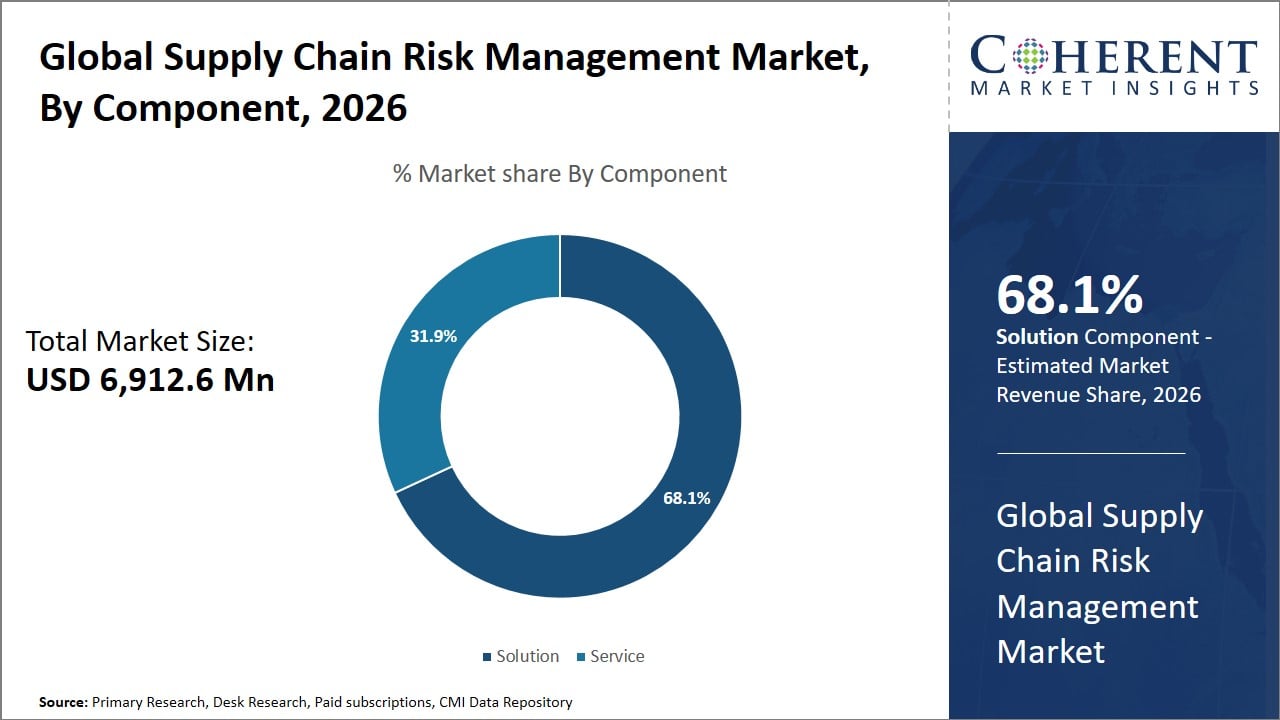
- The solution segment is expected to account for 68.1 % of the global supply chain risk management market share in 2026. The growing need for end-to-end risk detection is a major factor driving the growth of the solution segment. On October 7, 2025, SAP introduced its Supply Chain Orchestration. SAP Supply Chain Orchestration is a new AI-centric solution built to detect potential disruptions early, contextualize risk to a company’s unique supply chain configuration, apply intelligent impact analysis, and trigger AI-driven actions across planning, logistics, procurement, and manufacturing. (Source: SAP)
- The cloud-based segment is estimated to capture 73.3 % of the market share in 2026. Cloud deployment provides the flexibility of real-time data access and scalability options. On May 12, 2025, Nestle transitioned from six on-premises data centers to a unified, cloud-first SAP environment using RISE with SAP on Microsoft Azure. (Source: Microsoft)
- The manufacturing segment is estimated to capture 28.3 % of the market share in 2026. The manufacturing segment dominates the market mainly owing to real-world disruptions that are continuously showcasing the fragility of multi-tier production networks to weak semiconductor and component supply chains. For example, recent disruptions in the automotive manufacturing sector were triggered by the Nexperia semiconductor crisis, where geopolitical tensions between the Netherlands and China led to export restrictions that cut off chip supplies. This forced major automakers such as Honda, Nissan, and Bosch to reduce or halt production, directly exposing how a single upstream semiconductor supplier can disrupt global vehicle manufacturing lines across multiple countries and plants.
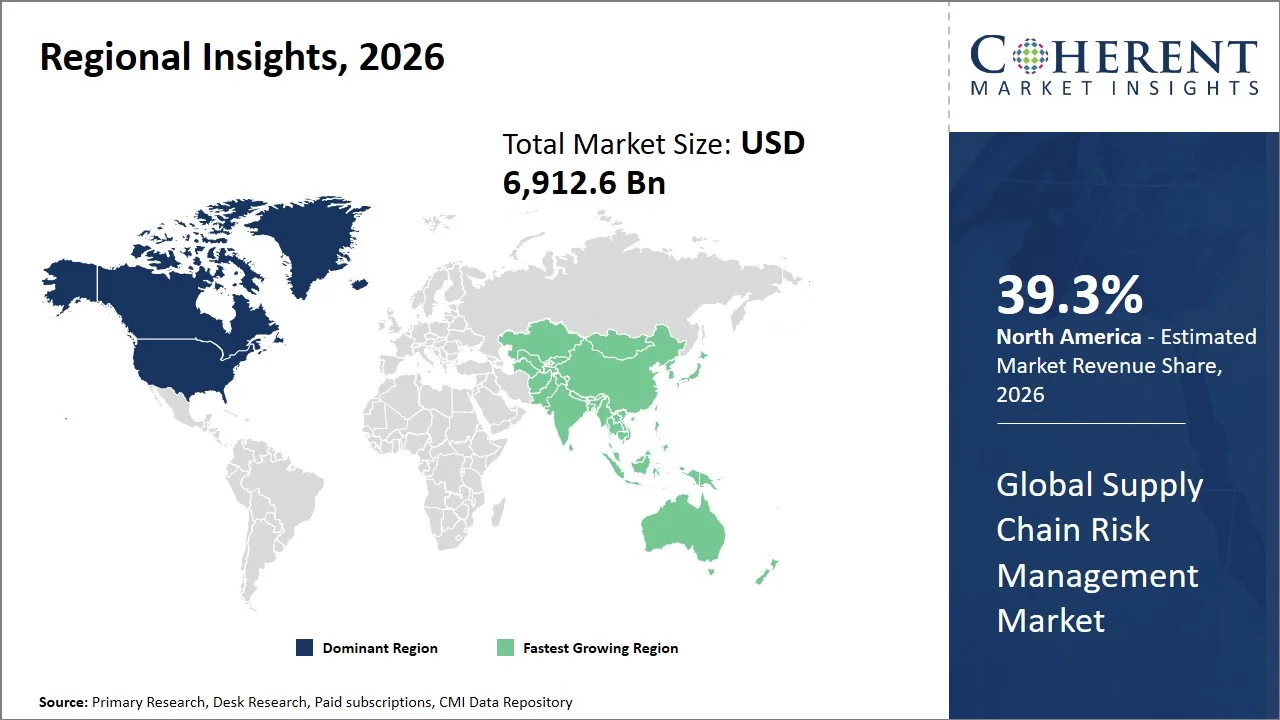
- North America is expected to dominate the supply chain risk management market in 2026 with a market share of 39.3 %. The market in North America is highly driven by needs to address increasing cost fluctuations. On December 8, 2025, PepsiCo announced a review of its North America supply chain, and declared it would aggressively reduce costs to drive growth after weeks of discussions with activist investor Elliott Investment Management. (Source: PepsiCo)
- Asia Pacific is expected to account for 23.3 % share in 2026 and is projected to record the fastest growth over the forecast period. The region is witnessing investments in high-tech supply chains and logistics hub. On March 25, 2026, United Parcel Service (UPS) opened a new USD 100 million logistics center in Taiwan, its largest in the Asia Pacific, riding a wave of demand from tech companies. (Source: UPS)
- Growing Adoption of Artificial Intelligence and Predictive Analytics: Companies are increasingly turning to AI, machine learning, and predictive analytics in supply chain risk management procedures to find disruptions before they happen. They scan vast amounts of real-time data from suppliers, logistics networks, weather patterns and geopolitical developments to predict potential problems and recommend corrective action.
- Rising Focus on Supply Chain Sustainability and ESG Compliance: Environmental, Social, and Governance (ESG) standards are emerging as a key driver of supply chain risk management techniques. Companies are increasingly looking at reputational and operational risks associated with ethical sourcing, carbon emissions, labor practices and regulatory compliance of their suppliers. The governments and regulatory agencies in these regions, including Europe and North America are coming up with stringent supply chain transparency legislation to promote firms to use sustainable procurement and supplier auditing solutions.
Segmental Insights
Why Does the Solution Segment Dominate the Global Supply Chain Risk Management Market?
The solution segment is expected to account for 68.1% of the global supply chain risk management market share in 2026. The solution segment accounts for the highest share of the global supply chain risk management market as organizations opt for end-to-end risk detection and mitigation platforms over standalone services to proactively tackle disruptions in real-time. Supply chain risk management solutions, risk analytics software, supplier monitoring tools and predictive intelligence platforms, offer businesses constant insight into supply chain weaknesses so that they may rapidly identify risks such as supplier failure, shipping delays or geopolitical disruptions.
On January 30, 2025, Oracle announced that it is introducing new AI-powered logistics and order management capabilities within Oracle Fusion Cloud Supply Chain & Manufacturing (SCM) to help organizations increase the efficiency and sustainability of global supply chains. (Source: Oracle)
- Current Industry Events of 2026
- Market Size Estimation
- Regional Breakdown
- Competitive Landscape
- Customer Intelligence
- Segmental Analysis
- Pricing Analysis
- Key Market Drivers, Challenges & Future Trends
- Customized Insights Section
Why is Cloud-Based the Most Preferred Deployment?
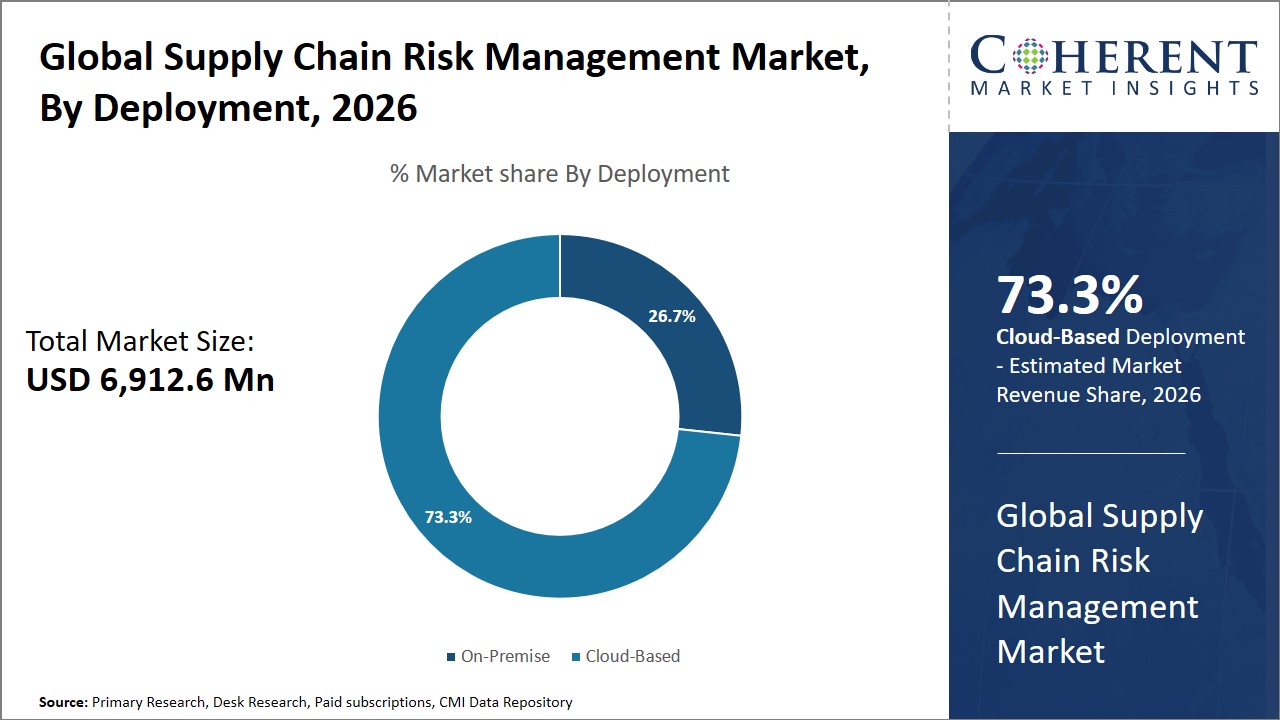
The cloud-based segment is expected to account for 73.3% of the global supply chain risk management market share in 2026. Cloud-based deployment is the most chosen supply chain risk management due to its features, including real-time data access and scalability across globally scattered supply networks. Cloud platforms do not have the limitations of on-premise systems. They give manufacturers, retailers and logistics providers the ability to track suppliers, shipments and risk events across several locations in real-time from one, integrated dashboard. This is especially important when dealing with disturbances such as port delays or supplier problems where rapid visibility and collaboration is critical.
On May 14, 2026, SAP announced extensions and enhancements to its SAP Supply Chain Orchestration. Beyond supply chain-specific scenarios, these will also extend into SAP’s cloud ERP environment, including SAP Cloud ERP Private, supporting SAP’s broader Autonomous Enterprise strategy. (Source: SAP)
Manufacturing Segment Dominates the Global Supply Chain Risk Management Market
The manufacturing segment is expected to account for 28.3% of the global supply chain risk management market share in 2026. The manufacturing category is dominating the worldwide supply chain risk management market owing to its presence in the highly complex multi-tier global supply networks that are particularly vulnerable to disruptions. Industries such as the automotive, electronics, aerospace and industrial machinery are dependent on a large number of suppliers for raw materials, components and sub-assemblies from different countries, making them highly vulnerable to risks such as geopolitical tensions, transportation delays and supplier failures.
On May 19, 2026, Airbus announced that it is cutting costs by 10% in non-industrial operations due to ongoing global supply chain disruptions affecting aircraft production, including issues with fuselage components and engine availability from suppliers like Pratt & Whitney and Spirit AeroSystems.
Currents Events and their Impact
Current Events | Description and its Impact |
U.S. CHIPS and Science Act |
|
European Union Corporate Sustainability Due Diligence Directive (CSDDD) |
|
(Source: Congress, European Commission)
Global Supply Chain Risk Management Market Dynamics
Market Drivers
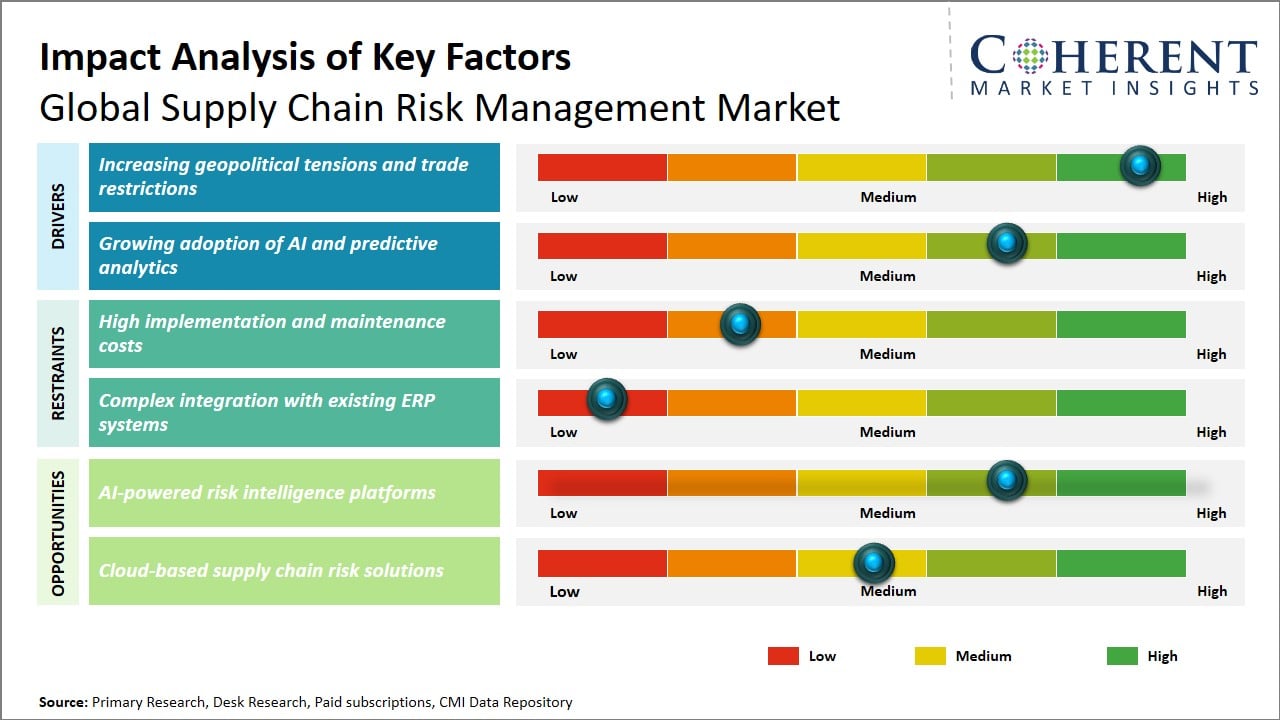
- Increasing geopolitical tensions and trade restrictions: Trade restrictions are growing and severely hurting global supply chains adding to uncertainty in sourcing, manufacturing and international trade operations. With trade disputes, sanctions, tariffs and export control measures impacting the world’s major economies, corporations are re-assessing their supplier networks and diversifying their sourcing practices to reduce dependence on certain locations. The disruptions are driving demand for innovative supply chain risk management solutions that may provide real-time monitoring, risk forecasting and contingency planning to assist organizations maintain operational stability and avoid financial losses. On May 20, 2026, the U.K. government delayed some sanctions on Russian oil and liquefied natural gas to help tackle soaring prices as the conflict in the Middle East disrupts global supplies.
- Growing adoption of AI and predictive analytics: AI and predictive analytics are revolutionizing supply chain risk management by helping firms to anticipate problems before they occur and react more efficiently. These technologies sift through vast amounts of data from suppliers, logistics networks, the market trends and external factors such as weather or geopolitical events to identify possible threats in advance. This helps companies improve demand forecasts, control inventory levels and speed up decision making. The outcome is more resilient and efficient supply chain operations. For example, according to recent IBM IBV research, 60% of C-suite leaders expect agentic AI to dissolve organizational silos by 2026. Furthermore, 77% of them treat automation and GBS transformation as a strategic imperative, not a cost exercise. Supply chain leadership is entering the same reality, one where workflows, data, decisions and partners must operate as a single adaptive network. (Source: IBM)
Emerging Trends
- Expansion of End-to-End Supply Chain Visibility Solutions: Companies are focusing more on achieving total visibility across the whole supply chain network for better transparency and agility. Advanced visibility technologies, powered by IoT sensors, cloud computing, and digital dashboards, allow firms to track supplier performance, follow shipments, and spot delays or disruptions as they happen.
- Increasing Use of Blockchain and Digital Twin Technologies: Blockchain and digital twin technologies are emerging as key enablers for boosting supply chain resilience and traceability. Blockchain provides secure and transparent records of transactions that foster trust amongst supply chain actors and minimize the risk of fraud.
Regional Insights
Why is North America a Strong Market for Supply Chain Risk Management?
North America is expected to account for a market share of 39.3% in 2026. North America is one of the most mature markets for Supply Chain Risk Management (SCRM) with a strong adoption of digital technologies and presence of major multinational companies. U.S. and Canadian companies in the automotive, healthcare, aerospace and retail industries are investing extensively in AI-based risk monitoring and predictive analytics solutions to increase the resilience of supply chains. For example, the COVID-19 epidemic and semiconductor shortages have disrupted supply chains, leading to huge retailers and logistics companies to deploy real-time supplier visibility systems. The region is also seeing a rise in the adoption of cybersecurity-focused SCRM solutions, as ransomware assaults on logistics networks and manufacturing systems have intensified.
Moreover, stringent regulations for trade compliance, ESG reporting and supplier transparency are compelling firms to use sophisticated cloud-based risk management systems. On February 12, 2026, the Department of Commerce’s Bureau of Industry and Security (BIS) announced a settlement agreement with Applied Materials Inc. of Santa Clara, California (AMAT) and Applied Materials Korea, Ltd. (AMK), covering illegal exports of U.S. semiconductor manufacturing equipment to China. AMAT and AMK agreed to pay a penalty of approximately USD 252 million, the second-highest penalty ever imposed by BIS. (Source: Bureau of Industry and Security)
Why Does the Asia Pacific Supply Chain Risk Management Market Exhibit High Growth?
Asia Pacific is projected to account for 23.3% of the global supply chain risk management market and is expected to register the fastest growth. Asia Pacific supply chain risk management market is witnessing strong growth, driven by region’s leading role in global manufacturing and exports, especially in countries such as China, Japan, South Korea, India and Southeast Asian countries. Businesses are ramping up supplier diversity and risk assessment tactics amid rising geopolitical tensions, trade curbs and supply chain disruptions in semiconductors and electronics.
For example, electronics firms in Taiwan and South Korea are using AI-driven supply chain analytics to reduce production disruptions and better organize inventory. Furthermore, the region is seeing increasing use of SCRM solutions with a cybersecurity focus, driven by the surge in ransomware attacks on logistics networks and manufacturing systems. On November 27, 2025, Japan's Asahi Group announced that it aims to normalize logistical operations by February 2026, after a cyberattack in late September 2025 forced widespread suspension.
Global Supply Chain Risk Management Market Outlook for Key Countries
Why is the U.S. Emerging as a Major Hub in the Supply Chain Risk Management Market?
The U.S. supply chain risk management market is mature and characterized by a rising level of worry about cybersecurity risks, import dependency, and supply chain disruptions in key industries like pharmaceuticals, semiconductors, defense, and food processing. Big companies are investing in digital twin technologies, AI-powered predictive analytics and supplier mapping solutions to help them be more operationally resilient.
For instance, U.S.-based automakers have ramped up spending in supplier risk intelligence systems after suffering from a semiconductor shortage that affected vehicle manufacturing. The federal government is also supporting supply chain resilience activities through regulations to reduce dependence on foreign suppliers of vital commodities and technologies. In addition, the rise of omnichannel retailing and same-day delivery options is forcing logistics providers and retailers to embrace complex SCRM technologies that offer real-time inventory tracking and transportation risk management.
Is China the Next Growth Engine for the Supply Chain Risk Management Market?
China is a key player in the global supply chain risk management market, propelled by its vast manufacturing sector and robust export-driven economy. Chinese manufacturers and logistics providers are turning to AI, IoT and blockchain technologies in growing numbers to increase supply chain transparency and reduce operational risks created by trade tensions and unpredictable global demand. To ensure the uninterrupted output of its major electronics, automobile and pharmaceutical industries and satisfy international standards, the government is rolling out new supplier monitoring systems. For instance, some Chinese businesses are investing in smart industrial technologies and predictive maintenance systems to reduce downtime and better manage shortages of raw materials. Furthermore, government initiatives to promote industrial automation and digital transformation are further accelerating the implementation of intelligent supply chain risk management solutions across industrial sectors.
Germany Supply Chain Risk Management Market Analysis and Trends
Germany supply chain risk management market is primarily driven by the country’s highly developed automotive, industrial machinery and chemical manufacturing industries. Disruptions from the Russia-Ukraine conflict and energy supply uncertainty have led German enterprises to place a greater focus on supply chain transparency, sustainability compliance and supplier diversification. Automotive manufacturers, for instance, are turning to digital supply chain platforms and AI-powered forecasting tools to safeguard their semiconductor supplies and fine-tune their production planning.
Germany’s Supply Chain Due Diligence Act has also upped the ante for supplier risk monitoring and ESG compliance solutions, especially among exporters and international firms. Moreover, the growing acceptance of Industry 4.0 in manufacturing facilities is driving the implementation of IoT-enabled risk monitoring systems that provide real-time operational insights and predictive maintenance capabilities.
The supply chain risk management market in India is experiencing robust growth, driven by growing industrialization, a booming e-commerce industry and government attempts to boost domestic manufacturing capabilities. Initiatives such as “Make in India” and the Production Linked Incentive (PLI) schemes are spurring companies to upgrade supply chain infrastructure and implement digital risk management solutions. Pharmaceutical, automotive and consumer products industries in India are using cloud-based supply chain visibility solutions to help them manage supplier risks, shipping interruptions and volatile raw material pricing. For example, major Indian e-commerce and retail enterprises are utilizing AI-powered demand forecasting and warehouse optimization solutions to boost delivery efficiency and eliminate inventory-related risks. Furthermore, growing investments in logistics parks, smart warehousing, and digital freight management systems are fueling the adoption of advanced SCRM technology across the country.
Supply Chain Risk Management Market - Annual Global Supply Chain Disruption
Indicator Type | Reported Value |
Companies experiencing at least one disruption annually | ~65% of global firms |
Companies facing more than 20 disruptions per year | ~25% of European shippers |
Disruption frequency (major disruptions >1 month) | Every 3.7 years (avg per firm cycle) |
Global supply chains experiencing reduced operations | 85% affected during major disruption cycles |
Share of firms reporting logistics disruption impact (APAC) | 91% report customer/service impact |
Typical operating cost increase due to disruptions | +3% to 5% operating cost rise |
Revenue impact of disruptions | ~7% sales reduction |
Severe disruption frequency trend | +38% increase in disruptions (2024 Y-O-Y) |
How are AI-Powered Risk Intelligence Platforms Creating New Growth Opportunities in the Global Supply Chain Risk Management Market?
The supply chain risk management market is witnessing new development opportunities with the advent of AI powered risk intelligence tools that enable businesses to identify, forecast and respond to possible disruptions more efficiently. These platforms leverage artificial intelligence, machine learning and real-time data analytics to track supply chain operations, identify emerging hazards and offer predictive insights to facilitate quicker decision-making. AI-powered solutions help organizations minimize disruptions, optimize supplier management, and improve overall supply chain performance by enhancing visibility, automating risk assessment, and improving operational resilience, driving the demand for advanced SCRM technologies across industries. On March 6, 2026, IBM announced that the introduction of agentic AI capabilities within IBM Sterling Order Management System (OMS) will bring cutting-edge Agentic AI to the IBM Sterling OMS platform, embedding intelligence seamlessly across the order lifecycle while leveraging the robust foundation of the existing system. (Source: IBM)
Supply Chain Risk Management Market - AI/ML Adoption in Supply Chain Risk Analytics
Company | AI/ML Application Area | Recent Development | Reported Outcome |
General Motors | Predictive risk intelligence + supplier network mapping | AI system scans supplier data, news, weather, and logistics signals in real time to detect disruptions early | Prevented ~75 production stoppages in 2025 by early disruption detection |
IBM | Cognitive supply chain + predictive analytics + risk orchestration | Cognitive Control Tower” uses AI + Watson to unify planning, procurement, logistics, and external risk data | >95% faster decision cycles and improved risk escalation handling in enterprise deployments |
S&P Global + IBM | Agentic AI for supply chain + vendor risk intelligence | Embedded IBM watsonx agentic AI into supply chain risk and procurement systems | Enables real-time supplier risk scoring and automated decision support across procurement networks |
Oracle | AI/ML-based demand sensing + ETA prediction | Oracle Transportation Management uses ML for shipment delay prediction and supply disruption forecasting | Improved estimated arrival time (ETA) accuracy and proactive delay mitigation |
SAP | Predictive supply chain analytics + AI planning | Agentic AI” integrated into SAP supply chain suite for procurement and logistics automation | Automates decision-making across demand, supply, and logistics workflows |
Market Players, Key Development, and Competitive Intelligence
Key Developments
- On May 4, 2026, Amazon announced that it is giving other businesses access to its supply chain network that has powered the e-commerce behemoth’s operations for decades, pitting it directly against logistics heavyweights such as UPS and FedEx.
- On September 9, 2024, IBM announced plans to acquire Accelalpha, a global Oracle services provider with deep expertise helping clients digitize core business operations and accelerate the adoption of Oracle Cloud Applications. This acquisition expands IBM's Oracle consulting expertise in supply chain and logistics, finance, enterprise performance management (EPM) and customer transformation.
Competitive Landscape
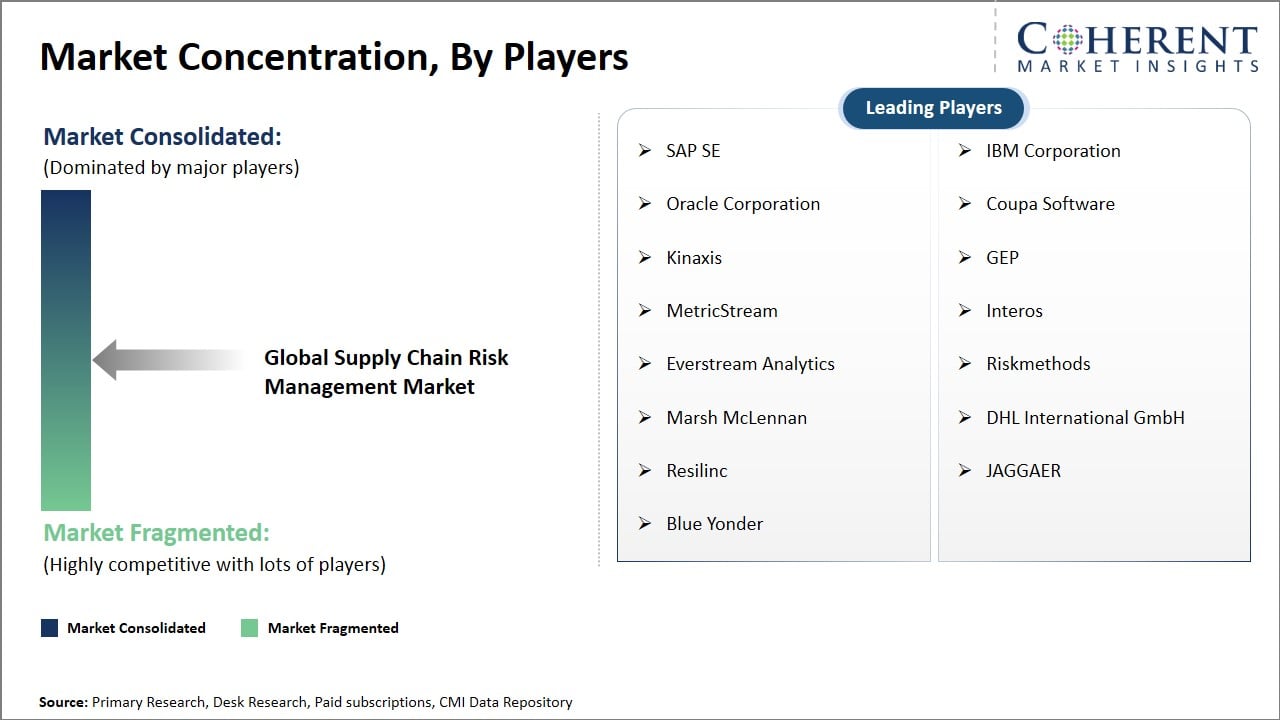
The worldwide supply chain risk management (SCRM) industry is highly competitive and with the increasing complexity of global supply chains, leading technology providers, logistics corporations and specialized risk management organizations are focused on innovation and strategic partnerships to strengthen their market presence. Top players are investing in sophisticated technologies like artificial intelligence, machine learning, blockchain and predictive analytics to provide better visibility, real-time monitoring and proactive risk mitigation capabilities. Companies are also increasing their cloud-based products and adding end-to-end supply chain intelligence solutions to address the increased demand for digital transformation across industries.
Market Report Scope
Supply Chain Risk Management Market Report Coverage
| Report Coverage | Details | ||
|---|---|---|---|
| Base Year: | 2025 | Market Size in 2026: | USD 6,912.6 Mn |
| Historical Data for: | 2020 To 2024 | Forecast Period: | 2026 To 2033 |
| Forecast Period 2026 to 2033 CAGR: | 11.6% | 2033 Value Projection: | USD 14,889.2 Mn |
| Geographies covered: |
| ||
| Segments covered: |
| ||
| Companies covered: | SAP SE, IBM Corporation, Oracle Corporation, Coupa Software, Kinaxis, GEP, MetricStream, Interos, Everstream Analytics, Riskmethods, Marsh McLennan, DHL International GmbH, Resilinc, JAGGAER, and Blue Yonder | ||
| Growth Drivers: |
| ||
| Restraints & Challenges: |
| ||
Analyst Opinion (Expert Opinion)
- The global supply chain risk management market is expected to grow strongly as firms focus more on resilience, agility and operational continuity amid increasing global uncertainties. The rising occurrence of geopolitical conflicts, climate-related upheavals, cyber threats, and regulatory complications are forcing firms to use sophisticated risk management systems. This includes the implementation of AI-powered analytics and automation technologies that are creating traditional supply chain management more predictive and intelligent. The high costs of implementation and difficulties in integration may hinder adoption by smaller firms, but the long-term benefits of more transparency, higher efficiency and lower risks of disruption are projected to fuel continued market demand.
- The global supply chain risk management market looks very promising in the future due to fast digitization, rising usage of cloud technologies and increasing requirement for end-to-end supply chain visibility. New and emerging technologies such as blockchain, Internet of Things (IoT), digital twins, and advanced predictive analytics are poised to reshape risk management techniques and supply chain resilience. Businesses are likely to pay greater attention to diversifying their suppliers, sustainability programs and real-time risk intelligence to strengthen their operations against future disruptions. Moreover, due to the increasing e-commerce activities, globalization of trade, and stringent regulatory compliance requirements, SCRM solution providers are expected to witness considerable growth prospects in the next several years.
Speak to the analyst
Want personalized insights?
Take the findings above to one of our principal consultants, or have the report rebuilt around the segments, geographies and competitors you actually track.
Market Segmentation
- Component Insights (Revenue, USD Million, 2021 - 2033)
- Solution
- Service
- Deployment Insights (Revenue, USD Million, 2021 - 2033)
- On-Premises
- Cloud-Based
- End-use Industry Insights (Revenue, USD Million, 2021 - 2033)
- Government
- Pharmaceuticals
- Oil and Gas
- Transportation and Logistics
- Food and Beverages
- Manufacturing
- Other End-use Industries (Retail and E-commerce, Automotive, Electronics and Semiconductors, Aerospace and Defense, etc.)
- Regional Insights (Revenue, USD Million, 2021 - 2033)
- North America
- U.S.
- Canada
- Latin America
- Brazil
- Argentina
- Mexico
- Rest of Latin America
- Europe
- Germany
- U.K.
- Spain
- France
- Italy
- Russia
- Rest of Europe
- Asia Pacific
- China
- India
- Japan
- Australia
- South Korea
- ASEAN
- Rest of Asia Pacific
- Middle East
- GCC Countries
- Israel
- Rest of Middle East
- Africa
- South Africa
- North Africa
- Central Africa
- North America
- Key Players Insights
- SAP SE
- IBM Corporation
- Oracle Corporation
- Coupa Software
- Kinaxis
- GEP
- MetricStream
- Interos
- Everstream Analytics
- Riskmethods
- Marsh McLennan
- DHL International GmbH
- Resilinc
- JAGGAER
- Blue Yonder
Sources
Primary Research Interviews
- Chief Supply Chain Officers from multinational corporations
- Risk Management Directors from logistics companies
- Supply Chain Technology Solution Providers
- Supply Chain Consultants and Advisory Firms
Magazines
- Supply Chain Management Review
- Logistics Management Magazine
- Supply Chain Quarterly
- Material Handling & Logistics
Journals
- International Journal of Production Economics
- Supply Chain Management: An International Journal
- Journal of Business Logistics
Associations
- Council of Supply Chain Management Professionals (CSCMP)
- Supply Chain Risk Leadership Council (SCRLC)
- International Association for Risk and Crisis Management (IARCM)
- Global Supply Chain Council
Public Domain Sources
- World Trade Organization (WTO) Reports
- International Monetary Fund (IMF) Publications
- Government Trade and Commerce Department Reports
- World Bank Supply Chain Studies
Proprietary Elements
- CMI Data Analytics Tool
- Proprietary CMI Existing Repository of information for last 10 years
Get access to 250+ pages report
Every segment, forecast, competitor profile and data table behind the analysis above — available for instant download.
- ESOMAR Member
- ISO 9001:2015 Certified
- D-U-N-S Registered
- GDPR & CCPA Compliant
Missing comfort of reading report in your local language? Find your preferred language:
Transform your Strategy with Exclusive Trending Reports
Frequently Asked Questions
The global supply chain risk management market is expected to stand at USD 6,912.6 Mn in 2026 and is expected to reach USD 14,889.2 Mn by 2033.
The CAGR of the global supply chain risk management market is projected to be 11.6% from 2026 to 2033.
Increasing geopolitical tensions and trade restrictions and growing adoption of AI and predictive analytics are the major factors driving the growth of the global supply chain risk management market.
High implementation and maintenance costs and complex integration with existing ERP systems are the major factors hampering the growth of the global supply chain risk management market.
In terms of component, the solution segment is estimated to dominate the market revenue share in 2026.
SCRM helps organizations prepare for disruptions and maintain uninterrupted operations during unexpected events.
Globalization creates complex supply networks that are more vulnerable to political, economic, and environmental disruptions.