

Global Supply Chain Resilience Market Size and forecast – 2026-2033
The Global Supply Chain Resilience Market is estimated to be valued at USD 37.76 Bn in 2026 and is expected to reach USD 75.95 Bn by 2033, exhibiting a compound annual growth rate (CAGR) of 10.5% from 2026 to 2033.
Key Takeaways of the Global Supply Chain Resilience Market
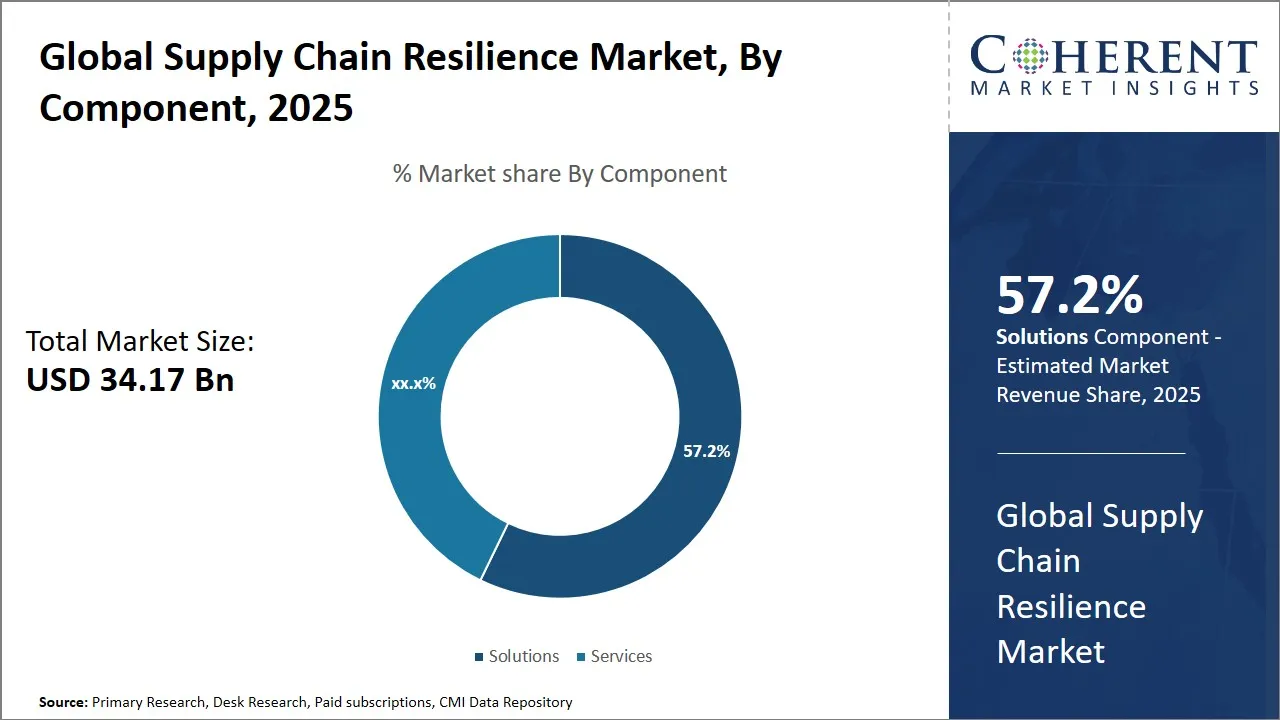
- The solutions segment is expected to lead the market holding a share of 58.2 % in 2026.
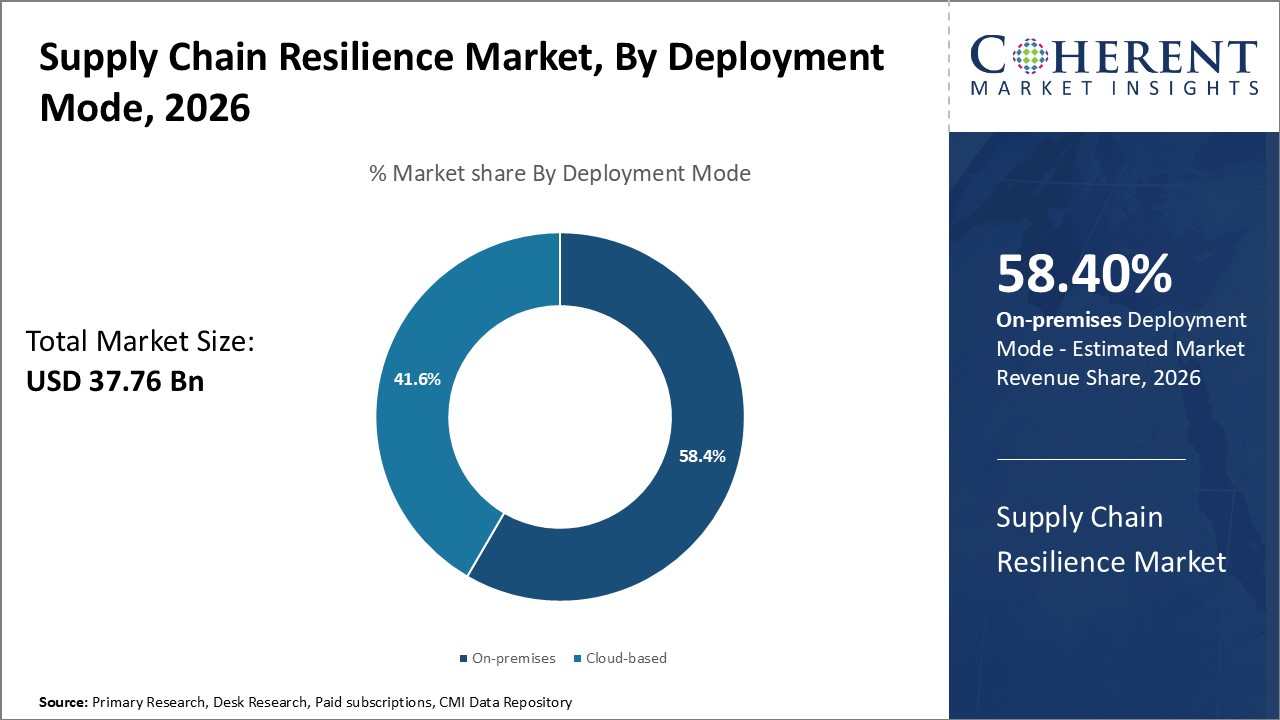
- The on-premises segment dominate with a projected share of 58.4 % in 2026.
- The large enterprises segment leads the market holding an estimated share of 85.5 % in 2026.
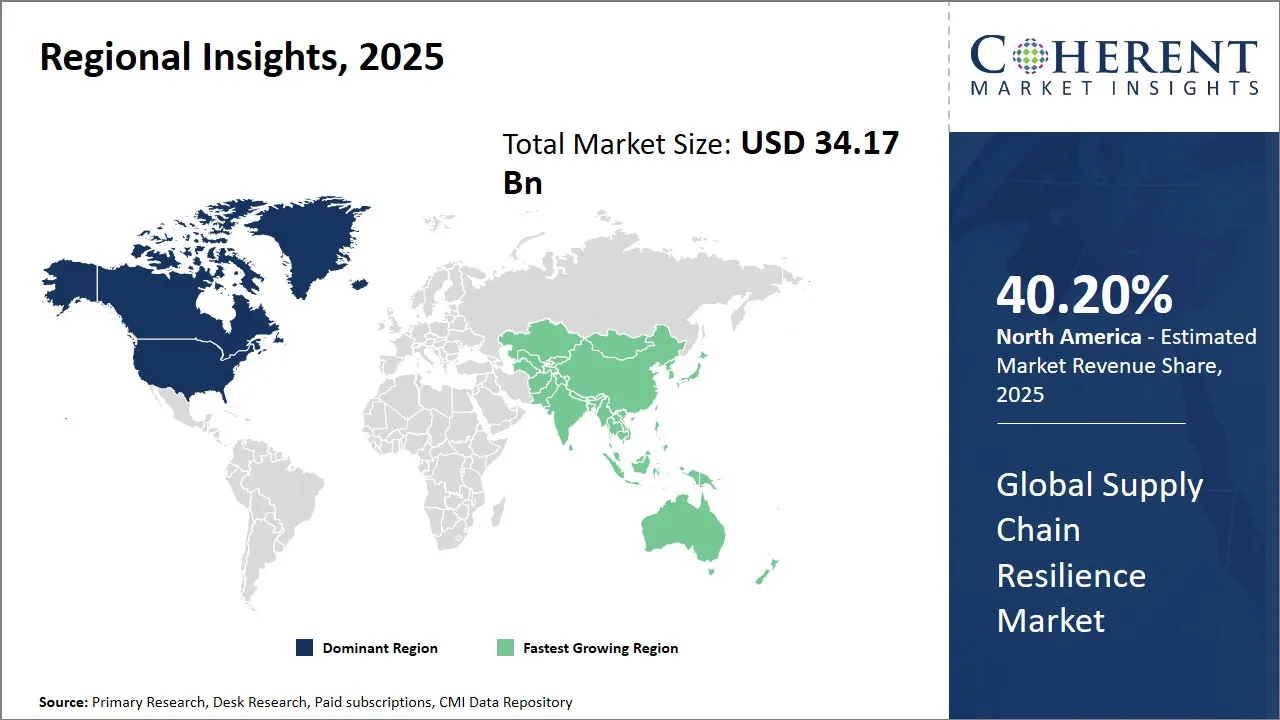
- North America, holding a projected share of 40.2% in 2026, and dominate the market.
- Asia Pacific, holding an estimated share of 19.3% in 2026, and shows the fastest growth in the market.
Market Overview
A prevailing trend in the supply chain resilience market is the integration of digital solutions such as AI, blockchain, and IoT to improve real-time visibility and predictive analytics. Companies are emphasizing automation and data-driven decision-making to address disruptions caused by geopolitical events, pandemics, and natural disasters. Also, there is a growing focus on sustainable supply chain practices to reduce environmental risks, making resilience initiatives not only about risk management but also about long-term value creation and compliance with evolving regulations.
Current Events and Its Impact
Current Events | Description and its Impact |
Geopolitical and Trade Developments |
|
Economic and Industrial Trends |
|
Segmental Insights
- Current Industry Events of 2026
- Market Size Estimation
- Regional Breakdown
- Competitive Landscape
- Customer Intelligence
- Segmental Analysis
- Pricing Analysis
- Key Market Drivers, Challenges & Future Trends
- Customized Insights Section
Global Supply Chain Resilience Market Insights, By Component – Leading Role of Solutions Driving Component-Wise Growth in Supply Chain Resilience
In the global supply chain resilience market, the solutions segment hold the highest share of 58.2% in 2026. Solutions, like software platforms, analytics, risk management tools, and real-time monitoring systems, dominate the market as companies move from reactive to proactive resilience strategies. AI-powered predictive analytics and IoT-enabled visibility help firms anticipate disruptions and optimize contingency plans. Sustainability and compliance tracking also improve solution adoption. SAP’s Joule AI platform makes possible predictive supply chain analytics and risk modeling, helping companies like Unilever improve visibility and anticipate supplier disruptions.
Global Supply Chain Resilience Market Insights, By Deployment Mode – Dominance of On-Premises Deployment Because of Security and Control Priorities
The on-premises segment is projected to account for 58.4% share in 2026. Despite cloud growth, enterprises choose on-premises deployments for improved security, control, and legacy system integration. Sensitive industries like pharmaceuticals and defense benefit from internal governance and compliance adherence, making on-premises solutions attractive. Pfizer uses on-premises deployment for its supply chain resilience systems to ensure regulatory compliance and safeguard proprietary manufacturing data.
Global Supply Chain Resilience Market Insights, By Organization Side – Large Enterprises Driving Market Growth Through Strategic Investments in Resilience
Large enterprises dominate the global supply chain resilience market with a share of 85.5% in 2026. Big companies drive market growth because of multi-tier global supply chains and high investment capacity. They use comprehensive solutions, professional services, and strategic initiatives to manage risks like supplier insolvencies, geopolitical disruptions, and natural disasters. Toyota has implemented a multi-tier supply chain visibility system combined with predictive risk analytics to reduce disruptions in its global automotive network.
Impact of AI on the Global Supply Chain Resilience Market
Artificial Intelligence (AI) is changing how organizations anticipate, absorb, and recover from disruptions in their supply chains. By using AI for demand forecasting, supplier risk assessment, and logistics optimization, companies are achieving high visibility and agility. Machine learning algorithms can process huge datasets from weather forecasts, geopolitical reports, and transportation systems to detect early warning signals of potential bottlenecks. This predictive capability allows enterprises to rebalance inventory, diversify sourcing, and automate contingency responses before disruptions occur—turning resilience from a reactive process into a proactive advantage.
An example is IBM and Dun & Bradstreet’s collaboration on AI-powered supply chain mapping. Their joint platform uses predictive analytics and supplier data intelligence to find hidden dependencies and vulnerabilities in multi-tier networks. During the 2024 Red Sea shipping crisis, companies using this system were able to reroute shipments and pre-allocate inventory based on AI-driven impact forecasts, reducing delivery delays by up to 30%.
Regional Insights
North America Supply Chain Resilience Market Analysis and Trends
North America, holding a projected share of 40.2% in 2026, dominates the global supply chain resilience market because of a mature market ecosystem supported by advanced technological infrastructure and a highly developed logistics network. The region sees huge investments by both private sector enterprises and supportive government policies that promote supply chain innovation, cybersecurity, and risk management. The presence of numerous multinational corporations in different industries like automotive, aerospace, pharmaceuticals, and technology intensifies the demand for resilient supply chain solutions.
Also, trade dynamics, including established free trade agreements and a strategic geographic position, make possible seamless cross-border flow of goods and services. Key companies like IBM, Cisco Systems, and Honeywell use cutting-edge AI, blockchain, and IoT technologies, significantly enhancing supply chain visibility and responsiveness.
Asia Pacific Supply Chain Resilience Market Analysis and Trends
The Asia Pacific, holding an estimated share of 19.3% in 2026, exhibits the fastest growth in the global supply chain resilience market, due to rapid industrialization, expanding manufacturing hubs, and increasing globalization of supply chains.
The strong presence of electronics, automotive, and consumer goods sectors makes demand for adaptive supply chain solutions to counter risks like geopolitical tensions. Trade dynamics, including regional trade agreements like RCEP, have boosted intra-regional commerce, necessitating enhanced inventory management and supply chain risk mitigation. Prominent players such as Huawei, Samsung SDS, and Hitachi play critical roles in integrating AI-enabled analytics, cloud computing, and automation to enhance supply chain agility and continuity throughout the region.
Global Supply Chain Resilience Market Outlook for Key Countries
U.S. Supply Chain Resilience Market Analysis and Trends
The U.S. sees a lot of focus on technology-driven supply chain resilience solutions. Companies like IBM and Honeywell focus on using AI, machine learning, and blockchain to improve risk prediction and supply chain transparency. Also, government initiatives for making critical infrastructure and cybersecurity frameworks stronger support the market. The country’s strong industrial base and global trade relationships push organizations to continuously refine risk management strategies, adding to growth in supply chain resilience.
China Supply Chain Resilience Market Analysis and Trends
China is growing fast owing to its position as the world’s manufacturing powerhouse and a pivotal node in global supply chains. Companies like Huawei and Alibaba are innovating with AI and big data analytics to optimize supply chain operations and reduce risks. The huge supplier base and emerging e-commerce ecosystem further stimulate the need for robust supply chain resilience.
Germany Supply Chain Resilience Market Analysis and Trends
Germany continues to lead Europe supply chain resilience market, anchored by its strong industrial and export-driven economy, particularly in automotive, machinery, and chemical sectors. The German government's focus on Industrie 4.0 and digital transformation helps companies in implementing advanced technologies for supply chain risk management. Siemens and Bosch are big players deploying IoT, digital twins, and predictive analytics to enhance supply chain agility. Germany's central location in Europe and strong trade connections reinforce its strategic advantage in resilient supply chains.
India Supply Chain Resilience Market Analysis and Trends
India supply chain resilience market is growing fast because of burgeoning manufacturing activities, government-supported “Make in India” initiatives, and rising adoption of digital supply chain technologies. The government’s focus on infrastructure development, logistics reforms, and trade facilitation makes supply chain stronger. Big players like Tata Consultancy Services (TCS) and Mahindra Logistics are using cloud-based solutions and AI-driven risk assessment tools to address the complexity of domestic and cross-border supply chains. India’s growing e-commerce sector also makes demand for last-mile delivery and inventory management systems.
Japan Supply Chain Resilience Market Analysis and Trends
Japan supply chain resilience market benefits from the country’s advanced technological capabilities and a lot of focus on quality and precision manufacturing. The government supports initiatives for supply chain digitization and disaster resilience, showing the need to mitigate risks from natural hazards. Companies like Hitachi and Fujitsu are making AI-powered supply chain monitoring systems and automation solutions that improve transparency and flexibility. Japan’s well-established trade networks and industrial clusters underpin ongoing investments in supply chain resilience technologies.
Market Players, Key Development, and Competitive Intelligence
Key Developments
- On October 10, 2025, Maersk and CATL, a global leader in new energy innovative technologies, signed a strategic Memorandum of Understanding (MoU) to jointly advance decarbonization across global supply chains and further strengthen CATL’s global logistics.
- On October 7, 2025, SAP launched the SAP Supply Chain Orchestration, a new AI-centric solution. It detects potential disruptions early, contextualizes risk to a company’s unique supply chain configuration, applies intelligent impact analysis, and triggers AI-driven actions across planning, logistics, procurement, and manufacturing.
- In August 2025, WiseTech Global, developer of leading logistics execution software CargoWise, announced the completion of the acquisition of U.S.-based E2open Parent Holdings, Inc., a leading provider of cloud-based trade and supply chain SaaS solutions.
- In May 2024, IBM launched the Supply Chain Resiliency module as part of IBM Sterling Order Management. IBM Sterling Order Management manages the day-to-day operations of order fulfillment across the omnichannel network and provides strong in-house analytics capabilities through OrderHub.
Top Strategies Followed by Supply Chain Resilience Market Players
- Established companies dominate the market by making huge investments in research and development (R&D) to innovate high-performance products that address complex supply chain challenges.
- SAP developed its “Joule Agents” AI suite through R&D, made to provide predictive supply chain analytics, automated scenario planning, and real-time risk detection.
- Mid-level players in the supply chain resilience market adopt a different approach, focusing on delivering cost-effective solutions that strike a balance between quality and affordability.
- o9 Solutions offers a modular, cloud-native supply chain platform that allows mid-sized companies to adopt predictive planning and risk management tools incrementally, lowering upfront costs and making advanced resilience accessible to a broader client base.
- Small-scale players, meanwhile, differentiate themselves by concentrating on niche segments and specialized features within the supply chain resilience market.
- Riskmethods, a small-scale vendor, specializes in multi-tier supplier risk monitoring and alerts, focusing on high-risk industries like electronics and automotive.
Market Report Scope
Supply Chain Resilience Market Report Coverage
| Report Coverage | Details | ||
|---|---|---|---|
| Base Year: | 2025 | Market Size in 2026: | USD 37.76 Bn |
| Historical Data for: | 2020 To 2024 | Forecast Period: | 2026 To 2033 |
| Forecast Period 2026 to 2033 CAGR: | 10.5% | 2033 Value Projection: | USD 75.95 Bn |
| Geographies covered: |
| ||
| Segments covered: |
| ||
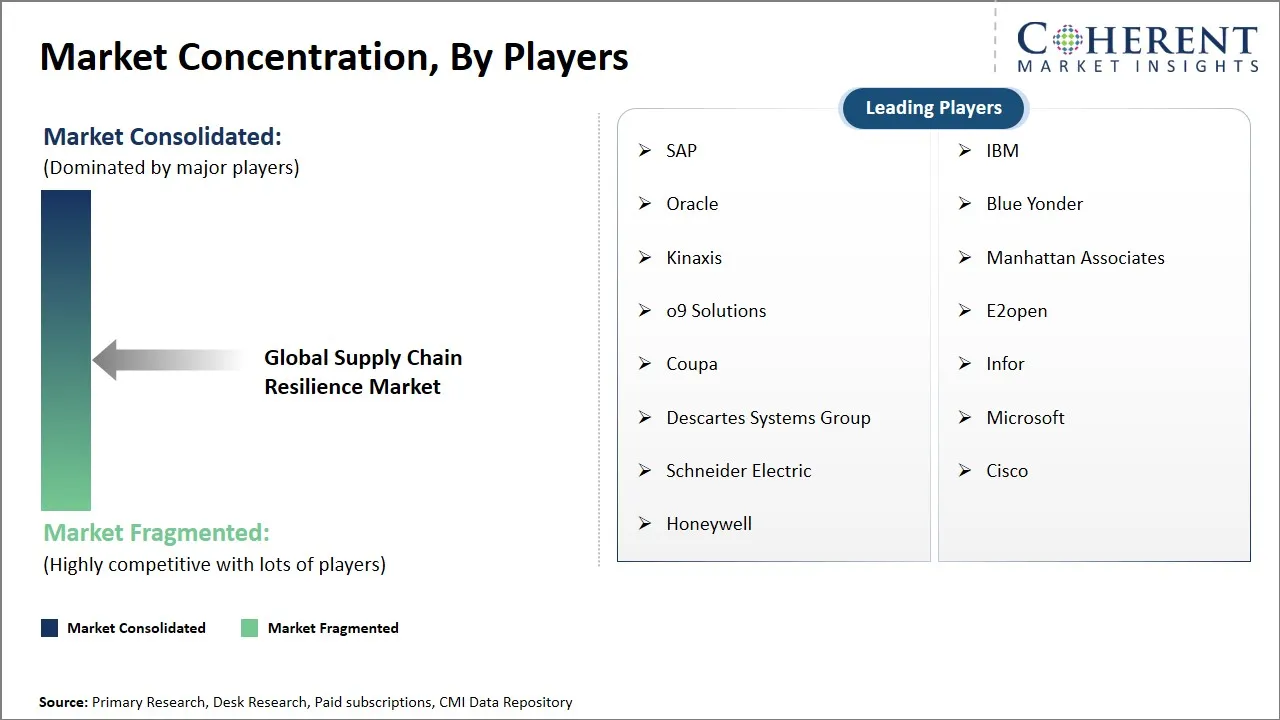
| Companies covered: | SAP, IBM, Oracle, Blue Yonder, Kinaxis, Manhattan Associates, o9 Solutions, E2open, Coupa, Infor, Descartes Systems Group, Microsoft, Schneider Electric, Cisco, and Honeywell | ||
| Growth Drivers: |
| ||
| Restraints & Challenges: |
| ||
Market Dynamics
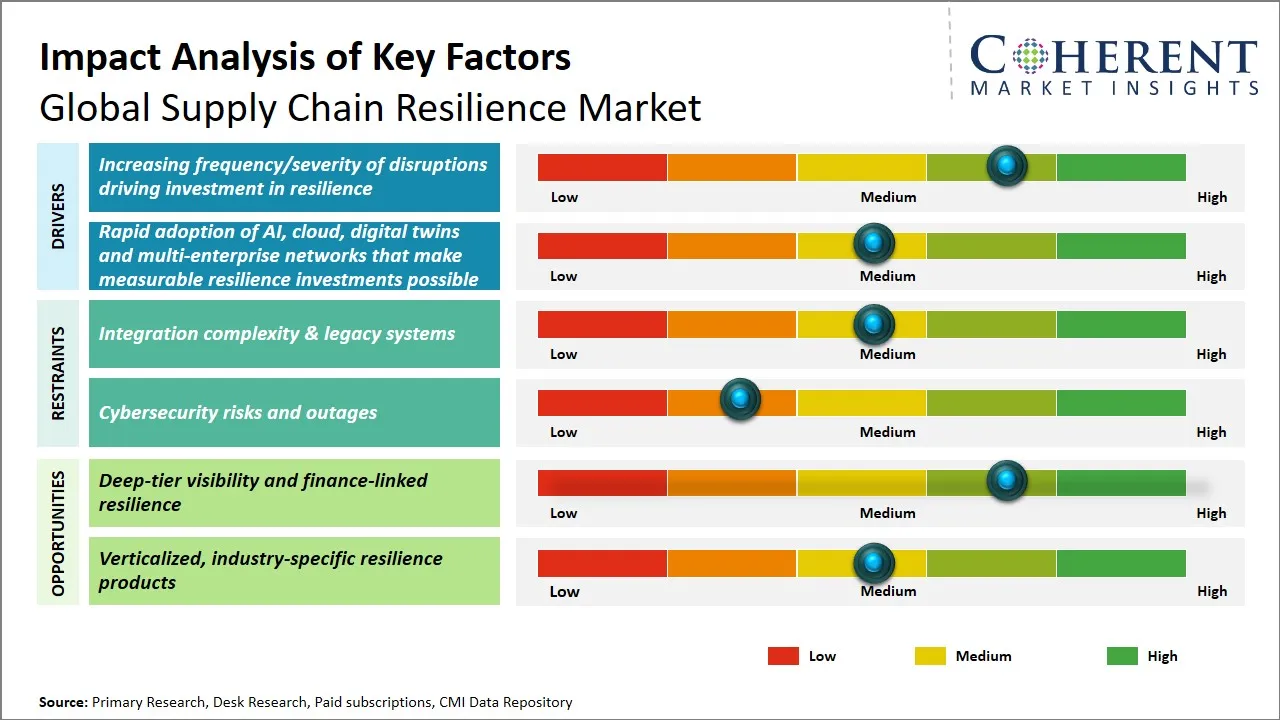
Global Supply Chain Resilience Market Driver – Increasing frequency/severity of disruptions driving investment in resilience
The growing frequency and intensity of global disruptions, including geopolitical tensions, natural disasters, and unexpected pandemics, have underscored significant vulnerabilities within traditional supply chains. These disruptions have led to widespread delays, inventory shortages, and increased operational costs, prompting organizations across industries to prioritize building more resilient supply chains. Businesses are now investing heavily in technologies and strategies that enhance visibility, agility, and risk mitigation capabilities to withstand and quickly recover from future shocks.
This heightened focus on resilience is driven by the recognition that reliance on just-in-time inventory and geographically concentrated suppliers creates critical exposure to supply interruptions. Consequently, companies are diversifying sourcing strategies, adopting advanced analytics for predictive risk assessment, and integrating digital platforms to enable real-time decision-making.
Global Supply Chain Resilience Market Opportunity – Deep-tier Visibility and Finance-Linked Resilience
The increasing complexity and interconnectedness of global supply chains have amplified the demand for deep-tier visibility solutions, presenting a significant opportunity within the global supply chain resilience market. Traditional supply chain management often focuses on direct suppliers, leaving multiple tiers of suppliers opaque and vulnerable to disruptions caused by geopolitical tensions, natural disasters, or pandemics. Deep-tier visibility enables organizations to gain comprehensive insights into their entire supply network, including sub-suppliers and raw material sources, thereby identifying potential risks much earlier and facilitating proactive mitigation strategies. Coupled with this, integrating finance-linked resilience is emerging as a critical area of growth.
By leveraging financial instruments such as supply chain finance, insurance products, and dynamic credit options, companies can strengthen the financial health of key suppliers, thereby enhancing overall supply chain stability. This approach not only reduces the risk of supplier insolvency but also promotes faster recovery from disruptions through improved cash flow and risk-sharing mechanisms. Technology advancements in real-time data analytics, blockchain, and AI are accelerating the adoption of these solutions, enabling more accurate risk assessment and automated financial triggers.
Analyst Opinion (Expert Opinion)
- Companies often over-invest in generic resilience tools, ignoring the fact that geopolitical, natural, and cyber disruptions require distinct approaches. AI-driven predictive platforms excel at forecasting supplier or logistics risks, but they cannot replace specialized cybersecurity safeguards or contingency planning for extreme weather events. Enterprises need a layered resilience strategy, combining technology with human oversight.
- While market leaders dominate large-scale deployments, mid-tier and specialized vendors are nimble enough to solve very specific disruption challenges—like cold-chain compliance or semiconductor supplier monitoring. Analysts argue that these players will increasingly capture pockets of market share because large ERP solutions often overlook vertical-specific vulnerabilities that can derail production in high-risk sectors.
- Experts caution that companies relying solely on historical data and reactive dashboards are already behind. The current climate—marked by rising cyber threats, trade restrictions, and climate volatility—demands predictive, AI-enabled, multi-tier supply chain visibility. Analysts are convinced that firms ignoring these solutions will face costly delays, reputational damage, and supply shortages that no manual intervention can fix in time.
Speak to the analyst
Want personalized insights?
Take the findings above to one of our principal consultants, or have the report rebuilt around the segments, geographies and competitors you actually track.
Market Segmentation
- Component Insights (Revenue, USD Bn, 2021 - 2033)
- Solutions
- Services
- Deployment Mode Insights (Revenue, USD Bn, 2021 - 2033)
- On-premises
- Cloud-based
- Organization Size Insights (Revenue, USD Bn, 2021 - 2033)
- Large Enterprises
- Small & Medium Enterprises (SMEs)
- End-use Industry Insights (Revenue, USD Bn, 2021 - 2033)
- BFSI
- Automotive
- Healthcare & Life Sciences
- Consumer Goods & Retail
- Food & Beverages
- Energy & Utilities
- Aerospace & Defense
- Electrical and Electronics
- Others
- Regional Insights (Revenue, USD Bn, 2021 - 2033)
- North America
- U.S.
- Canada
- Latin America
- Brazil
- Argentina
- Mexico
- Rest of Latin America
- Europe
- Germany
- U.K.
- Spain
- France
- Italy
- Russia
- Rest of Europe
- Asia Pacific
- China
- India
- Japan
- Australia
- South Korea
- ASEAN
- Rest of Asia Pacific
- Middle East
- GCC Countries
- Israel
- Rest of Middle East
- Africa
- South Africa
- North Africa
- Central Africa
- North America
- Key Players Insights
- SAP
- IBM
- Oracle
- Blue Yonder
- Kinaxis
- Manhattan Associates
- o9 Solutions
- E2open
- Coupa
- Infor
- Descartes Systems Group
- Microsoft
- Schneider Electric
- Cisco
Sources
Primary Research Interviews
Stakeholders
- Supply Chain Managers and Directors
- Logistics Service Providers and 3PL Operators
- Procurement Officers and Sourcing Specialists in high-risk industries
- Risk Management Consultants and Resilience Strategy Advisors
- Technology Providers of SCM Software and AI-Powered Risk Analytics Platforms
- Industry Analysts and Thought Leaders in Supply Chain Risk Management
Databases
- Global Logistics Data Hub (GLDH)
- International Trade and Supply Chain Database (ITSCDB)
- OECD Trade and Transport Statistics
- World Supply Chain Index (WSCI)
Magazines
- Supply Chain Today
- Logistics & Resilience Review
- Manufacturing & Operations Magazine
- Digital Supply Chain Insights
Journals
- Journal of Supply Chain Management & Strategy
- International Journal of Logistics Research
- Journal of Risk and Resilience in Operations
- Operations Management and Innovation Journal
Newspapers
- The Logistics Times
- Supply Chain Digest
- Financial Times (Supply Chain Section)
- The Economic Herald (Global Trade)
Associations
- Global Supply Chain Council (GSCC)
- Institute for Supply Chain Resilience (ISCR)
- International Federation of Logistics and Transportation (IFLT)
- Council of Supply Chain Risk Professionals (CSC-RP)
- World Logistics & Supply Chain Association (WLSCA)
Public Domain Sources
- United Nations Conference on Trade and Development (UNCTAD)
- International Monetary Fund (IMF) Data Portal
- World Bank Logistics Performance Database
- Trade and Transport Analysis Portal (TTAP)
- ResearchGate (Supply Chain & Resilience Studies)
Proprietary Elements
- CMI Data Analytics Tool, Proprietary CMI Existing Repository of information for last 8 years
Get access to 250+ pages report
Every segment, forecast, competitor profile and data table behind the analysis above — available for instant download.
- ESOMAR Member
- ISO 9001:2015 Certified
- D-U-N-S Registered
- GDPR & CCPA Compliant
Missing comfort of reading report in your local language? Find your preferred language:
Transform your Strategy with Exclusive Trending Reports
Frequently Asked Questions
The global supply chain resilience market is estimated to be valued at USD 37.76 billion in 2026 and is expected to reach USD 75.95 billion by 2033.
The CAGR of the global supply chain resilience market is projected to be 10.5% from 2026 to 2033.
Increasing frequency/severity of disruptions driving investment in resilience and rapid adoption of AI, cloud, digital twins and multi-enterprise networks that make measurable resilience investments possible are the major factors driving the growth of the global supply chain resilience market.
Integration complexity & legacy systems and cybersecurity risks and outages are the major factors hampering the growth of the global supply chain resilience market.
In terms of component, the solutions segment is estimated to dominate the market revenue share in 2026.
Supply chain resilience refers to a supply chain’s ability to anticipate, prepare for, respond to, and recover from disruptions, minimizing operational and financial impact.
Increasing geopolitical tensions, natural disasters, pandemics, and cyberattacks make supply chain resilience essential to avoid delays, shortages, and financial losses.