

5G Infrastructure Market Size and Share Analysis- Growth Trends and Forecasts (2026-2033)
The 5G Infrastructure Market size is anticipated to grow at a CAGR of 16.4% with USD 40.8 Bn in 2026 and is expected to reach USD 117.9 Bn in 2033. The primary drivers are defined by surging mobile data traffic, accelerating 5G deployments, expanding connected-device ecosystems, and growing demand for high-speed, low-latency connectivity. According to ITU, 5G networks covered around 55% of the global population in 2025, thereby supporting the sustained investment in advanced telecom infrastructure. This is also strengthening demand for small cells, macro cells, radio access networks, core networks, fiber backhaul, and edge computing solutions across various deployment environments. These include urban centers, industrial facilities, transportation networks, enterprises, campuses, and rural communities.
Key Takeaways
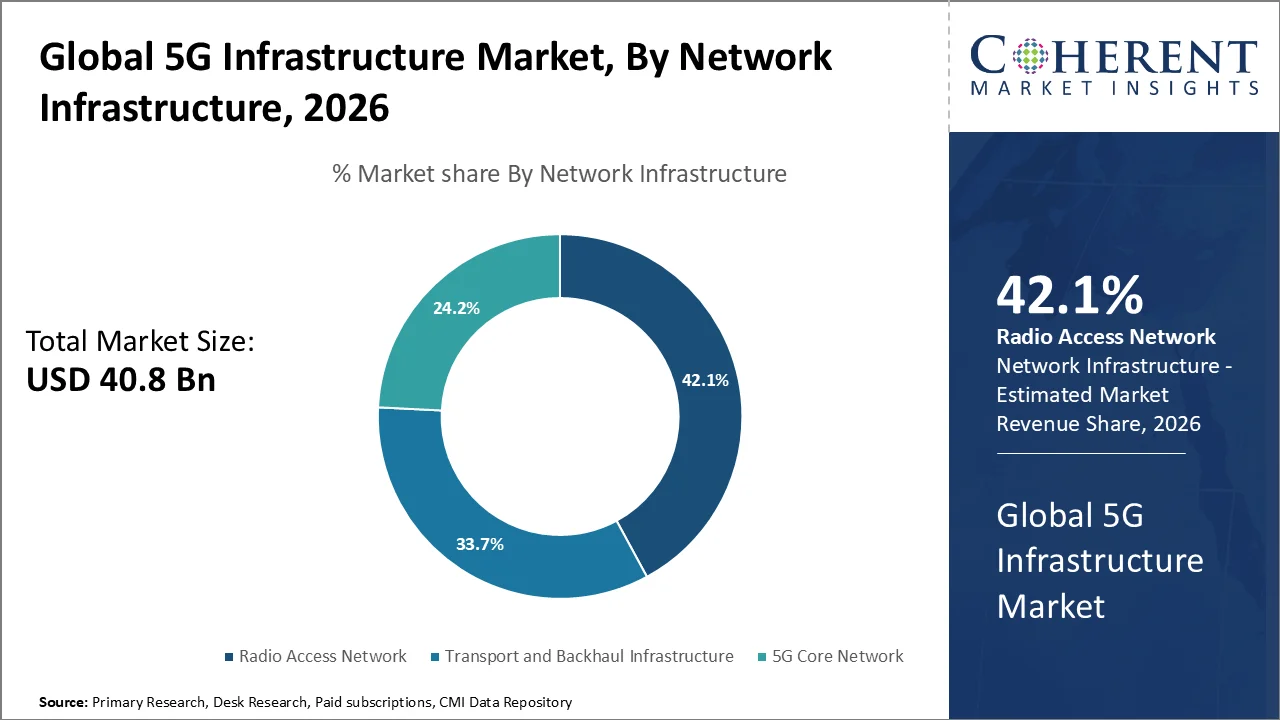
- The radio access network segment is likely to dominate the market with 42.1% in 2026. The segment’s growth is owing to the expanding base-station deployments, Massive MIMO adoption, small-cell densification, and network modernization. In 2026, Ericsson reported that Massive MIMO radios constitute a significant proportion of new TDD mid-band deployments.
- The consumer electronics segment is set to lead with 27.1% in 2026. The segment’s growth is owing to the increasing adoption of 5G smartphones, wearables, and connected devices.
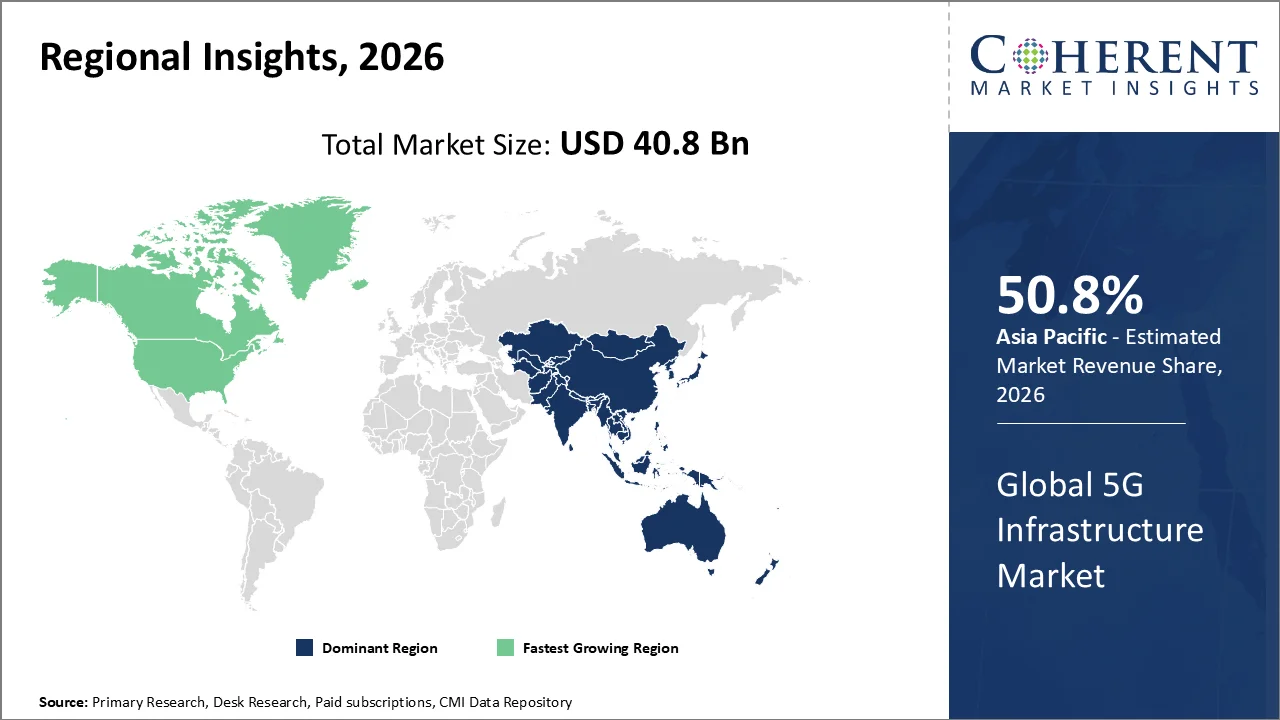
- Asia Pacific is expected to acquire the prominent share of 50.8% in 2026. The region’s growth is owing to the rapid network rollouts, large mobile subscriber bases, spectrum investments, and strong device adoption. North East Asia achieved 60% 5G subscription penetration in 2025, while 5G is projected to represent 50% of Asia Pacific connections by 2030.
Segmental Insights
Why is Radio Access Network Segment Acquiring the Largest Share?
On the basis of network infrastructure, the radio access network segment is projected to account for the largest 5G Infrastructure Market share of 42.1% in 2026. The segment’s growth is owing to the large number of radio sites required to provide 5G coverage, the growing use of Massive MIMO, expansion of mid-band spectrum, network densification, and the need to upgrade existing 4G sites for 5G and 5G-Advanced capabilities.
In February 2026, MasOrange and Ericsson deployed 5G Advanced across 20 Spanish cities, introducing carrier aggregation, RedCap, L4S, and VoNR. The rollout enhances spectrum efficiency, capacity, latency, IoT connectivity, immersive services, and commercial opportunities for consumers and enterprises throughout Spain.
- Current Industry Events of 2026
- Market Size Estimation
- Regional Breakdown
- Competitive Landscape
- Customer Intelligence
- Segmental Analysis
- Pricing Analysis
- Key Market Drivers, Challenges & Future Trends
- Customized Insights Section
Consumer Electronics hold the Largest Market Share
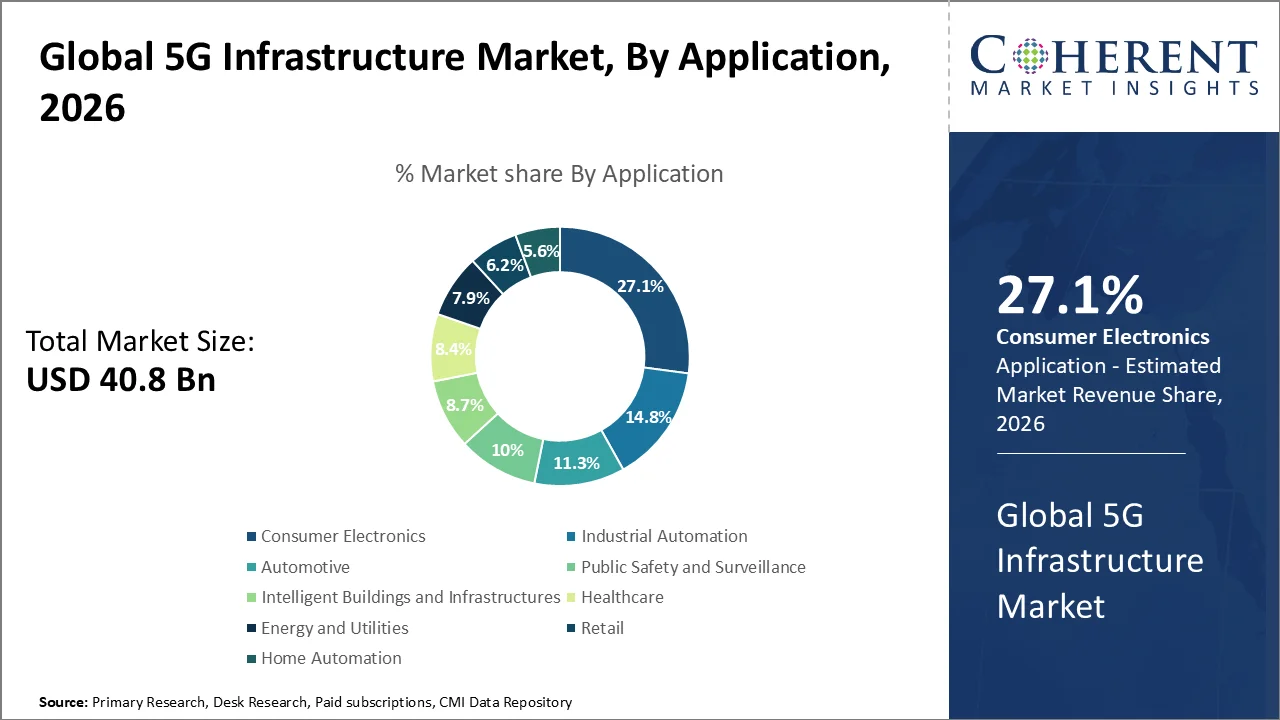
On the basis of application, the consumer electronics segment lead with a major 27.1% share in 2026. The growth is owing to the rising use of 5G-enabled smartphones, tablets, wearables, gaming devices, and connected home products that require dense access, low latency, and network capacity.
Ofcom reported in May 2026 that standalone 5G coverage outside UK premises ranged from 49% to 85% across the three operators that had deployed it. Its Connected Nations survey also found that UK mobile data consumption exceeded 1.2 billion GB per month in 2025, increasing 18% year over year, thereby reflecting heavier streaming as well as app usage on consumer devices.
In June 2026, Samsung introduced the Galaxy A27 5G, with commercial availability beginning July 10, 2026. The smartphone expands affordable access to 5G-enabled consumer electronics and supports increased adoption of high-speed mobile applications, including video streaming, cloud gaming, social media, and AI-based services.
Market Drivers
Rising Innovations in 5G-Advanced Networks are Transforming the 5G Infrastructure Market in China
China is emerging as a major testing and commercialization environment for 5G-Advanced infrastructure. This is supported by the large-scale deployments, dense urban networks, industrial digitization, and coordinated government policies.
According to China’s State Council Information Office, the country had nearly 4.958 million 5G base stations by March 2026, while 5G-Advanced coverage had expanded to 330 cities. More than 95% of administrative villages had 5G access, and the technology had been integrated into 91 of the country’s 97 major economic categories. These conditions provide infrastructure vendors with a substantial installed base for introducing advanced radios, intelligent antennas, cloud-native cores, deterministic networking, and AI-supported operations.
In July 2026, China Unicom Beijing and Huawei launched the world’s largest commercial 5G-Advanced 100 MHz GigaUplink network. More than 10,000 base stations were deployed across key areas of Beijing. Live-network testing achieved an 83% effective ratio for the 100 MHz uplink network and limited weak cell-edge points below 20 Mbps to approximately 0.1%.
AI-Native RAN: A Major Breakthrough in the 5G Infrastructure Market
AI-native radio access networks integrate machine-learning models directly into radio scheduling, link adaptation, traffic management, energy optimization, and network orchestration. AI-native systems analyze live radio conditions and subscriber behavior to make more dynamic decisions, thereby allowing operators to improve performance without relying exclusively on additional sites or spectrum.
In May 2026, Ericsson and T-Mobile reported large-scale commercial trials of an AI-native scheduler and link-adaptation system on live 5G-Advanced traffic. The solution delivered close to a 10% increase in spectral efficiency and up to a 15% improvement in downlink throughput compared with traditional rule-based methods.
In July 2026, Nokia announced its commercial AI-RAN platform, combining Nokia’s AI-native anyRAN software with NVIDIA’s Aerial AI-RAN platform. The firm stated that the platform is designed to deliver more than 100% spectral-efficiency gains by 2028, potentially doubling the capacity obtainable from existing spectrum assets. The platform will support three accelerated-computing baseband configurations, while Nokia’s existing portfolio is planned to become fully O-RAN compliant.
Current Events and Their Impact on the 5G Infrastructure Market
Current Event | Description and its Impact |
2026 EU Digital Networks Act Proposal
|
|
2026 EU Cybersecurity Revision and 5G Supplier De-Risking |
|
5G Infrastructure Market Trends
- Rapid migration toward 5G Standalone networks is allowing for slicing, ultra-low latency, and differentiated enterprise connectivity services.
- AI-native RAN and network automation is improving the spectrum efficiency, energy management, fault prediction, and operating economics for operators worldwide.
- Private 5G deployment is expanding across factories, ports, mines, and campuses, thereby supporting secure industrial automation
- The growing mobile data traffic and fixed wireless access adoption is increasing the demand for radios, antennas, core networks, and fiber backhaul. In June 2026, Ericsson reported 3.1 billion global 5G subscriptions after 162 million additions during the first quarter. Half of worldwide mobile data traffic was carried over 5G, while around 70% of fixed wireless access providers offered services using 5G infrastructure.
- Government spectrum allocation, infrastructure funding, and streamlined right-of-way policies accelerate nationwide 5G network deployment and improve rural connectivity. In February 2026, India’s Department of Telecommunications stated that the country completed the world’s fastest 5G rollout in 21 months, supported by approximately USD 5.5 billion in investment. Meanwhile, the European Union continues targeting 5G coverage across all populated areas by 2030, thereby supporting the sustained network spending and equipment modernization programs.
Regional Insights
Asia Pacific Dominates Owing to the Large-Scale Network Deployment and Manufacturing Digitization
The Asia Pacific region accounts for 50.8% of the market share in 2026. The region’s growth is owing to the large-scale network investments, expanding subscriber adoption, and continued upgrades to advanced connectivity. China’s extensive telecom infrastructure, India’s nationwide 5G rollout, mature networks in South Korea and Japan, as well as rising deployments in Southeast Asia are strengthening the regional demand.
India remains a major growth contributor, with the government reporting approximately 523,000 5G base transceiver station installations by February 2026 and services available across 99.9% of districts. Ericsson estimated that India had around 430 million 5G subscriptions at the end of 2025 and expects the figure to exceed 1.1 billion by 2031, thereby indicating the sustained infrastructure requirements.
In June 2026, Ericsson, Viettel, and MediaTek demonstrated 5G Advanced in Vietnam, achieving speeds above 10 Gbps by aggregating 11 carriers across C-band and mmWave spectrum. The trial used edge computing, Ericsson infrastructure, and MediaTek’s M90 chipset on commercial networks.
North America 5G Infrastructure Market Trends
North America is expected to witness strong growth in market over the forecast period. The region’s growth is owing to the network coverage, data demand, and federal investment in next-generation radio technologies. The United States remains the region’s growth engine as operators expand mid-band capacity, densify urban networks, and improve rural connectivity.
According to the Federal Communications Commission’s Broadband Data Collection, 96% of U.S. homes and small businesses had access to 5G mobile service delivering at least 7/1 Mbps, while 92% could access 5G service providing at least 35/3 Mbps. These coverage levels encourage the spending on radio access networks, small cells, fiber backhaul, edge infrastructure, as well as modernization.
In March 2026, Samsung Electronics along with AMD expanded their collaboration from technical verification to commercial deployment across 5G core, virtualized RAN, and private-network solutions. The firm stated that the cooperation supports cloud-native and AI-driven infrastructure including a 5G core deployment for Canadian operator Videotron.
Nationwide Coverage Targets and Cloud-Native Network Modernization is Accelerating the 5G Infrastructure Market in Japan
Japan is expected to remain one of the fastest-growing national markets owing to the nationwide coverage targets, network modernization, and demand for resilient digital services. The Digital Agency states that Japan aims to achieve 99% 5G population coverage nationwide and within every prefecture by fiscal 2030, thereby encouraging investment in base stations, fiber backhaul, small cells, and rural connectivity.
In March 2026, NTT DOCOMO and NEC launched Japan’s first commercial 5G core network on Amazon Web Services. Its AI-automated architecture can expand capacity dynamically during traffic surges, improving network flexibility, reliability, and sustainability while speeding up Japan’s transition toward cloud-native standalone 5G infrastructure.
United States 5G Infrastructure Market Trends
The United States is experiencing strong growth in the 5G infrastructure market supported by extensive mid-band deployment, nationwide operator competition, expanding fixed wireless access, and early adoption of 5G-Advanced and AI-RAN technologies. Ericsson reported that North America reached 79% 5G subscription penetration at the end of 2025, the highest level among global regions, thereby indicating mature consumer adoption and continued demand for network capacity.
In July 2026, NTIA announced up to USD 53 million to accelerate secure, American-led AI-native RAN development, testing, and commercialization. The funding prioritizes real-world demonstrations, open interoperability, cybersecurity, lower operating costs, new revenues, and compliance with 3GPP and O-RAN specifications.
Who are the Major Companies in 5G Infrastructure Industry
Some of the major key players in 5G Infrastructure Market are Analog Devices, Inc., Cavium, Cisco Systems, Inc., Ericsson, Fujitsu, Huawei Technologies Co., Ltd, Intel Corporation, LG Electronics Inc., MACOM Technology Solutions, MediaTek Inc., NEC Corporation, Qorvo, Qualcomm, Samsung, and VMware, Inc
Key News
- In March 2026, Singtel partnered with Ericsson to accelerate 5G Advanced in Singapore through a programmable, AI-powered network platform. The initiative supports network slicing, automation, commercial APIs, enterprise services, and emerging applications while improving performance, resilience, efficiency, and monetisation opportunities.
- In March 2026, Huawei unveiled a comprehensive U6 GHz product portfolio at MWC Barcelona. The solutions are designed to increase 5G-Advanced network capacity, lower latency, support mobile-AI traffic, as well as facilitate future evolution toward 6G.
- In February 2026, Ericsson launched a portfolio of AI-ready radios, antennas, and AI-RAN software designed for programmable, high-performance 5G networks. The solutions support network modernization, greater capacity, reduced energy consumption, and future AI-driven services.
Market Report Scope
5G Infrastructure Market Report Coverage
| Report Coverage | Details | ||
|---|---|---|---|
| Base Year: | 2025 | Market Size in 2026: | USD 40.8 Bn |
| Historical Data for: | 2020 To 2024 | Forecast Period: | 2026 To 2033 |
| Forecast Period 2026 to 2033 CAGR: | 16.4% | 2033 Value Projection: | USD 117.9 Bn |
| Geographies covered: |
| ||
| Segments covered: |
| ||
| Companies covered: | Analog Devices, Inc., Cavium, Cisco Systems, Inc., Ericsson, Fujitsu, Huawei Technologies Co., Ltd, Intel Corporation, LG Electronics Inc., MACOM Technology Solutions, MediaTek Inc., NEC Corporation, Qorvo, Qualcomm, Samsung, and VMware, Inc | ||
| Growth Drivers: |
| ||
| Restraints & Challenges: |
| ||
Analyst Opinion
- 5G infrastructure growth is driven by rapidly increasing connectivity and data demand. Global network data traffic across mobile and fixed wireless access services grew 22% year-on-year during the first quarter of 2026. This rising traffic is pushing telecom operators to expand radio capacity, modernize network cores, strengthen backhaul systems, and deploy more energy-efficient 5G equipment worldwide.
- The global 5G deployment continues to expand at a strong pace. Around 390 commercial 5G networks had been launched worldwide, while 5G population coverage reached 60% at the end of 2025 after extending connectivity to an additional 400 million people during the year. However, substantial coverage gaps continue to create infrastructure expansion opportunities across both developing as well as underserved markets.
- Fixed wireless access and standalone 5G are becoming important infrastructure catalysts. Around 71% of fixed wireless access providers now offer services over 5G, while commercial offerings based on standalone network slicing increased from 65 to 84 within six months. These developments are strengthening demand for advanced radio access networks, cloud-native cores, small cells, fiber and microwave backhaul, edge computing, and network-automation platforms across consumer and enterprise applications.
Speak to the analyst
Want personalized insights?
Take the findings above to one of our principal consultants, or have the report rebuilt around the segments, geographies and competitors you actually track.
Market Segmentation
- By Network Infrastructure (Revenue, USD Bn, 2021-2033)
- Radio Access Network
- 5G Core Network
- Transport and Backhaul Infrastructure
- By Application (Revenue, USD Bn, 2021-2033)
- Automotive
- Energy and Utilities
- Healthcare
- Retail
- Industrial Automation
- Intelligent Buildings and Infrastructures
- Consumer Electronics
- Home Automation
- Public Safety and Surveillance
- By Region (Revenue, USD Bn, 2021-2033)
- North America
- U.S.
- Canada
- Latin America
- Brazil
- Mexico
- Argentina
- Rest of Latin America
- Europe
- Germany
- U.K.
- France
- Italy
- Spain
- Russia
- Rest of Europe
- Asia Pacific
- China
- India
- Japan
- Australia
- South Korea
- ASEAN
- Rest of Asia Pacific
- Middle East
- GCC
- Israel
- Rest of Middle East
- Africa
- South Africa
- Central Africa
- North Africa
- North America
Sources
Primary Research Interviews
- Telecom network operators
- 5G infrastructure equipment manufacturers
- Radio access network engineers
- Core network architects
- Network planning and optimization professionals
- Tower infrastructure providers
- Small-cell and distributed antenna system providers
- Cloud and edge-computing service providers
- System integrators
- Telecom equipment distributors
- Government telecom officials
- Key opinion leaders in wireless communication and 5G technologies
Databases
- International Telecommunication Union (ITU)
- GSMA Intelligence
- World Bank
- Organisation for Economic Co-operation and Development (OECD)
- Federal Communications Commission (FCC)
- European Commission Digital Economy and Society Database
- U.S. National Telecommunications and Information Administration (NTIA)
- Eurostat
- National telecom regulatory authority databases
Magazines
- RCR Wireless News
- Light Reading
- Telecom Review
- Mobile World Live
- Fierce Network
- Capacity Media
- Network World
- Telecoms.com
Journals
- IEEE Communications Magazine
- IEEE Wireless Communications
- IEEE Transactions on Wireless Communications
- IEEE Journal on Selected Areas in Communications
- International Journal of Communication Systems
- Telecommunications Policy
- Journal of Network and Computer Applications
Newspapers
- The Wall Street Journal
- Financial Times
- The New York Times
- The Guardian
- Nikkei Asia
- South China Morning Post
- The Economic Times
Associations
- International Telecommunication Union
- 3rd Generation Partnership Project
- GSM Association
- European Telecommunications Standards Institute
- O-RAN Alliance
- Next G Alliance
- Telecom Infra Project
- CTIA – The Wireless Association
- Telecommunications Industry Association
- Small Cell Forum
Public Domain Sources
- Company annual reports and investor presentations
- Telecom operator network rollout announcements
- Government telecommunications ministry publications
- National spectrum-allocation and auction reports
- Telecom regulatory authority publications
- 5G coverage and deployment databases
- Company product launches and press releases
- Patent databases and technology-standard documents
- Public procurement and infrastructure-investment records
- Government digital-transformation and broadband-development programs
Proprietary Elements
- CMI Data Analytics Tool
- Proprietary CMI Existing Repository of Information for Last 10 Yearsa
Get access to 250+ pages report
Every segment, forecast, competitor profile and data table behind the analysis above — available for instant download.
- ESOMAR Member
- ISO 9001:2015 Certified
- D-U-N-S Registered
- GDPR & CCPA Compliant
Missing comfort of reading report in your local language? Find your preferred language:
Transform your Strategy with Exclusive Trending Reports
Frequently Asked Questions
The 5G Infrastructure Market is expected to reach USD 117.9 Bn in 2033.
Major players operating in the global 5G Infrastructure Market include Analog Devices, Inc., Cavium, Cisco Systems, Inc., Ericsson, Fujitsu, Huawei Technologies Co., Ltd, Intel Corporation, LG Electronics Inc., MACOM Technology Solutions, MediaTek Inc., NEC Corporation, Qorvo, Qualcomm, Samsung, and VMware, Inc
The high deployment costs, complex network integration, and regulatory hurdles are the key factors hampering growth of the market.
The high data demand, rising IoT adoption, and industrial automation is boosting the demand for 5G Infrastructure.
The 5G Infrastructure Market is anticipated to grow at a CAGR of 16.4% between 2026 and 2033.
Among regions, North America is expected to account for a largest market share in the global 5G Infrastructure Market over the forecast period.
The market outlook remains positive due to high data demand, enterprise digital transformation, and smart city projects.