

Space Planning Software Market Size and Share Analysis- 2026 To 2033
The Space Planning Software Market size is anticipated to grow at a CAGR of 11.2% with USD 5.2 Bn in 2026 and is expected to reach USD 11 Bn in 2033. The primary drivers are defined by the hybrid work adoption, rising demand for workplace utilization analytics, real estate portfolio optimization, and integration of AI-based workplace planning tools. According to the U.S. Bureau of Labor Statistics, 22.6% of U.S. workers teleworked or worked at home for pay in March 2026, thereby creating a stronger need for data-backed space management as well as booking solutions. This is strengthening demand for space planning, desk booking, room reservation, move management, and facility management software across corporate real estate, government, healthcare, education, and commercial workplaces.
Key Takeaways
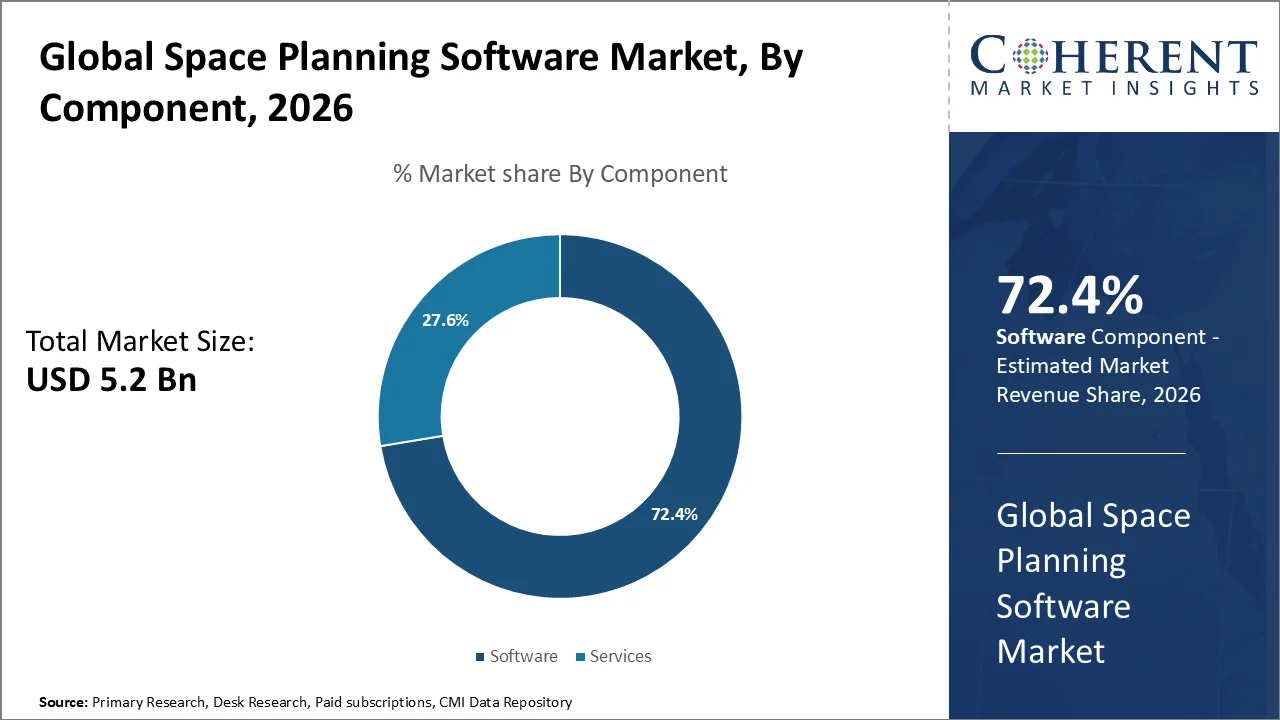
- The software segment is likely to dominate the market with 72.4% in 2026. The segment’s growth is owing to the cloud-based dashboards, digital floor plans, occupancy analytics, and workplace experience modules.
- The facility management segment is set to lead with 25.8% in 2026. The segment’s growth is owing to the growing need to connect floor plans, workplace services, asset tracking, maintenance, and occupancy data. According to the European Commission, the buildings use around 40% of energy consumed in the EU, thus making facility optimization a strategic priority. This strengthens the demand for integrated space as well as facility planning platforms.
- The cloud-based segment is set to lead with 76.5% in 2026. The segment’s growth is owing to the rising adoption of hybrid work environments, surging digital transformation, and the need for scalable, real-time facility management in enterprises.
- The real-estate segment is set to lead with 28.4% in 2026. The segment’s growth is owing to the increased focus on portfolio rightsizing, lease optimization, and hybrid occupancy planning. The U.S. General Services Administration reported that in 2025 it reduced its portfolio by three million square feet through disposal of 90 buildings, showing how space efficiency has become a major real estate priority.
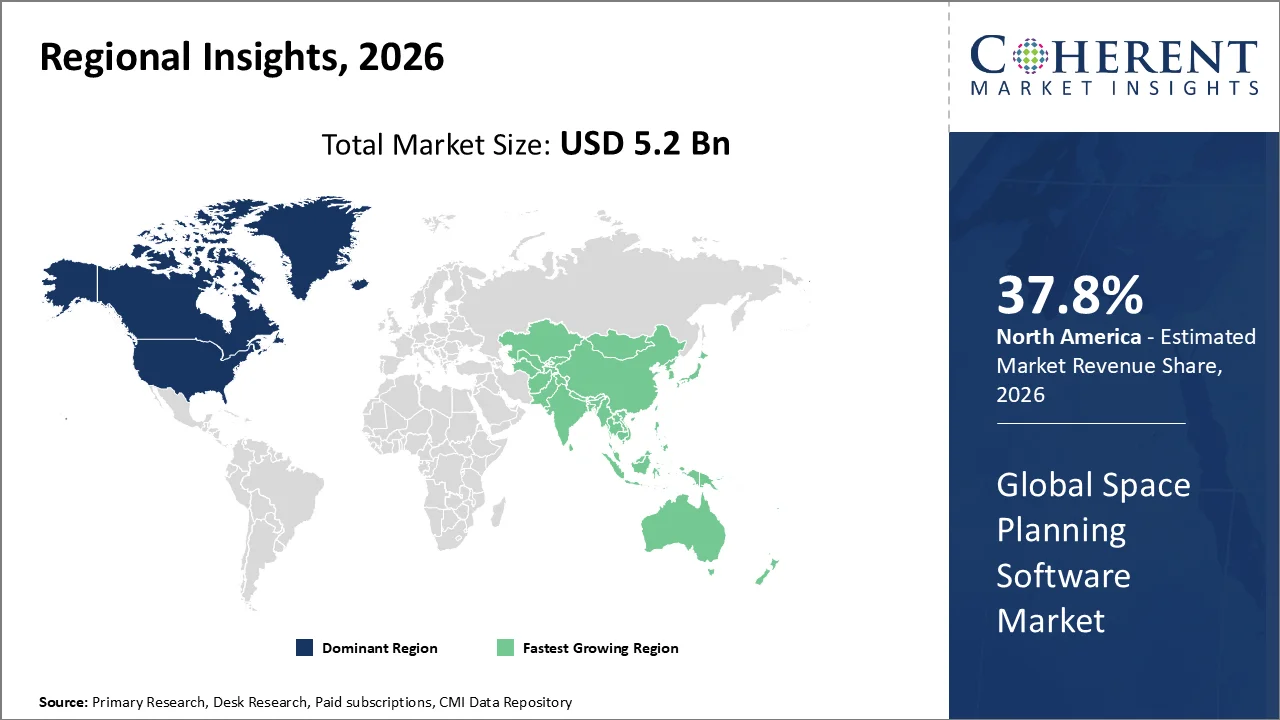
- North America is expected to acquire the prominent share of 37.8% in 2026. The region’s growth is owing to the high adoption of hybrid workplace technologies, large enterprise real estate portfolios, and strong software vendor presence. The GSA Public Buildings Service manages nearly 360 million square feet of rentable workspace, highlighting the scale of occupancy and portfolio planning needs in the region.
Segmental Insights
Why is Software Segment Acquiring the Largest Share?
On the basis of component, the software segment is projected to account for the largest Space Planning Software Market share of 72.4% in 2026. The segment’s growth is owing to the rising demand for digital floor plans, cloud dashboards, real-time space utilization analytics, desk booking, room reservation, workplace experience management, and portfolio optimization. Space planning is shifting from manual CAD-based planning and spreadsheet-based headcount allocation to integrated platforms that provide live visibility across buildings, teams, and work models.
Software platforms are also gaining traction because vendors are adding AI workflows, predictive insights, digital twin features, and integrations with collaboration platforms. In April 2026, Eptura announced live analytics, AI workflows, and a unified space layer across its space planning portfolio. These capabilities allow the teams to adjust workplace layouts based on actual usage instead of static reports.
- Current Industry Events of 2026
- Market Size Estimation
- Regional Breakdown
- Competitive Landscape
- Customer Intelligence
- Segmental Analysis
- Pricing Analysis
- Key Market Drivers, Challenges & Future Trends
- Customized Insights Section
Facility Management hold the Largest Market Share
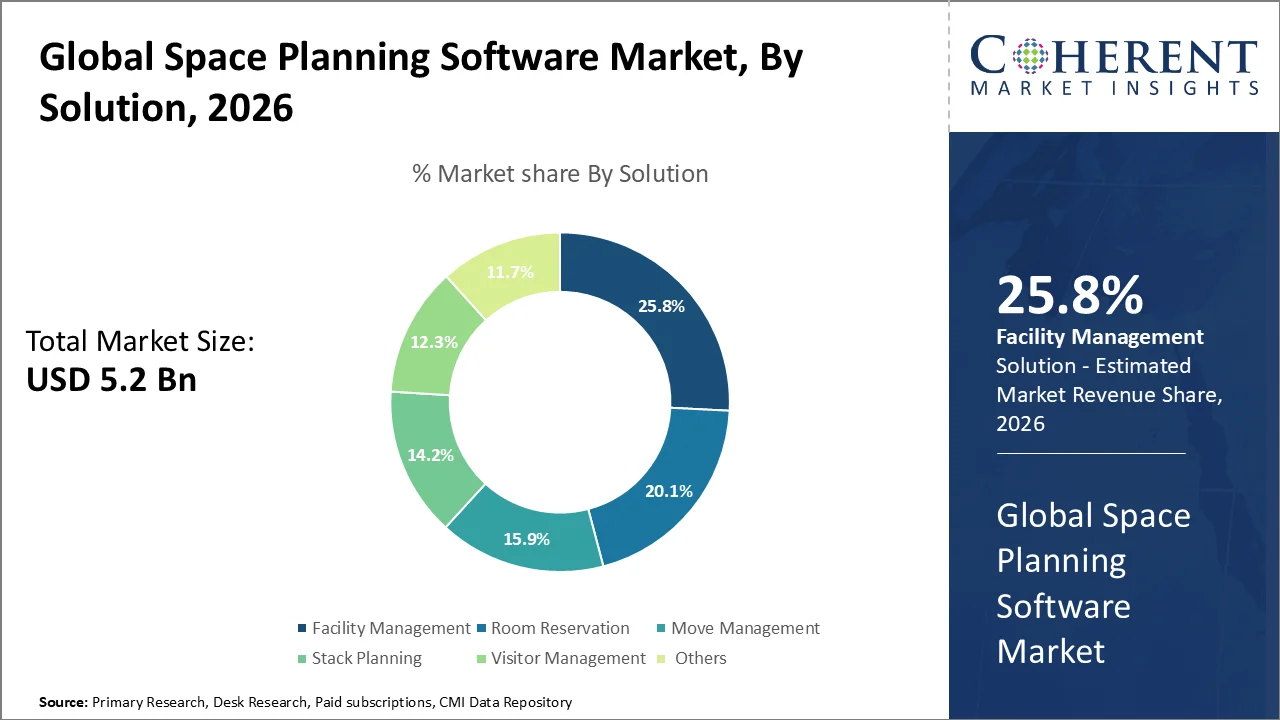
On the basis of solution, the facility management segment lead with a major 25.8% share in 2026. The growth is owing to the increasing demand for integrated tools that manage occupancy, room allocation, maintenance planning, asset visibility, move management, and workplace service delivery. Facility teams are shifting from spreadsheet-based floor planning to integrated workplace management platforms as buildings become more sensor-enabled and employee attendance becomes more variable.
According to the UNEP and GlobalABC, the buildings and construction sector accounts for around 37% of global CO₂ emissions and nearly 50% of global material extraction. This increases the pressure on facility managers to improve space utilization as well as reduce inefficient building operations. In addition, the IEA notes that global floor area is expected to increase by around 15% by 2030, thus reinforcing the need for software-supported space governance.
Market Drivers
Rising Innovations in AI-Enabled Workplace Management are Transforming the Space Planning Software Market in the U.S.
The U.S. space planning software market is witnessing rapid transformation. The growth is owing to the integration of AI-powered occupancy analytics, hybrid workplace optimization tools, and real-time space utilization intelligence. The organizations are replacing static floor plans with dynamic systems that optimize desk allocation, meeting room usage, and workplace density based on live employee presence data.
According to the IBM research on enterprise AI adoption, more than 40% of large organizations are already deploying AI-enabled automation in operational workflows, with facility and workplace management emerging as key use cases. This shift is reinforcing the demand for advanced space planning software capable of combining analytics, automation, as well as building intelligence.
In December 2025, OfficeSpace Software announced AI Canvas, a next-generation AI space planning tool integrated into its workplace management platform to generate and iterate floor plans and stack plans in minutes instead of months. The solution uses AI-driven occupancy and collaboration data to optimize layouts, improve space utilization, and allow for predictive, continuous workplace planning with agentic capabilities across the platform.
Digital Twin-Based Space Planning: A Major Breakthrough in Space Planning Software Market
Digital twin-based space planning is emerging as a major breakthrough in the Space Planning Software Market. This is because it connects floor plans, BIM models, occupancy data, IoT sensors, maintenance systems, and building-management systems into a single operating layer.
Digital twin platforms allow facility managers to understand how spaces are performing in real time. This allows for faster move planning, more accurate utilization analysis, predictive maintenance, energy optimization, and better emergency planning. Autodesk describes digital twins as data repositories that provide a hub for facility-management data throughout the building lifecycle, centralizing asset data as well as simplifying end-user workflows.
In April 2026, Globant and Autodesk Tandem announced a partnership to boost digital twin operations toward Physical AI. Globant was named an Autodesk Tandem Digital Twin Solution Provider, with the collaboration combining Globant’s enterprise integration expertise and Autodesk Tandem’s cloud-based digital twin technology to streamline operations in airports, smart buildings, manufacturing facilities, as well as logistics environments.
Current Events and Their Impact on the Space Planning Software Market
Current Event | Description and its Impact |
U.S. USE IT Act and Federal Occupancy Reporting Requirements
|
|
EU Energy Performance of Buildings Directive and Smart Building Digitalization |
|
Space Planning Software Market Trends
- Hybrid work models are increasing demand for space planning software to optimize desk allocation, seating arrangements, meeting rooms, and shared office layouts.
- AI-enabled occupancy analytics help facility managers compare assigned, booked, and actual space usage, improving workplace efficiency and planning accuracy.
- Integration with IWMS, CAFM, BIM, IoT sensors, and workplace apps allows for real-time visibility across corporate real estate portfolios.
- The rising return-to-office activity is encouraging enterprises to redesign workplaces around flexible seating, collaboration zones, and peak-day occupancy. In 2026, CBRE reported that average office utilization increased to 53%, compared to 38% in 2024 and 35% in 2023, thereby highlighting the growing need for data-driven space planning tools.
- Sustainability and cost optimization are pushing organizations to connect space planning with energy and facility operations. The IEA states that building operations account for 30% of global final energy consumption and 26% of energy-related emissions.
Regional Insights
North America Dominates Owing to the Enterprise Software Adoption and Large Corporate Real-Estate Portfolios
The North America region accounts for 37.8% of the market share in 2026. The region’s growth is owing to mature enterprise software adoption, large corporate real-estate portfolios, high hybrid-work penetration, and strong use of facility management platforms across offices, healthcare facilities, universities, logistics hubs, and government buildings.
The U.S. Census Bureau also reported annualized construction spending of USD 2,210.2 billion in May 2026, thereby reinforcing the scale of built assets requiring planning and management.
In April 2026, Kadence introduced SpaceOps, an AI-powered workplace platform that unifies planning, scheduling, and execution of office space changes using real occupancy and booking data. It helps organizations streamline stack planning, move management, as well as space optimization in a single connected system.
Asia Pacific Space Planning Software Market Trends
Asia Pacificis expected to witness strong growth in Space Planning Software Market over the forecast period. The region’s growth is owing torapid urbanization, expansion of commercial real estate, smart city development, large corporate campuses, and increasing demand for efficient workplace planning in China, India, Japan, Australia, South Korea, and ASEAN countries.
China remains important due to its large urban workforce and digital infrastructure expansion. According to the National Bureau of Statistics of China, the country’s urbanization rate of permanent residents reached 67.89% by the end of 2025, while urban employment reached 475.35 million people. These indicators strengthen the demand for digital workplace and building management systems in the commercial, industrial, and public facilities.
In September 2025, Table Space launched Meeting Rooms as a Product on its Workspace App, thus providing on-demand access to over 180 meeting rooms across Tier-1 cities in India. The feature allows for real-time booking, transparent pricing, and integrated visitor management, thereby strengthening its tech-first, app-driven workplace experience for enterprises and external users.
Strong Enterprise Software Penetration and Hybrid-work Adoption are Accelerating the Space Planning Software Market in United States
The United States Space Planning Software Market is driven by the strong enterprise software penetration, hybrid-work adoption, large office portfolios, and growing pressure to optimize building utilization. The U.S. Bureau of Labor Statistics reported that nearly 35% of employed people worked at home on days worked in 2025, thereby creating the demand for tools that manage flexible seating, office attendance, as well as team-based workplace planning.
The U.S. also has substantial real-estate optimization needs across both private as well as public sectors. In March 2025, GSA stated that it owned and maintained over 440 non-core assets, thus representing almost 80 million rentable square feet and more than USD 8.3 billion in recapitalization needs.
In November 2025, Esri announced Q4 2025 updates to ArcGIS Indoors including web applications for occupant experience, space planning, and floor-plan creation. This supports the indoor mapping and workplace space optimization across the large facilities.
India Space Planning Software Market Trends
India is emerging as a high-growth country for space planning software owing to the rapid office expansion, growth of global capability centers, flexible workspaces, and increasing adoption of digital real-estate tools. JLL reported that India’s office gross leasing activity reached 83.3 million square feet in 2025 driven by strong corporate occupier demand and expansion of large enterprise operations.
India’s long-term building demand also supports software adoption. A 2026 NITI Aayog buildings-sector document indicated that India’s total floor space may increase substantially through 2037 and 2050, thereby reflecting large-scale commercial and urban development.
In January 2024, WeWork India launched WeWork Workplace, a space management SaaS platform developed in collaboration with Yardi Systems. The platform aimed at improving enterprise workspace utilization and employee experience. It integrates desk booking, visitor management, real-time analytics, and multi-office space coordination across both owned as well as shared locations.
Who are the Major Companies in Space Planning Software Industry
Some of the major key players in Space Planning Software Market are Accruent, Archibus, FM:Systems Group, LLC, IBM TRIRIGA, iOFFICE, OfficeSpace Software, Planon, QuickFMS, and SPACEWELL INTERNATIONAL.
Key News
- In June 2026, Planon has announced its integration with Planon and Microsoft Places to enhance workplace management using occupancy and utilization data. The integration enables streamlined space operations, unified desk and meeting bookings via Microsoft Teams and Outlook, and improved workplace insights through combined AI-driven analytics.
- In March 2025, Planon strengthened its IWMS platform with enhanced cloud-based facility and real estate management capabilities, supporting integrated space planning, maintenance scheduling, and portfolio optimization across large enterprises.
Market Report Scope
Space Planning Software Market Report Coverage
| Report Coverage | Details | ||
|---|---|---|---|
| Base Year: | 2025 | Market Size in 2026: | USD 5.2 Bn |
| Historical Data for: | 2020 To 2024 | Forecast Period: | 2026 To 2033 |
| Forecast Period 2026 to 2033 CAGR: | 11.2% | 2033 Value Projection: | USD 11 Bn |
| Geographies covered: |
| ||
| Segments covered: |
| ||
| Companies covered: | Accruent, Archibus, FM:Systems Group, LLC, IBM TRIRIGA, iOFFICE, OfficeSpace Software, Planon, QuickFMS, and SPACEWELL INTERNATIONAL. | ||
| Growth Drivers: |
| ||
| Restraints & Challenges: |
| ||
Analyst Opinion
- Space Planning Software Market growth is driven by a practical workplace problem: companies need to know how much space is actually used. CBRE reports average office utilization rose to 53%, while global occupancy reached 111%, meaning more employees are assigned to buildings than seats, creating demand for better space allocation, desk planning, and scheduling tools.
- Hybrid work has made planning more complex. JLL notes that around 62% of organizations now require fixed in-office days and 70% of employees attend three to five days weekly. This is increasing the demand for tools that manage room booking, occupancy tracking, and workplace utilization.
- The market is also shifting from basic floor-plan management to analytics-led portfolio optimization. JLL shows portfolio optimization remains the top corporate real estate objective, cited by 71% of respondents, while space data accuracy is now the No. 2 priority. This is expected to propel the adoption of AI-enabled space planning platforms that improve visibility, minimize underutilized space, and support flexible workplace strategies.
Speak to the analyst
Want personalized insights?
Take the findings above to one of our principal consultants, or have the report rebuilt around the segments, geographies and competitors you actually track.
Market Segmentation
- By Component (Revenue, USD Bn, 2021-2033)
- Software
- Services
- Professional Services
- Consulting services
- Education & Training
- Installation, Support, & Maintenance
- Managed Services
- By Solution (Revenue, USD Bn, 2021-2033)
- Room Reservation
- Visitor Management
- Move Management
- Stack Planning
- Facility Management
- Others
- By Deployment Model (Revenue, USD Bn, 2021-2033)
- On-Premise
- Cloud-Based
- By End User (Revenue, USD Bn, 2021-2033)
- Real-Estate
- Logistics & Warehousing
- Manufacturing
- Healthcare
- Retail
- BFSI
- Others
- By Region (Revenue, USD Bn, 2021-2033)
- North America
- U.S.
- Canada
- Latin America
- Brazil
- Mexico
- Argentina
- Rest of Latin America
- Europe
- Germany
- U.K.
- France
- Italy
- Spain
- Russia
- Rest of Europe
- Asia Pacific
- China
- India
- Japan
- Australia
- South Korea
- ASEAN
- Rest of Asia Pacific
- Middle East
- GCC
- Israel
- Rest of Middle East
- Africa
- South Africa
- Central Africa
- North Africa
- North America
Sources
Primary Research Interviews
- Space planning software developers
- Facility managers
- Corporate real estate managers
- Workplace strategists
- Architects and interior designers
- Building information modeling (BIM) consultants
- Integrated workplace management system (IWMS) providers
- Computer-aided facility management (CAFM) solution providers
- Office space planners
- Commercial property managers
- IT managers and digital transformation heads
- Human resource and workplace experience managers
- Retail store planners and layout optimization consultants
- Education campus planners and healthcare facility planners
- Key opinion leaders (KOLs) in workplace technology and smart building solutions
Databases
- World Bank
- Organisation for Economic Co-operation and Development (OECD)
- Eurostat
- U.S. Census Bureau
- U.S. Bureau of Labor Statistics (BLS)
- United Nations Department of Economic and Social Affairs (UN DESA)
- General Services Administration (GSA)
- National Institute of Building Sciences
Magazines
- FacilitiesNet
- Work Design Magazine
- Interior Design Magazine
- Building Design+Construction
- Commercial Property Executive
- Facility Executive
- Workplace Insight
Journals
- Journal of Facilities Management
- Facilities
- Journal of Corporate Real Estate
- Automation in Construction
- Building and Environment
- Journal of Building Engineering
- International Journal of Strategic Property Management
Newspapers
- The New York Times
- The Guardian
- The Wall Street Journal
- Financial Times
- Reuters
Associations
- International Facility Management Association (IFMA)
- CoreNet Global
- Building Owners and Managers Association International (BOMA)
- Royal Institution of Chartered Surveyors (RICS)
- Institute of Workplace and Facilities Management (IWFM)
- American Institute of Architects (AIA)
- International Interior Design Association (IIDA)
- American Society of Interior Designers (ASID)
- Workplace Evolutionaries
Public Domain Sources
- Company Annual Reports and Investor Presentations
- Government Workplace and Real Estate Publications
- Public Procurement Portals
- Smart Building and Facility Management Policy Documents
- Building Code and Space Utilization Guidelines
- Patent Databases and Technology Filings
- Corporate Sustainability and ESG Reports
- Government Digital Transformation and Smart Infrastructure Reports
Proprietary Elements
- CMI Data Analytics Tool
- Proprietary CMI Existing Repository of Information for the Last 10 Years
Get access to 250+ pages report
Every segment, forecast, competitor profile and data table behind the analysis above — available for instant download.
- ESOMAR Member
- ISO 9001:2015 Certified
- D-U-N-S Registered
- GDPR & CCPA Compliant
Missing comfort of reading report in your local language? Find your preferred language:
Transform your Strategy with Exclusive Trending Reports
Frequently Asked Questions
The Space Planning Software Market is expected to reach USD 11 Bn in 2033.
Major players operating in the global Space Planning Software Market include Accruent, Archibus, FM:Systems Group, LLC, IBM TRIRIGA, iOFFICE, OfficeSpace Software, Planon, QuickFMS, and SPACEWELL INTERNATIONAL.
The high initial implementation costs, complex integration with legacy building systems, and a lack of skilled personnel to manage advanced AI and IoT-enabled tools are the key factors hampering growth of the market.
The rapid adoption of hybrid work models, cost optimization pressures, and the integration of AI-driven analytics is boosting the demand for Space Planning Software.
The Space Planning Software Market is anticipated to grow at a CAGR of 11.2% between 2026 and 2033.
Among regions, North America is expected to account for a largest market share in the global Space Planning Software Market over the forecast period.
The Space Planning Software Market includes software platforms and related services used to plan, allocate, visualize, and optimize physical spaces such as offices, campuses, warehouses, hospitals, retail stores, and public facilities. These solutions support floor planning, seating allocation, occupancy tracking, room booking, move management, and facility optimization.