

Global Building Management System Market Size and Forecast – 2026 To 2033
The global building management system market is expected to grow from USD 21 Bn in 2026 to USD 57 Bn by 2033, registering a compound annual growth rate (CAGR) of 15% from 2026 to 2033. The global building management system market is driven by the expansion of smart city initiatives worldwide. On March 2, 2026, Siemens announced that it will showcase its vision for the journey from smart to human-centric autonomous buildings, at Light + Building 2026, taking place in Frankfurt, Germany from March 8-13, 2026. This comes at a time when customers are grappling with workforce challenges, outdated planning approaches, and the pressure to increase their buildings’ energy efficiency and long-term value. (Source: Siemens)
Key Takeaways of the Global Building Management System Market
- The HVAC control systems segment is expected to account for 37.0 % of the global building management system market share in 2026. Increasing adoption of AI-driven solutions to monitor and control heating, ventilation and air conditioning deployments is driving the growth of the segment. On December 12, 2025, Hornets Sports & Entertainment and Honeywell announced a multi-year strategic partnership that designates Honeywell as the Official Building Automation Partner for the Charlotte Hornets. Through the partnership, Honeywell will deploy its innovative, AI-driven solutions to help enhance the safety and efficiency of HSE’s two core facilities, Spectrum Center and the Novant Health Performance Center (Source: Honeywell)
- The commercial segment is estimated to capture 46.0 % of the market share in 2026. Growing investments in commercial infrastructure and green buildings is a key factor driving the growth of the segment. On May 25, 2025, Schneider Electric launched its first Impact Building in Dubai as part of its new Impact Buildings Program. As the world’s most sustainable company, Schneider Electric’s Impact Buildings Program aims to drive sustainability through its own global commercial real estate using best in class EcoStruxure solutions, software and services. (Source: Schneider Electric)
- North America is expected to dominate the building management system market in 2026 with a market share of 36.0 %. Growth of net-zero and green building projects in North America is driving the growth of the regional market. On October 21, 2025, JPMorganChase officially opened its new global headquarters at 270 Park Avenue, marking a major milestone in its commitment to New York City, U.S. Designed to accommodate 10,000 employees and thousands of daily guests, the building offers 2.5 million square feet of flexible workspace, smart technology, and advanced infrastructure for the future of work. (Source: JPMorganChase)
- Asia Pacific is expected to account for 29.0 % of the market share in 2026 and is projected to record the fastest growth over the forecast period. Rapid urbanization and industrialization across Asia Pacific is a major factor driving the growth of the regional market. On December 12, 2025, Tata Steel, in partnership with constructsteel, inaugurated a pioneering steel-based Zero Energy Building (ZEB) constructed using advanced Light-Gauge Steel Frame (LGSF) technology. (Source: Tata Steel)
- AI-Powered Predictive Building Operations: Owners are rapidly incorporating AI and machine learning into BMS platforms to anticipate equipment failures, improve energy efficiency, and automate maintenance schedules. These capabilities deliver lower operating costs, longer asset life cycles, and less unscheduled downtime.
- Cloud-Based and SaaS BMS Deployments: The market is moving from legacy on-premises systems to cloud-native and Software-as-a-Service (SaaS) Cloud-based BMS solutions offer remote monitoring, centralized control of many facilities, lower initial expenses and quicker software upgrades.
Segmental Insights
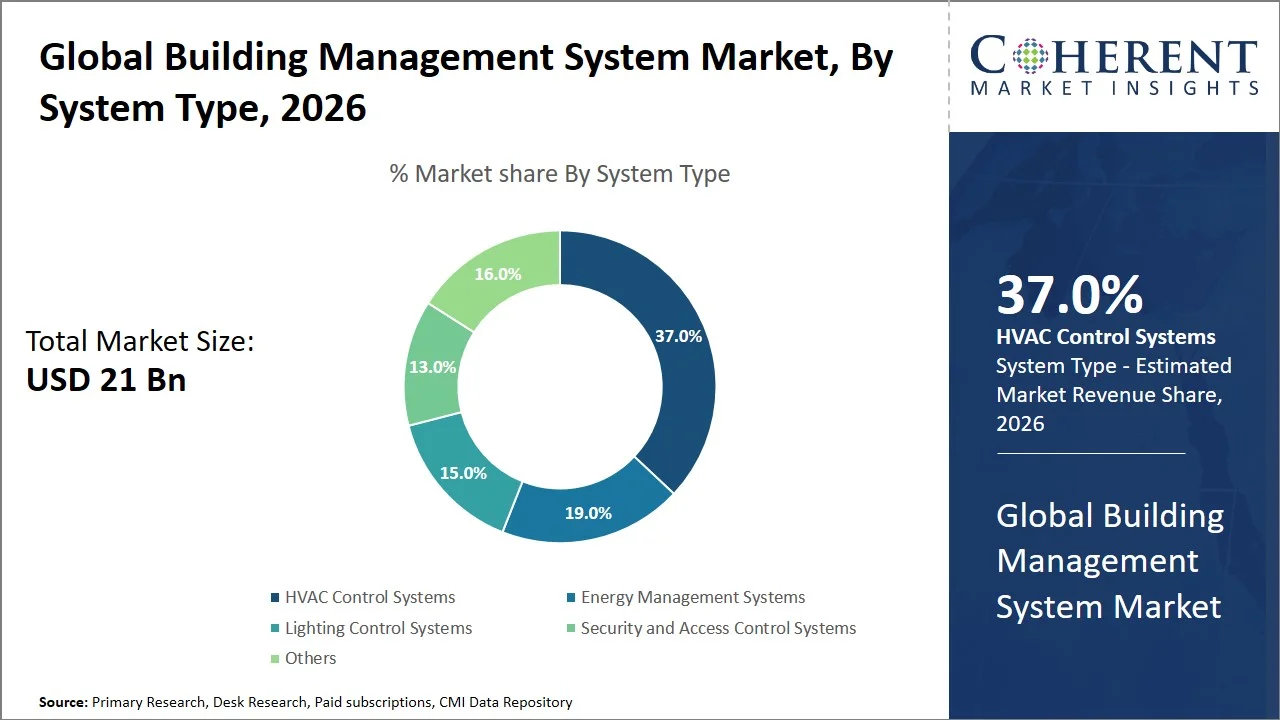
Why Do HVAC Control Systems Dominate the Global Building Management System Market?
The HVAC control systems segment is expected to account for 37.0% of the global building management system market share in 2026. HVAC control systems are dominating the global building management system market because HVAC equipment is the greatest energy consumer in a structure, generally accounting for 40-60% of total energy use in commercial buildings. Facility owners therefore use HVAC automation and optimization to minimize operating costs, enhance energy efficiency, maintain occupant comfort and meet sustainability laws, making HVAC control the most extensively implemented BMS application. On April 27, 2026, Johnson Controls announced the acquisition of Nantum AI, a U.S.-based company specializing in AI algorithms to help businesses unlock energy savings, enhance system controls and improve operational efficiency. The acquisition strengthens the Johnson Controls OpenBlue digital ecosystem by adding proven, proprietary AI-driven algorithms that further optimize HVAC performance and reduce energy consumption. (Source: Johnson Controls)
- Current Industry Events of 2026
- Market Size Estimation
- Regional Breakdown
- Competitive Landscape
- Customer Intelligence
- Segmental Analysis
- Pricing Analysis
- Key Market Drivers, Challenges & Future Trends
- Customized Insights Section
Why is Commercial the Most Widespread Application?
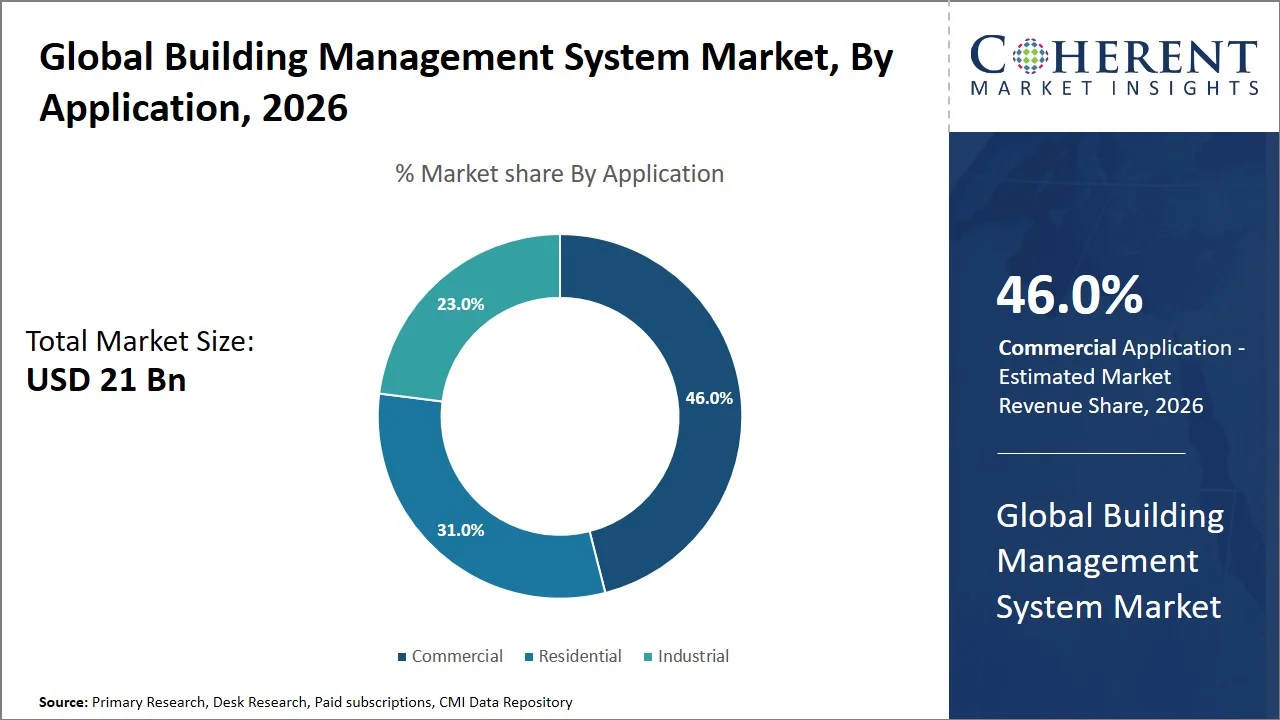
The commercial segment is expected to account for 46.0% of the global building management system market share in 2026. The most adopted application in the global building management system market is commercial buildings, due to the need of centralized control of HVAC, lighting, security and energy systems in large facilities such as offices, shopping malls, hotels, hospitals and airports to improve operational efficiency and lower energy expenses in complex building environments. On November 27, 2025, Tata Realty & Infrastructure Ltd and DBS Bank India Ltd announced the signing of a landmark USD 1.20 billion Green Loan Facility, reinforcing their shared commitment to sustainable development and to India’s transition to a low-carbon economy. DBS Bank India acted as the Sole Advisor and Green Loan Coordinator for this marquee transaction. (Source: DBS Bank)
Currents Events and their Impact
Current Events | Description and its Impact |
Energy Performance of Buildings Directive (EPBD) - European Union |
|
EU Smart Readiness Indicator (SRI) Framework - European Union |
|
(Source: European Commission, European Commission)
Building Management System Market Dynamics
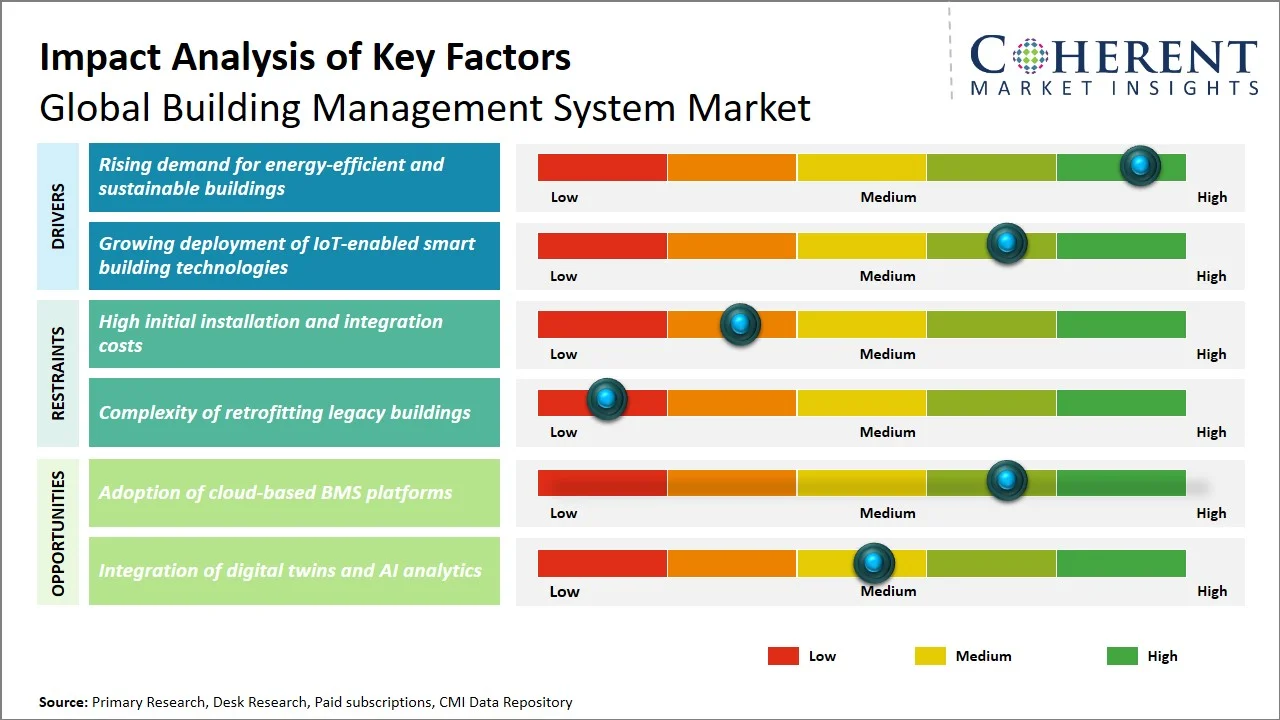
Market Drivers
Rising demand for energy-efficient and sustainable buildings
Growing demand for energy-efficient and sustainable buildings is a major factor driving the growth of the global building management system market. Governments, organizations and property owners are increasingly concerned about reducing energy use, reducing carbon emissions and meeting tough environmental legislation and green construction standards. Building management systems provide real-time monitoring and optimization of building functions such as HVAC, lighting, power, and others, enabling facilities to achieve large energy savings while improving occupant comfort and operational efficiency. Ongoing global investment in smart buildings, net-zero building projects and sustainability programs are driving the use of advanced BMS solutions across commercial, industrial and institutional sectors.
On March 19, 2025, Vornado Realty Trust became the first major U.S. office real estate owner to achieve 100% LEED certification of its in-service portfolio. This was achieved by major investment in energy-efficient building retrofits, smart automation technologies and sustainability-focused operating practices. (Source: U.S. Green Building Council)
Growing deployment of IoT-enabled smart building technologies
One of the major factors fueling the global building management system market is the increasing adoption of IoT-enabled smart building technologies. Modern buildings are increasingly packed with linked sensors, smart meters, occupancy detectors and smart control devices that create real-time data about how the HVAC, lighting, security and energy systems are doing. Building management systems offer the central platform for collecting and analyzing this data, enabling automated decision-making, predictive maintenance, remote monitoring and efficient resource management. The adoption of IoT-integrated BMS solutions is growing worldwide across commercial, residential, healthcare and industrial buildings as enterprises seek higher operational efficiency, improved occupant experience and data-driven facility management.
On July 7, 2025, Siemens Smart Infrastructure announced a collaboration agreement with Microsoft to transform access to Internet of Things (IoT) data for buildings. The collaboration will enable interoperability between Siemens' digital building platform, Building X, and Microsoft Azure IoT Operations enabled by Azure Arc. Azure IoT Operations, a component of this adaptive cloud approach, provides tools and infrastructure to connect edge devices while integrating data, enabling organizations to optimize their operations and utilize the potential of their IoT environments and maximize efficiency. (Source: Siemens)
Emerging Trends
- Integration of Digital Twins and IoT Ecosystems: Building operators are utilizing digital twin technology together with IoT sensors to develop real-time virtual duplicates of buildings. It offers continuous performance monitoring, scenario simulation, occupancy optimization and better decision making about energy and facilities management.
- Net-Zero and Sustainability-Focused Building Automation: Increasing regulatory pressures and corporate sustainability commitments are driving demand for BMS systems that support carbon footprint reduction, renewable energy integration and intelligent energy management. The sophisticated technologies installed in buildings are increasingly satisfying green certification standards and net-zero energy goals.
Regional Insights
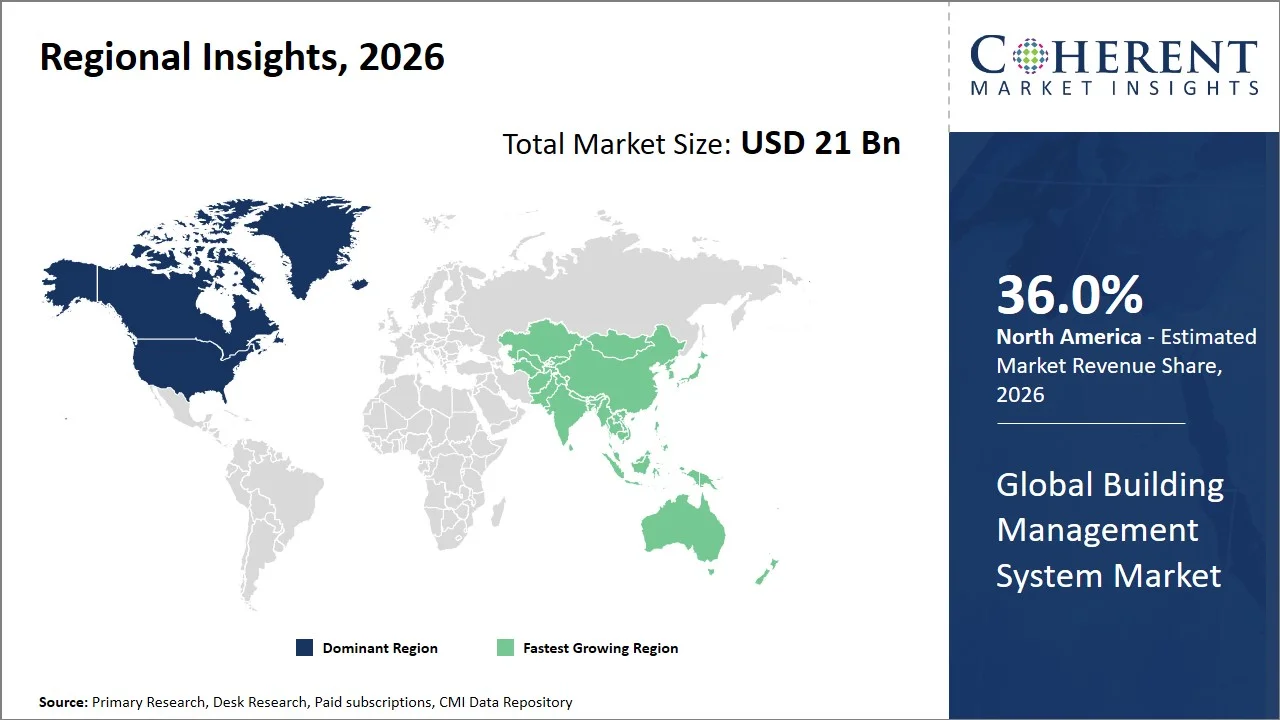
Why is North America a Strong Market for Building Management Systems?
North America is expected to account for a market share of 36.0% in 2026. North America continues to be the most advanced building management system market technologically, owing to large-scale smart building retrofits and strict energy efficiency regulations. Commercial real estate owners in the U.S. and Canada increasingly are turning to AI-enabled building automation technologies to optimize HVAC, lighting, occupancy management and energy consumption. Key projects include smart campus projects for prominent universities, smart hospital infrastructure renovations and data center expansions needing state-of-the-art environmental controls. The region also benefits from the extensive use of integrated platforms from businesses like as Johnson Controls, Honeywell International and Schneider Electric, that are merging predictive analytics and cloud-based monitoring capabilities into building operations. On June 10, 2025, Honeywell announced the launch of Honeywell Connected Solutions, an AI-powered platform that integrates critical building software and technologies into a single interface to help enable more efficient operations. (Source: Honeywell)
Why Does the Asia Pacific Building Management System Market Exhibit High Growth?
Asia Pacific is projected to account for 29.0% of the global building management system market and is expected to register the fastest growth. Rapid urbanization on a broad scale, smart city investments and rising sustainability imperatives are driving BMS implementation in Asia Pacific. Across the area, countries are using sophisticated building controls in commercial complexes, airports, industrial parks and mixed-use buildings. Centralized energy management and automation solutions are needed for digital infrastructure projects which governments are funding. IoT-enabled building technologies have been widely deployed in the region’s smart city projects, especially in China, Japan, Singapore, South Korea and India. The construction of high-rise commercial properties and green-certified buildings is on the rise, further speeding the deployment of modern building management solutions.
Moreover, major smart development projects across the region are also aiding the growth of the building management system market in Asia Pacific. On January 7, 2025, Toyota Motor Corporation announced the completion of Phase 1 construction of Toyota Woven City, its test course for mobility. The launch of Phase 1 is planned for fall 2025 or shortly thereafter. (Source: Toyota)
Global Building Management System Market Outlook for Key Countries
Why is the U.S. Emerging as a Major Hub in the Building Management System Market?
The U.S. is the world leader in adoption of building management systems, driven by aggressive commercial building modernization and energy-efficiency measures at the federal level. Intelligent building automation systems are being increasingly used in major office portfolios, hyperscale data centers, airports, healthcare buildings, and university campuses to cut operating expenses and improve sustainability performance. Programs run by agencies such as the U.S. Department of Energy to promote sophisticated energy management technology in federal and commercial buildings. Also widely used are cloud-connected BMS technologies that can integrate HVAC, security, lighting and occupancy analytics into a unified operational framework, in large-scale developments in places such as New York, Chicago, Dallas and San Francisco.
Is China the Next Growth Engine for the Building Management System Market?
China’s building management system market is influenced by the country’s carbon neutrality targets and the large-scale development of smart cities. Cities such as Shanghai, Shenzhen, Beijing and Guangzhou are incorporating smart building controls into commercial districts, transport hubs and government infrastructure projects. The government’s green building ratings and energy-efficient construction drive has led developers to install sophisticated automation technologies in office buildings, industrial parks and mixed-use projects. AI-powered energy optimization, digital twin technologies and centralized facility management systems are increasingly used in large-scale projects in innovation zones and smart industrial clusters to boost operational efficiency.
Germany Building Management System Market Analysis and Trends
Germany is among the most mature building management system markets in Europe, driven by tough energy-efficiency standards and large-scale use of smart building technologies. Commercial property owners are splashing out on automation solutions to meet national energy transition targets as well as European building performance regulations. Integrated building controls are being increasingly installed in industrial facilities, office complexes and public buildings to optimize energy usage and lower emissions. Germany’s strong technical base and leadership in Industry 4.0 have spurred the convergence of building automation with broader industrial digitization efforts, especially in manufacturing centers and technology parks.
U.K. Building Management System Market Analysis and Trends
The U.K. building management system industry is growing due to large scale retrofitting of older commercial buildings and implementation of net-zero carbon objectives. London and other large cities are rapidly using sophisticated energy management platforms in order to satisfy the more stringent criteria of building performance and sustainability standards. Commercial landlords are investing in smart HVAC controls, occupancy-based automation, and real-time energy analytics to make their buildings more efficient and appeal to tenants seeking environmentally responsible workspaces. There is also significant penetration in healthcare institutions, educational campuses, transport infrastructure and public sector buildings under modernization schemes.
Japan Building Management System Market Analysis and Trends
Japan has developed a highly sophisticated ecosystem of building management systems with a focus on operational efficiency, disaster resilience and smart infrastructure management. Big commercial buildings in Tokyo, Osaka and Yokohama are increasingly adopting innovative automation systems that can optimize energy use while keeping tight indoor environmental regulations. The country’s focus on seismic resilience has led to the integration of BMS platforms with emergency response, fire safety and critical infrastructure monitoring systems. Moreover, Japan’s aged building stock is being modernized through retrofitting projects that utilize IoT sensors, AI-based predictive maintenance and centralized facility management systems to improve long-term building performance and minimize operating costs.
Global Building Management System Market - Retrofit Projects by Region
Region | Estimated Annual BMS Retrofit Projects (2026) | Average Project Size (USD Million) |
North America | 24,500 | 1.15 |
Europe | 21,800 | 0.95 |
Asia Pacific | 20,200 | 0.72 |
Middle East & Africa | 6,800 | 0.88 |
Latin America | 4,700 | 0.54 |
Global Building Management System Market - Commercial Building Digitization Rate
Country | Estimated Commercial Building Digitization Rate (%) |
U.S. | 68 |
Singapore | 66 |
U.K. | 63 |
Germany | 61 |
Japan | 59 |
South Korea | 57 |
Canada | 56 |
Australia | 54 |
China | 49 |
U.A.E | 47 |
How is the Adoption of Cloud-Based BMS Platforms Creating New Growth Opportunities in the Building Management System Market?
The market is witnessing significant growth potential due to the adoption of cloud-based Building Management System (BMS) platforms that enable building owners and facility managers to remotely monitor, control and optimize building operations at multiple sites through a single interface. Cloud-based BMS solutions are less expensive to deploy than traditional on-premises systems, they’re easier to scale, they automatically upgrade, and they interface seamlessly with IoT devices, AI analytics, and digital twin technologies. These systems provide real-time access to operational data that allows organizations to enhance energy efficiency, implement predictive maintenance approaches, and quickly resolve system problems. As commercial real estate operators, healthcare facilities, educational institutions and multi-site enterprises become more focused on operational flexibility and data-driven decision making, they are demanding cloud-enabled BMS solutions, creating new revenue potential for software providers, system integrators and managed service vendors.
On May 19, 2026, Siemens Smart Infrastructure launched Asset Performance Advanced, a new AI-enabled managed building service. By combining an integrated predictive failure mode classification with advanced fault detection and diagnosis (FDD), the solution helps customers across industries optimize operations, improve energy performance, and enhance occupant comfort. (Source: Siemens)
Market Players, Key Development, and Competitive Intelligence

Key Developments
- On November 18, 2025, Johnson Controls announced the launch of Metasys 15.0, its flagship open building automation system. Engineered to meet the demands of mission-critical environments, Metasys 15.0 delivers unmatched scalability, built-in resiliency and instant energy intelligence giving facility managers the tools to optimize building performance, ensure compliance and accelerate decarbonization.
- On January 23, 2024, Honeywell launched Advance Control for Buildings, a building management system that can use a building’s existing wiring to give building managers more control over the efficiency of their buildings, ultimately helping improve the occupant experience while advancing energy management goals.
Competitive Landscape
The global building management system market is highly competitive, dominated by established automation, energy management and industrial technology providers who continuously improve their portfolios through product innovation, strategic partnerships, acquisitions and cloud-based platform development. Major players including Johnson Controls, Honeywell International, Siemens, Schneider Electric, ABB and Carrier Global are focused on AI-powered analytics, cloud integration, cybersecurity advancements and IoT-enabled building automation capabilities. The competition is also heating up as the increasing footprint of software-oriented vendors and specialty smart-building technology suppliers deliver interoperable, data-centric solutions specifically designed for commercial, industrial, healthcare and institutional institutions.
Market Report Scope
Building Management System Market Report Coverage
| Report Coverage | Details | ||
|---|---|---|---|
| Base Year: | 2025 | Market Size in 2026: | USD 21 Bn |
| Historical Data for: | 2020 To 2024 | Forecast Period: | 2026 To 2033 |
| Forecast Period 2026 to 2033 CAGR: | 15% | 2033 Value Projection: | USD 57 Bn |
| Geographies covered: |
| ||
| Segments covered: |
| ||
| Companies covered: | Honeywell International, Johnson Controls, Schneider Electric, Siemens, ABB, Carrier Global, Trane Technologies, Delta Controls, Legrand, Lutron Electronics, Azbil Corporation, Beckhoff Automation, Cisco Systems, Hitachi, and Emerson Electric | ||
| Growth Drivers: |
| ||
| Restraints & Challenges: |
| ||
Analyst Opinion (Expert Opinion)
- The building management system market is considered to be well poised for continued growth due to the rising focus on energy efficiency, sustainability and intelligent building operations around the world. The rapid rollout of smart buildings, the use of artificial intelligence and IoT technologies, and the upgrading of old building infrastructure are likely to drive significant growth. There will be also an increase in investments in cloud-based management platforms, predictive maintenance solutions, and digital building ecosystems. Demand will be further boosted by changing regulatory requirements and decarbonization activities.
- The future of the building management system market is projected to be driven by the confluence of artificial intelligence, cloud computing, digital twins and sophisticated IoT networks. The growing adoption of autonomous building operations, real-time energy optimization, occupant-centric controls, and net-zero building strategies are expected to revolutionize traditional facility management approaches. Large scale smart city projects, retrofitting of commercial buildings, green construction programs and the growing demand for integrated management of distributed energy resources are likely to provide opportunities. As operational efficiency, sustainability and data-driven decision-making remain key organizational priorities, BMS platforms are projected to develop into comprehensive, intelligent building operating systems that oversee energy, security, comfort and asset performance from one digital environment.
Speak to the analyst
Want personalized insights?
Take the findings above to one of our principal consultants, or have the report rebuilt around the segments, geographies and competitors you actually track.
Market Segmentation
- System Type Insights (Revenue, USD Billion, 2021 - 2033)
- HVAC Control Systems
- Energy Management Systems
- Lighting Control Systems
- Security and Access Control Systems
- Others
- Application Insights (Revenue, USD Billion, 2021 - 2033)
- Commercial
- Residential
- Industrial
- Regional Insights (Revenue, USD Billion, 2021 - 2033)
- North America
- U.S.
- Canada
- Latin America
- Brazil
- Argentina
- Mexico
- Rest of Latin America
- Europe
- Germany
- U.K.
- Spain
- France
- Italy
- Russia
- Rest of Europe
- Asia Pacific
- China
- India
- Japan
- Australia
- South Korea
- ASEAN
- Rest of Asia Pacific
- Middle East
- GCC Countries
- Israel
- Rest of Middle East
- Africa
- South Africa
- North Africa
- Central Africa
- North America
- Key Players Insights
- Honeywell International
- Johnson Controls
- Schneider Electric
- Siemens
- ABB
- Carrier Global
- Trane Technologies
- Delta Controls
- Legrand
- Lutron Electronics
- Azbil Corporation
- Beckhoff Automation
- Cisco Systems
- Hitachi
- Emerson Electric
Sources
Primary Research Interviews
- Facility Managers & Building Operators
- BMS Solution Providers & System Integrators
- HVAC & Energy Management Specialists
- Real Estate Developers & Property Managers
Magazines
- Buildings Magazine
- Automated Buildings
- ASHRAE Journal
- Facility Management Journal
Journals
- Energy and Buildings (Elsevier)
- Journal of Building Engineering
- Sustainable Cities and Society
Associations
- Building Owners and Managers Association (BOMA) International
- American Society of Heating, Refrigerating and Air-Conditioning Engineers (ASHRAE)
- Continental Automated Buildings Association (CABA)
- International Facility Management Association (IFMA)
Public Domain Sources
- U.S. Department of Energy (energy.gov)
- International Energy Agency (IEA)
- European Commission - Energy Efficiency Directives
- U.S. Environmental Protection Agency (EPA)
Proprietary Elements
- CMI Data Analytics Tool
- Proprietary CMI Existing Repository of information for last 10 years
Get access to 250+ pages report
Every segment, forecast, competitor profile and data table behind the analysis above — available for instant download.
- ESOMAR Member
- ISO 9001:2015 Certified
- D-U-N-S Registered
- GDPR & CCPA Compliant
Missing comfort of reading report in your local language? Find your preferred language:
Transform your Strategy with Exclusive Trending Reports
Frequently Asked Questions
The global building management system market is expected to stand at USD 21 Bn in 2026 and is expected to reach USD 57 Bn by 2033.
The CAGR of the global building management system market is projected to be 15% from 2026 to 2033.
Rising demand for energy-efficient and sustainable buildings and growing deployment of IoT-enabled smart building technologies are the major factors driving the growth of the global building management system market.
High initial installation and integration costs and complexity of retrofitting legacy buildings are the major factors hampering the growth of the global building management system market.
In terms of system type, the HVAC control systems segment is estimated to dominate the market revenue share in 2026.
It continuously monitors building systems and adjusts performance parameters to minimize unnecessary energy use.
IoT devices provide real-time data from connected equipment, enabling smarter automation and predictive maintenance.