

Ductless Mini Splits Market Size and Forecast
The Global Ductless Mini Splits Market is estimated to be valued at USD 19.40 Bn in 2026 and is expected to reach USD 34.42 Bn by 2033, exhibiting a compound annual growth rate (CAGR) of 8.5% from 2026 to 2033.
Key Takeaways
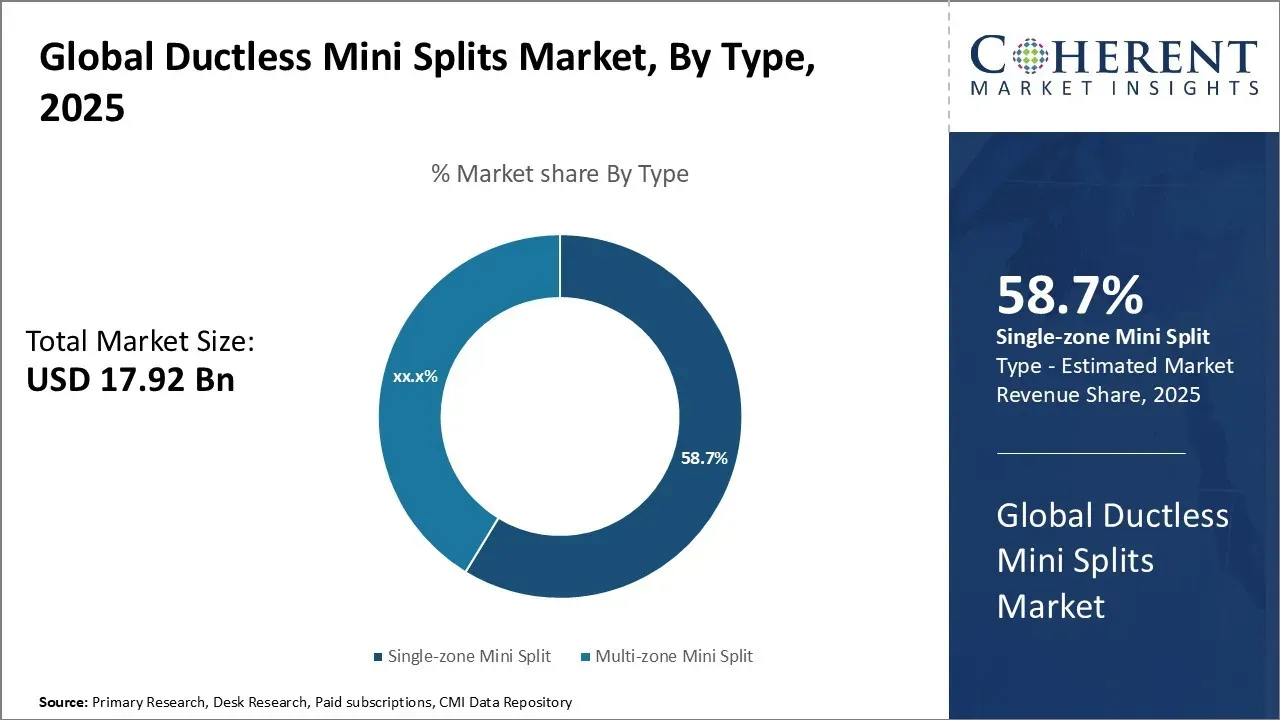
- By Type, Single-Zone Mini Split segment is estimated to lead the market with a share of 59.7% in 2026 as increased residential renovation and retrofit projects.
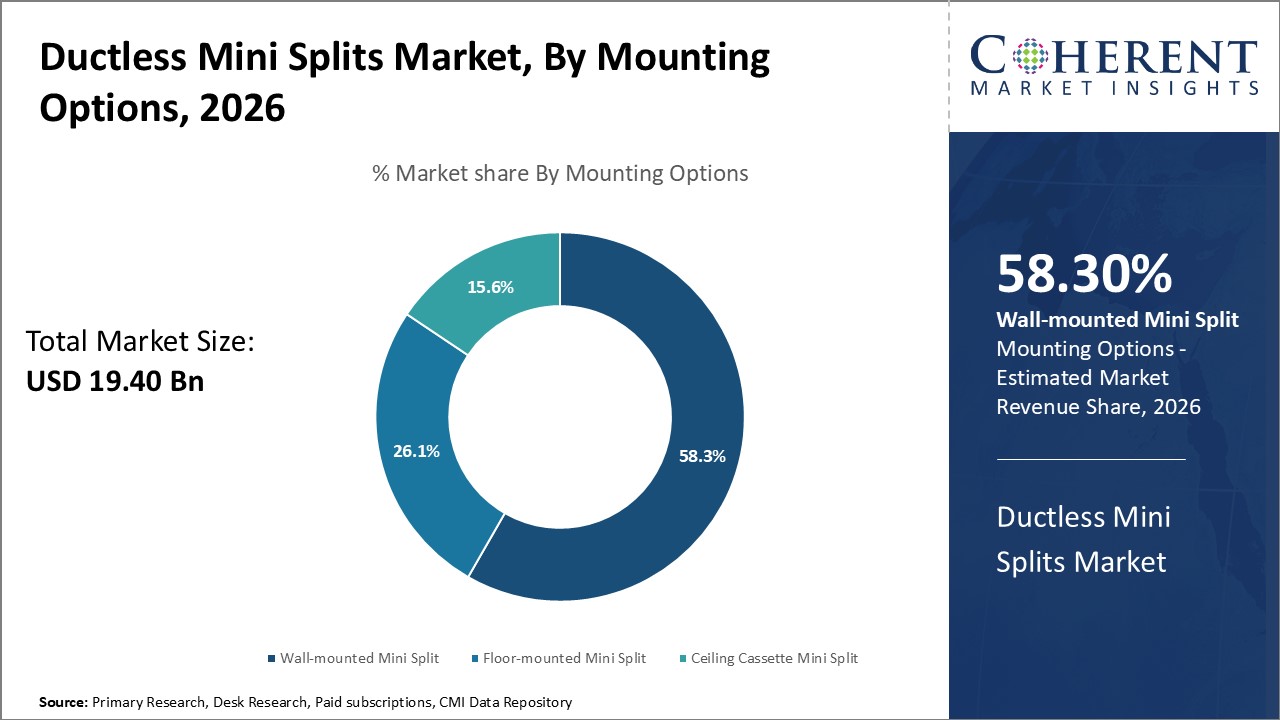
- By Mounting options, Wall-Mounted Mini Split segment is projected to dominate, holding 58.3% of the market share in 2026 as cost-effectiveness and affordability.
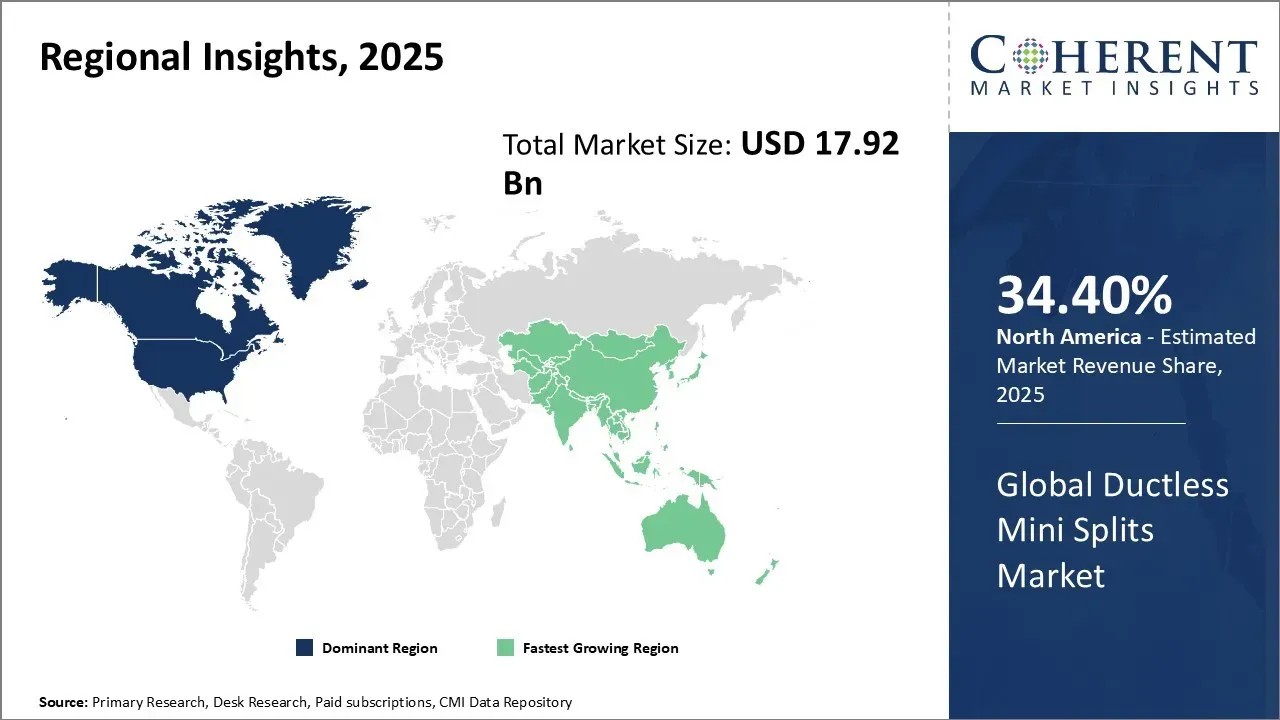
- By Region, North America is expected to lead the market, holding a share of 34.4% in 2026 as increasing awareness and education.
Market Overview
The global ductless mini splits market is witnessing significant growth, driven by the increasing demand for energy-efficient climate control solutions and rapid urbanization. The market benefits from the rising awareness of Heating, Ventilation, and Air Conditioning (HVAC) energy consumption and the push for eco-friendly alternatives. Additionally, stringent government policies and incentives promoting energy-efficient systems are accelerating the adoption of ductless mini splits.
Current Events and their Impact on the Ductless Mini Splits Market
Current Events | Description and its impact |
Regulatory Shifts in Refrigerant Policies |
|
Geopolitical Trade Barriers |
|
Technological and Efficiency Standards |
|
End-user Feedback and Unmet Needs in the Ductless Mini Splits Market
End-user Feedback and Unmet Needs
- Demand for Simplified Installation and Maintenance: End users often highlight the need for easier, faster installation processes and reduced maintenance requirements. Complex setups or frequent servicing can discourage adoption. Manufacturers focusing on plug-and-play designs and durable components can better meet consumer expectations and improve overall satisfaction and market growth.
- Concerns Over Upfront Costs: Many consumers find the initial purchase and installation costs of ductless mini splits to be a barrier. While energy savings are appreciated, the high upfront investment limits adoption, especially in price-sensitive markets. Financing options and incentives could better address this unmet need.
- Desire for Enhanced Climate Control Precision: Users want improved temperature regulation and more customizable zonal control, especially in multi-room settings. Enhancements in AI-driven automation and smart controls could provide tailored comfort and boost user experience, increasing long-term engagement with ductless systems.
- Current Industry Events of 2026
- Market Size Estimation
- Regional Breakdown
- Competitive Landscape
- Customer Intelligence
- Segmental Analysis
- Pricing Analysis
- Key Market Drivers, Challenges & Future Trends
- Customized Insights Section
Pricing Analysis of Ductless Mini Splits
Ductless mini-split systems typically cost between USD 1,500 and USD 4,000 for a single-zone setup, including both the unit and basic installation. Multi-zone systems that serve two to four rooms can range from USD 3,500 to over USD 10,000, depending on the number of indoor units and complexity. Premium systems with high efficiency ratings or advanced features may exceed $15,000.
Segmental Insights
Ductless Mini Splits Market Insights, By Type
Single-zone mini split contributes the highest share of the market owing to its environmental regulations and incentives
The single-zone mini split segment is expected to emerge as the dominant category in the global ductless mini splits market, holding a market share of approximately 59.7% in 2026. This segment's leadership is driven by its superior energy efficiency, cost-effectiveness, and targeted climate control capabilities. Single-zone mini splits are particularly favored for their ability to provide efficient heating and cooling for individual rooms or spaces, making them an ideal solution for residential applications, small offices, and specific commercial settings. For instance, in August 2024, Mr. Mini Split, the leading air conditioning provider in the Oklahoma City region, introduced the Bravo Single Zone Mini Splits, the latest addition to their product lineup.
Ductless Mini Splits Market Insights, By Mounting Options
Wall Mounted mini split contribute the highest share of the market owing to its energy efficiency and zonal comfort
The wall-mounted mini split segment is expected to be the leading mounting options in the global ductless mini splits market, commanding a market share of 58.3% in 2026. Its dominance is primarily attributed to its versatility, space-saving design, and superior energy efficiency. These systems are widely used in residential and commercial applications due to their ability to deliver targeted heating and cooling without the need for extensive ductwork or major renovations. Wall-mounted mini splits are particularly valued for their high energy efficiency ratings, as they come equipped with advanced inverter compressors that optimize power consumption based on real-time room conditions. Additionally, their user-friendly installation and maintenance make them a preferred choice for homeowners and businesses alike. For instance, in March 2024, Mitsubishi Electric Trane HVAC US LLC (METUS), a leading provider of ductless and ducted mini-split and variable refrigerant flow (VRF) heat pump and air conditioning systems, introduced Premier Wall-mounted Indoor Units (MSZ-GS/MSY-GS), upgrading their previous models (MSZ-GS/MSY-GL).
Regional Insights
North America Ductless Mini Splits Market Trends
Stringent energy-efficiency regulations, rising electricity costs, and attractive government incentives are driving the ductless mini-splits market growth in North America. Consumers are increasingly selecting eco-friendly, zoned HVAC systems for both new builds and home renovations. Leading manufacturers like Daikin, Mitsubishi, and Carrier compete by offering advanced inverter-based solutions. The rapid adoption of heat pump technology and smart home integration supports electrification goals and boosts year-round demand. The residential and light-commercial sectors in the U.S. and Canada are fueling this regional expansion. For instance, in February 2026, Samsung Lennox HVAC North America, through Lennox sales channels, launched its first ductless heat pump products: the Varix™ variable refrigerant flow (VRF) range and the Lennox Powered by Samsung mini-split systems.
Asia Pacific Ductless Mini Splits Market Trends
Growing urban populations in countries like China, India, and Japan are driving the demand for compact, efficient HVAC systems. Homeowners and developers are choosing ductless mini splits for their flexibility in small spaces, especially in apartments and city homes where traditional ducted systems are costly or impractical. The residential construction boom in emerging markets further boosts demand, as homeowners favor ductless systems for their easy installation, low maintenance, and ability to control temperatures by zone.
United States Ductless Mini Splits Market Trends
Federal and state programs, including utility rebates and IRA tax credits, actively promote the use of ductless heat pumps by reducing upfront costs and accelerating the move away from gas systems. Manufacturers and installers are leveraging electrification regulations to expand their product lines and increase market reach. Consumers are increasingly adopting Wi-Fi-enabled, inverter-based mini-splits compatible with smart thermostats, valuing their precise and energy-efficient climate control. Lennox’s Nest/Ecobee integration and Samsung-powered mini-splits clearly reflect this growing trend. For instance, in January 2026, Panasonic Corporation’s Heating & Ventilation A/C Company unveiled OASYS Residential Central Air Conditioning System for purchase in the United States. This central air conditioning system, considered the first of its kind in the U.S., includes an ERV, a mini split air conditioner, and transfer fans powered by DC motor-driven ventilation fans.
India Ductless Mini Splits Market Trends
India’s rapid urbanization and rising population density in cities like Bengaluru, Delhi, and Mumbai are increasing demand for space-efficient HVAC systems. Homeowners in apartments and small houses prefer ductless mini splits because traditional ducted systems prove too costly or impractical. Regional manufacturers like Blue Star and Voltas produce affordable, energy-efficient mini splits tailored to the Indian climate. Their extensive retail networks and low-cost manufacturing enable them to reach both urban and rural customers, driving faster market growth.
Market Report Scope
Ductless Mini Splits Market Report Coverage
| Report Coverage | Details | ||
|---|---|---|---|
| Base Year: | 2025 | Market Size in 2026: | USD 19.40 Bn |
| Historical Data for: | 2020 To 2024 | Forecast Period: | 2026 To 2033 |
| Forecast Period 2026 to 2033 CAGR: | 8.5% | 2033 Value Projection: | USD 34.42 Bn |
| Geographies covered: |
| ||
| Segments covered: |
| ||
| Companies covered: | Carrier Global Corporation, Mitsubishi Electric Corporation, Daikin Industries, Ltd., LG Electronics Inc., Panasonic Corporation, Samsung Electronics Co., Ltd., Fujitsu General Limited, Midea Group Co., Ltd., Johnson Controls International plc, Ramsond Corporation, Blue Star Limited, Sharp Corporation, MRCOOL, Haier Group Corporation, and Gree Electric Appliances Inc. | ||
| Growth Drivers: |
| ||
| Restraints & Challenges: |
| ||
Ductless Mini Splits Market Trend
Expansion Driven by Urbanization and Space Constraints
Rapid urbanization in developing countries has created a need for compact, flexible HVAC solutions. Ductless mini splits fit well in apartments, condos, and small homes where ductwork installation is impractical or expensive. Their space-saving design and easy installation make them ideal for both new constructions and retrofit projects in densely populated urban areas.
Rising Popularity in Residential Renovations and Retrofits
Many homeowners prefer ductless mini splits during renovations to avoid costly duct installations. These systems offer customizable zonal heating and cooling, making them perfect for extending comfort to specific rooms. As more consumers look for energy-efficient upgrades, ductless mini splits become a preferred alternative to window units and central HVAC.
Ductless Mini Splits Market Opportunity
Rising Focus on Energy Efficiency and Sustainability
As governments and consumers emphasize reducing carbon footprints, there’s growing opportunity for ductless mini splits due to their superior energy efficiency compared to traditional HVAC systems. Increased adoption in green buildings and sustainable homes opens new markets. Manufacturers can capitalize by developing ultra-efficient models and promoting eco-friendly refrigerants to meet evolving regulations and consumer preferences.
Ductless Mini Splits Market News
- In April 2025, Bosch Home Comfort introduced a new version of its Climate 5000 Ductless Mini-Split Heat Pump using low-GWP R-454B refrigerant, aligning with updated environmental regulations.
- In April 2025, Mitsubishi Electric Trane HVAC US LLC (METUS), a leading supplier of all-electric, all-climate ductless mini-split and variable refrigerant flow (VRF) heat pump and air-conditioning systems, launched a new, innovative product line featuring a low global warming potential (GWP) refrigerant.
- In September 2024, Morphy Richards, a leading innovator and trusted home appliance brand, introduced ductless portable air conditioner. Featuring revolutionary Cooling Max Technology, the Morphy Richards ductless portable AC delivers powerful, long-distance cooling without requiring traditional ducts, offering an unmatched solution in the air conditioning market.
Analyst Opinion (Expert Opinion)
- The ductless mini splits market is entering a phase of transformative growth driven not merely by product innovation but by shifting consumer expectations and regulatory landscapes. From an analytical standpoint, the most compelling driver is the accelerated adoption of inverter-driven technology combined with smart controls, which significantly outperforms traditional HVAC systems in energy efficiency and user customization. For instance, Mitsubishi Electric’s Hyper-Heating models have demonstrated up to 40% greater heating capacity at low ambient temperatures compared to conventional heat pumps, making them indispensable in colder regions where ductless systems were once considered marginal.
- Moreover, the integration of AI and IoT capabilities has evolved from a luxury to a baseline expectation. Brands like Daikin have leveraged smart thermostat compatibility and adaptive learning algorithms to reduce energy consumption by approximately 25%, a figure validated by field studies in residential settings. This technological leap is a fundamental market disruptor, as it aligns with increasingly stringent energy codes and consumer demand for cost-effective, intuitive climate solutions.
- However, the market still wrestles with critical challenges around upfront costs and installer skill shortages. While government incentives in regions like North America mitigate price barriers, the supply chain’s inability to quickly scale certified installers remains a bottleneck. This gap not only delays project timelines but also undermines consumer confidence, especially in retrofit scenarios.
- In my expert view, companies that invest heavily in installer training programs and develop plug-and-play systems will carve out dominant positions. The next frontier lies in modular, scalable ductless systems adaptable to multifamily and commercial properties, where energy savings and flexible zoning can drastically reduce operational expenses.
Speak to the analyst
Want personalized insights?
Take the findings above to one of our principal consultants, or have the report rebuilt around the segments, geographies and competitors you actually track.
Market Segmentation
- Type Insights (Revenue, USD Bn, 2021 - 2033)
- Single-zone Mini Split
- Multi-zone Mini Split
- Mounting Options Insights (Revenue, USD Bn, 2021 - 2033)
- Wall-mounted Mini Split
- Floor-mounted Mini Split
- Ceiling Cassette Mini Split
- Regional Insights (Revenue, USD Bn, 2021 - 2033)
- North America
- U.S.
- Canada
- Latin America
- Brazil
- Argentina
- Mexico
- Rest of Latin America
- Europe
- Germany
- U.K.
- Spain
- France
- Italy
- Russia
- Rest of Europe
- Asia Pacific
- China
- India
- Japan
- Australia
- South Korea
- ASEAN
- Rest of Asia Pacific
- Middle East
- GCC Countries
- Israel
- Rest of Middle East
- Africa
- South Africa
- North Africa
- Central Africa
- Key Players Insights
- Carrier Global Corporation
- Mitsubishi Electric Corporation
- Daikin Industries, Ltd.
- LG Electronics Inc.
- Panasonic Corporation
- Samsung Electronics Co., Ltd.
- Fujitsu General Limited
- Midea Group Co., Ltd.
- Johnson Controls International plc
- Ramsond Corporation
- Blue Star Limited
- Sharp Corporation
- MRCOOL
- Haier Group Corporation
- Gree Electric Appliances Inc.
Sources
Primary Research interviews
- HVAC industry experts
- Manufacturers’ technical and sales teams
- Certified HVAC installers and contractors
- End-user focus groups in residential and commercial sectors
Databases
- U.S. Energy Information Administration (EIA)
- International Energy Agency (IEA)
- National Renewable Energy Laboratory (NREL)
- Environmental Protection Agency (EPA) ENERGY STAR database
Magazines
- HVACR Business
- Air Conditioning, Heating & Refrigeration News (ACHR News)
- Green Building & Design Magazine
- Building Operating Management
Journals
- ASHRAE Journal
- Energy and Buildings
- Journal of Building Engineering
- Applied Energy
Newspapers
- The Wall Street Journal (Energy Section)
- The New York Times (Climate and Energy Reports)
- Financial Times (Energy & Environment)
- The Guardian (Sustainability Coverage)
Associations
- Air-Conditioning, Heating, and Refrigeration Institute (AHRI)
- American Society of Heating, Refrigerating and Air-Conditioning Engineers (ASHRAE)
- Heating, Air-conditioning & Refrigeration Distributors International (HARDI)
- International Institute of Refrigeration (IIR)
Public Domain sources
- U.S. Department of Energy (DOE) publications
- National Institute of Standards and Technology (NIST) reports
- Government energy efficiency incentive program websites
- Patent databases related to HVAC technology
Proprietary Elements
- CMI Data Analytics Tool, and Proprietary CMI Existing Repository of information for last 8 years
Get access to 250+ pages report
Every segment, forecast, competitor profile and data table behind the analysis above — available for instant download.
- ESOMAR Member
- ISO 9001:2015 Certified
- D-U-N-S Registered
- GDPR & CCPA Compliant
Missing comfort of reading report in your local language? Find your preferred language:
Transform your Strategy with Exclusive Trending Reports
Frequently Asked Questions
The global ductless mini splits market is estimated to be valued at USD 17.92 Bn in 2025 and is expected to reach USD 31.31 Bn by 2032.
The CAGR of the global ductless mini splits market is projected to be 8.3% from 2025 to 2032.
Increasing demand for energy-efficient HVAC systems and rising urbanization and residential construction activities are the major factors driving the growth of the global ductless mini splits market.
High initial installation costs and limited consumer awareness in emerging markets are the major factors hampering the growth of the global ductless mini splits market.
In terms of type, the single-zone mini split segment is estimated to dominate the market revenue share in 2025.
Carrier Global Corporation, Mitsubishi Electric Corporation, Daikin Industries, Ltd., LG Electronics Inc., Panasonic Corporation, Samsung Electronics Co., Ltd., Fujitsu General Limited, Midea Group Co., Ltd., Johnson Controls International plc, Ramsond Corporation, Blue Star Limited, Sharp Corporation, MRCOOL, Haier Group Corporation, and Gree Electric Appliances Inc. are the major players.
North America is expected to lead the global ductless mini splits market in 2025, holding a share of 34.4%.