

Artificial Intelligence in E Commerce Market Size and Forecast – 2026 to 2033
The global artificial intelligence in e commerce market is estimated to be valued at USD 9.70 Bn in 2026 and is expected to reach USD 47.87 Bn by 2033, exhibiting a compound annual growth rate (CAGR) of 25.7% from 2026 to 2033.
Key Takeaways
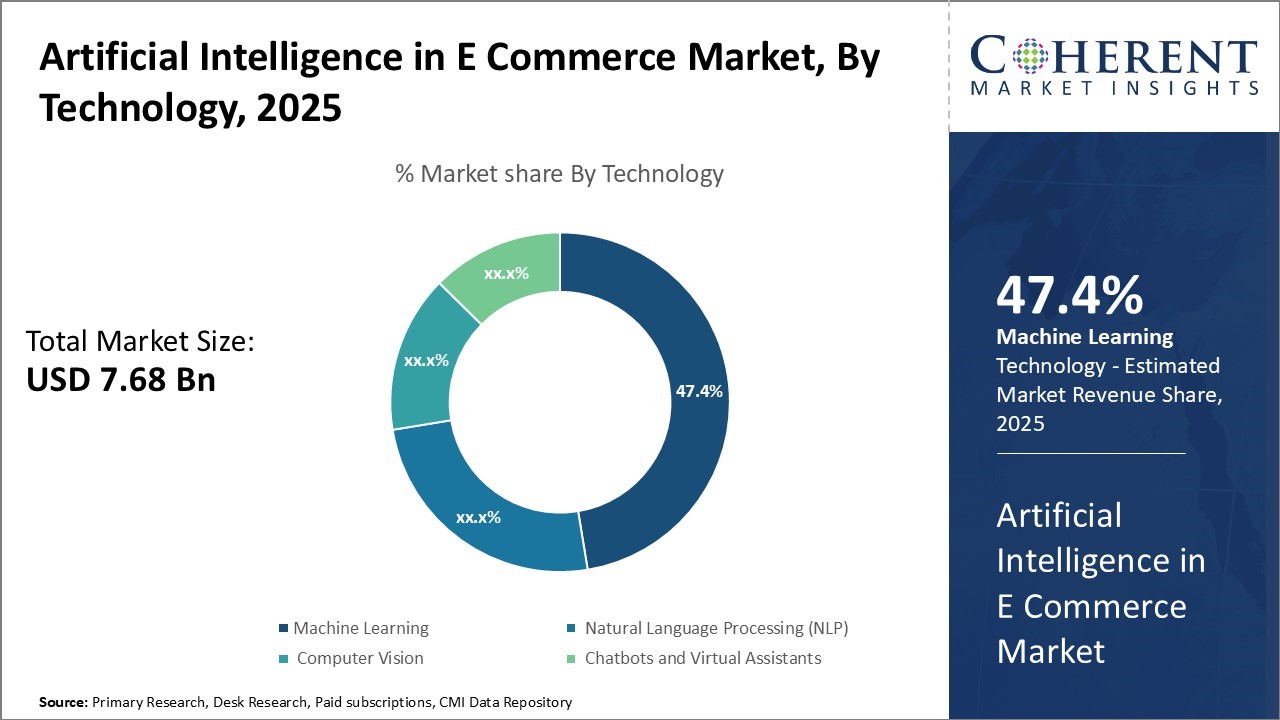
- By Technology, Machine Learning hold the largest market share of 48.4% in 2026 owing to its demand for personalized customer experiences.
- By Deployment, On-premises expected to hold largest market share of 40.4% in 2026 owing to the enhanced data security & control.
- By Vertical, B2B acquired the prominent market share of 57.6% in 2026 owing to the digital transformation & online shift.
- By Region, North America dominates the overall market with an estimated share of 40.8% in 2026 owing to the high adoption of AI technologies & digital infrastructure.
Market Overview
The Artificial Intelligence (AI) in E‑commerce market is actively transforming online retail by personalizing experiences, automating operations, and elevating customer satisfaction. Companies are applying AI technologies like machine learning, chatbots, recommendation engines, and predictive analytics to streamline pricing, manage inventory, and optimize supply chains. As consumers increasingly demand seamless, tailored shopping experiences, advancements in digital infrastructure and data analytics are accelerating adoption. AI now drives efficiency, boosts engagement, and strengthens competitive advantage in e‑commerce.
Current Events and Its Impact on the Artificial Intelligence in E Commerce Market
Current Events | Description and its impact |
Geopolitical and Regulatory Developments |
|
Technological Advances and Industry Innovations |
|
Economic Conditions and Market Dynamics |
|
Segmental Insights
- Current Industry Events of 2026
- Market Size Estimation
- Regional Breakdown
- Competitive Landscape
- Customer Intelligence
- Segmental Analysis
- Pricing Analysis
- Key Market Drivers, Challenges & Future Trends
- Customized Insights Section
Artificial Intelligence in E Commerce Market Insights, By Technology - Machine Learning contribute the highest share of the market owing to its massive growth in data availability
Machine Learning hold the largest market share of 48.4% in 2026. Machine learning is actively transforming AI-powered e‑commerce by empowering retailers to make smarter, data-driven decisions. Companies use it to anticipate customer behavior, adjust pricing, and deliver personalized product recommendations instantly. It automates inventory management, detects fraud, and optimizes supply chain operations while boosting customer engagement through intelligent chatbots and virtual assistants. The surge of consumer and transactional data, along with the demand for quicker insights and efficient operations, is driving retailers to increasingly rely on machine learning in online commerce. For instance, Amazon India has launched the Machine Learning Summer School, an integrated program designed to prepare students for the industry.
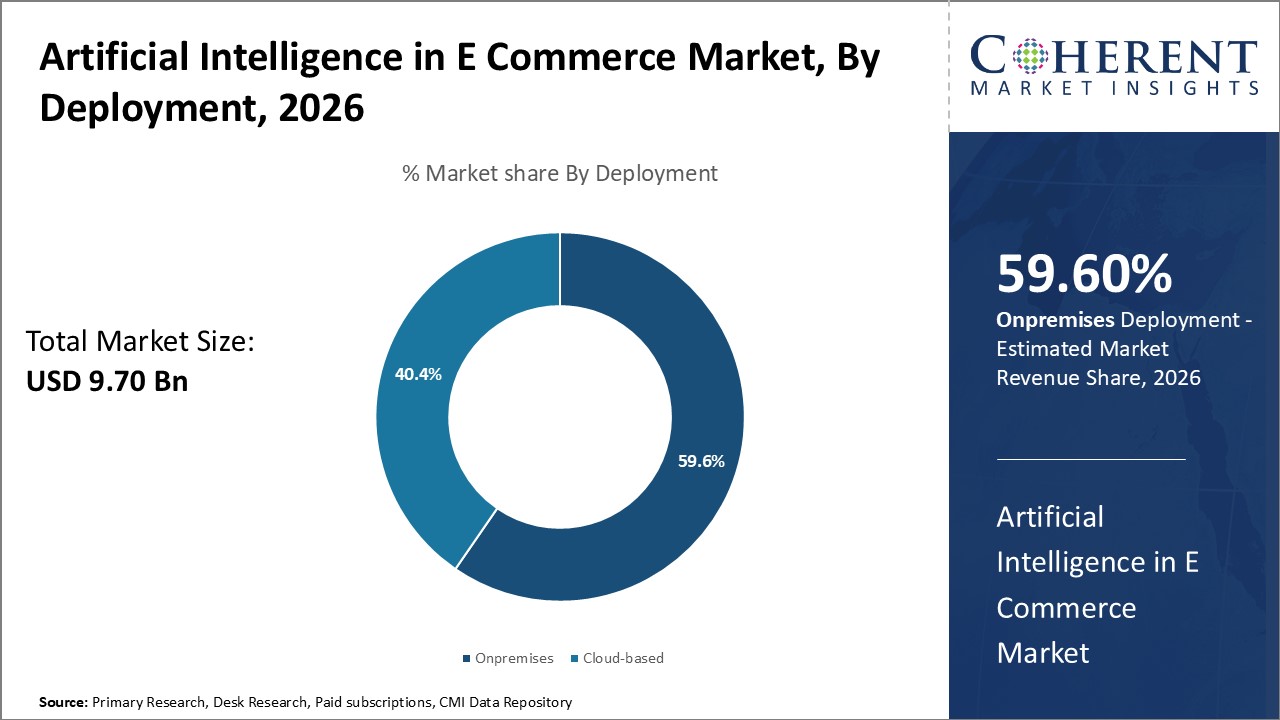
Artificial Intelligence in E Commerce Market Insights, By Deployment - On-Premises contribute the highest share of the market owing to its full customization & integration
On-premises expected to hold largest market share of 59.6% in 2026. E‑commerce businesses are increasingly adopting on-premises AI as they focus on security, control, and regulatory compliance. Companies deploy these solutions to protect sensitive customer data, adhere to regulations, and retain full oversight of their AI systems. On-premises setups enable extensive customization, smooth integration with existing infrastructure, and low-latency processing for real-time operations. By utilizing internal resources and avoiding vendor lock-in, retailers actively enhance performance, lower long-term costs, and deliver reliable, efficient AI-driven solutions in inventory management, personalization, and customer service.
Artificial Intelligence in E Commerce Market Insights, By Vertical - B2B contribute the highest share of the market owing to its data-driven decision making
B2B acquired the prominent market share of 57.6% in 2026. B2B e‑commerce companies are actively applying AI to simplify complex business transactions and strengthen customer relationships. They use AI to automate order processing, adjust pricing, and deliver personalized product recommendations to each client. Predictive analytics help them manage inventory, forecast demand, and optimize supply chains, while intelligent chatbots and virtual assistants enhance support and engagement. Rising demand for seamless, data-driven interactions, along with the push for greater operational efficiency and faster decision-making, is driving businesses to adopt AI across B2B e‑commerce platforms. For instance, in December 2025, Zydon, a B2B e-commerce platform, has launched "Pedido Rapido" (Fast Order), Brazil’s first AI that automatically reads and interprets purchase spreadsheets directly on the sales portal.
Regional Insights
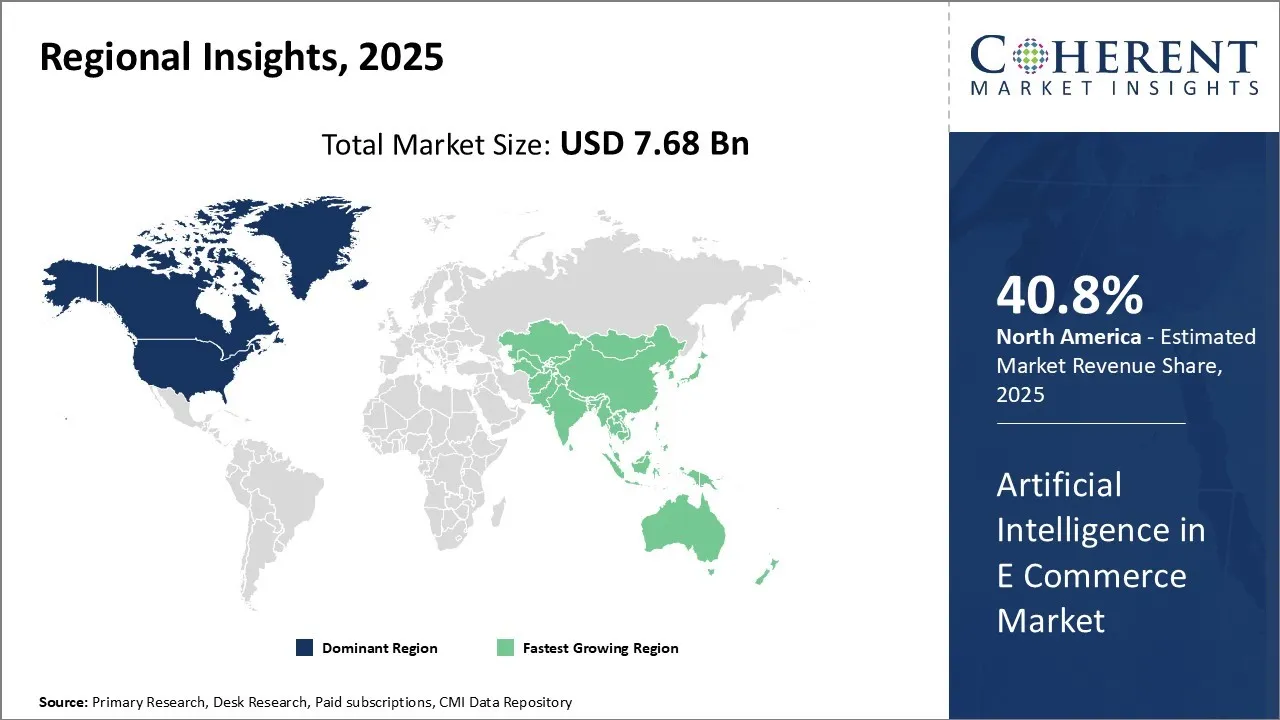
North America Artificial Intelligence in E Commerce Market Trends
North America dominates the overall market with an estimated share of 40.8% in 2026. North American e‑commerce companies are increasingly integrating advanced AI technologies to improve search, personalization, and customer support. Retailers actively deploy AI-powered chatbots, visual and voice search, and automated shopping experiences. Leading platforms are moving AI from pilot projects into full-scale operations for fraud prevention, personalization, and process automation, while some organizations continue addressing governance and scaling challenges. Major tech and retail players are driving ongoing innovation, encouraging wider adoption of AI solutions throughout the region. For instance, in December 2026, Fanplayr, a global leader in AI personalization, has launched Verada AI Tags, a new tool that enhances e-commerce product catalogs with human-like understanding to boost product discovery, relevance, and revenue.
Asia Pacific Artificial Intelligence in E Commerce Market Trends
E‑commerce companies in the Asia Pacific region are actively embedding AI solutions throughout the shopping journey, deploying chatbots, virtual assistants, advanced product search, and personalized recommendations that cater to diverse consumer preferences. Adoption rates differ across the region, with China and India leading while Southeast Asian retailers continue expanding integration. Increasing digital payments, the rise of social commerce, and localized innovations are driving retailers to use AI more effectively to engage customers, enhance experiences, and boost operational efficiency.
United States Artificial Intelligence in E Commerce Market Trends
U.S. e‑commerce companies are actively adopting AI to transform online shopping experiences and optimize operations. Major retailers deploy AI tools to assist customers and streamline workflows, using intelligent chatbots, AI assistants, and advanced search features to guide shoppers and boost engagement. They implement dynamic pricing and automated inventory systems to increase efficiency. The growing use of agent-style AI assistants by companies like Amazon and Walmart accelerates personalized product discovery, while wider integration of these technologies is reshaping how Americans shop online. For instance, in October 2026, Instacart North America’s leading grocery tech company, has rolled out a full suite of business features for its white-label e-commerce solutions, Storefront and Storefront Pro, enabling retailers like Woodman's Markets to better serve restaurants, offices, healthcare facilities, and schools through their websites and apps.
China Artificial Intelligence in E Commerce Market Trends
Chinese e‑commerce companies are actively advancing their AI capabilities to improve customer engagement, streamline operations, and drive sales. Retailers implement AI chatbots, digital human hosts, and sophisticated recommendation engines to enhance shopping experiences and support livestream commerce. Leading platforms like Alibaba and JD.com use real-time personalization, AI-powered search, and automated logistics, while smaller sellers adopt cost-effective AI tools to remain competitive. Expanding digital payments and social commerce are also prompting retailers to leverage AI more effectively across China’s online retail landscape. For instance, in October 2026, Alibaba launched a new AI chatbot assistant in its Quark app, strengthening its consumer-facing AI offerings against competitors like ByteDance and Tencent.
End-user Feedback and Unmet Needs in the Artificial Intelligence in E Commerce Market
- Personalization Expectations: End-users appreciate AI-driven recommendations but often find them generic or repetitive. Customers expect highly contextual and personalized experiences based on their preferences, browsing history, and purchase behavior. Retailers need to enhance AI algorithms to deliver more accurate, intuitive suggestions that feel uniquely tailored, improving engagement and conversion rates.
- Customer Support Limitations: While AI chatbots and virtual assistants handle routine queries efficiently, users report frustration with complex or nuanced issues. There is a need for AI systems that can escalate intelligently, understand sentiment, and provide human-like assistance to resolve intricate problems, ensuring a seamless and satisfying support experience.
- Privacy and Data Concerns: Consumers are increasingly concerned about how their data is collected, stored, and used for AI-driven personalization. End-users expect transparent data practices, secure handling, and control over their information. E‑commerce platforms must address privacy gaps and implement trust-building measures to encourage adoption and confidence in AI technologies
Artificial Intelligence in E Commerce Market Trend
Hyper-Personalization of Shopping Experiences
AI is driving hyper-personalized experiences in e‑commerce, enabling retailers to tailor product recommendations, pricing, and promotions based on individual browsing and purchase behavior. Machine learning algorithms analyze user interactions, preferences, and trends to deliver contextually relevant suggestions. This personalization enhances engagement, increases conversion rates, and strengthens customer loyalty. Retailers are investing in AI systems that adapt in real time, providing dynamic experiences that resonate with each consumer’s unique needs and expectations across platforms.
Artificial Intelligence in E Commerce Market Opportunity
Expansion of Personalized Shopping Solutions
AI provides retailers the opportunity to deliver highly tailored shopping experiences, from individualized product recommendations to dynamic pricing and customized promotions. By leveraging data from browsing behavior, past purchases, and social interactions, businesses can predict customer needs and preferences. This creates opportunities to increase conversion rates, enhance customer satisfaction, and foster loyalty. Retailers can differentiate themselves in competitive markets by offering seamless, hyper-personalized experiences that adapt in real time to evolving consumer behavior.
Market Report Scope
Artificial Intelligence in E Commerce Market Report Coverage
| Report Coverage | Details | ||
|---|---|---|---|
| Base Year: | 2025 | Market Size in 2026: | USD 9.70 Bn |
| Historical Data for: | 2020 To 2024 | Forecast Period: | 2026 To 2033 |
| Forecast Period 2026 to 2033 CAGR: | 25.7% | 2033 Value Projection: | USD 47.87 Bn |
| Geographies covered: |
| ||
| Segments covered: |
| ||
| Companies covered: | Amazon.com, Inc., AntVoice SAS, Appier Inc., Celect, Inc., Cortexica Vision Systems Ltd., Crobox B.V., Deepomatic SAS, Dynamic Yield Ltd., Eversight, Inc., Granify Inc., LivePerson, Inc., Manthan Software Services Pvt. Ltd., PayPal, Inc., Reflektion, Inc., and Riskified | ||
| Growth Drivers: |
| ||
| Restraints & Challenges: |
| ||
Artificial Intelligence in E Commerce Market News
- In November 2025, BiteSpeed, a leading AI-native marketing and support CRM, has launched AI Voice Agents to help e-commerce brands recover lost revenue with automated voice calls.
- In October 2025, India has launched a pilot program enabling e-commerce payments through OpenAI’s ChatGPT, in collaboration with NPCI and fintech leader Razorpay.
Analyst Opinion (Expert Opinion)
- The Artificial Intelligence in E‑commerce market is at a pivotal moment where strategic deployment differentiates industry leaders from laggards. Personalization is no longer optional—AI‑driven recommendation engines are now responsible for up to 30 % of e‑commerce revenue for many retailers, validating that tailored experiences materially drive engagement and conversions. AI chatbots are managing roughly 75 % of customer interactions, sharply reducing service costs while lifting satisfaction when implemented thoughtfully.
- In China, generative AI adoption is exceptionally high, with over 80 % of decision‑makers telling independent surveys they are deploying advanced AI tools, creating one of the world’s most data‑rich environments for retail innovation. This scale of adoption allows Chinese platforms to push real‑time personalization and AI automation deeper into logistics and livestream commerce than many Western counterparts.
- However, this rapid integration brings nuanced challenges. Consumer trust remains fragile in key markets: U.S. research finds a majority of online shoppers remain reluctant to let AI make autonomous purchasing decisions, highlighting gaps in reliability and transparency that must be resolved before agent‑style commerce becomes mainstream.
- Overall, the expert view is that AI’s strategic value in e‑commerce is undeniable—it is reshaping user experience, operational efficiency, and competitive positioning—but success hinges on balancing automation with trust, quality of personalization, and measurable business outcomes rather than blind technology adoption.
Speak to the analyst
Want personalized insights?
Take the findings above to one of our principal consultants, or have the report rebuilt around the segments, geographies and competitors you actually track.
Market Segmentation
- By Technology Insights (Revenue, USD Bn, 2021 - 2033)
- Machine Learning
- Natural Language Processing (NLP)
- Computer Vision
- Chatbots and Virtual Assistants
- By Deployment Insights (Revenue, USD Bn, 2021 - 2033)
- On-premises
- Cloud-based
- By Vertical Insights (Revenue, USD Bn, 2021 - 2033)
- B2B (Business to Business)
- B2C (Business to Consumer)
- Regional Insights (Revenue, USD Bn, 2021 - 2033)
- North America
- U.S.
- Canada
- Latin America
- Brazil
- Argentina
- Mexico
- Rest of Latin America
- Europe
- Germany
- U.K.
- Spain
- France
- Italy
- Russia
- Rest of Europe
- Asia Pacific
- China
- India
- Japan
- Australia
- South Korea
- ASEAN
- Rest of Asia Pacific
- Middle East
- GCC Countries
- Israel
- Rest of Middle East
- Africa
- South Africa
- North Africa
- Central Africa
- Key Players Insights
- AntVoice SAS
- Appier Inc.
- Celect, Inc.
- Cortexica Vision Systems Ltd.
- Crobox B.V.
- Deepomatic SAS
- Dynamic Yield Ltd.
- Eversight, Inc.
- Granify Inc.
- LivePerson, Inc.
- Manthan Software Services Pvt. Ltd.
- PayPal, Inc.
- Reflektion, Inc.
- Riskified
Sources
Primary Research interviews
- E‑commerce platform executives from leading retailers (e.g., Amazon, Alibaba, Walmart)
- AI technology and solution providers (e.g., NVIDIA, OpenAI, Google Cloud AI teams)
- Logistics and supply chain managers utilizing AI solutions
- Online consumer focus groups for feedback on AI-driven experiences
Databases
- Statista
- World Bank Open Data
- UN Comtrade Database
- Kaggle datasets related to e‑commerce and AI usage
Magazines
- Wired
- MIT Technology Review
- Fast Company
- Harvard Business Review (Technology & E‑commerce sections)
Journals
- Journal of Retailing and Consumer Services
- Electronic Commerce Research and Applications
- International Journal of Artificial Intelligence in Education
- Journal of Business Research (AI & E‑commerce studies)
Newspapers
- The New York Times (Technology & Business sections)
- The Wall Street Journal (E‑commerce & AI coverage)
- Financial Times (Technology & Retail analysis)
- South China Morning Post (Asia Pacific AI in E‑commerce insights)
Associations
- National Retail Federation (NRF)
- Electronic Transactions Association (ETA)
- AI & Robotics Association
- Internet Retailer Association
Public Domain sources
- Government reports on digital economy (U.S. Department of Commerce, China Ministry of Commerce)
- OECD reports on digital transformation and AI
- United Nations Conference on Trade and Development (UNCTAD) publications
- Open-access research repositories (arXiv, SSRN)
Proprietary Elements
- CMI Data Analytics Tool
- Proprietary CMI Existing Repository of information for last 8 years
Get access to 250+ pages report
Every segment, forecast, competitor profile and data table behind the analysis above — available for instant download.
- ESOMAR Member
- ISO 9001:2015 Certified
- D-U-N-S Registered
- GDPR & CCPA Compliant
Missing comfort of reading report in your local language? Find your preferred language:
Transform your Strategy with Exclusive Trending Reports
Frequently Asked Questions
The Artificial Intelligence in E Commerce Market is estimated to be valued at USD 9.70 Bn in 2026, and is expected to reach USD 47.87 Bn by 2033.
The CAGR of the Artificial Intelligence in E Commerce Market is projected to be 25.7% from 2026 to 2033.
Enhanced customer experience and improved operational efficiency are the major factors driving the growth of global artificial intelligence in E commerce market.
Data security and privacy concerns and lack of skilled professionals are the major factor hampering the growth of global artificial intelligence in E commerce market.
In terms of technology, machine learning, estimated to dominate the market revenue share 2026.
Amazon.com, Inc., AntVoice SAS, Appier Inc., Celect, Inc., Cortexica Vision Systems Ltd., Crobox B.V., Deepomatic SAS, Dynamic Yield Ltd., Eversight, Inc., Granify Inc., LivePerson, Inc., Manthan Software Services Pvt. Ltd., PayPal, Inc., Reflektion, Inc., and Riskified are the major players.
North America is expected to lead the global artificial intelligence in E commerce market.