

Data Visualization Tools Market Size and Trends - 2026 to 2033
The global data visualization tools market is estimated to reach at USD 9,039.9 Mn in 2026 and is projected to hold a sum of USD 23,755.2 Mn in 2033, exhibiting a compound annual growth rate (CAGR) of 14.8% from 2026 to 2033.
Key Takeaways
- Based on Deployment Mode, the Cloud segment is projected to dominate the market with 57.2% of total market share in 2026 due to their scalability, flexibility, and cost efficiency.
- On the basis of Application, business intelligence (BI) solutions are projected to dominate the global data visualization tools market in 2026.
- By Industry Vertical, IT and telecommunications are expected to hold the largest share of the global data visualization tools market in 2026.
- Based on Component, software solutions dominate the global data visualization tools market, as they provide core functionalities for data integration, dashboard creation, and reporting.
- By Region, North America is estimated to hold a dominant position with a 39.6% market share in 2026.
Market Overview
The increasing demand for data visualization tools is growing quickly because there is more big data being created, people are relying more on data to make decisions, and business intelligence solutions are becoming more popular. Cloud-native platforms and self-service analytics are making it easier for small and medium-sized businesses (SMEs) to use advanced tools, just like big businesses. AI, real-time streaming, and augmented analytics all work together to speed up adoption by providing automated insights and predictive capabilities. At the same time, more and more businesses in retail, healthcare, and finance are going through digital transformation, which increases demand.
Current Events and their Impact on the Data Visualization Tools Market
Current Events | Description and Impact |
Generative AI Integration and Competition |
|
Economic Pressures and Enterprise Budget Reallocations |
|
Role of AI (Artificial Intelligence) in Data Visualization Tools
AI changes data visualization tools by making data analysis, pattern recognition, and insight generation faster and more accurate. It makes things easier for users by letting them ask questions in natural language, use predictive analytics, and get smart suggestions for visualizations. AI also helps find problems, predict trends, and break down large datasets into smaller, easier-to-understand pieces for people who aren't technical.
For instance, in May 2025, Cloudera introduced Cloudera Data Visualization, bringing advanced AI capabilities to on-premises environments. This high-performance tool enables data engineers, analysts, and scientists to collaborate and share insights securely across the entire data lifecycle, using visualization as a common language, without compromising data governance.
- Current Industry Events of 2026
- Market Size Estimation
- Regional Breakdown
- Competitive Landscape
- Customer Intelligence
- Segmental Analysis
- Pricing Analysis
- Key Market Drivers, Challenges & Future Trends
- Customized Insights Section
Segmental Insights
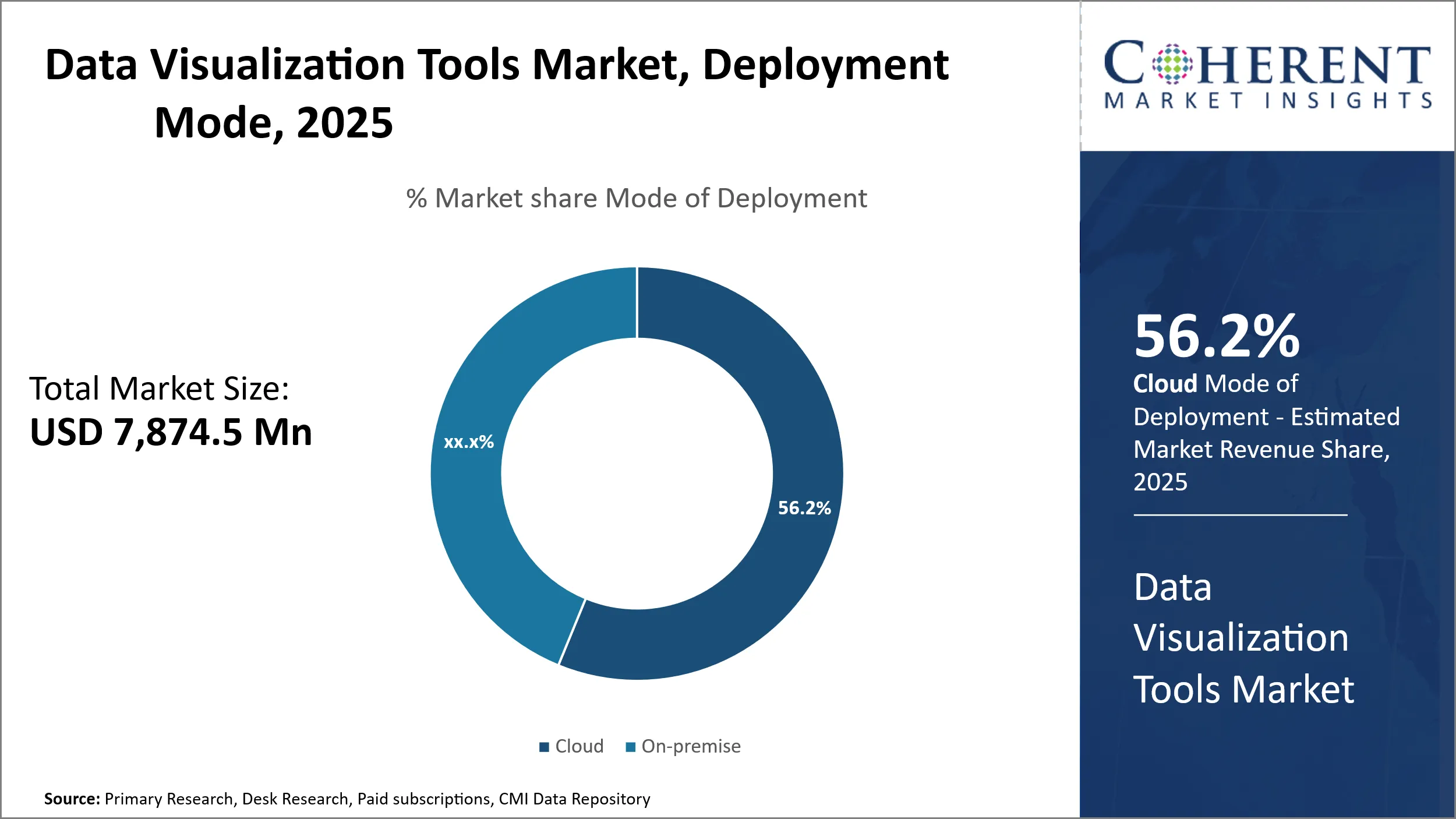
Data Visualization Tools Market Insights, By Deployment Mode: Cloud Segment Dominates Market Share
By deployment mode, the cloud segment is projected to dominate the global data visualization tools market in 2026, capturing 57.2% of total market share. Cloud-based platforms are popular because they are scalable, flexible, and cost-effective. This means that businesses of all sizes can use advanced visualization solutions without having to spend a lot of money on infrastructure. The rise of remote and hybrid work models makes cloud adoption even stronger, as businesses want to be able to access data insights from anywhere in the world.
For instance, July 2026, AWS unveiled Q Business Suite (QBS), a unified AI-enabled workspace that consolidates tools like QuickSight, Q Business, and Q Apps. This cloud-native platform streamlines business intelligence, generative AI capabilities, data queries, and report generation within a single interface demonstrating how enterprises are embracing fully cloud-based visualization and analytics solutions to boost collaboration and access.
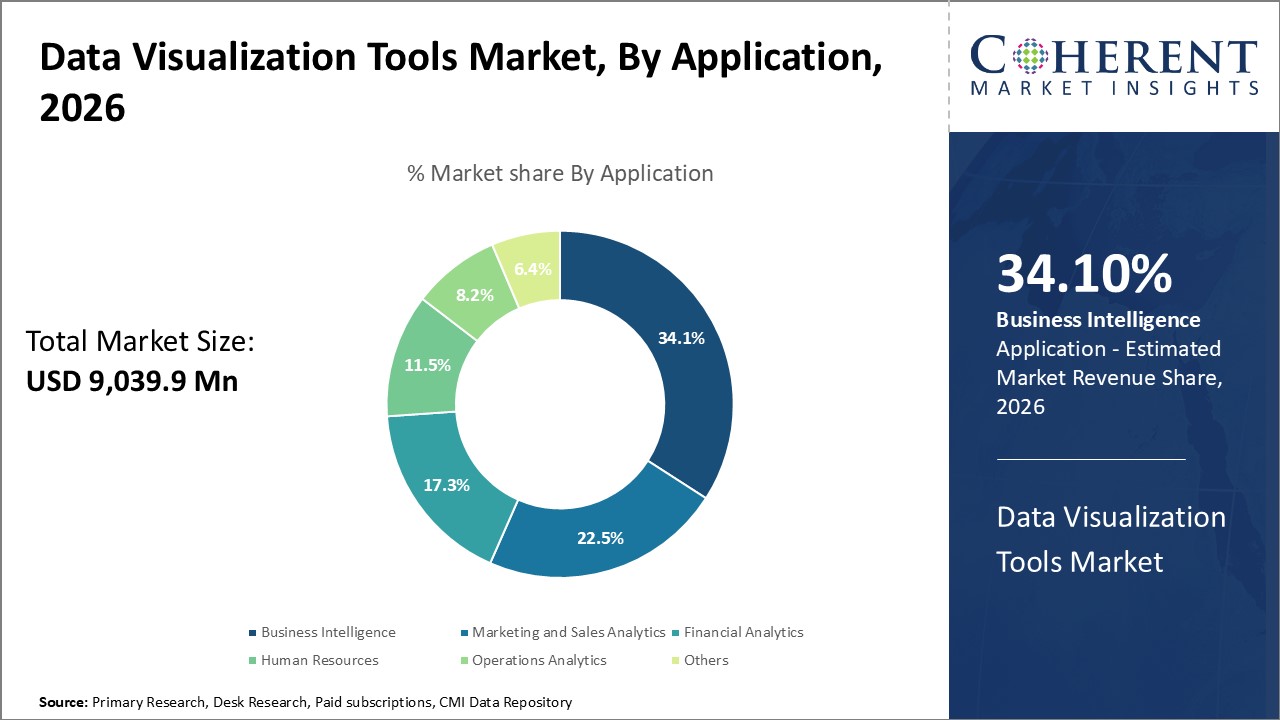
Data Visualization Tools Market Insights, By Application: Business Intelligence Applications Lead Adoption
By application, business intelligence (BI) solutions are projected to dominate the global data visualization tools market in 2026, capturing a significant share of total market revenue. BI applications are favored for their ability to transform complex datasets into actionable insights, enhance decision-making, and improve operational efficiency. The growing focus on data-driven strategies across industries further accelerates adoption of visualization tools for BI purposes.
For instance, in June 2026, Tableau introduced a new AI-driven module within Tableau CRM, enabling users to generate predictive dashboards and automated reports for enhanced decision-making. This demonstrates how BI-focused visualization tools are evolving to deliver real-time, intelligent insights to enterprises.
Data Visualization Tools Market Insights, By Industry Vertical: IT & Telecommunications Segment Dominates Market Share
By industry vertical, IT and telecommunications are expected to hold the largest share of the global data visualization tools market in 2026, driven by massive data volumes, digital transformation initiatives, and demand for real-time analytics. These industries leverage visualization platforms to monitor networks, improve customer experiences, and optimize service delivery.
For instance, in May 2026, Cisco launched a real-time analytics dashboard for its cloud-based network management platform, enabling enterprises to visualize network performance metrics and proactively address issues. This highlights how IT and telecom companies are increasingly using data visualization tools to enhance operational efficiency.
Data Visualization Tools Market Insights, By Component: Software Segment Captures Maximum Share
By component, software solutions dominate the global data visualization tools market, as they provide core functionalities for data integration, dashboard creation, and reporting. Advanced software offerings integrate AI, predictive analytics, and natural language processing, allowing organizations to extract deeper insights and enhance data-driven decision-making.
For example, in July 2026, Microsoft Power BI rolled out a new generative AI feature enabling users to create interactive dashboards from unstructured data using simple language prompts. This demonstrates how software components continue to drive adoption and innovation in the visualization tools market.
Regional Insights
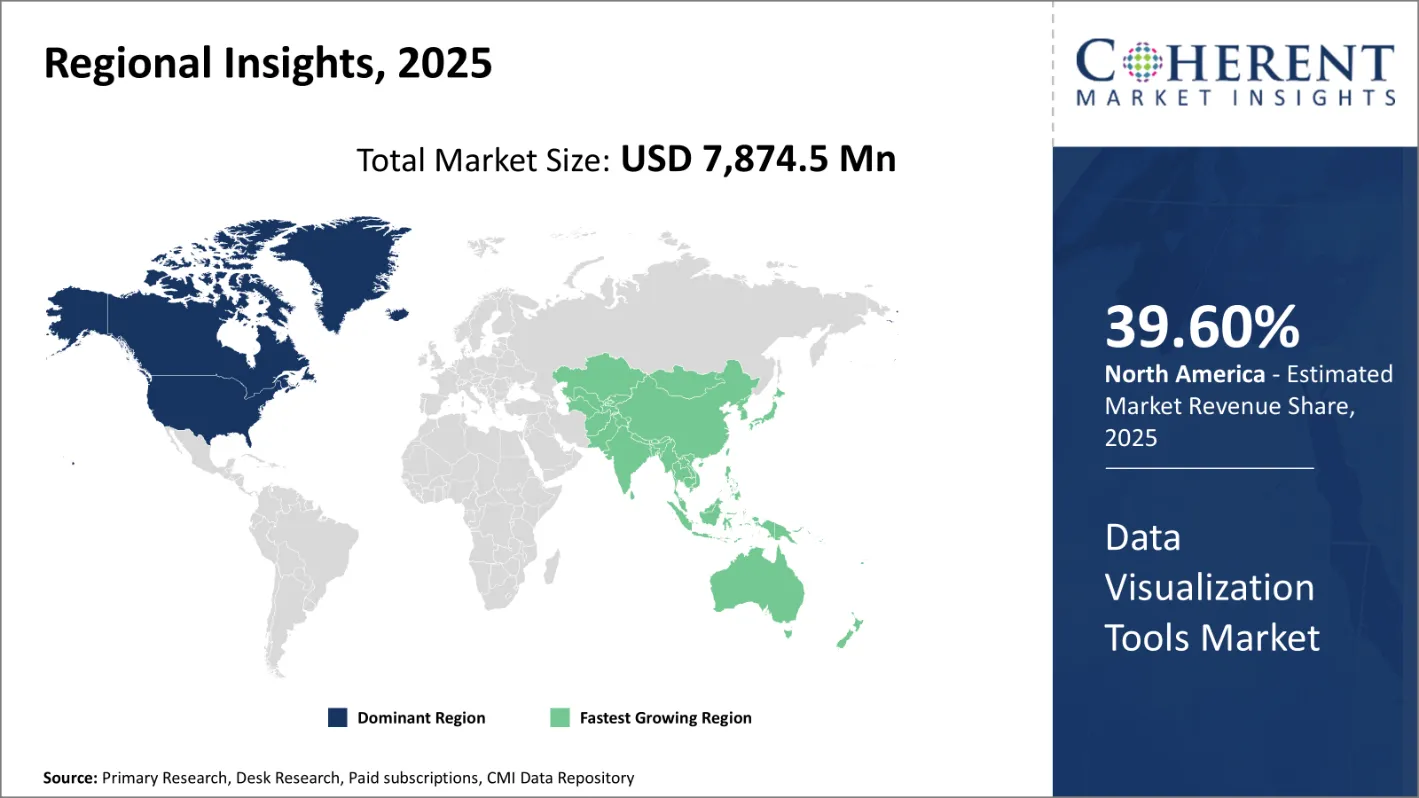
North America Data Visualization Tools Market Trends
North America is estimated to hold a dominant position with a 39.6% market share in 2026, supported by the rapid growth of big data, increasing demand for analytics in the retail industry, and strong adoption of technology-driven business solutions. The region’s enterprises are focusing on collecting and consolidating data from multiple sources into advanced visual formats to enable faster and more accurate decision-making. The U.S. leads the data visualization market revenue, driven by the massive data generated by small and medium-sized enterprises (SMEs) and the need for scalable visualization tools.
For instance, in August 2026, U.S.-based on-demand delivery firm Gopuff partnered with Seek and Koddi to launch Insight Cloud for Gopuff, a data visualization and analytics platform. This tool provides suppliers with an integrated, near real-time view of data, from point-of-sale to retail media, customer behavior, and supply chain performance, delivered via unified dashboards. This exemplifies how North American businesses leverage cloud-based visualization to empower data-driven decision-making.
Asia-Pacific Data Visualization Tools Market Trends
Asia-Pacific is the fastest-growing market, projected to account for a 31.0% share in 2026. Growth is fueled by rapid digital transformation, strong adoption of standalone visualization software, and expanding enterprise investments in analytics. Countries such as India, China, and Japan are at the forefront of adopting visualization platforms to drive operational efficiency and enhance decision-making.
For instance, in April 2026, HCLSoftware, a leading enterprise software firm from India, partnered with Tech Data (TD SYNNEX) to distribute its software products across the Asia-Pacific and Japan region. This includes analytics and data visualization solutions, reflecting rising adoption of enterprise visualization tools among APAC businesses.
Europe Data Visualization Tools Market Trends
Europe is the third-largest market, projected to hold a 22.6% share in 2026. Market growth is supported by strong enterprise digitization strategies, regulatory frameworks on data governance, and widespread adoption of analytics across industries such as banking, retail, and healthcare. Nations such as Germany, the U.K., and France are prominent adopters of visualization tools, leveraging advanced platforms to support data-driven business strategies.
For instance, in March 2026, the European Commission unveiled the European Energy Storage Inventory, a real-time, filterable dashboard tracking energy storage projects across Europe by status, country, and technology. This tool visualizes all planned and operational storage initiatives currently listing 905 projects with a combined 66 GW in operation as an interactive map and dataset, highlighting Europe’s push for transparent, data-driven energy infrastructure monitoring.
Data Visualization Tools Market Country-Wise
United States Data Visualization Tools Market
The U.S. is the primary driver of the North American market, benefiting from high data generation by SMEs and large enterprises. Organizations are increasingly adopting real-time dashboards, predictive analytics, and cloud-based visualization platforms to strengthen business intelligence.
For instance, Amazon QuickSight (part of Amazon Web Services, USA) announced general availability of “Amazon Q” in QuickSight, generative BI capabilities with natural-language queries, automated slide/report generation, etc.
China Data Visualization Tools Market
China is a leading growth market in Asia-Pacific, driven by large-scale digital transformation, e-commerce growth, and government-backed big data initiatives. Enterprises are adopting visualization platforms to handle massive data volumes generated by online platforms and smart city projects.
For instance, in May 2026, Shanghai’s municipal government partnered with global tech firms to implement advanced visualization dashboards for urban traffic and energy management.
India Data Visualization Tools Market Outlook
India is one of the fastest-growing markets in Asia-Pacific, supported by rapid adoption of standalone visualization software among SMEs and startups. The market benefits from rising demand for cost-effective solutions and government-backed digitalization initiatives.
For instance, in August 2026, the Uttar Pradesh Skill Development Mission (UPSDM) introduced an AI-driven dashboard named the UP Skill Gap dashboard to assess district-specific skill requirements across the state. This real-time analytics tool employs machine learning to match local industry demands with training programs, providing actionable insights. It also features a chatbot powered by a large language model to assist users.
Market Report Scope
Data Visualization Tools Market Report Coverage
| Report Coverage | Details | ||
|---|---|---|---|
| Base Year: | 2025 | Market Size in 2026: | USD 9,039.9 Mn |
| Historical Data for: | 2020 To 2024 | Forecast Period: | 2026 To 2033 |
| Forecast Period 2026 to 2033 CAGR: | 14.8% | 2033 Value Projection: | USD 23,755.2 Mn |
| Geographies covered: |
| ||
| Segments covered: |
| ||
| Companies covered: | Salesforce, Inc, Oracle Corporation, IBM, Amazon Web Services, Inc, Alteryx, SAS Institute Inc, Pentaho Corporation, Qlik Technologies Inc, Fivetran, Inc., Sigma Computing, and AVEVA Group | ||
| Growth Drivers: |
| ||
| Restraints & Challenges: |
| ||
Data Visualization Tools Market Drivers
Rising demand for Interactive View of Data in all enterprises
Majority of businesses uses a streamlined method that entails locating, gathering, and disseminating a lot of data. Tools for data visualization are used to speed up decision making process in businesses. In order to discover client preferences and patterns, extract strategic insights, and help maintain a balance between the demand and supply of new and existing items, the data should be made available with a standard visualization capability.
Companies from all industries use data visualization technologies to easily interpret data and gain valuable business insights. Cloud-based data visualization tools provide businesses a scalable and affordable approach to analyses their data. Businesses can use BI (Business Intelligence) to identify business drivers and Key Performance Indicators (KPIs), owing to data visualization capacity.
Data visualization tools help corporations to eliminate unnecessary data to determine insights, patterns, usage strategies, and trends, and this is expected to drive the market growth.
Data Visualization Tools Market Opportunities
Increasing Need to Generate Interactive Dashboards from Unused Data
Large amounts of data are produced by Google or Facebook. Data usage is essential for digital transformation of any firm. There is increase in usage of IoT (Internet of Things), and it is used to produce insights from all incoming data. Organizations use BI (Business Intelligence) in the modern corporate environment to make quicker and more important decisions. Social media businesses assemble a huge amount of data online. It is challenging to determine if an information source is reliable or not. The majority of the unstructured data gathered from different sources is not utilized.
Older versions of connected documents and unstructured data like email correspondences and account information are not utilized to generate value to aid in business decision-making. For best usage, businesses make significant investments in data acquisition. Utilizing underutilized data can provide businesses important insights. Tools for data visualization provide ways to make usage of any wasted data. Global data visualization tools market is driven by growing requirement for extracting insights from underused data.
Analyst Opinion (Expert Opinion)
The data visualization tools market is undergoing a structural transformation driven by the convergence of generative AI, real-time analytics, and decision automation. Traditional dashboards that merely “depict” data are rapidly being replaced by self-evolving, AI-interpreted visualization systems capable of contextual recommendations and predictive insight delivery. In 2025, over 61% of U.S. enterprises reported using AI-assisted visualization for strategic planning, according to IDC’s Analytics Trends Pulse, signaling a decisive shift from descriptive to prescriptive analytics.
Defining catalyst in this evolution is the fusion of large language models (LLMs) with visualization interfaces, allowing business users to query data in natural language and receive narrative-backed charts. Tools like Tableau Next’s “Concierge” agent and Amazon QuickSight Q exemplify this paradigm: they interpret ambiguous human questions, identify relevant metrics, and instantly generate visual insights. This capability is transforming BI platforms from passive data canvases into cognitive collaborators, drastically reducing “time to insight.”
Moreover, the democratization of analytics is no longer a theoretical goal, it is a competitive necessity. In the U.S., nearly 45% of Fortune 500 companies have deployed embedded analytics within their internal applications, enabling non-technical staff to build visualizations directly from operational systems. This shift decentralizes decision-making and embeds analytics within workflows, creating a culture of continuous, data-driven action rather than post-event analysis.
Ultimately, commercial success in this market now depends on delivering intelligence, not imagery. The winners will be those who transform visualization from a reporting function into a decision engine, bridging the gap between data literacy and strategic foresight.
Speak to the analyst
Want personalized insights?
Take the findings above to one of our principal consultants, or have the report rebuilt around the segments, geographies and competitors you actually track.
Key Developments
- In May 2025, Salesforce entered into a definitive agreement to acquire Informatica, a leading AI-powered cloud database management firm, for approximately $8 billion. Informatica shareholders will receive USD 25 per share, representing an approximate 11% premium over the prior closing price.
- In April 2025, at the Canva Create event, Canva launched Visual Suite 2.0, enhancing collaboration for professionals using Generative AI to create data reports and code-based projects globally.
- In October 2025, Oracle launched Oracle AI Database 26ai, integrating AI into its data management platform.
- On May 14 2025, Alteryx announced Alteryx One, a unified analytics & AI-powered platform, under its new vision for enterprise analytics.
Market Segmentation
- Component Insights (Revenue, USD Mn & KT, 2026 - 2033)
- Software
- Services
- Deployment Insights (Revenue, USD Mn & KT, 2026 - 2033)
- On-Premises
- Cloud-based
- Application Insights (Revenue, USD Mn & KT, 2026 - 2033)
- Business Intelligence
- Marketing and Sales Analytics
- Financial Analytics
- Human Resources
- Operation Analytics
- Others
- Industry Vertical Insights (Revenue, USD Mn & KT, 2026 - 2033)
- Banking, Financial Services, and Insurance (BFSI)
- IT and Telecom
- Healthcare
- Retail and E-commerce
- Manufacturing
- Government and Public sector
- Energy and Utilities
- Media and Entertainment
- Others
- Regional Insights (Revenue, USD Mn & KT, 2026 - 2033)
- North America
- U.S.
- Canada
- Europe
- U.K.
- Germany
- Italy
- France
- Spain
- Russia
- Rest of Europe
- Asia Pacific
- China
- India
- Japan
- South Korea
- ASEAN
- Australia
- Rest of Asia Pacific
- Middle East & Africa
- GCC Countries
- South Africa
- Rest of Middle East and Africa
- Latin America
- Brazil
- Argentina
- Mexico
- Rest of Latin America
- Key Players Insights (Revenue, USD Mn, 2021 - 2033)
- Salesforce, Inc
- Oracle Corporation
- IBM
- Amazon Web Services, Inc
- Alteryx
- SAS Institute Inc
- Pentaho Corporation
- Qlik Technologies Inc
- Fivetran, Inc.
- Sigma Computing
- AVEVA Group
Sources
Primary Research Interviews from the following stakeholders
Stakeholders
- Interviews with data visualization software vendors, BI solution providers, IT decision-makers, chief data officers, analytics professionals, and end-user organizations across enterprise and SME markets.
Specific stakeholders
- Analytics heads and BI leads at large enterprises (e.g., Salesforce, IBM, Amazon, Oracle)
- IT directors and data management officers at financial services, healthcare, and retail firms (e.g., JPMorgan Chase, Pfizer, Walmart)
- Data engineers, visualization developers, and process managers at analytics solution providers (e.g., Alteryx, Qlik, SAS, Fivetran)
- Business users and operations managers leveraging dashboards and reporting tools in decision-making processes
- AI and ML specialists involved in predictive analytics and automated visualization platforms
- Procurement and innovation officers evaluating visualization platforms for strategic deployments
- End-user teams in marketing, sales, supply chain, and operations utilizing interactive dashboards and insights
Databases
- World Bank Open Data
- U.S. Bureau of Labor Statistics
- GitHub repositories (for open-source data visualization tools usage)
Magazines
- InformationWeek
- CIO Magazine
- Analytics Magazine
- Data Management Review
- Others covering BI, analytics, and data visualization trends
Journals
- Journal of Business Intelligence Research
- International Journal of Data Science and Analytics
- IEEE Computer Graphics and Applications
- Others focused on data science, AI in analytics, and visualization techniques
Newspapers
- The Wall Street Journal – Technology Section
- Financial Times – Digital Business
- TechCrunch
- VentureBeat
- Others reporting on BI and enterprise analytics
Associations
- International Association for Statistical Computing (IASC)
- Data Management Association International (DAMA)
- Business Intelligence and Analytics Professionals Association
- International Institute of Business Analysis (IIBA)
- Others supporting analytics and BI professionals
Public Domain Sources:
- U.S. Bureau of Labor Statistics – Technology Reports
- European Commission – Digital Economy Reports
- OECD – Digital Government Studies
- World Bank – Digital Development Reports
- Others providing public analytics and technology datasets
Proprietary Elements
- CMI Data Analytics Tool
- Proprietary CMI existing repository of information collected over the last 8 years
*Definition: Data Visualization Tools is a robotic device that performs security tasks such as reporting, monitoring, investigating, and detecting intruders. It is used to increase the degree of safety and security in commercial establishments like malls, schools or campuses, or multi-building medical complexes.
Get access to 250+ pages report
Every segment, forecast, competitor profile and data table behind the analysis above — available for instant download.
- ESOMAR Member
- ISO 9001:2015 Certified
- D-U-N-S Registered
- GDPR & CCPA Compliant
Missing comfort of reading report in your local language? Find your preferred language:
Transform your Strategy with Exclusive Trending Reports
Frequently Asked Questions
Data visualization tools market is estimated to be valued at USD 9,039.9 Mn in 2026 and is expected to reach USD 23,755.2 Mn in 2033, exhibiting a compound annual growth rate (CAGR) of 14.8 % from 2026 to 2033.
The CAGR of the data visualization tools market is projected to be 14.8% from 2026 to 2033.
Rising need for interactive view of data, and technological advancement in data visualization tools are expected to drive the market growth.
IT and telecommunications segment is the leading end user segment in the market.
Lack of skilled professionals and variation in data formats is the major factors restraining growth of the market.
Salesforce, Inc, Oracle Corporation, IBM, Amazon Web Services, Inc, Alteryx, SAS Institute Inc, Pentaho Corporation, Qlik Technologies Inc, Fivetran, Inc., Sigma Computing, and AVEVA Group