

Virtual Sports Betting Market Size and Share Analysis
The Virtual Sports Betting Market is estimated to be valued at USD 17.60 Bn in 2026 and is expected to reach USD 56.69 Bn by 2033, exhibiting a compound annual growth rate (CAGR) of 18.2% from 2026 to 2033.
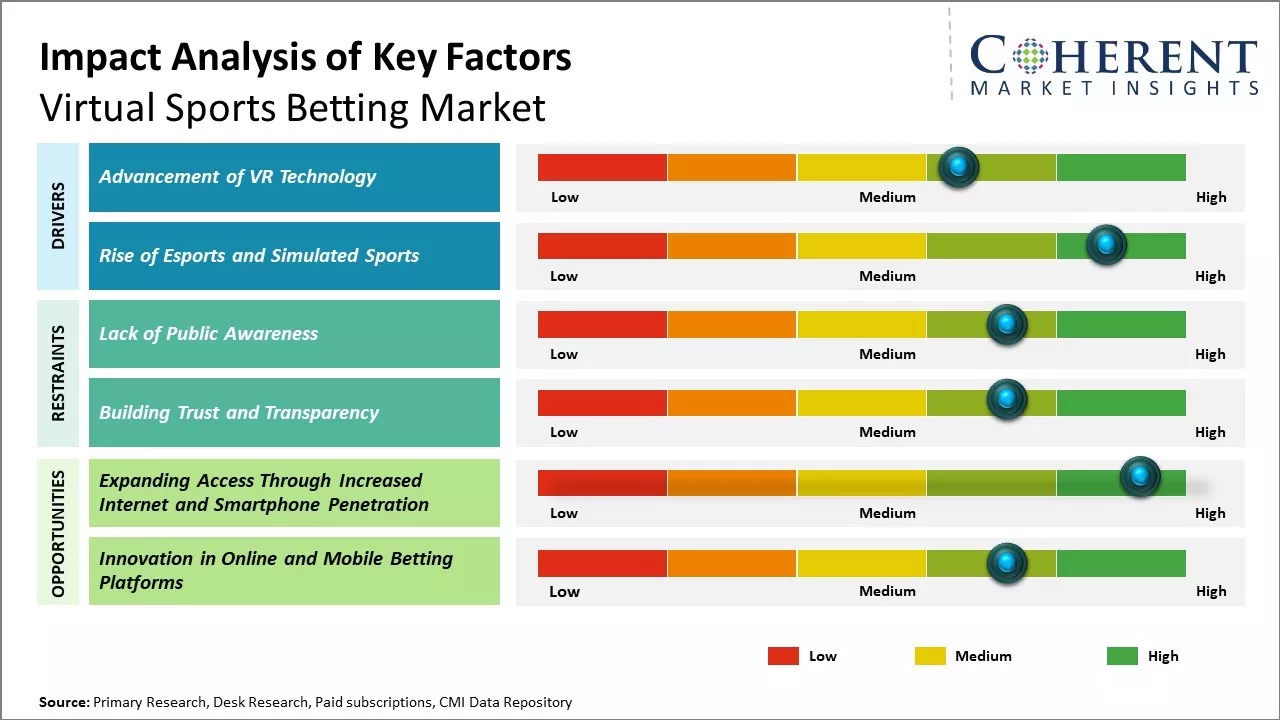
Key Takeaways
- By Simulation Type, RNG Based segment contributes the highest share of 78.6% in 2026.
- Based on End Users, Individual Players contributes the highest share of 84.67% in 2026.
- North America is the dominant region in the virtual sports betting market and is estimated to account for 28.7% market share in 2026.
Market Overview
The global virtual sports betting market demand is recording robust growth, fueled by developments in digital technology, high smartphone penetration rates, and an increasing requirement for on-demand, entertainment-driven betting opportunities. Virtual sports betting, offering computer-simulated versions of real-world sporting action, has been well-received by operators and consumers alike due to its 24/7 availability, speedy results, and high interaction potential. The market covers a wide variety of sports simulations including virtual football, horse racing, basketball, tennis, and greyhound racing and is distributed through retail terminals and online/mobile channels.
Current Events and its Impact on Virtual Sports Betting Market
Current Events | Description and its impact |
Integration of AI-Driven Personalization within Virtual Sports Platforms
|
|
Virtual Sports Offering Expansion in U.S. Regulated Markets
|
|
Technological Innovation in Virtual Sports Betting Market
Technology is a key driver of expansion and development in the virtual sports betting market, revolutionizing user experience and back-end processes. Central to virtual sports is the application of computer-simulated sports with random number generator (RNG) technology driving fairness and unpredictability in the outcomes of matches. Sophisticated 3D graphics rendering engines and motion capture technologies mimic real-life sports with high visual fidelity, boosting player engagement.
Artificial Intelligence (AI) and machine learning (ML) are also more commonly applied to mimic player behaviour, create lifelike results, and personalize the betting experience. Cloud computing enables the scalability and availability of virtual betting sites, enabling operators to roll out new games worldwide at low infrastructure cost. Mobile solutions and progressive web apps (PWAs) enabled virtual betting on-the-go, leading to increased user interaction and retention, particularly among young adults.
Blockchain and cryptocurrency are new trends, delivering increased transparency, security, and speed of transactions. Smart contracts can potentially automate the settlement of bets and rewards distribution.
Virtual Reality (VR) and Augmented Reality (AR) also are starting to have an impact on the market, providing immersive environments within which users can make bets in near-real sporting conditions, enriching the game experience. Together, these technologies not only enhance fairness and realism but also facilitate innovation in betting experiences, user personalization, and market reach technology is fast becoming a keystone of the virtual sports betting environment.
- Current Industry Events of 2026
- Market Size Estimation
- Regional Breakdown
- Competitive Landscape
- Customer Intelligence
- Segmental Analysis
- Pricing Analysis
- Key Market Drivers, Challenges & Future Trends
- Customized Insights Section
Market Dynamics
- Development of VR Technology
The accelerating development of virtual reality (VR) technology has had a profoundly positive impact on the online sports betting sector over the past few years. With advancements in consumer-level VR headsets provided by leading technology companies such as Oculus, HTC Vive, and PlayStation VR, the cost and quality of VR experiences have dramatically enhanced. This presents opportunities for sportsbook operators to deliver VR-based services to their clients.
Future VR headsets are getting close to photorealism and have the ability to provide extremely immersive experiences. Sportsbooks recognize potential to send customers directly into the stadium using VR and boost their involvement with live and virtual sporting events. Initial implementations are already being experimented with such as virtual game attendance and 360-degree replays.
As VR itself continues to develop with 5G networking and further increasing presence, interactivity, and realism, the potential for breaking up traditional online sports betting is attractive. Complete VR simulation of sporting venues, athletes, and live action can engage fans in fresh exciting ways beyond either online or TV-only experience. Sportsbooks might offer private, front-row tickets to top games and bespoke VR experiences accommodating varied betting interests.
In-play betting can also be incorporated more harmoniously within the immersive VR consumption of sports. Although technical difficulties exist, advances in VR technology are making possible visions that enthuse sportsbooks regarding innovative means of accessing and engaging young, digitally native users that fuel high demand within the virtual sportsbook betting markets.
- Rise of Esports and Simulated Sports
Growing to a billion-dollar industry now, esports grew exponentially in popularity among younger audiences around the world. When more conventional sporting events were canceled amidst the pandemic, esports proved successful in hosting many competitions online with massive audiences. Their digital, virtual-first design made them perfectly placed to keep entertaining their fans within a socially distanced world. This increased mainstream visibility and further fueled the ascent of esports.
At the same time, technology in simulation sports has advanced to the point that very realistic simulations of various games are available. Combined, esports' and simulated sports' intersecting growth paths mean a huge catalyst for virtual sports betting. In 2024, DraftKings, one of the U.S.'s largest sports betting operators, dramatically broadened its virtual and esports betting content to capitalize on expanding interest among Gen Z and Millennial consumers.
Virtual Sports Betting Market Opportunity
Expanding Access Through Increased Internet and Smartphone Penetration
The surge in internet and smartphone usage worldwide is fostering a fertile ground for growth and innovation within the virtual sports betting market demand. With greater global penetration of internet and smartphone access, a larger demographic now enjoys the convenience of placing virtual bets through online and mobile platforms.
Moreover, virtual betting enables operators to introduce sports experiences that might otherwise lack real leagues or matches, broadening the scope of offerings and opportunities within the industry.
Market Concentration and Competitive Landscape

Segmental Insights
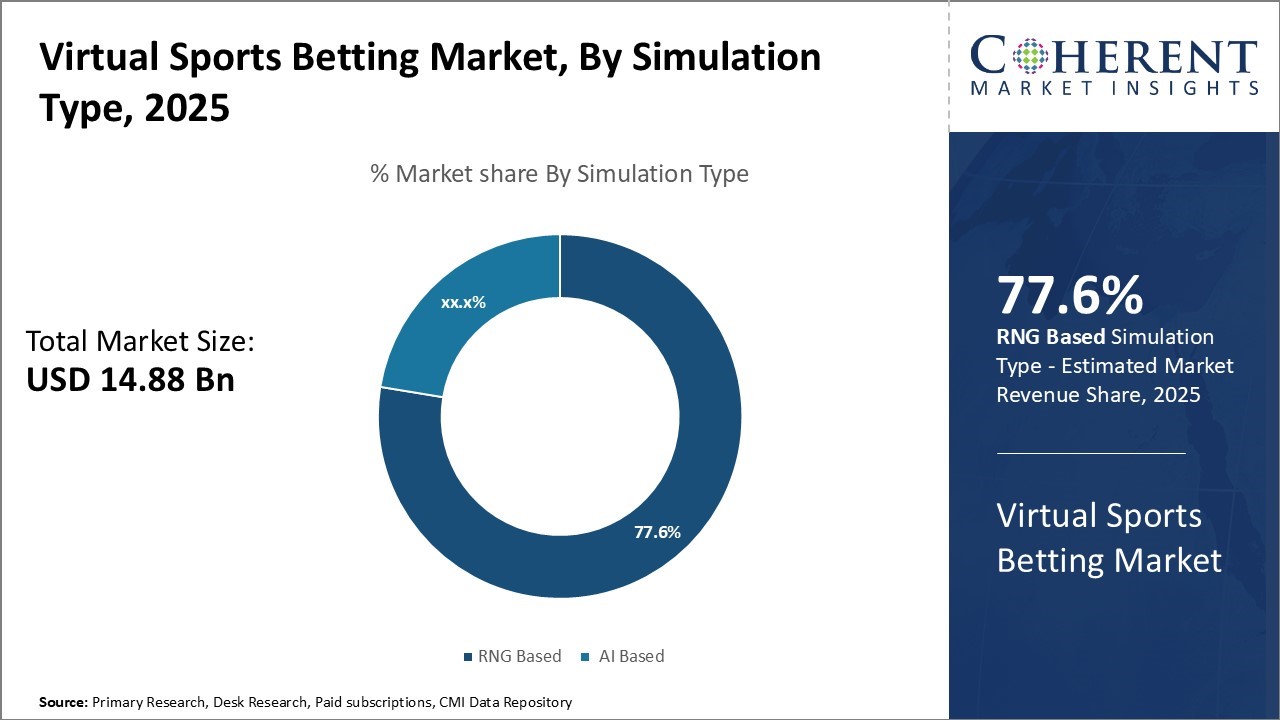
Global Virtual Sports Betting Market Insights, by Simulation Type
The RNG based virtual sports betting segment holds the 78.6% share of the overall market due to its straightforward gameplay model and broad appeal to casual and seasoned bettors alike. RNG, or random number generator, simulations employ algorithms to randomly generate outcomes in place of live sporting events, allowing for betting action around the clock. The randomness inherent in RNG games means no special gaming skills are required - anyone can participate on a level playing field just by choosing winners.
This simplicity has made RNG virtuals very popular as an alternative for when traditional live sports are not in season or available. Their accessibility means more betting opportunities for both operators and individual players. RNG games are also straightforward for betting companies to develop and manage compared to more specialized AI simulations. This ease of production has led to a wide variety of RNG-powered games covering all major betting sports being offered across many online and mobile betting platforms.
The randomness yet strategic betting aspects of RNG virtual provide balanced excitement for casual fans pursuing entertainment just as avid sports bettors pursuing profit. Their constant availability addresses the demand for continuous betting engagement. As such, RNG simulations have attracted the broadest consumer base and emerged as the largest segment driven by both active betting volumes and total player reach.
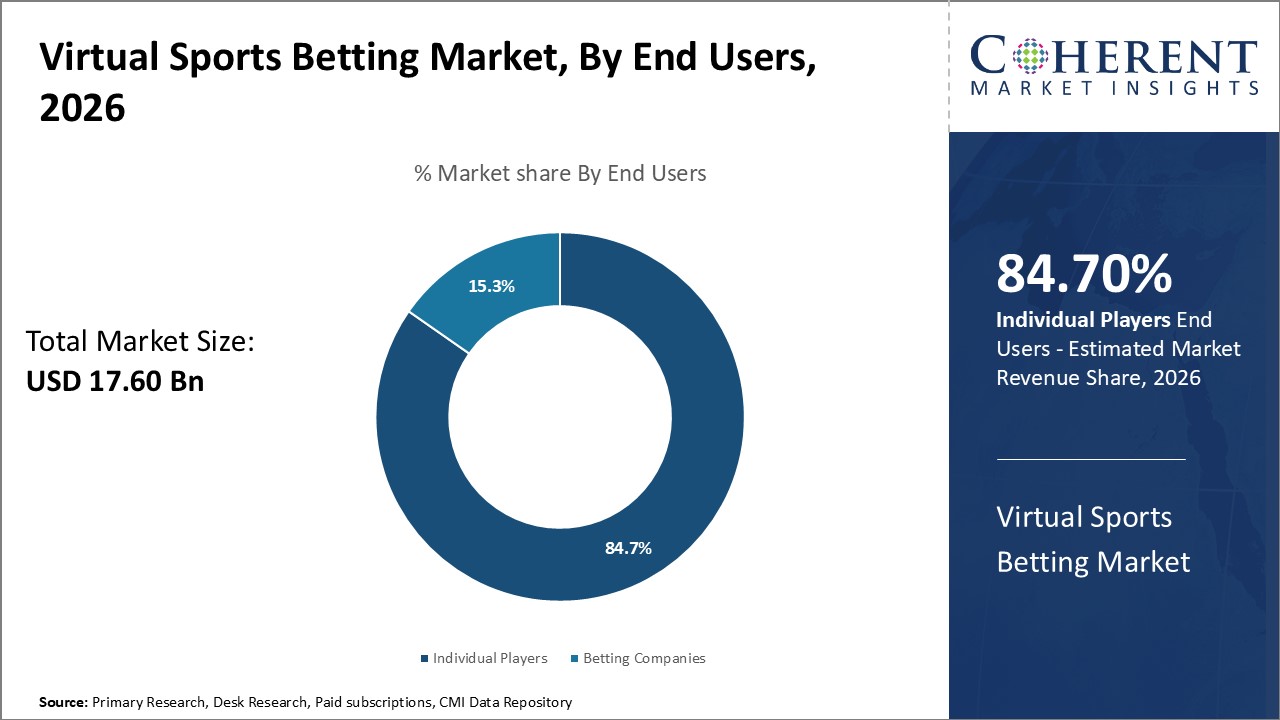
Global Virtual Sports Betting Market Insights, by End Users
The individual players segment generates the greatest revenue in the virtual sports betting space owing to rising interest and involvement in digital wagering. Virtual betting appeals directly to recreational players who enjoy placing wagers for fun but do not rely on profits. This group values the convenience of accessing games through any wireless connected device at their leisure.
Online and mobile platforms have made virtual betting accessible wherever and whenever players desire. Their constant connectivity has supported an ‘on-the-go’ lifestyle and fueled always-on engagement with gaming apps. For recreational bettors without professional obligations, virtual provide light entertainment that fits easily around work and personal responsibilities. Their low stakes also accommodate casual betting without large monetary risks.
Rising digital literacy among younger demographics combined with widespread device adoption has culturally normalized online betting participation. Virtual games cater to this digital-first attitude by fulfilling the mobile gaming and gambling demands of Gen Z and millennial audiences. As such, individual recreational players now make up the dominant force in virtual sports markets by driving higher frequencies and durations of virtual betting interaction on a personal level.
Regional Insights
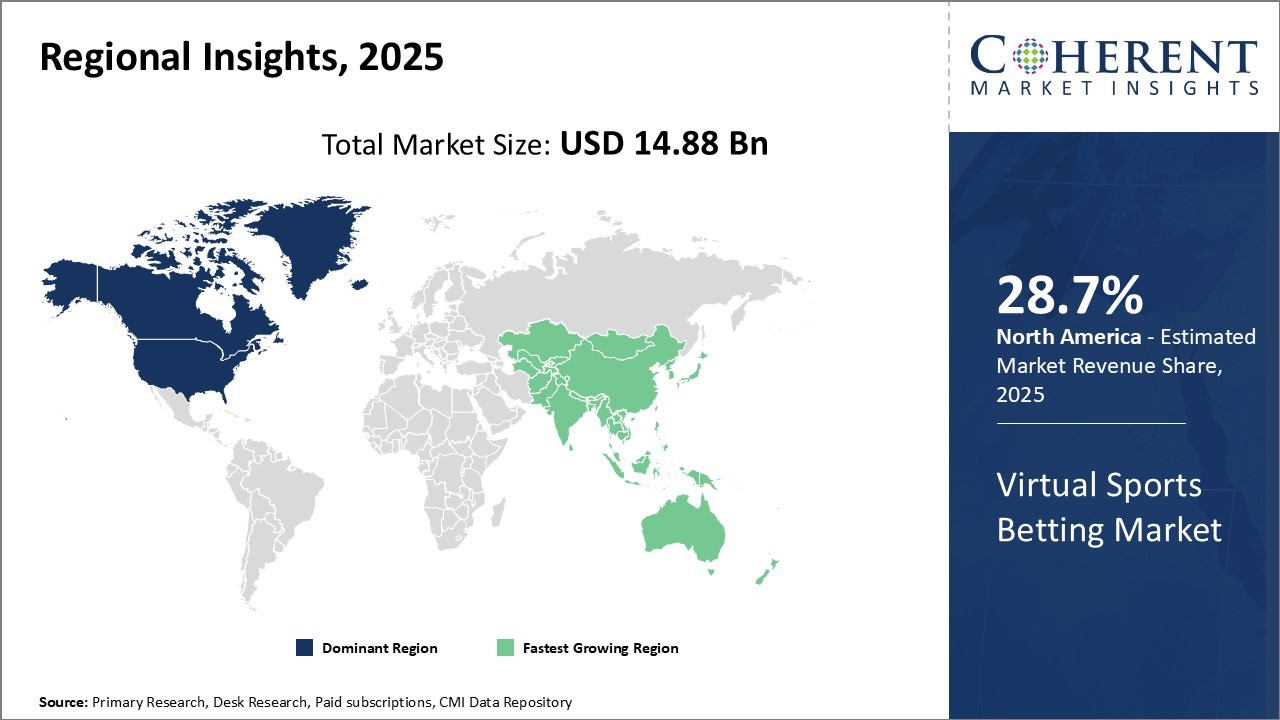
North America Virtual Sports Betting Market Trends and Analysis
North America is the dominant region in the virtual sports betting market and is estimated to account for 28.7% market share in 2026. The large size of the overall sports betting market in countries like the U.S. has provided a solid foundation for virtual betting to thrive. Many of the biggest betting operators have established their headquarters in the region which allows them to better understand customer preferences and tailor their virtual betting offerings accordingly.
Furthermore, the industry presence is quite extensive with several software developers focused on creating realistic virtual betting environments. A wide variety of sports are offered on betting platforms that capture the interest of massive fan bases in North America.
Asia Pacific Virtual Sports Betting Market Trends and Analysis
Asia Pacific region has emerged as the fastest growing market for virtual sports betting with CAGR of 22.13% in 2026. Several factors have contributed to the exponential rise seen in the APAC region over the past few years. Countries like India, China and others have a very young demographic willing to adopt new forms of online entertainment. Virtual betting provides an interactive experience to these new users in a responsible manner.
Local operators are also partnering with global betting platforms to leverage their technological know-how and expand offerings. Rising internet penetration across Asia combined with growing expenditure power of new online users will likely ensure the momentum continues in the foreseeable future.
While North America established early dominance, Asia Pacific is making aggressive strides to become a top market very quickly. Both regions show the opportunities virtual betting presents when tailored to local market characteristics and trends. Understanding differences will be key for operators to target each region's unique growth drivers and expand their customer base internationally.
Virtual Sports Betting Market Dominating Countries
United Kingdom Virtual Sports Betting Market Analysis and Trend
The UK continues to be among the most mature and prominent virtual sports betting markets. With a robust regulatory environment under the UK Gambling Commission, operators such as Bet365, Ladbrokes, and William Hill provide expansive virtual sports offerings. Strong digital penetration and exposure to betting culture have driven steady demand for virtual football, horse racing, and greyhound racing, particularly off-peak and in live sports lulls.
Italy Virtual Sports Betting Market Analysis and Trend
Italy is a top European virtual sports betting hub, where it generates a large percentage of overall sports betting turnover. ADM (Agenzia delle Dogane e dei Monopoli) regulates virtual games of calcio (football), car racing, and horse racing that are part of both online and retail betting frameworks. Quick-paced betting appeals to Italian consumers, so virtual sports are a staple everyday product.
United States Virtual Sports Betting Market Analysis and Trend
With the growth of legal sports betting in several states following the repeal of PASPA, the U.S. is now a high-value market for virtual sports. New Jersey, Michigan, and Pennsylvania are among the states that now support virtual products from operators like DraftKings, FanDuel, and BetMGM. The U.S. market is also in an expansion stage with mobile platforms and demand for alternative, readily available betting forms
Market Report Scope
Virtual Sports Betting Market Report Coverage
| Report Coverage | Details | ||
|---|---|---|---|
| Base Year: | 2025 | Market Size in 2026: | USD 17.60 Bn |
| Historical Data for: | 2020 To 2024 | Forecast Period: | 2026 To 2033 |
| Forecast Period 2026 to 2033 CAGR: | 18.2% | 2033 Value Projection: | USD 56.69 Bn |
| Geographies covered: |
| ||
| Segments covered: |
| ||
| Companies covered: | Betradar, BetConstruct, Inspired Entertainment, Inc., Kiron Interactive, Golden Race, NSoft Corporation, Betgenius, Vermantia, Global Bet Virtual, 1X2 Network, Playtech plc, BtoBet, Digitain, Sportradar AG, FSB Technology, Bragg Gaming Group, EveryMatrix Ltd., Metric Gaming LLC, Virtual Gaming Worlds, Microgame S.p.A., and Pari Match | ||
| Growth Drivers: |
| ||
| Restraints & Challenges: |
| ||
Virtual Sports Betting Industry News
- In May 2024, InplayBet a sports betting app, unveiled the addition of virtual sports betting to its platform, underlining its commitment to expanding its offerings and enriching player engagement. The move signifies a stride forward in the evolution of online betting and is made possible through a collaboration with Kiron Interactive.
- On May 10, 2024, Inspired Entertainment, Inc., a provider of gaming content and solutions, introduced its NBA Re-Play Virtual Sports product exclusively in Greece through a partnership with OPAP, a leading gaming company in Greece with global recognition for its diverse gaming portfolio.
Key Takeaways from Analyst
- The global virtual sports betting industry is driven by increasing technological convergence and consumer behaviour towards digital engagement. The main drivers are the rising ubiquity of mobile-first sites, which provide effortless entry to live odds betting experiences, and innovation in immersive technologies such as VR that improve interactivity. The cultural acceptance of internet-based gambling and organized partnerships between sports leagues and betting operators’ further fuels market growth by diversifying event offerings and differentiating demographics.
- Regions like North America are becoming hotbeds of innovation, fuelled by tech-forward populations and changing regulatory environments that focus on secure, open platforms. In the meantime, Asia-Pacific offers untapped prospects due to increasing internet penetration, although regulatory issues in major markets call for careful navigation.
- Operators that make investments in responsible cloud gaming solutions like self-exclusion features and AI-driven behaviour tracking are in a strong position to establish trust and meet changing standards. The direction of the market will depend on balancing innovation with ethical behaviour, as stakeholders work together to navigate regulatory complexity and tap into untapped demand in mature and emerging markets.
Market Segmentation
- By Simulation Type (Revenue, USD Bn, 2021 - 2033)
- RNG Based
- AI Based
- By End Users (Revenue, USD Bn, 2021 - 2033)
- Individual Players
- Betting Companies
- By Regional (Revenue, USD Bn, 2021 - 2033)
- North America
- U.S.
- Canada
- Latin America
- Brazil
- Argentina
- Mexico
- Rest of Latin America
- Europe
- Germany
- U.K.
- Spain
- France
- Italy
- Russia
- Rest of Europe
- Asia Pacific
- China
- India
- Japan
- Australia
- South Korea
- ASEAN
- Rest of Asia Pacific
- Middle East
- GCC Countries
- Israel
- Rest of Middle East
- Africa
- South Africa
- North Africa
- Central Africa
- Key Players Insights
- Betradar
- BetConstruct
- Inspired Entertainment, Inc.
- Kiron Interactive
- Golden Race
- NSoft Corporation
- Betgenius
- Vermantia
- Global Bet Virtual
- 1X2 Network
- Playtech plc
- BtoBet
- Digitain
- Sportradar AG
- FSB Technology
- Bragg Gaming Group
- EveryMatrix Ltd.
- Metric Gaming LLC
- Virtual Gaming Worlds
- Microgame S.p.A.
- Pari Match
Sources
Primary Research Interviews
- Virtual Sports Software Developers
- Others
Magazines
- Gambling Insider
- Sports Betting Magazine
- iGaming Business
- Others
Journals
- Journal of Gambling Studies
- International Journal of Virtual Communities and Organizations
- Journal of Behavioral Addictions
- Others
Newspapers
- The Financial Times (Gambling Industry Coverage)
- The Wall Street Journal (Technology & Betting Trends)
- The Japan Times (Asia Pacific Market Insights)
- Others
Associations
- International Gaming Association (IGA)
- European Gaming and Betting Association (EGBA)
- Asia Pacific Lottery Association (APLA)
- Others
Public Domain Sources
- U.S. Federal Communications Commission (FCC) Reports
- U.K. Gambling Commission Publications
- EU Open Data Portal (Gambling Regulations)
- Others
Proprietary Elements
- CMI Data Analytics Tool
- Proprietary CMI Existing Repository of Information for Last 8 Years
*Definition: Virtual Sports Betting Market involves betting on the outcomes of virtual or computer simulated sporting events, without any actual games being played. Bettors can wager money on the results of simulated games of sports like football, soccer, horse racing, motor racing and others. Licensed operators use random number generators to determine things like scores, races and fights in virtual environments replicating real world sporting conditions.
Get access to 250+ pages report
Every segment, forecast, competitor profile and data table behind the analysis above — available for instant download.
- ESOMAR Member
- ISO 9001:2015 Certified
- D-U-N-S Registered
- GDPR & CCPA Compliant
Missing comfort of reading report in your local language? Find your preferred language:
Transform your Strategy with Exclusive Trending Reports
Frequently Asked Questions
The Virtual Sports Betting Market size is estimated to be valued at USD 17.60 Bn in 2026, and is expected to reach USD 56.69 Bn by 2033.
The CAGR of the global Market is projected to be 18.2% from 2026 to 2033.
Advancement of VR technology and rise of esports and simulated sports are the major factor driving the growth of global market.
Lack of public awareness and building trust and transparency are the major factors hampering the growth of global market.
In terms of Simulation Type, RNG Based is estimated to dominate the market revenue share 2026.
Betradar, BetConstruct, Inspired Entertainment, Inc., Kiron Interactive, Golden Race, NSoft Corporation, Betgenius, Vermantia, Global Bet Virtual, 1X2 Network, Playtech plc, BtoBet, Digitain, Sportradar AG, FSB Technology, Bragg Gaming Group, EveryMatrix Ltd., Metric Gaming LLC, Virtual Gaming Worlds, Microgame S.p.A., and Pari Match are the major players.
North America is expected to lead the global Market.