

Cloud Gaming Market Size and Trends Forecast: 2026 - 2033
Cloud gaming market is estimated to be valued at USD 14.00 Bn in 2026 and is expected to reach USD 241.42 Bn by 2033, exhibiting a compound annual growth rate (CAGR) of 50.2% from 2026 to 2033.
Key Takeaways of the Cloud Gaming Market
- Based on type, the video streaming segment is projected to dominate holding a share of 59.8% in 2026.
- In terms of device, the smartphones segment is estimated to contribute the highest market share of 38.7% in 2026.
- In terms of gamer type, the casual gamers segment is estimated to contribute the highest market share of 78.8% in 2026.
- North America is expected to dominate the cloud gaming market with 47.8% market share in 2026.
Market Overview
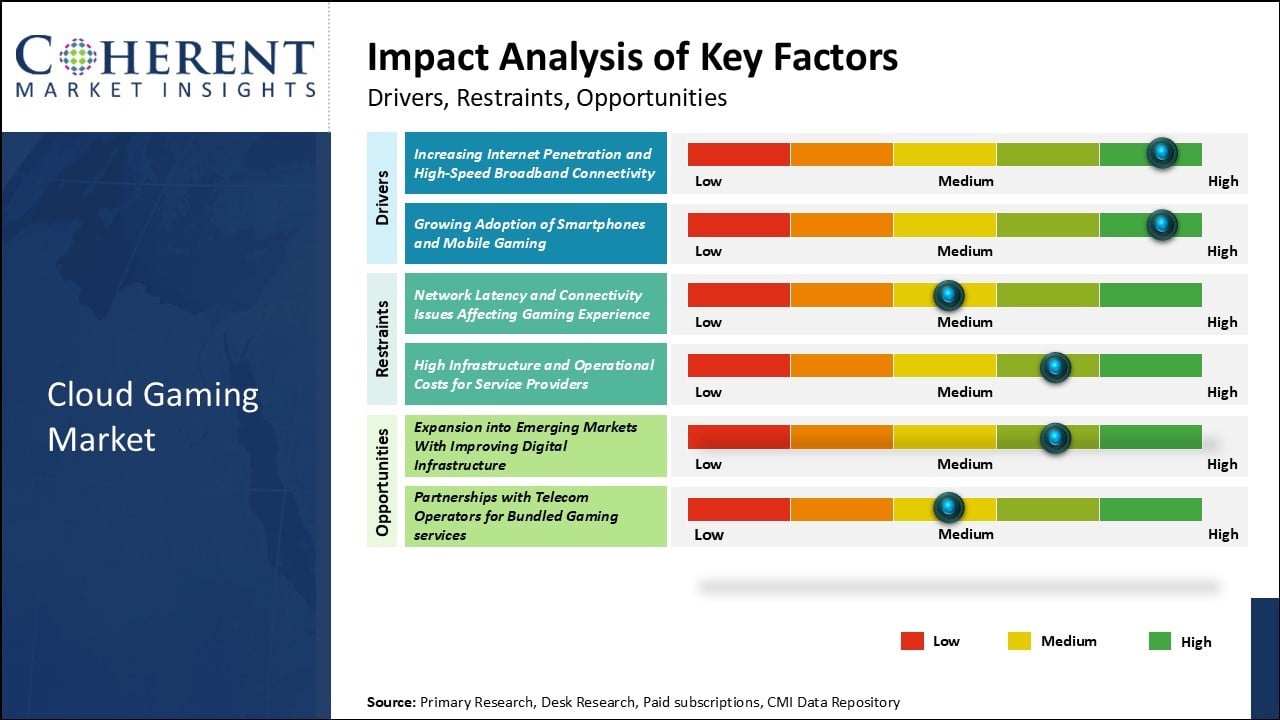
The high-speed internet and increasing adoption of game streaming services can drive the market growth. Major players are focused on improving their infrastructure and expanding into new regions to capitalize on the opportunity. Upgrade of 5G network globally is projected to enhance the overall experience for end users.
However, lack of awareness about cloud gaming in some parts of the world and concerns around data security and privacy can hamper the market growth. The development of affordable cloud gaming devices and lowering internet prices can offer new opportunities in the near future.
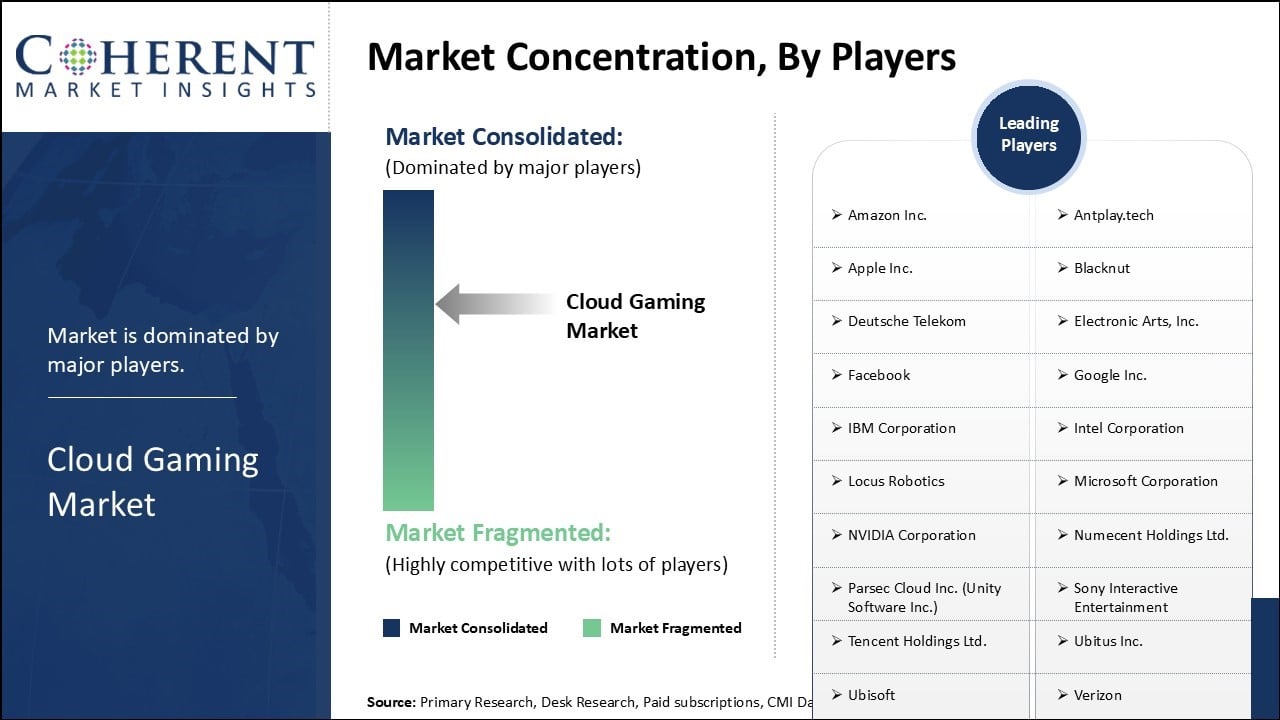
Market Concentration and Competitive Landscape
Current Events and Their Impact on the Cloud Gaming Market
Current Events | Description and its impact |
5G Network Infrastructure Expansion and Deployment |
|
U.S.-China Technology Trade Tensions and Export Controls |
|
- Current Industry Events of 2026
- Market Size Estimation
- Regional Breakdown
- Competitive Landscape
- Customer Intelligence
- Segmental Analysis
- Pricing Analysis
- Key Market Drivers, Challenges & Future Trends
- Customized Insights Section
Market Trends
Growing Demand for High-Quality Gaming Experiences Without Expensive Hardware
The increasing consumer appetite for premium gaming experiences, coupled with the prohibitive costs of high-end gaming hardware, has fundamentally transformed the gaming landscape and positioned cloud gaming and mobile gaming as compelling alternatives. In emerging markets like Latin America, for example, mobile gaming is surging — driven by the affordability and accessibility of smartphones.
For instance, according to the Games Forum, in 2024, LATAM saw installs grow about 8% and gaming sessions rise 5%–7%, the highest of any region. Cost-per-install rates in Latin America remain extraordinarily low, ranging from USD 0.50 to USD 2.00 — a stark contrast to North America's USD 2–USD 5 — making user acquisition and access to games more affordable than ever.
Segmental Insights
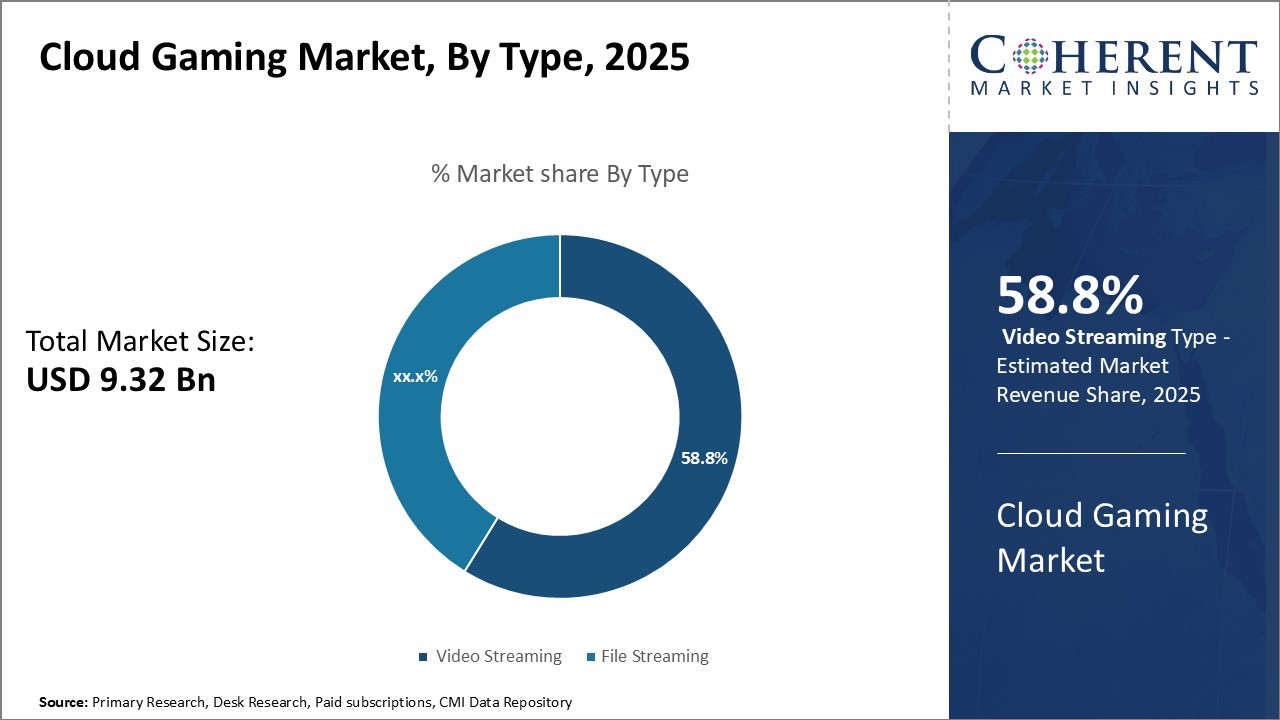
Cloud Gaming Market Insights, By Type: Video Streaming Dominates the Market Owing to its Engaging Experience
In terms of type, video streaming segment is estimated to contribute the highest market share of 59.8% in 2026. Video games have become increasingly realistic and complex over the years, demanding high-end graphics and smooth gameplay.
However, many users still have aging hardware or low-specification devices that cannot support these hardware-intensive games locally. This is where cloud gaming through video streaming helps bridge this gap. By offloading the intensive processing to remote data centers, even low-end devices are able to experience console-like AAA games through high-quality video streams. This allows users to enjoy their favorite games anywhere, anytime on a variety of screens from their smartphones to smart TVs.
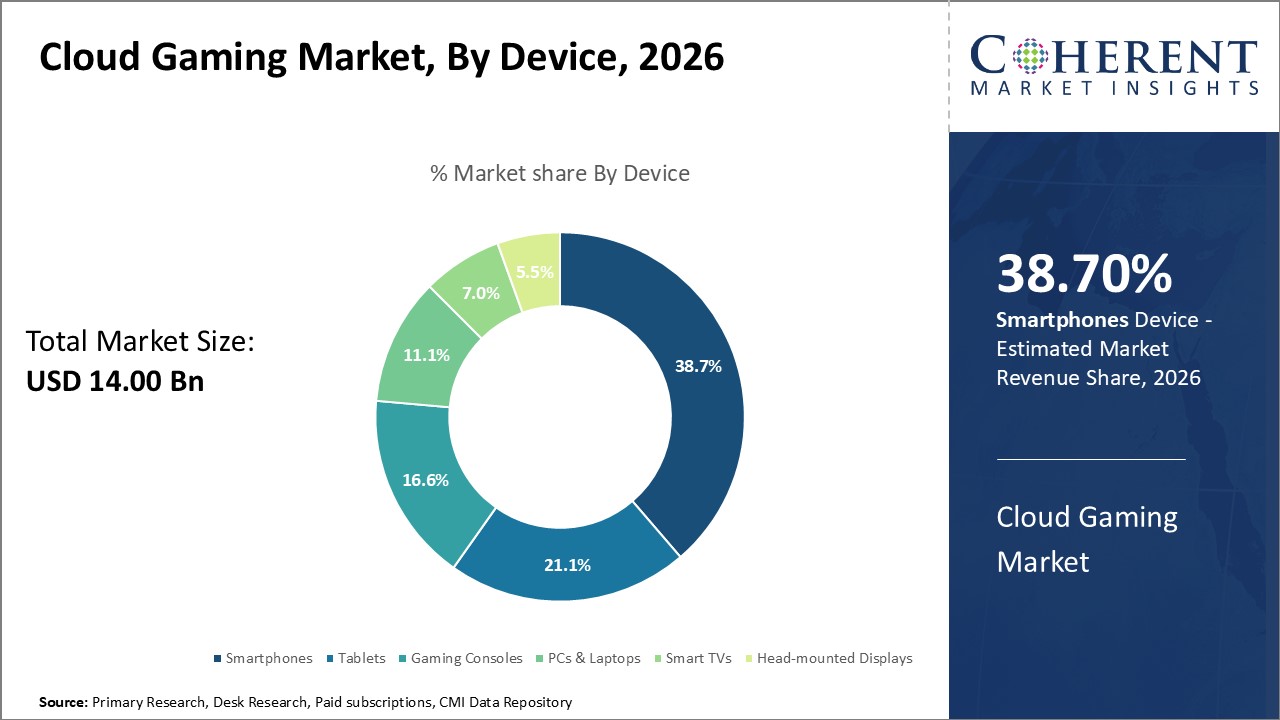
Cloud Gaming Market Insights, By Device: Smartphones Lead Owing to Increased Mobility
In terms of device, smartphones segment is estimated to contribute the highest market share of 38.7% in 2026. As gaming becomes more of a pastime activity amid busy schedules, users prefer playing on the go via their phones.
Cloud gaming solves the limitations of traditional mobile games by providing console-quality experiences that can be seamlessly picked up and enjoyed during commutes, breaks, or anytime away from dedicated devices. This appeals greatly to both casual gamers looking to kill time and hardcore players who want their favorite AAA franchises on a mobile form factor.
Cloud Gaming Market Insights, By Gamer Type: Casual Gamers Maintain Dominance Owing to Social Elements
In terms of gamer type, casual gamers segment is estimated to contribute the highest market share of 78.8% in 2026. This segment comprises individuals who enjoy games primarily as a casual pastime or for their entertainment value rather than hardcore gameplay.
These people prefer titles with lower commitment barriers that can be easily picked up during brief leisure windows. Cloud streaming addresses this need by removing installation burdens and allowing on-demand access through versatile devices from any location.
Emerging Innovations in the Cloud Gaming Market
- The Decentralization of Game Processing Power
- Traditionally, gaming required powerful consoles or PCs to process and render graphics. With the advent of cloud gaming, these computationally intensive tasks are offloaded to remote data centers. Players receive the game streams instantly over the internet, eliminating the need for expensive hardware. This has expanded gaming accessibility, allowing users with minimal device capabilities—such as smart TVs, smartphones, or low-end laptops—to engage with the latest games.
- Advancements In Video Compression Algorithms
- Advancements in video compression algorithms are drastically improving streaming efficiency. Newer codecs, such as AV1 and H.266/VVC (Versatile Video Coding), offer superior compression rates without compromising visual fidelity. This means games can be transmitted with sharper graphics and smoother frame rates over variable internet conditions while consuming less bandwidth. Efficient compression reduces buffering and improves overall user experience, which is critical in competitive and social gaming environments.
Impact of Artificial Intelligence on the Cloud Gaming Market
- NVIDIA’s GeForce NOW platform exemplifies by implementing AI-driven techniques to enhance graphics rendering and reduce input lag. Utilizing AI-based upscaling methods such as DLSS (Deep Learning Super Sampling), NVIDIA dynamically enhances in-game visuals by rendering games at lower resolutions and intelligently upscaling them to higher resolutions without compromising quality. This AI-powered process significantly reduces the computational load on cloud servers and decreases latency, delivering sharper graphics and smoother gameplay.
- Microsoft’s xCloud platform demonstrates a sophisticated AI implementation that has tangibly improved user experience and service scalability. Microsoft employs AI algorithms for adaptive bit-rate streaming and predictive maintenance, ensuring reduced lag and consistent gameplay quality even during peak demand. Notably, Microsoft uses AI to analyze gameplay data and user preferences, offering personalized game recommendations and matchmaking that enhance player engagement.
Regional Insights
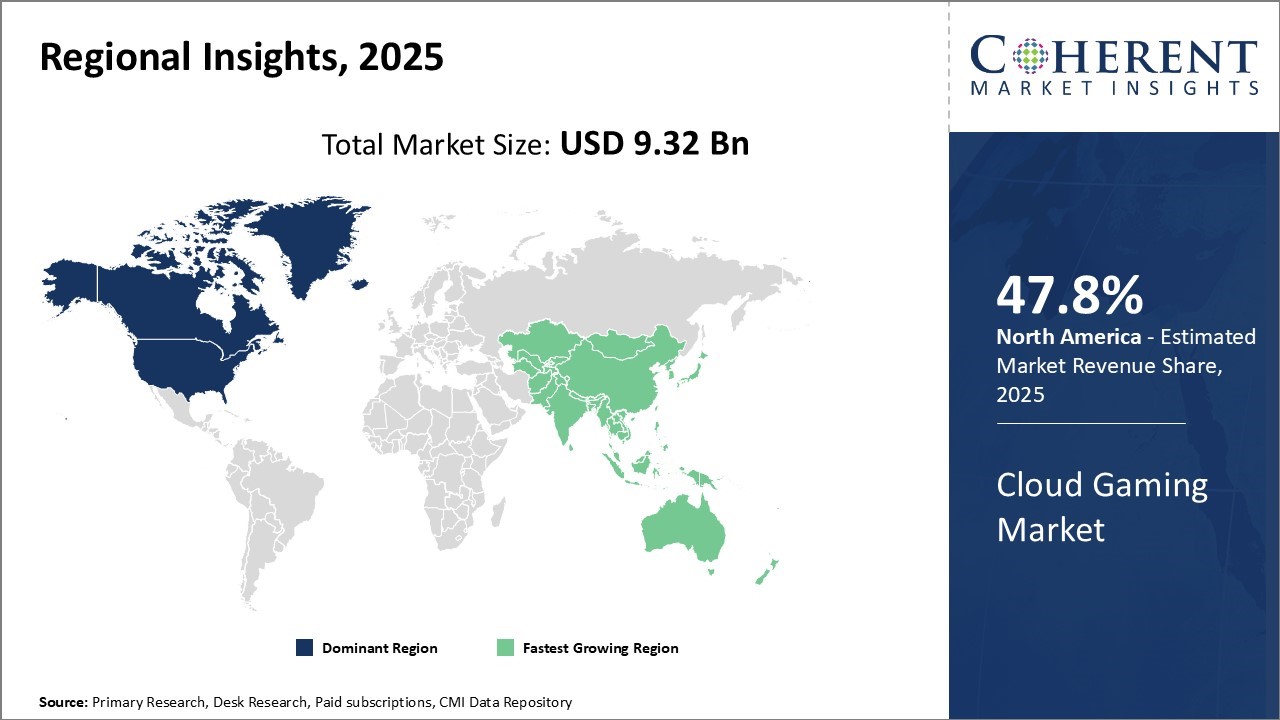
North America Cloud Gaming Market Analysis and Trends
North America has emerged as the dominant region in cloud gaming market with an estimated market share of 47.8% in 2026. With well-established infrastructure and early adoption of advanced technologies, the U.S. and Canada have witnessed rapid growth in cloud gaming subscriptions and revenues. Major cloud gaming providers such as Google Stadia, Microsoft xCloud, and Nvidia GeForce NOW have gained popularity in this region.
For instance, in March 2020, a Verizon network report revealed that gaming usage in the United States had surged by 75% during peak hours, compared to the previous week—highlighting a dramatic shift toward digital and cloud-based gaming platforms as users sought more convenient, hardware-light ways to access games amid the pandemic's early stages.
Asia Pacific Cloud Gaming Market Analysis and Trends
Asia Pacific is witnessing the fastest growth in the cloud gaming market for the forecast period of 2026-2032. Countries such as China, Japan, and South Korea are aggressively expanding their digital infrastructure to support emerging technologies. With large young demographic cohorts and increasing disposable incomes, this region provides a lucrative market for cloud-based gaming services.
For instance, according to the FICCI EY Report, published on March 27, 2026, the Indian online gaming sector is projected to grow at a compound annual growth rate of 10.8 percent over the next three years, reaching USD 368.7 million by 2027. This rapid expansion in online gaming is expected to accelerate demand for cloud gaming platforms, as consumers seek more accessible and hardware-independent gaming experiences across the Asia Pacific region.
Cloud Gaming Market Outlook for Key Countries
U.S. Cloud Gaming Market Analysis and Trends
The U.S. leads the global cloud gaming market due to its advanced digital infrastructure, widespread 5G adoption, and a strong ecosystem of technology giants such as Microsoft, Google, Amazon, and NVIDIA. These companies are investing heavily in cloud gaming platforms, leveraging their cloud computing capabilities and massive content libraries. High consumer spending on gaming and a large base of early tech adopters further support the rapid growth and innovation in the U.S. cloud gaming space.
China Cloud Gaming Market Analysis and Trends
China’s cloud gaming market is expanding rapidly, driven by its large population of mobile gamers, strong government support for digital innovation, and widespread high-speed internet access, including 5G coverage. Leading tech firms such as Tencent and NetEase are developing proprietary cloud gaming services, often integrated with their vast gaming portfolios. Despite facing export restrictions on advanced hardware, China’s domestic investments and focus on AI and edge computing are helping sustain momentum in the sector.
South Korea Cloud Gaming Market Analysis and Trends
South Korea is a key player in cloud gaming due to its exceptional broadband penetration, tech-savvy population, and government-backed digital infrastructure policies. The country boasts one of the world’s fastest internet speeds, which enables low-latency gaming experiences—a critical requirement for cloud gaming success. South Korea is also home to globally recognized game developers and e-sports organizations, creating a highly supportive environment for the adoption and scaling of cloud gaming services.
Japan Cloud Gaming Market Analysis and Trends
Japan remains a strong cloud gaming market, supported by its long-established gaming culture, technological innovation, and rising adoption of subscription-based gaming models. Major gaming companies such as Sony and Nintendo are exploring cloud-based services to extend their reach beyond traditional consoles. Japan's strong mobile gaming ecosystem and early interest in immersive technologies like VR and AR also create fertile ground for cloud gaming platforms to thrive, particularly among younger consumers.
Pricing Analysis of the Cloud Gaming Market
Platform | Approximate Cost (USD) |
Google Stadia Pro | 9.99 |
NVIDIA GeForce NOW RTX 3080 | 19.99 |
Xbox Game Pass Ultimate | 14.99 |
PlayStation Plus Premium | 17.99 |
Amazon Luna + Ubisoft | 24.98 (Combined) |
Market Report Scope
Cloud Gaming Market Report Coverage
| Report Coverage | Details | ||
|---|---|---|---|
| Base Year: | 2025 | Market Size in 2026: | USD 14.00 Bn |
| Historical Data for: | 2020 To 2024 | Forecast Period: | 2026 To 2033 |
| Forecast Period 2026 to 2033 CAGR: | 50.2% | 2033 Value Projection: | USD 241.42 Bn |
| Geographies covered: |
| ||
| Segments covered: |
| ||
| Companies covered: | Amazon Inc., Antplay.tech, Apple Inc., Blacknut, Deutsche Telekom, Electronic Arts, Inc., Facebook, Google Inc., IBM Corporation, Intel Corporation, Locus Robotics, Microsoft Corporation, NVIDIA Corporation, Numecent Holdings Ltd., Parsec Cloud Inc. (Unity Software Inc.), Sony Interactive Entertainment, Tencent Holdings Ltd., Ubitus Inc., and Ubisoft, Verizon | ||
| Growth Drivers: |
| ||
| Restraints & Challenges: |
| ||
Cloud Gaming Industry News
- In July 2025, Blacknut’s cloud gaming platform came up with pre-installed on the Logitech G CLOUD Gaming Handheld, offering immediate access to over 500 premium games.
- In July 2025, Deutsche Telekom introduced its 5G+ Gaming offer nationwide. The gaming package based on the latest 5G Standalone technology which is also available on even more smartphones: 5G+ gaming is supported by all iPhones of the 15 and 16 series including the iPhone 16e.
- In June 2025, Somnia announced a collaboration with Google Cloud. The new collaboration, announced during EthCC in Cannes, will redefine creativity and what’s possible for gaming developers worldwide.
- In March 2025, Microsoft introduced Xbox Cloud Gaming (Beta) expands the audience, making it possible to deliver your games to millions of new users on the devices they already own. At Xbox, their mission was to enable players to play the games they want, with the people they want, anywhere they want.
Analyst View
- The cloud gaming market is witnessing significant momentum as advancements in internet infrastructure and computing power redefine how consumers access and experience video games. Key drivers fueling this growth include the increasing penetration of high-speed broadband and 5G networks, which enable the seamless streaming of high-quality gaming content without the need for expensive hardware.
- Additionally, the rising preference for on-demand gaming and subscription-based models is encouraging users to shift from traditional console or PC gaming to cloud platforms, offering greater convenience and flexibility.
- However, the market faces notable restraints such as latency issues and inconsistent internet connectivity in emerging regions, which can impair the user experience. Data security and privacy concerns also pose challenges as sensitive user information and gaming data are transmitted and stored over cloud servers.
- Moreover, technological innovations such as edge computing and AI-driven game optimization are expected to enhance service quality, further enticing gamers and developers to adopt cloud-based solutions.
- Collaborations between cloud service providers and gaming studios will likely accelerate content availability and diversity, broadening the appeal of cloud gaming. Overall, the cloud gaming market stands at a transformative juncture, driven by technological progress and evolving consumer preferences, with considerable prospects for expansion worldwide.
Market Segmentation
- Type Insights (Revenue, USD Bn, 2021 - 2033)
- File Streaming
- Video Streaming
- Device Insights (Revenue, USD Bn, 2021 - 2033)
- Smartphones
- Tablets
- Gaming Consoles
- PCs & Laptops
- Smart TVs
- Head-mounted Displays
- Gamer Type Insights (Revenue, USD Bn, 2021 - 2033)
- Casual Gamers
- Avid Gamers
- Lifestyle Gamers
- Regional Insights (Revenue, USD Bn, 2021 - 2033)
- North America
- U.S.
- Canada
- Latin America
- Brazil
- Argentina
- Mexico
- Rest of Latin America
- Europe
- Germany
- U.K.
- Spain
- France
- Italy
- Russia
- Rest of Europe
- Asia Pacific
- China
- India
- Japan
- Australia
- South Korea
- ASEAN
- Rest of Asia Pacific
- Middle East
- GCC Countries
- Israel
- Rest of Middle East
- Africa
- South Africa
- North Africa
- Central Africa
- Key Players Insights
- Amazon Inc.
- Antplay.tech
- Apple Inc.
- Blacknut
- Deutsche Telekom
- Electronic Arts, Inc.
- Google Inc.
- IBM Corporation
- Intel Corporation
- Locus Robotics
- Microsoft Corporation
- NVIDIA Corporation
- Numecent Holdings Ltd.
- Parsec Cloud Inc. (Unity Software Inc.)
- Sony Interactive Entertainment
- Tencent Holdings Ltd.
- Ubitus Inc.
- Ubisoft
- Verizon
Sources
Primary Research Interviews
- Cloud Gaming Platform Providers
- Game Developers & Publishers
- Technology Infrastructure Providers
- Cloud Service Providers (e.g., AWS, Google Cloud)
- Others
Magazines
- Game Developer Magazine
- Wired
- Gamasutra
- Edge Magazine
- Others
Journals
- Journal of Cloud Computing
- Entertainment Computing
- IEEE Transactions on Multimedia
- ACM Transactions on Interactive Intelligent Systems
- Others
Newspapers
- The Wall Street Journal
- The Financial Times
- The New York Times – Technology Section
- TechCrunch
- Others
Associations
- International Game Developers Association (IGDA)
- Cloud Gaming Association (CGA)
- Interactive Software Federation of Europe (ISFE)
- Entertainment Software Association (ESA)
- Others
Public Domain Sources
- Company Annual Reports & Investor Presentations
- Government Publications on Digital Entertainment
- Industry News Portals (e.g., GamesIndustry.biz)
- Press Releases from Leading Market Players
- Others
Proprietary Elements
- CMI Data Analytics Tool – Cloud Gaming Market
- CMI Existing Repository of Information for the Last 8 Years
*Definition: Cloud gaming allows users to stream and play video games hosted on remote servers instead of downloading the entire game file to their local device. Users can access and play high-end video games through an internet connection without needing expensive high-powered gaming PCs or consoles. The games are rendered on cloud servers and the video and input are streamed to any device via the internet, providing users with instant access to play full console- and PC-quality games from anywhere.
Get access to 250+ pages report
Every segment, forecast, competitor profile and data table behind the analysis above — available for instant download.
- ESOMAR Member
- ISO 9001:2015 Certified
- D-U-N-S Registered
- GDPR & CCPA Compliant
Missing comfort of reading report in your local language? Find your preferred language:
Transform your Strategy with Exclusive Trending Reports
Frequently Asked Questions
The cloud gaming market is estimated to be valued at USD 14.00 Bn in 2026, and is expected to reach USD 241.42 Bn by 2033.
The CAGR of the cloud gaming market is projected to be 50.2% from 2026 to 2033.
High-speed internet penetration and advancements in network infrastructure and rising demand for on-demand and accessible games are the major factors driving the growth of global cloud gaming market.
High investment in low-latency streaming technology and dependence on advanced broadband infrastructure are the major factors hampering the growth of the global cloud gaming market.
In terms of type, video streaming segment is estimated to dominate the market in 2026.
Amazon Inc., Antplay.tech, Apple Inc., Blacknut, Deutsche Telekom, Electronic Arts, Inc., Facebook, Google Inc., IBM Corporation, Intel Corporation, Locus Robotics, Microsoft Corporation, NVIDIA Corporation, Numecent Holdings Ltd., Parsec Cloud Inc. (Unity Software Inc.), Sony Interactive Entertainment, Tencent Holdings Ltd., Ubitus Inc., Ubisoft, and Verizon are the major players operating in the cloud gaming market.
North America is expected to lead the cloud gaming market in 2026.