

Virtual Reality in Gaming Market Size and Share Analysis - 2026 To 2033
The global virtual reality in gaming market is estimated to be valued at USD 25,586.8 Mn in 2026 and is projected to grow at a compound annual growth rate (CAGR) of 22% from 2026 to 2033, reaching USD 102,568.4 Mn by 2033. This can be attributed to rising adoption of immersive gaming experiences, increasing advancements in VR hardware and software technologies, and growing popularity of multiplayer and metaverse-based gaming platforms.
Key Takeaways from the Virtual Reality in Gaming Market Report
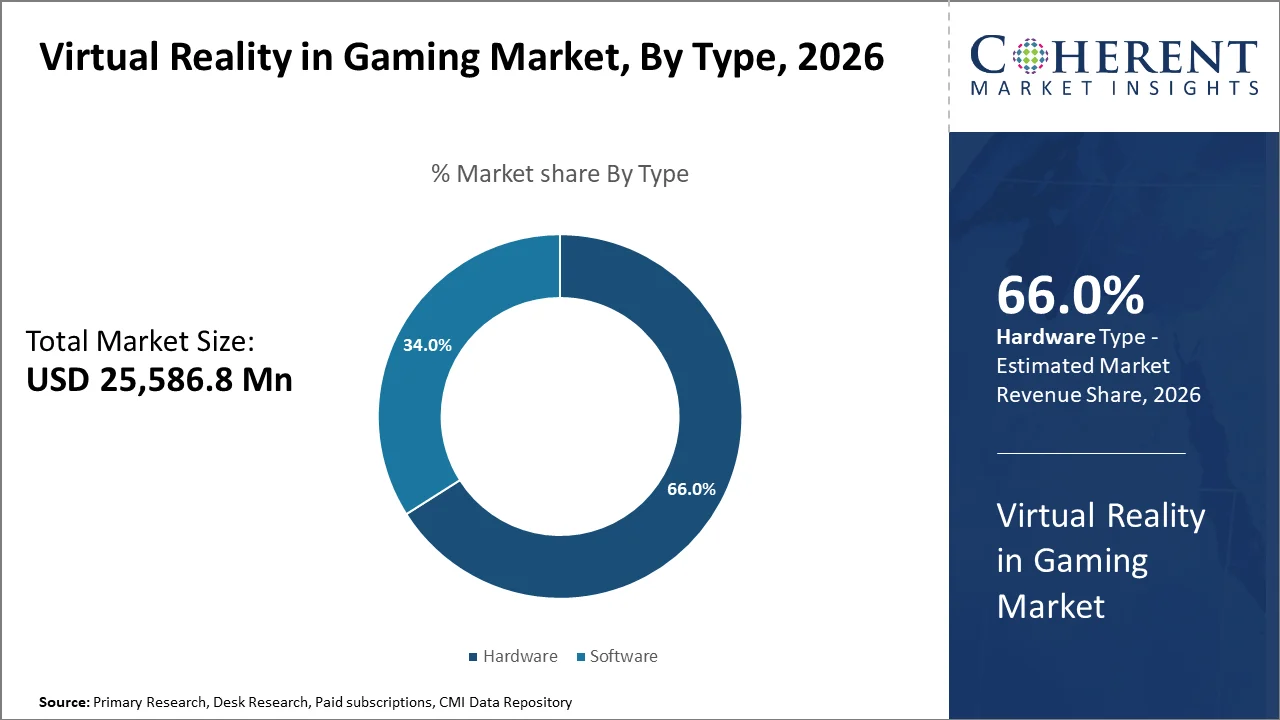
- Hardware segment is expected to lead the virtual reality in gaming market with a share of over 66% in 2026 due to rising demand for VR headsets, motion sensors, controllers, and expanding VR gaming ecosystems.
- Play station is likely to remain the top revenue-generation segment, accounting for a share of 36% in 2026, owing to strong PlayStation VR adoption as well as an expanding user base.
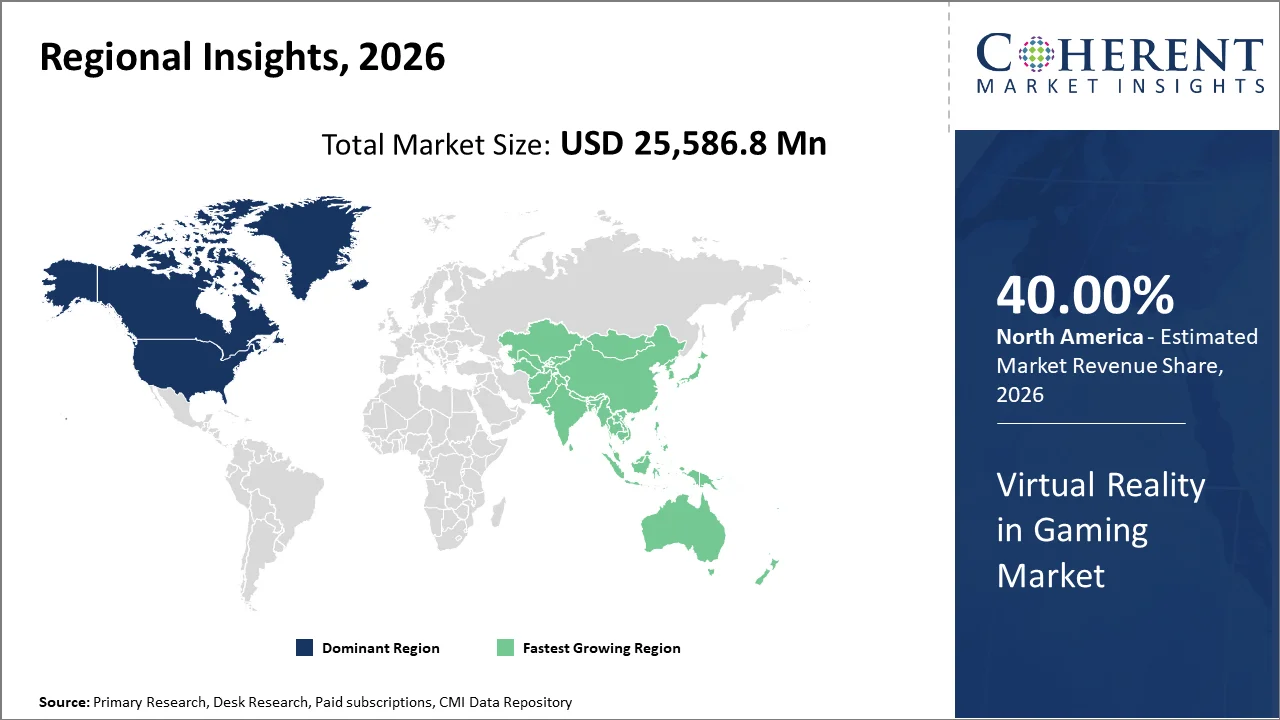
- North America is projected to dominate the global virtual reality industry with a share of 40% in 2026, owing to strong presence of leading VR gaming companies, high consumer spending, and strong adoption of advanced gaming technologies drive regional dominance. For example, according to ESA, U.S. consumer spending on video games reached approximately $60.7 billion in 2025.
- Asia Pacific, capturing a share of 30% in 2026, is poised to emerge as the fastest growing virtual reality in gaming market, thanks to expanding gaming population growth in China, Japan, and South Korea. For instance, South Korea’s gaming market expanded by 47% between 2019 and 2023, reaching 22.96 trillion won, highlighting the region’s rapidly growing gaming ecosystem.
Virtual Reality in Gaming Market Overview
The global virtual reality in gaming market is poised to exhibit robust growth during the forecast period. This growth is due to rising adoption of immersive gaming technologies, increasing demand for interactive entertainment experiences, advancements in VR hardware and software, and growing popularity of multiplayer and metaverse-based gaming platforms.
Increasing investments by gaming companies in virtual reality content development are supporting market expansion. In addition, the increasing affordability of VR headsets, rapid expansion of 5G connectivity, and growing consumer demand for realistic and interactive entertainment experiences are expected to bode well for the market during the forthcoming period.
Virtual reality refers to a simulated environment created using software and hardware to provide users with an immersive experience of a real or imagined environment. It is primarily experienced through sight and sound, and in some advanced systems, motion tracking and haptic feedback are also used. Users typically interact with VR using head-mounted displays (HMDs) and handheld controllers equipped with sensors.
Virtual reality can be used for simulating real environments for education and training, as well as creating imagined environments for storytelling and gaming. Virtual reality in gaming involves the use of 3D graphics and interactive technology where users experience the game through a head-mounted display (HMD) and motion-tracking devices.
Segmental Insights
Which Type Segment Dominates the Virtual Reality in Gaming Market?
Hardware Segment Emerges as Key Revenue Contributor
As per Coherent Market Insights’ latest virtual reality in gaming market analysis, hardware segment is set to dominate the market, accounting for a share of 66% in 2026. This dominance is mainly due to rising adoption of VR headsets, motion tracking devices, haptic feedback systems, and advanced gaming consoles across both consumer and commercial gaming environments.
Growing investments by gaming companies in next-generation VR devices and increasing popularity of immersive multiplayer and metaverse-based gaming experiences are also boosting segment growth. For instance, according to
In addition, declining hardware prices and the expanding availability of standalone VR headsets are encouraging wider consumer adoption worldwide. Top gaming brands continue to launch attractive pricing strategies and hardware upgrades to woo customers. Sony, for example, permanently reduced the price of its PlayStation VR2 headset to USD 399 in 2025 to expand its user base and boost accessibility for gamers.
- Current Industry Events of 2026
- Market Size Estimation
- Regional Breakdown
- Competitive Landscape
- Customer Intelligence
- Segmental Analysis
- Pricing Analysis
- Key Market Drivers, Challenges & Future Trends
- Customized Insights Section
Which Console Type Is Most Popular in the VR Gaming Market?
Play Station Maintains Strong Consumer Demand
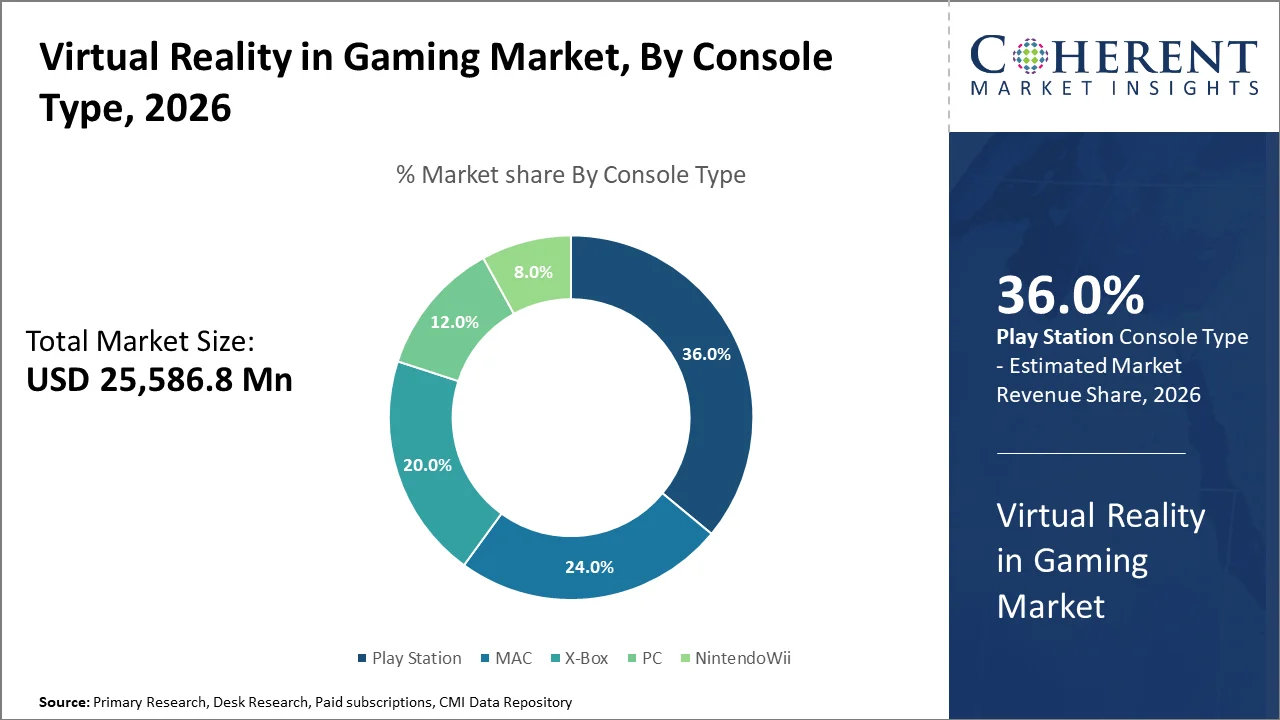
Based on console type, play station segment is anticipated to lead the VR in gaming market, holding a share of 36% in 2026. This can be attributed to Sony’s strong ecosystem of VR-compatible gaming titles, expanding adoption of next-generation consoles, and increasing consumer preference for immersive gaming experiences. The popularity of the PlayStation 5 and continued consumer interest in the PlayStation VR2 are also supporting the segment’s growth.”
Sony has also benefited from its large installed user base and exclusive VR game offerings, which continue to attract both casual and hardcore gamers. In addition, the expanding availability of VR-focused content and multiplayer gaming experiences is contributing to increased consumer engagement with PlayStation-based VR systems.
Virtual Reality in Gaming Market Growth Drivers
Rising Demand for Immersive Gaming Experiences: Gamers in the contemporary world increasingly prefer highly immersive and realistic gameplay instead of traditional screens. This, in turn, is putting technologies like virtual reality into the spotlight. VR creates a “real-life” feeling inside games, which strongly boosts user engagement and adoption. Thus, growing demand for immersive gaming experiences is expected to provide a strong impetus for the growth of virtual reality in gaming market during the forecast period.
Virtual Reality in Gaming Market Opportunities
Continuous Improvements in Virtual Reality Hardware: Advancements in VR headsets, motion tracking, controllers, and display quality are making VR gaming more comfortable, realistic, and accessible for users. For example, in 2025, Meta showcased next-generation VR prototypes with much higher resolution displays and a wider field of view, showing how improved hardware is improving immersive gaming experiences. These innovations are expected to create lucrative growth opportunities for the virtual reality in gaming market during the forthcoming period.
Virtual Reality in Gaming Market Trends
Rising Popularity of Social and Multiplayer VR Gaming: Growing interest in multiplayer VR games is a key growth-shaping trend in the virtual reality in gaming market. VR gaming is becoming more social, allowing players to interact, compete, and collaborate in shared virtual environments. This trend is particularly strong in multiplayer and e-sports-style VR experiences.
Current Events and Their Impact on the Virtual Reality in Gaming Market
Current Event | Description and its Impact |
Sony expands PlayStation VR2 support to PC gaming ecosystem |
|
Meta shifts VR strategy toward gaming-focused Quest ecosystem |
|
Regional Insights
North America Remains at the Epicenter of Virtual Reality in Gaming Market Growth
North America is expected to lead the global virtual reality in gaming market, holding around 40% share in 2026. This is mostly due to increasing consumer spending on gaming, early adoption of VR hardware, and strong penetration of gaming consoles and PC ecosystems. The presence of major ecosystem players like Meta’s Quest platform and Sony’s PlayStation VR also continues to support rapid content expansion and user adoption.
According to the This expanding user base is set to fuel immersive gaming demand during the forthcoming period.
Asia Pacific to Emerge as a Hotbed for Industry Players
Asia Pacific is expected to witness the fastest growth in the virtual reality in gaming market, holding a global market share of 30% in 2026. This growth is mostly due to rapid digital transformation, expansion of mobile-first gaming ecosystems, rising esports participation, and increasing penetration of high-speed 5G networks.
Nations like China, Japan, South Korea, and India are witnessing strong growth in digital entertainment consumption. This, in turn, is fueling demand for immersive VR gaming experiences. Similarly, new trends like mixed reality, eye-tracking, haptic feedback, and advanced graphics are making VR experiences more lifelike as well as engaging.
Virtual Reality in Gaming Market Outlook – Country-wise
U.S. Virtual Reality in Gaming Market Trends
The U.S. is expected to remain a leading market for the Virtual Reality gaming solutions due to strong consumer spending on video games, increasing adoption of advanced gaming hardware, and the presence of major VR ecosystem players such as Meta and Sony. In addition, rising popularity of immersive gaming experiences, cloud gaming services, and next-generation VR headsets like Meta Quest is supporting market growth in the country.
China Virtual Reality in Gaming Market Forecast
China’s virtual reality in gaming market is poised to record strong growth during the forecast period. This is due to its massive gaming population, rapid digital infrastructure development, and strong government support for advanced technologies. Increasing adoption of mobile gaming, expansion of 5G networks, and rising investment in immersive entertainment platforms are also driving VR gaming demand in the nation. In addition, the integration of VR with esports, online gaming ecosystems, and AI-powered content platforms is further strengthening market growth across China.
Who are the Major Companies in the Virtual Reality in Gaming Market?
Some of the major players in Virtual Reality in Gaming Market are Electronic Arts Inc., Kaneva LLC, Nintendo Co. Ltd, Avatar Reality Inc., Sony Corporation, Oculus VR, Activision Publishing Inc., and Sega Corporation.
Key Strategies Adopted by Industry Players
Leading companies operating in the virtual reality in gaming industry are adopting various strategies to boost their sales as well as expand their regional footprint. They are heavily investing in R&D to improve graphics quality, motion tracking, and overall immersion for more realistic gameplay experiences. Companies are also focusing on developing lighter, more comfortable, and wireless headsets to improve user convenience and encourage longer play sessions. For example,
- In May 2026, Electronic Arts Inc. and Visa announced a global, multi-year partnership with EA SPORTS. The partnership aims to create new immersive and player-focused experiences across EA SPORTS games.
- In August 2025, Zero Latency VR upgraded its Mumbai venue to its Gen 3 platform. The system removes backpacks and wires and delivers a fully untethered VR experience using Wi-Fi 6E technology.
- In April 2024, Sony launched Gaming Virtualizer by 360 Reality Audio. It is a plug-in software for game developers that helps create spatial 3D game sound for headphone users.
Market Report Scope
Virtual Reality in Gaming Market Report Coverage
| Report Coverage | Details | ||
|---|---|---|---|
| Base Year: | 2025 | Market Size in 2026: | USD 25,586.8 Mn |
| Historical Data for: | 2020 To 2024 | Forecast Period: | 2026 To 2033 |
| Forecast Period 2026 to 2033 CAGR: | 22% | 2033 Value Projection: | USD 102,568.4 Mn |
| Geographies covered: |
| ||
| Segments covered: |
| ||
| Companies covered: | Electronic Arts Inc., Kaneva LLC, Nintendo Co. Ltd, Avatar Reality Inc., Sony Corporation, Oculus VR, Activision Publishing Inc., and Sega Corporation. | ||
| Growth Drivers: |
| ||
| Restraints & Challenges: |
| ||
Analyst Opinion (Expert Opinion)
- VR gaming is growing because more people want immersive play. Studies show VR players experience a stronger “sense of presence” compared to normal gaming, which makes games feel more real and engaging.
- User activity is increasing. For example, SteamVR reached about 4.3 million monthly active VR players in early 2025, showing a steady base of real users already playing VR games.
- Hardware improvements are helping adoption. Modern headsets like Meta Quest and others now offer better graphics, wireless play, and lower latency, making VR gaming easier and more comfortable for users.
- Content and engagement are expanding. In 2025, over 140 VR games were released on the Quest platform, and more than 100 titles have already earned over USD 1 million in revenue, showing strong developer activity and user spending interest. This is further propelling the market opportunities.
Speak to the analyst
Want personalized insights?
Take the findings above to one of our principal consultants, or have the report rebuilt around the segments, geographies and competitors you actually track.
Market Segmentation
- By Type Insights ( Revenue, US$ Mn, 2021 - 2033)
- Software
- Hardware
- By Application Insights ( Revenue, US$ Mn, 2021 - 2033)
- MAC
- X-BOX
- Play Station
- PC
- Nintendo Wii
- By Region Insights ( Revenue, US$ Mn, 2021 - 2033)
- North America
- U.S.
- Canada
- Latin America
- Brazil
- Argentina
- Mexico
- Rest of Latin America
- Europe
- Germany
- U.K.
- Spain
- France
- Italy
- Russia
- Rest of Europe
- Asia Pacific
- China
- India
- Japan
- Australia
- South Korea
- ASEAN
- Rest of Asia Pacific
- Middle East
- GCC Countries
- Israel
- Rest of Middle East & Africa
- Africa
- South Africa
- North Africa
- Central Africa
- North America
- Key Players in the Virtual Reality in Gaming Market
- Electronic Arts Inc.
- Kaneva LLC
- Nintendo Co. Ltd
- Avatar Reality Inc.
- Sony Corporation
- Oculus VR
- Activision Publishing Inc.
- Sega Corporation
Sources
Primary Research Interviews
- Virtual reality headset manufacturers
- Gaming hardware providers
- VR software developers
- Game publishers
- Immersive technology specialists
- Esports professionals
- Gaming studio executives
- Distributors, retailers, and industry experts
Databases
- World Bank Open Data
- IMF Data
- UN Comtrade Database
- OECD Data
- Steam Statistics
- Sensor Tower
- App Annie/Data.ai
- IDC Data
- U.S. Census Bureau
- Trading Economics
Magazines
- VRScout Magazine
- UploadVR
- Road to VR
- PC Gamer
- Wired
- Gaming Intelligence
- TechCrunch
- Forbes Technology
- MIT Technology Review
Journals
- Journal of Virtual Reality and Broadcasting
- Virtual Reality Journal
- International Journal of Human-Computer Interaction
- Entertainment Computing, IEEE Transactions on Visualization and Computer Graphics
- Journal of Gaming & Virtual Worlds
Newspapers
- The Wall Street Journal
- Financial Times
- The New York Times
- The Guardian
- The Economic Times
- Business Standard
- Nikkei Asia
Associations
- Entertainment Software Association (ESA)
- VR/AR Association
- IEEE
- International Game Developers Association (IGDA)
- Consumer Technology Association (CTA)
- XR Association
Public Domain Sources
- Company annual reports
- Investor presentations
- SEC filings
- Government publications
- White papers
- Corporate press releases
- Trade portals
- Industry publications
- Official company websites
- Gaming platform statistics
- Regulatory authority publications
Proprietary Elements
- CMI Data Analytics Tool
- Proprietary CMI Existing Repository of information for last 10 years
Get access to 250+ pages report
Every segment, forecast, competitor profile and data table behind the analysis above — available for instant download.
- ESOMAR Member
- ISO 9001:2015 Certified
- D-U-N-S Registered
- GDPR & CCPA Compliant
Missing comfort of reading report in your local language? Find your preferred language:
Transform your Strategy with Exclusive Trending Reports
Frequently Asked Questions
The global market is estimated to be valued at USD 25,586.8 Mn in 2026.
The global Virtual Reality in Gaming Market value is expected to reach USD 102,568.4 Mn by 2033.
The global market is poised to exhibit a CAGR of 22% from 2026 to 2033.
Major growth factors include rising demand for immersive gaming experiences and technological advancements in VR hardware and software.
Hardware segment, with about 66% share in 2026, dominates the market.
Some major companies in the Virtual Reality in Gaming Market include Electronic Arts Inc., Kaneva LLC, Nintendo Co. Ltd, Avatar Reality Inc., Sony Corporation, Oculus VR, Activision Publishing Inc., and Sega Corporation.
North America, with 40% share in 2026, is set to lead the market during the forecast period.