

Transformer Substation Inspecting Robot Market Size and Forecast – 2026 to 2033
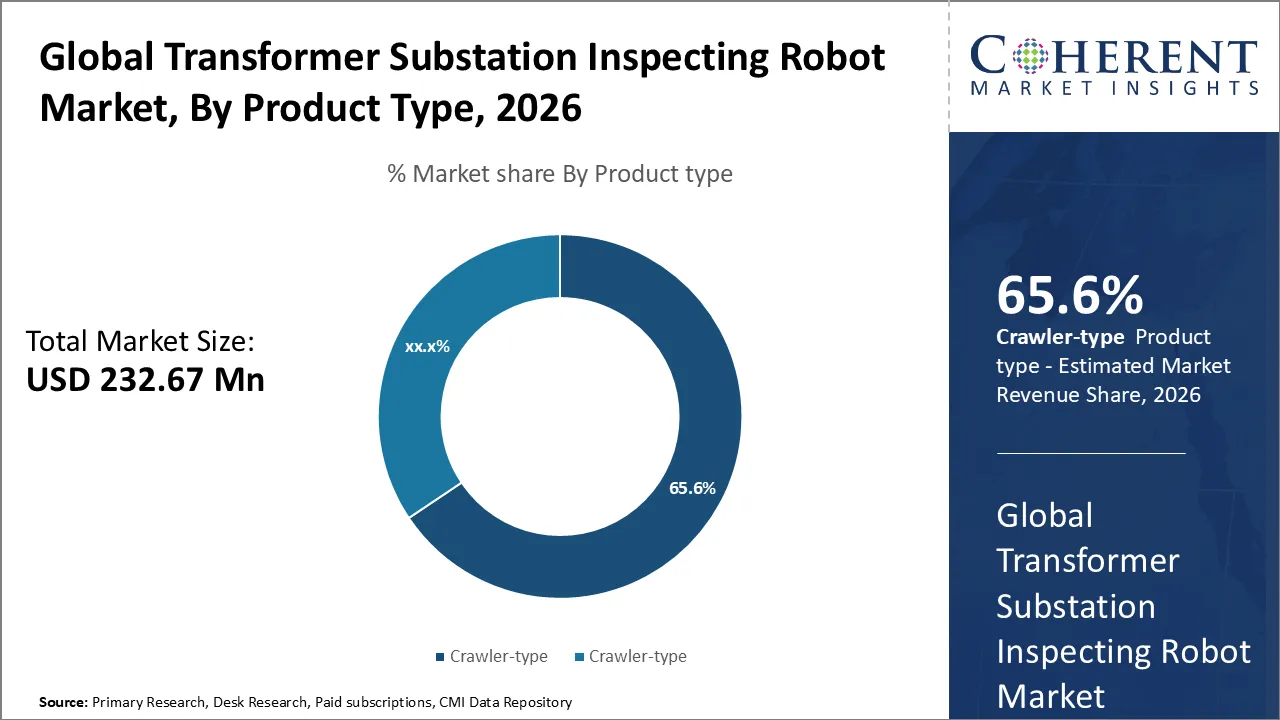
The Transformer Substation Inspecting Robot Market is estimated to be valued at USD 232.67 Mn in 2026 and is expected to reach USD 617.71 Mn by 2033, exhibiting a compound annual growth rate (CAGR) of 11.8% from 2026 to 2033.
Key Takeaways
- By Product Type, Crawler-Type hold the largest market share of 65.6% in 2026 owing to the superior terrain navigation & ruggedness.
- By Application, Single Station Type expected to hold the largest market share of 52.2% in 2026 owing to its simpler deployment & operational focus.
- By Region, North America dominates the overall market with an estimated share of 36.7% in 2026 owing to the advanced power infrastructure & smart grid modernization.
Market Overview
The Transformer Substation Inspecting Robot Market centers on robotic systems that automate inspection, monitoring, and maintenance activities within electrical substations. These robots improve operational safety by minimizing human exposure to high-voltage environments while increasing inspection accuracy and efficiency. Utilities adopt these solutions to manage growing grid complexity, aging infrastructure, and the demand for reliable, real-time equipment monitoring. The use of advanced sensors, artificial intelligence, and remote monitoring technologies further strengthens adoption across utility and industrial applications.
Current Events and Its Impact on the Transformer Substation Inspecting Robot Market
Current Events | Description and its impact |
Geopolitical and Regulatory Developments |
|
Economic and Industry Trends |
|
Regional Infrastructure and Market Expansion |
|
Segmental Insights
- Current Industry Events of 2026
- Market Size Estimation
- Regional Breakdown
- Competitive Landscape
- Customer Intelligence
- Segmental Analysis
- Pricing Analysis
- Key Market Drivers, Challenges & Future Trends
- Customized Insights Section
Transformer Substation Inspecting Robot Market Insights, By Product Type: Crawler-Type contribute the highest share of the market owing to its growth in utility safety regulations and standards.
Crawler-Type hold the largest market share of 65.6% in 2026. Crawler-type robots drive growth in the Transformer Substation Inspecting Robot Market by navigating uneven terrain and complex substation layouts more effectively than wheeled alternatives. Their tracked design provides stability to carry heavy sensor payloads and perform detailed inspections in hard-to-reach areas. Utilities adopt these robots to improve safety by limiting human exposure to hazardous environments, enabling autonomous and continuous monitoring, and ensuring consistent inspection performance. Rising demand for durable and versatile inspection solutions further supports their adoption. For instance, in September 2024, Greensea IQ has launched an upgraded underwater hull inspection robot for EverClean IQ, combining its crawling and flight capabilities with ultrasonic sensors and cameras to create a powerful, cloud-connected inspection tool.
Transformer Substation Inspecting Robot Market Insights, By Application: Single Station Type contribute the highest share of the market owing to its focus on safety & automation at critical points.
Single Station Type expected to hold the largest market share of 52.2% in 2026. Single station type robots drive growth in the Transformer Substation Inspecting Robot Market by offering easy deployment and targeted operation within individual substations. Utilities use these robots to perform frequent, site-specific inspections with less complexity and lower cost than multi-station systems. They connect seamlessly with local monitoring platforms, enhancing data accuracy and operational efficiency. By improving safety and reducing the need for manual inspections in high-voltage areas, these robots help utilities ensure reliability and manage site-specific challenges effectively. For instance, in December 2025, Florida startup Max Space planned to launch a prototype of its expandable single-module space station, Thunderbird, by 2027, aiming to cut the number of trips needed to assemble the 12,360-cubic-foot orbital lab.
Role of AI (Artificial Intelligence) in the Transformer Substation Inspecting Robot Market
Artificial intelligence drives the Transformer Substation Inspecting Robot Market by allowing robots to process data from sensors, cameras, and diagnostics in real time. It enables robots to detect faults, recognize patterns, and perform predictive maintenance, helping utilities address issues before they escalate. AI guides autonomous navigation and decision-making during inspections, minimizing the need for human intervention. By boosting accuracy, efficiency, and responsiveness, AI helps utilities ensure reliable operations and optimize the performance of assets across substations. For instance, in June 2025, SYNC ROBOTIC, a Foxlink Group subsidiary, launched Taiwan’s first AI Robot Platform, advancing into the emerging field of Physical AI and addressing the rising global demand for intelligent security and inspection solutions.
Regional Insights

North America Transformer Substation Inspecting Robot Market Trends
North America dominates the overall market with an estimated share of 36.7% in 2026. In North America, strong investments in grid modernization and advanced automation drive the Transformer Substation Inspecting Robot Market. Utilities in the U.S. and Canada deploy robotic systems to boost inspection efficiency, enhance safety, and manage aging infrastructure, leading to early adoption of both wheeled and crawler robots. They integrate these robots with digital monitoring platforms and AI‑powered diagnostics to enable predictive maintenance and detect anomalies in real time. A mature regulatory framework and active R&D ecosystem further promote innovation and market growth.
In June 2025, Canada-based Optimotive has launched its IRIS MK2 autonomous robot, designed to collect data on muddy, dusty, and unpredictable terrain in construction and other tough outdoor environments.
Europe Transformer Substation Inspecting Robot Market Trends
In Europe, utilities increasingly adopt transformer substation inspection robots to enhance grid reliability, promote sustainability, and advance digital transformation. Operators equip these robots with advanced analytics and remote data systems to manage complex grid conditions and integrate renewable energy sources. Strict safety and environmental regulations drive the development of high-performance, compliant solutions. Through pilot projects and autonomous deployments across key countries, European utilities implement continuous, automated monitoring to minimize downtime and maintain critical energy infrastructure efficiently.
In December 2025, Quantum Systems and Frontline Robotics today formed Quantum Frontline Industries (QFI), a German-Ukrainian joint venture that will build Europe’s first fully automated, industrial-scale drone production line for the Ukrainian Armed Forces.
United States Transformer Substation Inspecting Robot Market Trends
In the United States, utilities increasingly deploy transformer substation inspecting robots to modernize aging infrastructure and boost reliability through automation. Operators equip these robots with advanced sensors and digital systems to monitor conditions and reduce the risks of manual inspections in high‑voltage environments. Federal initiatives promoting grid resilience and modernization encourage technology adoption, while utilities focus on safety and predictive maintenance to prevent outages and lower maintenance costs, driving wider implementation of autonomous inspection solutions. For instance, in September 2025, ABB Robotics has launched OmniCore™ EyeMotion, allowing any OmniCore™-powered robot to recognize its surroundings with any third-party camera or sensor and adapt in real time, even in complex tasks.
United Kingdom Transformer Substation Inspecting Robot Market Trends
In the United Kingdom, transformer substation inspecting robots are gaining traction as utilities explore automation to enhance safety and efficiency in power infrastructure maintenance. Operators test robotic platforms and autonomous drones with advanced sensors to improve condition monitoring and minimize human exposure to high‑risk environments, supported by innovation initiatives within the energy sector. Trials of centralised inspection systems and AI‑enabled technologies reflect the UK’s push toward digital grid transformation, real‑time data capture, and reduced operational complexity.
End-User Feedback and Unmet Needs in the Transformer Substation Inspecting Robot Market
- Reliability and Accuracy Concerns: End-users often highlight the need for robots to deliver consistent performance under diverse environmental conditions. While current systems perform well in controlled settings, users report occasional sensor errors and navigation challenges in complex or cluttered substations, emphasizing the demand for more robust and fault-tolerant inspection technologies.
- Integration with Existing Systems: Utilities seek robots that seamlessly integrate with SCADA, IoT, and asset management platforms. Feedback shows difficulties in syncing data streams, software compatibility issues, and manual intervention requirements. Users express a need for plug-and-play solutions that streamline workflow and consolidate inspection data without extensive IT adjustments.
- Operational Flexibility and Mobility: End-users note limitations in robot mobility across uneven terrains, stairs, or tight substation areas. They request more adaptable designs, such as hybrid crawler-wheeled systems or modular configurations, to navigate diverse layouts, ensuring inspections can cover all critical assets without repositioning equipment or halting operations.
Transformer Substation Inspecting Robot Market Trend
Shift Toward Autonomous Inspection Systems
Utilities increasingly adopt fully autonomous robots to minimize human exposure to high-voltage environments. These systems combine AI, advanced sensors, and real-time monitoring, allowing robots to navigate substations, detect anomalies, and report issues independently. The trend reflects a broader move toward automation in grid maintenance, enabling more frequent inspections, reducing operational downtime, and supporting predictive maintenance strategies that improve reliability and asset longevity across diverse substation environments.
Integration of AI and Predictive Analytics
AI-driven analytics are becoming central to inspection robots, transforming raw sensor data into actionable insights. Robots now identify fault patterns, predict potential equipment failures, and optimize maintenance schedules. This trend allows utilities to move from reactive to proactive maintenance, enhancing operational efficiency. Predictive diagnostics also reduce unexpected outages, extend equipment life, and provide data-driven decision support, making intelligent inspection platforms an increasingly valuable investment for modern substations.
Market Report Scope
Transformer Substation Inspecting Robot Market Report Coverage
| Report Coverage | Details | ||
|---|---|---|---|
| Base Year: | 2025 | Market Size in 2026: | USD 232.67 Mn |
| Historical Data for: | 2020 To 2024 | Forecast Period: | 2026 To 2033 |
| Forecast Period 2026 to 2033 CAGR: | 11.8% | 2033 Value Projection: | USD 617.71 Mn |
| Geographies covered: |
| ||
| Segments covered: |
| ||
| Companies covered: | Shandong Luneng Intelligence Tech, Zhejiang Guozi Robotics, Shenzhen Langchixinchuang, Hangzhou Shenhao Tech, Yijiahe Technology, Dali Technology, Shenzhen Skyee Smart Grid Technology, CSG Smart Science & Technology, Zhengzhou Wanda Technology, Sino Robot, SMP Robotics, and Hydro Québec | ||
| Growth Drivers: |
| ||
| Restraints & Challenges: |
| ||
Transformer Substation Inspecting Robot Market News
- In May 2025, Deep Robotics has launched the Lynx M20 series, calling it the world’s first mid-sized wheeled-legged robot built for industrial operations in challenging terrains and hazardous environments.
Analyst Opinion (Expert Opinion)
- The Transformer Substation Inspecting Robot Market is at a pivotal juncture where operational demands and technological capability are colliding to redefine utility inspection practices. Advanced inspection platforms combining thermal imaging and LiDAR are now standard in approximately 70 % of cutting‑edge robots, enabling simultaneous 3D mapping and anomaly detection that was previously unfeasible with manual methods. These systems have demonstrably reduced inspection durations by up to 70 % in hybrid UAV/UGV pilot programs compared with human teams, sharply illustrating the efficiency gains robotics delivers in complex substation environments.
- The shift from periodic, labor‑intensive checks to continuous, automated monitoring is not anecdotal but supported by concrete utility adoption trends. Case data from multiple substations reveal that robots can flag actionable thermal anomalies in 10–30 % of patrols and structural issues in 5–15 %, underscoring how routine robotic surveillance accelerates fault detection timelines. Moreover, globally reported accuracy metrics for AI‑driven defect detection—approaching 99.98 % for infrared hotspot recognition—signal a maturation of analytics that materially surpasses human diagnostic reliability.
- Utility operators are increasingly integrating robotics into predictive maintenance frameworks, leveraging richer data sets for lifecycle modeling. For example, robots capture tens of measurable parameters per asset, compared to fewer than a dozen via traditional inspection, feeding digital twin simulations that have extended transformer service life by multiple years in some deployments.
Speak to the analyst
Want personalized insights?
Take the findings above to one of our principal consultants, or have the report rebuilt around the segments, geographies and competitors you actually track.
Market Segmentation
- By Product type
- Wheel-type
- Crawler-type
- By Application
- Single Station Type
- Multi-station Type
- By Regional Insights
- North America
- U.S.
- Canada
- Latin America
- Brazil
- Argentina
- Mexico
- Rest of Latin America
- Europe
- Germany
- U.K.
- Spain
- France
- Italy
- Russia
- Rest of Europe
- Asia Pacific
- China
- India
- Japan
- Australia
- South Korea
- ASEAN
- Rest of Asia Pacific
- Middle East
- GCC Countries
- Israel
- Rest of Middle East
- Africa
- South Africa
- North Africa
- Central Africa
- North America
- Key Players Insights
- Shandong Luneng Intelligence Tech
- Zhejiang Guozi Robotics
- Shenzhen Langchixinchuang
- Hangzhou Shenhao Tech
- Yijiahe Technology
- Dali Technology
- Shenzhen Skyee Smart Grid Technology
- CSG Smart Science & Technology
- Zhengzhou Wanda Technology
- Sino Robot
- SMP Robotics
- Hydro Québec
Sources
Primary Research interviews
- Utility operations managers and engineers from major power distribution companies
- Robotics and automation engineers specializing in substation inspection
- AI and IoT technology specialists working in energy infrastructure
- Maintenance and reliability personnel in electric power substations
Databases
- IEEE Xplore Digital Library
- ScienceDirect
- Engineering Village
- National Grid and utility technical archives
Magazines
- Power Engineering International
- Transmission & Distribution World
- Electric Energy Online
- Modern Power Systems
Journals
- IEEE Transactions on Power Delivery
- Journal of Electrical Engineering & Technology
- International Journal of Electrical Power & Energy Systems
- Automation in Construction
Newspapers
- The Wall Street Journal – Energy Section
- Financial Times – Energy & Utilities
- The New York Times – Technology & Energy
- Utility Dive
Associations
- Institute of Electrical and Electronics Engineers (IEEE)
- International Council on Large Electric Systems (CIGRÉ)
- North American Electric Reliability Corporation (NERC)
- Electrical Power Research Institute (EPRI)
Public Domain sources
- Government energy department reports (U.S. Department of Energy, UK BEIS)
- Utility annual reports and technical disclosures
- Grid modernization and smart grid program publications
- Public patent filings for inspection robot technologies
Proprietary Elements
- CMI Data Analytics Tool
- Proprietary CMI Existing Repository of information for last 8 years
Get access to 250+ pages report
Every segment, forecast, competitor profile and data table behind the analysis above — available for instant download.
- ESOMAR Member
- ISO 9001:2015 Certified
- D-U-N-S Registered
- GDPR & CCPA Compliant
Missing comfort of reading report in your local language? Find your preferred language:
Transform your Strategy with Exclusive Trending Reports
Frequently Asked Questions
The Transformer Substation Inspecting Robot Market is estimated to be valued at USD 232.67 Mn in 2026 and is expected to reach USD 617.71 Mn by 2033.
The CAGR of the Transformer Substation Inspecting Robot Market is projected to be 11.8% from 2026 to 2033.
Substation robots are typically classified as crawler-type (for rough terrain and heavy payloads), wheeled robots (for smooth surfaces), and single-station or multi-station systems (focused on one or multiple substations).
Robots enhance safety by reducing human exposure to high-voltage hazards, improve inspection accuracy, enable predictive maintenance, and reduce operational costs.
Key challenges include high initial investment, integration with legacy SCADA and monitoring systems, regulatory approvals, and the need for trained personnel to maintain and operate the robots.