

Orthopedic Surgical Navigation Systems Market Size and Forecast — 2026-2033
The Global Orthopedic Surgical Navigation Systems Market size is estimated to be valued at USD 2.15 billion in 2026 and is expected to reach USD 3.80 billion by 2033, exhibiting a compound annual growth rate (CAGR) of 8.5% from 2026 to 2033.
Overview
Orthopedic Surgical Navigation Systems are advanced medical technologies designed to enhance precision and accuracy during orthopedic procedures, including joint replacements, spinal surgeries, and fracture repairs. These systems integrate real-time imaging, sensors, and computer-assisted guidance to help surgeons plan and execute complex procedures with higher accuracy, reducing the risk of errors and improving patient outcomes. By providing three-dimensional visualization and tracking of surgical instruments relative to patient anatomy, these systems support minimally invasive techniques and optimize implant positioning, alignment, and overall surgical efficiency.
The adoption of orthopedic surgical navigation is driven by the growing prevalence of musculoskeletal disorders, an aging population, and increasing demand for minimally invasive surgeries. Hospitals and surgical centers benefit from reduced operation times, lower complication rates, and improved post-operative recovery. Additionally, advancements such as robotic-assisted navigation, augmented reality overlays, and AI-driven planning tools are further expanding the capabilities of these systems. As a result, orthopedic surgical navigation is becoming a standard in high-precision orthopedic care, contributing to better clinical outcomes and patient satisfaction.
Key Takeaways
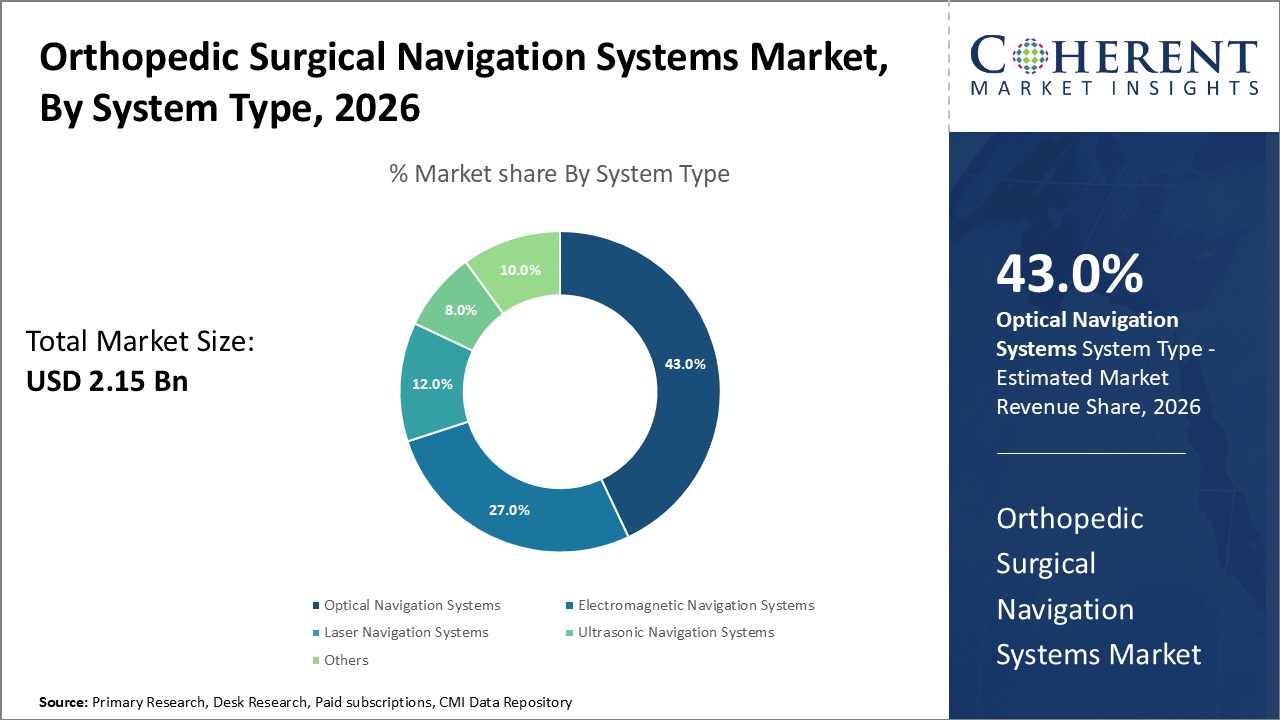
In the system type segment, Optical systems dominate with 43% share due to high accuracy, while electromagnetic systems grow fastest, overcoming line-of-sight limits and enabling minimally invasive spine and trauma surgeries.
In the End-User segment, Hospitals dominate with over 51% share due to infrastructure and volume, while ambulatory centers grow fastest as outpatient orthopedic procedures increase, driving wider adoption of navigation technologies.
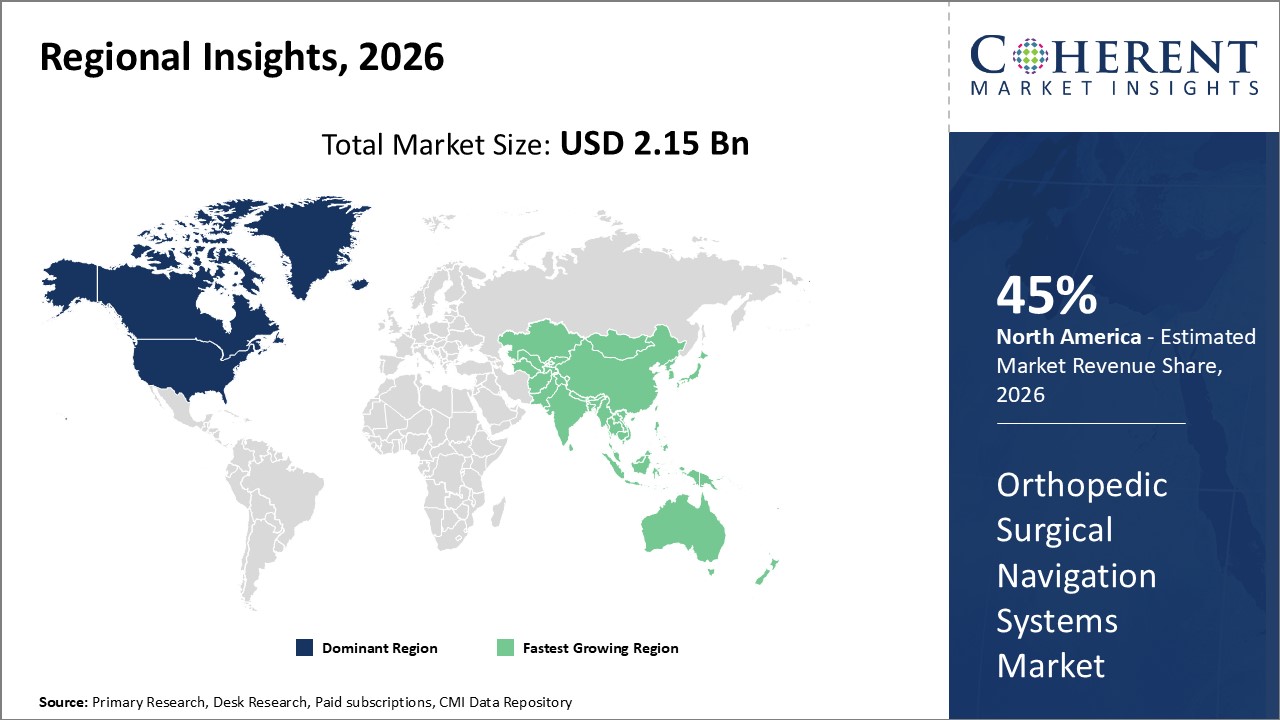
North America dominates due to strong healthcare infrastructure, while Asia Pacific shows fastest growth from hospital digitization. The U.S. leads innovation with high navigation-assisted procedures, and Germany advances adoption through strong manufacturing, AR integration, and support for minimally invasive surgery.
Orthopedic Surgical Navigation Systems Market Segmentation Analysis
Orthopedic Surgical Navigation Systems Market Insights, By System Type
In terms of system type, dominating Optical Navigation Systems hold approximately 42% of market revenue due to high accuracy and surgeon familiarity, especially in joint replacements. The fastest-growing Electromagnetic Navigation Systems use magnetic fields, enabling minimally invasive procedures in spine and trauma surgeries where optical systems face line-of-sight limitations. Laser and Ultrasonic systems serve specialized roles with smaller shares, while emerging hybrid technologies combining optical and electromagnetic modalities are expected to enhance precision and drive growth.
Orthopedic Surgical Navigation Systems Market Insights, By Applications
In applications, dominating Knee Replacement holds over 35% of market revenue due to high procedure prevalence and improved implant accuracy reducing revision rates. The fastest-growing Spine Surgery segment is expanding with rising spinal deformities and advanced navigation platforms enabling safer, minimally invasive procedures. Trauma Surgery and Hip Replacement contribute steadily, driven by fracture incidence and clinical needs, while the others segment, including tumor resections and sports-related surgeries, is gradually gaining traction as system versatility improves.
Orthopedic Surgical Navigation Systems Market Insights, By End-User
For end-users, dominating Hospitals lead with over 50% of market revenue due to superior infrastructure, high surgery volumes, and investment capacity. The fastest-growing Ambulatory Surgical Centers benefit from the shift toward outpatient orthopedic procedures requiring efficient navigation. Orthopedic Clinics and Research & Academic Institutes serve niche yet strategic roles, supporting clinical research and early adoption of innovative technologies. Rising demand for surgical accuracy and improved patient outcomes drives adoption across all end-user segments.
Orthopedic Surgical Navigation Systems Market Trends
Increasing incorporation of artificial intelligence into navigation systems enables predictive surgical analytics and better intraoperative decision-making. A 2024 clinical study reported a 15% reduction in revision surgeries at institutions using AI-augmented systems.
Development of compact, portable navigation platforms expands usage to outpatient and ambulatory surgical settings, increasing accessibility beyond traditional hospital environments.
Gradual shift from purely optical systems to hybrid models combining optical and electromagnetic tracking improves versatility, particularly in spine and trauma surgeries where line-of-sight limitations exist.
Trends focus on improving accuracy, reducing complications, and optimizing patient outcomes, driving broader adoption across orthopedic procedures and diverse clinical settings.
Orthopedic Surgical Navigation Systems Market Insights, By Geography
North America Orthopedic Surgical Navigation Systems Market Analysis and Trends
In North America, dominance in the Orthopedic Surgical Navigation Systems market stems from a sophisticated healthcare ecosystem, high expenditure on healthcare technology, and favorable reimbursement frameworks encouraging advanced surgical equipment adoption. The U.S. accounts for over 40% of global market revenue, supported by leading players headquartered there and early adoption of navigated surgeries.
Asia Pacific Orthopedic Surgical Navigation Systems Market Analysis and Trends
Meanwhile, Asia Pacific exhibits the fastest growth characterized by increasing hospital digitization, government initiatives promoting healthcare infrastructure modernization, and a growing patient population requiring orthopedic surgeries. Countries such as China and India have recorded double-digit CAGR in system installations, driven by expanding hospital networks and rising awareness about navigation benefits.
Orthopedic Surgical Navigation Systems Market Outlook for Key Countries
USA Orthopedic Surgical Navigation Systems Market Analysis and Trends
The U.S. market is propelled by intensive R&D investments and a large clinical base performing orthopedic surgeries. Strategic introductions of AI-enabled systems by companies like Medtronic and Stryker have enhanced procedural efficiency, with over 30% of total knee replacements now utilizing navigation assistance as of 2024. Institutional adoption is further supported by government grants targeting surgical innovation and nationwide training programs enhancing surgeon proficiency.
Germany Orthopedic Surgical Navigation Systems Market Analysis and Trends
Germany’s market gains strength from strong healthcare infrastructure, high per capita surgical procedures, and robust medical device manufacturing industry. Leading European companies like Brainlab AG have pioneered integration of augmented reality with navigation, contributing to over 38% of the regional market share. Rising collaborations between hospitals and tech innovators fuel continuous adoption, especially in spinal and trauma applications, complemented by government incentives promoting minimally invasive surgery adoption.
Analyst Opinion
The demand-side indicators reveal an increasing adoption rate of orthopedic surgical navigation systems in complex joint replacement surgeries, particularly in knee and hip arthroplasties. Recent hospital procurement data from 2024 shows a 23% year-over-year increase in system installations in tertiary care and specialty orthopedic hospitals, reflecting growing trust in navigation technologies for improved surgical outcomes.
Production capacity dynamics indicate that several market players are expanding manufacturing units with automation to meet accelerated demand. In 2026, new production lines dedicated to next-gen navigation devices have boosted supply availability by 16%, leading to reduced lead times and market revenue growth across regions.
Import trends highlight a rising flow of advanced navigation equipment from Asian manufacturing hubs to North America and Europe. Import volumes surged by 18% in 2024, driven by strategic trade agreements and increasing clinical trials validating system efficacy in diverse populations.
Across industry verticals, small and medium orthopedic clinics are increasingly integrating navigation systems by opting for cost-efficient and compact devices, expanding market scope beyond traditional large hospital settings. Diverse clinical applications in spinal surgeries and trauma fixation also indicate widening market adoption beyond primary joint procedures.
- Current Industry Events of 2026
- Market Size Estimation
- Regional Breakdown
- Competitive Landscape
- Customer Intelligence
- Segmental Analysis
- Pricing Analysis
- Key Market Drivers, Challenges & Future Trends
- Customized Insights Section
Market Scope
| Report Coverage | Details | ||
|---|---|---|---|
| Base Year: | 2026 | Market Size in 2026: | USD 2.15 billion |
| Historical Data for: | 2020 To 2024 | Forecast Period: | 2026 To 2033 |
| Forecast Period 2026 to 2033 CAGR: | 8.5% | 2033 Value Projection: | USD 3.80 billion |
| Geographies covered: |
| ||
| Segments covered: |
| ||
| Companies covered: | Medtronic PLC, Stryker Corporation, Zimmer Biomet Holdings Inc., Brainlab AG, Smith & Nephew plc, Globus Medical Inc., NuVasive Inc., DePuy Synthes (Johnson & Johnson), OrthAlign Inc., Intellijoint Surgical Inc., Orthofix International N.V., CAScination AG, THINK Surgical Inc., Corin Group PLC, AAP Implantate AG, XACT Robotics, Renishaw PLC, Marle SA, Medacta International SA, B. Braun Melsungen AG | ||
| Growth Drivers: |
| ||
Orthopedic Surgical Navigation Systems Market Growth Factors
The Orthopedic Surgical Navigation Systems market is growing rapidly due to the rising global burden of musculoskeletal disorders, with WHO data indicating a 20% increase in osteoarthritis and related conditions from 2022 to 2024. Technological progress, including AI-enhanced image processing and advanced 3D visualization, has improved surgical precision and reduced complication rates, strengthening the appeal of navigation-assisted procedures among surgeons.
Expansion of healthcare infrastructure in emerging economies, particularly in Asia Pacific, is accelerating adoption through hospital digitization programs and government incentives supporting modern surgical technologies. Additionally, the rising preference for minimally invasive orthopedic surgeries continues to drive demand, as navigation systems play a crucial role in reducing operative times, lowering revision risks, and improving overall patient outcomes.
Orthopedic Surgical Navigation Systems Market Development
In August 2023, Orthofix announced the U.S. launch of its 7D FLASH™ Navigation System Percutaneous Module 2.0, strengthening its position in the orthopedic surgical navigation systems market. The system uses machine-vision technology to deliver rapid 3D imaging, improving accuracy and workflow efficiency in minimally invasive spine procedures. This advancement supports growing adoption of next-generation navigation platforms across orthopedic and spine surgery settings.
In October 2026, Zimmer Biomet completed its acquisition of Monogram Technologies, enhancing its position in the orthopedic surgical navigation systems market. Monogram’s AI-driven, CT-based robotic platforms complement Zimmer Biomet’s ROSA navigation ecosystem, advancing semi- and fully autonomous joint replacement solutions. This integration strengthens the company’s competitive edge and accelerates development of next-generation orthopedic navigation and robotic technologies.
Key Players
Leading Companies of the Market
Medtronic PLC
Stryker Corporation
Zimmer Biomet Holdings, Inc.
Brainlab AG
Smith & Nephew plc
Globus Medical, Inc.
NuVasive, Inc.
DePuy Synthes (a Johnson & Johnson company)
OrthAlign, Inc.
Intellijoint Surgical, Inc.
Orthofix International N.V.
CAScination AG
THINK Surgical, Inc.
Corin Group PLC
AAP Implantate AG
XACT Robotics
Renishaw PLC
Marle SA
Medacta International SA
B. Braun Melsungen AG
Several leading companies have embraced strategic acquisitions and technology partnerships to consolidate their market position. For instance, Medtronic’s acquisition of a navigation-specific AI startup in 2024 enhanced its system capabilities, enabling real-time intraoperative analytics that improved surgical accuracy by 17%. Similarly, Stryker’s alliance with an augmented reality firm effectively streamlined surgeon training, increasing adoption rates by 12% in North America within one year.
Orthopedic Surgical Navigation Systems Market Future Outlook
The future outlook for the Orthopedic Surgical Navigation Systems market remains highly positive, driven by rapid technological innovation and growing clinical adoption. Advancements in AI-assisted planning, augmented reality overlays, and robotic-integrated navigation will significantly enhance surgical precision and workflow efficiency. Increasing global demand for minimally invasive orthopedic procedures will further accelerate system uptake across hospitals and ambulatory centers. Emerging markets in Asia Pacific and Latin America are expected to witness strong growth due to expanding healthcare infrastructure and rising awareness of navigation benefits. As hybrid optical-electromagnetic platforms mature, the market will continue shifting toward more versatile, portable, and data-driven navigation solutions.
Orthopedic Surgical Navigation Systems Market Historical Analysis
The historical growth of the Orthopedic Surgical Navigation Systems market has been shaped by steady advancements in imaging technologies, rising orthopedic surgery volumes, and increasing acceptance of computer-assisted procedures. Early adoption began with optical navigation systems, which gained traction in large hospitals due to their accuracy in joint replacement surgeries. Over the past decade, improvements in 3D visualization, sensor technology, and workflow integration broadened usage across spine and trauma procedures. Growing awareness of navigation’s role in reducing revision surgeries and improving implant alignment further accelerated adoption. Additionally, expanding reimbursement support and the emergence of portable systems strengthened market penetration globally.
Sources
Primary Research Interviews:
Orthopedic Surgeons
Spine SurgeonsJoint Replacement Specialists
Surgical Navigation Technologists
Hospital Procurement Managers
Operating Room (OR) Coordinators
Databases:
ClinicalTrials.gov
PubMed / MEDLINE
Global Health Data Exchange (GHDx)
World Health Organization (WHO) Global Health Observatory
National Institute of Arthritis and Musculoskeletal and Skin Diseases (NIAMS)
Magazines & Industry Publications:
Orthopedics Today
Becker’s Spine Review
Journal of Orthopaedic Surgery & Research News
Medical Device and Diagnostic Industry (MD+DI)
Journals:
Journal of Bone & Joint Surgery (JBJS)
Spine Journal
Journal of Orthopaedic Research
International Journal of Computer Assisted Radiology and Surgery
Journal of Arthroplasty
Associations & Organizations:
American Academy of Orthopaedic Surgeons (AAOS)
North American Spine Society (NASS)
International Society for Computer Assisted Orthopaedic Surgery (CAOS)
European Federation of National Associations of Orthopaedics and Traumatology (EFORT)
Get access to 250+ pages report
Every segment, forecast, competitor profile and data table behind the analysis above — available for instant download.
- ESOMAR Member
- ISO 9001:2015 Certified
- D-U-N-S Registered
- GDPR & CCPA Compliant
Missing comfort of reading report in your local language? Find your preferred language:
Transform your Strategy with Exclusive Trending Reports
Frequently Asked Questions
The dominant market players include Medtronic PLC, Stryker Corporation, Zimmer Biomet Holdings, Inc., and Brainlab AG, which collectively hold a significant share due to their strong R&D focus and expansive distribution networks.
The market size is projected to grow from USD 2.15 billion in 2026 to USD 3.80 billion by 2033, demonstrating a robust CAGR of 8.5% driven by technological innovations and increasing orthopedic surgeries.
Hospitals constitute the largest end-user segment by market share due to increasing capital investments and adoption of advanced surgical navigation technologies in complex procedural settings.
Market development will trend toward hybrid technology systems, AI integration for surgical planning, and cloud-based platforms enabling remote assistance and data sharing, reshaping surgical navigation landscape.
Competition revolves around innovation, strategic alliances, and expanding geographic reach, with challenges including high device costs, regulatory hurdles, and the need for surgeon training programs.
Market players emphasize technology partnerships, acquisitions, clinical collaborations, and localized marketing to strengthen presence and accelerate adoption of navigation systems globally.