

Surgical Navigation System Market Size and Forecast – 2026 to 2033
Global surgical navigation system market is estimated to be valued at USD 8.91 Bn in 2026 and is expected to reach USD 14.31 Bn by 2033, exhibiting a compound annual growth rate (CAGR) of 7.0% from 2026 to 2033.
Key Takeaways
- By Application, Orthopedic Surgeries hold the largest market share of 31.5% in 2026 owing to the rising incidence of orthopedic disorders & ageing population.
- By Technology, CT-based navigation systems expected to hold largest market share of 31.6% in 2026 owing to the superior anatomical detail of bone/osseous structures.
- By End User, Hospital and nursing homes acquired the prominent market share of 61.5% in 2026 owing to its high volume of complex and specialty surgeries in hospitals.
- By Region, North America dominates the overall market with an estimated share of 39.7% in 2026 owing to the well-developed healthcare infrastructure & high surgical volumes.
Market Overview
Rising demand for precision and minimally invasive surgeries across orthopedic, neurosurgical, and ENT procedures is driving steady the surgical navigation system market growth. Advancements in imaging, robotics, and artificial intelligence enhance surgical accuracy and efficiency. Hospitals and specialized surgical centers increasingly adopt these systems as healthcare infrastructure and surgeon awareness improve. Ongoing technological innovation and the integration of real-time navigation tools actively transform surgical workflows and elevate patient outcomes across the globe.
Current Events and their Impact on the Surgical Navigation System Market
Current Events | Description and its impact |
Technological Advancements in AI and Robotics |
|
Geopolitical and Economic Factors |
|
Clinical Trends and Healthcare Practices |
|
Role of AI (Artificial Intelligence) in Surgical Navigation System
Artificial Intelligence (AI) plays a crucial role in modern surgical navigation systems by enhancing precision, safety, and efficiency during complex procedures. AI algorithms process real-time imaging data to create accurate 3D visualizations, helping surgeons plan and navigate with greater accuracy. It enables automatic identification of anatomical structures, predicts surgical outcomes, and minimizes human error. By integrating AI with advanced imaging technologies like the O-ARM system, surgeons can perform minimally invasive surgeries with improved alignment and reduced operation time. Overall, AI transforms surgical navigation into a smarter, data-driven process that improves patient outcomes and surgical confidence.
In April 2025, Kauvery Hospital Alwarpet introduced Chennai’s first O-ARM with Navigation System—an AI-powered imaging platform revolutionizing complex brain, spine, and orthopedic surgeries.
- Current Industry Events of 2026
- Market Size Estimation
- Regional Breakdown
- Competitive Landscape
- Customer Intelligence
- Segmental Analysis
- Pricing Analysis
- Key Market Drivers, Challenges & Future Trends
- Customized Insights Section
Segmental Insights
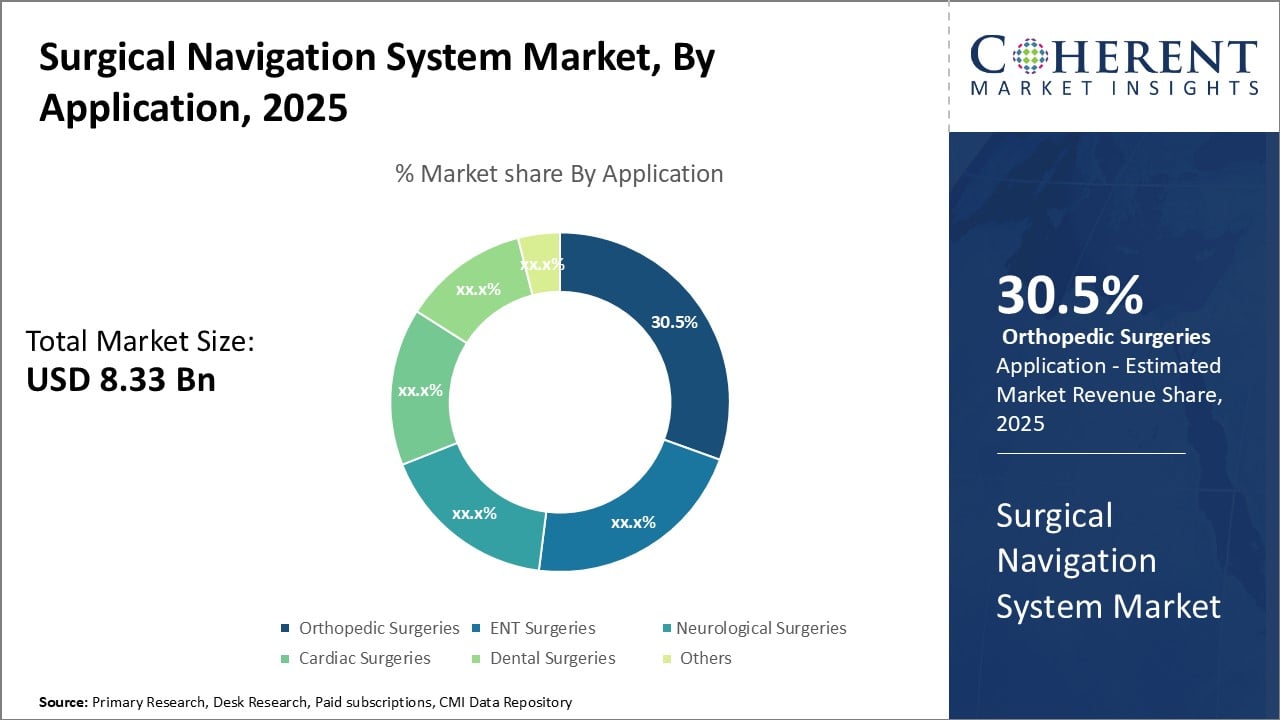
Surgical Navigation System Market Insights, by Application: Orthopedic Surgeries contribute the highest share of the market owing to its demand for improved surgical outcomes and cost-efficiency.
Orthopedic Surgeries hold the largest market share of 31.5% in 2026. The rising volume of orthopedic surgeries drives the surgical navigation system market as surgeons pursue higher precision and better patient outcomes. Growing incidences of bone and joint disorders, combined with an aging population, intensify the demand for advanced surgical guidance. These systems help surgeons achieve accurate implant placement, proper alignment, and perform minimally invasive procedures. Ongoing advancements in 3D imaging, robotics, and computer-assisted navigation enable orthopedic specialists to improve efficiency, minimize complications, and enhance patient recovery. For instance, in October 2025, Hospital for Special Surgery (HSS), the nation’s top-ranked orthopedic hospital, collaborated with global investor General Atlantic to launch a new independent network of ambulatory surgery centers (ASCs) focused on advanced, patient-centered orthopedic and spine outpatient care.
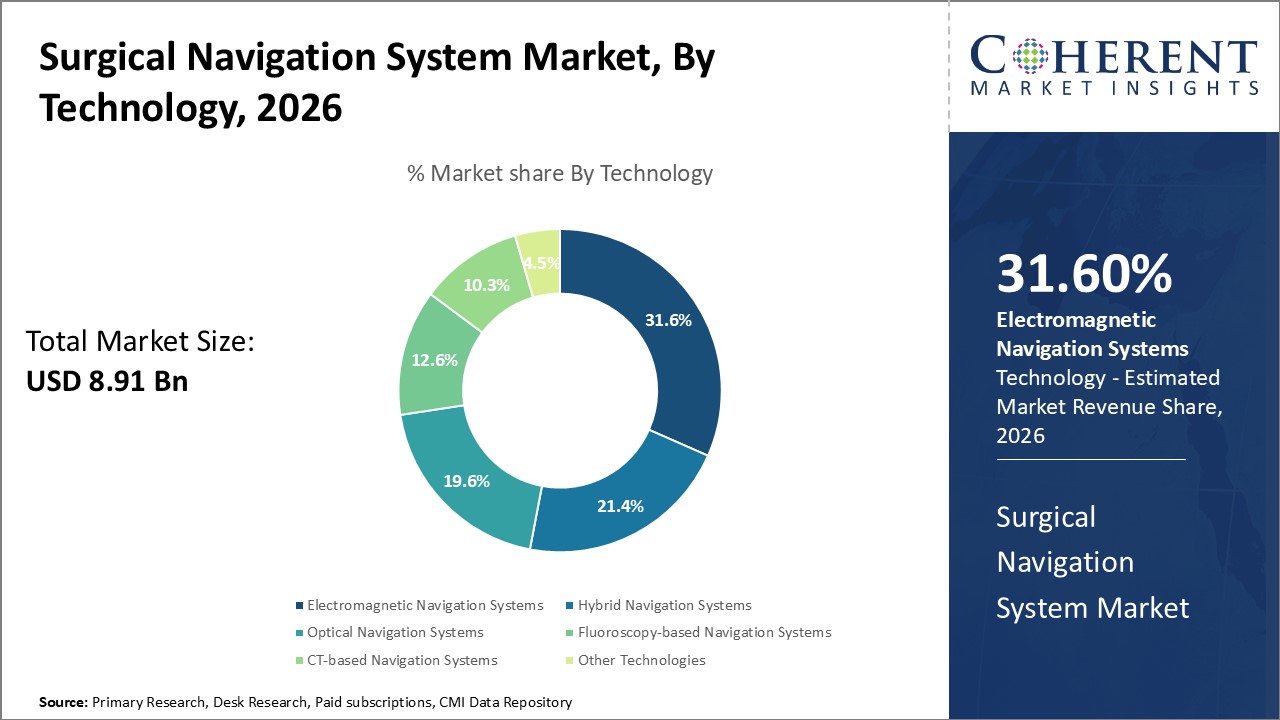
Surgical Navigation System Market Insights, by Technology: CT-based navigation systems contribute the highest share of the market owing to its growing availability & improvements in CT imaging systems.
CT-based navigation systems expected to hold largest market share of 31.6% in 2026. CT-based navigation systems drive growth in the surgical navigation system market by delivering highly accurate imaging and detailed 3D visualization of bone structures. Surgeons use these systems to plan and perform complex orthopedic, spinal, and neurosurgical procedures with superior precision. Expanding access to advanced CT scanners and integration with intraoperative imaging strengthen real-time surgical guidance. Ongoing enhancements in image processing and software algorithms boost adoption, helping surgeons achieve safer, faster, and more effective surgical outcomes. For instance, in November 2024, Globus Medical, Inc., a leading musculoskeletal solutions company, launched the ExcelsiusHub™ navigation system, expanding its Excelsius™ technology ecosystem and setting a new standard for freehand navigation.
Surgical Navigation System Market Insights, by End User: Hospital and nursing homes contribute the highest share of the market owing to its large patient flow and concentration of cases in hospitals.
Hospital and nursing homes acquired the prominent market share of 61.5% in 2026. Hospitals and nursing homes increasingly adopt surgical navigation systems to boost surgical precision, enhance patient safety, and streamline operative workflows. High volumes of complex procedures, such as orthopedic, spinal, and neurosurgeries, drive demand for advanced guidance technologies. Healthcare facilities invest in modern operating rooms, advanced imaging infrastructure, and surgeon training to integrate these systems effectively. By reducing complications, minimizing revision surgeries, and improving efficiency, they deliver better patient outcomes, attract more patients, and strengthen their competitive position in the evolving surgical landscape. For instance, in April 2025, Kauvery Hospital Alwarpet, part of the Kauvery Group, introduced Chennai’s first O-ARM with Navigation System, an AI-powered imaging platform aimed at improving complex brain, spine, and orthopedic surgeries.
Regional Insights
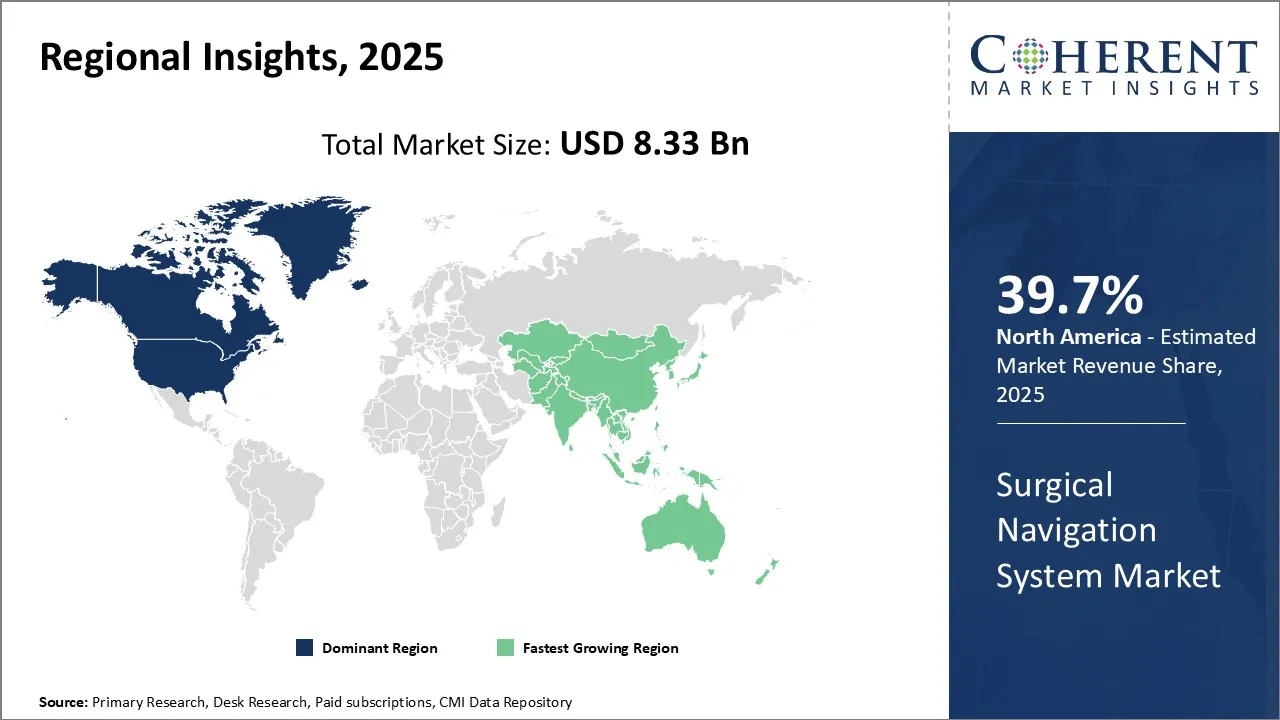
North America Surgical Navigation System Market Trends
North America dominates the overall market with an estimated share of 39.7% in 2026. In North America, hospitals and specialized surgical centers widely adopt surgical navigation systems to meet the growing demand for precision in complex orthopedic, spinal, and neurosurgical procedures. Advanced imaging technologies and real-time navigation tools improve surgical outcomes and enhance operational efficiency. Hospitals actively invest in hybrid operating rooms and state-of-the-art imaging infrastructure to support these systems. Additionally, favorable reimbursement policies and the increasing focus on minimally invasive procedures drive broader adoption and expansion of the market. For instance, in September 2026, Brainlab, a digital medical technology company, received FDA 510(k) clearance and launched Spine Mixed Reality Navigation in the U.S., providing surgeons with mixed reality guidance for ergonomic pedicle screw placement directly in their field of view.
Asia Pacific Surgical Navigation System Market Trends
The Asia Pacific surgical navigation system market share grows rapidly as hospitals and surgical centers perform more complex procedures and adopt advanced medical technologies. India, China, and Japan lead the region, with India showing the highest adoption rates. Rising medical tourism in countries like Thailand and Malaysia further boosts demand. Hospitals implement technological innovations, including AI integration and hybrid operating rooms, to improve surgical precision and patient outcomes. Despite cost and infrastructure challenges, the region actively drives market expansion through healthcare modernization. For instance, City Mayor Ms. Sunkara Pavani inaugurated the first Neuro Navigation system in Andhra Pradesh’s coastal districts at Apollo Hospitals, Kakinada, praising the hospital for enabling more accurate, minimally invasive brain tumor and spinal surgeries.
United States Surgical Navigation System Market Trends
In the United States, hospitals and surgical centers are rapidly adopting surgical navigation systems to meet the growing demand for precision in orthopedic, spinal, and neurosurgical procedures. Advanced technologies, including AR and robotic-assisted systems, improve accuracy and patient outcomes. Real-time imaging and navigation tools streamline workflows, making surgeries more efficient and reducing recovery times. Favorable reimbursement policies and continuous investment in healthcare infrastructure actively support the widespread use of these systems nationwide. For instance, in April 2026, Medivis Inc., a leader in surgical intelligence, received FDA 510(k) clearance for its Spine Navigation platform, using AR and AI to provide surgeons with holographic guidance for open and minimally invasive spine procedures.
China Surgical Navigation System Market Trends
In China, hospitals are rapidly expanding their use of surgical navigation systems as healthcare investments rise and advanced medical technologies are adopted. Surgeons integrate these systems into complex orthopedic, spinal, and neurosurgical procedures to enhance precision and improve patient outcomes. Government initiatives on healthcare modernization and infrastructure development actively support widespread implementation. Additionally, growing medical tourism and increasing demand for minimally invasive surgeries drive further market growth across the country.
End-user Feedback and Unmet Needs in the Surgical Navigation System Market
- Precision and Accuracy Demands: Surgeons highlight the need for consistently high accuracy in complex procedures like orthopedic, spinal, and neurosurgeries. Current systems sometimes require frequent calibration or manual adjustments, causing workflow delays. End-users seek navigation tools that minimize errors, provide real-time feedback, and integrate seamlessly with imaging modalities for more reliable surgical guidance.
- Ease of Use and Workflow Integration: End-users report challenges with system complexity, prolonged setup times, and steep learning curves. They demand intuitive interfaces, simplified calibration, and faster system responsiveness. Improved integration with hospital IT infrastructure, imaging devices, and robotic platforms can streamline surgical workflows, reduce OR time, and enhance overall operational efficiency.
- Cost and Accessibility Constraints: Hospitals and surgical centers often face budget limitations when adopting navigation systems. High upfront costs and maintenance expenses restrict widespread implementation, particularly in smaller facilities. End-users desire affordable solutions without compromising precision, along with flexible pricing models, leasing options, or modular systems that allow incremental adoption over time.
Surgical Navigation System Market Trend
Rise of Minimally Invasive and Complex Surgeries
The increasing preference for minimally invasive procedures in orthopedics, neurosurgery, and spinal operations is driving demand for surgical navigation systems. Surgeons rely on these technologies for precise guidance in confined operative spaces, reducing complications and recovery times. Hospitals are integrating navigation systems to enhance surgical outcomes, optimize workflow, and meet patient expectations, making advanced guidance tools an essential component of modern surgical practice.
Integration of Advanced Imaging and Real-Time Navigation
Surgical navigation systems increasingly incorporate high-resolution imaging and real-time feedback, enabling accurate intraoperative decision-making. The integration of CT, MRI, and 3D imaging with navigation platforms improves visualization, implant placement, and alignment accuracy. This trend allows surgeons to plan and adjust procedures dynamically, enhancing patient safety, minimizing errors, and increasing procedural efficiency across multiple surgical specialties.
Surgical Navigation System Market Opportunity
Development of Hybrid Operating Rooms
The development of hybrid operating rooms, equipped with advanced imaging and navigation technologies, offers significant opportunities for surgical navigation systems. These integrated environments facilitate complex procedures by providing real-time imaging and navigation support, enhancing surgical precision and efficiency. The growing trend towards minimally invasive surgeries further drives the demand for such advanced operating room setups, positioning hybrid ORs as a key area for investment and innovation in surgical navigation technologies.
Market Report Scope
Surgical Navigation System Market Report Coverage
| Report Coverage | Details | ||
|---|---|---|---|
| Base Year: | 2025 | Market Size in 2026: | USD 8.91 Bn |
| Historical Data for: | 2020 To 2024 | Forecast Period: | 2026 To 2033 |
| Forecast Period 2026 to 2033 CAGR: | 7.0% | 2033 Value Projection: | USD 14.31 Bn |
| Geographies covered: |
| ||
| Segments covered: |
| ||
| Companies covered: | Amplitude Surgical SA, Brainlab AG, B. Braun Melsungen AG, Intersect ENT, Karl Storz GmbH & Co. KG, Medtronic PLC, Scopis GmbH, Siemens Aktiengesellschaft, Stryker Corporation, Zimmer Biomet Holdings, Inc., GE Healthcare, Fiagon GmbH, OMNI, Intuitive Surgical, Inc., Smith & Nephew, Arthrex, Inc., NuVasive, Inc., Accuray Incorporated, and Philips Healthcare | ||
| Growth Drivers: |
| ||
| Restraints & Challenges: |
| ||
Surgical Navigation System Market News
- In June 2025, Yas Clinic – Khalifa City has introduced its advanced robotic spine surgery program, featuring an AI-driven medical navigation system, marking a transformative step in precision medicine and patient care.
- In July 2025, MediView launched a multicenter study to validate its XR90 Holographic Surgical Navigation system, aiming to assess its efficiency as an adjunct to standard imaging like ultrasound and CT in percutaneous tumor biopsies.
- In June 2025, ChoiceSpine LLC, a U.S. spinal implant company, partnered with surgical robotics innovator eCential Robotics to launch the ChoiceSpine™ app for use on the eCential Op.n™ robotic and navigation platform.
- In April 2024, Medtronic India has introduced its NeuroSmart™ Portable Micro Electrode Recording (MER) Navigation system for deep brain stimulation (DBS) to treat Parkinson’s disease.
Analyst Opinion (Expert Opinion)
- The surgical navigation systems market is experiencing a paradigm shift, driven by technological advancements and an increasing demand for precision in complex surgeries. The integration of augmented reality (AR), artificial intelligence (AI), and robotics is not just enhancing surgical outcomes but is fundamentally transforming the way surgeries are performed.
- The adoption of these advanced systems is accelerating, particularly in neurosurgery, orthopedics, and ENT procedures. Hospitals and academic medical centers are leading this charge, accounting for nearly 68% of the market share in 2024. This trend is further supported by the growing prevalence of age-related conditions such as osteoarthritis and neurological disorders, which are increasing the demand for precise surgical interventions.
- However, the rapid evolution of surgical navigation technologies presents challenges in terms of integration and standardization. While systems like Intuitive Surgical's da Vinci and Ion platforms have demonstrated significant growth—reporting a 19% rise in global procedure usage and a 13% uptick in placements in a recent quarter—the broader healthcare ecosystem must ensure interoperability and consistency across various platforms. Without standardized protocols, the potential for fragmented care increases, potentially compromising patient outcomes.
Speak to the analyst
Want personalized insights?
Take the findings above to one of our principal consultants, or have the report rebuilt around the segments, geographies and competitors you actually track.
Market Segmentation
- Application Insights (Revenue, USD Bn, 2021 - 2033)
- Neurological Surgeries
- ENT Surgeries
- Orthopedic Surgeries
- Cardiac Surgeries
- Dental Surgeries
- Others
- Technology Insights (Revenue, USD Bn, 2021 - 2033)
- Electromagnetic Navigation Systems
- Hybrid Navigation Systems
- Optical Navigation Systems
- Fluoroscopy-based Navigation Systems
- CT-based Navigation Systems
- Other Technologies
- End User Insights (Revenue, USD Bn, 2021 - 2033)
- Hospital and Nursing Home
- Ambulatory Surgical Centers
- Others
- Regional Insights (Revenue, USD Bn, 2021 - 2033)
- North America
- U.S.
- Canada
- Latin America
- Brazil
- Argentina
- Mexico
- Rest of Latin America
- Europe
- Germany
- U.K.
- Spain
- France
- Italy
- Russia
- Rest of Europe
- Asia Pacific
- China
- India
- Japan
- Australia
- South Korea
- ASEAN
- Rest of Asia Pacific
- Middle East
- GCC Countries
- Israel
- Rest of Middle East
- Africa
- South Africa
- North Africa
- Central Africa
- Key Players Insights
- Amplitude Surgical SA
- Brainlab AG
- B. Braun Melsungen AG
- Intersect ENT
- Karl Storz GmbH & Co. KG
- Medtronic PLC
- Scopis GmbH
- Siemens Aktiengesellschaft
- Stryker Corporation
- Zimmer Biomet Holdings, Inc.
- GE Healthcare
- Fiagon GmbH
- OMNI
- Intuitive Surgical, Inc.
- Smith & Nephew
- Arthrex, Inc.
- NuVasive, Inc.
- Accuray Incorporated
- Philips Healthcare
Sources
Primary Research Interviews
- Interviews with surgeons and medical professionals specializing in neurosurgery, orthopedics, and ENT procedures.
- Discussions with biomedical engineers involved in the development and integration of surgical navigation technologies.
- Conversations with hospital administrators regarding the adoption and implementation of navigation systems in surgical departments.
Databases
- PubMed: A comprehensive database for peer-reviewed articles on surgical navigation systems and their clinical applications.
- IEEE Xplore: Provides access to research papers on the technological advancements in surgical navigation, including robotics and augmented reality.
- Scopus: A multidisciplinary database offering articles on the efficacy and outcomes of navigation systems in various surgical specialties.
Magazines
- Surgical Innovation: A peer-reviewed journal focusing on minimally invasive surgical techniques and new technologies.
- Journal of Robotic Surgery: Covers robotic surgery, including surgical simulation and medical imaging techniques.
Journals
- International Journal of Cranio Maxillofacial Surgery and Rehabilitation: Publishes articles on navigation systems in oral and maxillofacial surgery.
- The Saudi Dental Journal: Features research on dynamic navigation systems in dento-alveolar surgery.
- Journal of Pharmaceutical Negative Results: Includes reviews on navigation systems in neurosurgery.
Newspapers
- The Times of India: Reports on the introduction of navigation systems in endoscopic sinus surgery at GMCH-32 in Chandigarh.
Associations
- Society of Robotic Surgery: An organization that publishes the Journal of Robotic Surgery and focuses on robotic surgical techniques.
Public Domain Sources
- National Institutes of Health (NIH): Provides access to research and clinical trial data on surgical navigation systems.
- World Health Organization (WHO): Offers global health statistics and reports relevant to surgical procedures and technologies.
Proprietary Elements
- CMI Data Analytics Tool
- Proprietary CMI Existing Repository of information for last 8 years
Get access to 250+ pages report
Every segment, forecast, competitor profile and data table behind the analysis above — available for instant download.
- ESOMAR Member
- ISO 9001:2015 Certified
- D-U-N-S Registered
- GDPR & CCPA Compliant
Missing comfort of reading report in your local language? Find your preferred language:
Transform your Strategy with Exclusive Trending Reports
Frequently Asked Questions
The Surgical Navigation System Market is estimated to be valued at USD 8.91 Bn in 2026, and is expected to reach USD 14.31 Bn by 2033.
The CAGR of the Surgical Navigation System Market is projected to be 7.0% from 2026 to 2033.
Rising prevalence of target diseases and advancing technological capabilities are the major factors driving the growth of global surgical navigation system market.
High cost of surgical navigation systems and availability of alternative surgical guidance methods are the major factors hampering the growth of global surgical navigation system market.
In terms of application, orthopedic surgeries segment is estimated to dominate the market in 2026.
Amplitude Surgical SA, Brainlab AG, B. Braun Melsungen AG, Intersect ENT, Karl Storz GmbH & Co. KG, Medtronic PLC, Scopis GmbH, Siemens Aktiengesellschaft, Stryker Corporation, Zimmer Biomet Holdings, Inc., GE Healthcare, Fiagon GmbH, OMNI, Intuitive Surgical, Inc., Smith & Nephew, Arthrex, Inc., NuVasive, Inc., Accuray Incorporated, and Philips Healthcare are the major players.
North America is expected to lead the global surgical navigation system market.