

Radiology Information System Market Size and Share Analysis: 2026-2033
The Radiology Information System Market is anticipated to grow at a CAGR of 11.3% with USD 1.16 Bn in 2026 and is expected to reach USD 2.45 Bn in 2033. This growth in the market is driven by the rapid digitalization of healthcare workflows and rising demand for integrated imaging data management systems.
Key Takeaways
- Integrated RIS accounts for the largest share of 58.4% in 2026, driven by the growing demand for seamless interoperability between radiology workflows, PACS, and electronic health records (EHR). By 2025, 76% of hospitals in the U.S. were using all four core interoperability domains. Also, 96% of non-federal acute care hospitals had adopted certified EHRs as the standard digital backbone for connected workflows, which increased the need for integrated RIS-PACS-EHR environments.
- Based on Component, Software will dominate with a share of 63.7% in 2026, supported by the rising adoption of AI-enabled analytics, automated reporting and workflow optimization tools. In 2025, 70% of radiology departments were already using AI tools. A pilot study in npj Digital Medicine in 2025 found that AI-assisted radiology reporting cut the median reporting time by 27.1%–28.8% without making the reports any less accurate.
- Based on End User, Hospitals hold the dominant share of 58.9% in 2026 on account of their ability to handle high imaging volumes and integrate advanced healthcare IT systems.
- North America is expected to acquire the dominant share of 39.6% in 2026, attributed to high healthcare IT spending and early adoption of AI-powered radiology solutions. The northeastern United States has the highest estimated IT costs for hospitals, with an average of USD 18.7 million in 2024. The northeast region has higher averages because it has big hospitals in big cities like New York City and in metropolitan areas in states like New Jersey and Massachusetts
Segmental Insights
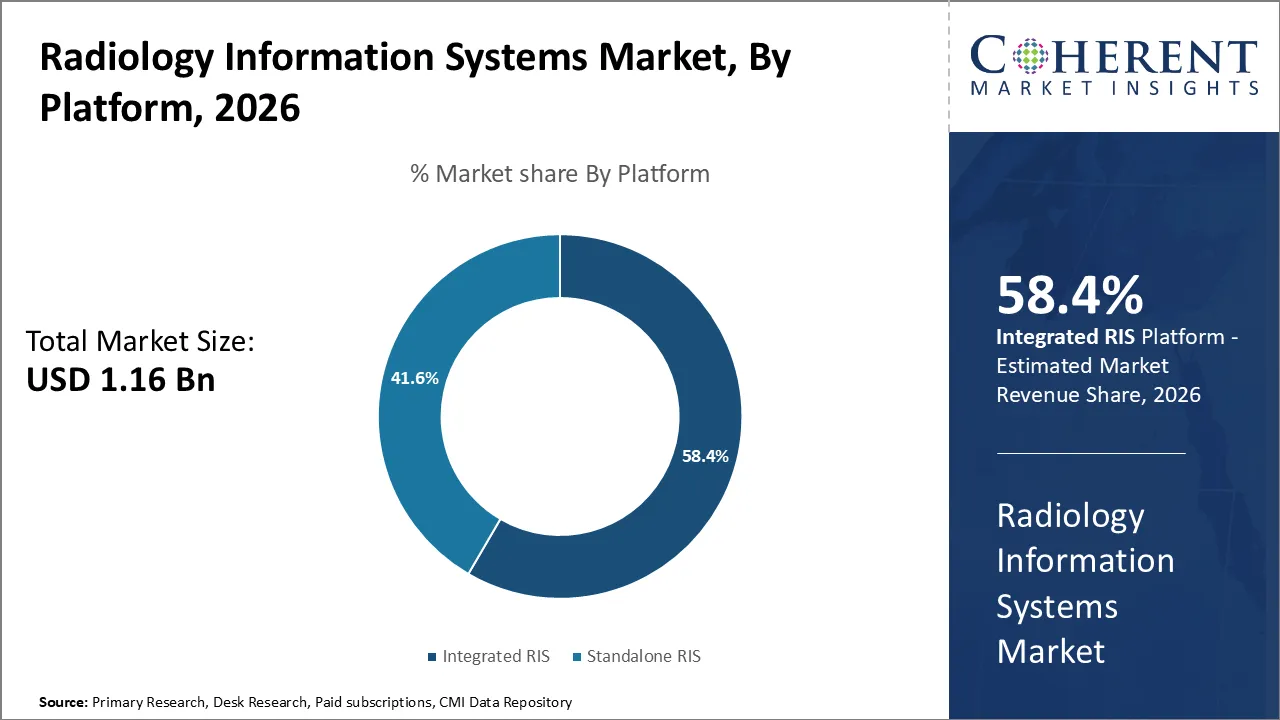
Which Platform segment dominates the Radiology Information System Market?
As a result of its capacity to easily work along with Picture Archiving & Communication Systems (PACS) and Electronic Health Records (EHR), the integrated RIS segment is accounted to command about 58.4% of the market share in 2026, this dominance is due to the increase in demand for centralized data management and interoperability among health systems.
In 2025, it was estimated that 70% or more of the large healthcare providers around the world invested into integrated health IT systems, driven by the need to improve patient outcomes, data accuracy, and compliance with government regulations.
MedSoftwares put out their Medical Imaging & PACS Software Guide 2026 on February 21, 2026. The guide talks about how teleradiology, cloud-native platforms, and AI-assisted interpretation are changing the way medical imaging and data management are done.
- Current Industry Events of 2026
- Market Size Estimation
- Regional Breakdown
- Competitive Landscape
- Customer Intelligence
- Segmental Analysis
- Pricing Analysis
- Key Market Drivers, Challenges & Future Trends
- Customized Insights Section
Why is Software segment acquiring the Dominant Share in the Radiology Information System Market?
The software segment for 2026 is anticipated to hold the largest share at 63.7% which primarily reflects the importance of all software in the management of radiology workflow, patient data and reporting systems within a healthcare provider’s facility. Advanced RIS addresses tedious tasks traditionally handled by administrative personnel through automated scheduling, real-time reporting as well as billing integration, and enhanced abilities to utilize artificial intelligence-enabled analytics to assist healthcare organizations with enhancing their accuracy of diagnosis and shortening the time required to obtain results.
The increased utilization by companies of tools based on artificial intelligence (AI) and data analysis is driving rapid growth rates for many years of the market. As an example, some recent estimates show at least 60%-65% of all radiology departments around the world have either implemented AI-enabled software products or are planning on doing so to improve workflow efficiencies and increased accuracy of diagnoses.
On March 4, 2026, DeepHealth, a RadNet, Inc. company, showed off its most complete set of native clinical AI solutions for major imaging modalities at ECR 2026. The platform combined MR, CT, X-ray, mammography, and ultrasound capabilities into one system that could do detection, assessment, and monitoring all at once
Which deployment segment dominates the market?
Cloud-based deployments account for the largest market share with approximately 55.2% in 2026, and are projected to grow at a CAGR of around 10% during the forecast period. Cloud-based RIS Solutions dominate because of their cost efficiency, flexibility and scalability compared to on-premise segment. They allow healthcare providers to access imaging data securely from anywhere in the world, allowing for increased growth of tele-radiology services and providing seamless functions for multi-site healthcare networks.
The accelerating shift to a digital healthcare ecosystem is creating an additional growth factor for the cloud-based RIS market. It was estimated that more than 60% of healthcare organizations made the transition to cloud-based radiology information system (RIS) or similar type of imaging IT solutions in 2025, indicating a strong transition toward digital transformation in radiology workflow processes.
Which end-user segment dominates the market?
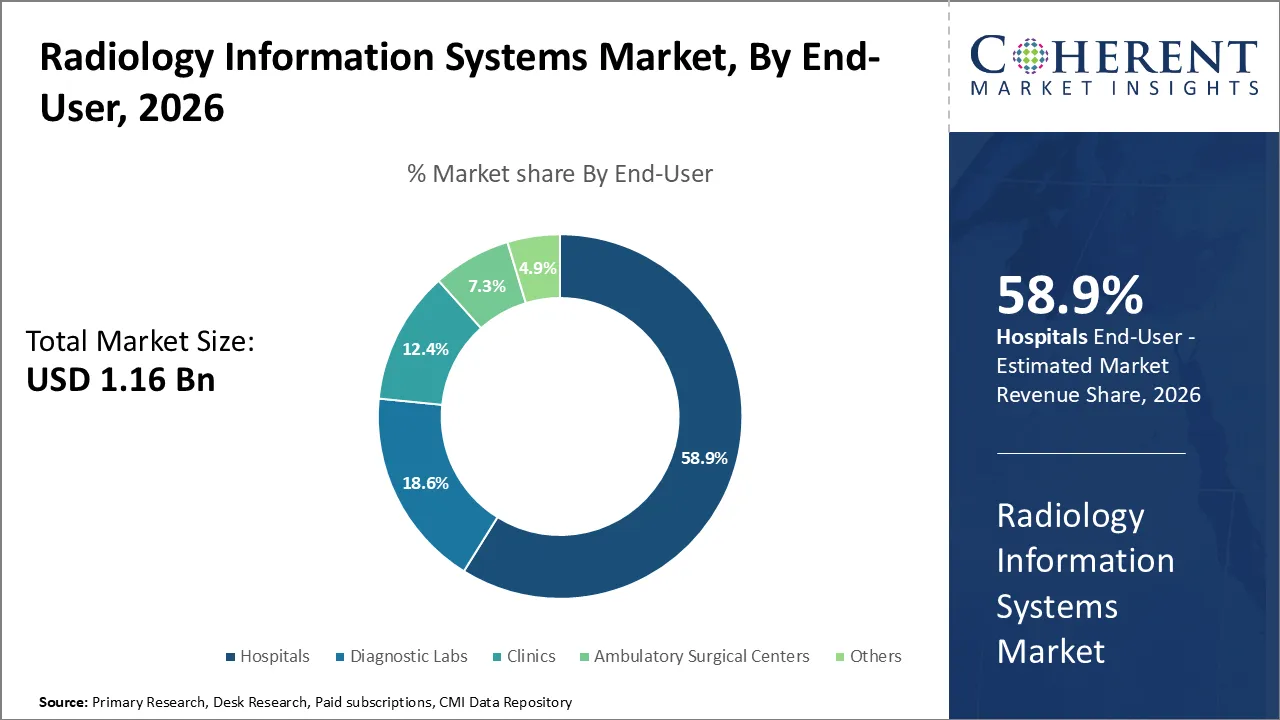
In 2026, hospitals will represent 58.9% of the total market share, because hospitals improve workflow efficiency, enhance reporting accuracy and reduce turnaround time with hospital IT infrastructure, large radiology volume and the integration of RISP, EHR and PACS. Large hospitals often have multi-specialty diagnostic departments that require an efficient way to manage data for workflow streamlining, reporting accuracy improvement and turnaround time reduction.
The growing burden of chronic disease drives the demand for diagnostic imaging. In 2025, chronic diseases globally were on a rise. For example, by 2030, the number of cancer cases is expected to exceed 24 million, creating an increased need for advanced imaging diagnostics.
Radiology Information System Market Trends
- By 2025, the number of diagnostic imaging procedures that were performed took place worldwide was more than 650 million, which means that a need for more efficient data management and workflow systems has been created.
- Approximately 60% of healthcare organizations implemented cloud-based health information technology systems due to the demand for more scalable systems that offer remote access and lower infrastructure costs in 2025.
Rising Innovations in the Radiology Information System Market: AI-Driven Radiology workflow Optimization
Artificial Intelligence has revolutionized the Radiology Information System Market by improving diagnostic accuracy and functionality through increased levels of automation and efficiencies in multiple ways. For Example, AI-enabled radiology information systems can automate scheduling, facilitate intelligent image-previewing capabilities before they are sent out to users and generate real-time reports, thereby shortening turnaround times for patients receiving care from radiologists.
In addition, the use of machine learning algorithms engineered into radiology information systems allows facility managers to predict patient flow (or manage resources), as well as detect abnormalities earlier than previously possible. Moreover, cloud-based applications facilitate interoperability among different healthcare technologies and support seamless exchange of images across clinical departments and between facilities. These Innovations contribute to increased operational efficiency, reduce opportunities for human error, and give radiologists more time to work on complex films.
On March 4, 2026, DeepHealth, a RadNet, Inc. company, showed off its most complete set of native clinical AI solutions for major imaging modalities at ECR 2026. The platform combined MR, CT, X-ray, mammography, and ultrasound capabilities into one system that could do detection, assessment, and monitoring all at once.
Cloud-Native RIS platforms: A Major Breakthrough in Imaging Data Management
The development of cloud-native radiology information systems (RIS) is causing the rapid growth of the RIS market by providing scalable, low-cost and secure data management solutions. This means that healthcare organizations will no longer need to purchase and maintain on-premise infrastructure to manage their radiology information, they will have fast and reliable access to the data in the cloud, as well as the ability to recover form disasters. Additionally, cloud RIS systems are designed to comply with regulations that apply to healthcare organizations, due to their use of advanced encryption methods.
On November 27, 2025, AdvaHealth Solutions unveiled AdvaPACS, a cloud-native and AI-driven imaging platform, at RSNA 2025. AdvaPACS combines imaging workflow functions like reporting, diagnostic viewing, clinician access, and patient access into a fully managed cloud-native platform that doesn't need local servers or a lot of setup time. It can be set up in less than 15 minutes.
Current Events and Their Impact on the Radiology Information System Market (regulatory shifts, government policies)
Current Event | Description and its Impact |
EU AI Act Adoption Impacting Radiology IT Systems |
|
U.S. ONC Interoperability Rule Enforcement Expansion |
|
FDA Regulation of AI in Radiology Software |
|
Regional Insights
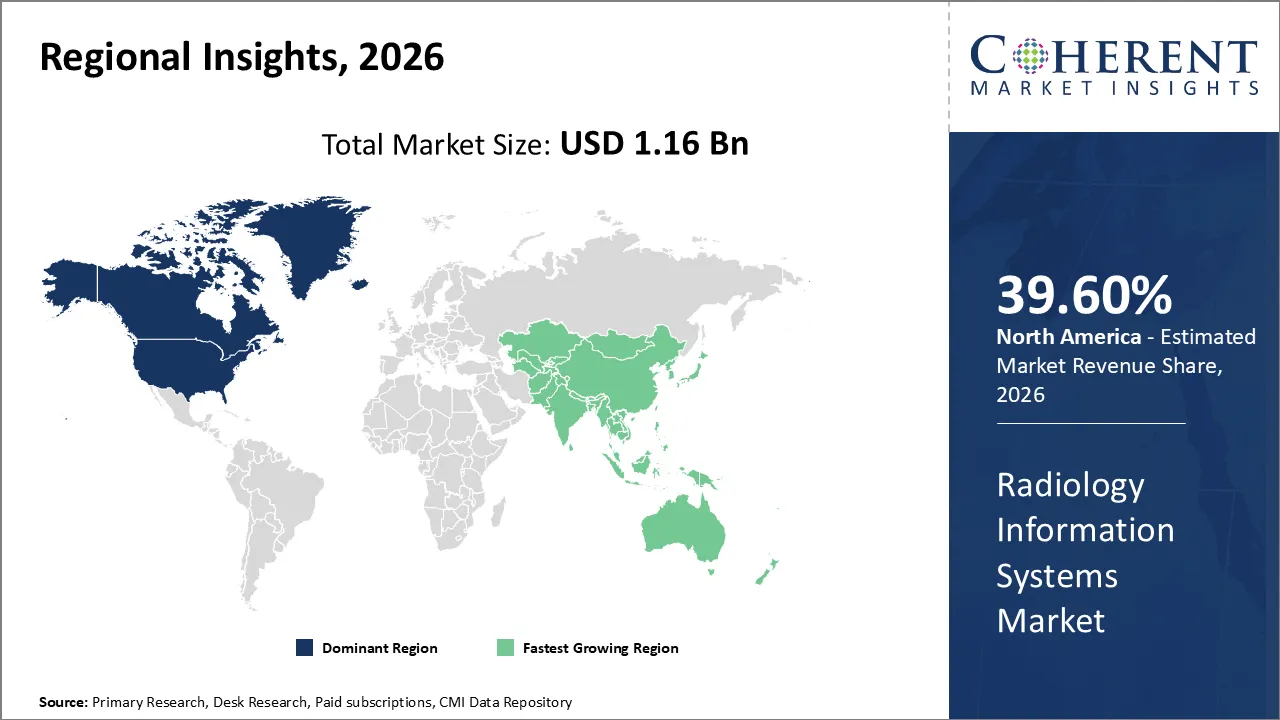
North America dominates owing to growing adoption of advanced healthcare IT systems
With 39.6% of the total market share in Radiology Information Systems (RIS) predicted for 2026, North America is anticipated to continue its rapid growth in this sector due, in part, to the growing adoption of digital healthcare systems and major companies’ presence in the industry. The continuous demand for improved imaging data management and growing use of artificial intelligence (AI) in radiologic workflows systems are major factors driving the growth of the North American RIS market. In addition, the number of diagnostic imaging procedures performed in the U.S. each year and positively contributes to the market growth of RIS. To illustrate, the U.S. performs over 80 million computed tomography (CT) scans per year, demonstrating a clear need for advanced imaging data management systems.
Technological advances in innovation have also positively impacted the market, for example in August 2025, GE HealthCare launched a RIS platform to automate workflow and improve the accuracy of diagnoses in hospitals throughout the U.S. Also in June 2025, via investments in clouds Storage for imaging, Canada began expanding their digital health infrastructure to improve data sharing between provinces. Overall, this will result in continued growth of the Radiology Information System market in both regions for many years to come.
Asia Pacific Radiology Information System Market
It is widely anticipated that the Asia-Pacific region will grow the fastest, with an average annual growth rate of 22% in 2026. The demand for diagnostic imaging services and investments into Healthcare IT infrastructure is both contributing factors to this growth trend. Countries such as India and China are undergoing digital transformation within their healthcare systems. While India is rolling out nationwide initiatives to digitize the health system, China is increasing its hospital infrastructure and increasing its imaging capabilities to accommodate its massive population.
In addition, many of the key players across Asia-pacific, in countries like China, Japan and India are progressively adopting cloud-based radiology information systems (RIS) to improve productivity. A research team within the Chinese academy of sciences introduced an Artificial Intelligence (AI) enabled Imaging workflow system designed to improve diagnostic Imaging efficiency by over 30% in January 2026. This AI-enabled system is intended to simplify radiology data processing, which in turn will lead to a reduction in reporting delays.
Country Analysis
United States Leads driven by advanced radiology infrastructure and high imaging volumes
The advanced healthcare IT infrastructure and early adoption of AI-driven diagnostic technologies give the United States the highest market share of the radiology information system in the North American Region. In the USA, many imaging procedures are done that generate a lot of data and require the use of RIS to make sure all that data is managed efficiently.
China Dominates the Growth supported by rapid healthcare digitization and expanding hospital infrastructure
China is the fastest-growing radiology information systems market in the Asia-Pacific region due to rapid hospital building and increasing digitization of healthcare. China is heavily investing in creating smart hospitals and in implementing AI-based diagnostic systems to accommodate its large patient population. The increasing prevalence of chronic diseases and the growing demand for imaging diagnostics has driven the adoption of RIS in urban and semi-urban healthcare settings.
Who are the Major Companies in Radiology Information Systems Market
Some of the major key players in Radiology Information Systems are GE HealthCare, Siemens Healthineers, Philips, Oracle Health, Epic Systems, FUJIFILM, Sectra, INFINITT Healthcare, AGFA HealthCare, MedInformatix, RamSoft, Novarad, eRAD
Key News
- On February 6, 2026, FUJIFILM India unveiled its latest diagnostic imaging and healthcare IT solutions at the prestigious IRIA. The newly introduced portfolio includes advanced CT scanners, Mammography systems, X-ray technologies and AI-enabled radiology solutions, designed to enhance diagnostic precision and operational efficiency.
Market Report Scope
Radiology Information Systems Report Coverage
| Report Coverage | Details | ||
|---|---|---|---|
| Base Year: | 2025 | Market Size in 2026: | USD 1.16 Bn |
| Historical Data for: | 2020 To 2024 | Forecast Period: | 2026 To 2033 |
| Forecast Period 2026 to 2033 CAGR: | 11.3% | 2033 Value Projection: | USD 2.45 Bn |
| Geographies covered: |
| ||
| Segments covered: |
| ||
| Companies covered: | GE HealthCare, Siemens Healthineers, Philips, Oracle Health, Epic Systems, FUJIFILM, Sectra, INFINITT Healthcare, AGFA HealthCare, MedInformatix, RamSoft, Novarad, eRAD | ||
Analyst Opinion
- The significant move being made in the market is toward completely integrated cloud-enabled ecosystems called “smart” or “cloud-enabled” healthcare systems. In 2025, almost 60% of all healthcare providers adopted cloud solutions. As a result, vendors who provide AI-based analytical services, such as data interoperability and scalable cloud infrastructure services to healthcare organizations will likely gain the greatest share of anticipated future growth within the RIS market.
Speak to the analyst
Want personalized insights?
Take the findings above to one of our principal consultants, or have the report rebuilt around the segments, geographies and competitors you actually track.
Radiology Information System Market Segmentation
- Global Radiology Information Systems Market, By Platform
- Integrated
- Standalone
- Global Radiology Information Systems Market, By Component
- Services
- Consulting Services
- Custom Application Development
- System Integration
- Support and Training Services
- Others
- Hardware
- Software
- Services
- Global Radiology Information Systems Market, By Deployment
- Cloud-Based
- On-Premises
- Global Radiology Information Systems Market, By End User
- Hospitals
- Ambulatory Surgical Centers
- Clinics
- Diagnostics Labs
- Others
- Global Radiology Information Systems Market, By Regions
- North America
- U.S.
- Canada
- Europe
- U.K.
- Germany
- Italy
- France
- Spain
- Russia
- Rest of Europe
- Asia Pacific
- China
- India
- Japan
- ASEAN
- Australia
- South Korea
- Rest of Asia Pacific
- Latin America
- Brazil
- Mexico
- Argentina
- Rest of Latin America
- Middle East
- GCC
- Israel
- Rest of Middle East
- Africa
- North Africa
- Central Africa
- South Africa
- North America
Sources
Primary Research interviews
- Radiology department heads
- Hospital imaging administrators
- RIS/PACS managers
- Imaging informatics specialists
- Hospital CIOs / CMIOs
- Radiologists
- Teleradiology service providers
- Outpatient imaging center operators
- Radiology workflow consultants
- Product managers / implementation leads from radiology IT vendors
Databases
- PubMed / MEDLINE
- PubMed Central (PMC)
- ClinicalTrials.gov
- U.S. FDA databases and guidance repositories
- CMS reimbursement and OPPS databases
- ONC interoperability and health IT resources
- NHS England Diagnostic Imaging Dataset
- NCBI databases
Magazines
- Diagnostic Imaging
- Radiology Today
- Radiology Business
- AuntMinnie
- Healthcare IT News
Journals
- Journal of Imaging Informatics in Medicine
- Radiology
- Journal of the American College of Radiology
- European Radiology
- Clinical Radiology
Newspapers
- Financial Times
- The Economic Times
- Business Standard
- ET HealthWorld
Associations
- Radiological Society of North America (RSNA)
- American College of Radiology (ACR)
- Society for Imaging Informatics in Medicine (SIIM)
- European Society of Radiology (ESR)
- AHRA: The Association for Medical Imaging Management
- The Royal College of Radiologists (RCR)
Public Domain sources
- World Health Organization (WHO)
- U.S. FDA
- Centers for Medicare & Medicaid Services (CMS)
- Office of the National Coordinator for Health Information Technology (ONC)
- NHS England
- NCBI / NIH
- Official company websites
- Annual reports
- Investor presentations
- SEC / stock exchange filings
- Hospital annual reports
- Government health ministry portals
- Official interoperability and imaging policy documents
Proprietary Elements
- CMI Data Analytics Tool
- Proprietary CMI Existing Repository of information for last 8 years
Get access to 250+ pages report
Every segment, forecast, competitor profile and data table behind the analysis above — available for instant download.
- ESOMAR Member
- ISO 9001:2015 Certified
- D-U-N-S Registered
- GDPR & CCPA Compliant
Missing comfort of reading report in your local language? Find your preferred language:
Transform your Strategy with Exclusive Trending Reports
Frequently Asked Questions
The Radiology Information System market is valued at 1.16 Bn in 2026 and is projected to reach around 2.45 Bn by 2033, rapidly growing at the CAGR of about 11.3% during the forecast period.
A radiology information system is an IT solution utilized in the healthcare space to successfully manage the workflow of medical imaging, this includes everything from patient scheduling to reporting to data storage. The RIS will connect with PACS and EHR systems to increase the efficiency of radiology operations.
The major drivers of the RIS market are increasing demand for diagnostic imaging, increased adoption rates for healthcare technology and the advancements of AI and Cloud Technology.
The integrated RIS segment is the leading segment due to provide seamless interoperability with other healthcare systems while providing improved workflow efficiencies.
The scalability of cloud-based systems, the cost efficiencies produced by cloud-based systems, and the accessibility of having remote staff accessing a cloud-based system and better data security all contribute to why cloud-based RIS systems are becoming more prominent throughout the healthcare industry.
North America has the largest market share in Radiology Information System due to an existing advanced healthcare infrastructure. Asia Pacific, on the other hand, has the fastest rate of growth in radiology information systems due to an increased emphasis on digitizing healthcare throughout this region.