

Population Health Management Solution Market Size and Forecast — 2026-2033
The Global Population Health Management Solution Market size is estimated to be valued at USD 16.77 billion in 2026 and is expected to reach USD 33.30 billion by 2033, exhibiting a compound annual growth rate (CAGR) of 10.3% from 2026 to 2033.
Overview
Population health management (PHM) platforms are software-driven solutions that integrate and analyze patient data from multiple sources to improve clinical outcomes. These products include data analytics dashboards, risk stratification tools, care coordination platforms, and patient engagement modules. PHM solutions aggregate data from EHRs, claims, and wearable devices to identify high-risk patients and guide interventions. Advanced products leverage AI for predictive analytics, FHIR-based interoperability, and real-time reporting, enabling healthcare providers to support value-based care and preventive health initiatives.
Key Takeaways
The Risk Stratification segment leads with 43% market share, propelled by its critical role in early detection of high-risk patients enhancing clinical decision-making.
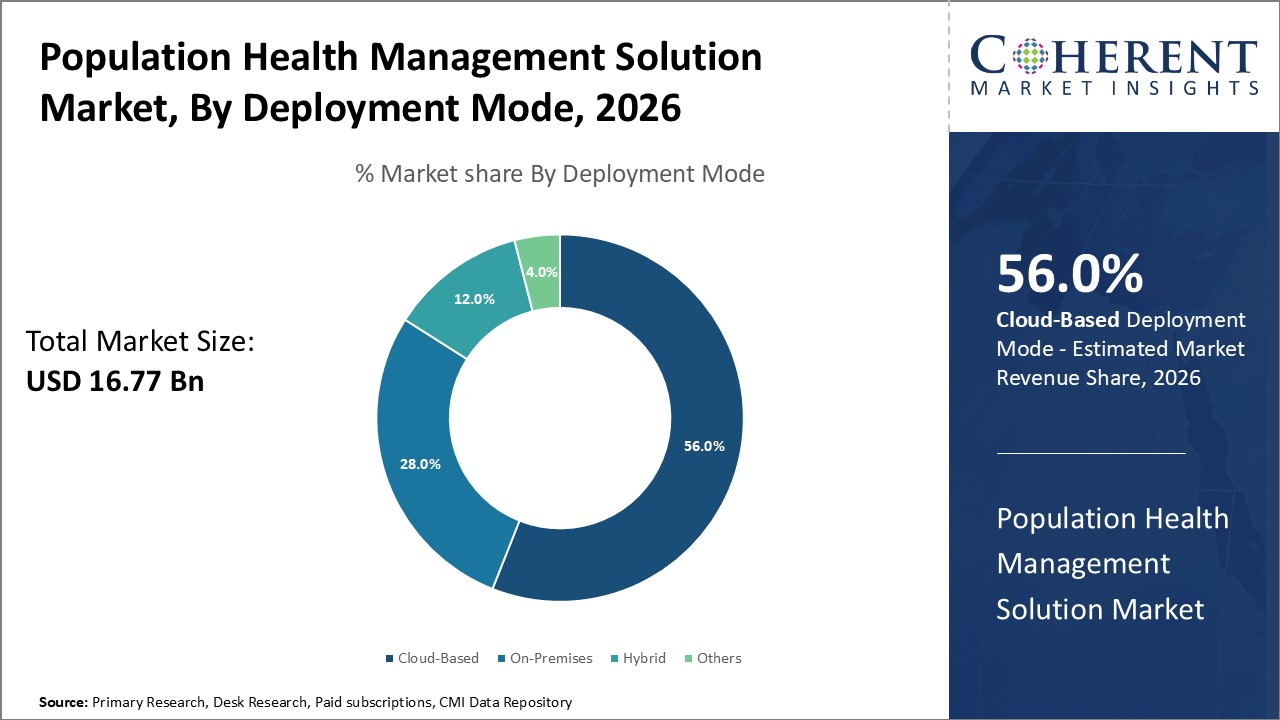
Cloud-Based deployment dominates due to flexibility and cost advantages, accounting for 56% industry share, signaling a strong preference for scalable digital health solutions.
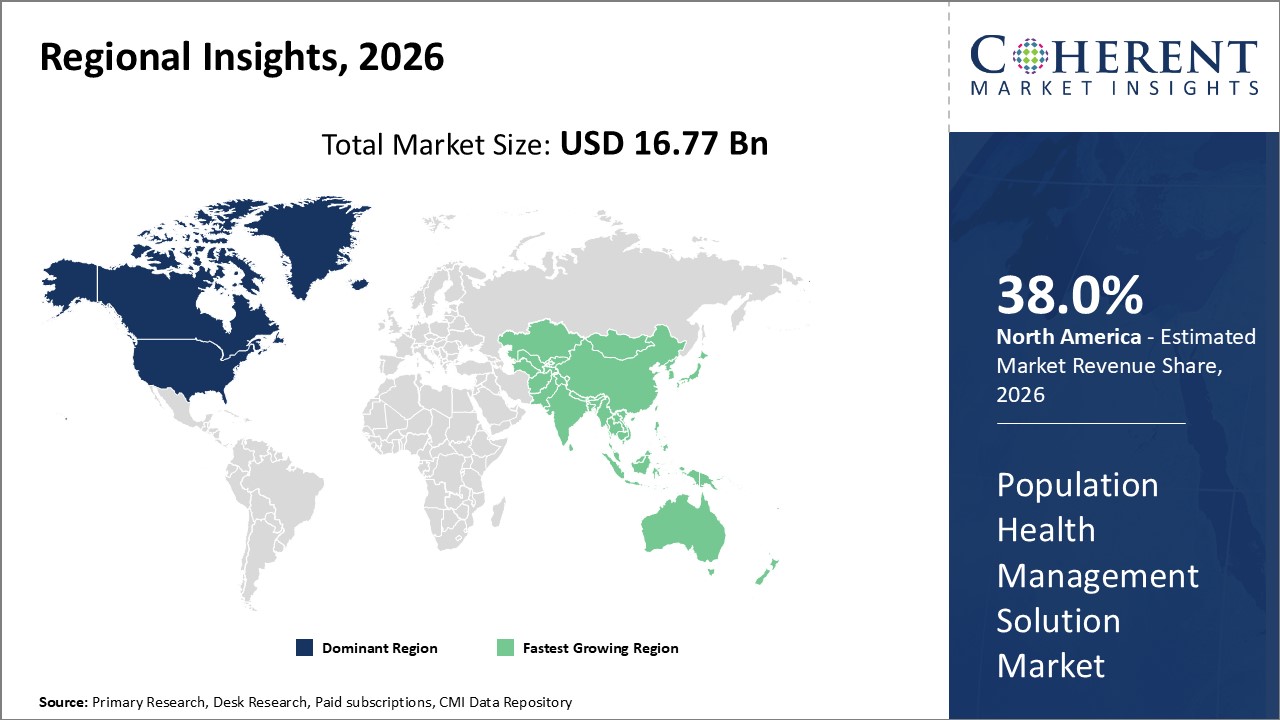
North America remains the dominant region driven by advanced healthcare infrastructure and substantial healthcare IT investments, commanding over 38% of the market share.
Asia Pacific represents the fastest-growing market, propelled by rising digital health adoption and supportive government policies facilitating rapid market growth.
Population Health Management Solution Market Segmentation Analysis
Population Health Management Solution Market Insights, By Solution Type
Risk Stratification commands the largest share of 43%, primarily due to its capability to identify high-risk patients proactively, enabling targeted interventions and resource optimization. This segment’s dominance is augmented by healthcare providers’ increased focus on reducing readmission rates and managing chronic diseases efficiently. The fastest growing subsegment within this category is Patient Engagement, driven by the rise in digital health literacy and demand for personalized care platforms that foster patient participation in health management. Care Coordination remains crucial, facilitating streamlined communication among providers but with slower growth due to integration complexities.
Population Health Management Solution Market Insights, By End User
Hospitals & Health Systems dominate the market share with extensive investments in population health management infrastructure to meet regulatory requirements and improve clinical outcomes. Hospitals and Health Systems benefit from comprehensive data integration capabilities and large patient volumes, making them major adopters of advanced risk stratification and care coordination tools. The fastest growing end user segment is Physician Practices, particularly small to mid-sized groups increasingly adopting cloud-based solutions to enhance patient management and operational efficiency. Payers, while slower in direct adoption, are expanding their role by incentivizing value-based care through population health analytics.
Population Health Management Solution Market Insights, By Deployment Mode
This deployment mode supports faster implementation cycles and appeals to smaller healthcare entities. Hybrid deployment is the fastest growing segment as organizations seek balanced control over sensitive data while leveraging cloud benefits. On-Premise solutions, though secure and customizable, face slower growth due to high maintenance costs and infrastructure demands.
Population Health Management Solution Market Trends
The Population Health Management Solution market trends demonstrate a strong inclination towards AI and machine learning integration, significantly enhancing risk prediction and personalized care plans.
For instance, IBM Watson Health reported a 26% increase in accuracy of predictive models deployed in 2026, facilitating better resource allocation.
Another pivotal trend is the growing adoption of cloud-based solutions which provide scalability and cost-effectiveness, as reflected by a 31% surge in cloud deployment preference in 2025 across mid-sized healthcare providers.
Interoperability remains a focus area with governments strengthening mandates such as the U.S. 21st Century Cures Act, encouraging seamless data exchange that improves care coordination.
Telehealth integration also redefines market scope, expanding beyond conventional healthcare settings and generating new revenue streams for market companies.
Population Health Management Solution Market Insights, By Geography
North America Population Health Management Solution Market Analysis and Trends
In North America, the dominance in the Population Health Management Solution market stems from its advanced healthcare IT infrastructure, substantial R&D investments, and favorable policies promoting value-based care. The region commands over 38% of the market share. Major players headquartered here continuously innovate with AI and cloud technologies, further solidifying market leadership.
Asia Pacific Population Health Management Solution Market Analysis and Trends
Meanwhile, Asia Pacific exhibits the fastest growth with a CAGR exceeding 12%, driven by digital health adoption in emerging economies such as China and India. Government initiatives aiming for universal healthcare and increasing private sector healthcare investments foster rapid market expansion. Telehealth platforms in countries like India have notably increased population health management deployments in rural areas.
Population Health Management Solution Market Outlook for Key Countries
USA Population Health Management Solution Market Analysis and Trends
The USA market is a critical driver due to significant federal funding supporting healthcare IT modernization and stringent healthcare regulations emphasizing data accuracy and interoperability. Leading market companies like Epic Systems and Cerner hold substantial market revenue shares, with continuous innovations in AI-driven population health solutions. Hospital systems adopting these technologies have reported a 20% reduction in avoidable hospitalizations, reflecting the market’s business growth and impact.
India Population Health Management Solution Market Analysis and Trends
India’s Population Health Management Solution market is growing rapidly, supported by government initiatives such as the National Digital Health Mission launched in 2025, aiming to integrate digital health records nationwide. The presence of emerging local companies alongside global players facilitates tailored solutions for vast and diverse patient populations. Market adoption is bolstered by telemedicine expansion, contributing to improved healthcare access in rural regions, bolstering overall market revenue and growth potential.
Analyst Opinion
A surge in demand-side indicators such as diversified use cases across healthcare providers has led to a rising adoption of population health solutions for chronic disease management and post-acute care coordination. For instance, in 2025, hospital networks employing population health tools reported a 16% improvement in readmission rates, underscoring enhanced patient monitoring capabilities.
Supply-side signals reflect a robust expansion in production capacity from technology developers integrating AI and machine learning modules into population health management platforms. In 2026, over 36% of new product launches incorporated predictive analytics to enhance risk stratification, boosting market share in more technologically advanced segments.
Pricing dynamics have evolved, with a shift towards subscription-based SaaS models allowing smaller healthcare providers broader access, which contributed to market revenue increases of approximately 19% year-over-year in early adopters.
Export data from North America to emerging healthcare markets indicates a growing appetite for these solutions worldwide, with 2026 reporting a 22% rise in international deployments, primarily due to government incentives that support digital health infrastructure development in these regions.
- Current Industry Events of 2026
- Market Size Estimation
- Regional Breakdown
- Competitive Landscape
- Customer Intelligence
- Segmental Analysis
- Pricing Analysis
- Key Market Drivers, Challenges & Future Trends
- Customized Insights Section
Market Scope
| Report Coverage | Details | ||
|---|---|---|---|
| Base Year: | 2025 | Market Size in 2026: | USD 16.77 billion |
| Historical Data for: | 2020 To 2024 | Forecast Period: | 2026 To 2033 |
| Forecast Period 2026 to 2033 CAGR: | 10.3% | 2033 Value Projection: | USD 33.30 billion |
| Geographies covered: |
| ||
| Segments covered: |
| ||
| Companies covered: | Cerner Corporation, Allscripts Healthcare Solutions, Philips Healthcare, IBM Watson Health, McKesson Corporation, GE Healthcare, Athenahealth, Inc., NovoHealth Solutions, Netsmart Technologies, Inovalon, Enli Health Intelligence. | ||
| Growth Drivers: |
| ||
Population Health Management Solution Market Growth Factors
Key drivers accelerating market growth include expanding chronic disease prevalence, which has boosted demand for risk stratification tools offering predictive patient insights. Increasing government initiatives worldwide to implement value-based care models have driven healthcare systems to integrate population health management solutions to optimize patient outcomes and cost efficiency. Advances in cloud technology have enabled scalable, secure deployment, facilitating adoption in small-to-medium healthcare practices seeking operational efficiencies. Additionally, rising patient awareness and engagement facilitated through digital platforms have resulted in higher demand for personalized care coordination services.
Population Health Management Solution Market Development
In November 2021, IBM Watson Health introduced new opportunities for Imaging AI adoption, unveiling an expanded suite of AI-powered imaging and diagnostic solutions designed to accelerate clinical decision-making and improve operational efficiency in healthcare settings. The initiative integrates Watson’s advanced imaging analytics with cloud-based data interoperability tools, allowing seamless integration of AI algorithms into radiology workflows.
In April 2026, MedeAnalytics introduced its Health Fabric™ data platform on the Snowflake AI Data Cloud, marking a next-generation advancement in population health analytics and data interoperability. The platform enables healthcare organizations to integrate, analyze, and act on multi-source data — including claims, EHR, and social determinants of health — within a unified, scalable cloud environment. Health Fabric™ supports AI-driven segmentation, performance benchmarking, and predictive modeling, empowering providers and payers to make data-backed decisions that improve outcomes and reduce costs.
Key Players
Leading Companies of the Market
Cerner Corporation
Allscripts Healthcare Solutions
Philips Healthcare
IBM Watson Health
McKesson Corporation
Athenahealth, Inc.
NovoHealth Solutions
Netsmart Technologies
Inovalon
Enli Health Intelligence
Competitive strategies predominantly include strategic partnerships and product innovation. For example, Cerner's collaboration with major healthcare providers in 2025 to incorporate AI-driven predictive analytics expanded their market reach, enhancing client retention and revenue streams. Similarly, Philips Healthcare’s launch of integrated patient engagement platforms achieved a 21% increase in user adoption rates across North America by mid-2026.
Population Health Management Solution Market Future Outlook
In the coming years, the PHM solutions market will see substantial growth driven by chronic disease prevalence, aging populations, and the need for cost-efficient healthcare delivery. AI and predictive modeling will continue to refine risk stratification and intervention targeting. Integration with wearable devices and real-world data will improve the accuracy of patient outcome prediction. Governments and payers are expected to incentivize PHM adoption through reimbursement models that reward preventive care and quality outcomes. Moreover, cloud-based PHM platforms will enable data exchange across healthcare ecosystems, fostering collaboration among providers, insurers, and public health organizations.
Population Health Management Solution Market Historical Analysis
The population health management (PHM) market began gaining traction in the early 2010s as healthcare systems shifted toward value-based care models. Initially, PHM solutions focused on aggregating clinical and claims data to identify high-risk patients. Over time, advancements in analytics, interoperability standards like HL7 and FHIR, and the expansion of electronic health record (EHR) adoption enabled a more comprehensive approach to care coordination. Integration with remote monitoring tools and AI-based risk modeling expanded the capabilities of PHM platforms, making them central to preventive healthcare strategies.
Sources
Primary Research Interviews:
Health IT Executives
Clinical Informatics Specialists
Healthcare Administrators
Data Scientists
Payers and Insurers
Databases:
HIMSS Analytics
CDC Public Health Data
Magazines:
Healthcare IT News
Health Data Management
MedTech Insight
Modern Healthcare
Journals:
Journal of Biomedical Informatics
Population Health Management Journal
Journal of Medical Internet Research
Health Affairs
Newspapers:
The Washington Post (Health)
The New York Times (Science)
The Guardian (Healthcare
The Economic Times (Health)
Associations:
Healthcare Information and Management Systems Society (HIMSS)
American Public Health Association (APHA)
American Medical Informatics Association (AMIA)
Centers for Disease Control and Prevention (CDC)
Get access to 250+ pages report
Every segment, forecast, competitor profile and data table behind the analysis above — available for instant download.
- ESOMAR Member
- ISO 9001:2015 Certified
- D-U-N-S Registered
- GDPR & CCPA Compliant
Missing comfort of reading report in your local language? Find your preferred language:
Transform your Strategy with Exclusive Trending Reports
Frequently Asked Questions
The market features prominent companies including Cerner Corporation, Epic Systems Corporation, and Philips Healthcare, each leveraging advanced analytics and strategic collaborations to sustain competitive advantages.
The market size is projected to reach USD 33.30 billion by 2033, growing at a CAGR of 10.3% from USD 16.77 billion in 2026, reflecting escalating demand across healthcare sectors.
Hospitals and health systems present the largest growth potential owing to their increasing reliance on data-driven patient management and integration of value-based care models.
Trends will focus on AI-driven predictive analytics, enhanced interoperability, cloud platform dominance, and integration with telehealth fostering holistic population health strategies.
The competitive landscape is characterized by strategic partnerships, rapid technological innovation, and aggressive market expansion, while key challenges include compliance with evolving data privacy regulations and interoperability barriers.
Market players deploy collaboration with healthcare providers, subscription-based pricing models, and aggressive digital marketing alongside product innovation to increase adoption and retention.