

Healthcare Predictive Analytics Market Size and Share Analysis: 2026 - 2033
The healthcare predictive analytics market was valued at USD 79.5 Bn in 2026 and is forecast to reach a value of USD 130.0 Bn by 2033 at a CAGR of 8% between 2026 and 2033.
Key Takeaways
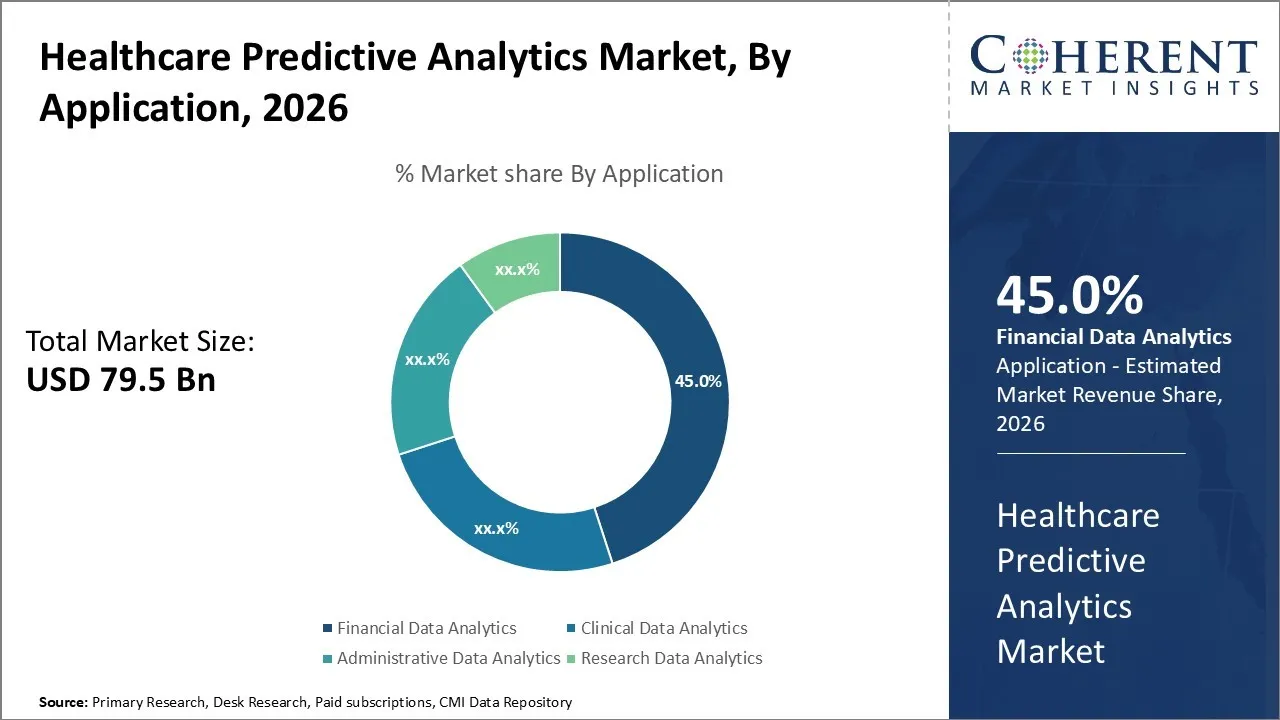
- Based on application, the financial data analytics segment is expected to hold 45% share of the market in 2026.
- Based on component, the services segment is projected to account for 60% share of the market in 2026.
- Based on deployment, the cloud-based segment is expected to lead the market with 65% share in 2026.
- Based on End-User, the healthcare providers segment is projected to capture 66% share in 2026.
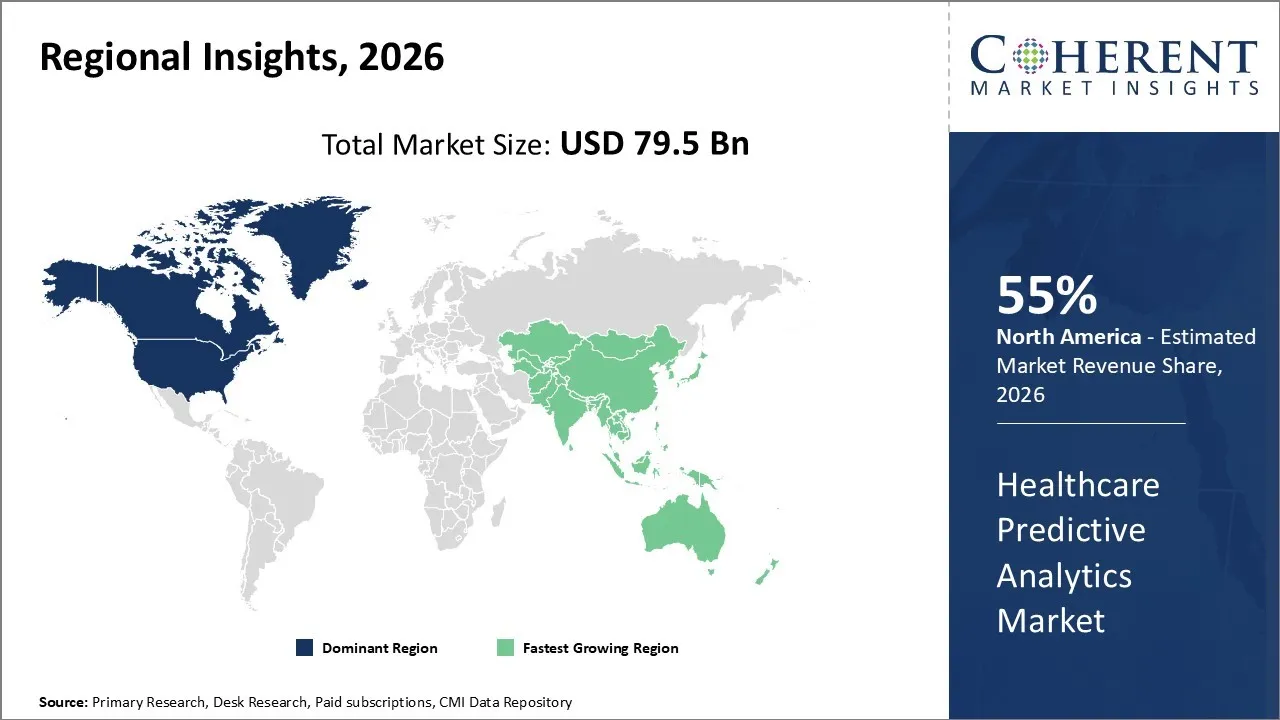
- Based on Region, North America is set to lead the Healthcare Predictive Analytics market with 55% share in 2026. While, Asia Pacific is anticipated to have the fastest growing region.
Market Overview
The global healthcare predictive analytics market is experiencing strong growth due to the rising burden of chronic diseases, emergence of personalized and evidence-based medicine, increasing need of increasing efficiency in healthcare sector, and increasing demand to curtail healthcare costs by reducing unnecessary costs. However, lack of robust infrastructure and lack of properly trained it professionals in healthcare are major factors expected to hamper growth of the healthcare predictive analytics market.
Current Events and their Impacts on the Healthcare Predictive Analytics Market
Current Event | Description and its Impact |
AI-Driven Drug Development Platforms |
|
AI-Based Demand Forecasting in Pharmaceuticals |
|
Segmental Insights
- Current Industry Events of 2026
- Market Size Estimation
- Regional Breakdown
- Competitive Landscape
- Customer Intelligence
- Segmental Analysis
- Pricing Analysis
- Key Market Drivers, Challenges & Future Trends
- Customized Insights Section
Healthcare Predictive Analytics Market Insights, By Application - financial data analytics represent the largest share
In terms of application, the financial data analytics segment is expected to lead the market with 45% share in 2026, due to its critical role in optimizing healthcare expenditure, managing insurance claims, reducing fraud, and enhancing revenue cycle management. Health systems as well as payers are highly relying on predictive models to analyze vast financial datasets encompassing billing, claims processing, reimbursement patterns, and cost forecasting.
For instance, the Centers for Medicare & Medicaid Services (CMS), a pivotal government organization in the United States, has emphasized the use of predictive analytics to identify and prevent improper payments and fraud through Advanced Analytics Initiatives.
Healthcare Predictive Analytics Market Insights, By Component - Services dominate the market
In terms of component, the services segment is expected to hold 60% share of the market in 2026. Due to their critical role in enabling healthcare organizations to effectively implement as well as maintain predictive analytics solutions. The complexity of healthcare data, stemming from diverse sources such as electronic health records (EHRs), medical imaging, patient monitoring systems, and genomics, demands specialized expertise in data integration, model development, validation, and ongoing system management.
For instance, in June 2025, IQVIA, a global company that helps healthcare and life sciences organizations with research and insights, has introduced new AI tools at GTC Paris. These AI tools, built with NVIDIA technology, are made to make work faster and give better insights for life sciences. They show how IQVIA’s AI and expertise can improve business processes and help patients get better care.
Healthcare Predictive Analytics Market Insights, By Deployment - Cloud Based leads the market
In terms of deployment, the cloud based segment is projected to account for 65% share of the market in 2026. The Cloud-Based segment holds the highest share in the market owing to its major advantages related to scalability, cost efficiency, accessibility, as well as continuous updates. Healthcare organizations are highly adopting cloud-based predictive analytics solutions because they provide seamless integration with existing IT infrastructures as well as enable healthcare providers to analyze vast amounts of patient data in real-time from multiple sources.
For instance, in March 2026, Roche announced that it is expanding its global AI systems by building a large AI facility using the latest NVIDIA technology. This facility has 2,176 powerful GPUs in the United States and Europe and will be used across the company to speed up the development of new diagnostics and treatments. With this addition, Roche now has more than 3,500 GPUs in total, the largest number of GPUs reported for any pharmaceutical company.
Healthcare Predictive Analytics Market Insights, By End-User - Healthcare Providers dominate the market
In terms of end-user, the Healthcare Providers segment is projected to capture 66% share in 2026, owing to their direct involvement in patient care, the high emphasis on value-based healthcare, and the increasing integration of advanced analytics to improve clinical decision-making. Healthcare providers such as hospitals, clinics, and ambulatory care centers utilize predictive analytics to optimize patient outcomes by enabling early diagnosis, personalized treatment plans, and efficient resource allocation.
Regional Insights
North America Healthcare Predictive Analytics Market Analysis & Trends
North America is expected to dominate the Healthcare Predictive Analytics market with 55% share in 2026, due to several critical factors rooted in its advanced healthcare infrastructure, high adoption of cutting-edge technologies, and robust regulatory frameworks that facilitate data-driven healthcare delivery. The presence of a highly digitized healthcare system, supported by widespread implementation of Electronic Health Records (EHRs) mandated by initiatives by government authorities such as the Health Information Technology for Economic and Clinical Health (HITECH) Act, has enabled healthcare organizations to a mass vast pools of clinical as well as operational data.
For instance, in January 2025, Clarivate, a global company that provides healthcare and life sciences intelligence, has launched a new platform called DRG Fusion. This platform utilizes real-world data as well as expert knowledge to help biopharma and medical technology companies understand diseases and market trends, making it easier to work with complex data.
Asia Pacific Healthcare Predictive Analytics Market Analysis & Trends
Asia Pacific is expected to exhibit the fastest growth, because of rapid digitization, increased government initiatives supporting healthcare IT infrastructure, and the rising burden of chronic diseases prompting predictive healthcare interventions. Countries such as China, India, and South Korea are highly investing in predictive analytics to address local healthcare challenges such as early disease diagnosis, hospital readmission reduction, as well as personalized treatment.
For instance, in August 2025, Takeda announced that its Japan manufacturing team is now using AI to better predict the demand for its medicines. Before, they relied on past data and expert opinions. With AI, they can find patterns in large amounts of data, making forecasts more accurate. By combining AI with human expertise, Takeda can update production plans more often and respond faster to changes in the market.
Healthcare Predictive Analytics Market Outlook Country-Wise
The U.S. Healthcare Predictive Analytics Market Trends
The U.S. contributes the highest share in the Healthcare Predictive Analytics Market owing to its well-established healthcare infrastructure, high adoption of advanced technologies, along with a significant government and private sector investments. A major factor driving the U.S. leadership in this segment is the high deployment of electronic health records (EHRs) mandated by federal initiatives such as the Health Information Technology for Economic and Clinical Health (HITECH) Act.
For instance, this foundational digitization has enabled healthcare organizations to avail large datasets, which serve as the backbone for predictive analytics applications focusing to improve patient outcomes and reduce costs. For example, the U.S. Department of Veterans Affairs (VA) has implemented predictive analytics models to identify patients at a higher risk for hospital readmission and chronic disease progression.
Japan Healthcare Predictive Analytics Market Trends
Japan contributes the highest share in the Healthcare Predictive Analytics Market in the region, owing to its advanced healthcare infrastructure, high adoption of digital health technologies, along with a strong push by governmental authorities towards connected AI and data analytics into healthcare decision-making processes. Japan’s healthcare system is known for its high standards and extensive use of technology to improve patient outcomes, particularly in predictive analytics for chronic disease management, aging population care, and personalized medicine.
Japan’s Ministry of Health, Labour and Welfare has been actively promoting projects that leverage big data and predictive models to enhance elderly care, as the country has one of the world’s oldest populations.
Market Report Scope
Healthcare Predictive Analytics Market Report Coverage
| Report Coverage | Details | ||
|---|---|---|---|
| Base Year: | 2025 | Market Size in 2026: | USD 79.5 Bn |
| Historical Data for: | 2020 To 2024 | Forecast Period: | 2026 To 2033 |
| Forecast Period 2026 to 2033 CAGR: | 8% | 2033 Value Projection: | USD 130.0 Bn |
| Geographies covered: |
| ||
| Segments covered: |
| ||
| Companies covered: | Optum, Inc., Health Catalyst, Allscripts Healthcare Solutions, Medeanalytics, Inc., Mckesson Corporation, Oracle Corporation, Cerner Corporation, Information builders, and International Business Machines Corporation (IBM), among others | ||
| Growth Drivers: |
| ||
| Restraints & Challenges: |
| ||
Healthcare Predictive Analytics Market Driver
Increasing adoption of big data and AI in healthcare
The increasing adoption of big data and artificial intelligence (AI) in healthcare has emerged as a pivotal force propelling the expansion of the Healthcare Predictive Analytics Market. Healthcare organizations today are inundated with vast volumes of clinical, operational, as well as patient-generated data, ranging from electronic health records (EHRs) to medical imaging and genomic sequences. Big data analytics enable for the aggregation as well as processing of this complex data, while AI, including machine learning algorithms, extracts meaningful patterns and predictive insights.
Growing prevalence of chronic diseases
The growing prevalence of chronic diseases such as diabetes, cardiovascular disorders, and cancer is significantly propelling the adoption and expansion of healthcare predictive analytics. Chronic diseases represent a substantial global health burden, necessitating advanced tools to manage their complexity effectively. These conditions are characterized by long durations and slow progression, demanding continuous monitoring and personalized care strategies. Healthcare predictive analytics leverages large datasets from electronic health records (EHRs), wearable devices, and genomics to anticipate disease progression, treatment responses, and potential complications.
Healthcare Predictive Analytics Market Opportunity
Integration with wearable and IoT devices
Integration with wearable and IoT devices represents a transformative opportunity in the healthcare predictive analytics market, primarily because these technologies enable continuous, real-time data collection that is critical for predictive modeling. Wearables like smartwatches, fitness trackers, and medical-grade biosensors, along with connected IoT devices such as smart glucose monitors and home-based vital sign trackers, allow for seamless monitoring of patients' physiological parameters outside traditional clinical settings.
Analyst Opinion (Expert Opinion)
- The Healthcare Predictive Analytics Market is poised for significant transformation, driven primarily by a high demand for personalized medicine as well as improved patient outcomes. High adoption of electronic health records (EHRs) and advancements in artificial intelligence (AI) as well as machine learning (ML) technologies have empowered healthcare providers to make data-driven decisions, thereby enhancing diagnostic accuracy and treatment efficiency.
- Additionally, the escalating prevalence of chronic diseases and the escalating need for cost containment in healthcare systems are propelling the adoption of predictive analytics tools.
- However, challenges such as data privacy concerns, interoperability issues among diverse healthcare systems, as well as the high initial investment needed for analytics infrastructure may restrain market expansion. Moreover, regulatory uncertainties along with the complexity of integrating predictive analytics into existing clinical workflows could slow widespread adoption.
- On the opportunity front, the rising utilization of wearable devices as well as remote patient monitoring systems is expected to generate real-time data, offering new avenues for predictive insights and proactive healthcare management. Furthermore, emerging economies in the Asia-Pacific region are witnessing rapid digital healthcare transformation, positioning this area as one of the fastest-growing markets due to rising healthcare expenditures, government initiatives, and expanding healthcare infrastructure.
Speak to the analyst
Want personalized insights?
Take the findings above to one of our principal consultants, or have the report rebuilt around the segments, geographies and competitors you actually track.
Global Healthcare Predictive Analytics Market: Key Developments
- In November 2025, BC Platforms, a healthcare data and analytics company, launched BC Catalyst, a new AI platform. It turns complicated genomic and clinical data into useful insights for drug development. The platform helps find patient groups, discover new drug targets, understand genetic differences, and provide guidance on treatment standards, making it easier to develop therapies and improve patient care.
Market Segmentation
- By Application
- Clinical Data Analytics
- Financial Data Analytics
- Administrative Data Analytics
- Research Data Analytics
- By Component
- Software
- Hardware
- Services
- By Deployment
- On Premise
- Cloud Based
- By End-User
- Healthcare Providers
- Industry
- Research Institutions
- By Region
- North America
- U.S.
- Canada
- Latin America
- Brazil
- Argentina
- Mexico
- Rest of Latin America
- Europe
- Germany
- U.K.
- Spain
- France
- Italy
- Russia
- Rest of Europe
- Asia Pacific
- China
- India
- Japan
- Australia
- South Korea
- ASEAN
- Rest of Asia Pacific
- Middle East & Africa
- GCC Countries
- Israel
- Rest of Middle East & Africa
- North America
- Key Players
- Optum, Inc.
- Health Catalyst
- Allscripts Healthcare Solutions
- Medeanalytics, Inc.
- Mckesson Corporation
- Oracle Corporation
- Cerner Corporation
- Information builders
- International Business Machines Corporation (IBM)
Sources
Primary Research Interviews
- Healthcare IT Directors
- Data Scientists in Healthcare
- Hospital Administrators
- Healthcare Analytics Vendors
- Others
Databases
- Healthcare Cost and Utilization Project (HCUP)
- Others
Magazines
- Healthcare IT News
- Health Data Management
- Journal of AHIMA
- Healthcare Analytics News
- Others
Journals
- Journal of Biomedical Informatics
- IEEE Journal of Biomedical and Health Informatics
- Health Informatics Journal
- Others
Newspapers
- The Wall Street Journal (Healthcare Section)
- The New York Times (Health Section)
- The Guardian (Healthcare)
- Financial Times (Healthcare Sector)
- Others
Associations
- Healthcare Information and Management Systems Society (HIMSS)
- American Medical Informatics Association (AMIA)
- Predictive Analytics World
- National Association of Healthcare Quality (NAHQ)
- Others
Public Domain Sources
- World Health Organization (WHO)
- Centers for Disease Control and Prevention (CDC)
- U.S. National Library of Medicine, National Institutes of Health (NIH)
- Others
Proprietary Elements
- CMI Data Analytics Tool
- Proprietary CMI Existing Repository of Information for the Last 8 Years
Get access to 250+ pages report
Every segment, forecast, competitor profile and data table behind the analysis above — available for instant download.
- ESOMAR Member
- ISO 9001:2015 Certified
- D-U-N-S Registered
- GDPR & CCPA Compliant
Missing comfort of reading report in your local language? Find your preferred language:
Transform your Strategy with Exclusive Trending Reports
Frequently Asked Questions
The global healthcare predictive analytics market size was valued at USD 79.5 Bn in 2026 and is expected to reach USD 130.0 Bn in 2033.
Major players operating in the market include Optum, Inc., Health Catalyst, Allscripts Healthcare Solutions, Medeanalytics, Inc., Mckesson Corporation, Oracle Corporation, Cerner Corporation, Information builders, and International Business Machines Corporation (IBM), among others
Among application, the financial data analytics segment estimated significant revenue in 2026.
Rising burden of chronic diseases on a global level and growing need of increasing efficiency in healthcare sector is fueling the growth of the market.
The market is estimated to exhibit a CAGR of 8% till 2033.
Among region, North America is expected to witness significant growth over the forecast period.