

Picture Archiving and Communication System (PACS) Market Size and Share Analysis - Growth Trends and Forecasts (2026 - 2033)
The Picture Archiving and Communication System (PACS) market is anticipated to grow at a CAGR of 5.8% with USD 4.75 Bn in 2026 and is expected to reach USD 7.03 Bn in 2033. The rising number of government initiatives to promote the adoption of advanced health information technology is driving the PACS market development. The Government of India enhanced PACS viability through the Project for Computerization of Functional PACS, integrating all functional PACS into a national ERP-based system linked with NABARD via State and District Cooperative Banks.
Key Takeaways
- On Premise is expected to account the largest share of 45% in 2026, because of data security and integration with existing IT systems. Cloud-targeted attacks have surged by 136% in the first half of 2025 compared to 2024.
- The enterprise PACS segment will dominate with 55% in 2026, Enterprise PACS is highly used in large hospitals and multi-site networks. In 2025, there were approximately 26,000 government hospitals in India.
- The hospitals segment will dominate with 60% in 2026, as they have various imaging modalities, large patient volumes, as well as complex workflows. Large hospitals typically operate 5–20+ imaging modalities (MRI, CT, X-ray, PET, ultrasound), compared to 1–3 in clinics or diagnostic centers.
- North America is expected to acquire the dominant share of 50% in 2026, large number of hospitals and imaging centers. There was 5,030 Diagnostic Imaging Centers in the U.S. businesses as of 2025.
Market Drivers
Digital Imaging and Communications in Medicine (DICOM) Standard is transforming the Picture Archiving and Communication System (PACS) Industry
DICOM is the foundation of medical imaging, standardizing image formats, metadata, as well as transmission across healthcare systems. Prominent adopters such as Siemens Healthineers, Philips Healthcare, Mayo Clinic, etc., have integrated DICOM into their imaging portfolios as well as enterprise systems, enabling seamless connectivity, multi-vendor integration, and standardized workflows across multiple facilities.
The use of DICOM has majorly lowered integration costs by 40–60%, improved interoperability between different vendor systems, as well as accelerated sharing of images across departments. Additionally, it advances workflow efficiency through automated image routing, making medical imaging operations faster, reliable, as well as affordable.
Current Events and Their Impact
Current Event | Description and its Impact |
Rising Healthcare IT Regulations in North America and Europe |
|
Government Incentives for Digital Health in Asia-Pacific |
|
- Current Industry Events of 2026
- Market Size Estimation
- Regional Breakdown
- Competitive Landscape
- Customer Intelligence
- Segmental Analysis
- Pricing Analysis
- Key Market Drivers, Challenges & Future Trends
- Customized Insights Section
Segmental Insights
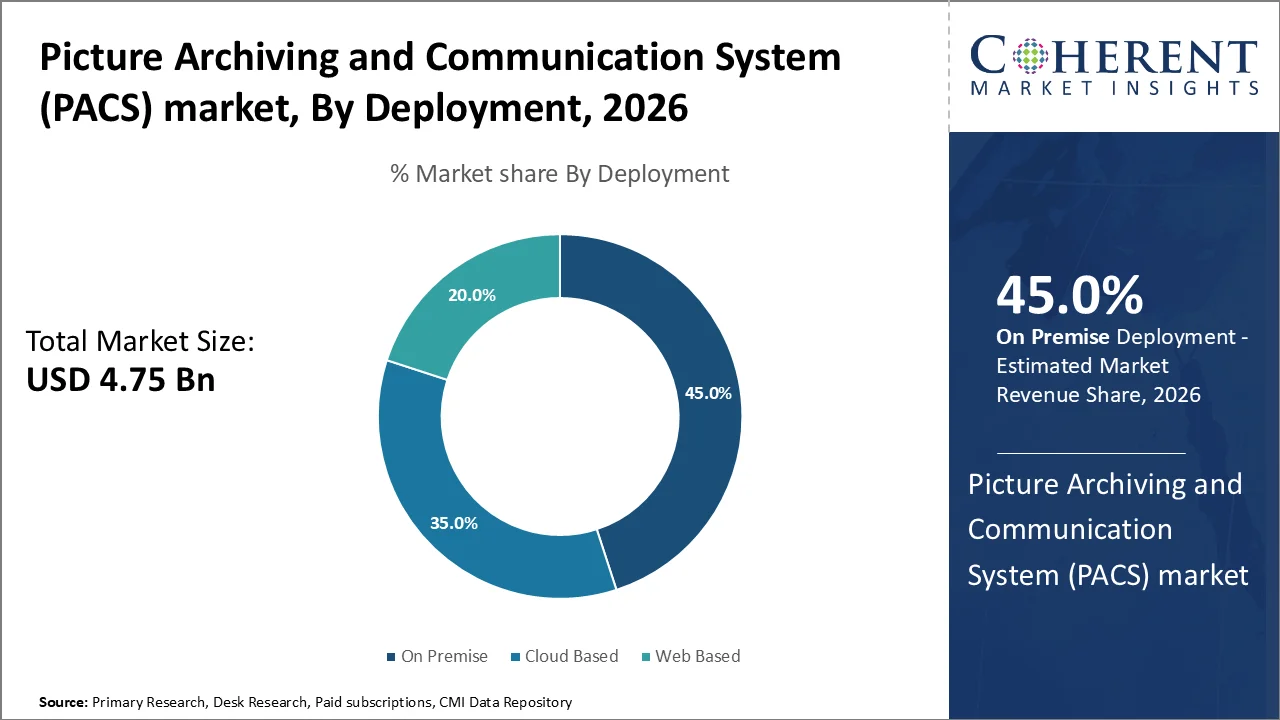
Why is On Premise Segment Acquiring the Largest Market Share?
On premise segment is projected to account for the largest share of deployment in 2026, representing approximately 45% of the total volume. The deeply built infrastructure preferences along with regulatory requirements that have dominated healthcare systems globally for decades is one of the factors responsible for the growth of the segment. In 2025, OECD countries are estimated to have allocated around 10.0% of their GDP to health on average.
Fundamental needs of the Healthcare organizations to maintain direct control over their critical medical imaging data and patient information is another propelling factor.
Major healthcare institutions, particularly large hospital systems and academic medical centers, have invested heavily in establishing robust IT infrastructure that supports on-premise solutions, making a significant barrier to cater to alternative deployment models.
Enterprise PACS holds the Largest Market Share
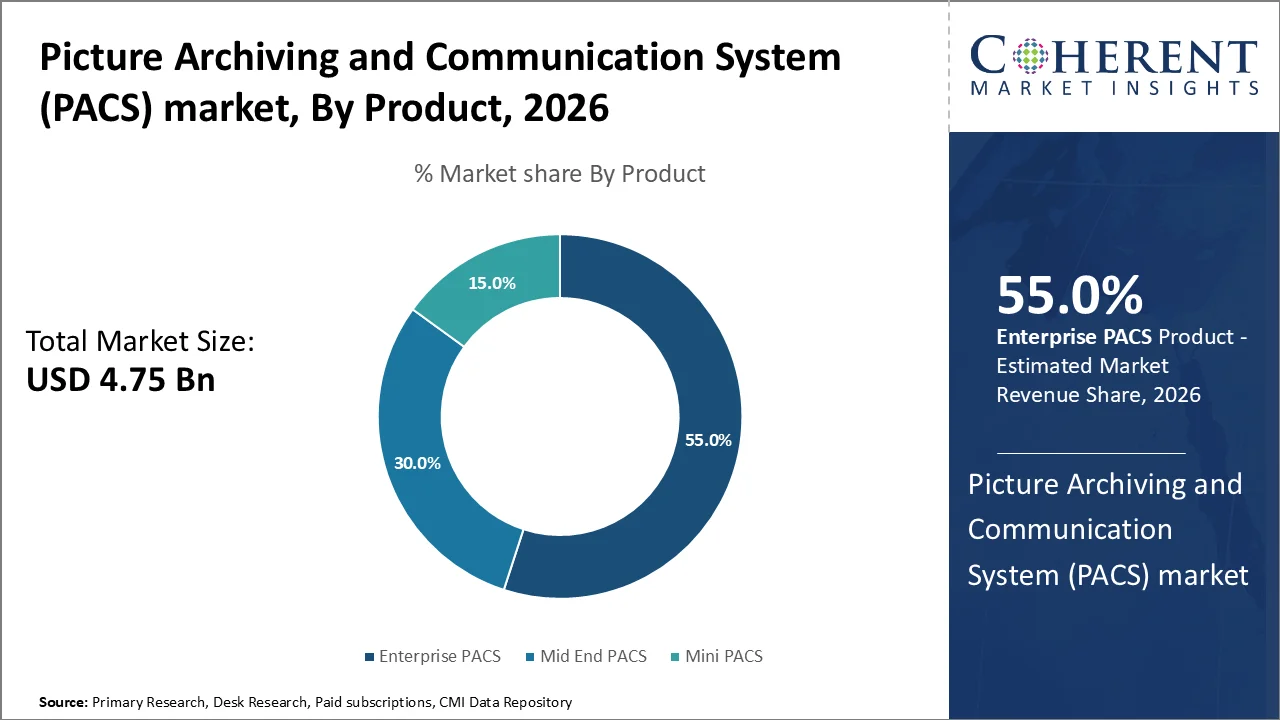
Enterprise PACS dominate the market, accounting for a significant 55% share in 2026, its overall functionality, scalability, along with the ability to handle massive volumes of medical imaging data across large healthcare networks is one of the factors responsible for the growth of the segment. In 2025, the share of healthcare organizations that already report moderate or high ROI reached 82%.
Enterprise PACS solutions are specifically made to serve multi-facility healthcare systems, integrated delivery networks, as well as large hospital chains that require seamless connectivity between various departments and locations. The increasing consolidation of healthcare providers into larger health systems, which necessitates robust, enterprise-level solutions capable is another growth-inducing factor.
The market is further stimulated by major healthcare organizations including Kaiser Permanente, Cleveland Clinic, etc., which have implemented enterprise PACS solutions.
Hospitals holds the Largest Market Share
Hospitals segment dominates the market, accounting for a significant 60% share in 2026, owing to their extensive infrastructure requirements, high patient volume, and comprehensive imaging departments that necessitate robust digital image management solutions. The total number of hospitals globally estimated to reach 215,977 by 2026 choosing the right institution has profound consequences for Patient Outcomes and Healthcare.
Hospitals typically operate multiple imaging modalities including CT scanners, MRI machines, X-ray equipment, ultrasound systems, nuclear medicine devices, etc., all of which generate substantial volumes of medical images that require efficient storage, retrieval, as well as distribution capabilities.
The complexity of hospital operations, with various departments requiring simultaneous access to patient imaging data, makes PACS systems indispensable for maintaining workflow efficiency along with ensuring seamless communication between radiologists, clinicians, a well as other healthcare professionals.
Picture Archiving and Communication System (PACS) Market Trends
- High inclination from on-premises to cloud-based solutions, providing better scalability, less infrastructure costs, as well as improved accessibility
- Escalating adoption of artificial intelligence for automated image analysis, workflow optimization, with diagnostic support. Sciome’s platform leverages Convolutional Neural Networks to automate high-throughput chemical screening, achieving over 98% accuracy in distinguishing healthy and altered cell states. This approach streamlines image analysis, reducing manual effort and improving classification precision.
- High demand for interoperable systems that support multiple imaging modalities as well as healthcare IT platforms. Hybrid imaging modalities such as PET/MRI and PET/CT continue to expand clinical utility and diagnostic accuracy
- Rising utilization of mobile-enabled platforms for remote access and telemedicine applications
- Evolution beyond radiology to encompass cardiology, pathology, ophthalmology, and other medical specialties
Regional Insights
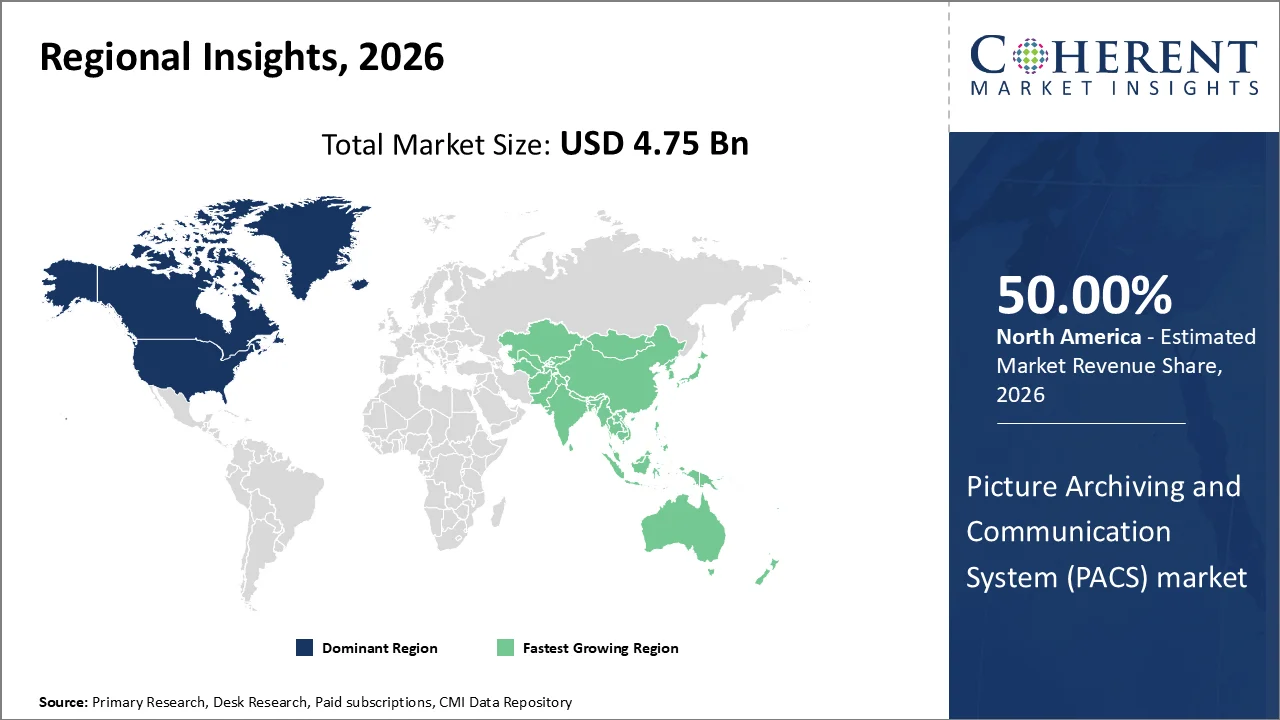
North America dominates owing to the region's robust healthcare infrastructure
North America account 50% market share in 2026, the robust healthcare infrastructure of the region, with the widespread adoption of advanced medical imaging technologies, and strong regulatory framework are the factors augmenting the market growth. Approximately, 25% of funds are used to purchase commodities (e.g., diagnostics, drugs), approximately 15% of funds are used to employ over 270,000 frontline healthcare workers (e.g., mostly nurses and community health workers).
Its comprehensive network of hospitals, diagnostic centers, and specialty clinics that have extensively integrated Picture Archiving and Communication Systems into their operational workflows.
Asia Pacific Picture Archiving and Communication System (PACS) Market Trends
The Asia Pacific region is poised to be the fastest-growing region through 2026-2033, expanding at a CAGR of approximately 6.2%. the rapid healthcare infrastructure modernization initiatives is one of the factors fueling the market growth in the region. Additionally, increasing domestic technological capabilities is also stimulating the market growth. The healthcare sector in India is projected to reach USD 638 b by 2025 from USD 400 b in 2024.
Countries like South Korea, Japan, and Australia are witnessing unprecedented growth in PACS adoption, supported by substantial government investments in digital health transformation programs.
South Korea's Ministry of Health and Welfare's Digital New Deal initiative has accelerated PACS implementation across public hospitals, while Japan's Society of Radiological Technology has been promoting standardization of PACS systems nationwide.
The Substantial Healthcare Expenditure is Accelerating the Picture Archiving and Communication System (PACS) Market Demand in U.S.
The U.S. contributes the highest share in the PACS market in North America owing to its sophisticated healthcare infrastructure, substantial healthcare expenditure, and widespread adoption of digital imaging technologies across medical facilities.
Projected imaging utilization in 2055 is 16.9% to 26.9% higher than 2023 levels assuming current per-person utilization will persist into the future, but continuation of recent per-person utilization trends broadens this range.
The United States healthcare system's emphasis on technological advancement has made an environment where PACS solutions are not merely supplementary tools but essential components of modern medical practice.
The market in the country is growing because many hospitals, imaging centers, and clinics have set up complete PACS systems.
For example, the Cleveland Clinic, one of the leading medical institutions of America, has implemented an enterprise-wide PACS solution that manages over 2 million imaging studies annually across its multiple facilities, showing the scale and sophistication of PACS deployment in major U.S. healthcare systems.
Japan Picture Archiving and Communication System (PACS) Market Trends
Japan contributes highest share in market in Asia Pacific owing to its sophisticated healthcare infrastructure and early adoption of advanced medical technologies. The leadership position of the country is fundamentally anchored in its comprehensive healthcare digitalization initiatives as well as robust regulatory framework that has facilitated widespread PACS deployment across hospitals and diagnostic centers.
Aging population of the country, which according to the Ministry of Health, Labour and Welfare represents over 29% of the total population being 65 years or older as of 2023, has created an unprecedented demand for efficient medical imaging and diagnostic systems.
This cohort pressure has made the implementation of streamlined PACS solutions to manage the high volume of medical imaging procedures required for geriatric care. The Japan Radiological Society has been instrumental in setting standardized protocols for PACS implementation, ensuring simple integration with extensive network of medical facilities across the country.
Who are the Major Companies in Picture Archiving and Communication System (PACS) Industry
Some of the major key players in Picture Archiving and Communication System (PACS) market include, Agfa-Gevaert Group, Carestream Health, FUJIFILM Medical Systems, INFINITT Healthcare Co. Ltd., GE Healthcare, Koninklijke Philips N.V., Merge Healthcare Solutions Inc., Mckesson Corp., Sectra AB, and Siemens Healthineers.
Key News
- In April 2026, the Himalayan Institute of Medical Sciences (HIMS), Jolly Grant has taken a significant step toward strengthening modern healthcare services with the launch of an advanced Picture Archiving and Communication System (PACS)–based reporting system in its Department of Radiology.
- In February 2025, DeepHealth, Inc., a global leader in AI-powered health informatics and a wholly-owned subsidiary of RadNet, Inc., will introduce next-generation AI-powered radiology informatics and population screening solutions at the European Congress of Radiology (ECR) 2025 in Vienna.
Market Report Scope
Picture Archiving and Communication System (PACS) Market Report Coverage
| Report Coverage | Details | ||
|---|---|---|---|
| Base Year: | 2025 | Market Size in 2026: | USD 4.75 Bn |
| Historical Data for: | 2020 To 2024 | Forecast Period: | 2026 To 2033 |
| Forecast Period 2026 to 2033 CAGR: | 5.8% | 2033 Value Projection: | USD 7.03 Bn |
| Geographies covered: |
| ||
| Segments covered: |
| ||
| Companies covered: | Agfa-Gevaert Group, Carestream Health, FUJIFILM Medical Systems, INFINITT Healthcare Co. Ltd., GE Healthcare, Koninklijke Philips N.V., Merge Healthcare Solutions Inc., Mckesson Corp., Sectra AB, and Siemens Healthineers | ||
| Growth Drivers: |
| ||
| Restraints & Challenges: |
| ||
Analyst Opinion
- The Picture Archiving and Communication System (PACS) market demonstrates robust momentum driven by the accelerating digitization of healthcare infrastructure and increasing adoption of cloud-based medical imaging solutions. OECD countries have made progress in expanding access to EHRs. In 2024, the average availability of online digital health services reached 82%, an increase from 79% in 2023 among countries with comparable data.
- Healthcare providers are highly recognizing PACS as essential for streamlining radiology workflows, minimizing operational costs, as well as enhancing diagnostic accuracy with simple image storage and retrieval capabilities. By mid-2025 the FDA had added 115 radiology AI algorithms to its approved list (approximately 873 total) – making medical imaging the single largest AI target among specialties.
- Key market drivers include the high prevalence of chronic diseases requiring frequent imaging procedures, escalating demand for remote diagnostic capabilities, and regulatory mandates for digital healthcare record management. The elderly population in India was estimated to be 158.7 million in 2025, which would be 11.1% of the total population.
Speak to the analyst
Want personalized insights?
Take the findings above to one of our principal consultants, or have the report rebuilt around the segments, geographies and competitors you actually track.
Market Segmentation
- By Deployment (Revenue, USD Bn, 2021-2033)
- Web Based
- Cloud Based
- On Premise
- By Product (Revenue, USD Bn, 2021-2033)
- Mid End PACS
- Enterprise PACS
- Mini PACS
- By End User (Revenue, USD Bn, 2021-2033)
- Hospitals
- Clinics
- Diagnostics Imaging Centers
- Others
- Global Picture Archiving and Communication System (PACS) Market, By Region: (Revenue, USD Bn, 2021-2033)
- North America
- U.S.
- Canada
- Latin America
- Brazil
- Mexico
- Argentina
- Rest of Latin America
- Europe
- Germany
- U.K.
- France
- Italy
- Spain
- Russia
- Rest of Europe
- Asia Pacific
- China
- India
- Japan
- Australia
- South Korea
- ASEAN
- Rest of Asia Pacific
- Middle East
- GCC
- Israel
- Rest of Middle East
- Africa
- South Africa
- Central Africa
- North Africa
- North America
- Key Players
- Agfa-Gevaert Group
- Carestream Health
- FUJIFILM Medical Systems
- INFINITT Healthcare Co. Ltd.
- GE Healthcare
- Koninklijke Philips N.V.
- Merge Healthcare Solutions Inc.
- Mckesson Corp.
- Sectra AB
- Siemens Healthineers
Sources
Primary Research Interviews
- PACS Vendors and Solution Providers
- Hospital IT Directors and Radiology Administrators
- Healthcare Technology Consultants
- Medical Imaging Equipment Manufacturers
- Others
Databases
- Healthcare Information and Management Systems Society (HIMSS) Database
- FDA 510(k) Medical Device Database
- Global Health Observatory (GHO) Data Repository
- Medical Device Market Research Databases
- Others
Magazines
- Healthcare IT News
- Radiology Business
- Medical Imaging Magazine
- Healthcare Informatics Magazine
- Others
Journals
- Journal of Digital Imaging
- Radiographics
- American Journal of Roentgenology
- Others
Newspapers
- Healthcare Finance News
- Modern Healthcare
- FierceHealthcare
- Health Data Management
- Others
Associations
- Radiological Society of North America (RSNA)
- American College of Radiology (ACR)
- Healthcare Information and Management Systems Society (HIMSS)
- DICOM Standards Committee
- Society for Imaging Informatics in Medicine (SIIM)
- Others
Public Domain Sources
- Centers for Medicare & Medicaid Services (CMS) Reports
- World Health Organization (WHO) Publications
- National Institute of Standards and Technology (NIST) Guidelines
- FDA Medical Device Safety Communications
- Others
Proprietary Elements
- CMI Data Analytics Tool, Proprietary CMI Existing Repository of information for last 10 years
Get access to 250+ pages report
Every segment, forecast, competitor profile and data table behind the analysis above — available for instant download.
- ESOMAR Member
- ISO 9001:2015 Certified
- D-U-N-S Registered
- GDPR & CCPA Compliant
Missing comfort of reading report in your local language? Find your preferred language:
Transform your Strategy with Exclusive Trending Reports
Frequently Asked Questions
The Picture Archiving and Communication System (PACS) market is expected to reach USD 7.03 Billion in 2033.
Substantial initial implementation costs are expected to restrain the Picture Archiving and Communication System (PACS) market growth over the forecast period.
Growing healthcare IT adoption, coupled with increasing demand for diagnostic imaging are driving growth of the global Picture Archiving and Communication System (PACS) market.
The Picture Archiving and Communication System (PACS) market is anticipated to grow at a CAGR of 5.8% between 2026 and 2033.
Among regions, North America is expected to account for a largest market share in the global Picture Archiving and Communication System (PACS) market over the forecast period.
It stores large volumes of images while organizing them in a way that allows the transmission of medical data quickly and securely. Additionally, the PACS server manages permissions and access, ensuring that only authorized users can view or share sensitive patient data within the PACS network.
Picture Archiving and Communication System (PACS) is a medical imaging technology used for storing, retrieving, sharing and presenting images produced by various medical devices, such as ultrasound, CT scan, X-ray, and MRI machines. The technology have been majorly used in healthcare systems and in hospitals.