

Clinical Informatics Market Size and Trends Forecast – 2026 to 2033
The clinical informatics market is estimated to be valued at USD 280.20 Billion in 2026 and is expected to reach USD 801.39 Billion by 2033, exhibiting a compound annual growth rate (CAGR) of 16.2% from 2026 to 2033.
Key Takeaways of the Clinical informatics Market
- By type, the Clinical Data Management System (CDMS) segment is expected to contribute the highest share of the market with 23.1% in 2026.
- By component, the software segment is expected to contribute the highest share with 39.2% in 2026.
- By deployment, the on-premise segment is expected to hold the largest share with 53.1% in 2026.
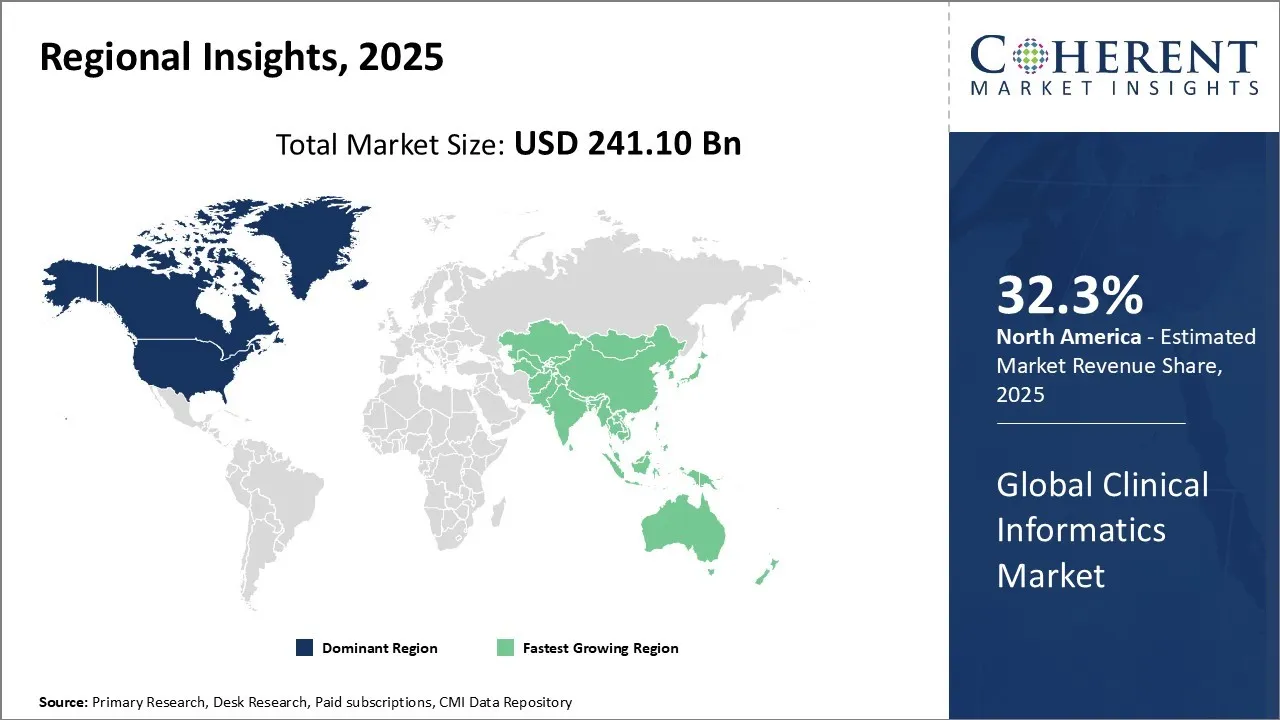
- North America is expected to top the global market with 32. 3% share in 2026, followed by Asia Pacific with 27.7% share in 2026.
Market Overview
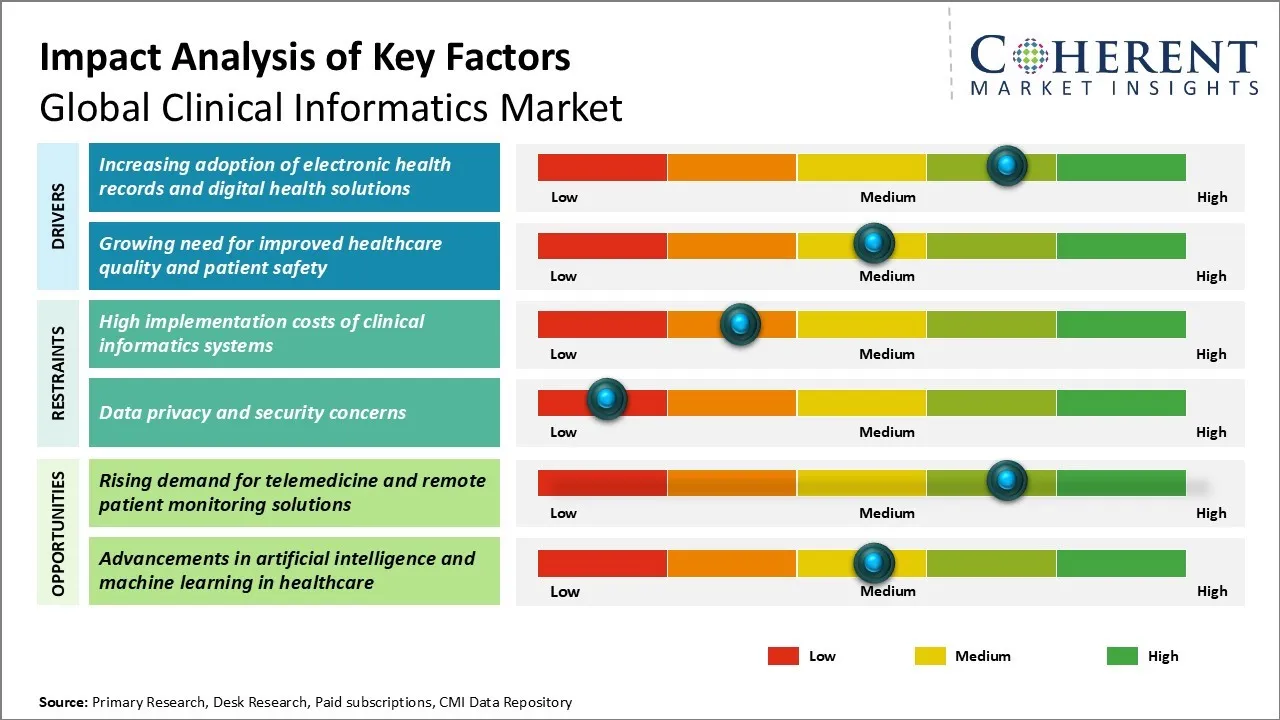
Increasing investments from government and private players to modernize healthcare infrastructure along with the rising number of patient volumes in hospitals are fueling the market growth. The clinical informatics market is expected to witness significant growth over the forecast period. This can be attributed to the growing need to integrate healthcare systems and improve efficiencies of clinical processes. Furthermore, increasing application of analytics in healthcare to obtain meaningful insights is also driving the adoption of clinical informatics solutions.
However, high costs associated with these solutions and lack of skilled IT professionals in the healthcare industry may hinder the market growth.
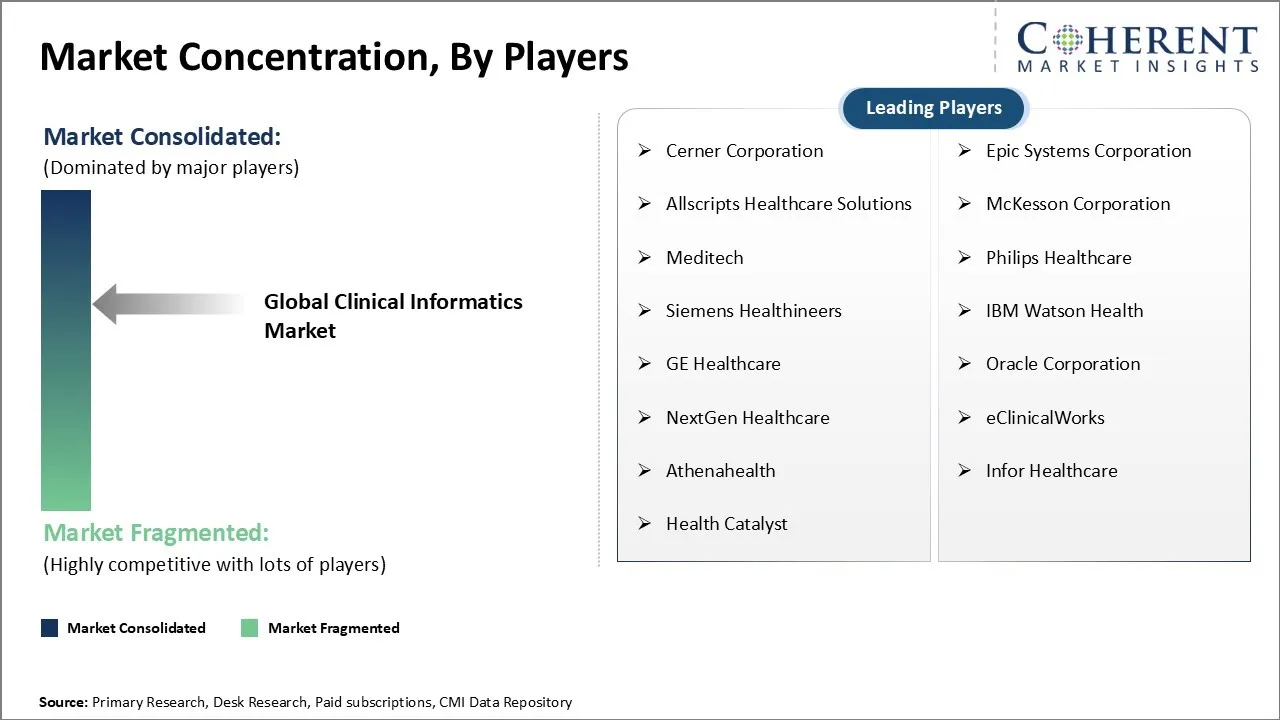
Market Concentration and Competitive Landscape
Current Events and Their Impact on the Clinical informatics Market
Current Events | Description and its impact |
Telehealth Policy Extensions and Reforms |
|
Geopolitical and Economic Shifts |
|
- Current Industry Events of 2026
- Market Size Estimation
- Regional Breakdown
- Competitive Landscape
- Customer Intelligence
- Segmental Analysis
- Pricing Analysis
- Key Market Drivers, Challenges & Future Trends
- Customized Insights Section
Market Trends
Increasing Adoption of Electronic Health Records and Digital Health Solutions
The healthcare industry around the world has seen a significant rise in the adoption of digital technologies in recent years. With the aim of improving clinical workflows as well as providing better care to patients, hospitals and healthcare providers have been embracing various electronic solutions. One of the major focus areas for digital transformation has been implementing electronic health records or EHR systems.
For instance, according to the Kaiser Family Foundation, approximately 45 percent of patients have reported that quality of care has increased as a result of EHR system adoption, with only 6 percent reporting a decline in quality of care. EHR allows easy storage, retrieval, and sharing of patient health records and clinical data among authorized healthcare providers.
Growing Emphasis on Data-Driven, Value-Based Healthcare Delivery
The growing emphasis on data-driven, value-based healthcare delivery. With rising healthcare costs and increasing pressure to improve patient outcomes, providers are leveraging clinical informatics solutions to analyze patient populations, identify risk patterns, and implement targeted interventions.
For instance, as per a study by the Medical Group Management Association, in January 2025, MGMA Stat poll found that just as many medical practice leaders have a positive outlook (40%) for VBC in their organizations in 2025 as those with a neutral outlook (40%). Only two in 10 (20%) respondents reported having a negative outlook for their organizations’ value-based care activities. The poll had 208 applicable responses.
Segment Analysis
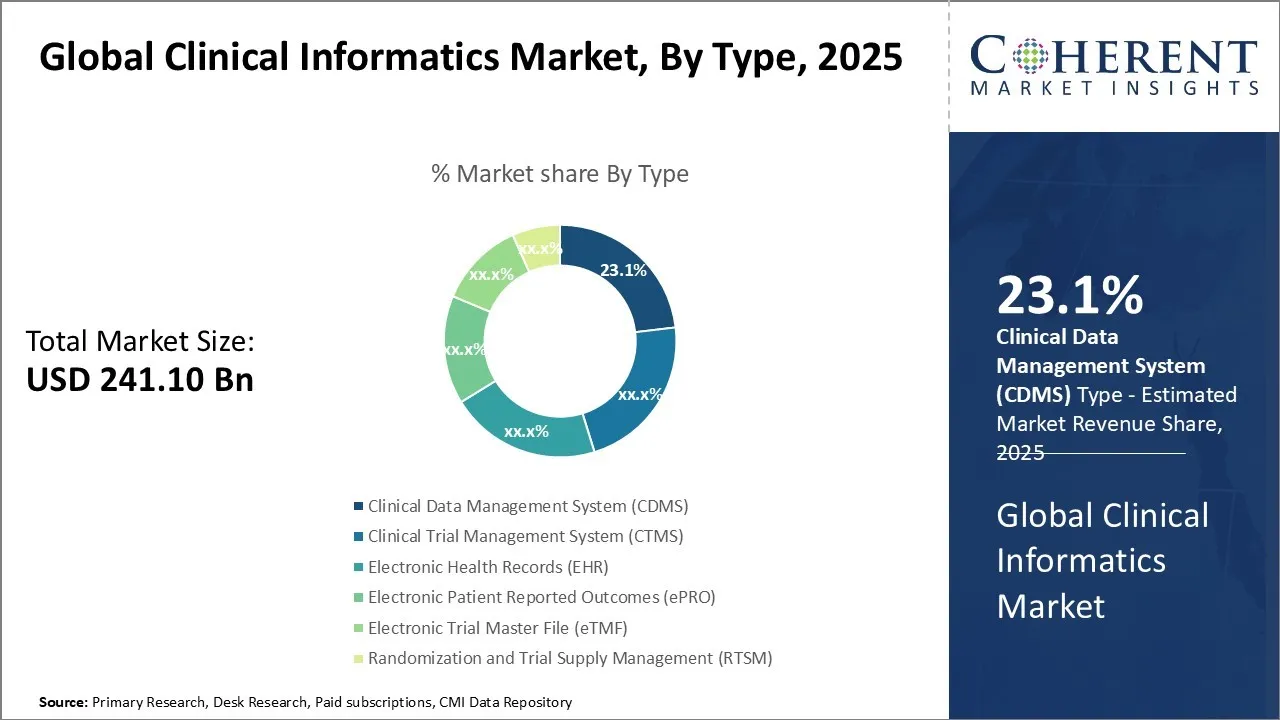
Clinical informatics Market Insights, by Type Insights- Need for Improved Data Management Drives Demand for Clinical Data Management Systems (CDMS)
In terms of type, the Clinical Data Management System (CDMS) segment is expected to contribute the highest share of the market with 23.1% in 2026 owing to the growing need for improved data management across the healthcare industry.
Clinical data is growing exponentially due to the increase in patient volume, adoption of electronic health records and various testing procedures. Managing this massive amount of data from different sources and ensuring it is organized, standardized, and accessible has become a major challenge for healthcare organizations. Clinical Data Management System (CDMS) offers a centralized platform to collect, integrate and analyze clinical data from disparate systems in a unified manner.
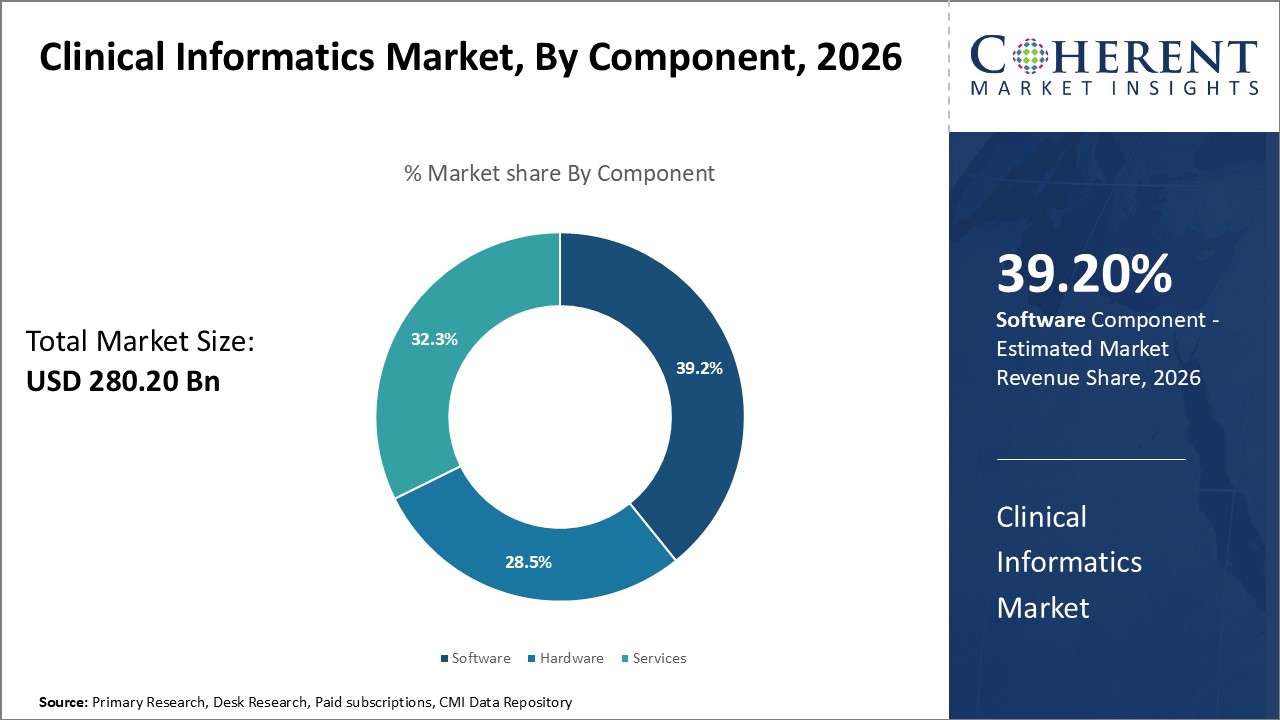
Clinical informatics Market Insights by Component Insights - Software Drives Clinical Informatics by Optimizing Operations and Improving Patient Care
Among the component segment, the software segment is expected to contribute the highest share with 39.2% in 2026, driven by the widespread adoption of Electronic Health Records (EHR) and advanced software functionalities like clinical decision support and e-Prescribing.
Electronic Health Record (EHR) systems enhance workflow efficiency, reduce medical errors, and support value-based care by enabling coordinated and data-driven healthcare. The pandemic has further accelerated the demand for telehealth and remote monitoring solutions, reinforcing the critical role of software in modern healthcare. Continuous innovation will sustain this segment's dominance in improving patient care and operational efficiency.
Clinical informatics Market Insights by Deployment Insights - Security and Control Drive On-Premise Deployments
With regards to deployment, the on-premise segment is expected to hold the largest share with 53.1% in 2026 compared to the cloud-based counterpart.
This can be attributed to factors like security concerns, regulatory compliance, and need for infrastructure control that drives many organizations towards on-premise clinical informatics solutions. Patient health records contain highly sensitive personal information and access to these systems needs to be tightly governed.
Emerging Innovations in the Clinical informatics Market
- Health Data Interoperability
Application: With interoperability, it’s critical to ensure that sensitive data (patient information, health records, etc.) are protected. The Center for Medicare and Medicaid Services published a finalized Interoperability and Patient Access Rule. The goal is to improve care coordination and patient outcomes, as well as reduce costs.
For instance, in March 2025, at the 2025 the Health Information Management Systems Society Conference (HIMSS25), 1upHealth, a leader in health data interoperability, announced the latest release of its 1up Platform, which introduces a modern lakehouse architecture.
- Artificial Intelligence
Application: With AI, patient data can be analyzed and sorted to simplify how providers look at data. This can lead to care becoming more accessible to more people. Researchers at Stanford University used AI to increase the number of patients who received palliative care, which is given when someone has a serious, often life-threatening illness. Too often doctors overestimate the lifespan of an ill patient and as a result, palliative care is not recommended in time.
Example: In February 2025, DeepHealth introduced new Ai-powered radiology informatics and population screening solutions at ECR2025.
Impact of AI in the Clinical informatics Market
The influence of artificial intelligence (AI) has drastically risen in recent years, especially in the field of medicine
- Hospitals, health systems and other provider-based organizations have integrated AI into their daily workflows to improve patient care, reduce costs and enhance efficiency. Providers, payers and other stakeholders have also realized many other advantages, including more personalized treatment plans, improved communications across stakeholders and digital transformation across the enterprise.
- AI is here to stay in healthcare, and its reach will likely increase. Innovations in AI, such as generative AI (GenAI), agentic AI and intelligent automation, are making waves in the healthcare industry, attempting to solve some of healthcare's most significant pain points.
- AI takes this one step further by enabling providers to take advantage of information within the EHR and data pulled from outside of it. Because AI tools can process larger amounts of data more efficiently than other tools while enabling stakeholders to pull fine-grained insights, they have significant potential to transform clinical decision-making.
- Using AI's advanced pattern recognition capabilities, CDSS tools can incorporate risk stratification and predictive analytics to help clinicians make more informed, personalized treatment recommendations in high-value use cases, such as chronic disease management.
- Health data extraction products can help clinicians find the information they're looking for quickly and effectively, reducing information overload. Many of these tools use natural language processing (NLP). This AI approach enables algorithms to flag key components of human language and use those insights to parse through text data to extract meaning.
Regional Insights
North America Clinical Informatics Market Analysis and Trends
North America is expected to dominate the clinical informatics market with a projected share of 32.3% in 2026. The growth can be attributed to the robust healthcare infrastructure, widespread adoption of digital technologies, and the presence of leading players in the region. Moreover, in North America, AI-assisted decision support systems are being used by doctors and nurses to expedite workflows and lower errors. Administrative departments are also using AI for everything from scheduling patients to processing claims.
For instance, in June 2026, according to LITSLINK, a trusted software development company based in the U.S. that provides customized solutions to startups, 46% of U.S. healthcare organizations are in the early phases of implementing Generative AI. AI tools like image analysis, predictive analytics, and NLP-driven transcription are now used in the daily operations of a sizable majority of hospitals.
Asia Pacific Clinical Informatics Market Analysis and Trends
The Asia Pacific region is expected to exhibit the fastest growth with a share of 27.7% in 2026 fueled by increased government focus on modernizing healthcare systems. Growing investments by public and private entities towards digitization are influencing the uptake of clinical informatics platforms across major markets.
For instance, according to the International Trade Administration, in 2023, AI Korea, hosted by Busan Metropolitan City, focuses on Korea’s AI capabilities and provides a platform for global companies to convene and discuss trends in AI. This year’s theme will include AI application for smart cities, mobility, healthcare, manufacturing, and government policy in AI.
U.S Clinical informatics Market Analysis and Trends
The U.S. leads the global clinical informatics market, driven by the widespread adoption of EHR systems. Major U.S.-based companies such as Oracle Corporation and McKesson Corporation play a key role in the clinical informatics space, reflecting the country’s strong market presence and innovation capabilities.
Germany Clinical Informatics Market Analysis and Trends
Germany is making significant strides in clinical informatics, primarily due to government initiatives such as the Hospital Future Act (KHZG).
For instance, as of January 15, 2026, all statutorily insured individuals in Germany are automatically assigned an electronic patient record (ePA), greatly improving data access and interoperability across outpatient and hospital settings.
Japan Clinical Informatics Market Analysis and Trends
Japan clinical informatics market is growing, driven by an aging population and the increasing prevalence of chronic diseases. Government initiatives promoting the adoption of EHRs and telemedicine services are enhancing healthcare delivery. The integration of AI and data analytics is further improving patient management and clinical outcomes.
China Clinical informatics Market Analysis and Trends
China clinical informatics market is on a rapid growth trajectory, driven by strong governmental support and the integration of advanced technologies as well as high adoption of EHR. China’s clinical informatics market is on a rapid growth trajectory, driven by strong governmental support and the integration of advanced technologies.
Pricing Analysis of the Clinical informatics Market
- Licensing Models & Pricing
- Typical License Tiers (2025 estimates): Single-user: Approximately USD 4,560, department license: USD 5,055, site license: USD 5,595, and global enterprise license: USD 6,000. These tiered license models reflect common industry practice for clinical informatics and data analytics platforms.
- Implementation & Consulting Fees
- Consulting services for system implementation range from USD 100 to USD 300 per hour, depending on project complexity.
- Small-scale deployments may start around USD 5,000, while full-scale system integrations can exceed USD 50,000.
- Ongoing Support & Maintenance
- Monthly support contracts run between USD 1,000 and USD 5,000, covering updates, troubleshooting, and compliance.
- Subscription services, such as regulatory updates, typically cost USD 50USD 500/month.
- Cost Trend & Key Challenges
- Cloud-based implementations can see annual cost increases of 10–12%, while web-based systems experience 7–9% annual increases.
- Ongoing maintenance and training costs add approximately 8–10% each year. These rising costs can be especially burdensome for smaller healthcare providers
Market Report Scope
Clinical Informatics Market Report Coverage
| Report Coverage | Details | ||
|---|---|---|---|
| Base Year: | 2025 | Market Size in 2026: | USD 280.20 Bn |
| Historical Data for: | 2020 To 2024 | Forecast Period: | 2026 To 2033 |
| Forecast Period 2026 to 2033 CAGR: | 16.2% | 2033 Value Projection: | USD 801.39 Bn |
| Geographies covered: |
| ||
| Segments covered: |
| ||
| Companies covered: | Cerner Corporation, Epic Systems Corporation, Allscripts Healthcare Solutions, McKesson Corporation, Meditech, Philips Healthcare, Siemens Healthineers, IBM Watson Health, GE Healthcare, Oracle Corporation, NextGen Healthcare, eClinicalWorks, Athenahealth, Infor Healthcare, and Health Catalyst | ||
| Growth Drivers: |
| ||
| Restraints & Challenges: |
| ||
Global Clinical Informatics Industry News
- In May 2025, Oracle Health, Cleveland Clinic, and G42 announced a strategic partnership to develop a groundbreaking AI-based healthcare delivery platform. This initiative aims to improve patient care and public health management by leveraging AI, nation-scale data analytics, and intelligent clinical applications to create secure, scalable, and accessible care models that positively impact people’s health and longevity.
- In March 2025, Epic showcased industry-leading ai, genomics, and interoperability at HIMSS 2025 conference. Over 2,000 Epic hospitals and over 50,000 Epic clinics are either live or preparing to go live on the federal TEFCA framework for nationwide health data exchange. For app developers, Epic offers Individual Access Services (IAS) for secure patient record retrieval—and currently there are almost 800 patient-facing apps live and exchanging data.
- In February 2025, at ECR 2025, Philips showcased its latest AI-powered systems, intelligent imaging software, and cloud-based services, all designed to streamline radiology workflows, enhance diagnostic accuracy, and deliver deeper clinical insights across the care continuum.
- In January 2025, Siemens Healthineers, a leading medical devices company, showcased a comprehensive range of diagnostic imaging solutions at Asian Oceanian Congress of Radiology (AOCR) 2025 in Chennai. Highlighting the importance of informed clinical decision-making across the entire healthcare continuum.
Analyst View
- The demand for electronic health records and other healthcare IT solutions is increasing rapidly across major regions owing to rising focus on reducing healthcare costs and improving clinical outcomes. North America currently dominating the market but Asia Pacific region is expected to offer the highest growth opportunities due to growing healthcare expenditures and improving regulatory scenario.
- Sector-specific demand surges like chronic disease management focus is impacting by rising diabetes/CVD prevalence spurs investment in AI-enabled monitoring tools, expanding clinical informatics in home-based care models.
- Expansion in mental health telemedicine, is creating an impact on CMS waivers for virtual mental health services increase adoption of specialized informatics platforms for behavioral data integration.
- The primary drivers for this market include rising adoption of mHealth and telehealth services, growing need to curtail medical errors and increase efficiency of healthcare services, various government initiatives for promoting EHR adoption, and rising investments by hospitals and other healthcare organizations to digitize their processes. However, data security challenges associated with healthcare information and reluctance of small practices to adopt advanced solutions may restrain the market growth to some extent.
- The opportunities for market players lie in increasing penetration of EHR in ambulatory surgical centers and specialty clinics, growing adoption of clinical decision support tools, rising demand for healthcare cloud computing, and potential of artificial intelligence in clinical analytics.
- Major market players are also focusing on mergers and acquisitions to expand their product portfolio and geographical footprint. Overall, the clinical informatics market is expected to flourish over the next decade as digitization transforms the global healthcare sector.
Market Segmentation
- Type Insights (Revenue, USD Billion, 2021 - 2033)
- Clinical Data Management System (CDMS)
- Clinical Trial Management System (CTMS)
- Electronic Health Records (EHR)
- Electronic Patient Reported Outcomes (ePRO)
- Electronic Trial Master File (eTMF)
- Randomization and Trial Supply Management (RTSM)
- Component Insights (Revenue, USD Billion, 2021 - 2033)
- Software
- Hardware
- Services
- Deployment Insights (Revenue, USD Billion, 2021 - 2033)
- On-Premise
- Cloud-Based
- End User Insights (Revenue, USD Billion, 2021 - 2033)
- Hospitals
- Clinics
- Research Institutions
- Government Organizations
- Others
- Regional Insights (Revenue, USD Billion, 2021 - 2033)
- North America
- U.S.
- Canada
- Latin America
- Brazil
- Argentina
- Mexico
- Rest of Latin America
- Europe
- Germany
- U.K.
- Spain
- France
- Italy
- Russia
- Rest of Europe
- Asia Pacific
- China
- India
- Japan
- Australia
- South Korea
- ASEAN
- Rest of Asia Pacific
- Middle East
- GCC Countries
- Israel
- Rest of Middle East
- Africa
- South Africa
- North Africa
- Central Africa
- Key Players Insights
- Cerner Corporation
- Epic Systems Corporation
- Allscripts Healthcare Solutions
- McKesson Corporation
- Meditech
- Philips Healthcare
- Siemens Healthineers
- IBM Watson Health
- GE Healthcare
- Oracle Corporation
- NextGen Healthcare
- eClinicalWorks
- Athenahealth
- Infor Healthcare
- Health Catalyst
Sources
Primary Sources:
Primary Research Interviews:
- Healthcare IT Managers
- Clinical Informatics Specialists
- Hospital
- CIOs
- EMR/EHR vendors
- Others
Databases:
- World Health Organization (WHO) Database
- Global Health Data Exchange (GHDx)
- Others
Magazines:
- Healthcare IT News
- Health Data Management
- Clinical Informatics News
- Others
Journals:
- Journal of the American Medical Informatics Association
- International Journal of Medical Informatics
- Journal of Biomedical Informatics
- Others
Newspaper:
- The Healthcare Reporter
- The Landscape Digital Health
- Modern Healthcare Daily
- Health Affairs Today
- Others
Associations:
- Healthcare Information and Management Systems Society
- American Medical Informatics Association
- International Medical Informatics Association
- Others
Public Domain Sources:
- U.S. Food and Drug Administration (FDA)
- Centre for Disease Control and Prevention
- National Institute of Health
- Others
Proprietary Elements:
- CMI Data Analytics Tool
- CMI Existing Repository of Information for the Last 8 Years
*Definition: Clinical informatics market is a multidisciplinary field that focuses on the application of information technology and data analytics to improve patient care and healthcare delivery. It involves the design, development, implementation, and optimization of clinical information systems such as electronic health records (EHRs), decision support tools, and health data analytics platforms.
Get access to 250+ pages report
Every segment, forecast, competitor profile and data table behind the analysis above — available for instant download.
- ESOMAR Member
- ISO 9001:2015 Certified
- D-U-N-S Registered
- GDPR & CCPA Compliant
Missing comfort of reading report in your local language? Find your preferred language:
Transform your Strategy with Exclusive Trending Reports
Frequently Asked Questions
The global clinical informatics market is estimated to be valued at USD 280.20 Billion in 2026 and is expected to reach USD 801.39 Billion by 2033.
The CAGR of the global clinical informatics market is projected to be 16.2% from 2026 to 2033.
Increasing adoption of electronic health records and digital health solutions and growing need for improved healthcare quality and patient safety are the major factors driving the growth of the global clinical informatics market.
High implementation costs of clinical informatics systems and data privacy and security concerns are the major factors hampering the growth of the global clinical informatics market.
In terms of type, the Clinical Data Management System (CDMS) segment is estimated to dominate the market revenue share in 2026.
Cerner Corporation, Epic Systems Corporation, Allscripts Healthcare Solutions, McKesson Corporation, Meditech, Philips Healthcare, Siemens Healthineers, IBM Watson Health, GE Healthcare, Oracle Corporation, NextGen Healthcare, eClinicalWorks, Athenahealth, Infor Healthcare, and Health Catalyst are the major players in the global clinical informatics market.
North America is expected to lead the global clinical informatics market in 2026.