

Dental Practice Management Software Market Analysis & Forecast: 2026-2033
Dental Practice Management Software Market is estimated to be valued at USD 3,116.3 Mn in 2026 and is expected to reach USD 6,429.2 Mn in 2033, exhibiting a compound annual growth rate (CAGR) of 10.9% from 2026 to 2033.
Key Takeaways
- Based on Deployment Mode, the Web/Cloud Solutions segment is expected to lead the market with 61% share in 2026, driven by scalability, remote access, lower costs, and seamless telehealth integration.
- Based on Application, the Patient Communication Software segment is expected to hold the largest share of the market in 2026, driven by reminders, digital engagement, teleconsultation, and improved retention.
- Based on End Use, the Dental Clinics segment is projected to account for the highest share of the market in 2026, driven by high tool adoption, rising private practices, and cloud affordability.
- Based on Region, the North America region is set to lead the dental practice management software market with 33.4% share in 2026. While, Asia Pacific is anticipated to be the fastest growing region.
Market Overview
The global dental practice management software market encompasses software solutions designed to streamline and oversee different facets of dental practices. These software packages provide a wide array of tools and feature to automate administrative tasks, improve patient care, and enhance overall operational efficiency in dental practices. The market is marked by the presence of numerous software providers offering diverse solutions that cater to the specific requirements of dental practices. These solutions can be either cloud-based or on-premises, offering flexibility and scalability to meet the unique needs of different practices.
Current Events and Its Impacts on the Dental Practice Management Software Market
Current Event | Description and its Impact |
AI and Healthcare Technology Integration Revolution |
|
Regulatory Compliance and Data Privacy Evolution |
|
AI, Mobility, and Efficiency Drive Dental Practice Management Software Growth in 2025
- AI Integration: By 2025, 20% of DPMS platforms incorporate AI features such as automated clinical documentation, predictive scheduling, and patient engagement analytics.
- Mobile Access: Over 60% of dentists in urban practices use mobile-enabled DPMS apps for real-time patient updates and scheduling.
- Cost Savings: Clinics using DPMS report 15–20% reduction in administrative overheads and up to 25% faster insurance claim approvals.
- Patient Retention: Practices leveraging DPMS-driven communication tools see 30% higher patient retention rates compared to those without digital systems.
- Current Industry Events of 2026
- Market Size Estimation
- Regional Breakdown
- Competitive Landscape
- Customer Intelligence
- Segmental Analysis
- Pricing Analysis
- Key Market Drivers, Challenges & Future Trends
- Customized Insights Section
Segmental Insights
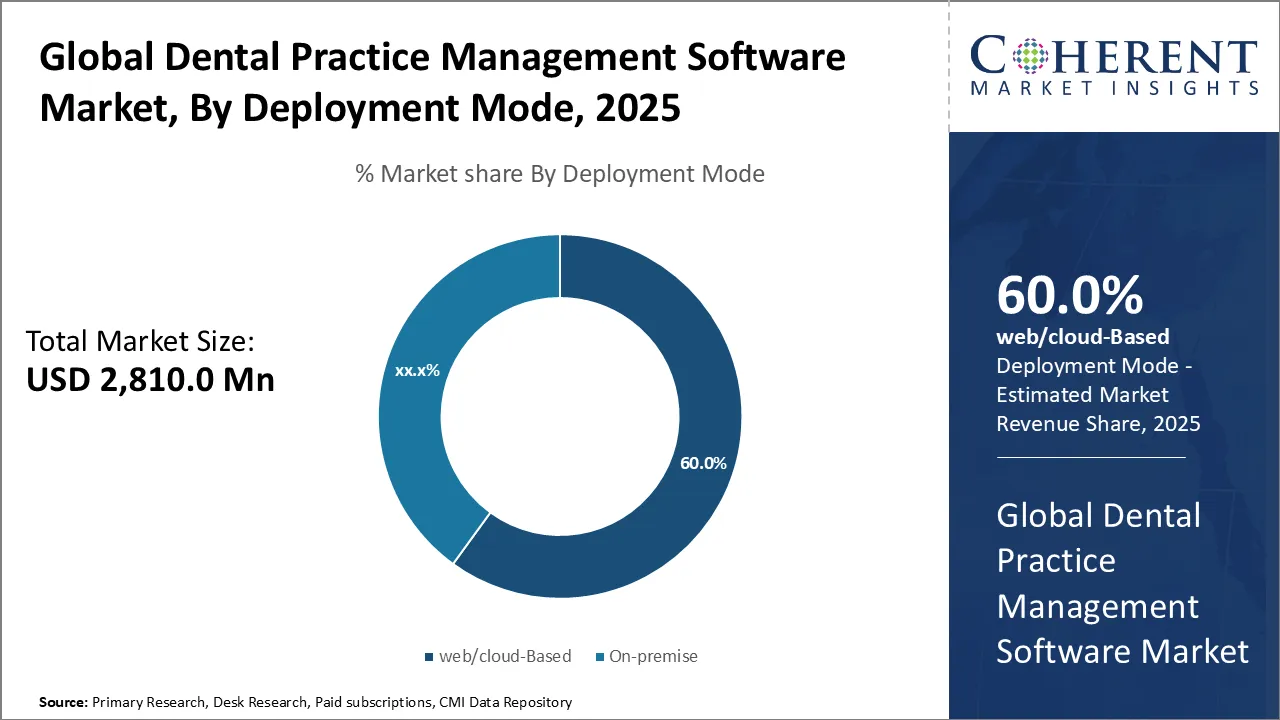
Global Dental Practice Management Software Market Insights, By Deployment Mode: Web/Cloud Solutions Dominance Is Driven by Scalability, Remote Access, Lower Costs, And Seamless Telehealth Integration
In terms of deployment mode, the web/cloud solutions segment is expected to lead the market with 61% share of the market in 2026, due to scalability, remote accessibility, and reduce upfront costs. Web/cloud solutions offer seamless integration with telehealth and mobile platforms which enhances efficiency.
For instance, in December 2026, the partnership between Intiveo and DentalEMR demonstrates that cloud-based dental practice management solutions are becoming more popular. Endodontic practices can grow, work more efficiently, and access their systems from anywhere by combining patient communication and web-based EMR systems. This partnership makes patients more involved, makes workflows more efficient, and shows how the industry is moving toward more modern cloud deployment models.
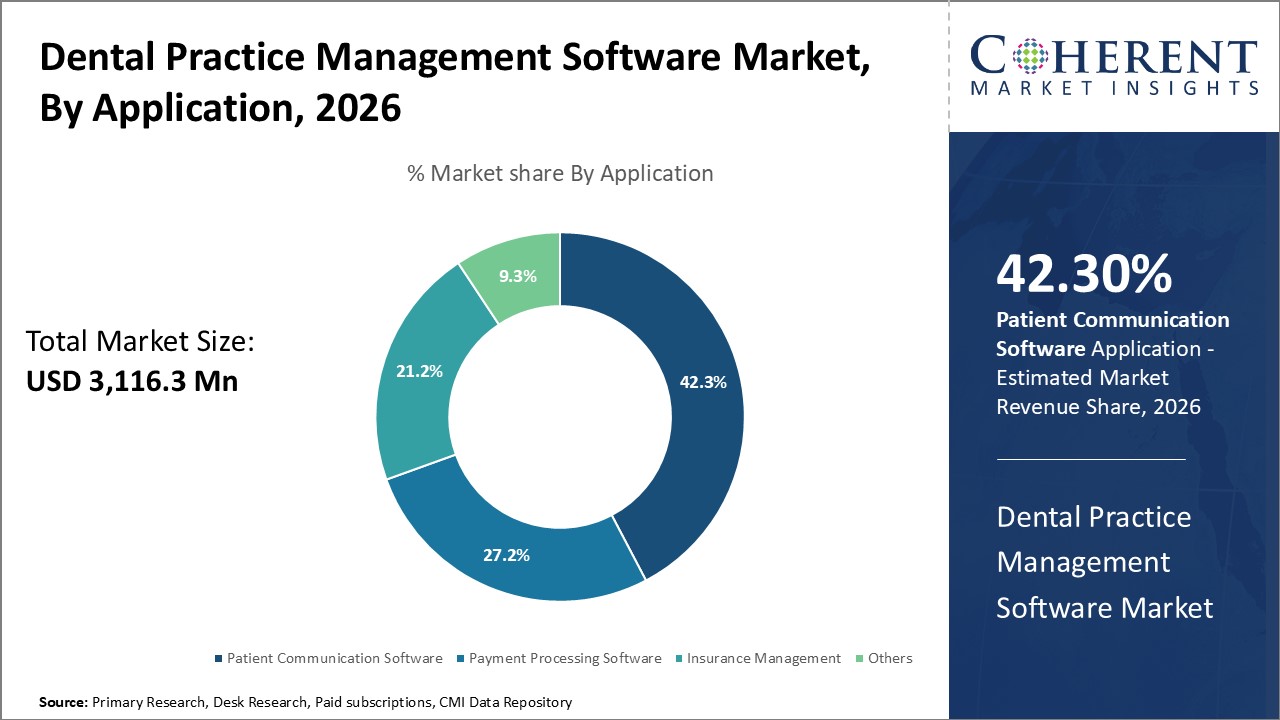
Global Dental Practice Management Software Market Insights, By Application: Patient Communication Software Lead Is Driven by Reminders, Digital Engagement, Teleconsultation, And Improved Retention
In terms of application, the patient communication software segment is expected to hold the largest share of the market in 2026, fueled by growing demand for appointment reminders, digital engagement tools, and teleconsultation services. Personalized communication enhances patient retention, making patient communication software is crucial for improving efficiency and strengthening dentist-patient relationships.
For instance, in July 2026, The Oryx Dental article emphasizes patient communication as vital for new practices. Its cloud-based platform offers appointment reminders, digital engagement, and secure messaging, helping dentists build trust and retain patients. By streamlining workflows and enhancing efficiency, patient communication software becomes essential for delivering quality care and strengthening dentist-patient relationships.
Global Dental Practice Management Software Market Insights, By End Use: Dental Clinics Dominance Is Driven by High Tool Adoption, Rising Private Practices, And Cloud Affordability
In terms of End Use, the dental clinics segment is projected to account for the highest share of the market in 2026, driven by global adoption of tools that streamline scheduling, billing, and patient communication. The growing number of private dental practices worldwide and the affordability of cloud-based solution which strengthen their position.
For instance, in October 2026, the launch of iGrow by Agilio Dental helps independent dental clinics by making their work easier, improving compliance, and driving growth. The platform gives practices digital tools for scheduling, communicating, and running their businesses more efficiently. In 2025's competitive market, iGrow improves clinic performance and patient experience by focusing on making things affordable and easy to use.
Regional Insights
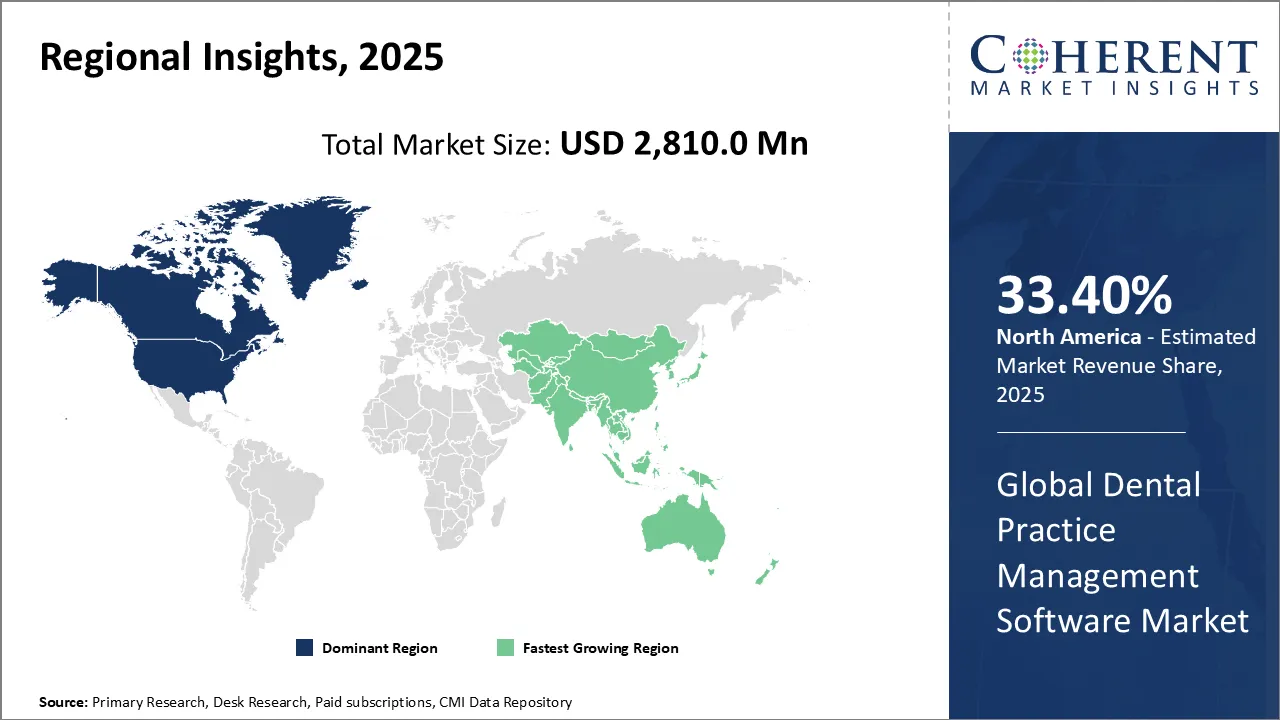
North America Dental Practice Management Software Market Analysis & Trends
The North American market, including the United States and Canada, has historically been a significant market for dental practice management software with 33.4% share in 2026, due to the region's large number of dental practices and advanced healthcare infrastructure. The presence of leading software vendors and high-tech dental practices in the region has contributed to the growth of the market.
For instance, in August 2026, Henry Schein and Henry Schein One launched Linkit within Dentrix, delivering an industry-first seamless digital workflow. This innovation enhances dental practice management by integrating tools for scheduling, billing, and patient communication. Linkit improves efficiency, reduces administrative burden, and strengthens patient experience, reinforcing Dentrix’s role as a leading software platform.
Asia Pacific Dental Practice Management Software Market Analysis & Trends
The Asia-Pacific region has seen significant growth in the dental practice management software market. With a rising population, increasing awareness about dental health, and improving healthcare infrastructure in countries like China, India, Japan, and South Korea, there has been a growing adoption of dental software solutions.
For instance, in September 2026, Carestream Dental a newsroom in Singapore that covers new developments in digital dentistry and practice management in the Asia-Pacific region. The updates show imaging systems, cloud-based platforms, and workflow tools that are made for clinics in the area. These solutions make it easier to schedule appointments, bill patients, and talk to them.
Dental Practice Management Software Market Outlook Country-Wise
The U.S. Dental Practice Management Software Market Trends
In 2026, the U.S. Dental Practice Management Software market is booming as more people are going to the dentist, more practices are opening, and more people want cloud-based solutions. Adoption is driven by a greater emphasis on patient communication, insurance management, and workflow optimization. This makes sure that the rapidly growing dental healthcare sector runs smoothly and follows the rules.
For instance, in July 2026, Pearl's press releases discuss its AI-powered dental innovations, such as diagnostic tools that have been approved by the FDA, imaging integrations, and partnerships with top practice management platforms. Pearl raises global standards for dental care by making radiology more accurate, workflows more efficient, and communication with patients better. Its AI solutions are now essential parts of modern dental practice management software.
Australia Dental Practice Management Software Market Trends
The market for Dental Practice Management Software in Australia is doing well in 2026 as more individuals are getting dental work done, there is a demand for cloud-based solutions, and communication with patients is important. Clinics want to be more efficient, follow the rules, and improve their workflow. This is why they are using advanced DPMS platforms that make administration easier, get patients more involved, and help with digital transformation.
For instance, in July 2026, Centaur Software, which is based in Australia, worked with Kiroku in the UK to add AI-powered dental documentation to its Dental4Windows practice management system. This partnership makes dental professionals' work easier by streamlining workflows, automating clinical note-taking, and lowering administrative burdens. This is an important advancement forward in the development of dental practice management software across the region.
Market Report Scope
Dental Practice Management Software Market Report Coverage
| Report Coverage | Details | ||
|---|---|---|---|
| Base Year: | 2025 | Market Size in 2026: | USD 3,116.3 Mn |
| Historical Data for: | 2020 To 2024 | Forecast Period: | 2026 To 2033 |
| Forecast Period 2026 to 2033 CAGR: | 10.9% | 2033 Value Projection: | USD 6,429.2 Mn |
| Geographies covered: |
| ||
| Segments covered: |
| ||
| Companies covered: | Henry Schein, Inc., Patterson Companies, Inc., Carestream Dental LLC., Curve Dental, Inc., Practice-Web, Inc., ACE Dental Software. | ||
| Growth Drivers: |
| ||
| Restraints & Challenges: |
| ||
Global Dental Practice Management Software Market Drivers
Increasing Adoption of Digital Technologies
The dental industry is witnessing a growing trend of dental practices embracing digital technologies to improve their operational efficiency. This shift towards digitalization is driven by the recognition of the benefits offered by dental practice management software. These software solutions provide advanced tools and features that automate administrative tasks, enhance patient care, and streamline workflows. The demand for digitization in dental practices is a significant factor contributing to the growth of the dental practice management software market. For instance, dental practices are adopting software solutions that automate appointment scheduling, patient record management, and billing processes. Instead of relying on manual paperwork and phone calls, digital tools allow for streamlined and efficient management of appointments, reducing errors and enhancing the overall patient experience.
Regulatory Compliance and Documentation
Dental practice management software plays a crucial role in helping dental practices meet regulatory compliance requirements and maintain accurate patient records. By automating and streamlining compliance processes, the software simplifies documentation tasks and ensures adherence to regulatory standards. For instance, dental practice management software enables practices to capture and store patient information securely, including personal details, medical history, treatment plans, and consent forms. The software typically offers standardized templates and forms that comply with industry regulations, making it easier for dental professionals to create and maintain documentation.
Global Dental Practice Management Software Market Opportunities
Integration of Telehealth and Virtual Consultations
The growing acceptance and utilization of telehealth and virtual consultations present a significant opportunity for dental practice management software to incorporate these functionalities into their solutions. By integrating telehealth capabilities, dental software can enable dental practitioners to conduct virtual consultations with patients remotely, offering a convenient alternative to in-person visits. This expansion of services allows dental practices to extend their reach beyond physical boundaries, reaching patients in remote areas or those with limited mobility. By capitalizing on the opportunity to integrate telehealth and virtual consultations, dental practice management software providers can enhance patient care, improve patient engagement, and differentiate their offerings in the competitive market.
Expansion of Mobile Applications
The expansion of mobile applications in the dental practice management software market presents significant opportunities to enhance convenience and accessibility for both dental practitioners and patients. Mobile apps can offer dental practitioner’s features such as appointment management, allowing them to schedule, reschedule, or cancel appointments easily. Dentists can also send automated reminders to patients, reducing no-shows and optimizing appointment scheduling. Mobile apps can serve as a valuable resource for patients, providing access to dental health information, educational materials, and preventive care tips. Patients can access their treatment plans, review post-operative instructions, and receive personalized oral health recommendations through the app. This not only empowers patients to take charge of their dental health but also strengthens their engagement with the dental practice.
Global Dental Practice Management Software Market Trends
Cloud-based Solutions
There is an increasing trend towards the adoption of cloud-based dental practice management software due to its various advantages. Cloud solutions offer convenient access, scalability, automatic updates, and cost savings on IT infrastructure. Dental practices are choosing cloud-based software because it provides flexibility, remote accessibility to patient data, and smooth collaboration among dental teams. For instance, dental practices can leverage cloud-based dental practice management software to access patient records, appointment schedules, and treatment plans from any location with an internet connection. This flexibility allows dentists to provide efficient and timely care, even when they are not physically present in the office. Additionally, cloud-based software enables seamless collaboration among dental teams, allowing multiple practitioners to access and update patient information in real-time, facilitating better coordination and continuity of care.
Integration of Artificial Intelligence (AI) and Machine Learning (ML)
Dental practice management software is increasingly incorporating artificial intelligence (AI) and machine learning (ML) technologies to introduce advanced features and capabilities. These technologies enable tasks like voice recognition, automated treatment planning, image analysis, and predictive analytics within the software. By leveraging AI and ML, dental practice management software enhances accuracy, efficiency, and decision-making, ultimately leading to improved treatment outcomes and streamlined workflows. For instance, AI-powered voice recognition can be integrated into dental practice management software to enable dentists to dictate patient notes and treatment plans using natural language. The software transcribes the voice input into text, eliminating the need for manual data entry and improving efficiency.
For instance, in June 2025, Archy Dental, which is based in San Jose, California, released Archy Intelligence, an AI-powered tool for its cloud-based dental practice management software. It automates workflows, improves communication with patients, and gives practices insights that make them more efficient and focused on patients. This new idea makes North America even more of a leader in dental technology.
Analyst Opinion (Expert Opinion)
As sensors, compute platforms, and full-stack autonomy software improve, the market for self-driving cars is moving closer to large-scale commercialization. Industry reports for 2024 show that the global market will be very active. This is due to pilot fleets are being deployed quickly, AI perception systems are getting better, and some areas are relaxing their rules. North America continues to remain the busiest place for testing and deployment, thanks to early regulatory frameworks and high-density urban trials. The autonomy compute segment is growing swiftly. This is as high-performance chips and AI accelerators are the most expensive part of higher-level autonomy, which shows how compute-intensive perception and planning workloads are.
Operational data from the top robotaxi companies shows that the number of completed autonomous trips is expected to increase sharply between 2023 and 2024. This means that the service is going to be more reliable and cover a larger area. Partnerships between ride-hail platforms and autonomy developers show that the ecosystem is moving toward platform integration instead of full verticalization. A greater amount of capital is going into autonomy software, sensor innovation, and fleet management systems. These are all areas where there is a lot of potential for recurring revenue through OTA updates, data-driven improvements, and subscription-based service models.
Some of the main limitations are that market definitions can change, regulations can be confusing, and unit economics can be affected by the manner in which they are used. Even with such challenges, the market is moving quickly toward profitable large-scale fleet operations as technology and operational readiness improve.
Speak to the analyst
Want personalized insights?
Take the findings above to one of our principal consultants, or have the report rebuilt around the segments, geographies and competitors you actually track.
Global Dental Practice Management Software Market: Key Developments
- In August 2025, Curve Dental added Flo AI to its cloud-based dental practice management software. This is an intelligence feature that is built into the software. Flo makes practices more efficient and patient-centered by streamlining workflows, automating routine tasks, and improving communication with patients. This new idea shows how AI is becoming more important in modern dental practice management, making care better and operations more efficient.
- In July 2025, Dentscribe launched GPS, an AI-powered Guided Practice Solution in the United States, reinforcing North America’s leadership in dental practice management innovation. GPS makes workflows easier, improves communication with patients, and reduces on administrative work. This launch shows how AI is becoming more and more important in modern dental practices.
- In June 2025, Align Technology's digital platforms connected more than 2,000 doctors and staff, making it easier for them to work together and get things done faster. Align makes managing a dental practice easier by combining imaging, treatment planning, and communication with patients. This program makes things easier for administrators, improves patient care, and strengthens its role in moving modern dental practice forward.
Market Segmentation
- Global Dental Practice Management Software Market, By Deployment Mode (Revenue, USD Mn, 2021 - 2033)
- On-Premise
- Web/Cloud-based
- Global Dental Practice Management Software Market, By Application (Revenue, USD Mn, 2021 - 2033)
- Patient Communication Software
- Payment Processing Software
- Insurance Management
- Others
- Global Dental Practice Management Software Market, By End Use (Revenue, USD Mn, 2021 - 2033)
- Dental Clinics
- Hospitals & Other Healthcare Settings
- Others
- Global Dental Practice Management Software Market, By Region (Revenue, USD Mn, 2021 - 2033)
- North America
- U.S.
- Canada
- Latin America
- Brazil
- Argentina
- Mexico
- Rest of Latin America
- Europe
- Germany
- U.K.
- Spain
- France
- Italy
- Russia
- Rest of Europe
- Asia Pacific
- China
- India
- Japan
- Australia
- South Korea
- ASEAN
- Rest of Asia Pacific
- Middle East & Africa
- GCC Countries
- Israel
- Rest of Middle East & Africa
- North America
- Key Companies Insights (Revenue, USD Mn, 2021 - 2033)
- Henry Schein, Inc.
- Patterson Companies, Inc.
- Carestream Dental LLC.
- Curve Dental, Inc.
- Practice-Web, Inc.
- ACE Dental Software
Sources
Primary Research Interviews
- Dental Practice Owners / Clinic Directors
- General Dentists & Dental Specialists (Orthodontists, Endodontists, Oral Surgeons)
- Practice Managers / Office Administrators
- Dental Practice IT Managers / System Administrators
- Dental Practice Management Software Vendors (product managers, sales heads, implementation teams)
- Dental Billing & Insurance / Revenue Cycle Management Experts
- Dental Software Implementation & Training Consultants
- Dental Equipment & Intraoral Scanner Suppliers
- Third-party Service Providers (tele-dentistry platforms, cloud hosting providers)
- Others
Databases
- Bloomberg Terminal
- Thomson Reuters Eikon
- IHS Markit
- Euromonitor International
- S&P Global Market Intelligence
- Clarivate (Derwent / Web of Science)
- Statista
- Gartner / Forrester (market & vendor evaluations)
- Others
Magazines
- Dental Economics
- Dentistry Today
- The Journal of the American Dental Association (JADA) — magazine section
- Inside Dentistry
- Dental Products Report
- DentistryIQ (magazine & online)
- Others
Journals
- Journal of Dental Research
- International Dental Journal
- Journal of Dentistry
- Journal of the American Dental Association (JADA) — research articles
- Community Dentistry and Oral Epidemiology
- Others
Newspapers
- Financial Times
- The Wall Street Journal
- Reuters
- Bloomberg News
- The New York Times (business/healthcare coverage)
- Others
Associations
- American Dental Association (ADA)
- FDI World Dental Federation
- British Dental Association (BDA)
- International Association for Dental Research (IADR)
- National dental/professional associations by country (state dental societies)
- Others
Public Domain Sources
- World Health Organization (WHO) – Oral Health programme
- Centers for Disease Control & Prevention (CDC) – Oral Health data
- National Health Service (NHS) Digital (UK) – dentistry statistics & e-records guidance
- Organisation for Economic Co-operation and Development (OECD) – health statistics
- U.S. Department of Health & Human Services (HHS) – HRSA / oral health data
- Public health agencies / national ministries of health (country-specific dental statistics)
- Others
Proprietary Elements
- CMI Data Analytics Tool
- Proprietary CMI Existing Repository of Information for the Last 8 Years
Definition: The Global Dental Practice Management Software market refers to the industry that encompasses the development, distribution, and implementation of software solutions specifically designed to facilitate and manage various administrative and clinical tasks within dental practices. Dental practice management software is a critical tool that helps dental professionals streamline their daily operations, improve patient care, and enhance overall efficiency and productivity.
Get access to 250+ pages report
Every segment, forecast, competitor profile and data table behind the analysis above — available for instant download.
- ESOMAR Member
- ISO 9001:2015 Certified
- D-U-N-S Registered
- GDPR & CCPA Compliant
Missing comfort of reading report in your local language? Find your preferred language:
Transform your Strategy with Exclusive Trending Reports
Frequently Asked Questions
The Dental Practice Management Software Market is estimated to be valued at USD 3,116.3. 0 Mn in 2026, and is expected to reach USD 6,429.2 Mn by 2033.
The increasing adoption of digital technologies, regulatory compliance, and documentation are the key factors driving the market.
Data security and privacy concerns, technical challenges, and system integration are the major factors hampering the market.
The key players operating in the market are Henry Schein, Inc., Patterson Companies, Inc., Carestream Dental LLC., Curve Dental, Inc., Practice-Web, Inc., ACE Dental Software.
The CAGR of the Dental Practice Management Software Market is projected to be 10.9% from 2026 to 2033.