

Patient Engagement Solution Market Size and Share Analysis - 2026 To 2033
The Patient Engagement Solution Market is anticipated to grow at a CAGR of 18.2% with USD 32.0 Bn in 2026 and is expected to reach USD 108.1 Bn in 2033. The global Patient Engagement Solution Market in 2026 continues expanding as digital health becomes core to modern care delivery, driven by widespread adoption of patient portals, mobile apps, and remote access tools that enhance communication and self‑management. U.S. hospitals saw nearly universal adoption of foundational electronic patient engagement capabilities (e.g., view/download/transmit data) in 2024, with 95–99 % adoption of key functions, per the American Hospital Association survey data published in 2025. Patient engagement research in Applied Clinical Informatics (April 2026) highlights the challenge of scaling from pilots to routine use. India’s Ayushman Bharat Digital Mission reached over 900 million digital health IDs by May 2026, signifying massive digital health engagement momentum.
Key Takeaways
- Software as a Service is expected to account the largest share of 56.8% in 2026, due to its cloud‑based ease of access, rapid deployment, and scalability which align with global digital health priorities. The World Health Organization’s Global Strategy on Digital Health emphasizes interoperable digital tools to improve patient access and health system efficiency (WHO, updated 1 Dec 2025). Furthermore, according to CDC, in the U.S., modern connected digital infrastructure enables timely patient engagement, with 65 % of Americans accessing online medical records in 2024. These factors, combined with supportive digital health strategies and adoption of cloud-enabled platforms, reinforce the preference for SaaS delivery models in patient engagement solutions.
- Hospitals & clinics will dominate with 62.0% in 2026, because they widely implement digital tools that enable patients to electronically access and manage health information. In 2024, 99 % of U.S. hospitals allowed patients to view records, 96 % to download them, 84 % to transmit data, and 92 % provided secure messaging, demonstrating broad adoption of engagement capabilities that drive clinical use.
Source: Healthit.gov
- North America is expected to acquire the dominant share of 44.0% in 2026, due to strong EHR adoption, mature hospital IT infrastructure, widespread patient portal use, high chronic disease burden, and supportive interoperability policies. In the U.S., 2024 hospital data showed 99% of hospitals allowed patients to view records, 96% enabled downloads, 84% allowed data transmission, and 92% supported secure messaging, published by ASTP/ONC in September 2025. Patient-side adoption is also high, as 65% of individuals accessed online medical records in 2024, published in June 2025. CDC reported in May 2026 that three in four U.S. adults have at least one chronic condition, supporting demand for continuous digital engagement.
Segmental Insights
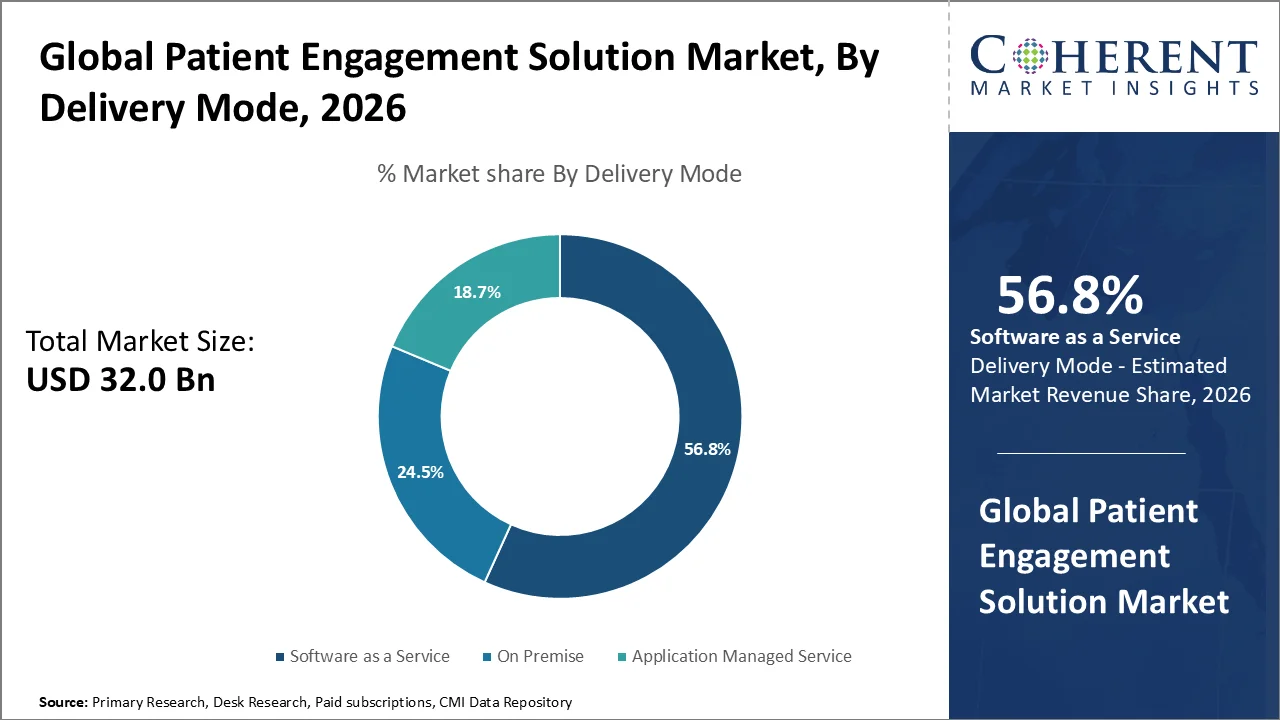
Why is Software as a Service Acquiring the Largest Market Share?
Software as a Service is projected to account for the largest share of cognitive systems spending in 2026, representing approximately 56.8% of the total volume. The Software as a Service delivery model leads the patient engagement solutions market because it delivers cloud‑based patient portals, mobile access, interoperability, scalability, and low upfront IT investment, aligning with evolving digital health priorities. Patient demand for on‑demand health information has surged: in 2024, 65 % of individuals in the U.S. were offered and accessed online medical records or patient portals, driven by standards‑based APIs and smartphone app integration under federal policy (ASTP/ONC data brief, July 2025). Widespread EHR adoption underpins this trend: 95 % of U.S. office‑based physicians used EHR systems in 2024 according to the CDC’s NEHRS survey (May 2026). Cloud‑enabled SaaS platforms integrate easily with these systems and support secure data access, messaging, and app‑based health management, making them preferable for providers struggling to keep pace with interoperability and patient expectations. Additionally, WHO’s strategic emphasis on scaling interoperable digital solutions reinforces global adoption of SaaS‑centric engagement tools (Digital Health Strategy, Dec 2025).
Source: Healthit.gov; CDC.gov; WHO.int
- Current Industry Events of 2026
- Market Size Estimation
- Regional Breakdown
- Competitive Landscape
- Customer Intelligence
- Segmental Analysis
- Pricing Analysis
- Key Market Drivers, Challenges & Future Trends
- Customized Insights Section
Hospitals & Clinics holds the Largest Market Share
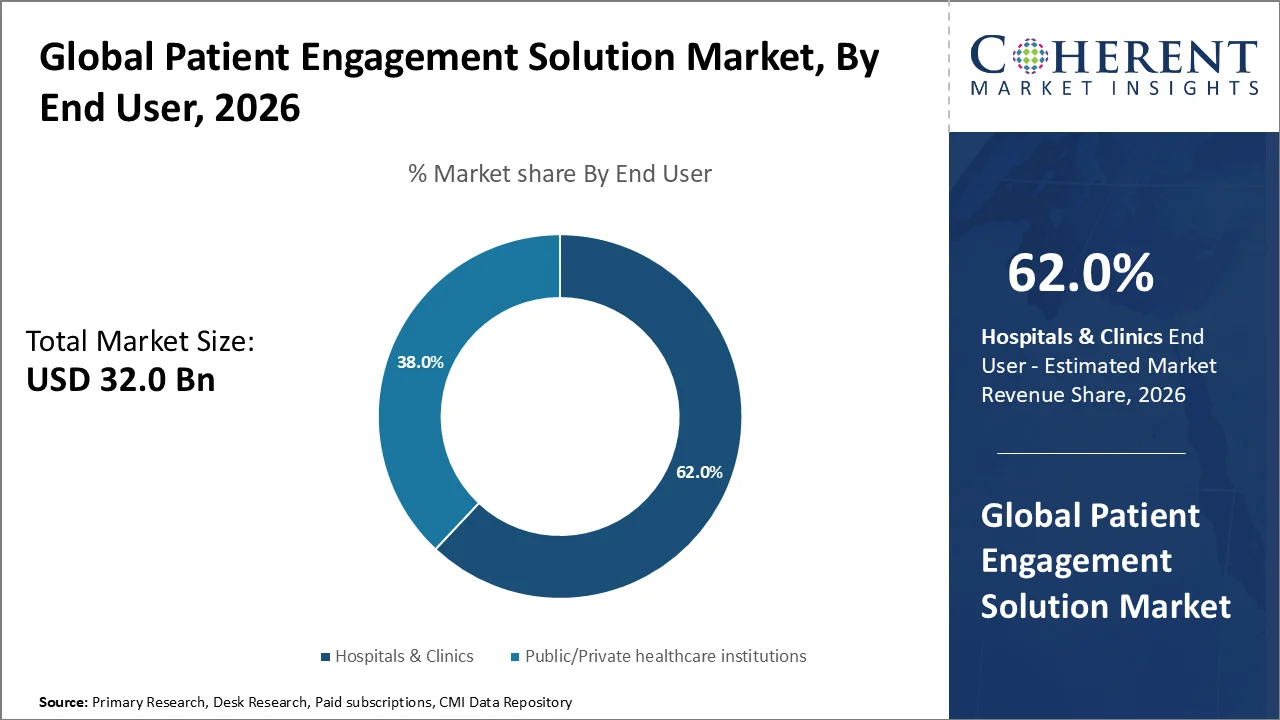
Hospitals & clinics dominate the market, accounting for a significant 62.0% share in 2026, because they are rapidly adopting digital patient access and communication tools as core parts of care delivery. U.S. data shows that by 2024, 99 % of hospitals enabled patients to electronically view their health information, 96 % allowed downloads, 84 % permitted structured data transmission, and 92 % supported secure messaging with providers, reflecting widespread integration of engagement capabilities in both inpatient and outpatient settings (ASTP/ONC data brief, September 2025). Hospitals’ strong EHR adoption and federal incentives to support interoperability and patient access incentivize clinics to invest in portals, secure messaging, scheduling, and app‑based access. These foundational and emerging capabilities equip providers to improve care coordination, patient satisfaction, and outcomes, making hospitals and clinics the dominant end users of engagement solutions.
Market Drivers
Growing Prevalence of Chronic Diseases
Increasing prevalence of chronic diseases has driven the global patient engagement solution market growth over the forecast period. The rising prevalence of chronic diseases intensifies demand for continuous care coordination and self‑management tools, propelling the patient engagement solution market. In 2023, 76.4 % of U.S. adults (≈194 million) reported at least one chronic condition, and 51.4 % had multiple chronic conditions, increasing long‑term care needs and digital engagement use (CDC, April 2025). Chronic disease management requires ongoing monitoring, medication adherence, and communication, which digital platforms facilitate. Digital health interventions have been shown to prevent acute events and support chronic care, highlighting their value in reducing hospitalizations and improving outcomes. As chronic disease burdens rise, adoption of patient engagement solutions grows accordingly.
Shift to Patient ‑ Centric & Value ‑ Based Care
The global health system’s pivot to patient‑centric and value‑based care emphasizes quality, outcomes, and shared decision‑making, creating strong demand for digital patient engagement solutions that support continual patient involvement. Value‑based models prioritize patient experience and outcomes over volume, and patients engaged in their own care are significantly more active in treatment adherence, communication, and follow‑up outcomes that engagement platforms facilitate. According to 2026 value‑based care statistics, patient engagement rates in value‑based settings have reached ~75%, markedly higher than in traditional care models, reflecting deeper involvement in care planning and execution. The OECD (25 Mar 2026) report on people‑centered digital health emphasizes that access to digital tools and complete health information significantly enhances patient experience and trust, which are core elements for engagement. CDC acknowledges that patient activation a key component of engagement correlates with better health outcomes and informed health decisions. This collective evidence underscores how value‑based, patient‑centric models drive adoption of engagement technologies essential for improved outcomes and health system efficiency.
Rising Innovation and Integration of AI & Intelligent Networks operations is transforming the Patient Engagement Solution Market
Advances in AI and intelligent networks are reshaping patient engagement solutions by enabling highly personalized, automated, and data‑driven interactions across the healthcare journey. For instance, in 2026, 52% of patients report using AI tools to research health conditions, and 70% agree AI enhances patient health literacy and engagement, illustrating how AI directly boosts patient involvement and satisfaction core goals of engagement platforms. Integration of AI‑powered virtual assistants, predictive analytics, and conversational AI enables seamless appointment scheduling, reminders, personalized education, and real‑time support, reducing clinician burden and enhancing care continuity. Major health institutions like the CDC’s 2026 AI strategy emphasize scaling AI capabilities to improve operational efficiency and data‑driven care delivery, reflecting broader systemic adoption. The trend toward intelligent, omnichannel patient communication is also driving healthcare providers and payers to invest in next‑generation engagement tools that leverage AI for proactive outreach and tailored care pathways. Overall, AI innovation and intelligent networks are central to making patient engagement more effective, efficient, and scalable in modern healthcare systems.
Current Events and Their Impact on the Patient Engagement Solution Market
Current Event | Description and its Impact |
CMS Launch of HealthTech Ecosystem Tools |
|
ASTP/ONC TEFCA Milestone – 500M Health Records Exchanged |
|
CMS ACCESS Model Payment Reforms |
|
FDA Digital Health Center of Excellence Pilot |
|
EU Digital Health Funding & European Health Data Space |
|
Patient Engagement Solution Market Trends
- AI‑Enabled Personalization & Intelligent Front Doors – In 2026, consumer health behavior shows nearly 60% of patients engaging with AI‑enabled tools for health information and guidance, illustrating a shift toward AI as a “digital front door” for patient care rather than a back‑end pilot. This trend drives demand for intelligent patient engagement platforms that automate appointment scheduling, responses, symptom triage, and tailored guidance while still aligning with clinician oversight and privacy governance, capturing patient expectations for speed and personalization in interactions.
Regional Insights
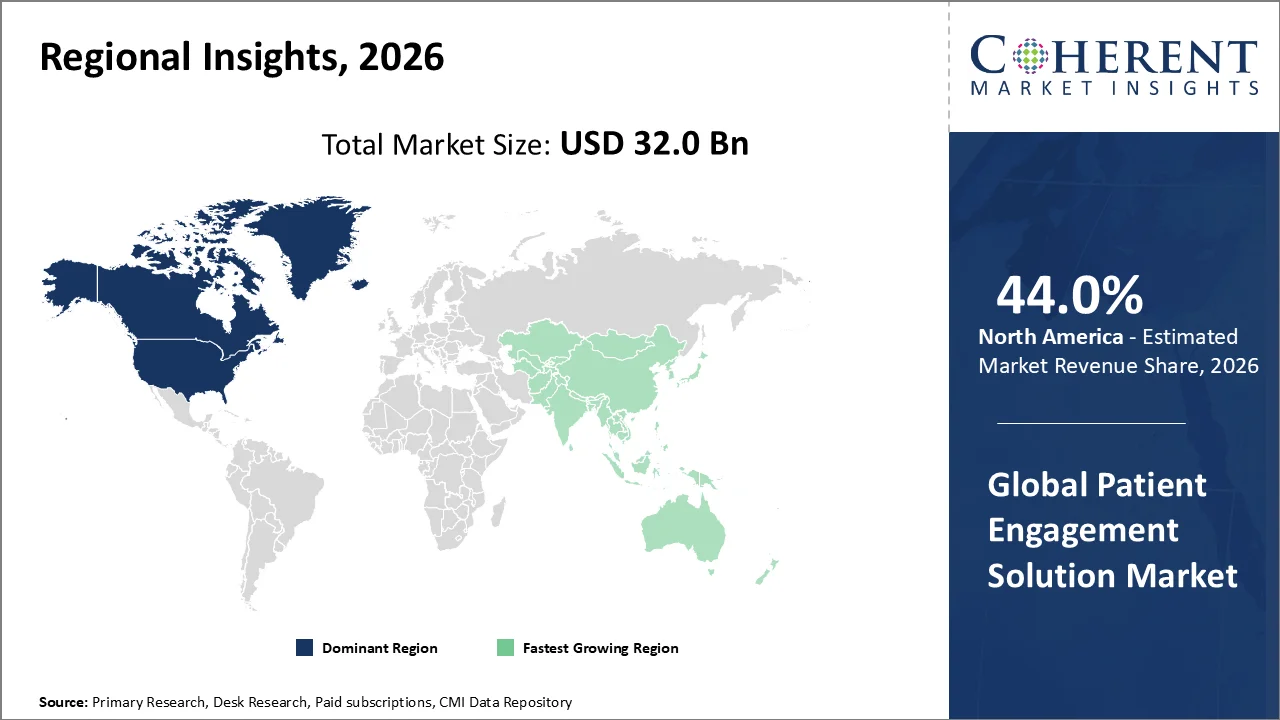
North America dominates owing to Widespread Electronic Health Record (EHR) Adoption
North America account 44.0% market share in 2026, supported by advanced healthcare IT infrastructure, widespread electronic health record (EHR) adoption, strong regulatory support, and proactive digital health policies. Nearly all U.S. hospitals enabled electronic viewing of patient health information by 2024, with foundational engagement capabilities widely implemented, reflecting deep digital integration. The region accounted dominant share in 2025, driven by enterprise demand, integrated health systems, and payer reimbursement pathways that support interoperable solutions. Government mandates like the HITECH Act and information blocking rules have created a fertile environment for engagement tools, while high patient portal utilization rates and API‑enabled app access further reinforce adoption, making North America the dominant regional market.
Additionally, government incentives, such as value-based care initiatives and digital health reimbursement models, encourage providers to invest in engagement technologies that improve outcomes and patient satisfaction. The combination of infrastructure readiness, regulatory support, and a digitally literate population positions North America as the leading region for patient engagement solutions, attracting both established vendors and innovative startups seeking market penetration and scale.
Asia Pacific Patient Engagement Solution Market Trends
The Asia-Pacific region is poised to be as the fastest-growing region through 2026-2033, owing to rapid digital health infrastructure expansion, large patient populations, rising smartphone-based healthcare access, and strong government-led health digitization programs. In India, the Ayushman Bharat Digital Mission crossed 100 crore health records linked with ABHA in May 2026, supporting consent-based digital record sharing between patients and verified providers. Australia’s My Health Record modernization, published in January 2026, requires default sharing of pathology and diagnostic imaging reports from July 2026, improving patient access to test results. These initiatives accelerate adoption of portals, apps, reminders, telehealth, and digital care coordination tools.
Source: PIB; health.gov.au; WHO
Strong Interoperability Policy and High Consumer Use of Patient Portals is Accelerating the Patient Engagement Solution Market Demand in United States
The U.S. leads due to wide digital health adoption, strong interoperability policy, and high consumer use of patient portals and engagement tools. By 2024, nearly all non‑federal U.S. hospitals enabled patients to electronically view health records (99%), download them (96%), transmit data (84%), and securely message providers (92%), reflecting deep integration of engagement capabilities. Individual use mirrors this trend, with 65 % of Americans offered and accessing online medical records or patient portals in 2024. Federal initiatives such as the 21st Century Cures Act and interoperability rules have strengthened seamless data exchange, expanding engagement tool utility and provider investment. These high adoption and supportive regulatory efforts make the U.S. the dominant country in the regional market.
China Patient Engagement Solution Market Trends
China has become the biggest player in the Asia Pacific market in 2026. China’s dominance in the Asia Pacific patient engagement market stems from rapid digital health adoption, extensive online medical service use, large patient base, government policies supporting digital healthcare, and increasing mobile health engagement. By mid‑2025, over 390 million people in China had used online medical services, equivalent to about 35 % of internet users, reflecting strong demand for telemedicine and patient engagement platforms (Statista, May 7, 2026). Chinese public hospitals are actively offering smartphone‑based patient‑centric services such as online appointment scheduling, consultations, prescriptions, medication delivery, and health education, with many integrating these services into mobile ecosystems (JMIR Formative Research, published Dec 4, 2024). Research from April 2026 shows growing awareness and adoption of digital health services among older adults, a key demographic for engagement tools (Frontiers in Public Health, Apr 24, 2026). China’s focus on internet hospitals, regulatory encouragement for online healthcare, and strong consumer engagement with digital health applications drive its leadership in the region.
Who are the Major Companies in Patient Engagement Solution Market
Some of the major key players in Patient Engagement Solution Market are Medecision, Inc., Cerner Corporation, Phytel, Inc., iMD Health Global Corp., Axial Exchange, Orion Health, Emmi Solutions LLC, Athenahealth, Inc., RingCentral, InteliChart, Radix Health, GetWellNetwork, Inc., Pomelo Health, eVideon, and SeamlessMD
Key News
- In April 2026, Inventurus Knowledge Solutions Limited introduced MyCareHub, an agentic AI‑enabled patient engagement platform, at the American Medical Group Association (AMGA) Annual Conference. MyCareHub integrates with Epic’s Connection Hub and uses behavioral modeling, longitudinal memory, and decision intelligence to personalize patient engagement before, during, and after care, aiming to transform healthcare journeys and automate outreach.
Source: Inventurus Knowledge Solutions Limited
- In May 2026, Elsevier completed its acquisition of Mytonomy and launched comprehensive end‑to‑end patient engagement solutions for healthcare providers. This builds on Mytonomy’s video‑based patient engagement platform integrated with Elsevier’s clinical solutions portfolio to support education, adherence, and engagement across care pathways and improve outcomes.
- In May 2026, Assort Health unveiled Assort Activate, an omni‑channel AI patient outreach agent used by over 1,000 providers. The platform proactively engages patients to boost appointments, close care gaps, and enhance financial processes without increasing front‑office workload, integrating with EHR/PMS for scalable engagement automation.
- In December 2025, the U.S.FDA launched the Technology‑Enabled Meaningful Patient Outcomes (TEMPO) for Digital Health Devices Pilot. This pilot encourages streamlined regulatory oversight for digital health technologies including software used to support patient outcomes in chronic disease while collecting real‑world performance data to inform future approvals and market entry strategies.
- In April 2026, the U.S. Centers for Medicare & Medicaid Services (CMS) launched the HealthTech Ecosystem Tools initiative, introducing patient‑facing digital applications and interoperability frameworks that accelerate the adoption and deployment of patient engagement solutions across providers. This regulatory‑linked infrastructure boost helps developers and healthcare organizations integrate digital engagement tools into mainstream care delivery.
Market Report Scope
Patient Engagement Solution Market Report Coverage
| Report Coverage | Details | ||
|---|---|---|---|
| Base Year: | 2025 | Market Size in 2026: | USD 32.0 Bn |
| Historical Data for: | 2020 To 2024 | Forecast Period: | 2026 To 2033 |
| Forecast Period 2026 to 2033 CAGR: | 18.2% | 2033 Value Projection: | USD 108.1 Bn |
| Geographies covered: |
| ||
| Segments covered: |
| ||
| Companies covered: | Medecision, Inc., Cerner Corporation, Phytel, Inc., iMD Health Global Corp., Axial Exchange, Orion Health, Emmi Solutions LLC, Athenahealth, Inc., RingCentral, InteliChart, Radix Health, GetWellNetwork, Inc., Pomelo Health, eVideon, and SeamlessMD among others. | ||
Analyst Opinion
- Patient engagement solutions are becoming indispensable core investments, not optional add‑ons, as health systems pursue better outcomes, adherence, and experience metrics. Analysts note that as healthcare shifts to outcomes‑based reimbursements, providers can no longer afford disjointed patient interactions. In 2026, surveys show an increased priority on engagement platforms that integrate care plans, real‑time reminders, and communication across channels, reflecting deeper trust and deployment beyond pilots into everyday care delivery.
- The rise of virtual care and telehealth is a major catalyst for patient engagement platform adoption. With remote monitoring and teleconsultation becoming routine, engagement tools are essential for scheduling, follow‑up, digital check‑ins, and patient education. In 2026, telehealth utilization continues above pre‑pandemic baselines, and health systems report up to 65% improved patient satisfaction scores when engagement platforms support virtual pathways, confirming their strategic value in hybrid care delivery.
- Healthcare leaders are allocating larger portions of digital budgets to patient engagement technologies as part of broader digital transformation strategies. Analysts observe that engagement solutions are now tied directly to quality reporting, HEDIS metrics, and patient experience scores that impact reimbursement. In 2026, CMI surveys indicate that over 70% of hospitals prioritize patient engagement tools for strategic investments, underscoring their role in operational improvement and competitive positioning.
- Integration of predictive analytics and AI into engagement platforms strengthens preventive care and risk stratification. Analysts highlight that blending AI insights with patient communication workflows increases early intervention and chronic disease management. In 2026, real‑world data shows predictive flags routed through engagement systems help reduce avoidable ER visits by measurable margins, validating the market’s shift toward intelligence‑driven patient outreach and retention mechanisms.
- North America remains the dominant region in the patient engagement solution market due to advanced healthcare infrastructure, high digital adoption, and supportive regulatory frameworks. The U.S. leads in electronic health record (EHR) integration, telehealth penetration, and value‑based care programs, driving demand for patient engagement platforms. In 2026, the CDC reports over 90% of hospitals use certified EHRs with integrated patient portals, reinforcing North America’s role as a frontrunner in engagement technology adoption.
Speak to the analyst
Want personalized insights?
Take the findings above to one of our principal consultants, or have the report rebuilt around the segments, geographies and competitors you actually track.
Market Segmentation
- By Delivery Mode (Revenue, USD Bn, 2021-2033)
- On Premise
- Software as a Service
- Application Managed Service
- By End User (Revenue, USD Bn, 2021-2033)
- Hospitals & Clinics
- Public/Private healthcare institutions
- By Region (Revenue, USD Bn, 2021-2033)
- North America
- U.S.
- Canada
- Latin America
- Brazil
- Mexico
- Argentina
- Rest of Latin America
- Europe
- Germany
- U.K.
- France
- Italy
- Spain
- Russia
- Rest of Europe
- Asia Pacific
- China
- India
- Japan
- Australia
- South Korea
- ASEAN
- Rest of Asia Pacific
- Middle East
- GCC
- Israel
- Rest of Middle East
- Africa
- South Africa
- Central Africa
- North Africa
- North America
Sources
Primary Research Interviews
- Interviews with healthcare CIOs, IT directors, and digital transformation leaders to understand implementation challenges, interoperability barriers with EHRs, patient adoption constraints, and the operational impact of engagement technologies on clinical workflows and care coordination.
- Insights from digital health solution providers, software architects, and clinical informatics specialists on advancements in mobile health interfaces, AI‑driven personalization, data analytics use cases, and emerging trends in secure messaging and remote patient monitoring.
- Discussions with healthcare market analysts, strategy consultants, and technology advisors to evaluate market drivers, competitive dynamics, regulatory impacts, and the role of digital engagement tools in enhancing patient satisfaction and outcomes.
- Conversations with hospital administrators, clinical directors, and healthcare executives to assess procurement priorities, cost‑benefit considerations, integration challenges, user training needs, and data security and privacy concerns influencing solution adoption.
Databases
- U.S. Bureau of Labor Statistics (BLS)
- OECD (Organisation for Economic Co-operation and Development) ICT Database
- U.S. National Institute of Standards and Technology (NIST)
- U.S. Department of Health & Human Services (HHS) Health IT Database
- European Commission Digital Health and eHealth Database
Magazines
- Healthcare IT News (Patient Engagement & Digital Health sections)
- MIT Technology Review (Digital Health & AI in Healthcare sections)
- Health Data Management Magazine (Patient Engagement and Analytics)
- Government Technology Magazine (Healthcare IT Trends)
- AI & Healthcare Review (published by Springer/Elsevier)
Journals
- Journal of Medical Internet Research (JMIR)
- Applied Clinical Informatics (ACI)
- Frontiers in Digital Health
- International Journal of Medical Informatics (Elsevier)
- Journal of Healthcare Informatics Research (Springer)
Newspapers
- Financial Times (Healthcare Technology Section)
- The New York Times (Health & Technology Section)
- The Guardian (Digital Health and AI Section)
- The Wall Street Journal (Health IT Section)
- Healthcare IT News Daily
Associations
- Healthcare Information and Management Systems Society (HIMSS)
- American Hospital Association (AHA) Digital Health Committee
- International Medical Informatics Association (IMIA)
- Institute of Electrical and Electronics Engineers (IEEE) Healthcare & AI Section
- U.S. Office of the National Coordinator for Health IT (ONC)
Public Domain Sources
- U.S. Government Health IT Reports (healthit.gov)
- European Commission Digital Health Strategy Documents
- U.S. FDA Guidance on Digital Health and Medical Devices
- National Health IT Policy Frameworks (HHS & ONC)
- Company Annual Reports and Investor Presentations for Patient Engagement Software Firms
Proprietary Elements
- CMI Data Analytics Tool
- Proprietary CMI Existing Repository of information for last 10 years
Get access to 250+ pages report
Every segment, forecast, competitor profile and data table behind the analysis above — available for instant download.
- ESOMAR Member
- ISO 9001:2015 Certified
- D-U-N-S Registered
- GDPR & CCPA Compliant
Missing comfort of reading report in your local language? Find your preferred language:
Transform your Strategy with Exclusive Trending Reports
Frequently Asked Questions
The Patient Engagement Solution Market is expected to reach USD 108.1 Bn in 2033.
Major players operating in the global Patient Engagement Solution Market include Medecision, Inc., Cerner Corporation, Phytel, Inc., iMD Health Global Corp., Axial Exchange, Orion Health, Emmi Solutions LLC, Athenahealth, Inc., RingCentral, InteliChart, Radix Health, GetWellNetwork, Inc., Pomelo Health, eVideon, and SeamlessMD
Lack of standardized metrics & demonstrable value and data privacy, security & compliance concerns are the major factors hampering the growth of the patient engagement solution market.
Growing prevalence of chronic diseases and shift to patient‑centric & value‑based care are the key factors driving the growth of the patient engagement solution market.
The Patient Engagement Solution Market is anticipated to grow at a CAGR of 18.2% between 2026 and 2033.
Among regions, North America is expected to account for a largest market share in the global Patient Engagement Solution Market over the forecast period.
Patient Engagement Solution is a digital platform or software that enables patients to interact with healthcare providers, access personal health records, receive reminders, educational content, and communicate securely. It improves care coordination, adherence, and overall patient experience, leveraging portals, apps, and telehealth tools.