

Global Electronic Health Records Market Size and Share Analysis
Electronic Health Records Market is estimated to be valued at USD 31.63 Bn in 2026 and is expected to reach USD 38.90 Bn in 2033, exhibiting a compound annual growth rate (CAGR) of 3.0% from 2026 to 2033.
Key Takeaways
- Based on Product, Web Based EHR Segment is expected to dominate the electronic health records market over the forecast period with 56.8% market share.
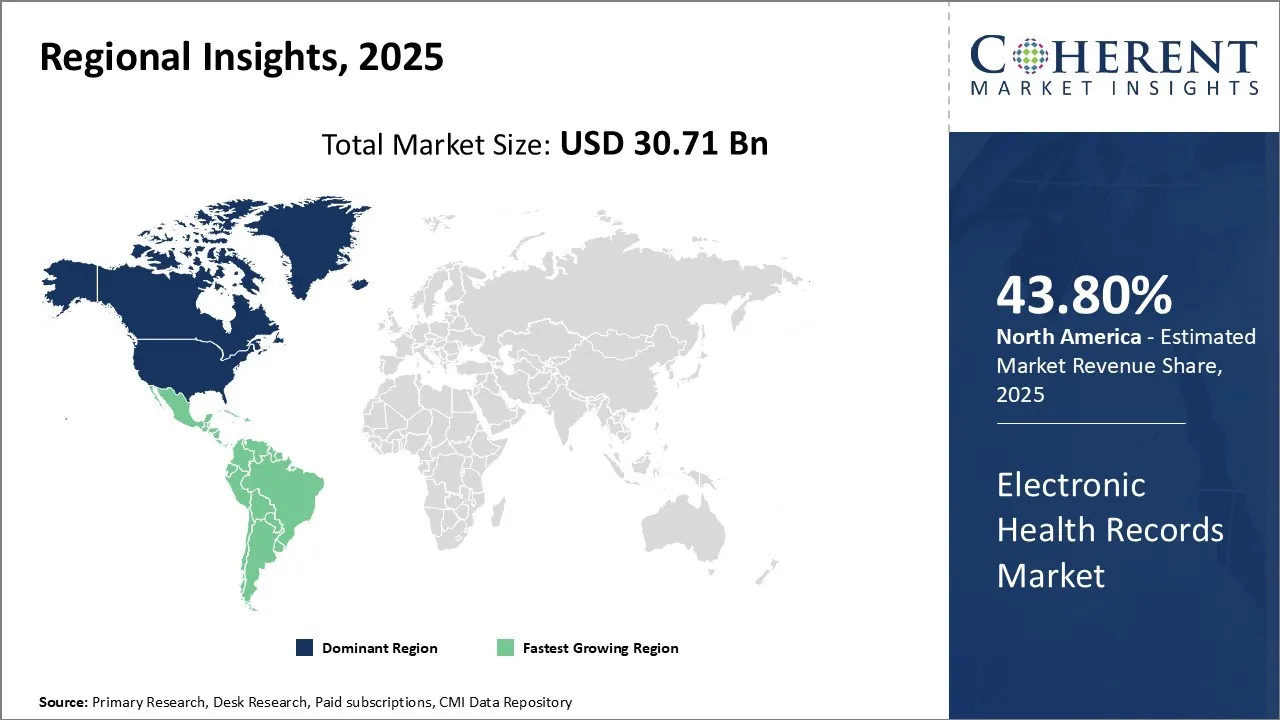
- North America is expected to gain 43.8% share in the market during the forecast period.
Market Overview
The Electronic Health Records (EHR) market growth is increasing steadily with the global transformation towards computerized healthcare systems, increased demand for networked care for patients, and regulatory requirements for transparency and exchangeability of data. Hospital, clinic, and ambulatory care center adoption is driven by increased need to improve clinical efficiency, reduce medical errors, and improve healthcare operations. Emerging economies are also investing tremendously in healthcare IT infrastructure, further propelling the use of EHR.
Current Events and Its Impact on Electronic Health Records (EHR) Market
Current Events | Description and its impact |
EU Installs European Health Data Space (EHDS)
|
|
Oracle Unveils Next ‑ Gen AI ‑ Integrated EHR Platform
|
|
Pipeline Analysis for Electronic Health Records (EHR) Market
The Electronic Health Records (EHR) market pipeline is changing fast due to technological innovation, regulation, and healthcare digitization. Through 2025, some of the major EHR vendors such as Epic Systems, Cerner (Oracle Health), and Allscripts are already developing next-generation platforms with increased interoperability, AI-driven clinical decision support, and patient engagement capabilities. Cloud-based EHR platforms are a major area of innovation, with various vendors piloting scalable, modular offerings that can be implemented in large hospital systems as well as in small practices.
Major innovations on the horizon are voice-based data entry, chronic disease management using predictive analytics, and integration with blockchain for secure patient data sharing. Several of these are in clinical trials or pilot implementations in North America, Europe, and Asia-Pacific, especially in public health infrastructures and academic medical institutions. Furthermore, governments are financing interoperability frameworks such as TEFCA in the United States and comparable frameworks across Europe, persuading EHR vendors to align product pipelines with standardized data sharing protocols.
The pipeline in the EHR market is strong and aligned to address the increasing demand for brighter, more connected, and patient-focused health information systems. These developments are targeted at enhancing care coordination, minimizing physician burden, and long-term health outcomes.
- Current Industry Events of 2026
- Market Size Estimation
- Regional Breakdown
- Competitive Landscape
- Customer Intelligence
- Segmental Analysis
- Pricing Analysis
- Key Market Drivers, Challenges & Future Trends
- Customized Insights Section
Patent Landscape of Electronic Health Records (EHR) Market
The patent environment in the Electronic Health Records (EHR) industry is witnessing an increasing emphasis on interoperability, data protection, user interface design, and Artificial Intelligence (AI)-based features. Up to 2025, top technology vendors and healthcare IT companies such as Epic Systems, Oracle Cerner, Allscripts, and IBM maintain a substantial portfolio of active patents for EHR software systems.
These patents encompass innovations like real-time data synchronization across diverse care settings, automated clinical decision support systems, and privacy-preserving data sharing techniques.
Recent patents also highlight the role of artificial intelligence and machine learning in streamlining clinical workflows, such as voice-over charting, predictive analytics, and treatment recommendation. Companies are also obtaining intellectual property rights for blockchain systems that support safe, tamper-evident health record exchanges between organizations. There is also increased patenting activity in mobile EHR applications, touching on remote access, biometric security, and offline data management.
The U.S. and China dominate in filings, with Europe displaying consistent action via the European Patent Office (EPO). Several filings are also being done under the Patent Cooperation Treaty (PCT) to provide protection globally. This competitive patent situation emphasizes the strategic value of innovation in driving regulation compliance and differentiation in the EHR space.
Global Electronic Health Records Market Drivers
- Increasing adoption healthcare IT solutions to drive market growth
One of the key factors expected to augment growth of the global electronic health records market is the increasing adoption healthcare IT solutions and/or government initiatives to encourage HCIT usage. In August 2024, the National Health Authority (NHA) announced that more than 4 crore (40 million) outpatient department registrations were completed using the QR-driven “Scan & Share” feature under Ayushman Bharat Digital Mission (ABDM).
- Growing use of electronic health records to propel market growth
Another factor which is driving the growth of the global electronic health records market during the forecast period is the growing usage of electronic health record (EHR) in healthcare settings. For instance, an electronic health record (EHR) is a systematic collection of patient and population health information stored electronically in a digital format.
In September 2013, Indian Government (the Ministry of Health & Family Welfare) notified the Electronic Health Record (EHR) Standards for India. Moreover, the Indian government has begun its Digital Health Mission, which seeks to digitize all of the country's citizens' medical records by 2022.
Global Electronic Health Records Market Opportunities
Increasing prevalence of chronic diseases around the world is expected to offer significant growth opportunities for players in the global electronic health records market. For instance, EHR systems can help improve the care of patients with multiple chronic diseases. EHRs provide an excellent way to help patients and doctors manage chronic disease.
According to the Centers for Disease Control and Prevention (CDC), chronic diseases such as heart disease, cancer, and diabetes are the leading causes of death and disability in the United States. Thus, with the increasing prevalence of chronic diseases, the use of HER is also increasing worldwide.
Growing geriatric population across the globe is expected to offer significant growth opportunities for players in the electronic health records market. For instance, elderly people are highly prone to multiple diseases, and it is difficult for physicians to maintain health records. EHRs help seniors access and understand their own medical situation while doctors can follow up with their patients while tracking their continuing care.
According to the World Health Organization (WHO), one in six people in the world will be aged 60 years or over by 2030, and the world’s population of people aged 60 years and older will double (2.1 billion) by 2050.
Global Electronic Health Records Market Trends
- Increasing adoption of cloud-based EHR is a recent trend
Cloud-based EHRs provide various benefits over web-based EHRs, such as lower installation cost, easy maintenance, accessibility, and scalability. Cloud-based software can promote data security. Moreover, cloud-based HER offers easy remote access to data, real-time data tracking guarantees proper disaster recovery, and business continuity solutions support quality patient care.
They also have the potential to overcome interoperability and data exchange challenges in the future, which in turn is expected to increase the use of cloud-based EHR. This trend is expected to continue over the forecast period, driving the growth of the market.
- Increasing healthcare expenditure is another trend
Governments of many developing economies are investing in and launching novel initiatives for ensuring better healthcare facilities for their citizens. Several governments worldwide are looking to digitize all medical records to make it easier for individuals to access and share their personal data with medical professionals.
EHR implementation can provide a robust system for integrating various patient records within a single system, which in turn helps improve the patient outcomes, increasing the use of cloud-based EHR. This trend is also expected to continue during the forecast period, driving the growth of the market.
Segmental Insights

Global Electronic Health Records Market Insights, By Product
Based on Product, the market is segmented into Client Server based EHR and Web-based EHR. Out of which, Web-based EHR Segment is expected to dominate the electronic health records market over the forecast period. This is due to its lower upfront costs, ease of access from any location, and minimal IT infrastructure requirements. It offers scalability and simplified maintenance compared to client-server systems. Additionally, increasing adoption by small to mid-sized healthcare providers supports its growth.
Global Electronic Health Records Market Insights, By Type
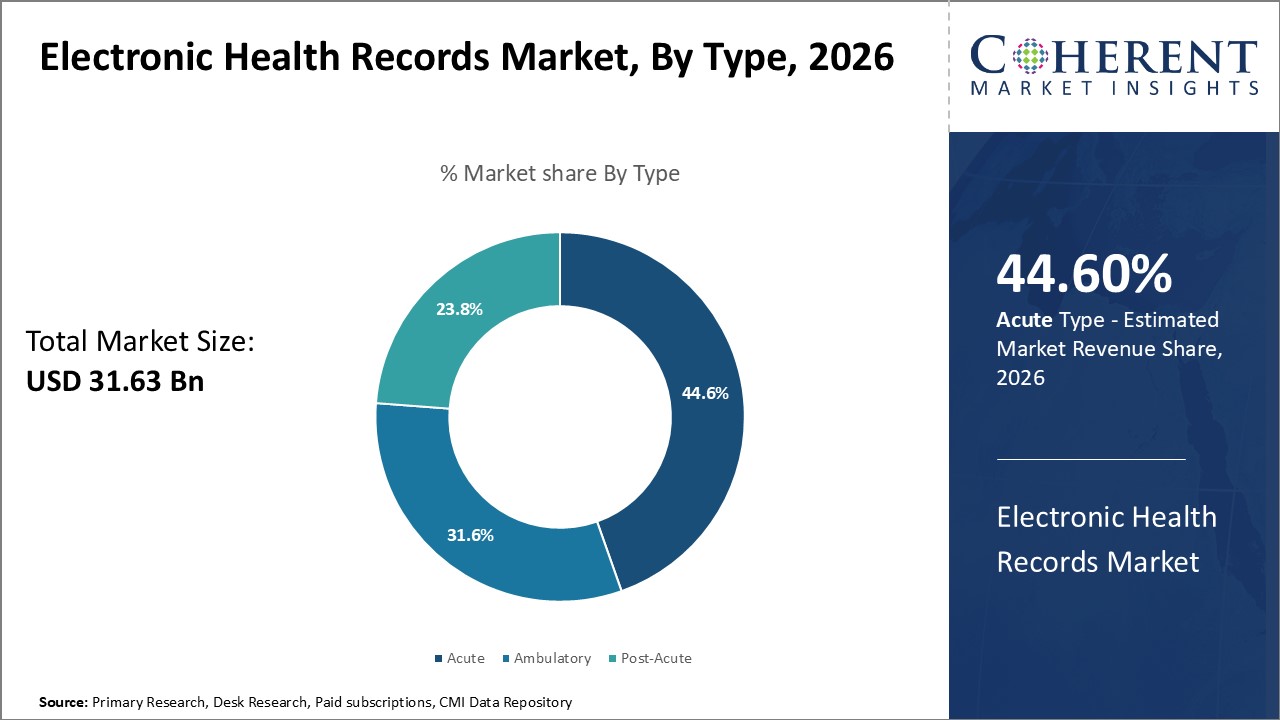
Based on Type, the market is segmented into Acute, Ambulatory, and Post-Acute. Out of which, Acute Segment is expected to dominate the market over the forecast period and this is attributed to the government initiatives for the adoption of electronic health records in small-scale facilities. Acute EHR software is designed specifically for tracking patient's overall health status effectively as he/she switches to outpatient treatment from an inpatient setting.
Global Electronic Health Records Market Insights, By End Use
Based on End Use, the market is segmented into Hospital Use and Ambulatory Use. Out of which, Hospital Use Segment is expected to dominate the market over the forecast period and this is attributed to the large amount of medical data generated in hospitals. Ambulatory Use Segment is also expected to witness robust growth in the near future and this is owing to rising number of ambulatory care centers in the developed and developed economies.
Global Electronic Health Records Market Insights, By Business Model
Based on Business Model, the market is segmented into Licensed Software EHR, Technology Resale, Subscriptions, Professional Services, and Others. Out of which, Licensed Software EHR Segment is expected to dominate the market over the forecast period and this is attributed to the rise in adoption of licensed EHR software/solutions. Subscriptions Segment is also expected to witness significant growth in the near future and this is owing to rise in adoption of subscription EHR models.
Global Electronic Health Records Market – Regional Insights
North America Electronic Health Records Market Analysis and Trends
North America is expected to gain highest share in the market during the forecast period owing to the increasing adoption healthcare IT solutions, growing usage of electronic health records (EHRs) in healthcare settings, and well-established healthcare infrastructure in the United States.
For instance, according to the US Office of the National Coordinator for Health Information Technology, as of 2021, nearly 4 in 5 office-based physicians (78%) and all non-federal acute care hospitals (96%) adopted a certified EHR. This marks substantial 10-year progress since 2011 when 28% of hospitals and 34% of physicians had adopted an EHR.
Europe Electronic Health Records Market Analysis and Trends
Europe is also expected to witness significant growth in the global electronic health records market due to the increasing adoption healthcare IT solutions, increasing prevalence of chronic diseases, growing geriatric population, and growing awareness about the benefits of EHR in these regions.
For instance, the European Commission (EC) has adopted a Recommendation on a European EHR exchange format to unlock the flow of health data across borders. Moreover, the EC is looking to digitise all medical records in the European Union (EU) by 2026 to make it easier for individuals to access and share their personal data with medical professionals.
Electronic Health Records Market Dominating Countries
United States Electronic Health Records Market Analysis and Trend
The United States dominates the world market in EHRs, fueled by sophisticated healthcare infrastructure, compulsory federal mandates such as the HITECH Act, and a very high rate of EHR adoption among hospitals and private practices. Large players like Epic Systems and Oracle Cerner have headquarters in the U.S., further reinforcing its leadership. Strong governmental incentives and ongoing investment in health IT maintain the country's position in the vanguard of digital health evolution.
Germany Electronic Health Records Market Analysis and Trend
Germany is a top EHR market in Europe, backed by government-sponsored digitization initiatives such as the Hospital Future Act. The momentum for secure, interoperable platforms and the implementation of electronic patient records (ePA) are driving EHR penetration higher. Germany's emphasis on data privacy and structured health records puts it in the leadership position in the region.
Market Report Scope
Electronic Health Records Market Report Coverage
| Report Coverage | Details | ||
|---|---|---|---|
| Base Year: | 2025 | Market Size in 2026: | USD 31.63 Bn |
| Historical Data for: | 2020 To 2024 | Forecast Period: | 2026 To 2033 |
| Forecast Period 2026 to 2033 CAGR: | 3.0% | 2033 Value Projection: | USD 38.90 Bn |
| Geographies covered: |
| ||
| Segments covered: |
| ||
| Companies covered: | eClinicalWorks, Cerner Corporation, GE Healthcare, Allscripts Healthcare, LLC, and Epic Systems Corporation. | ||
| Growth Drivers: |
| ||
| Restraints & Challenges: |
| ||
Global Electronic Health Records Market: Key Developments
- At its October 2024 conference, eClinicalWorks launched multiple AI-enabled modules, including “healow Genie” (AI portal/chat service), AI-based revenue cycle management tools, and “Sunoh.ai”—a multilingual AI medical scribe.
- In October 2024, Oracle Health revealed its next-generation EHR—built from the ground up on Oracle Cloud Infrastructure—featuring generative clinical AI agents, voice-activated navigation, and embedded analytics via its Health Data Intelligence suite.
Analyst View
- Electronic Health Records (EHRs) have revolutionized the provision of healthcare by making clinical processes efficient, enhancing patient safety, and generally adding value to the quality of care for patients. Increased government assistance and legislation to compel the computerization of medical records significantly propels international extensive use. Increased focus on preventing drug errors and enhancing communication among healthcare providers also propels EHR uptake in hospitals and private clinics.
- The market is hampered by excessive cost of investment and reluctance on the part of medical practitioners to change. Medical facilities are also typically plagued by interoperability issues that hinder easy integration of free data and coordination among various software systems.
- North America continues to be the leading region in terms of sophisticated healthcare infrastructure, substantial healthcare IT spending, and progressive regulatory regimes that promote the adoption of EHRs. But Asia-Pacific is profitable with the continent seeing growth fueled by government efforts to upgrade healthcare infrastructure and rising awareness of digital health solutions.
- Healthcare organizations implementing next-generation EHR analytics powered by artificial intelligence are well-placed, gaining from added prowess in predictive analytics, better diagnosis, and improved patient engagement.
- The use of cloud-based EHR systems also enables easy access to information and enhanced scalability, which is particularly useful in remote or limited-resource healthcare environments. In order to achieve long-term growth, industry stakeholders need to break through challenges like the problem of interoperability and data security.
Market Segmentation
- Global Electronic Health Records Market, By Product (Revenue, USD Bn, 2021 - 2033)
- Client Server based HER
- Web-based HER
- Global Electronic Health Records Market, By Type (Revenue, USD Bn, 2021 - 2033)
- Acute
- Ambulatory
- Post-Acute
- Global Electronic Health Records Market, By End User (Revenue, USD Bn, 2021 - 2033)
- Hospital Use
- Ambulatory Use
- Global Electronic Health Records Market, By Business Model (Revenue, USD Bn, 2021 - 2033)
- Licensed Software HER
- Technology Resale
- Subscriptions
- Professional Services
- Others
- Global Electronic Health Records Market, By Geography (Revenue, USD Bn, 2021 - 2033)
- North America
- U.S.
- Canada
- Latin America
- Brazil
- Argentina
- Mexico
- Rest of Latin America
- Europe
- Germany
- U.K.
- Spain
- France
- Italy
- Russia
- Rest of Europe
- Asia Pacific
- China
- India
- Japan
- Australia
- South Korea
- ASEAN
- Rest of Asia Pacific
- Middle East
- GCC Countries
- Israel
- Rest of Middle East
- Africa
- South Africa
- North Africa
- Central Africa
- North America
- Company Profiles
- eClinicalWorks
- Cerner Corporation
- GE Healthcare
- Allscripts Healthcare, LLC
- Epic Systems Corporation
Sources
Primary Research Interviews
- Healthcare IT Providers
- Hospitals & Clinics Decision Makers
- Health Insurance Companies Representatives
- Industry Consultants
- Others
Databases
- ClinicalTrials.gov
- World Health Organization (WHO) Database
- Global Health Observatory Data Repository
- Others
Magazines
- Healthcare IT News
- Health Data Management
- Becker's Hospital Review
- Healthcare Informatics
- Others
Journals
- Journal of Medical Internet Research
- International Journal of Medical Informatics
- Journal of Healthcare Information Management
- Others
Newspapers
- The Wall Street Journal
- The Guardian
- The New York Times
- The Economic Times
- Others
Associations
- American Medical Informatics Association (AMIA)
- Healthcare Information and Management Systems Society (HIMSS)
- Medical Group Management Association (MGMA)
- American Health Information Management Association (AHIMA)
- Others
Public Domain Sources
- Centers for Medicare & Medicaid Services (CMS)
- Office of the National Coordinator for Health Information Technology (ONC)
- U.S. Department of Health and Human Services (HHS)
- HealthIT.gov
- Others
Proprietary Elements
- CMI Data Analytics Tool, Proprietary CMI Existing Repository of Information for last 8 years
*Definition: Electronic health record (EHR) is a systematized collection of patient and population electronically stored health information in a digital format. EHRs are real-time, patient-centered records that make information available instantly & securely to authorized users. EHR is a digital version of the patient’s paper chart.
Get access to 250+ pages report
Every segment, forecast, competitor profile and data table behind the analysis above — available for instant download.
- ESOMAR Member
- ISO 9001:2015 Certified
- D-U-N-S Registered
- GDPR & CCPA Compliant
Missing comfort of reading report in your local language? Find your preferred language:
Transform your Strategy with Exclusive Trending Reports
Frequently Asked Questions
The Electronic Health Records Market size is estimated to be valued at USD 31.63 Bn in 2026, and is expected to reach USD 38.90 Bn by 2033.
The CAGR of the global Market is projected to be 3.0% from 2026 to 2033.
Increasing adoption healthcare IT solutions and growing usage of electronic health record (EHR) is fueling the market.
Web-based EHR segment is the leading product segment in the market.
High cost of EHR implementation and reluctance to adopt EHRs among physicians and patients are major factors restraining growth of the market.
Major players operating in the market are eClinicalWorks, Cerner Corporation, GE Healthcare, Allscripts Healthcare, LLC, and Epic Systems Corporation.