

Infections Surveillance Solutions Market – 2026 to 2033
Infection Surveillance Solutions Market is estimated to be valued at USD 1020.4 Mn in 2026 and is expected to reach USD 2,616.8 Mn in 2033, exhibiting a compound annual growth rate (CAGR) of 14.4% from 2026 to 2033.
Key Takeaways
- By Product & Services Type, the software segment is anticipated to dominate the global infection surveillance solutions market in 2026. This dominance is driven by the increasing adoption of surveillance software for managing healthcare-associated infections, offering real-time monitoring and predictive analytics capabilities.
- Based on Infection Type, Surgical site infections are expected to lead the infection owing to the rising prevalence of surgical site infections globally, necessitating effective surveillance and prevention strategies.
- By End-User Segment, Hospitals are projected to be the dominant end-users of infection surveillance solutions in 2026. The increasing number of hospitals and the need for efficient infection control measures contribute to this trend.
- Based on Region, North America is expected to lead the global infection surveillance solutions market in 2026, holding approximately 45.1% of the market share. This is due to the high prevalence of hospital-acquired infections and the advanced healthcare infrastructure in the region.
Market Overview
The global infection surveillance solutions market is expected to witness significant growth over the forecast period, driven by the rising prevalence of healthcare-associated infections (HAIs), increasing focus on infection control, and growing adoption of advanced technologies such as real-time data analytics and AI in healthcare. The demand for these solutions is further fueled by the need for improved patient safety and compliance with regulatory standards across hospitals and other healthcare settings. However, high implementation and maintenance costs, along with challenges in data integration, may slightly hinder market growth.
Current Events and Its Impact
Current Events | Description and its impact |
Expansion of International Pathogen Genomic Surveillance Initiatives |
|
Antimicrobial Resistance (AMR) Crisis Response |
|
Regulatory and Compliance Pressures |
|
Healthcare Digitalization Surges in Emerging Market |
|
Role of AI (Artificial Intelligence) in Infection Surveillance Market
AI-powered systems continuously monitor infection data in real-time, quickly identifying unusual patterns or spikes in cases. This allows for rapid responses to potential outbreaks, reducing the time between detection and action. In April 2025, the BEACON platform was launched as a first-of-its-kind, open-source global surveillance tool designed to detect emerging infectious diseases in near real-time. Combining the power of artificial intelligence (AI) with a worldwide network of human subject matter experts, BEACON provides fast, verified alerts about potential outbreaks. The platform aims to strengthen global health security by offering timely, reliable data, enabling quicker responses to emerging infectious threats and enhancing overall public health preparedness.
- Current Industry Events of 2026
- Market Size Estimation
- Regional Breakdown
- Competitive Landscape
- Customer Intelligence
- Segmental Analysis
- Pricing Analysis
- Key Market Drivers, Challenges & Future Trends
- Customized Insights Section
Segmental Insights
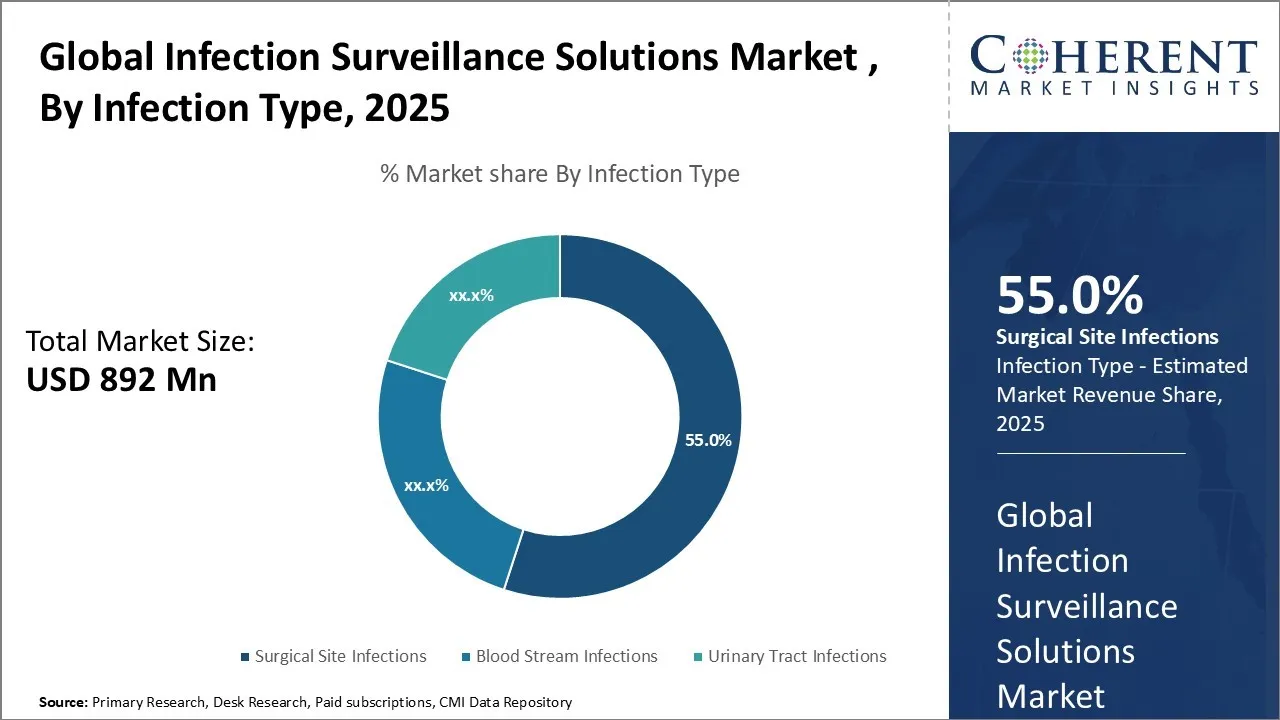
Infection Surveillance Solutions Market, by Infection type: Surgical site infections accounts for the largest share due to increasing prevalence of surgical site infections
Surgical site infections (SSIs) represent a significant concern in the realm of infection surveillance, accounting for a substantial share due to their high prevalence and associated complications. In India alone, an estimated 1.5 million SSIs occur annually, with orthopaedic procedures exhibiting a particularly high incidence rate of 55.2%. Further studies have reported SSI rates of 12.88% in general surgical procedures and up to 18.6% in abdominal surgeries. These infections not only prolong hospital stays and increase healthcare costs but also contribute to higher morbidity and mortality rates. The significant burden of SSIs underscores the critical need for effective infection surveillance solutions to monitor, prevent, and manage these infections, thereby improving patient outcomes and enhancing overall healthcare quality.
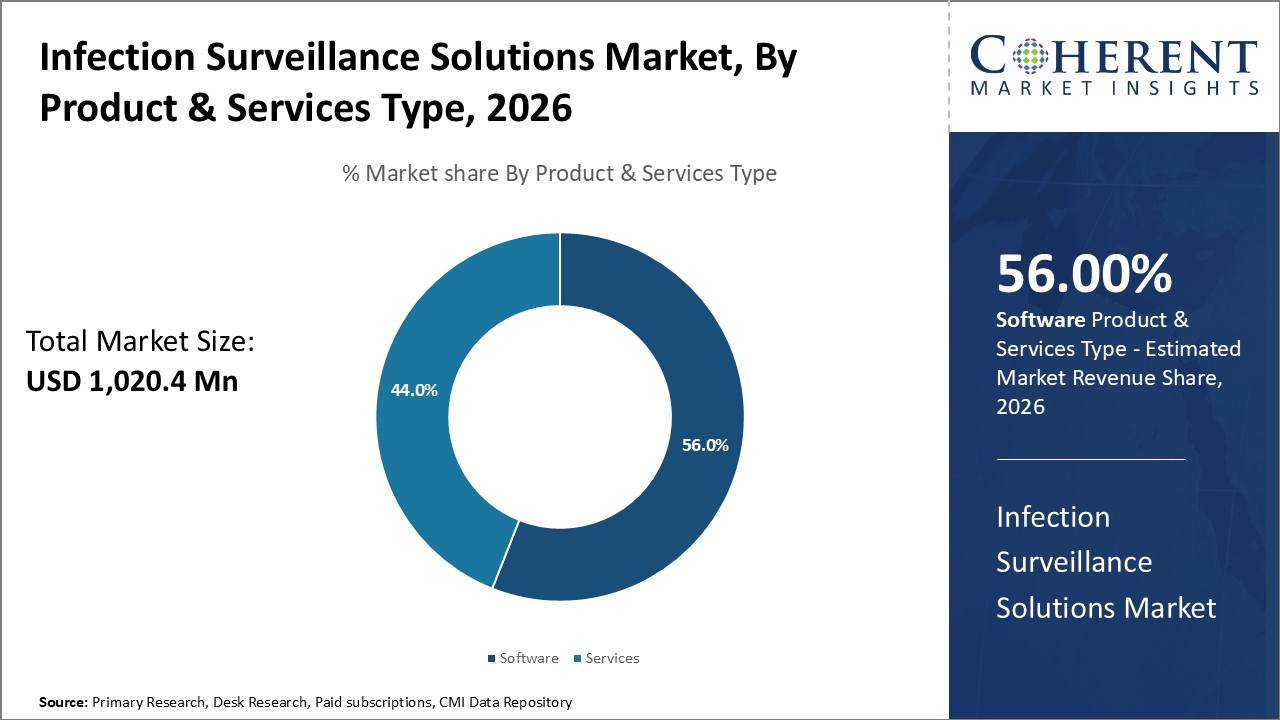
Infection Surveillance Solutions Market, by Product & Services Type: Software segment accounts for the largest share due to the increase in usage of surveillance software for management
The software segment dominates the infection surveillance solutions market, primarily due to its increasing adoption in healthcare settings for managing and preventing healthcare-associated infections (HAIs). Hospitals are leveraging advanced software platforms to enhance real-time monitoring, data analysis, and reporting capabilities, which are crucial for effective infection control. For instance, the integration of artificial intelligence (AI) and automation tools has provided hospitals with improved methods to prevent HAIs, as highlighted in a recent article by Healthcare Purchasing News. These technological advancements enable healthcare providers to detect infection patterns promptly, implement timely interventions, and comply with stringent regulatory requirements, thereby improving patient outcomes and safety. The growing emphasis on patient safety and the need for efficient infection control measures continue to drive the demand for sophisticated infection surveillance software in the healthcare industry
Infection Surveillance Solutions Market, By End User, Hospital segment accounts for the largest share due to the increase in the number of new hospitals for the management infection.
The hospital segment holds the largest share in the infection surveillance solutions market, driven by the increasing number of new hospitals and the growing emphasis on infection control measures. For instance, the foundation stone for a new 100-bed area hospital was laid in Parigi, Vikarabad district, Telangana, on May 12, 2026. This facility aims to offer a range of specialty medical services, including a trauma care centre with advanced infrastructure, highlighting the government's initiative to enhance state-run hospitals' functionality and patient services. Additionally, hospitals worldwide are adopting advanced technologies to achieve 'smart hospital' status, incorporating AI, IoT, and robotics to improve patient care and operational efficiency. For example, Cleveland Clinic employs AI for sepsis detection, and Oulu University Hospital launched a 5G network for enhanced communication. These developments underscore the critical role of hospitals in implementing infection surveillance solutions to enhance patient safety and healthcare quality.
Regional Insights
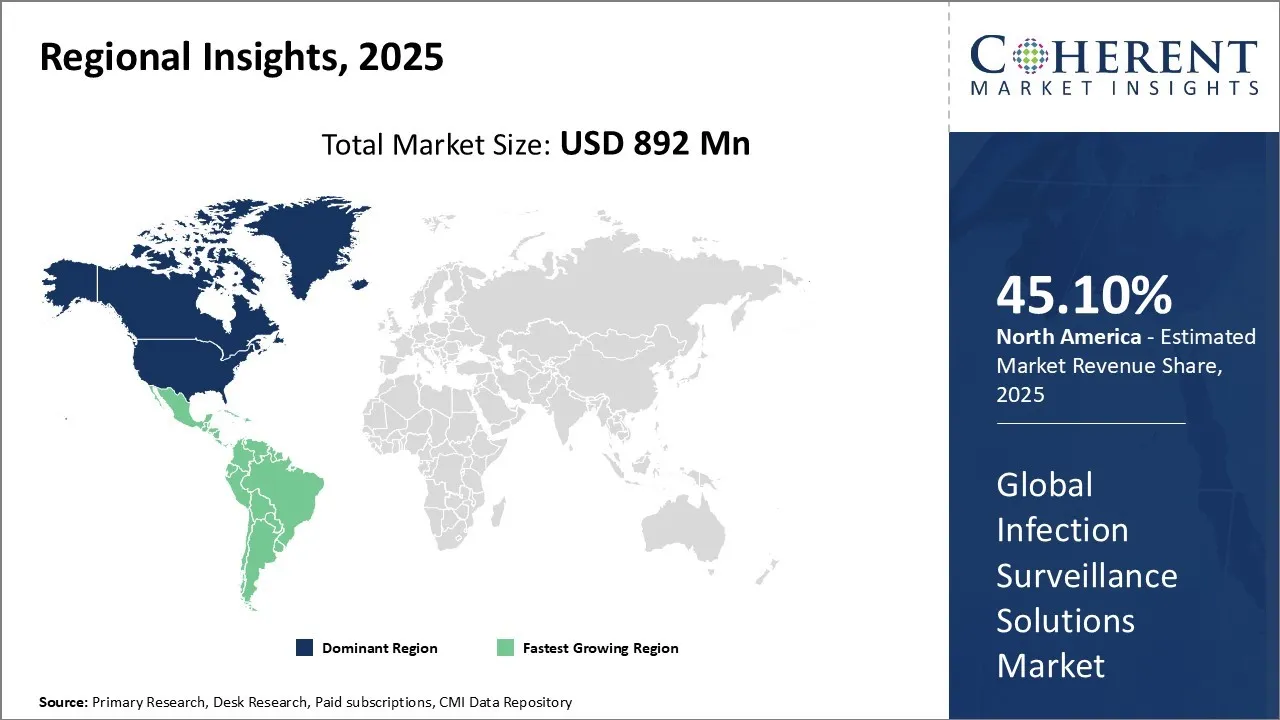
North America Infection Surveillance Solutions Market Trends
North America is expected to retain its leading position in the global infection surveillance solutions market, holding 45.1% of the market share, driven by the high prevalence of hospital-acquired infections (HAIs) and increasing emphasis on infection prevention. According to the CDC, about 1 in 31 hospital patients in the U.S. has at least one HAI on any given day, highlighting the need for robust surveillance systems . In response, healthcare facilities across the region are adopting advanced infection surveillance software and AI tools to enhance early detection and control, reinforcing North America’s dominant role in infection surveillance solutions market share through 2026 and beyond.
Europe Infection Surveillance Solutions Market Trends
Europe holds a significant share in the global infection surveillance market, fueled by stringent healthcare regulations and the high prevalence of healthcare-associated infections (HAIs). The European Centre for Disease Prevention and Control (ECDC) reports that approximately 6% of patients in European acute care hospitals acquire at least one HAI, highlighting the critical need for effective infection control solutions. Countries like Germany, France, and the UK are investing heavily in AI-based infection monitoring systems, hospital digitalization, and real-time data analytics to enhance infection detection and prevention. Additionally, European healthcare providers are increasingly adopting integrated electronic health records (EHR) and IoT-enabled devices to streamline infection surveillance. These coordinated efforts drive the expansion of infection surveillance solutions market demand, positioning Europe as a key market with strong growth prospects through 2026 and beyond.
Canada Infection Surveillance Solutions Market Trends
Canada is poised for growth in the infection surveillance solutions market, driven by national efforts to reduce healthcare-associated infections (HAIs) and enhance care quality. According to the Public Health Agency of Canada, approximately 10% of patients in acute care settings experience HAIs, highlighting the urgency of effective infection control. Hospitals across Canada are adopting electronic surveillance systems and AI tools to detect infections earlier and improve response. Government-supported programs like the Canadian Nosocomial Infection Surveillance Program (CNISP) are further strengthening data collection and antimicrobial resistance monitoring, contributing to infection surveillance solutions market share through 2026.
United States Infection Surveillance Solutions Market Trends
The increasing focus on monitoring zoonotic diseases, such as avian influenza A(H5N1), is driving the growth of the U.S. infection surveillance solutions market. With advancements in real-time data tracking tools, public health authorities can access detailed outbreak information across humans, birds, and mammals. These solutions improve surveillance capabilities by offering key insights into disease trends, helping prevent the transmission of infections to humans. Enhanced data visualization, such as maps and tables, strengthens active surveillance efforts, contributing to more informed decision-making and better preparedness for potential outbreaks, thus boosting demand for advanced infection surveillance systems. For instance, in January 2026, the Pan American Health Organization (PAHO) launched an interactive dashboard to track avian influenza A(H5N1) cases in the Americas. This tool provides key data on outbreaks in humans, domestic and wild birds, and mammals, sourced from the World Organization for Animal Health (WOAH). The dashboard supports PAHO's surveillance efforts to prevent human transmission of the disease. This is further accelerating the infection surveillance solutions market demand.
Global Infection Surveillance Solutions Market – Driver
Increasing Awareness Campaign for the Urinary Tract Infection
Increasing awareness campaign by key market players is expected to drive the infection surveillance market over the forecast period. For instance, Urovant Sciences, a pharmaceutical company, announced that it had launched a new multichannel education campaign that aims to spread awareness among people about the urinary tract infection and guide them through proper management and prevention of urinary tract infection. This is further accelerating the infection surveillance solutions market growth.
Global Infection Surveillance Solutions Market: Opportunities
AMR is a growing global health threat, and surveillance systems focused on tracking antibiotic resistance patterns across populations are critical for mitigating its spread. The development of real-time, comprehensive AMR surveillance systems that can provide insights into resistance trends, inform public health strategies, and enable timely interventions is creating lucrative infection surveillance solution market opportunities. The European Antimicrobial Resistance Surveillance Network (EARS-Net) is an example of a regional system that collects data on AMR. It now covers over 30 countries, providing valuable data on antimicrobial usage and resistance patterns. EARS-Net has helped shape antimicrobial stewardship policies and assisted healthcare providers in making evidence-based decisions to combat AMR. This is further accelerating the infection surveillance solutions market revenue.
Market Report Scope
Infections Surveillance Solutions Market Report Coverage
| Report Coverage | Details | ||
|---|---|---|---|
| Base Year: | 2025 | Market Size in 2026: | USD 1020.4 Mn |
| Historical Data for: | 2020 To 2024 | Forecast Period: | 2026 To 2033 |
| Forecast Period 2026 to 2033 CAGR: | 14.4% | 2033 Value Projection: | USD 2,616.8 Mn |
| Geographies covered: |
| ||
| Segments covered: |
| ||
| Companies covered: | Baxter, BD, STERIS, Getinge AB, Medtronic, Koninklijke Philips N.V., Abbott, Medexter Healthcare, Asolva, GOJO Industries, Inc., Wolters Kluwer N.V., VigiLanz Corporation, RLDatix, Roper Technologies Inc., Health Outcomes Worldwide, OpGen, Inc., Urovant Sciences and Premier | ||
| Growth Drivers: |
| ||
| Restraints & Challenges: |
| ||
Global Infection Surveillance Solutions Market: Key Developments
- In May 2025, Fiji opened its Pathogen Genomics Laboratory at the Fiji Centre for Disease Control. This advanced facility represents a significant achievement in the country's capacity to quickly detect, analyze, and respond to infectious disease threats, including antimicrobial-resistant bacteria and viral infections such as influenza.
- In April 2025, researchers from the University of Liverpool initiated a surveillance project, VetCLIN-AMR, focused on antimicrobial resistance in clinical infections from companion animals.
- In January 2025, the UK Health Security Agency (UKHSA) introduced a groundbreaking metagenomics initiative to accelerate the detection of infectious diseases that may pose a threat to the UK.
- In November 2024, Pfizer India, in partnership with the Government of Goa, Goa Medical College, Directorate of Health Services, and Americares India Foundation, launched Project Parivartan. Supported by Pfizer’s CSR program, the initiative focuses on enhancing infection prevention and control (IPC) in Goa’s public healthcare facilities, in line with India’s National Action Plan on AMR and WHO’s global health priorities.
Analyst Opinion (Expert Opinion)
- The infection surveillance market is experiencing significant transformation, driven by the increasing burden of infectious diseases, the rise of antimicrobial resistance (AMR), and the growing reliance on advanced technologies such as artificial intelligence (AI) and machine learning. The demand for enhanced infection surveillance has become a central focus for healthcare systems, governments, and organizations aiming to safeguard public health and improve patient outcomes.
- A key driving force behind the expansion of infection surveillance systems is the growing threat of AMR, which has reached alarming levels globally. The World Health Organization (WHO) has warned that AMR could lead to 10 million deaths annually by 2050 if current trends continue. In 2021, a report from the CDC revealed that over 2.8 million people in the United States suffer from antibiotic-resistant infections each year, resulting in approximately 35,000 deaths. These statistics underscore the critical need for real-time, data-driven surveillance systems capable of monitoring antibiotic use, tracking resistance patterns, and informing timely interventions. Surveillance systems, such as the European Antimicrobial Resistance Surveillance Network (EARS-Net), are providing invaluable data to tackle this global health challenge, with over 30 European countries contributing to the network’s findings, which guide antimicrobial stewardship programs and policy decisions.
- Another major concern is healthcare-associated infections (HAIs), which continue to pose a significant threat to patient safety worldwide. The CDC estimates that 1 in 31 hospital patients in the United States is affected by at least one HAI on any given day. The economic burden of these infections is also staggering, with the Agency for Healthcare Research and Quality (AHRQ) estimating the total cost of HAIs in U.S. hospitals at over USD 28 billion annually. The integration of infection surveillance with hospital information systems and electronic health records (EHR) has proven to be an effective strategy in combating HAIs. A study published in the American Journal of Infection Control in 2022 found that hospitals with integrated infection surveillance systems saw a 22% reduction in the incidence of bloodstream infections alone. This demonstrates the value of real-time monitoring and the ability to trigger early responses to outbreaks within hospital settings.
Speak to the analyst
Want personalized insights?
Take the findings above to one of our principal consultants, or have the report rebuilt around the segments, geographies and competitors you actually track.
Market Segmentation
- Global Infection Surveillance Solutions Market, By Products and Services (Revenue, USD Mn, 2021 - 2033)
- Software
- On-Premises
- Web-Based
- Services
- Support & Maintenance
- Training & Consulting
- Software
- Global Infection Surveillance Solutions Market, By Infection Type (Revenue, USD Mn, 2021 - 2033)
- Surgical Site Infections
- Blood Stream Infections
- Urinary Tract Infections
- Global Infection Surveillance Solutions Market, By End User (Revenue, USD Mn, 2021 - 2033)
- Hospitals
- Clinics
- Ambulatory Surgical Centers
- Other (Specialty Center, etc.)
- Global Infection Surveillance Market, By Region (Revenue, USD Mn, 2021 - 2033)
- North America
- U.S.
- Canada
- Latin America
- Brazil
- Argentina
- Mexico
- Rest of Latin America
- Europe
- Germany
- U.K.
- Spain
- France
- Italy
- Russia
- Rest of Europe
- Asia Pacific
- China
- India
- Japan
- Australia
- South Korea
- ASEAN
- Rest of Asia Pacific
- Middle East
- GCC Countries
- Israel
- Rest of Middle East
- Africa
- South Africa
- North Africa
- Central Africa
- North America
- Company Profiles
- Baxter
- BD
- STERIS
- Getinge AB
- Medtronic
- Koninklijke Philips N.V.
- Abbott
- Medexter Healthcare
- Asolva
- GOJO Industries, Inc.
- Wolters Kluwer N.V.
- VigiLanz Corporation
- RLDatix
- Roper Technologies, Inc.
- Health Outcomes Worldwide
- OpGen, Inc.
- Urovant Sciences
- Premier
Sources
Primary Research Interviews from the following stakeholders
Stakeholders
- Interviews with infection control specialists, hospital administrators, IT solution providers, epidemiologists, public health officials, and industry experts specializing in healthcare surveillance technologies.
- Specific stakeholders: Infection preventionists, clinical microbiologists, hospital CIOs, healthcare quality officers, and software developers in health IT.
Databases
- PubMed
- ClinicalTrials.gov
- HealthData.gov
- CDC National Healthcare Safety Network (NHSN)
- WHO Global Health Observatory
Magazines
- Healthcare IT News
- Infection Control Today
- MedTech Insight
- HealthTech Magazine
- Becker’s Hospital Review
Journals
- American Journal of Infection Control
- Journal of Hospital Infection
- Infection Control & Hospital Epidemiology
- Journal of Medical Systems
- BMC Infectious Diseases
Newspapers
- The New York Times
- The Guardian
- The Wall Street Journal
- Financial Times
- The Washington Post
Associations
- Association for Professionals in Infection Control and Epidemiology (APIC)
- Society for Healthcare Epidemiology of America (SHEA)
- Healthcare Information and Management Systems Society (HIMSS)
- Infectious Diseases Society of America (IDSA)
- European Centre for Disease Prevention and Control (ECDC)
Public Domain Sources
- World Health Organization (WHO)
- Centers for Disease Control and Prevention (CDC)
- Food and Drug Administration (FDA)
- National Institutes of Health (NIH)
- U.S. Department of Health and Human Services (HHS)
Proprietary Elements
- CMI Data Analytics Tool, and Proprietary CMI Existing Repository of information for last 8 years
Get access to 250+ pages report
Every segment, forecast, competitor profile and data table behind the analysis above — available for instant download.
- ESOMAR Member
- ISO 9001:2015 Certified
- D-U-N-S Registered
- GDPR & CCPA Compliant
Missing comfort of reading report in your local language? Find your preferred language:
Transform your Strategy with Exclusive Trending Reports
Frequently Asked Questions
The Infection Surveillance Solutions Market is estimated to be valued at USD 1020.4 Mn in 2026, and is expected to reach USD 2,616.8 Mn by 2033.
The CAGR of the Infection Surveillance Solutions Market is projected to be 14.4% from 2026 to 2033.
Increasing prevalence of infectious diseases is expected to drive the market.
Surgical site infection is the leading infection type segment in the market.
Inadequate data management and computing resources is expected to hinder the market over the forecast period.
Major players operating in the market include Baxter, BD, STERIS, Getinge AB, Medtronic, Koninklijke Philips N.V., Abbott, Medexter Healthcare, Asolva, GOJO Industries, Inc., Wolters Kluwer N.V., VigiLanz Corporation, RLDatix, Roper Technologies Inc., Health Outcomes Worldwide, OpGen, Inc., Urovant Sciences and Premier.