

Internet Of Things Healthcare Market Size and Forecast — 2026 - 2033
The Global Internet of Things Healthcare Market size is estimated to be valued at USD 85.3 billion in 2026 and is expected to reach USD 172.9 billion by 2033, exhibiting a compound annual growth rate (CAGR) of 11.2% from 2026 to 2033.
Overview
The Internet of Things (IoT) healthcare market encompasses a diverse range of connected devices and solutions designed to improve patient care, monitoring, and operational efficiency. Key products include wearable devices, such as smartwatches and fitness trackers, remote patient monitoring systems, connected medical equipment, and smart implants. Software platforms for data collection, analytics, and real-time alerts complement these devices, enabling proactive health management. Hospital and home healthcare solutions integrate IoT with telemedicine and mobile health applications to enhance treatment outcomes. Growing adoption is driven by rising chronic diseases, the need for personalized care, and the push for efficient, data-driven healthcare delivery.
Key Takeaways
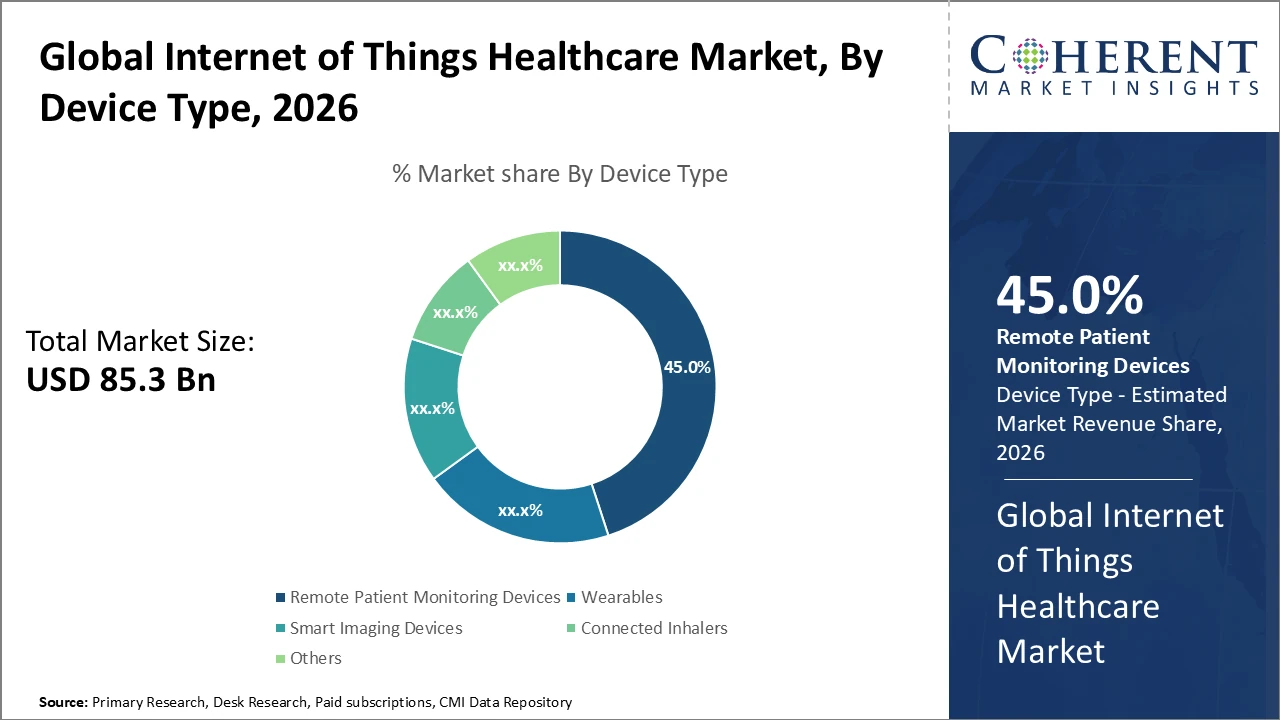
Remote Patient Monitoring Devices dominate the IoT healthcare market with a 45% share, driven by widespread use in chronic disease management and acute care settings.
Telemedicine applications are rapidly growing, fueled by pandemic-driven adoption, reflecting a significant shift in healthcare service delivery models.
Hospitals and clinics are the primary end-users, contributing the largest revenue by leveraging IoT technologies to improve operational efficiency and patient outcomes.
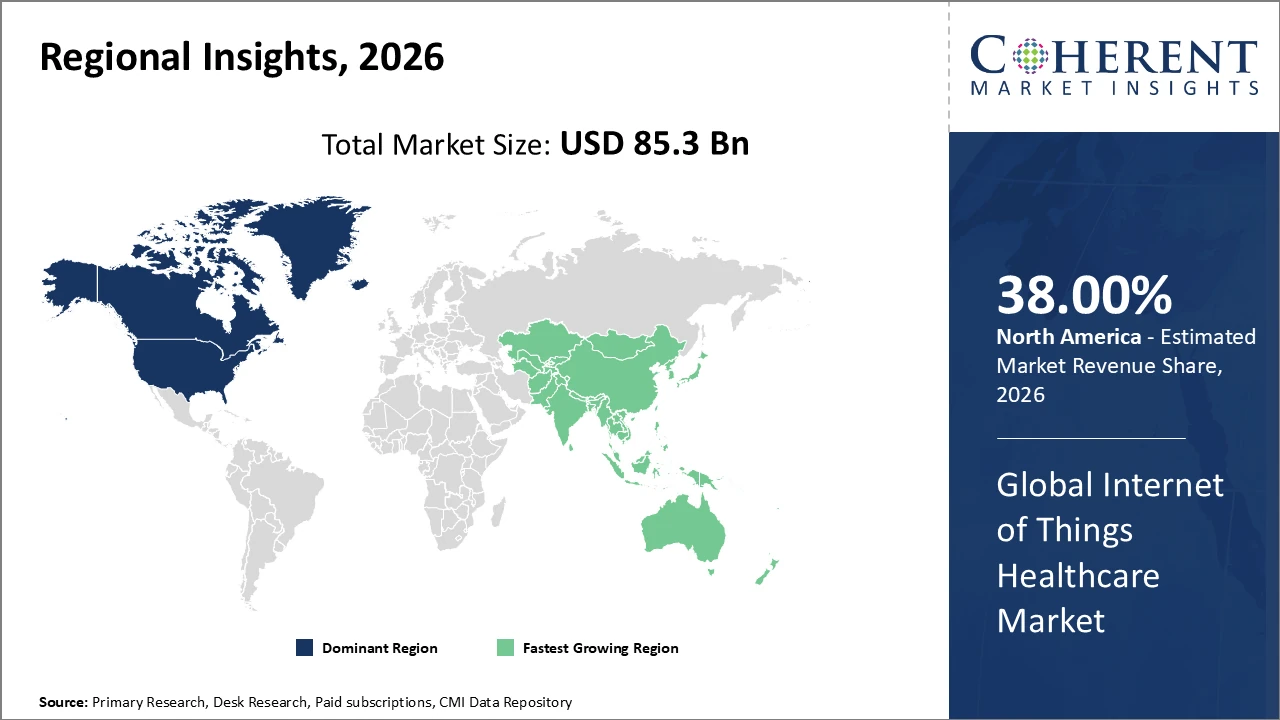
North America holds the largest regional market share at around 38%, supported by advanced healthcare infrastructure and substantial government funding.
Asia Pacific shows the fastest CAGR, driven by increasing IoT device adoption in China and India, expanding telecom networks, and evolving healthcare policies.
Internet Of Things Healthcare Market Segmentation Analysis
Internet Of Things Healthcare Market Insights, By Device Type
Remote Patient Monitoring Devices lead the IoT healthcare market with a 45% share, driven by advances in biosensors and connectivity protocols that support chronic disease management requiring continuous monitoring. These devices allow real-time data transmission to healthcare providers, enhancing patient compliance and clinical outcomes. Wearables are the fastest growing subsegment, fueled by rising health awareness and fitness trends, offering features like heart rate monitoring, sleep tracking, and activity measurement. Smart imaging devices improve diagnostic accuracy, while connected inhalers target respiratory patients. The Others category includes implantable devices and specialized applications, contributing steadily to overall market growth.
Internet Of Things Healthcare Market Insights, By Application
Telemedicine is the leading application segment in the IoT healthcare market, driven by global healthcare digitization and growing demand for remote consultations and diagnostics. Its expansion reflects the need for accessible, cost-effective healthcare services. Chronic Disease Management is also rapidly growing, utilizing IoT devices for continuous monitoring and personalized treatment adjustments. Asset Management in hospitals focuses on tracking critical medical equipment to improve operational efficiency, while Medication Management leverages connected systems to enhance patient adherence. The Others category includes applications such as rehabilitation assistance and emergency response systems, providing complementary support to primary healthcare delivery and improving overall patient outcomes.
Internet Of Things Healthcare Market Insights, By End User
Hospitals and clinics dominate the IoT healthcare market, benefiting from extensive integration of connected devices to optimize patient workflows, manage medical assets, and enhance clinical decision-making. Rising pressures to reduce operational costs while improving patient outcomes further drive adoption. Home healthcare represents the fastest-growing subsegment, supported by aging populations seeking in-home care and advancements in user-friendly IoT devices. Diagnostic centers leverage IoT-enabled imaging and laboratory equipment to improve accuracy and reduce turnaround times. The Others category includes telepharmacies and specialized care facilities, offering niche opportunities that complement broader healthcare delivery and contribute to overall market growth.
Internet Of Things Healthcare Market Trends
The IoT healthcare market is increasingly driven by the convergence of AI, edge computing, and advanced sensor technologies, enabling proactive patient care and enhanced monitoring.
Rising prevalence of chronic diseases has accelerated the adoption of telehealth and remote patient monitoring, boosting demand for wearable and implantable IoT devices.
In 2026, AI-enhanced glucose monitors were launched by key players, transforming diabetes management through continuous monitoring and real-time insights.
Growing regulatory support for digital health frameworks, particularly in developed economies, is accelerating market adoption.
Integration of blockchain technology addresses data security concerns, encouraging higher adoption rates of IoT healthcare solutions globally.
Internet Of Things Healthcare Market Insights, By Geography
North America Internet Of Things Healthcare Market Analysis and Trends
In North America, the IoT healthcare market is dominated by robust healthcare infrastructure, advanced research and development, and substantial government funding. The United States contributes a significant portion of market revenue, with extensive hospital networks adopting IoT solutions for patient monitoring, asset management, and operational efficiency. Regulatory frameworks supporting digital health growth, such as the 21st Century Cures Act, facilitate innovation and adoption of connected medical devices. High consumer awareness, strong private-sector investment, and a focus on advanced technologies like AI and edge computing further strengthen the region’s leadership in IoT healthcare, making it a key global market driver.
Asia Pacific Internet Of Things Healthcare Market Analysis and Trends
Meanwhile, Asia Pacific is the fastest-growing region in the IoT healthcare market, with a CAGR exceeding 13%. Rapid expansion of telecom infrastructure, particularly 5G deployment in China and India, enables seamless connectivity for IoT devices, supporting remote patient monitoring and telehealth services. Government initiatives to digitize healthcare systems further accelerate adoption across hospitals, clinics, and home healthcare settings. A growing middle class, rising disposable incomes, and increasing prevalence of chronic diseases are driving demand for cost-effective, technology-driven healthcare solutions. These factors collectively position Asia Pacific as a key growth hub, offering significant opportunities for both global and regional IoT healthcare providers.
Internet Of Things Healthcare Market Outlook for Key Countries
USA Internet Of Things Healthcare Market Analysis and Trends
The U.S. IoT healthcare market is driven by significant investments in telehealth and remote patient monitoring infrastructure. Leading companies, including Medtronic and Philips Healthcare, have facilitated widespread deployment of connected devices across hospital networks, capturing over 40% of the regional market share in 2026. Supportive government initiatives emphasizing interoperability standards and stringent data security regulations have encouraged innovation in compliant IoT solutions. Hospitals, clinics, and home healthcare providers increasingly adopt these technologies to improve patient outcomes, streamline operations, and enhance care efficiency, reinforcing the U.S. as a global leader in the rapidly expanding IoT healthcare market.
Germany Internet Of Things Healthcare Market Analysis and Trends
Germany’s IoT healthcare market is driven by advanced healthcare infrastructure, high technology adoption, and supportive regulatory frameworks. Hospitals and clinics are increasingly integrating connected devices for patient monitoring, asset management, and workflow optimization. Telemedicine and remote patient monitoring are rapidly gaining traction, fueled by rising chronic disease prevalence and an aging population. Wearables and smart imaging devices are increasingly used to enhance diagnostics and patient care. Government initiatives promoting digital health and data interoperability further accelerate adoption. The market also benefits from strong R&D activities by key players, fostering innovation in AI-enabled devices, sensor technologies, and secure data management solutions.
Analyst Opinion
Accelerated adoption of remote patient monitoring devices is a key driver, contributing significantly to market revenue. In 2025, global shipments of remote health monitoring devices increased by 22%, reflecting growing demand for chronic disease management and IoT-enabled telehealth solutions, particularly among aging populations.
Competitive pricing strategies by IoT healthcare device manufacturers are influencing market size. In 2024, several companies reduced device prices by an average of 8% to capture emerging markets such as Asia Pacific, boosting regional revenue streams by over 15% annually.
Increased hospital imports of smart medical devices are enhancing market share. U.S. hospitals alone imported over USD 3.5 billion of IoT-enabled healthcare equipment in 2026 to upgrade connected healthcare infrastructure.
Expanding IoT use in personalized medicine and predictive healthcare is driving market growth. Data from wearable devices in 2025 enabled over 30% more precise health analytics, supporting proactive treatment plans and improved patient outcomes.
- Current Industry Events of 2026
- Market Size Estimation
- Regional Breakdown
- Competitive Landscape
- Customer Intelligence
- Segmental Analysis
- Pricing Analysis
- Key Market Drivers, Challenges & Future Trends
- Customized Insights Section
Market Scope
| Report Coverage | Details | ||
|---|---|---|---|
| Base Year: | 2025 | Market Size in 2026: | USD 85.3 billion |
| Historical Data for: | 2020 To 2024 | Forecast Period: | 2026 To 2033 |
| Forecast Period 2026 to 2033 CAGR: | 11.2% | 2033 Value Projection: | USD 172.9 billion |
| Geographies covered: |
| ||
| Segments covered: |
| ||
| Companies covered: | Medtronic, Philips Healthcare, GE Healthcare, Honeywell International, Cisco Systems, Abbott Laboratories, Siemens Healthineers, Baxter International, IBM, Intel Corporation | ||
| Growth Drivers: |
| ||
Internet Of Things Healthcare Market Growth Factors
The integration of AI with IoT devices is driving significant market growth by enabling predictive analytics for early diagnosis and improved patient outcomes. In 2026, AI-powered IoT solutions in European pilot programs reduced hospital readmission rates by 18%. Government initiatives promoting telehealth infrastructure further support expansion, with the U.S. investing over USD 500 million in connected healthcare projects in 2025. Rising prevalence of chronic diseases, including diabetes and cardiovascular conditions, fuels demand for continuous monitoring through IoT devices. Additionally, advancements in wireless technologies, particularly 5G deployment in Asia, enhance device connectivity, underpinning projected market growth by 2027.
Internet Of Things Healthcare Market Development
In March 2025, Validic announced that its complete suite of Intelligent Digital Care Solutions and Services will be available on AWS Marketplace. This includes its Health IoT platform, remote patient management solution, as well as logistics, device procurement, and patient support services.
Key Players
Leading Companies of the Market
Medtronic
Philips Healthcare
GE Healthcare
Abbott Laboratories
Siemens Healthineers
IBM
Intel Corporation
Cisco Systems
Honeywell International
Baxter International
Several market players have pursued strategic mergers and acquisitions to strengthen their IoT healthcare capabilities. For instance, Philips Healthcare’s acquisition of BioTelemetry in 2025 significantly expanded its remote patient monitoring portfolio, increasing its market footprint by approximately 12%. Additionally, Intel Corporation’s investment in edge computing infrastructure enhanced real-time healthcare data analytics by 20%, providing a competitive advantage in the IoT healthcare market. These strategic moves have enabled companies to broaden their product offerings, improve operational efficiency, and capture greater market share while addressing the growing demand for connected, data-driven healthcare solutions globally.
Internet Of Things Healthcare Market Future Outlook
The Internet of Things healthcare market is expected to experience robust growth driven by increasing adoption of connected devices, AI integration, and advanced sensor technologies. Remote patient monitoring, telemedicine, and wearable health devices will continue to expand, addressing the rising prevalence of chronic diseases and demand for personalized care. Enhanced connectivity through 5G and edge computing will support real-time data analytics and predictive healthcare solutions. Government initiatives promoting digital health, coupled with growing investments in infrastructure and interoperability standards, will accelerate adoption. The market is poised for continued innovation, improved patient outcomes, and expanded access across hospitals, home care, and emerging regions through 2033.
Internet Of Things Healthcare Market Historical Analysis
The Internet of Things healthcare market has shown strong growth over the past decade, driven by advancements in connected devices, wearable technologies, and telehealth solutions. Early adoption focused on remote patient monitoring and chronic disease management, enabling healthcare providers to track patient vitals and improve treatment outcomes. The proliferation of smartphones, cloud computing, and wireless connectivity facilitated real-time data collection and analysis. Hospitals and clinics increasingly integrated IoT solutions for asset management, workflow optimization, and patient monitoring. Rising consumer awareness, combined with supportive regulatory frameworks in developed economies, laid the foundation for rapid market expansion, setting the stage for today’s technology-driven healthcare landscape.
Sources
Primary Research Interviews:
Chief medical officers, hospital IT directors, and clinical operations managers at leading hospitals and clinics
R&D heads, product managers, and biomedical engineers at IoT healthcare device manufacturers
Healthcare consultants, telehealth specialists, and clinical researchers advising on device adoption, patient monitoring, and operational optimization
Magazines:
Healthcare IT News – IoT Implementation, Digital Health Trends, and Device Innovations
mHealth Intelligence – Telehealth, Remote Monitoring, and IoT Healthcare Developments
Medical Device and Diagnostic Industry (MD+DI) – Connected Devices and Clinical Integration
HealthTech Magazine – Wearables, Smart Devices, and IoT Healthcare Market Updates
Journals:
Journal of Medical Internet Research – Connected Health, Wearables, and Patient Monitoring Studies
IEEE Internet of Things Journal – IoT Device Innovations and Healthcare Applications
Telemedicine and e-Health Journal – Remote Patient Monitoring and Telehealth Solutions
Newspapers:
The Wall Street Journal – Digital Health, IoT Healthcare Market Developments, and Industry Trends
Financial Times – Healthcare Investments and Connected Device Market Growth
MedTech Dive – Innovations, Startups, and Competitive Movements in IoT Healthcare
Business Insider – Digital Health Industry Updates and Market Dynamics
Associations:
Healthcare Information and Management Systems Society (HIMSS) – Guidelines and Best Practices in Connected Health
American Telemedicine Association (ATA) – Telehealth Standards and IoT Adoption Trends
Consumer Technology Association (CTA) – Wearables, Digital Health Devices, and Market Insights
International Society for Telemedicine & eHealth (ISfTeH) – Connected Healthcare Practices and Policy Recommendations
Get access to 250+ pages report
Every segment, forecast, competitor profile and data table behind the analysis above — available for instant download.
- ESOMAR Member
- ISO 9001:2015 Certified
- D-U-N-S Registered
- GDPR & CCPA Compliant
Missing comfort of reading report in your local language? Find your preferred language:
Transform your Strategy with Exclusive Trending Reports
Frequently Asked Questions
Dominant players include Medtronic, Philips Healthcare, GE Healthcare, Honeywell International, and Cisco Systems, recognized for their innovation and extensive IoT healthcare product portfolios.
The market is projected to reach USD 172.9 billion by 2033, growing at a CAGR of 11.2% from 2026 to 2033.
Hospitals and clinics represent the largest growth opportunity, generating the highest revenue through IoT integration for improved patient care, asset tracking, and operational efficiency.
Trends indicate a shift toward edge computing, blockchain-enabled secure data exchange, and hybrid wearable devices that enhance real-time monitoring and healthcare delivery.
The market is highly dynamic, driven by rapid technological innovation and aggressive pricing strategies. Challenges include data privacy concerns, regulatory compliance, and interoperability between diverse IoT systems.
Key strategies include mergers and acquisitions, strategic technology partnerships, and development of region- and end-user-specific solutions to meet varying healthcare needs and regulations.