

Patient Registry Software Market Size and Share Analysis: 2026-2033
The Global Patient Registry Software Market is anticipated to grow at a CAGR of 12.6% with USD 2.05 Bn share in 2026 and is expected to reach USD 4.72 Bn in 2033. This growth in the market is driven by rising burden of chronic diseases and increasing demand for real-world evidence (RWE) in clinical decision-making.
Key Takeaways
- Commercial Registry Software has the biggest market share in 2026, with 62%. The segment is in the lead because provider organizations are already very digitally mature: By 2025, 96% of non-federal acute care hospitals in the U.S. and 78% of office-based doctors had switched to certified EHRs. 76% of hospitals were using all four interoperability domains, with a preference for scalable vendor-backed commercial platforms. (ONC)
- The Cancer Registry segment has the dominant market share in 2026, with 28%. Oncology is still the biggest use case for registries because of the huge amount of monitoring that needs to be done: IARC estimated 20 million new cancer cases, 9.7 million deaths, and 53. There are 5 million people living with cancer five years after their diagnosis around the world in 2022. The CDC's U.S. public-use database has information on more than 39 million cancer cases. (IARC)
- The Government segment has the biggest share of the market by end user, with 55% in 2026.
- North America will have 40% of the market in 2026. The region has a very advanced digital health and registry infrastructure. For example, by 2025, 96% of hospitals in the U.S. had certified EHRs and 76% of them could work across all four exchange domains. In Canada, the Canadian Cancer Registry has been keeping track of all primary cancer cases since 1992, and 52% of providers used digital systems to share information with others in 2024.
Segmental Insights
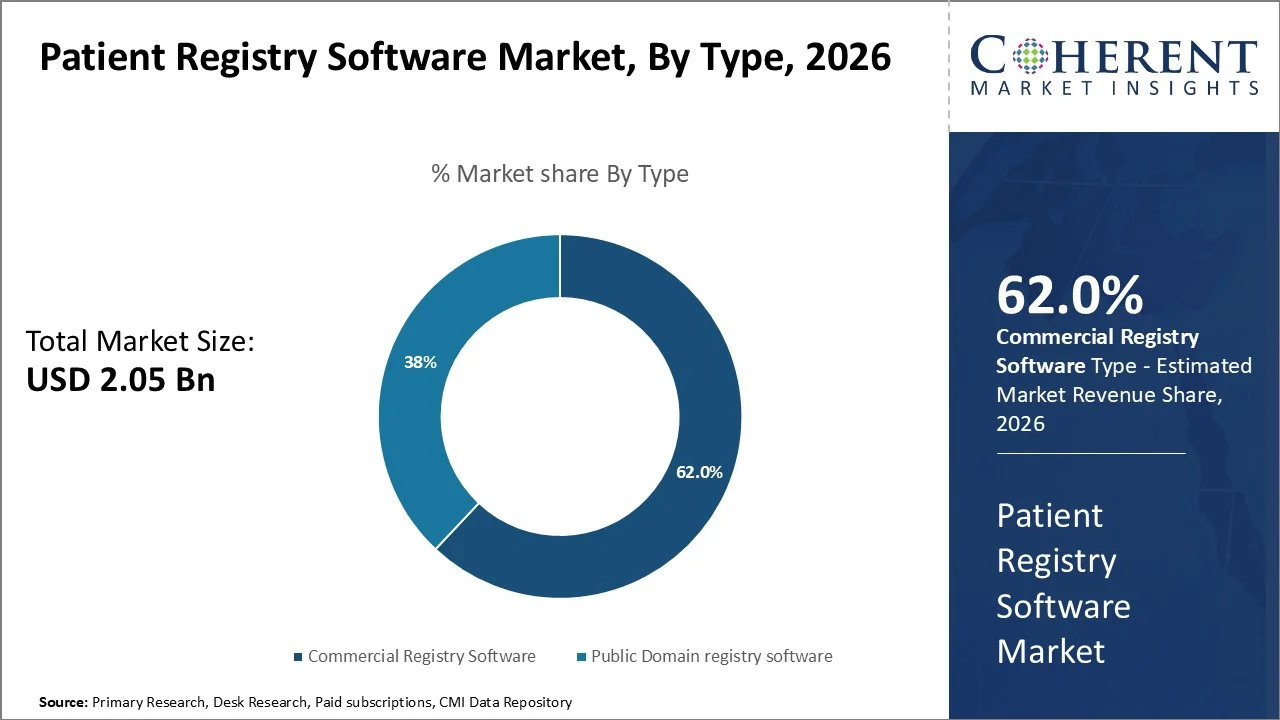
Commercial Registry Software dominates with 62% of market share in 2026
Commercial Registry Software has the biggest market share at 62% in 2026 because hospitals, specialty networks, pharma companies, and CROs usually prefer vendor-backed platforms that can work across multiple sites, work with EHR workflows, and support regulated reporting. That preference is backed up by the fact that healthcare delivery is becoming more digital. By 2025, 96% of non-federal acute care hospitals and 78% of office-based doctors had adopted certified EHRs. By 2023, 70% of hospitals were involved in all four areas of interoperable exchange.
The FDA says that product and disease registries are good sources of real-world data. Its guidance also talks about using new or existing registries to help make decisions about drugs and biologics. That makes it more likely that commercial platforms will have better auditability, validation, security, and control over workflows with multiple stakeholders. The CDC says that chronic diseases are the main cause of the country's $4.9 trillion in annual healthcare costs. 90% of U.S. healthcare spending is for people with chronic and mental health problems.
The American College of Cardiology started the CONNECT-HCM digital registry on August 19, 2025. At the time, it had already signed up more than 70 patients and connected registry data with EHRs to keep track of symptoms, imaging, treatments, and outcomes.
- Current Industry Events of 2026
- Market Size Estimation
- Regional Breakdown
- Competitive Landscape
- Customer Intelligence
- Segmental Analysis
- Pricing Analysis
- Key Market Drivers, Challenges & Future Trends
- Customized Insights Section
The Cancer Registry Segment dominates with 28% of market share in 2026
The Cancer Registry segment makes up 28% of the patient registry software market and is the most popular because oncology needs one of the most mature, standardized, and large-scale data infrastructures in healthcare. The base of demand is very large: In 2025, IARC reported 30 million new cancer cases, 9.7 million deaths, and 53.5 million people still alive five years after their diagnosis.
The number of people who survive cancer is rising, which means that long-term follow-up, tracking recurrences, analyzing treatment pathways, and monitoring outcomes are all becoming more important. The National Cancer Institute (NCI) estimates that there are 18.6 million cancer survivors in the U.S., which is 5.4% of the population. Oncology is becoming a top priority for regulatory-grade real-world evidence. FDA's registry guidance clearly talks about how to use new or existing registries to help make regulatory decisions.
The FDA held a public workshop on August 27, 2025, called "The Future of Registries in Oncology." It was about common data elements and best practices for developing oncology registries. On September 5, 2025, the CDC also released GenEDITS Plus 6.1.31 for cancer registries and EditWriter 6.0.77 on February 27, 2026.
The Government Segment dominates with 55% of market share in 2026
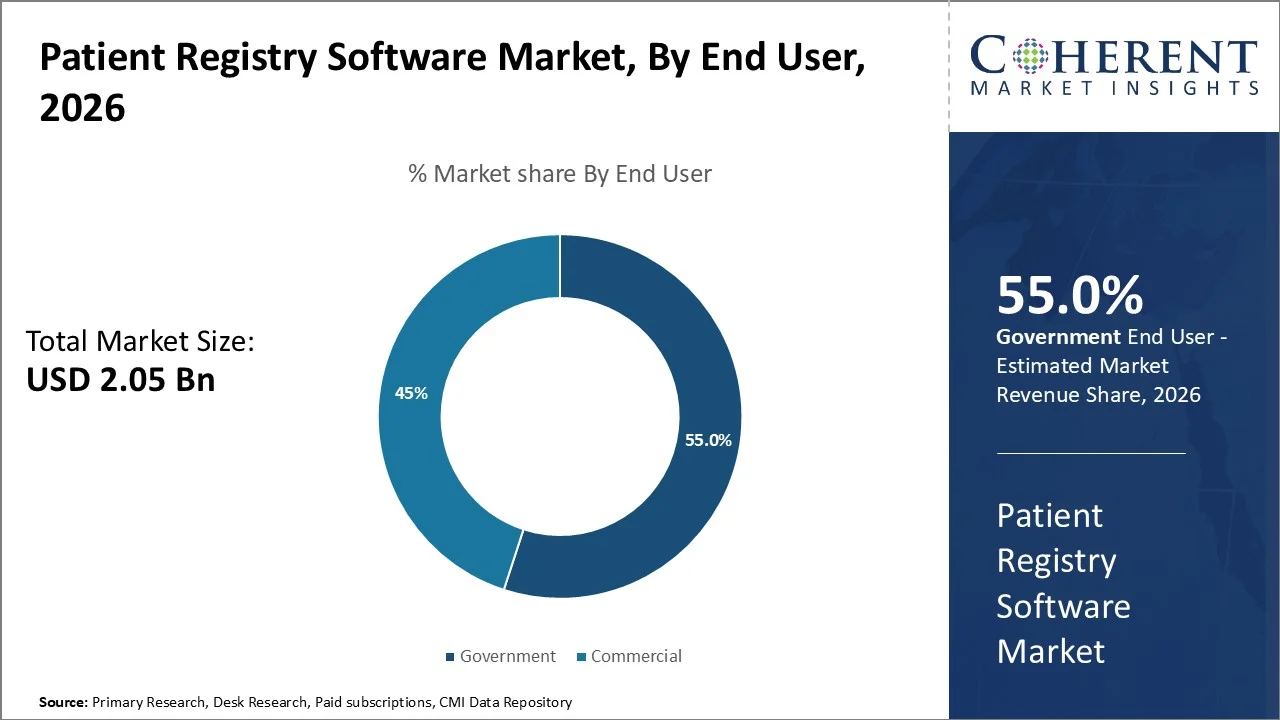
The Government segment makes up 55% of the patient registry software market. This is because public agencies run the biggest registries for surveillance and population-level monitoring. The CDC's National Program of Cancer Registries helps central registries in 46 states, the District of Columbia, Puerto Rico, the U.S. Pacific Island Jurisdictions, and the U.S. Virgin Islands, which together represent 97% of the U.S. population. Along with NCI's SEER program, these systems collect cancer data for the entire U.S. population. CDC's U.S. Cancer Statistics has covered all new cancers and deaths in all 50 states and D.C. from 2003 to 2022.
On September 5, 2025, CDC released GenEDITS Plus 6.1.31, which added the ability to process large registry files at the same time. CDC updated CRS Plus/TLC Plus, its main central-registry database tools, on September 11, 2025. CDC said that more than 40,000 people had signed up for the National Firefighter Registry for Cancer by February 10, 2026.
Patient Registry Software Market Trends
- As the number of people with chronic diseases rises, so does the need for long-term patient registries. The World Health Organization (WHO) says that noncommunicable diseases (NCDs) killed at least 43 million people in 2021. This is 75% of all deaths that were not caused by a pandemic. Cardiovascular diseases killed at least 19 million people, cancers killed 10 million, chronic respiratory diseases killed 4 million, and diabetes killed more than 2 million. This is strengthening demand for registry software that can track long-term outcomes, treatment pathways, and disease progression.
- Registry platforms that work with electronic health records (EHRs) are becoming more important than registries that are kept by hand. The U.S. ONC says that by 2024, 96% of non-federal acute care hospitals and 78% of office-based doctors had adopted a certified EHR. This is up from 28% of hospitals and 34% of doctors in 2011.
Patient Registry Software Market Innovations
Registry platforms are getting better at using real-world evidence. According to the FDA the product or disease registries, electronic health records, medical claims, and digital health technologies are all good sources of real-world data (RWD). The FDA's CDER data also show that the number of protocol submissions related to RWE went up from 10 in FY2023 to 11 in FY2024. In FY2024, there were also 5 final study reports that used RWD/RWE. Four of the FY2024 protocol submissions used electronic health records, and seven used medical claims. This means that new ideas in registry software are more and more focused on structured data capture, compliance, analytics, and creating evidence that meets regulatory standards. (FDA)
Current Events and Their Impact on Patient Registry Software Market
Current Event | Description and its Impact |
FDA Workshop Pushes for High-Quality Oncology Registries |
|
NORD Lowers Entry Barrier for Rare Disease Registries |
|
Regional Insights
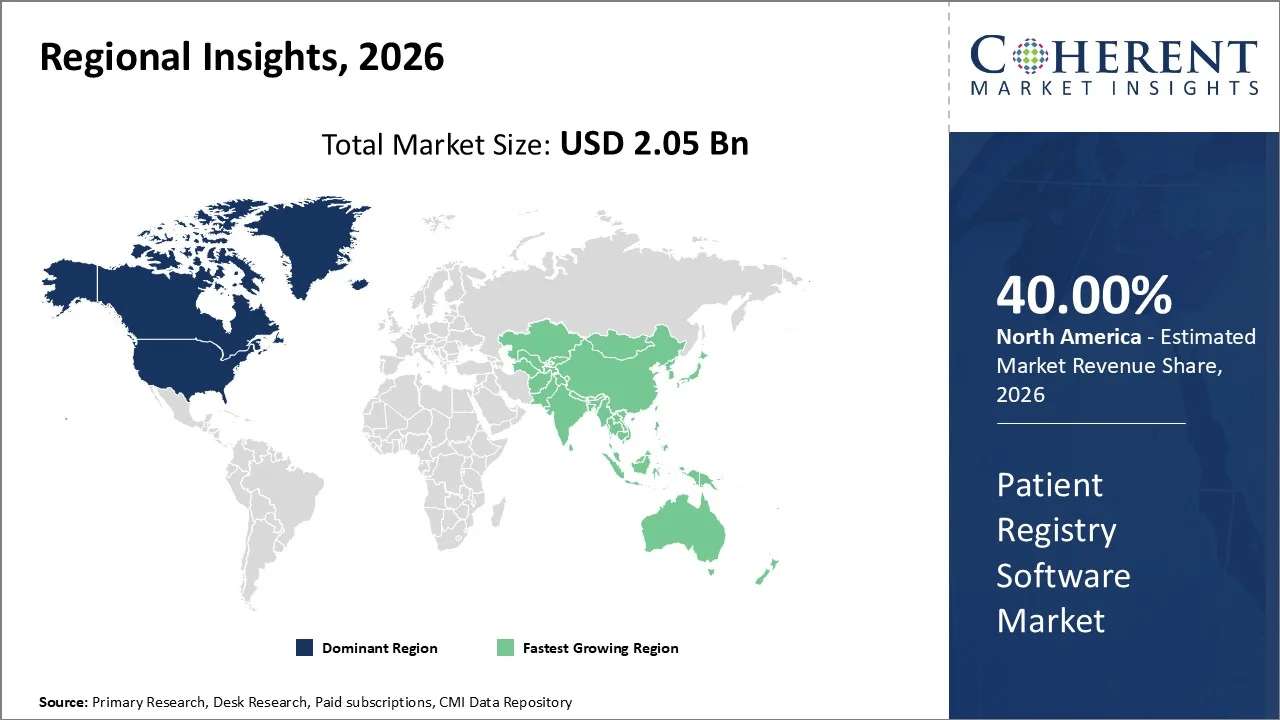
North America Leads the Market with 40% of the Market Share
With a projected 40% market share in 2026, North America remains the largest region for patient registry software, supported by sophisticated healthcare IT and a robust regulatory environment. Additionally, the number of large vendors and widespread adoption by providers of electronic health records have helped. According to Centers for Medicare and Medicaid, US healthcare spending is projected to exceed USD 4.5 trillion, with an increasing amount of that investment being allocated to digital health solutions like registry systems.
Asia Pacific Drives Rapid Growth in Market
The Asia Pacific region is forecasted to be the fastest growing region, with a compound annual growth rate of 14.8% between 2026-2033, due largely to accelerating digitization of healthcare and increasing government investments. An additional factor supporting increased investment in registry solutions in Asia Pacific countries like India and China is that both nations are developing and deploying national health databases and registries to help them manage rising levels of chronic disease among their populations. The world bank has documented steady growth in healthcare expenditures throughout the Asia Pacific, driven by economic expansion and policy changes.
Country Analysis
United States Leads the Patient Registry Software Market
The U.S. has one of the most advanced environments for patient registry software because it already has a strong digital base. By 2024, 9 out of 10 hospitals had allowed patients to access their records through an API, and 7 out of 10 will have done so through a standards-based API. This supports the need for registry software that can connect directly to hospital systems, automatically collect data, and make long-term tracking better.
India Dominates the Growth in the Patient Registry Software Market
India is becoming a high-potential market for patient registry software because it is building a huge digital health backbone. As of December 12, 2025, the Government of India said that 83.94 crore ABHA accounts had been made, 7.47 lakh healthcare professionals had signed up for ABDM, 4.42 lakh health facilities had signed up, and 79.71 crore health records had been linked to ABHA. This scale lays a solid groundwork for registry software that can help identify patients, link records, and share data between facilities.
Market Report Scope
Patient Registry Software Market Report Coverage
| Report Coverage | Details | ||
|---|---|---|---|
| Base Year: | 2025 | Market Size in 2026: | USD 2.05 Bn |
| Historical Data for: | 2020 To 2024 | Forecast Period: | 2026 To 2033 |
| Forecast Period 2026 to 2033 CAGR: | 12.6% | 2033 Value Projection: | USD 4.72 Bn |
| Geographies covered: |
| ||
| Segments covered: |
| ||
| Companies covered: | IQVIA, Global Vision Technologies, Dacima Software, ImageTrend, Oracle, Health Catalyst, Conduent, Elekta, PatientCrossroads, McKesson, Liaison Technologies, Evado eClinical Solutions. | ||
Who are the Major Companies in Patient Registry Software Market?
Some of the major key players in Patient Registry Software Market are IQVIA, Global Vision Technologies, Dacima Software, ImageTrend, Oracle, Health Catalyst, Conduent, Elekta, PatientCrossroads, McKesson, Liaison Technologies, Evado eClinical Solutions.
Key News
- In November 2025, the National Organization for Rare Disorders (NORD®) announced a request for proposals inviting nonprofit patient advocacy groups to develop two new patient registries on its IAMRARE® data and research platform.
- In January 2026, Odisha announced plans to launch India’s first comprehensive chronic kidney disease (CKD) registry by March 31. The registry will collect reliable data on CKD prevalence to support evidence-based policy decisions for managing the rising burden of kidney disease.
Analyst Opinion
- The patient registry software market has advanced beyond its basic function of supplemental healthcare to become a vital foundation for today’s clinical decisions. In addition, the US Food and Drug administration has confirmed that more than half of all submissions it receives, include RWE (Real-World-Evidence), which means registry programs are evolving from optional analytics programs into mandatory requirements of the regulatory process, especially in the areas of oncology and rare disease research for longitudinal patient data.
- A significant transformation is taking place because of the convergence of cloud technology with artificial intelligence. The way patient data is captured and used is being altered fundamentally by this combination. According to research conducted by Coherent Market Insights, approximately 65% of all workloads for healthcare IT will be migrated to the cloud. This allows vendors to deploy scalable registries that take advantage of new capabilities provided by cloud providers.
Speak to the analyst
Want personalized insights?
Take the findings above to one of our principal consultants, or have the report rebuilt around the segments, geographies and competitors you actually track.
Market Segmentation
- Global Patient Registry Software Market, By Type
- Public Domain Registry Software
- Commercial Registry Software
- Global Patient Registry Software Market, By Disease Area
- Diabetes Registry
- Cardiovascular Registry
- Cancer Registry
- Rare Disease/Orphan Disease Registry
- Other Chronic Disease Registry
- Global Patient Registry Software Market, By End User
- Government
- Commercial
- By Region
- North America
- U.S.
- Canada
- Latin America
- Brazil
- Mexico
- Argentina
- Rest of Latin America
- Europe
- Germany
- U.K.
- France
- Italy
- Spain
- Russia
- Rest of Europe
- Asia Pacific
- China
- India
- Japan
- Australia
- South Korea
- ASEAN
- Rest of Asia Pacific
- Middle East
- GCC
- Israel
- Rest of Middle East
- Africa
- South Africa
- Central Africa
- North Africa
- North America
Sources
Primary Research interviews
- Hospital Administrators
- Clinical Research Coordinators
- IT Managers In Healthcare Systems
- Medical Device Manufacturers
- Pharmaceutical Company Research Teams
- Health Informatics Specialists
- Patient Registry Program Managers
Databases
- World Health Organization (WHO) Global Health Observatory
- U.S. Food and Drug Administration (FDA)
- Adverse Event Reporting System (FAERS)
- Centers for Medicare & Medicaid Services (CMS) Data Portal
- National Institutes of Health (NIH) Data Repositories
Magazines
- Journal of AHIMA (American Health Information Management Association)
- Healthcare IT News
- Modern Healthcare
- HealthTech Magazine
- Nature Medicine (news & features section)
- Medical Device & Diagnostic Industry (MD+DI)
Journals
- Journal of Medical Internet Research
- Journal of Biomedical Informatics
- BMC Medical Informatics and Decision Making
- The Lancet Digital Health
- IEEE Journal of Biomedical and Health Informatics
Newspapers
- The Hindu (Science & Health section)
- The Indian Express (Health)
- Hindustan Times (Health & Science)
- The Economic Times (Healthcare & Technology)
- Business Standard
Associations
- World Health Organization (WHO)
- Food and Drug Administration (FDA)
- European Medicines Agency (EMA)
- Centers for Disease Control and Prevention (CDC)
Proprietary Elements
- CMI Data Analytics Tool
- Proprietary CMI Existing Repository of information for last 10 years
Get access to 250+ pages report
Every segment, forecast, competitor profile and data table behind the analysis above — available for instant download.
- ESOMAR Member
- ISO 9001:2015 Certified
- D-U-N-S Registered
- GDPR & CCPA Compliant
Missing comfort of reading report in your local language? Find your preferred language:
Transform your Strategy with Exclusive Trending Reports
Frequently Asked Questions
In 2026, the global market for patient registry software will be worth USD 2.05 Bn. This shows that more hospitals, government agencies, research institutions, and private healthcare companies are using registry platforms.
By 2033, the market is expected to be worth USD 4.72 Bn. This growth shows that there is a strong long-term need for registry platforms that help track patients, monitor outcomes, and create real-world evidence.
The market is expected to grow at a rate of 12.6% per year during the time period covered by the forecast. This growth rate shows that software for patient registries is becoming an even more important part of digital healthcare infrastructure.
The market is mostly driven by the growing number of people with chronic diseases and the growing use of real-world evidence in making clinical and regulatory decisions. Healthcare systems are also putting more money into digital tools that can help with long-term patient monitoring and treatment plans based on data.
In 2026, the Commercial Registry Software segment will hold 62% of the market. This segment is in the lead because commercial solutions can be scaled up more easily and are better able to handle complex workflows, compliance needs, and deployments across multiple sites.