

Healthcare Automation Market Size and Forecast – 2026 to 2033
The Healthcare Automation Market is anticipated to grow at a CAGR of 9.3% with USD 52.3 Bn in 2026 and is expected to reach USD 98.7 Bn in 2033. Healthcare providers are driving the Healthcare Automation Market by seeking greater operational efficiency, addressing labor shortages, managing rising patient volumes, and reducing administrative errors. Healthcare marketing automation adoption has risen from 34% in 2023 to 52% today and is projected to reach 70% by 2027.
Key Takeaways
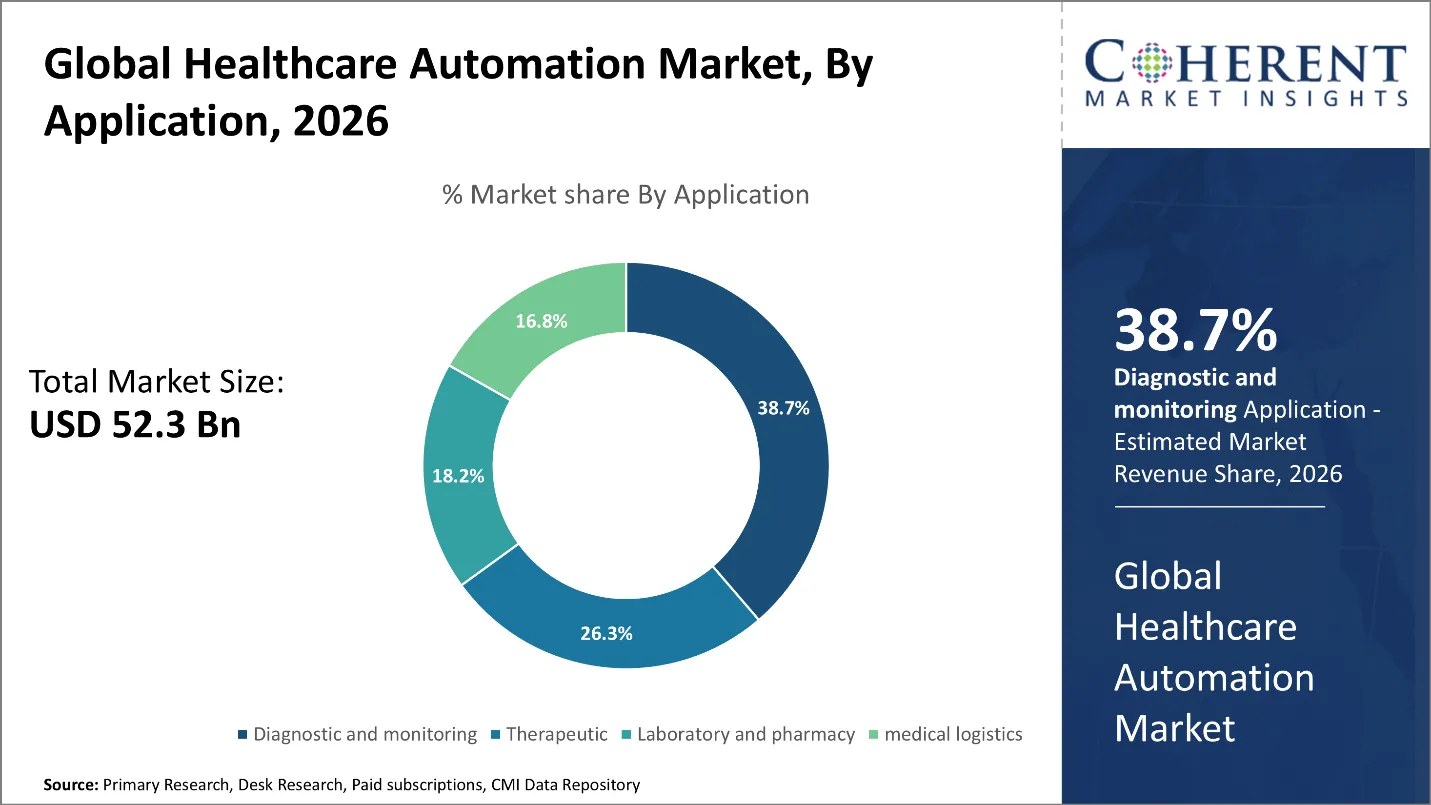
- Diagnostic and monitoring hold the largest market share of 38.7% in 2026 owing to the rising prevalence of chronic diseases. More than 90% of adults aged 65 and older have at least one chronic health condition. Source: CDC
- Hospitals and Diagnostic Centers expected to hold largest market share of 39.5% in 2026 owing to its rising patient volumes. Outpatient care volumes are projected to rise by 18% over the next decade.
- North America is expected to acquire the dominant share of 39.2% in 2026 owing to the high healthcare expenditure and advanced infrastructure. U.S. healthcare spending reached $5.3 trillion in 2024, equivalent to 18.0% of GDP, creating strong demand for technologies that improve efficiency and automate processes.
Current Events and Their Impact on the Healthcare Automation Market
Current Event | Description and its Impact |
EU AI Act Enters Application in 2026 |
|
FDA Quality Management System Regulation Takes Effect |
|
Segmental Insights
- Current Industry Events of 2026
- Market Size Estimation
- Regional Breakdown
- Competitive Landscape
- Customer Intelligence
- Segmental Analysis
- Pricing Analysis
- Key Market Drivers, Challenges & Future Trends
- Customized Insights Section
Why is Diagnostic and monitoring Acquiring the Largest Market Share?
Diagnostic and monitoring hold the largest market share of 38.7% in 2026. The Diagnostic and Monitoring segment of the Healthcare Automation Market is gaining momentum as healthcare providers address the growing burden of chronic diseases and increasing demand for early, accurate diagnosis. Automated systems accelerate testing, support continuous patient monitoring, analyze real-time data, and assist clinical decision-making. Healthcare organizations are also adopting artificial intelligence, connected medical devices, wearable technologies, and remote monitoring solutions to improve care delivery. In addition, workforce shortages, efforts to minimize diagnostic errors, and the growing focus on personalized and preventive healthcare continue to encourage providers to deploy automated solutions. Beckman Coulter Diagnostics launched the DxU 1800 System in the U.S., combining automated urine chemistry analysis with proven microscopy technology. Introduced at the ADLM Annual Scientific Meeting & Clinical Lab Expo, the system helps laboratories standardize testing, improve efficiency, and support faster clinical decision-making.
Which End User segment dominates the market?
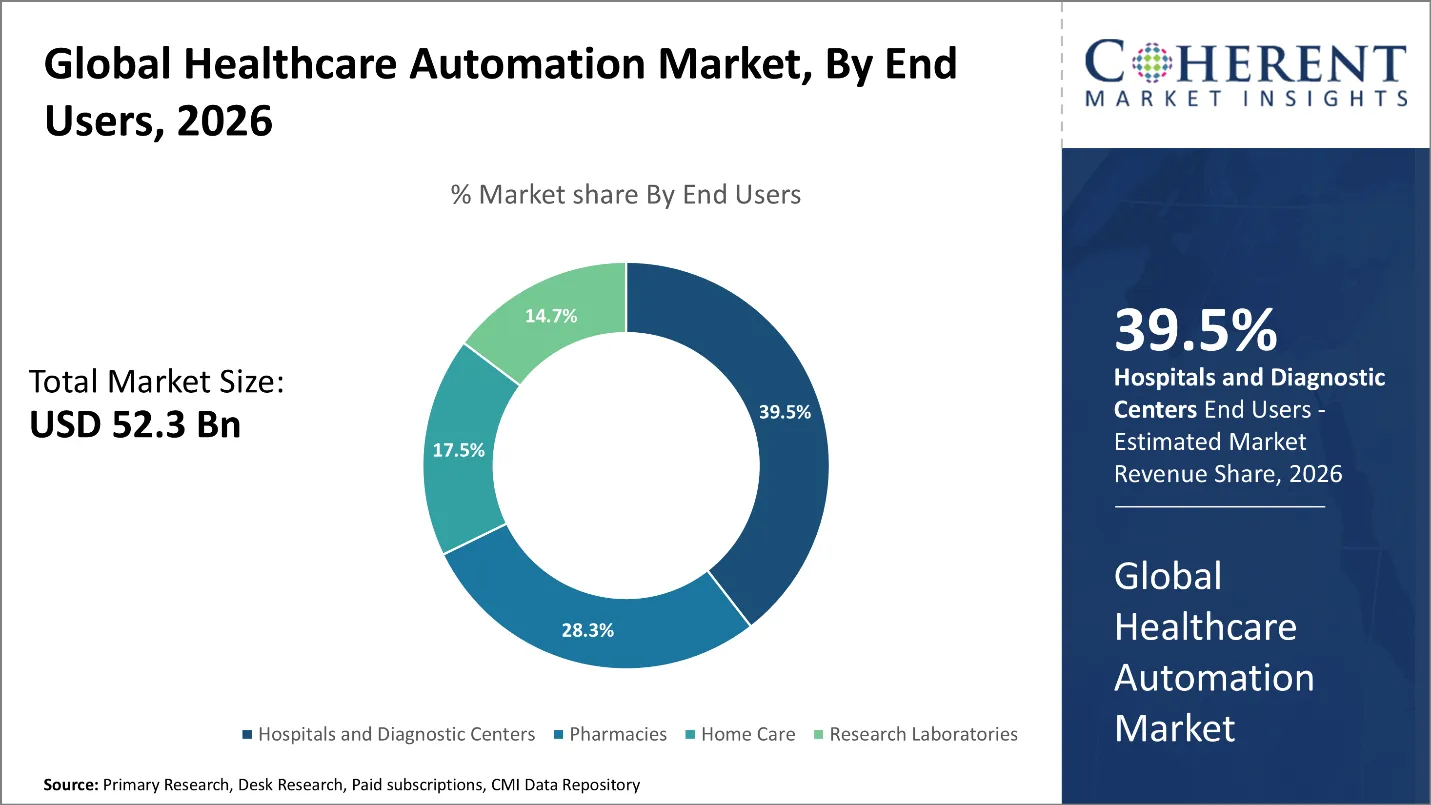
Hospitals and Diagnostic Centers expected to hold largest market share of 39.5% in 2026. Hospitals and diagnostic centers are adopting healthcare automation to handle growing patient volumes, increase operational efficiency, and deliver services faster. They use automated systems to streamline laboratory testing, patient registration, scheduling, billing, medication management, and diagnostic workflows while minimizing manual tasks and errors. Healthcare providers are also integrating artificial intelligence, robotics, and connected technologies to strengthen clinical decision-making and improve patient care. Global medical robot sales reached approximately 6,100 units in 2023, up 36% from 2022. Workforce shortages, rising diagnostic demand, cost pressures, digital transformation, and expectations for shorter waiting times continue to drive investments in advanced automation solutions. The WHO projects a global shortage of 11 million health workers by 2030, primarily affecting low- and lower-middle-income countries.
Healthcare Automation Market Trends
- Growing adoption of artificial intelligence and machine learning enables healthcare providers to automate diagnostics, clinical decision-making, patient monitoring, and administrative workflows. In the U.S., 71% of hospitals reported using predictive AI integrated with electronic health records (EHRs) in 2024, up from 66% in 2023, demonstrating continued adoption of AI across clinical and operational workflows.
- Increasing use of robotics and intelligent automation in hospitals and diagnostic centers streamlines surgery, laboratory testing, medication dispensing, logistics, and patient-care processes while reducing repetitive manual tasks. The U.S. FDA reported more than 1,600 AI-enabled medical devices authorized for marketing as of September 2026, illustrating the expanding range of AI-enabled technologies entering clinical use.
- Increasing demand for faster and more accurate diagnostics promotes the adoption of automated laboratory systems, AI-enabled medical imaging, robotic sample handling, and digital diagnostic platforms. The FDA's AI-enabled medical-device list surpassed 1,600 authorized devices by September 2026, covering applications that support diagnosis, treatment, imaging, and monitoring.
- Rising investment in smart hospitals and digital healthcare infrastructure accelerates deployment of automated pharmacies, robotic logistics, intelligent monitoring systems, and AI-powered workflow-management solutions. In U.S. hospitals, AI use for automating billing increased from 36% in 2023 to 61% in 2024, while AI use for facilitating scheduling increased from 51% to 67%, showing particularly strong growth in administrative automation.
Regional Insights
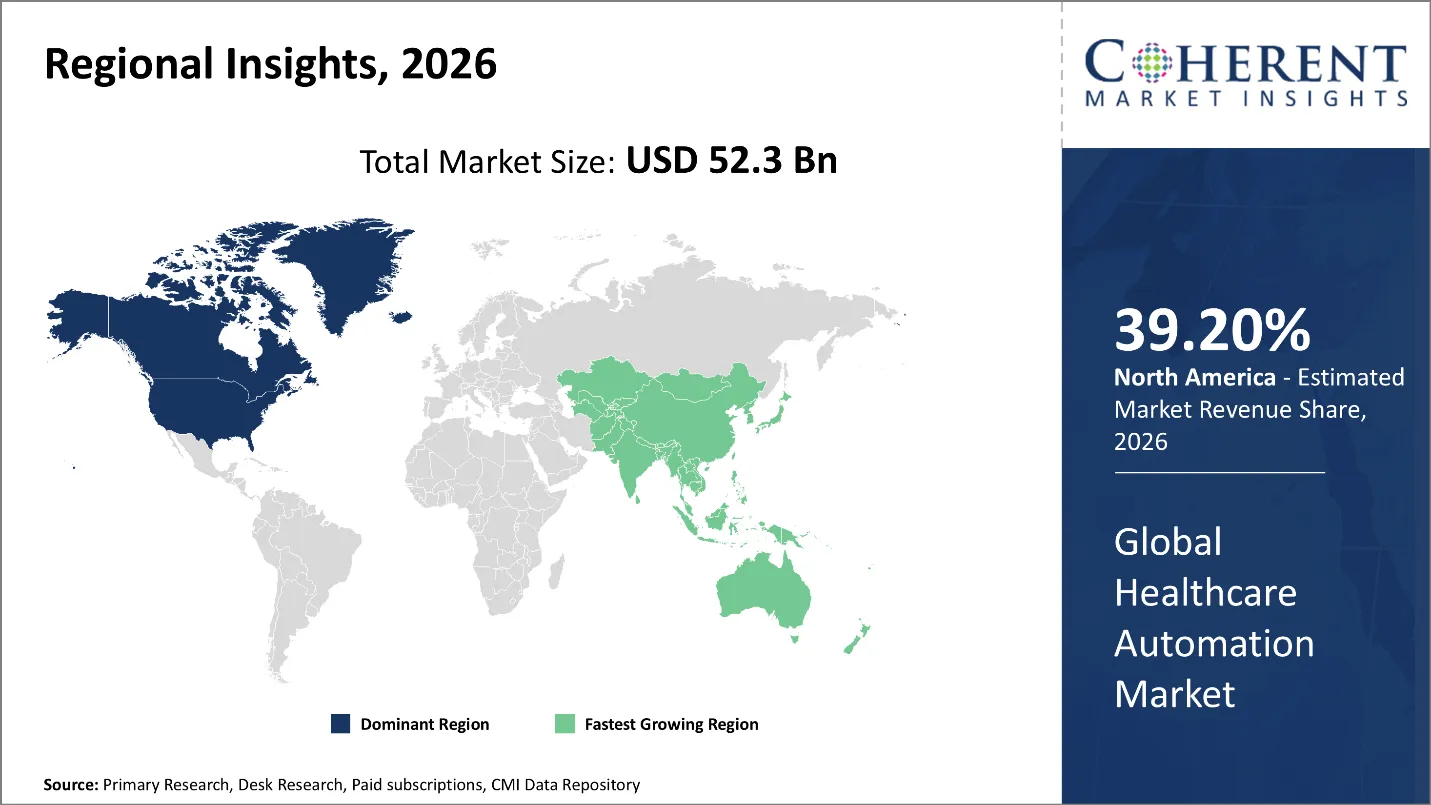
North America dominates owing to digital transformation of healthcare facilities
North America is expected to acquire the dominant share of 39.20% in 2026. North America’s Healthcare Automation Market is expanding as healthcare providers invest in advanced infrastructure and digital technologies to improve care delivery. Hospitals and diagnostic centers increasingly use artificial intelligence, robotics, automated laboratory systems, and connected devices to streamline clinical and administrative processes. Investments in smart hospitals, digital health platforms, remote monitoring, and interoperable systems also drive regional market growth. Melmark Inc. launched specialized blockchain services for healthcare, focusing on secure data management, interoperability, digital records, and AI-powered healthcare automation.
Asia Pacific Healthcare Automation Market Trends
The Asia-Pacific healthcare automation market is expanding as healthcare providers accelerate digital transformation and build modern hospital infrastructure. Hospitals increasingly adopt artificial intelligence, robotics, and automated diagnostic technologies to improve efficiency and care delivery. Government digital-health initiatives, wider electronic health-record adoption, smart-hospital investments, and the need for safer, faster diagnostics further strengthen market growth. Syneos Health has opened a new Global Capability Centre in Hyderabad to expand its India operations and strengthen the city’s healthcare and life sciences ecosystem. Located in Gachibowli, the facility is the company’s largest centre in Asia and third-largest globally.
United States Healthcare Automation Market Trends
The United States healthcare automation market continues to grow as healthcare organizations face rising administrative workloads, workforce shortages, and increasing pressure to improve operational efficiency. Providers increasingly use AI-powered solutions for clinical documentation, billing, coding, prior authorization, scheduling, and revenue-cycle management to streamline repetitive processes and reduce administrative tasks. Growing demand for digital patient services, interoperability, and faster data exchange further supports adoption. Healthcare organizations also invest in generative and agentic AI to automate workflows, boost productivity, and enable clinicians to devote more time to patient care. DeepHealth has launched Reporting Pro, a generative AI platform that automates clinical documentation and report generation across X-ray, ultrasound, CT, PET/CT, and MRI. After deploying it across RadNet, DeepHealth is now expanding the platform to external U.S. healthcare customers.
China Healthcare Automation Market Trends
China’s healthcare automation market grows as healthcare providers seek more efficient medical services, respond to an aging population, and manage increasing resource pressures. Hospitals implement AI, robotics, automated diagnostics, smart pharmacies, and intelligent patient-management systems to streamline operations and enhance service quality. Government programs promote AI adoption, digital health infrastructure, medical robotics, and intelligent healthcare equipment, accelerating market development. For instance, China is expanding digital healthcare services to improve access for its 1.4 billion people, particularly by addressing urban–rural disparities and gaps in primary care infrastructure. Expanding healthcare data, technological advances in AI, and growing domestic investment in medical-device innovation further support automation adoption across China.
Who are the Major Companies in Healthcare Automation Industry
Some of the major key players in Healthcare Automation are Aetna, Inc., Allscripts Healthcare Solutions, Cerner, Cigna Corporation, OptumHealth, Oracle, IBM Corp, Verisk Analytics, MedeAnalytics, McKesson, Truven Health Analytics, and UnitedHealth Group, Inc.
Key News
- In February 2026, UiPath introduced new agentic AI solutions for healthcare providers and payers at ViVE 2026. The solutions automate medical-record summarization, claim-denial management, and prior authorization while improving data connectivity, operational efficiency, and revenue-cycle management.
Market Report Scope
Healthcare Automation Market Report Coverage
Report Coverage | Details | ||
Base Year: | 2025 | Market Size in 2026: | USD 52.3 Bn |
Historical Data for: | 2020 to 2024 | Forecast Period: | 2026 to 2033 |
Forecast Period 2026 to 2033 CAGR: | 9.3% | 2033 Value Projection: | USD 98.7 Bn |
Geographies covered: |
| ||
Segments covered: |
| ||
Companies covered: | Aetna, Inc., Allscripts Healthcare Solutions, Cerner, Cigna Corporation, OptumHealth, Oracle, IBM Corp, Verisk Analytics, MedeAnalytics, McKesson, Truven Health Analytics, and UnitedHealth Group, Inc. | ||
Analyst Opinion
- Healthcare automation is being driven by capacity constraints, not simply technology enthusiasm. The World Health Organization projects a global shortage of 11 million health workers by 2030, making automation increasingly important for routine administrative, diagnostic, pharmacy, and operational tasks. Hospitals will prioritize automation where it directly reduces repetitive workloads and allows scarce clinical staff to spend more time on patient care.
- Robotic-assisted procedures demonstrate how automation is moving from experimentation into routine clinical workflows. More than 14 million robotic-assisted surgical procedures have been performed globally using the da Vinci system since its introduction, according to Intuitive. This level of accumulated clinical use strongly supports the view that healthcare automation is becoming an established component of surgical practice rather than a niche technology.
- AI-based automation is also gaining traction because diagnostic workloads are rising faster than specialist capacity in many healthcare systems. For example, the U.S. FDA had authorized more than 1,000 AI-enabled medical devices by 2025, with radiology accounting for the largest share. This concentration is significant: imaging provides highly structured clinical data and repetitive interpretation workflows, making it one of the most commercially practical areas for automation. In my assessment, diagnostic imaging will remain a key proving ground for healthcare automation as providers seek faster and more consistent clinical workflows.
Speak to the analyst
Want personalized insights?
Take the findings above to one of our principal consultants, or have the report rebuilt around the segments, geographies and competitors you actually track.
Market Segmentation
- By Application (Revenue, USD Bn, 2021-2033)
- Diagnostic and monitoring
- Therapeutic
- Laboratory and pharmacy
- Medical logistics
- By End Users (Revenue, USD Bn, 2021-2033)
- Hospitals and Diagnostic Centers
- Pharmacies
- Home Care
- Research Laboratories
- By Region (Revenue, USD Bn, 2021-2033)
- North America
- U.S.
- Canada
- Latin America
- Brazil
- Mexico
- Argentina
- Rest of Latin America
- Europe
- Germany
- U.K.
- France
- Italy
- Spain
- Russia
- Rest of Europe
- Asia Pacific
- China
- India
- Japan
- Australia
- South Korea
- ASEAN
- Rest of Asia Pacific
- Middle East
- GCC
- Israel
- Rest of Middle East
- Africa
- South Africa
- Central Africa
- North Africa
- North America
Sources
Primary Research interviews
- Hospital administrators and healthcare executives
- Physicians, surgeons, radiologists, and laboratory professionals
- Healthcare IT and digital-health specialists
- Medical-device and healthcare-automation technology experts
- Pharmacy and clinical operations professionals
- AI and robotics specialists in healthcare
Databases
- U.S. Food and Drug Administration (FDA) – AI-Enabled Medical Device Database
- PubMed / MEDLINE
- ClinicalTrials.gov
- World Health Organization (WHO) Global Health Observatory
- U.S. Centers for Medicare & Medicaid Services (CMS) datasets
- U.S. Census Bureau
- OECD Health Statistics
- World Bank Open Data
- National Center for Health Statistics (NCHS)
Magazines
- Medical Economics
- Healthcare IT News
- Becker’s Hospital Review
- Health Management Technology
- MobiHealthNews
- Modern Healthcare
Journals
- Journal of Medical Internet Research
- The Lancet Digital Health
- npj Digital Medicine
- Nature Medicine
- Journal of the American Medical Informatics Association
- BMJ Health & Care Informatics
- International Journal of Medical Informatics
Newspapers
- The New York Times
- The Wall Street Journal
- Financial Times
- The Guardian
- Reuters
- The Washington Post
Associations
- American Hospital Association (AHA)
- Healthcare Information and Management Systems Society (HIMSS)
- American Medical Association (AMA)
- American College of Radiology (ACR)
- American Society of Health-System Pharmacists (ASHP)
- Medical Group Management Association (MGMA)
- International Federation of Robotics (IFR)
Public Domain sources
- U.S. Food and Drug Administration (FDA)
- World Health Organization (WHO)
- U.S. Department of Health and Human Services (HHS)
- Centers for Disease Control and Prevention (CDC)
- Centers for Medicare & Medicaid Services (CMS)
- National Institutes of Health (NIH)
- National Center for Health Statistics (NCHS)
- Office of the National Coordinator for Health Information Technology (ONC)
- European Medicines Agency (EMA)
- European Commission
- National Health Commission of the People’s Republic of China
- China National Medical Products Administration (NMPA)
- National Bureau of Statistics of China
- Government of India – Ministry of Health and Family Welfare
- Australian Institute of Health and Welfare (AIHW)
Proprietary Elements
- CMI Data Analytics Tool
- Proprietary CMI Existing Repository of information for last 10 years
Get access to 250+ pages report
Every segment, forecast, competitor profile and data table behind the analysis above — available for instant download.
- ESOMAR Member
- ISO 9001:2015 Certified
- D-U-N-S Registered
- GDPR & CCPA Compliant
Missing comfort of reading report in your local language? Find your preferred language:
Transform your Strategy with Exclusive Trending Reports
Frequently Asked Questions
The Healthcare Automation Market is anticipated to grow at a CAGR of 9.3% with USD 52.3 Bn in 2026 and is expected to reach USD 98.7 Bn in 2033.
The Healthcare Automation Market is primarily driven by the need to improve operational efficiency, reduce administrative errors, and accelerate clinical and diagnostic workflows.
Diagnostic and monitoring is the leading application segment, supported by increasing demand for early diagnosis, AI-assisted diagnostics, and real-time clinical data analysis.
Healthcare providers are increasingly using automated diagnostic systems to process information faster, and improve monitoring of patients with chronic conditions.
Hospitals and diagnostic centers represent the leading end-user segment because they manage high patient volumes and medication management, diagnostics, and other operational workflows.
Key trends include AI and machine learning adoption, healthcare robotics, automated laboratory systems, cloud-based healthcare platforms, and greater integration of electronic health records.