

Medical Animation Market Size and Share Analysis - Growth Trends and Forecast (2026 - 2033)
The global medical animation market is estimated to be valued at USD 863 Mn in 2026 and is projected to grow at a robust CAGR of 19.2% during the forecast period (2026-2033), reaching USD 2,889 Mn by 2033. This growth is attributable to rising demand for visually engaging and scientifically accurate medical content across pharmaceutical marketing, patient education, and healthcare training.
Key Takeaways from the Medical Animation Market Report
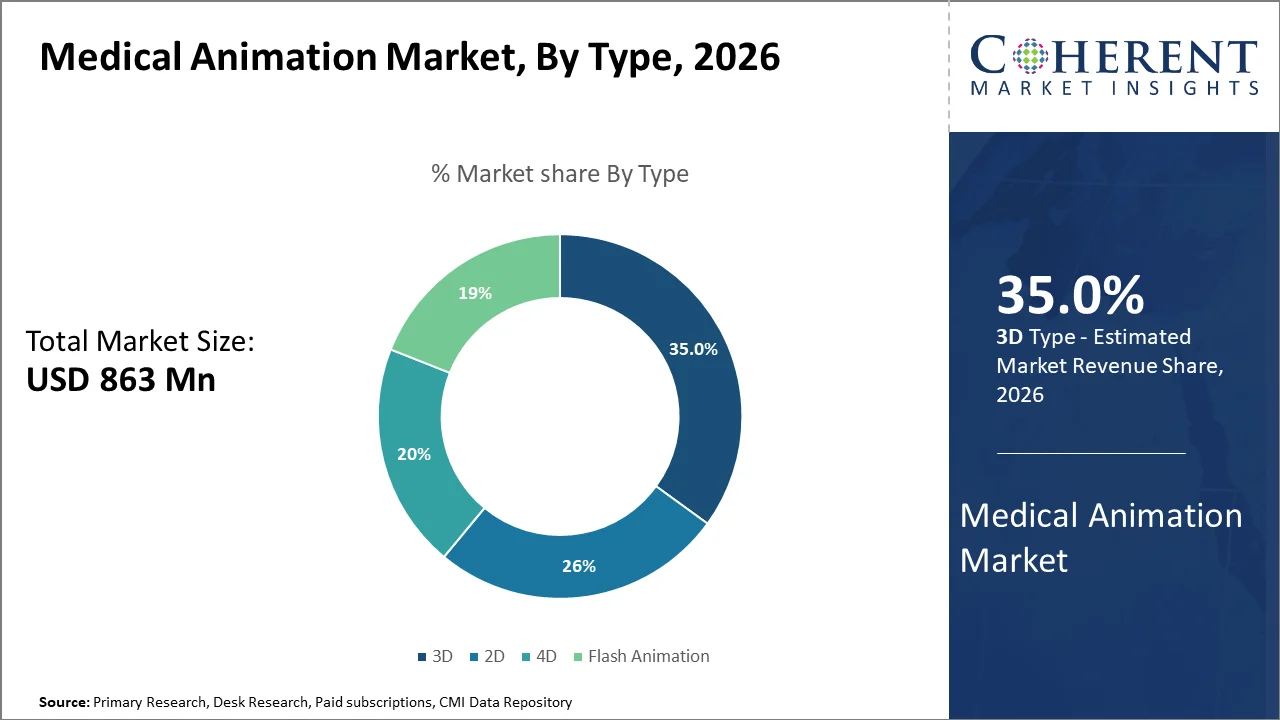
- 3D animation segment is projected to lead the market with a share of 35% in 2026 because it is widely used for anatomical visualization, mechanism-of-action (MoA) videos, surgical simulations, medical device demonstrations, and physician education due to its proven effectiveness. For example, a 2024 meta-analysis in BMC Medical Education (39 trials, 2,959 participants) found that 3D visualization tools significantly improved test scores as well as engagement and learner satisfaction.
- Oncology segment is slated to account for the largest market revenue share of 26% in 2026, due to intensive pharmaceutical R&D, increasing cancer prevalence, and strong demand for mechanism-of-action animations explaining immunotherapies, targeted therapies, and biologics. For instance, the thereby increasing the need for patient education and physician communication tools, including medical animations.
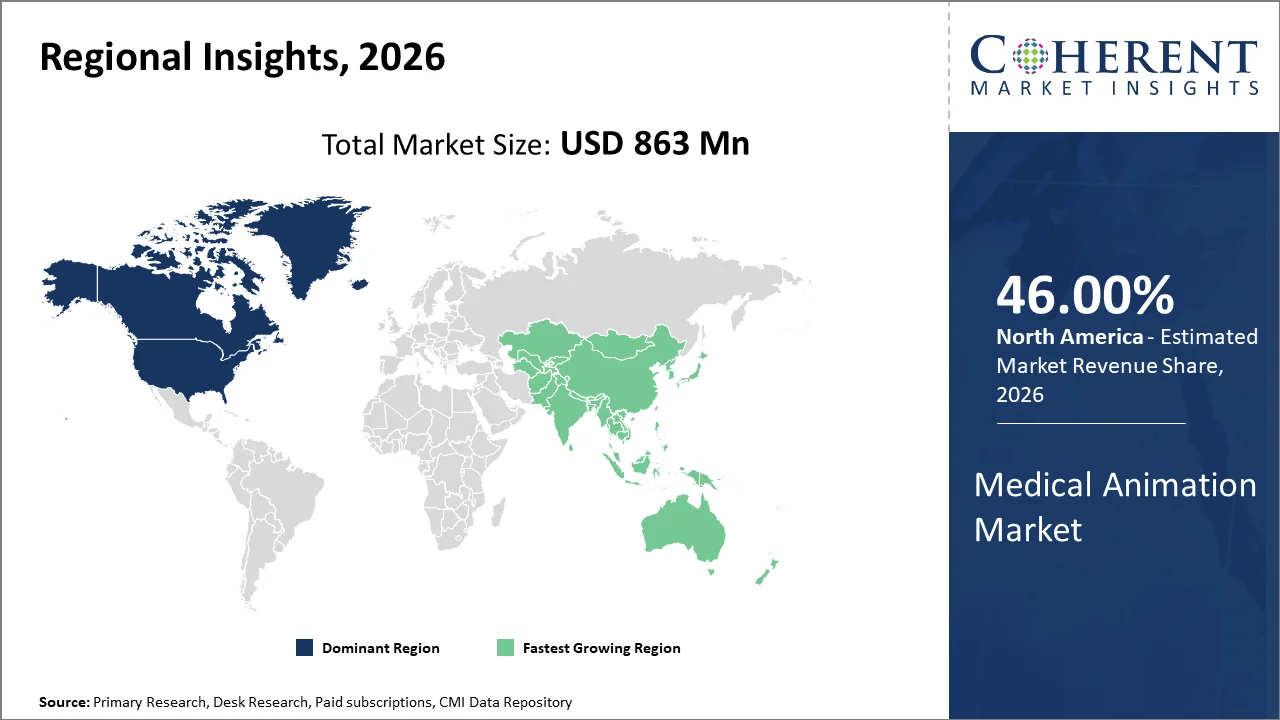
- North America is expected to retain its dominance over the global medical animation industry with a share of 46% in 2026 due to strong concentration of pharmaceutical companies, medical device manufacturers, biotechnology firms, academic medical centers, and digital healthcare adoption. For example, PhRMA reports over 8,000 medicines in clinical development, showing a strong biopharma R&D ecosystem and rising demand for medical animations in drug development and education.
- Asia Pacific is expected to be the fastest-growing market for medical animation, with a CAGR of 22% during the forecast period. This growth is driven by rapid improvements in healthcare infrastructure, rising use of digital health technologies, increasing investment in medical education and training, and the expanding presence of pharmaceutical and biotechnology companies in countries such as China, India, and Japan.
Medical Animation Market Overview
The global medical animation market is poised to exhibit robust growth during the forecast period. This growth is primarily due to increasing adoption of medical animation across a wide range of applications, including patient education, medical device and drug mechanism visualization, emergency care training, surgical simulation and training, forensic reconstruction, and healthcare marketing. Rising demand for visually engaging and accurate medical content to enhance communication, learning, and decision-making is also supporting market expansion.
Medical animations enable complex biological processes, surgical procedures, and treatment mechanisms to be presented in an easy-to-understand format, enhancing knowledge retention among healthcare professionals, patients, and students. Rising adoption of digital learning platforms, advancements in 3D visualization technologies, and growing use of animated content by pharmaceutical and biotechnology companies are boosting market growth.
Similarly, integration of emerging technologies like augmented reality (AR), virtual reality (VR), and artificial intelligence (AI) into medical visualization solutions is creating new growth opportunities for market participants. As healthcare providers continue to emphasize patient-centric care and digital transformation, demand for high-quality medical animation services is expected to grow rapidly during the forecast period.
Expansion of digital healthcare ecosystems is fueling also supporting growth of the medical animation market. The ongoing digital transformation of healthcare, including telemedicine, digital health platforms, and online patient portals, are increasing demand for high-quality visual content that can communicate medical information remotely and effectively.
Segmental Insights
Which Type of Medical Animation Dominates the Market?
3D Animation to Capture Over One-Third of the Medical Animation Market in 2026
According to Coherent Market Insights’ latest medical animation market analysis, 3D animation segment is expected to lead the market with a share of 35% in 2026. This dominance can be attributed to growing adoption of advanced 3D visualization technologies in medical education, patient communication, pharmaceutical marketing, and surgical training.
Compared with traditional 2D animation, 3D medical animation offers more realistic, immersive, and interactive representations of human anatomy, physiological processes, disease progression, and treatment mechanisms. These capabilities improve comprehension among healthcare professionals, patients, and students, driving greater adoption and positioning 3D animation as the preferred format across the healthcare industry.
- Current Industry Events of 2026
- Market Size Estimation
- Regional Breakdown
- Competitive Landscape
- Customer Intelligence
- Segmental Analysis
- Pricing Analysis
- Key Market Drivers, Challenges & Future Trends
- Customized Insights Section
Which Therapeutic Area Leads the Medical Animation Industry?
Oncology Remains the Largest Therapeutic Area Segment
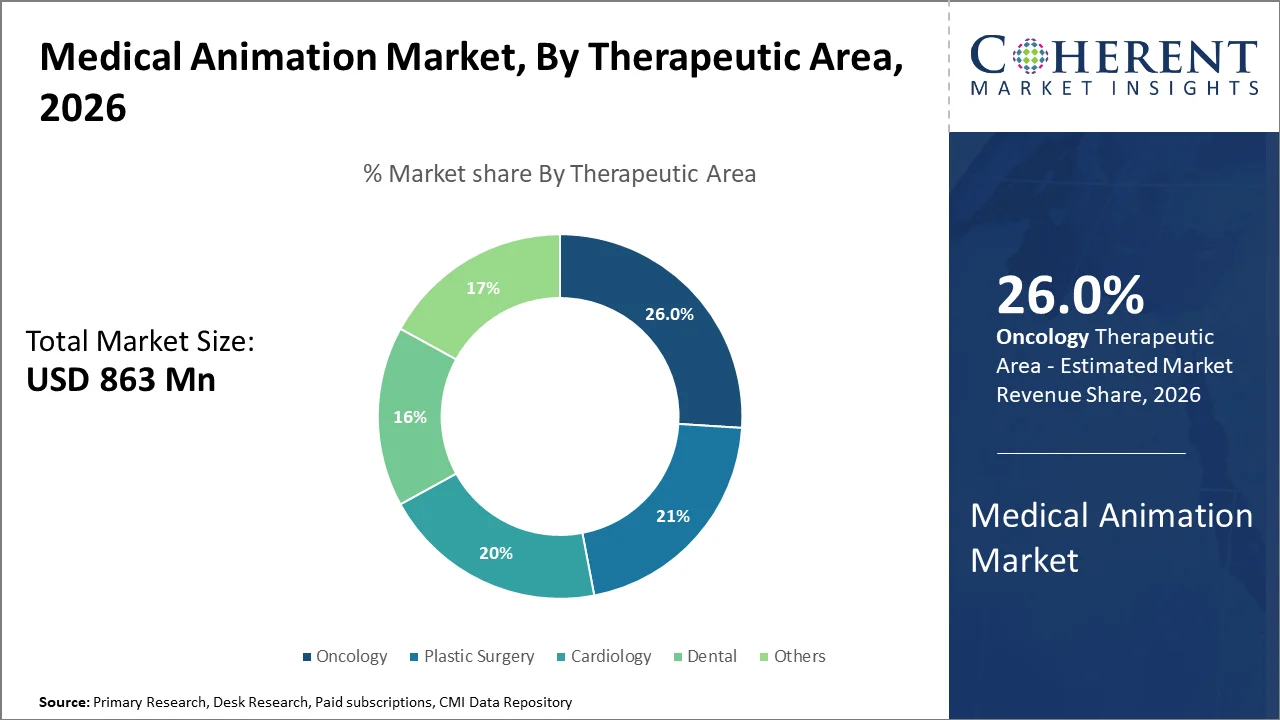
Based on therapeutic area, oncology segment is set to lead the market, accounting for a market revenue share of 26% in 2026. This is mostly due to rising global burden of cancer, increasing complexity of oncology treatments, and growing need for effective patient and healthcare professional education.
Medical animations have the tendency to help simplify intricate concepts such as tumor biology, cancer progression, immunotherapy mechanisms, targeted therapies, and treatment pathways, making them easier to understand for both clinicians and patients. In addition, pharmaceutical and biotechnology companies are increasingly utilizing oncology-focused animations in drug development, clinical trial recruitment, medical training, and marketing activities.
Similarly, introduction of novel cancer therapies, including cell and gene therapies, also drives demand for high-quality visual communication tools. These factors make oncology leading revenue-generation segment within the medical animation industry.
Medical Animation Market Growth Drivers
Rising Demand for Patient Education and Engagement
Growing emphasis on patient education and engagement is providing a strong impetus for the growth of medical animation market. Healthcare providers in the contemporary world are increasingly utilizing medical animations to explain complex diseases, treatment procedures, surgical interventions, and drug mechanisms in a clear and visually engaging manner.
Medical animations enhance patient understanding, improve treatment adherence, facilitate informed decision-making, and strengthen communication between healthcare professionals and patients. As healthcare systems continue to prioritize patient-centered care, demand for medical animation solutions is expected to increase rapidly during the forthcoming period.
Medical Animation Market Opportunities
Growth in Pharmaceutical and Medical Device Marketing
Pharmaceutical and medical device companies increasingly use medical animations to illustrate drug mechanisms of action (MoA), product functionality, and clinical benefits. These animations simplify complex scientific concepts and enhance communication with physicians, investors, healthcare professionals, and patients. As pharmaceutical and medical device companies continue to expand their marketing and educational initiatives, the demand for high-quality medical animation solutions is expected to increase, creating significant growth opportunities for the medical animation market during the forecast period.
Medical Animation Market Trends
Rising Adoption of 3D and 4D Medical Animation
Increasing preference for 3D and 4D animations is a key growth-shaping trend in the medical animation market. Pharmaceutical companies, medical device manufacturers, hospitals, academic institutions, and research organizations are increasingly utilizing advanced animation technologies to create highly detailed visual representations of human anatomy, disease progression, treatment mechanisms, and medical procedures.
The use of 3D animation is especially growing due to its ability to enhance medical education, patient communication, product marketing, and professional training through realistic and engaging visual content. Similarly, 4D animation is gaining traction in surgical simulation, dynamic physiological modeling, and treatment planning, enabling healthcare professionals to better understand complex biological processes and improve clinical decision-making.
Current Events and Their Impact on the Medical Animation Market
Current Event | Description and its Impact |
Growing Use of Digital Health and Patient Education Platforms (2025–2026) |
|
Continuous Increase in New Drug Approvals |
|
Regional Insights
North America Remains at the Epicenter of Medical Animation Market Growth
North America is expected to dominate the global medical animation market during the assessment period, capturing a share of 46% in 2026. This can be attributed to rising adoption of 3D/4D medical visualization, advanced healthcare infrastructure, and high use of digital tools in patient education and clinical training.
Rising need to simplify complex diseases and procedures for both doctors and patients is providing a strong impetus for the growth of North America medical animation market. For example, according to the CDC, 6 in 10 adults in the U.S. live with at least one chronic disease. This, in turn, is significantly increasing demand for better medical communication tools such as animations to improve treatment understanding and adherence.
Asia Pacific Becoming a Central Hub for Medical Animation Solution Providers
Asia Pacific is forecast to emerge as a hotbed for producers of medical animations, recording a CAGR of 22% during the projection period. This is mainly due to rapid healthcare digitalization, expanding medical education systems, and increasing adoption of e-learning and visual training tools in hospitals and universities.
High burden of neurological and other chronic diseases requiring better medical awareness and training is boosting Asia Pacific medical animation market. For instance, according to the WHO, nearly 50 million people worldwide suffer from epilepsy, with about 80% living in low- and middle-income countries in Asia Pacific and other developing regions, driving the need for scalable visual medical education tools like medical animation.
Medical Animation Market Outlook – Country-wise
U.S. Medical Animation Market Trends
The United States remains a leading market for medical animation solutions. This can be attributed to strong adoption of digital healthcare tools and advanced clinical training systems. Similarly, rising demand for medical visualization in patient education, increasing chronic disease burden, and widespread use of 3D/AR-based learning in hospitals and universities are supporting market expansion in the nation.
China Medical Animation Market Forecast
The medical animation market in China is expected to grow rapidly during the assessment period. This is mostly due to increasing healthcare modernization and growing digital learning adoption in medical institutions. Similarly, improving healthcare infrastructure, rising awareness of neurological and chronic diseases, growing need for better patient communication and medical education tools, and government efforts to expand healthcare access and medical training quality are boosting market growth in the nation.
Who are the Major Companies in the Medical Animation Market?
Some of the major players in medical animation market are Infuse Medical, Hybrid Medical Animation, Inc., Ghost Productions, Inc., Scientific Animations, Inc., INVIVO Communications, Inc., Random42 Scientific Communication, Radius Digital Science, Nucleus Medical Media, Inc., AXS Studio, Inc., Trinsic Animation, and Medmovie Inc.
Key Strategies Adopted by Industry Players
Leading medical animation companies are adopting various organic and inorganic strategies to boost their revenue as well as gain a competitive edge in the industry. These include new product launches, mergers and acquisitions, partnerships, and distribution agreements. Industry players are also investing in advanced 3D visualization technologies, artificial intelligence (AI), virtual reality (VR), and augmented reality (AR) solutions to enhance animation quality and improve user engagement. For instance,
- In March 2026, Nucleus Medical Media partnered with Point Across Media (PAM) to provide integrated healthcare video solutions for hospitals. The partnership combines medical animations with physician-focused video content to help hospitals explain complex procedures and healthcare services more effectively.
- In January 2026, Ghost Productions, Inc. released its “Medical Animation 2026 DemoReel.” It showcases 3D medical animations for surgical visualization, medical devices, and healthcare training purposes.
Market Report Scope
Medical Animation Market Report Coverage
| Report Coverage | Details | ||
|---|---|---|---|
| Base Year: | 2025 | Market Size in 2026: | USD 863 Mn |
| Historical Data for: | 2020 To 2024 | Forecast Period: | 2026 To 2033 |
| Forecast Period 2026 to 2033 CAGR: | 19.2% | 2033 Value Projection: | USD 2,889 Mn |
| Geographies covered: |
| ||
| Segments covered: |
| ||
| Companies covered: | Infuse Medical, Hybrid Medical Animation, Inc., Ghost Productions, Inc., Scientific Animations, Inc., INVIVO Communications, Inc., Random42 Scientific Communication, Radius Digital Science, Nucleus Medical Media, Inc., AXS Studio, Inc., Trinsic Animation, and Medmovie Inc. | ||
| Growth Drivers: |
| ||
| Restraints & Challenges: |
| ||
Analyst Opinion (Expert Opinion)
- The growing complexity of medical treatments and devices is increasing demand for medical animation. Healthcare and pharmaceutical companies rely on animations to explain procedures, mechanisms of action (MoA), and product benefits more effectively, supporting greater adoption across marketing, training, and patient education.
- Visual communication is becoming very important in healthcare. According to the World Health Organization (WHO), visuals make health information easier to understand for people with different literacy levels. This is increasing the use of medical animation in patient awareness campaigns and public health communication, which is helping to expand the market’s customer base.
- Studies show visual learning works really well. In fact, visual health tools boost patient understanding and literacy. This finding is pushing hospitals, pharma, and schools to invest more in medical animations. More funding means the medical animation field is growing long term.
Speak to the analyst
Want personalized insights?
Take the findings above to one of our principal consultants, or have the report rebuilt around the segments, geographies and competitors you actually track.
Market Segmentation
- By Type Insights (Revenue, USD Mn, 2021 - 2033)
- 2D
- 3D
- 4D
- Flash Animation
- By Therapeutic Area Insights (Revenue, USD Mn, 2021 - 2033)
- Oncology
- Plastic Surgery
- Cardiology
- Dental
- Others
- By Application Insights (Revenue, USD Mn, 2021 - 2033)
- Patient Education
- Medical Device/ Drug Formula Simulation
- Molecular/ Cellular Animation
- Emergency Care Education
- Surgical Training
- Forensic Reconstruction
- By End User Insights (Revenue, USD Mn, 2021 - 2033)
- Pharmaceutical and Medical Device Manufacturers
- Hospitals and Clinics
- Research Laboratories
- Others
- By Region Insights (Revenue, USD Mn, 2021 - 2033)
- North America
- U.S.
- Canada
- Latin America
- Brazil
- Argentina
- Mexico
- Rest of Latin America
- Europe
- Germany
- U.K.
- Spain
- France
- Italy
- Russia
- Rest of Europe
- Asia Pacific
- China
- India
- Japan
- Australia
- South Korea
- ASEAN
- Rest of Asia Pacific
- Middle East
- GCC Countries
- Israel
- Rest of Middle East
- Africa
- South Africa
- North Africa
- Central Africa
- North America
Sources
Primary Research Interviews
- Medical animation software providers
- Medical illustrators and animators
- Healthcare marketing professionals
- Pharmaceutical and biotechnology company executives
- Medical device manufacturers
- Academic researchers and medical educators
- Hospital and healthcare communication specialists
Databases
- PubMed
- MEDLINE
- Scopus
- Embase
- ScienceDirect
- ClinicalTrials.gov
- World Health Organization (WHO) Database
- National Center for Biotechnology Information (NCBI)
Magazines
- Medical Design & Outsourcing
- Pharmaceutical Executive
- Healthcare Marketing & Physician Strategies
- Scientific Computing World
- BioPharm International
- Medical Marketing & Media (MM+M)
Journals
- Journal of Biocommunication
- Journal of Visual Communication in Medicine
- Medical Science Educator
- BMC Medical Education
- Advances in Medical Education and Practice
- Journal of Medical Internet Research (JMIR)
- Frontiers in Digital Health
Newspapers
- The Wall Street Journal
- Financial Times
- The New York Times
- USA Today
- The Guardian
- The Economic Times
Associations
- Association of Medical Illustrators (AMI)
- Biomedical Visualization Association (BVA)
- Healthcare Information and Management Systems Society (HIMSS)
- International Society for Medical Publication Professionals (ISMPP)
- American Medical Association (AMA)
- Biotechnology Innovation Organization (BIO)
Public Domain Sources
- World Health Organization (WHO)
- U.S. Food and Drug Administration (FDA)
- National Institutes of Health (NIH)
- Centers for Disease Control and Prevention (CDC)
- National Center for Biotechnology Information (NCBI)
- European Medicines Agency (EMA)
- Organisation for Economic Co-operation and Development (OECD)
- World Bank
- United Nations (UN)
Proprietary Elements
- CMI Data Analytics Tool
- Proprietary CMI Existing Repository of Information for Last 10 Years
Get access to 250+ pages report
Every segment, forecast, competitor profile and data table behind the analysis above — available for instant download.
- ESOMAR Member
- ISO 9001:2015 Certified
- D-U-N-S Registered
- GDPR & CCPA Compliant
Missing comfort of reading report in your local language? Find your preferred language:
Transform your Strategy with Exclusive Trending Reports
Frequently Asked Questions
The global market is estimated to be valued at USD863 Mn in 2026.
The global Medical Animation Market value is expected to reach USD 2,889 Mn by 2033.
The global market is poised to exhibit a CAGR of 19.2% from 2026 to 2033.
Major growth factors include rising adoption of medical animation techniques by healthcare professionals for demonstrating medical procedures and increasing demand for visually engaging and scientifically accurate medical content.
3D animation is expected to lead the market with a share of over 35% in 2026.
Some major companies in the Medical Animation Market include Infuse Medical, Hybrid Medical Animation, Inc., Ghost Productions, Inc., Scientific Animations, Inc., INVIVO Communications, Inc., Random42 Scientific Communication, Radius Digital Science, Nucleus Medical Media, Inc., AXS Studio, Inc., Trinsic Animation, and Medmovie Inc.
North America, with a 46% share in 2026, is set to lead the market during the forecast period.