

Global and Chinese Healthcare Simulators Market Size and Share Analysis - Growth Trends and Forecasts (2026 - 2033)
The Global and Chinese healthcare simulators market is anticipated to grow at a CAGR of 16.8% with USD 3.85 Bn in 2026 and is expected to reach USD 11.3 Bn in 2033. The growing availability of virtual training and distance learning education (approximately 30% of U.S. students have enrolled in at least one online course and 63% of high school students) is indicating a shift toward less hands-on training practices, which is expected to drive the growth of the global and Chinese healthcare simulator market over the forecast period. Globally, the number of medical and research institute is increasing as the need for practices in healthcare services, training programs for skill development.
Key Takeaways
- Patients simulators are expected to account the largest share of 40% in 2026, broad use across medical training used in: medical schools, nursing programs, and hospitals. The study found that 80% of students enjoyed learning in a simulation environment, and 78% found it intellectually stimulating.
- Manikin-Based Simulation will dominate with 55% in 2026, core of medical training used for: CPR training, emergency response, ICU/trauma simulation. Only 41.7% of adults suffering cardiac arrest outside a hospital receive bystander CPR.
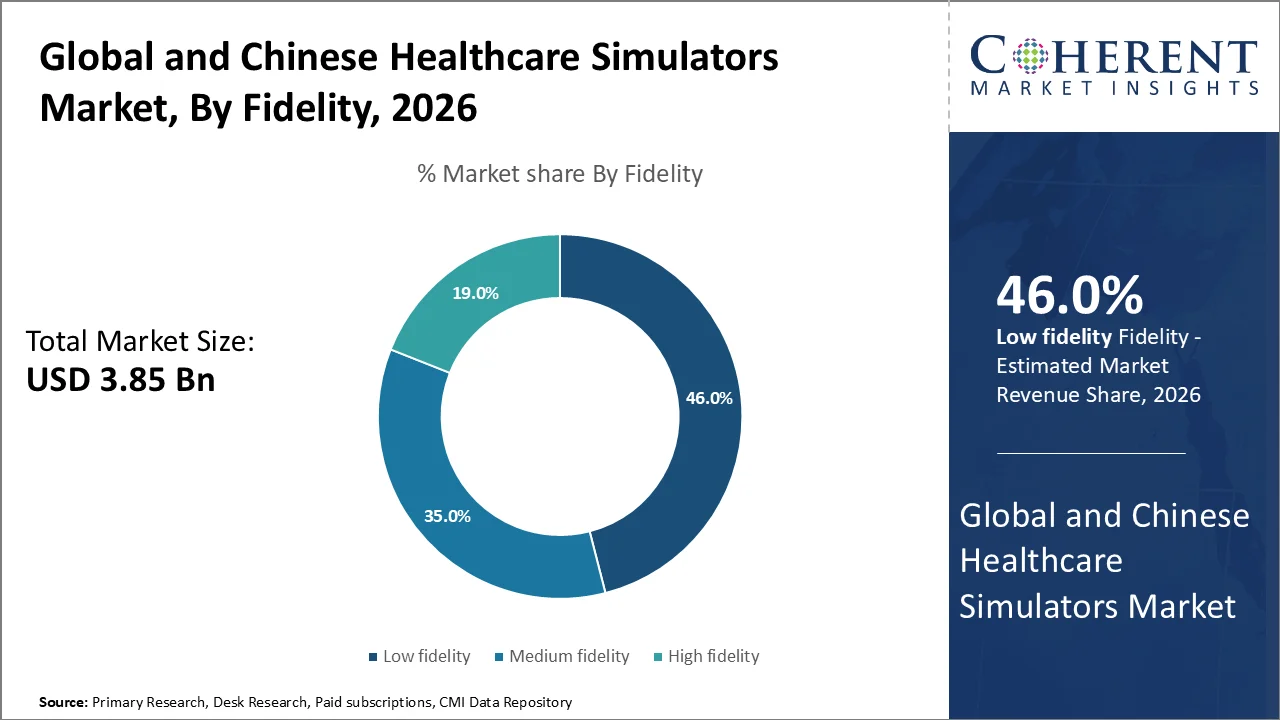
- Low fidelity will dominate with 46% in 2026, cost-effective training, very low cost compared to advanced simulators, includes task trainers like IV arms, CPR models, suturing pads. Over 60% of nursing and basic clinical skill programs globally still rely primarily on task trainers (IV arms, CPR mannequins, suturing pads).
- Academic and research institutes will dominate with 50% in 2026, medical and nursing schools are the largest users of simulators. Government has approved 43 new medical colleges in India for the 2025-26 academic year.
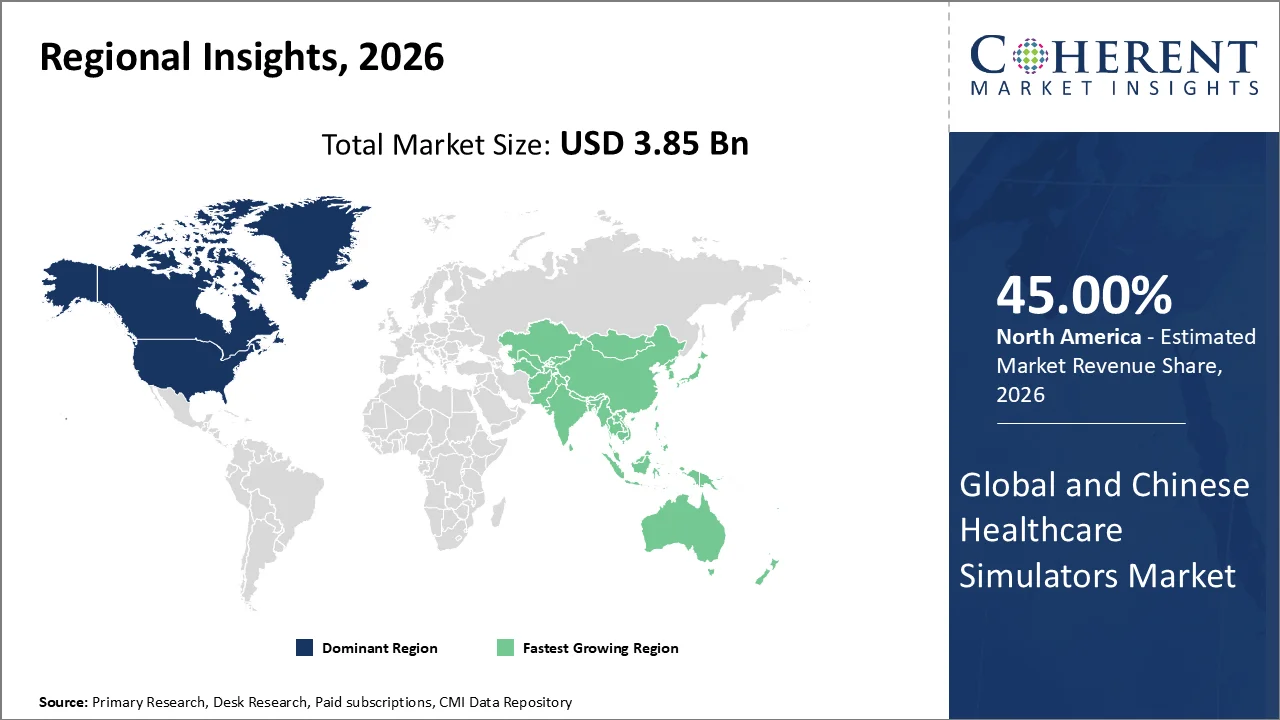
- North America is expected to acquire the dominant share of 45% in 2026, North America has highly advanced hospitals, medical universities, and training centers. There are 6,100 hospitals in the United States.
Segmental Insights
Low fidelity holds the Largest Market Share
Based on Fidelity, low fidelity dominates the market, accounting for a significant 46% share in 2026, the widespread accessibility, cost-effectiveness, as well as fundamental utility in basic clinical skills development are the growth inducing factors. Low fidelity simulators typically encompass simple models such as anatomical mannequins, task trainers, and part-task simulators which focus on specific procedures like intravenous insertion, catheterization, or suturing practice. Given that 15–25% of hospital patients undergo urethral catheterization, structured training in this commonly performed procedure becomes essential.
Their relative simplicity makes them highly versatile as well as favorable, particularly in educational institutions and healthcare settings where resource constraints usually dictate equipment purchases. For example, public hospitals as well as medical training colleges in both China and various other global regions tend to prioritize low fidelity simulators due to their affordability as well as simplicity of use, especially in foundational medical curricula.
The World Health Organization’s emphasis on strengthening basic clinical skills training in low-resource settings has further strengthened the demand for low fidelity simulators, as these tools help meet global standards for healthcare education at minimal investment.
- Current Industry Events of 2026
- Market Size Estimation
- Regional Breakdown
- Competitive Landscape
- Customer Intelligence
- Segmental Analysis
- Pricing Analysis
- Key Market Drivers, Challenges & Future Trends
- Customized Insights Section
Why is Patients Simulators Acquiring the Largest Market Share?
Patients simulators are projected to account for the largest share of product type in 2026, representing approximately 40% of the total volume. Owing to their broad application scope as well as vital role in medical education and training. Over 75% of students understood the value of patient simulators as a useful addition to learning with real patients, and 68% felt that SBL aided enhance their communication skills.
This dominance of the segment can be widely attributed to the high emphasis on hands-on clinical training without compromising patient safety, a priority stressed by leading global healthcare bodies including the World Health Organization (WHO) as well as various medical councils around the world.
Patient simulators provide an overall, immersive learning experience for healthcare professionals, encompassing a number of scenarios from basic clinical skills to advanced critical care procedures. For instance, high-fidelity adult as well as pediatric patient simulators allow trainees to practice resuscitation, airway management, as well as medication administration in highly realistic settings, resulting in improved clinical outcomes.
Manikin-Based Simulation holds the Largest Market Share
Based on service, Manikin-Based Simulation dominates the market, accounting for a significant 55% share in 2026. Its extensive adoption in medical education as well as clinical training environments worldwide is one of the factors propelling the growth of the segment. These high-fidelity manikins offer a tangible, interactive experience that closely mimics real-life clinical scenarios, enabling healthcare professionals as well as students to handle complex procedures including cardiac resuscitation, airway management, surgical interventions, etc., in a controlled as well as safe environment. With the global unmet need for surgery estimated at around 160 million procedures annually, the demand for highly skilled surgical training continues to grow.
The realism and versatility of these manikins have made them an indispensable tool in medical institutions and teaching hospitals, particularly in China and other advancing healthcare markets. They emphasize on advancing the competency as well as preparedness of medical staff.
For example, institutions including Peking Union Medical College Hospital, the Shanghai Jiao Tong University School of Medicine, etc., have adopted advanced manikin-based simulators into their curricula to build hands-on learning without compromising patient safety, promoting higher confidence among trainees before actual clinical cases.
Academic and Research Institutes holds the Largest Market Share
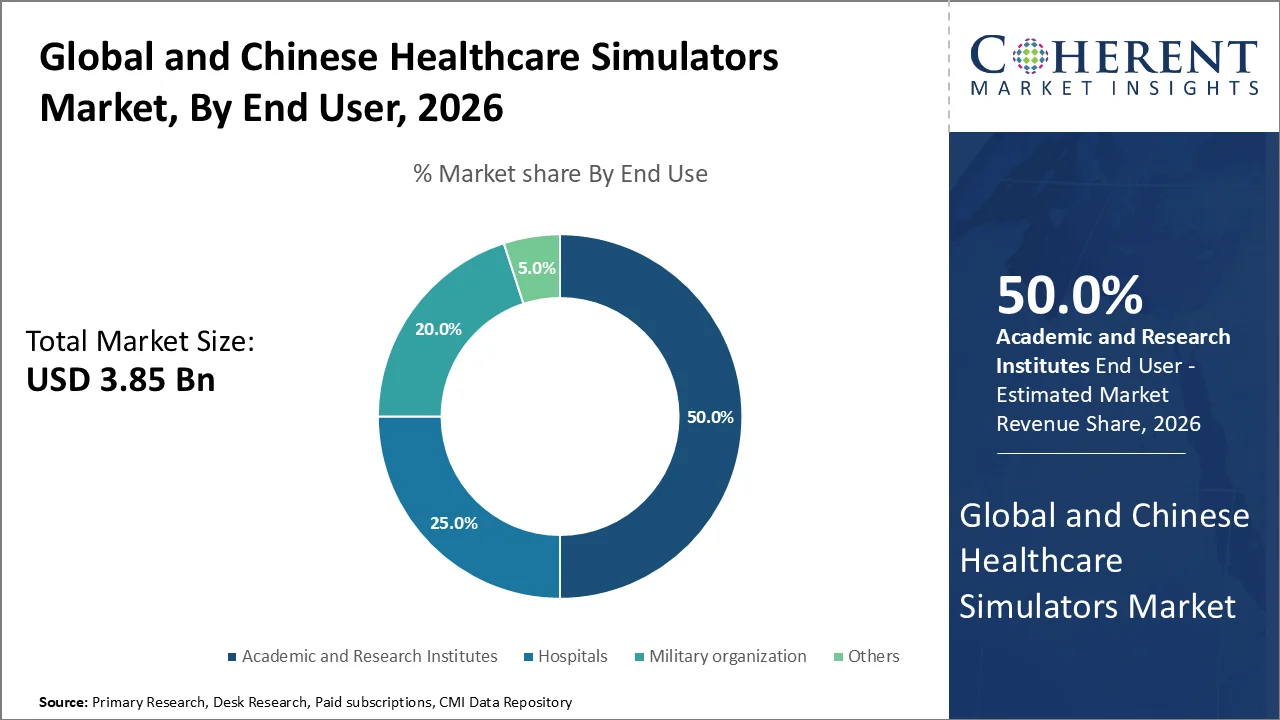
Based on end user, academic and research institutes dominate the market, accounting for a significant 50% share in 2026, their pivotal role in advancing healthcare education, research, and the development of medical technologies are the factors propelling the growth of the market. India's medical devices industry is projected to grow steadily from USD 15.2 billion in 2025 to USD 50.1 billion by 2030.
Academic institutions and research bodies across the globe, including prominent universities as well as dedicated healthcare research establishments, have highly adopted sophisticated healthcare simulators as integral tools for training as well as experimentation.
These simulators bring in depth study of complex physiological processes as well as clinical procedures in a controlled, risk-free environment, which is essential for cultivating highly skilled healthcare professionals. For instance, medical universities including Peking University Health Science Center, Tongji Medical College, etc., are heavily investing in advanced simulation technologies to enhance the quality of medical training.
Market Drivers
Virtual Reality (VR) and Augmented Reality (AR) is transforming the Global and Chinese Healthcare Simulators Industry
Virtual Reality (VR) makes a fully digital 3D environment, while Augmented Reality (AR) adds digital information on top of the real world. In healthcare training, these technologies aid students as well as doctors better understand anatomy and practice procedures in a safe and interactive way.
Companies like Osso VR in the US and CAE Healthcare use VR/AR to train surgeons, while in China, firms including HoloMed, Ximmerse, etc., use similar tools for medical learning. These technologies make training more realistic, improve engagement, as well as allow repeated practice with feedback, helping students learn skills faster even when real clinical experience is limited.
Manikin-based High-Fidelity Simulation: A major breakthrough in Global and Chinese Healthcare Simulators
Manikin-based high-fidelity simulation uses lifelike physical mannequins that behave like real patients. These simulators can show real human signs including pulse, breathing, heart sounds, changing vital signs, etc., helping learners practice medical skills in a safe environment.
These simulators are widely used in global medical training, such as Laerdal’s SimMan and Gaumard birthing simulators, and also in China by hospitals and universities using both imported and local systems. They help students practice procedures, improve teamwork, and learn how to handle emergencies through repeated realistic training.
Current Events and Their Impact
Current Event | Description and its Impact |
Rapid expansion of VR/AR-based medical training adoption in hospitals as well as universities |
|
Push by the government authorities for competency-based medical education (CBME) in China and Asia-Pacific |
|
Global and Chinese Healthcare Simulators Market Trends
- Adoption of Virtual Reality (VR), Augmented Reality (AR), and Artificial Intelligence (AI)-enabled simulators is transforming traditional training methods, providing immersive as well as realistic learning experiences. VR training has shown a staggering 76% increase in learning effectiveness compared to traditional methods.
- Integration of cloud-based platforms advancing accessibility as well as scalability of simulation-based training. Cloud-based learning platforms are adopted by over 70% of medium to large enterprises.
- High emphasis on multidisciplinary and interprofessional education driving demand for comprehensive simulation solutions.
- Rising prevalence of chronic diseases with a high demand for specialized medical training in areas such as surgery, anesthesiology, and emergency care. The prevalence of at least one chronic condition increased from 72.3% to 76.4%.
Regional Insights
North America dominates owing to advanced healthcare simulation technologies
North America account 45% market share in 2026, the United States and Canada, as key contributors within North America, have been at the forefront of integrating advanced healthcare simulation technologies into medical education, training, and research, providing a robust ecosystem for market growth. An AAMC survey of U.S. and Canadian institutions found simulation centers typically operate with USD1–3 million annual budgets, averaging 54 simulation rooms and 16,528 sq. ft. of training space.
A critical underpinning for this leadership is the well-established infrastructure of healthcare education as well as provision, supported by significant government and institutional investments aimed at enhancing clinical skills and patient safety.
For example, the Partnership for Health Advancement (PHA), an international nonprofit operating in the US, recently reported a remarkable uptick in the adoption of high-fidelity simulation programs across major academic medical centers, including Johns Hopkins University and Mayo Clinic.
These institutions deploy state-of-the-art simulators encompassing virtual reality, augmented reality, and sophisticated mannequin-based systems to train healthcare professionals in complex procedures such as robotic surgery and emergency response.
Asia Pacific Global and Chinese Healthcare Simulators Market Trends
The Asia Pacific region is poised to be the fastest-growing region through 2026-2033, expanding at a CAGR of approximately 7.5%. Driven primarily by rapid advancements in healthcare infrastructure, increasing investments by government authorities in medical education, and rising awareness about patient safety and skill development. The government led by Narendra Modi has launched a major expansion of medical education. On September 24, 2025, the Union Cabinet approved a INR 15,034 crore, four-year plan to create more than 10,000 new medical seats across existing government medical colleges and hospitals.
Countries such as China, India, and South Korea have intensified efforts to establish simulation-based medical training programs, which immensely contribute to the burgeoning demand for healthcare simulators.
China’s Ministry of Health has launched comprehensive policies encouraging simulation training for healthcare professionals to improve diagnostic accuracy and procedural proficiency, which has triggered a cascade of investments into healthcare simulation centers across the country. For example, the Shanghai Medical Simulation Centre represents a landmark initiative enabling immersive, technology-enabled training tailored to meet local disease burdens and clinical workflows.
An Early Adoption of Cutting-Edge Simulation Technologies is Accelerating the Global and Chinese Healthcare Simulators Market Demand in United States
The U.S. contributes the highest share in the healthcare simulators market within the region owing to its well-established healthcare infrastructure, significant investment in medical education, and an early adoption of cutting-edge simulation technologies.
The U.S. healthcare ecosystem has long prioritized enhancing clinical training through realistic, high-fidelity simulators that allow healthcare professionals as well as students to practice complex procedures without risk to patients.
For instance, the Agency for Healthcare Research and Quality (AHRQ), a U.S. government agency, actively promotes the integration of simulation-based training in hospitals and medical schools to reduce medical errors and improve patient outcomes.
China Global and Chinese Healthcare Simulators Market Trends
China contributes the highest share in the global healthcare simulators market in Asia Pacific due to a combination of factors including its expansive healthcare infrastructure development, robust government initiatives, and growing emphasis on medical education and training.
China's healthcare system has undergone transformative reforms in recent years aimed at improving both the quality and accessibility of care, which necessitates the adoption of advanced training solutions such as healthcare simulators.
Who are the Major Companies in Global and Chinese Healthcare Simulators Industry
Some of the major key players in Global and Chinese healthcare simulators market include, Laerdal Medical, 3M, 3D Systems, Simulab Corporation, Simulaids, Inc., Kyoto Kagaku, Mentice, Medaphor, CAE Healthcare, Gaumard Scientific Company, Limbs & Things, BT INC., Trandomed 3D, Fujian Zhongli Co., Tellyes Scientific Co. Ltd, Kavo Dental, Surgical science AB, and Adam Rouilly Ltd.
Key News
- In February 2026, Maverick Simulation Solutions has launched ‘SIDDH’, a next-generation high-fidelity critical care adult patient simulator developed and manufactured in India, aimed at transforming hands-on clinical training across medical colleges and hospitals.
- In December 2025, SmartWinnr, a leading sales enablement and readiness platform, has announced the launch of a specialized medical simulation center of excellence to strengthen the accuracy, relevance and compliance readiness of its AI-driven learning solutions for the pharmaceutical and medtech sectors.
Market Report Scope
Global and Chinese Healthcare Simulators Market Report Coverage
| Report Coverage | Details | ||
|---|---|---|---|
| Base Year: | 2025 | Market Size in 2026: | USD 3.85 Bn |
| Historical Data for: | 2020 To 2024 | Forecast Period: | 2026 To 2033 |
| Forecast Period 2026 to 2033 CAGR: | 16.8% | 2033 Value Projection: | USD 11.3 Bn |
| Geographies covered: |
| ||
| Segments covered: |
| ||
| Companies covered: | Laerdal Medical, 3M, 3D Systems, Simulab Corporation, Simulaids, Inc., Kyoto Kagaku, Mentice, Medaphor, CAE Healthcare, Gaumard Scientific Company, Limbs & Things, BT INC., Trandomed 3D, Fujian Zhongli Co., Tellyes Scientific Co. Ltd, Kavo Dental, Surgical science AB, and Adam Rouilly Ltd. | ||
| Growth Drivers: |
| ||
| Restraints & Challenges: |
| ||
Analyst Opinion
- The global healthcare simulators market is witnessing significant advancements driven by the increasing demand for enhanced medical training and patient safety.
- Technological innovations such as virtual reality (VR), augmented reality (AR), and artificial intelligence (AI) are propelling the adoption of sophisticated simulation tools, allowing healthcare professionals to practice complex procedures in risk-free environments.
- Growing awareness regarding the benefits of simulation-based training in reducing medical errors is further accelerating market growth. However, high costs associated with advanced simulator equipment and the need for continuous software updates pose challenges to widespread adoption.
- In the Chinese healthcare simulators market, rapid healthcare infrastructure development and government initiatives aimed at improving medical education quality are key market drivers.
- The rising number of medical colleges, coupled with increasing investments in healthcare technology, creates substantial opportunities for market expansion.
- Additionally, China's aging population and the consequent rise in chronic diseases necessitate enhanced training for healthcare providers, fostering simulator adoption.
Speak to the analyst
Want personalized insights?
Take the findings above to one of our principal consultants, or have the report rebuilt around the segments, geographies and competitors you actually track.
Market Segmentation
- By Product Type (Revenue, USD Bn, 2021-2033)
- Patients Simulators
- Dental Simulators
- Surgical Simulators
- Ultrasound and Imagining Simulators
- Others
- By Service (Revenue, USD Bn, 2021-2033)
- Manikin-Based Simulation
- Skills-Training Simulation
- Tissue-based Simulation
- Virtual Reality Simulation
- Standardized Patient Simulation
- Others
- By Fidelity (Revenue, USD Bn, 2021-2033)
- Low fidelity
- Medium fidelity
- High fidelity
- By End User (Revenue, USD Bn, 2021-2033)
- Hospitals
- Academic and Research Institutes
- Military organization
- Others
- Global and Chinese Healthcare Simulators Market, By Region: (Revenue, USD Bn, 2021-2033)
- North America
- U.S.
- Canada
- Latin America
- Brazil
- Mexico
- Argentina
- Rest of Latin America
- Europe
- Germany
- U.K.
- France
- Italy
- Spain
- Russia
- Rest of Europe
- Asia Pacific
- China
- India
- Japan
- Australia
- South Korea
- ASEAN
- Rest of Asia Pacific
- Middle East
- GCC
- Israel
- Rest of Middle East
- Africa
- South Africa
- Central Africa
- North Africa
- North America
- Key Players
- Laerdal Medical
- 3M
- 3D Systems
- Simulab Corporation
- Simulaids, Inc.
- Kyoto Kagaku
- Mentice
- Medaphor
- CAE Healthcare
- Gaumard Scientific Company
- Limbs & Things
- BT INC.
- Trandomed 3D
- Fujian Zhongli Co.
- Tellyes Scientific Co. Ltd
- Kavo Dental
- Surgical science AB
- Adam Rouilly Ltd
Sources
Primary Research Interviews
- Healthcare Simulation Technology Manufacturers
- Medical Educators in Chinese and Global markets
- Hospital Procurement Managers
- Simulation Training Centers
- Others
Databases
- GlobalData Healthcare
- Frost & Sullivan
- National Bureau of Statistics of China
- Others
Magazines
- Healthcare IT News
- Medical Simulation News
- Asia Healthcare Magazine
- Simulation in Healthcare
- Others
Journals
- Journal of Medical Simulation
- Simulation in Healthcare
- BMJ Simulation & Technology Enhanced Learning
- Chinese Journal of Medical Education
- Others
Newspapers
- China Daily (Healthcare section)
- The Guardian (Health)
- South China Morning Post (Health)
- Reuters Health News
- Others
Associations
- Society for Simulation in Healthcare (SSH)
- Chinese Society for Simulation in Medical Education (CSSME)
- International Nursing Association for Clinical Simulation and Learning (INACSL)
- Asia-Pacific Simulation Alliance
- Others
Public Domain Sources
- World Health Organization (WHO) Reports
- Ministry of Health of the People's Republic of China
- Centers for Disease Control and Prevention (CDC)
- National Health Commission of China
- Others
Proprietary Elements
- CMI Data Analytics Tool, Proprietary CMI Existing Repository of information for last 10 years
Get access to 250+ pages report
Every segment, forecast, competitor profile and data table behind the analysis above — available for instant download.
- ESOMAR Member
- ISO 9001:2015 Certified
- D-U-N-S Registered
- GDPR & CCPA Compliant
Missing comfort of reading report in your local language? Find your preferred language:
Transform your Strategy with Exclusive Trending Reports
Frequently Asked Questions
The Global and Chinese healthcare simulators market is expected to reach USD 11.3 Billion in 2033.
Regulatory challenges and approval delays is expected to restrain the Global and Chinese healthcare simulators market growth over the forecast period.
Growing focus on patient safety and risk reduction are driving growth of the global and Chinese Healthcare Simulators market.
The Global and Chinese healthcare simulators market is anticipated to grow at a CAGR of 16.8% between 2026 and 2033.
Data analytics professionals should know these four types of simulation models: Monte Carlo method, Agent-based modeling, Discrete event simulation, and System dynamic modeling.
Healthcare simulation technology reproduces the clinical situations/environment by creating reel life scenarios of medical conditions, interactive videos in 3D or 4D resolution for a better understanding of operations carried out during healthcare professionals’ training. It is an artificial representation that is used for learning and teaching purpose in medical and research institutes.
Among regions, North America is expected to account for a largest market share in the global and Chinese healthcare simulators market over the forecast period.