

Global Smart Home Healthcare Market Size and Share Analysis – Growth Trends and Forecasts (2026-2033)
Smart Home Healthcare Market is estimated to be valued at USD 33.92 Bn in 2026 and is expected to reach USD 158.14 Bn in 2033, exhibiting a compound annual growth rate (CAGR) of 24.6% from 2026 to 2033.
Key Takeaways
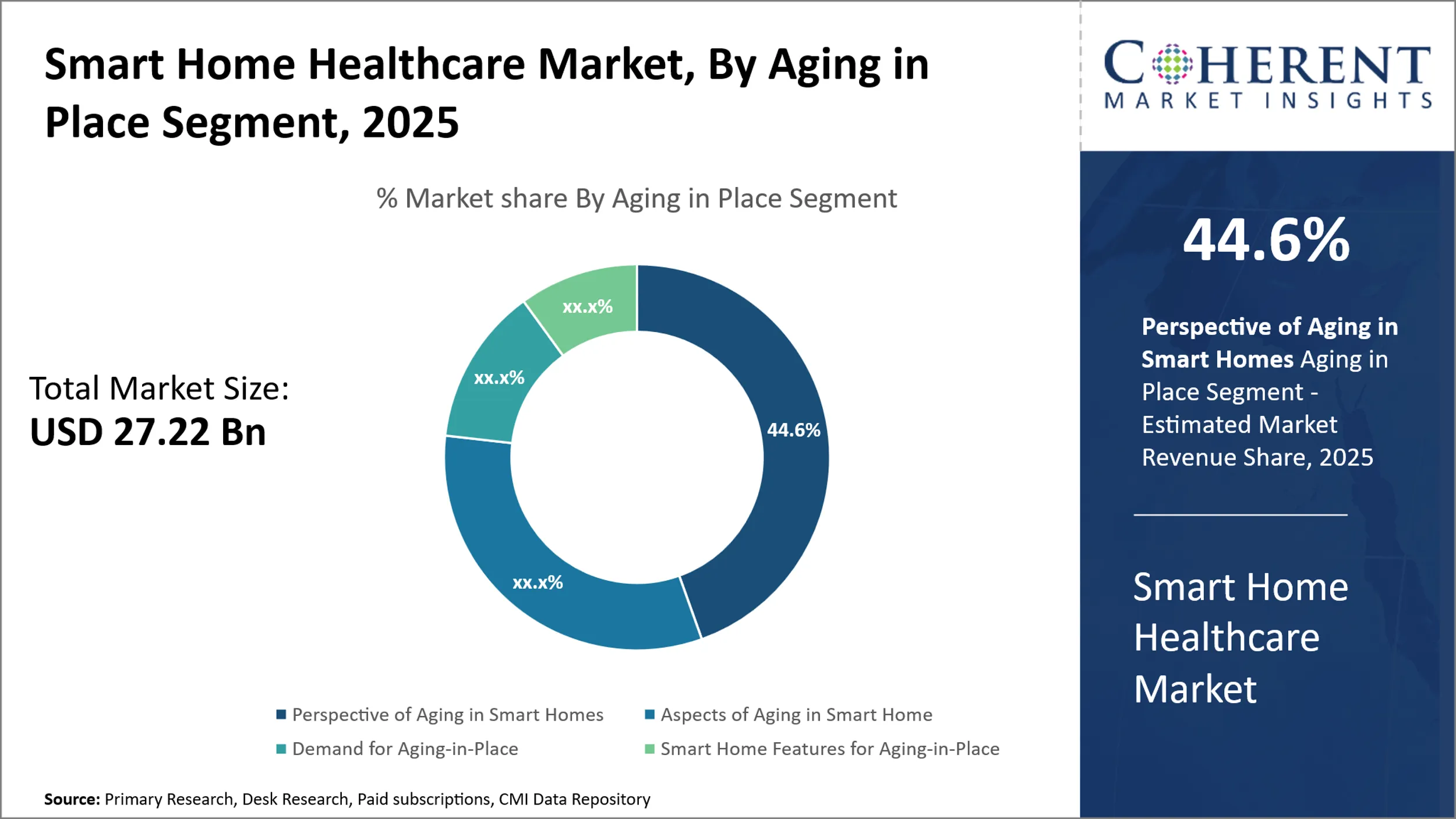
- Based on Aging-In-Place, Perspective of Aging in Smart Homes Segment Is expected to dominate the global market over the forecast period with 45.6% market share. This is due to the rise in development of solutions by vendors to collect and monitor vital health data of old age population.
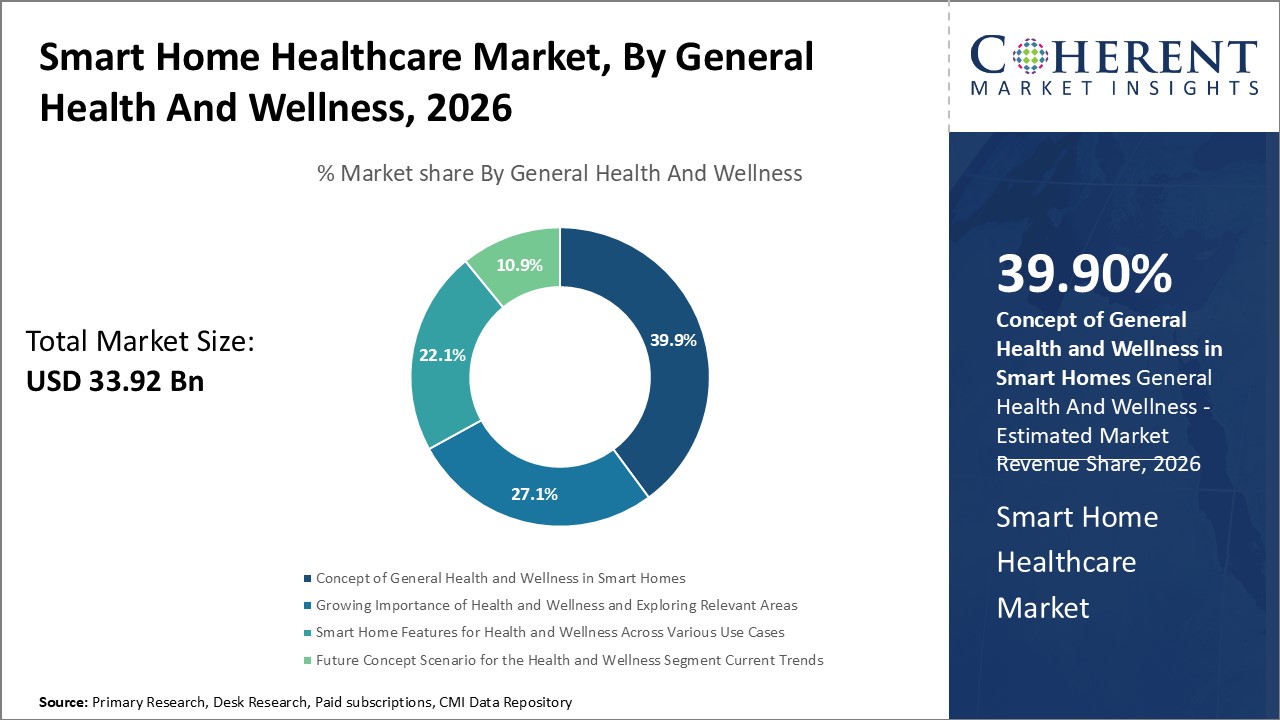
- Based on General Health and Wellness, Concept of General Health and Wellness in Smart Homes segment is expected to dominate the global market over the forecast period. This is due to the increasing adoption of smart speakers in homes further driving the number of smart solutions used in daily lives.
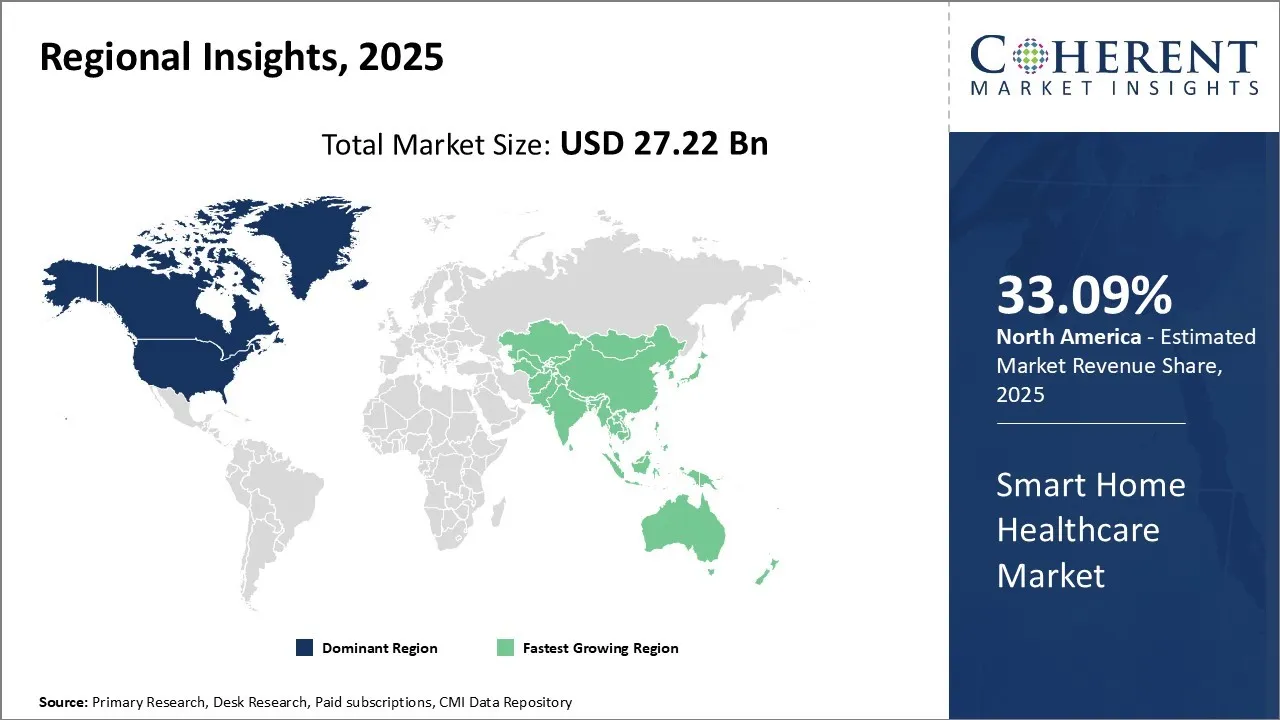
- North America dominates the market with 33.09% market share. The growth is attributed by the presence of numerous home health care business in the U.S. along with presence of large pool of geriatric population in the country.
- Asia Pacific is set to hold around 26.40% shares in the global market during the forecast period, owing to rising digital transformation and integration of IoT devices.
- Europe is projected to account for 22.82% shares in the smart home healthcare market in 2026.
Market Overview
The smart home healthcare market is growing strongly, supported by rising demand for remote patient monitoring, population aging, and the growing incidence of chronic conditions like diabetes, hypertension, and respiratory illnesses. Smart devices from connected blood pressure monitors and glucose meters to AI-based medication dispensers and fall detection systems are enabling patients to take charge of their healthcare in the comfort of their homes. This is in keeping with the international trend towards value-based care in which minimizing hospitalizations and enhancing patient outcomes are high on the agenda.
In 2025, MedTech Nova introduced its AI-based SmartVitals Hub, a home health hub that consolidates data from a variety of health devices and delivers real-time alerts to caregivers and doctors. It applies predictive analytics to forecast health risk and recommend early interventions, greatly enhancing home-based chronic care and lowering emergency room reliance.
Current Events and Its Impact on Smart Home Healthcare Market
Current Events | Description and its impact |
Apple Incorporates AI-Based Health Tracking in Apple Watch Series 10 |
|
UK NHS Tests Smart Home Kits for Older Adults |
|
Pipeline Analysis
The smart home healthcare market is experiencing a robust and innovation-rich pipeline as next-generation solutions attract investment from companies to address increased consumer and clinical needs. The leading trends are AI-driven diagnostics, remote monitoring of vital signs, and automated medication management.
These industry giants like Philips, GE Healthcare, and Medtronic are developing their intelligent health ecosystems with multi-device platforms that combine wearables, sensors, and voice-based assistants. For example, Philips is creating its next-generation Home Care Companion, a system with motion sensors, smart home healthcare by fall detection, and health analytics to assist solo-dwelling older patients.
Startups and mid-market firms are also broadening the pipeline with tailored solutions. HealthBeacon, for instance, is bringing in AI-driven dosing reminders and digital patient feedback loops into its connected medication adherence solution. Resideo and Withings, for their part, are creating unified hubs that aggregate and interpret health data from across touchpoints such as heart rate, oxygen saturation, and sleep patterns.
- Current Industry Events of 2026
- Market Size Estimation
- Regional Breakdown
- Competitive Landscape
- Customer Intelligence
- Segmental Analysis
- Pricing Analysis
- Key Market Drivers, Challenges & Future Trends
- Customized Insights Section
Patent Landscape
The smart home healthcare patent scenario is growing at a very fast pace, an indication of the technological convergence and the intensity of innovation within the industry. The most notable patent domains are voice-enabled health assistants, intelligent dispensers for medication, wearable medical devices, AI diagnostics, and patient monitoring remotely.
Major players such as Philips, Samsung, Medtronic, ResMed, and Apple collectively own an immense number of active patents. Philips, for instance, owns several patents for sensor-enabled bed systems in addition to fall-detection algorithms. Samsung and Apple continue to file patents for wearables for health monitoring but with intuitive interfaces that are easy to use and integrate perfectly with smart home platforms.
Today's patent submissions are also dominated by emphasis on non-invasive biosensors, continuous tracking of health data, and predictive analytics for pre-emptive action. Businesses are looking to secure intellectual property rights for AI models processing patient data to identify anomalies, such as aberrant heart rhythms or sleep disorders.
Startups and technology companies entering the market are patenting smart inhalers, IoT-based glucose meters, and in-patient rehab systems. Cross-industry collaborations are also propelling patent applications that integrate health tech with consumer electronics and cloud computing.
Overall, the patent landscape is growing more competitive as incumbent medtech players and new entrants attempt to safeguard creative, connected, and patient-focused smart home device healthcare innovations.
Global Smart Home Healthcare Market Drivers
- Rising geriatric populations across the globe to fuel market growth
The rate of old age population is increasing all over the world, which is further creating the need for smart home healthcare solutions. For instance, according to the National Institute of Aging, currently the number of people aged 65 or above 700 million globally, and this number is likely to increase by 2050.
With rise in old age population, the urgent need for finding ways to enhance patient outcome, reduce overall cost, and enhance access to care also increases. Due to this, the demand for smart home healthcare is expanding worldwide, which is projected to augment growth of the global smart home healthcare market over the forecast period.
- Earlier onset of chronic diseases to propel market pace
The early onset of chronic diseases such as issues of dementia are increasing all over the world. This in turn is leading to development of new technology for people suffering from such diseases. For instance, the U.K. Imperial College London received GBP 20 million in funding for the development of smart home technologies that will help individuals suffering from dementia.
Due to such investments and developments in smart home, the popularity of telehealth and telecare applications is increasing all over the world. This factor is thus expected to accelerate growth of the global smart home healthcare market during the forecast period.
Global Smart Home Healthcare Market Opportunities
Growing technological advancements in smart home to create multiple growth opportunities for vendors in the global smart home healthcare market over the forecast period. As advanced payment models of smart home healthcare aim at value over volume, post-diagnostics patient care, and maintaining low cost as a priority, the demand for this market is expanding all over the world.
The affordability of digital technologies is growing with increasing technological advancements; the adoption of smart homes is increasing rapidly. This factor thus, creating growth opportunities in the global market.
Increase in government regulations is also anticipated to generate ample opportunities in the global smart home healthcare market during the forecast period. Several governments around the world are implementing regulations and laws for new buildings in most developing and developed countries for implementing more advanced technologies. This factor is in turn creating lucrative environment for growth opportunities in the global market.
Global Smart Home Healthcare Market Trends
- Growing adoption of various intelligent devices in houses is a major trend
As the industrialization and expansion of cities is growing all over the world, the pollution and climate change have become major issues globally. This is further mainstreaming the adoption of smart devices in houses such as smoke detectors, air purifiers, and energy-efficient smart HVACs. Thus, the market players are introducing more diverse products through fostering general wellness and health. This trend is thus expected to continue in the global smart home healthcare market over the forecast period.
- Popularity of Smart Home Healthcare in telemedicine is a recent trend
New services are increasingly replacing current healthcare models based on home visits by doctors, therapists, and nurses. Market players are therefore introducing remote healthcare solutions. For instance, Cox Communications acquired Trapollo, who created various remote healthcare solutions, including telemedicine packages for connecting medical teams and people via the technology. This trend is in turn projected to drive growth of the global smart home healthcare market in the coming future.
Segmental Insights
Global Smart Home Healthcare Market Insights, By Aging-In-Place
Based on Aging-In-Place, the market is segmented into Perspective of Aging in Smart Homes, Aspects of Aging in Smart Home and, Demand for Aging-in-place, and Smart Home Features for Aging-in-place. Out of which, Perspective of Aging in Smart Homes is expected to dominate the global market over the forecast period and this is attributed to the rise in development of solutions by vendors to collect and monitor vital health data of old age population.
For instance, recently, Xenoma, a Japanese start-up launched e-skin, which is a range of various pajamas designed for old age people. These pajamas are embedded with sensors, with natural look and feel. This product can analyze vitals and detect issues when the wearer is asleep. Such product development is likely to drive growth of this segment in the global market.
Aspects of Aging in Smart Home and, Demand for Aging-in-place segment is also expected to witness significant growth in the near future and this is owing to the rise in launch of solutions by smart home security vendors that offer control to users through voice commands and offers door open notifications among other features. For instance, Boundary Alarm comes with EmSPARK Security Suite, provides an intruder alarm that allows user to remote monitoring through smartphone.
Smart Home Healthcare Market Insights, By General Health and Wellness
Based on General Health and Wellness, the Concept of General Health and Wellness in Smart Homes is expected to dominate the global market over the forecast period and this is attributed to the increasing adoption of smart speakers in homes further driving the number of smart solutions used in daily lives. For instance, Virtual assistants such as Google Home, Siri, and Alexa can remind and help with instructions for maintaining a healthy diet and exercise routines with workout guides. Such solutions offer better health and do not require major investments in equipment.
Thus, the segment is likely to gain strong growth in the global smart home healthcare market during the forecast period. Growing Importance of Health and Wellness and Exploring Relevant Areas segment is also expected to witness significant growth in the near future and this is owing to the rise in old age population all over the world, as governments are introducing initiatives for enhancing the longevity revolution.
The number of aging populations is increasing across most developed countries. As per the World Health Organization, one in six individuals globally will be of age 60 years or above, by 2030. This factor in turn is expected to drive demand for the segment, which is likely to boost the market growth in coming years.
Global Smart Home Healthcare Market – Regional Insights
North America Smart Home Healthcare Market
The global smart home healthcare market is expected to witness promising growth in North America, over the forecast period. The growth of this region can be attributed to presence of numerous home health care business in the U.S. along with presence of large pool of geriatric population in the country. Moreover, ongoing medical project in Canada offering health care potential of smart homes is also expected to fuel growth of the global smart home healthcare market in North America region.
Asia Pacific Smart Home Healthcare Market
Asia Pacific is anticipated to show significant growth in the global smart home healthcare market during the forecast period, owing to rise in digital transformation, penetration of IoT devices for modernization of healthcare delivery. Furthermore, rise in high data connectivity across countries such as South Korea, Singapore, and Taiwan is also expected to drive growth of the global smart home healthcare market in Asia Pacific.
Smart Home Healthcare Market Dominating Countries
United States Smart Home Healthcare Market Analysis and Trend
The United States dominates the worldwide smart home healthcare market due to its superior healthcare infrastructure, high adoption rate for digital health technology, and increasing population of older people. Support from the government for telehealth and chronic disease management programs and technology-oriented customers fuels demand for connected devices such as smart monitors, medicament dispensers, and remote diagnostic products.
Germany Smart Home Healthcare Market Analysis and Trend
Germany is a key smart home healthcare player in Europe, leveraging its established medical device sector and advanced digital health policy. It is making investments in elderly home-based long-term care and rehab technology and has insurance reimbursement models that support increasingly advanced remote patient monitoring solutions.
Japan Smart Home Healthcare Market Analysis and Trend
Japan's ageing population, growing at a rapid rate, has placed it in the vanguard of embracing smart home care technologies. Robots, artificial intelligence monitoring systems, and fall sensors are being extensively adopted to lower hospitalization and homecare administration among the elderly. Government programs also encourage the utilization of digital health technologies in old-age care.
China Smart Home Healthcare Market Analysis and Trend
China is experiencing extremely high growth in this sector, fueled by urbanization, increasing middle-class healthcare expenditure, and increased digital literacy. Businesses are making significant investments in AI-enabled health apps, wearable sensors, and intelligent health hubs that are linked to government-funded health platforms for tele-diagnosis and the management of chronic care.
Market Report Scope
Smart Home Healthcare Market Report Coverage
| Report Coverage | Details | ||
|---|---|---|---|
| Base Year: | 2025 | Market Size in 2026: | USD 33.92 Bn |
| Historical Data for: | 2020 To 2024 | Forecast Period: | 2026 To 2033 |
| Forecast Period 2026 to 2033 CAGR: | 24.6% | 2033 Value Projection: | USD 158.14 Bn |
| Geographies covered: |
| ||
| Segments covered: |
| ||
| Companies covered: | Medtronic PLC, Sleepace, Evermind Inc., Awair Inc., and Eight Sleep | ||
| Growth Drivers: |
| ||
| Restraints & Challenges: |
| ||
Key Developments
- In November 2024, London care home KYN Bickley introduced Ally Cares, an infrared and acoustic artificial intelligence system for non-invasive falls monitoring and room monitoring. This smart system informs staff of unusual movement (e.g., bed leavings) within 30 seconds, resulting in an 83% fall reduction in trials; comparable NHS pilots reduced response times from one hour to less than two minutes.
- In October 2024, Withings launched BeamO, a design that resembles a TV remote and is a futuristic-looking remote health kit that can take body temperature, lung sounds, heart rhythm, and SpO₂. BeamO is home-use design that will track up to eight users and send data to doctors via remote diagnosis.
Analyst View
- The smart home healthcare market is a paradigm shift in the delivery and consumption of healthcare services that is driven by the aging population worldwide and the necessity of remote monitoring solutions for patients.
- The market drivers are growing healthcare costs, rising prevalence of chronic diseases, and technological advancements in IoT sensors, artificial intelligence, and wearable sensors. Voice assistants and integration with smart devices provide seamless health monitoring, drug reminders, and emergency response systems, particularly for the elderly who wish to age in place safely.
- However, the most critical constraints that still prevail are data privacy concerns, the issue of regulation compliance, and compatibility between different smart healthcare platforms. This is also constrained by high initial implementation costs and low digital literacy among certain sections.
- North America dominates the market, followed by high levels of technology adoption, healthcare infrastructure, and supportive regulations. The Asia-Pacific market is the most rapidly growing market owing to high levels of digitization, rising healthcare awareness, and pro-smart city policies by the government.
Market Segmentation
- Global Smart Home Healthcare Market, By Aging-In-Place
- Perspective of Aging in Smart Homes
- Aspects of Aging in Smart Home and Demand for Aging-in-place
- Smart Home Features for Aging-in-place
- Global Smart Home Healthcare Market, By General Health and Wellness
- Concept of General Health and Wellness in Smart Homes
- Growing Importance of Health and Wellness and Exploring Relevant Areas
- Smart Home Features for Health and Wellness Across Various Use Cases
- Future Concept Scenario for the Health and Wellness Segment
- Current Trends, Challenges, and Market Projection for the Overall Health and Wellness Ecosystem
- Global Smart Home Healthcare Market, By Region
- North America
- U.S.
- Canada
- Latin America
- Brazil
- Argentina
- Mexico
- Rest of Latin America
- Europe
- Germany
- U.K.
- Spain
- France
- Italy
- Russia
- Rest of Europe
- Asia Pacific
- China
- India
- Japan
- Australia
- South Korea
- ASEAN
- Rest of Asia Pacific
- Middle East
- GCC Countries
- Israel
- Rest of Middle East
- Africa
- South Africa
- North Africa
- Central Africa
- North America
- Company Profiles
- Sleepace
- Awair Inc.
- Eight Sleep
- Evermind Inc.
- Medtronic PLC.
Sources
Primary Research Interviews
- Healthcare Technology Executives
- Smart Home Device Manufacturers
- Healthcare Providers and Practitioners
- End-Users (Patients and Caregivers)
- Others
Databases
- Healthcare Technology Database (HTD)
- Smart Home Market Intelligence Database
- Medical Device Registration Database
- IoT Healthcare Analytics Database
- Others
Magazines
- Healthcare IT News
- Smart Home Magazine
- Medical Device & Technology
- Connected Health Magazine
- Others
Journals
- Journal of Medical Internet Research
- IEEE Journal of Biomedical and Health Informatics
- Smart Health Journal
- Others
Newspapers
- Healthcare Finance News
- Modern Healthcare
- FierceHealthcare
- Health Tech Newspaper
- MedTech Breakthrough News
- Others
Associations
- Healthcare Information and Management Systems Society (HIMSS)
- Connected Health Alliance
- Smart Home Association
- American Telemedicine Association (ATA)
- Healthcare Technology Association
- Others
Public Domain Sources
- FDA Medical Device Database
- CMS Healthcare Innovation Reports
- WHO Digital Health Guidelines
- National Institute of Health (NIH) Publications
- CDC Health Technology Reports
- Others
Proprietary Elements
- CMI Data Analytics Tool
- Proprietary CMI Existing Repository of information for last 8 years
*Definition: Smart Homes are a type of home that is equipped with sensors and devices to monitor and improve its occupants’ health. This technology can be used in a variety of ways to improve healthcare for elderly and disabled patients.
Get access to 250+ pages report
Every segment, forecast, competitor profile and data table behind the analysis above — available for instant download.
- ESOMAR Member
- ISO 9001:2015 Certified
- D-U-N-S Registered
- GDPR & CCPA Compliant
Missing comfort of reading report in your local language? Find your preferred language:
Transform your Strategy with Exclusive Trending Reports
Frequently Asked Questions
The Smart Home Healthcare Market size is estimated to be valued at USD 33.92 Bn in 2026, and is expected to reach USD 158.14 Bn by 2033.
The CAGR of the global Market is projected to be 24.6% from 2026 to 2033.
Rising geriatric populations across the globe and earlier onset of chronic diseases are fueling the growth of market.
The General Health and Wellness segment is the leading component segment in the market.
Resistance to technology among consumers and privacy related issues of smart home technologies are the major factors restraining growth of the market.
Medtronic PLC, Sleepace, Evermind Inc., Awair Inc., and Eight Sleep.
Smart devices support home healthcare by enabling remote monitoring of vital signs, medication reminders, and emergency alerts.