

Healthcare Chatbots Market Size and Forecast: 2026 to 2033
Healthcare Chatbots Market is estimated to be valued at USD 345.9 Mn in 2026 and is expected to reach USD 903.5 Mn in 2033, exhibiting a compound annual growth rate (CAGR) of 14.7% from 2026 to 2033.
Key Takeaways
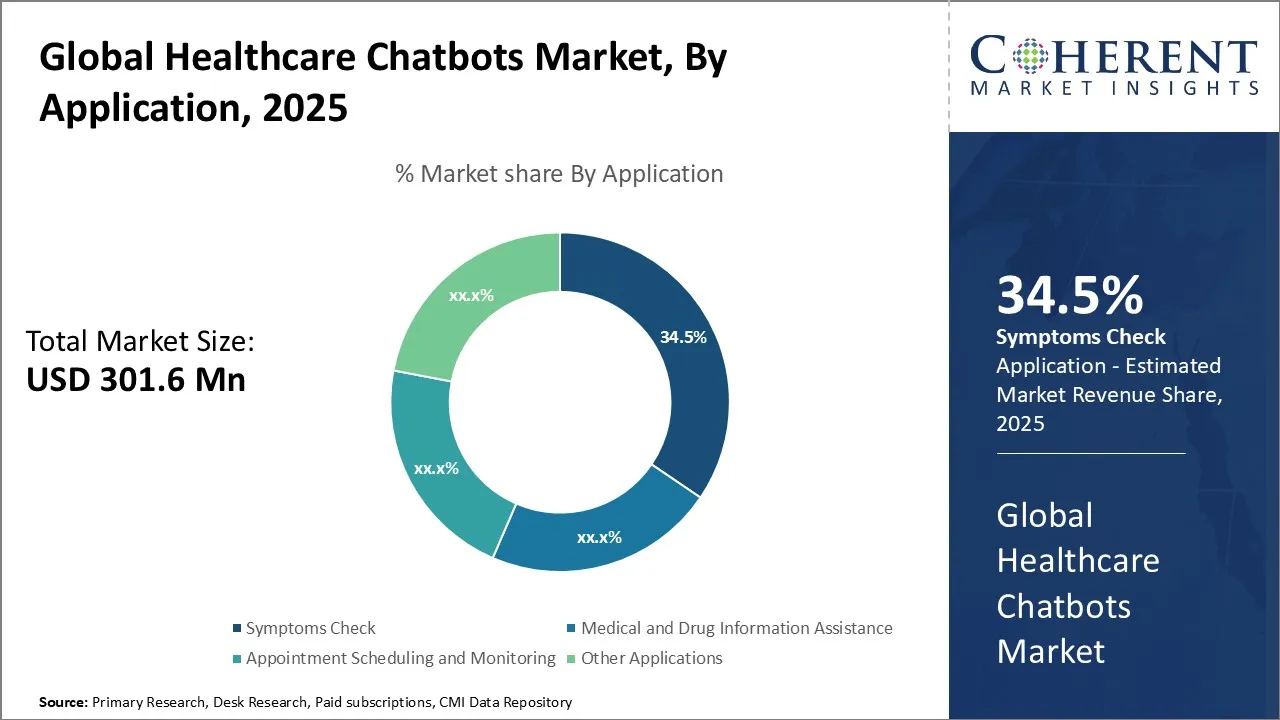
- By Application, Symptoms Check hold the largest market share of 35.5% in 2026 owing to the rising demand for virtual and remote healthcare.
- By End User, Healthcare Providers expected to hold largest market share in 2026 owing to its operational efficiency & cost reduction.
- By Deployment, Cloud Based acquired the prominent market share in 2026 owing to the scalability & ability to handle large volumes of interactions.
- By Region, North America dominates the overall market with an estimated share of 34.7% in 2026 owing to the advanced digital health infrastructure & high technology adoption.
Market Overview
Healthcare chatbots are rapidly transforming patient engagement and care delivery by utilizing artificial intelligence and natural language processing. Patients increasingly rely on these digital assistants for symptom checking, appointment scheduling, medication reminders, and virtual consultations, which reduce administrative burdens and improve accessibility. Telemedicine adoption, rising demand for patient-centered care, and advancements in cloud-based solutions are driving providers to streamline operations with chatbots, offering patients around-the-clock support. North America and Europe actively lead in innovation and deployment of these solutions.
Current Events and Its Impact on the Healthcare Chatbots Market
Current Events | Description and its impact |
Technological Advancements in AI and NLP |
|
Regulatory and Data Privacy Developments |
|
Geopolitical and Economic Factors |
|
Segmental Insights
- Current Industry Events of 2026
- Market Size Estimation
- Regional Breakdown
- Competitive Landscape
- Customer Intelligence
- Segmental Analysis
- Pricing Analysis
- Key Market Drivers, Challenges & Future Trends
- Customized Insights Section
Healthcare Chatbots Market Insights, By Application - Symptoms Check contribute the highest share of the market owing to its advances in AI, natural language processing (NLP) and machine learning
Symptoms Check hold the largest market share of 35.5% in 2026. Healthcare systems are increasingly adopting symptom-checking chatbots to provide immediate and accessible medical guidance. Patients use these chatbots to receive quick assessments before consulting a doctor, while providers leverage them to reduce workload and manage resources efficiently. Artificial intelligence and natural language processing enhance the accuracy and personalization of interactions, building trust and improving usability. Widespread smartphone and internet access, along with the demand for round-the-clock, patient-focused care, actively drive the expansion of symptom-checking chatbot use globally. For instance, in April 2024, Fortis Healthcare introduced “Adayu Mindfulness,” an AI-powered chatbot that helps individuals facing mental health challenges. The app provides psychological support and assessment tools, enabling users to identify potential mental health issues, especially for those hesitant to seek professional help due to stigma.
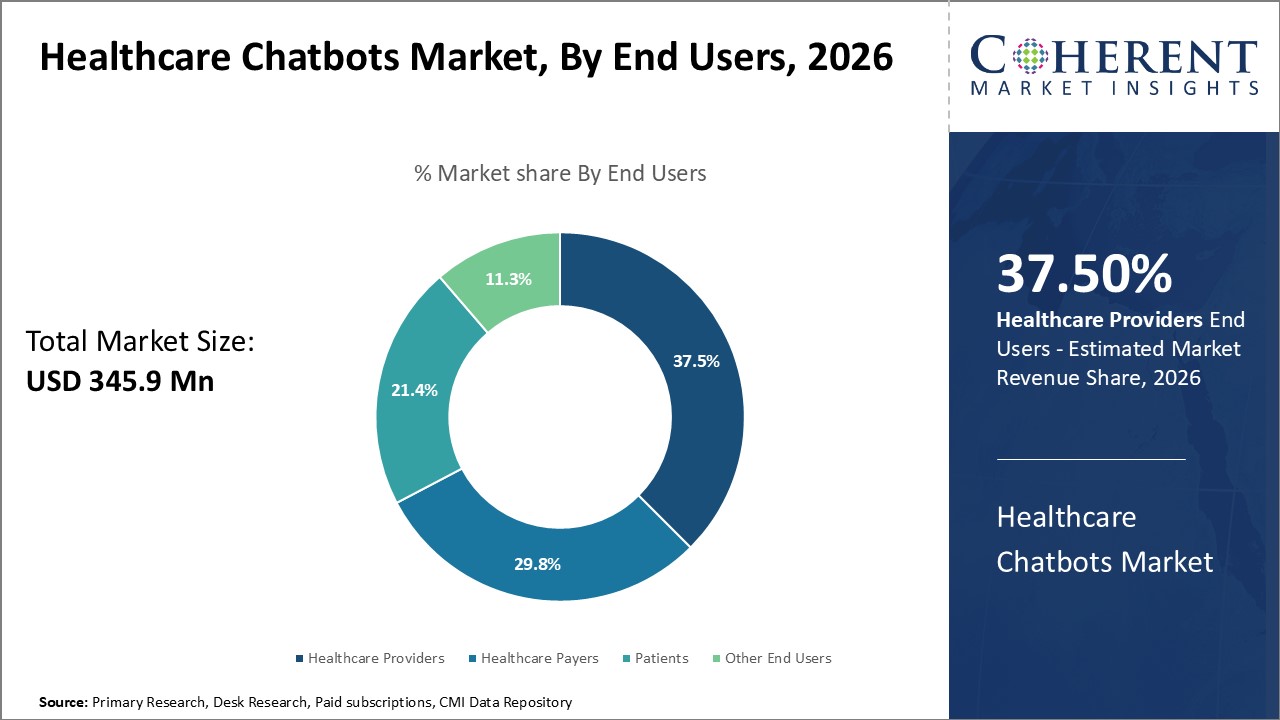
Healthcare Chatbots Market Insights, By End Users - Healthcare Providers contribute the highest share of the market owing to its scalability and handling high patient volumes
Healthcare providers are actively implementing chatbots to boost operational efficiency and simplify patient interactions. They automate routine tasks like appointment scheduling, follow-ups, and basic inquiries, reducing administrative workload and allowing staff to focus on critical care. Chatbots engage patients through personalized messages, reminders, and remote monitoring, enhancing satisfaction and adherence. By integrating with electronic health records and telemedicine platforms, providers efficiently manage large patient volumes, optimize workflows, and deliver timely, consistent care across a variety of healthcare environments. For instance, in February 2025, HUG launched “confIAnce,” Switzerland’s first AI-powered medical chatbot, providing reliable medical information to the public and healthcare professionals while easing pressure on primary care services.
Healthcare Chatbots Market Insights, By Deployment - Cloud Based contribute the highest share of the market owing to its flexibility & accessibility
Healthcare organizations are actively adopting cloud-based chatbots to improve scalability, accessibility, and operational efficiency. Providers use these solutions to manage high volumes of patient interactions simultaneously while offering round-the-clock support across multiple devices. Cloud deployment lowers infrastructure costs and simplifies maintenance, allowing faster updates and smooth integration with electronic health records and telemedicine systems. By leveraging advanced AI, analytics, and remote care capabilities, healthcare providers deliver personalized, efficient, and reliable services to patients globally. For instance, in July 2025, Samsung Electronics unveiled a beta AI Health Coach in the US via the Samsung Health app, offering at-home medical guidance while protecting data through a hybrid on-device and cloud privacy system.
Role of AI (Artificial Intelligence) in the Healthcare Chatbots Market
Artificial intelligence drives the Healthcare Chatbots Market by creating intelligent, interactive, and personalized experiences for patients. AI-powered chatbots understand natural language, interpret symptoms, provide relevant medical information, and guide users efficiently through healthcare processes. They help providers triage patients, automate routine tasks, and deliver customized health recommendations. By learning continuously from interactions and medical data, AI improves accuracy, responsiveness, and reliability, enabling healthcare systems to boost patient engagement, streamline operations, and support informed decision-making across a variety of care settings. For instance, in September 2025, the MP government introduced the AI-powered ‘SUMAN SAKHI’ chatbot to provide 24/7 women’s health support in Hindi, offering pregnant women guidance on antenatal care, high-risk conditions, and government health and welfare schemes.
Regional Insights
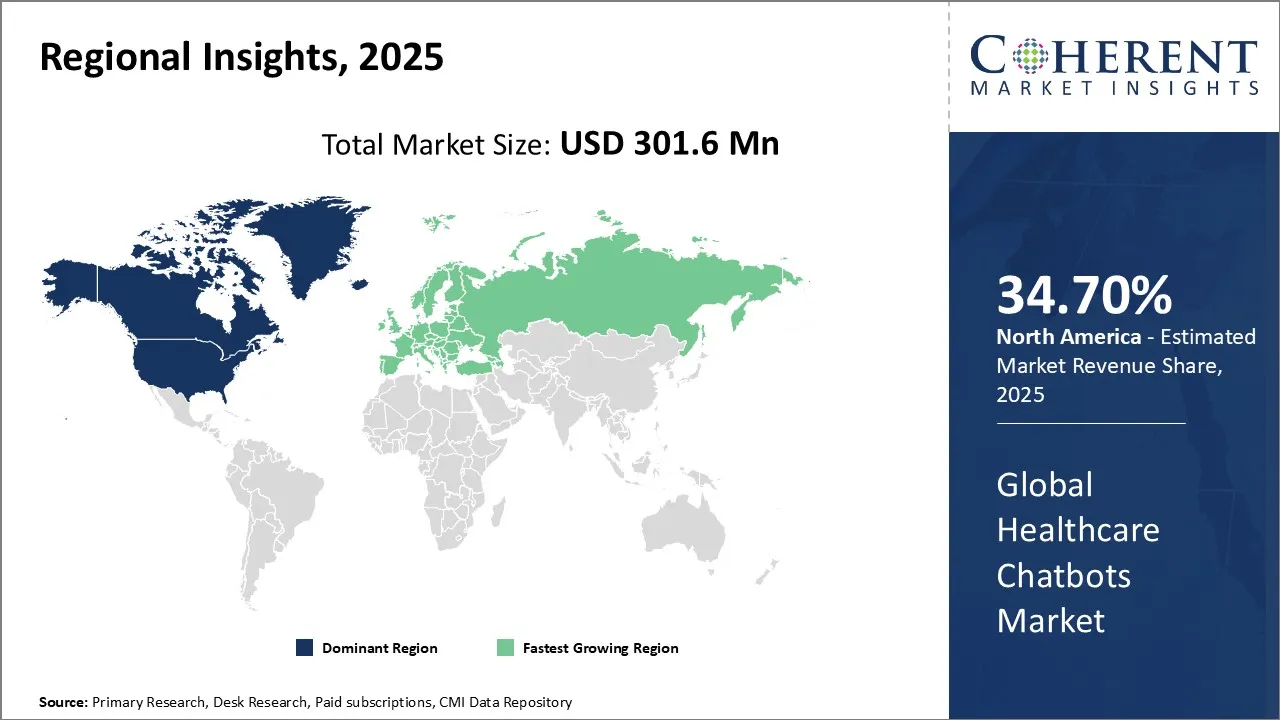
North America Healthcare Chatbots Market Trends
North America dominates the overall market with an estimated share of 34.7% in 2026. North America’s healthcare chatbot market thrives on advanced digital-health infrastructure and a tech-savvy population seeking convenience. Providers and insurers actively use chatbots for scheduling, triage, prescription refills, and post-treatment care, enhancing access and easing administrative workloads. Widespread adoption of electronic health records and supportive regulations enable seamless integration of chatbots into existing systems. At the same time, growing demand for virtual care and personalized health services drives continuous innovation and expansion of chatbot solutions across hospitals and clinics. For instance, in June 2026, Canadian AI company Cohere Inc. is entering healthcare by partnering with U.S.-based Ensemble Health Partners to use AI agents that help hospitals and providers manage revenue.
Europe Healthcare Chatbots Market Trends
Europe’s healthcare chatbot market is growing as health services become more digitized, remote care demand rises, and traditional healthcare systems face increasing pressure. Healthcare providers and insurers across the region actively use chatbots to manage scheduling, symptom triage, follow-ups, and patient inquiries, reducing the burden on staff. Advances in AI and natural-language processing enhance chatbot reliability and accessibility across multiple languages. Strong regulations on privacy and data protection drive the development of secure, compliant platforms, increasing user trust and adoption.
For instance, Berlin-based digital health company Ada Health has partnered with AXA OneHealth, Egypt’s AXA subsidiary, to enhance its digital ecosystem and transform the user experience in the region.
United States Healthcare Chatbots Market Trends
The United States healthcare chatbot market is expanding rapidly as patients and providers embrace digital health solutions. Hospitals, clinics, insurers, and telehealth platforms actively use chatbots for appointment management, symptom triage, prescription refills, virtual consultations, and mental health support. High smartphone penetration and reliable internet connectivity give patients easy access, while providers rely on automation to streamline workflows and reduce administrative burdens. Advances in AI, natural-language processing, and data integration allow chatbots to deliver accurate, real-time, personalized care, meeting growing demand for convenient, 24/7 healthcare services.
For instance, in July 2026, Samsung Electronics unveiled a beta AI health coach in the Samsung Health app in the US by year-end, enabling users to track health data and follow doctors’ advice in daily routines, said Park Hun-soo of Samsung’s MX digital health team.
United Kingdom Healthcare Chatbots Market Trends
The United Kingdom’s healthcare chatbot market is expanding rapidly as providers and patients embrace digital health solutions. Hospitals, clinics, and other healthcare institutions actively use chatbots for appointment booking, symptom triage, follow-ups, and patient messaging, reducing staff workload and improving access. Advances in AI and natural language processing make chatbots more conversational and reliable, increasing patient acceptance. Rising demand for remote care, chronic disease management, and mental health support, combined with supportive digital-health policies, drives wider adoption and innovation in chatbot solutions across the UK.
End-user Feedback and Unmet Needs in the Healthcare Chatbots Market
- Ease of Use and Accessibility: Patients value chatbots that are intuitive, quick, and accessible across devices. However, some users report difficulties navigating complex interfaces or encountering limited language options. There is a need for more user-friendly designs, multilingual support, and accessibility features to ensure broader adoption and seamless patient engagement.
- Accuracy and Reliability of Information: End-users appreciate instant responses but often question the reliability of medical advice provided. Many chatbots lack sufficient context or fail to handle complex symptoms accurately. Improving AI capabilities, integrating clinical validation, and providing clear disclaimers can enhance trust and reduce the risk of misinformation.
- Personalization and Patient Engagement: Patients expect chatbots to deliver tailored recommendations based on their health history, preferences, and previous interactions. Current solutions often offer generic responses, limiting engagement. Enhanced personalization through data integration and adaptive learning can improve patient adherence, satisfaction, and long-term use of chatbot services
Healthcare Chatbots Market Trend
Expansion of Virtual Healthcare Services
Healthcare chatbots are increasingly integrated into telemedicine platforms, enabling virtual consultations, remote monitoring, and follow-ups. This trend responds to growing demand for convenient, on-demand care and reduces patient dependence on in-person visits. Chatbots assist in pre-consultation triage, appointment scheduling, and routine inquiries, helping providers manage workloads efficiently while offering patients timely access to medical guidance. The shift toward virtual healthcare is accelerating digital adoption and fostering innovation in chatbot capabilities across hospitals, clinics, and telehealth providers.
Advances in AI and Natural Language Processing
The adoption of AI and NLP allows chatbots to understand and respond to complex patient queries more accurately. These technologies enable symptom assessment, personalized health recommendations, and natural, conversational interactions. Continuous learning algorithms improve performance over time, enhancing trust and usability. By integrating AI with analytics, chatbots can provide actionable insights to providers, support chronic disease management, and deliver customized care pathways, marking a significant evolution in the way digital tools contribute to patient engagement and healthcare delivery.
Healthcare Chatbots Market Opportunity
Expansion into Telemedicine & Remote Care Platforms
As telemedicine grows, chatbots can serve as front‑line tools for virtual care — handling appointment scheduling, symptom triage, post‑consultation follow‑ups, and continuing care outside physical clinics. Integrating chatbots into telehealth services broadens access, especially for remote or underserved populations, and reduces pressure on in‑person resources.
Market Report Scope
Healthcare Chatbots Market Report Coverage
| Report Coverage | Details | ||
|---|---|---|---|
| Base Year: | 2025 | Market Size in 2026: | USD 345.9 Mn |
| Historical Data for: | 2020 To 2024 | Forecast Period: | 2026 To 2033 |
| Forecast Period 2026 to 2033 CAGR: | 14.7% | 2033 Value Projection: | USD 903.5 Mn |
| Geographies covered: |
| ||
| Segments covered: |
| ||
| Companies covered: | ADA Digital Health Ltd., Buoy Health, Inc., Gyant.com, Inc., Infermedica, Microsoft, and Babylon Healthcare Service Limited, among others | ||
| Growth Drivers: |
| ||
| Restraints & Challenges: |
| ||
Healthcare Chatbots Market News
- In March 2025, Shanghai-based Ping An Health, the health tech unit of Chinese insurer Ping An, has launched a generative AI chatbot on its mobile health app, featuring avatars of real doctors.
- In August 2025, SSG Hospital, central Gujarat’s largest government hospital, has launched an AI-powered oncology chatbot to support cancer patients and their families.
- In September 2025, Union Health Minister JP Nadda has launched ‘Ayushman Sakhi’, a smart chatbot aimed at improving citizen services under national health schemes.
Analyst Opinion (Expert Opinion)
- Healthcare chatbots are already delivering tangible value to health systems, functioning not as futuristic experiments but as practical tools that meaningfully alleviate operational burdens. For instance, recent data indicates that in 2024 alone, approximately 60 million patient interactions occurred monthly across AI-driven healthcare chatbot platforms. Numerous hospitals, clinics, and telehealth providers now rely on these systems for triage, appointment scheduling, medication reminders, and routine follow-ups. By automating such administrative and repetitive tasks, chatbots enable healthcare professionals to dedicate time and expertise to complex or critical cases—an outcome that, in the context of workforce shortages and rising chronic disease prevalence, can differentiate a reactive healthcare system from a sustainably managed one.
- Furthermore, AI-powered chatbots demonstrate significant clinical potential when deployed judiciously. A recent benchmarking study reported that an AI system achieved 81.8% “top-one” diagnostic accuracy across 400 validated clinical vignettes spanning 14 specialties, outperforming conventional symptom-checker tools while requiring fewer questions and facilitating more efficient workflows, all within an empathic conversational framework. Meta-analytic evidence also suggests that, in text-only interactions, AI chatbots are frequently rated as more empathic than human healthcare providers, with a standardized mean difference of approximately 0.87 in favor of AI, corresponding to roughly a two-point increase on a 0–10 empathy scale. In healthcare environments constrained by high patient demand and limited human resources, such advantages are structural rather than marginal.
- Nonetheless, these developments warrant cautious optimism. The same technology that enables efficient triage and routine follow-ups can, and has, produced unsafe or clinically inaccurate outputs. A 2025 physician-led evaluation of four leading publicly available LLM-based chatbots revealed notable variability: overall rates of “problematic” responses ranged from approximately 21.6% to 43.2%, with “unsafe” advice occurring in up to 13% of instances. When scaled to millions of users, such error rates pose a tangible risk to patient safety and legal accountability.
Speak to the analyst
Want personalized insights?
Take the findings above to one of our principal consultants, or have the report rebuilt around the segments, geographies and competitors you actually track.
Market Segmentation
- Global Healthcare Chatbots Market, By Application
- Symptoms Check
- Medical and Drug Information Assistance
- Appointment Scheduling and Monitoring
- Other Applications
- Global Healthcare Chatbots Market, By End User
- Healthcare Providers
- Healthcare Payers
- Patients
- Other End Users
- Global Healthcare Chatbots Market, By Deployment
- Cloud-based
- On-premise
- Regional Insights (Revenue, USD Mn, 2021 - 2033)
- North America
- U.S.
- Canada
- Latin America
- Brazil
- Argentina
- Mexico
- Rest of Latin America
- Europe
- Germany
- U.K.
- Spain
- France
- Italy
- Russia
- Rest of Europe
- Asia Pacific
- China
- India
- Japan
- Australia
- South Korea
- ASEAN
- Rest of Asia Pacific
- Middle East
- GCC Countries
- Israel
- Rest of Middle East
- Africa
- South Africa
- North Africa
- Central Africa
- North America
- Key Players Insights
- ADA Digital Health Ltd.
- Buoy Health, Inc.
- com, Inc.
- Infermedica
- Microsoft
- Babylon Healthcare Service Limited
Sources
Primary Research interviews
- Healthcare providers (hospitals, clinics, telemedicine platforms)
- AI and chatbot developers in healthcare
- Patients and caregivers using healthcare chatbots
- Pharmaceutical companies deploying patient support chatbots
- Health insurance companies integrating chatbots for customer support
Databases
- PubMed
- ClinicalTrials.gov
- WHO Global Health Observatory
- National Center for Biotechnology Information (NCBI)
- HealthData.gov
Magazines
- Healthcare IT News
- Health Management Technology
- MedTech Outlook
- Digital Health Magazine
- mHealth Intelligence
Journals
- Journal of Medical Internet Research (JMIR)
- International Journal of Medical Informatics
- BMC Medical Informatics and Decision Making
- Frontiers in Digital Health
- Healthcare: The Journal of Delivery Science and Innovation
Newspapers
- The New York Times – Health Section
- The Guardian – Health
- The Washington Post – Health
- The Times of India – Health
- Financial Times – Healthcare & Pharma
Associations
- American Medical Association (AMA)
- Healthcare Information and Management Systems Society (HIMSS)
- International Society for Telemedicine & eHealth (ISfTeH)
- European Federation for Medical Informatics (EFMI)
- American Telemedicine Association (ATA)
Public Domain sources
- Government healthcare portals (CDC, NIH, NHS)
- World Health Organization (WHO) reports
- Open access datasets from hospitals and universities
- FDA and EMA regulatory databases
- National health statistics and census data
Proprietary Elements
- CMI Data Analytics Tool
- Proprietary CMI Existing Repository of information for last 8 years
Get access to 250+ pages report
Every segment, forecast, competitor profile and data table behind the analysis above — available for instant download.
- ESOMAR Member
- ISO 9001:2015 Certified
- D-U-N-S Registered
- GDPR & CCPA Compliant
Missing comfort of reading report in your local language? Find your preferred language:
Transform your Strategy with Exclusive Trending Reports
Frequently Asked Questions
The Healthcare Chatbots Market is estimated to be valued at USD 345.9 Mn in 2026, and is expected to reach USD 903.5 Mn by 2033.
The CAGR of the Healthcare Chatbots Market is projected to be 14.7% from 2026 to 2033.
Increasing adoption or the use of healthcare chatbots and the outbreak of COVID-19 (pandemic) is fueling the growth of the market.
The Symptoms Check segment is the leading component segment in the market.
Concerns regarding the data privacy and lack of acceptance or integration are some major factors restraining growth of the market.
Major players operating in the market are ADA Digital Health Ltd., Buoy Health, Inc., Gyant.com, Inc., Infermedica, Microsoft, and Babylon Healthcare Service Limited, among others.