

Healthcare Simulators Market Size and Forecast: 2026-2033
The Healthcare Simulators Market is estimated to be valued at USD 3.8 Bn in 2026 and is expected to reach USD 13.89 Bn by 2033, exhibiting a compound annual growth rate (CAGR) of 13.9% from 2026 to 2033.
Key Takeaways
- By Product and Services, Patient Simulation hold the largest market share of 36.6% in 2026 owing to the emphasis on patient safety and reducing medical errors.
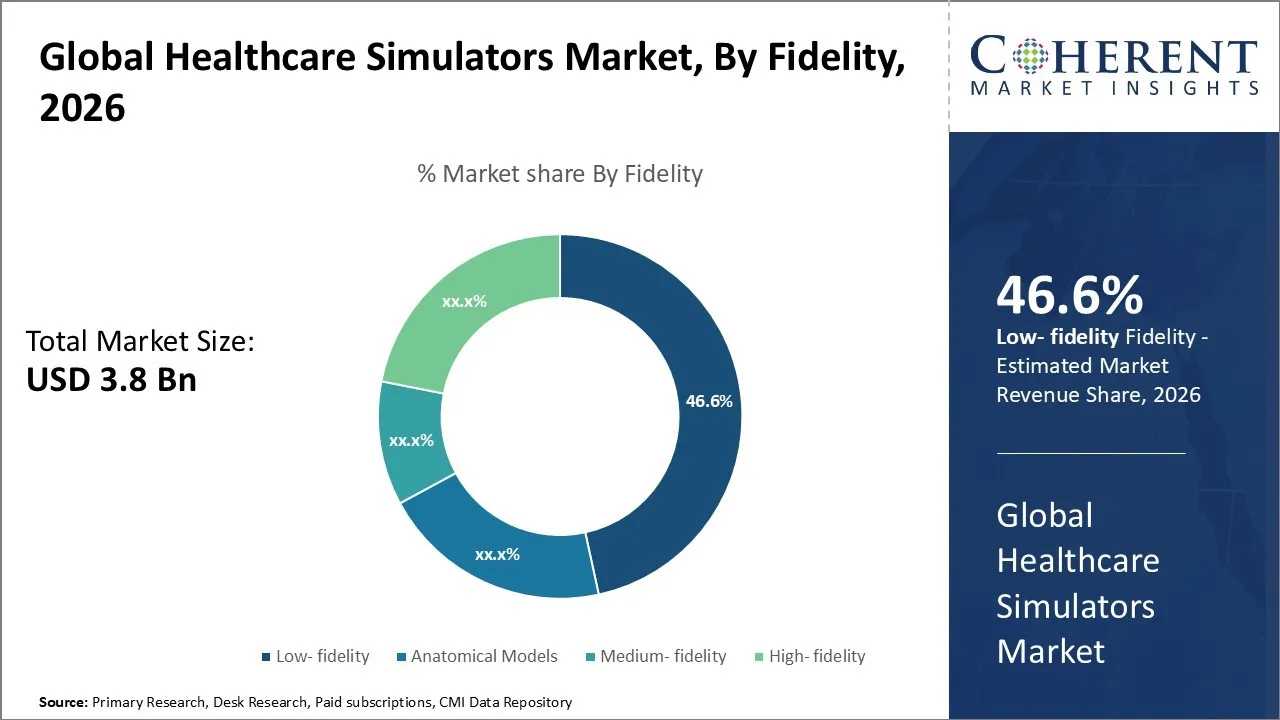
- By Fidelity, Low-fidelity expected to hold largest market share of 46.6% in 2026 owing to its cost-effectiveness.
- By End Users, Hospitals acquired the prominent market share of 43.3% in 2026 owing to the improving patient safety & reducing medical errors.
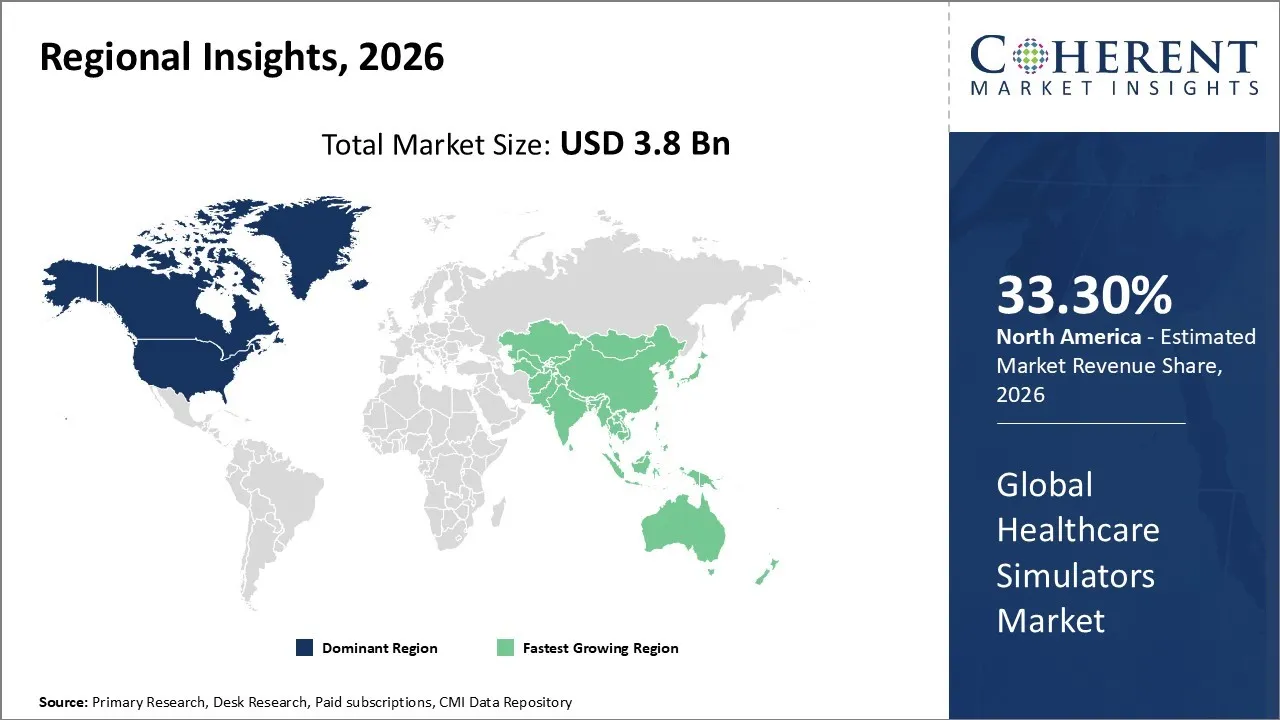
- By Region, North America dominates the overall market with an estimated share of 33.3% in 2026 owing to the emphasis on patient safety and quality of care.
Market Overview
The healthcare simulators market sells instruments that let healthcare workers practice in safe, controlled environments. It includes patient simulators, surgical simulators, task trainers, and virtual simulation platforms that are used by hospitals, schools, and the military. The adoption of simulation as a key part of modern healthcare education and clinical readiness is being driven by a growing focus on patient safety, the increasing complexity of medical procedures, the need for more training for the workforce, and the development of new technologies like virtual reality and artificial intelligence.
Current Events and Its Impact on the Healthcare Simulators Market
Current Events | Description and its impact |
Geopolitical and Regulatory Developments |
|
Economic Trends and Healthcare Spending |
|
Regional Healthcare Infrastructure Initiatives |
|
Segmental Insights
- Current Industry Events of 2026
- Market Size Estimation
- Regional Breakdown
- Competitive Landscape
- Customer Intelligence
- Segmental Analysis
- Pricing Analysis
- Key Market Drivers, Challenges & Future Trends
- Customized Insights Section
Healthcare Simulators Market Insights, By Fidelity - Low-fidelity contribute the highest share of the market owing to its support for large-scale and repetitive training
Low-fidelity expected to hold largest market share of 46.6% in 2026. Institutions that don't have a lot of money use low-fidelity healthcare simulators since they are cheap and easy to use. These simulators are used in training programs to teach fundamental clinical and procedural skills where extreme realism isn't needed. Their simple form makes it easy for students to practice over and over again, and it works well for large groups of students, especially in the early stages of medical school. Healthcare professionals also employ low-fidelity models to instruct pupils before they go on to more complex and complicated simulation systems.
Healthcare Simulators Market Insights, By Product and Services - Patient Simulation contribute the highest share of the market owing to its shortage of clinical training opportunities
Patient Simulation hold the largest market share of 36.6% in 2026. The healthcare simulators market promotes patient simulation by placing patient safety first and minimizing medical errors through safe, hands-on training. Healthcare providers utilize patient simulators to deal with the growing complexity of clinical procedures and to meet the requirements for competency-based education. These tools are very useful for hospitals and universities since they help people who don't have a lot of clinical expertise make better clinical decisions and work better as a team. Patient simulation is becoming more common in healthcare education because manikins and simulation software are getting better all the time.
For instance, in January 2024, Laerdal Medical has launched MamaAnne, a maternal simulator designed to improve simulation-based training and address leading causes of maternal morbidity and mortality.
Healthcare Simulators Market Insights, By End User - Hospitals contribute the highest share of the market owing to its compliance with accreditation & regulatory standards
Hospitals acquired the prominent market share of 43.3% in 2026. Hospitals drive the healthcare simulators market by using simulation technology to enhance patient safety and clinical outcomes. They train staff on complex procedures, improve decision-making, and strengthen teamwork. Simulators help meet certification standards, address skill gaps, reduce training costs, prepare personnel for crises, and adopt new technologies, making them essential for improving healthcare quality and operational readiness.
Regional Insights
North America Healthcare Simulators Market Trends
North America dominates the overall market with an estimated share of 33.30% in 2026. The market for healthcare simulators in North America is growing as hospitals and schools use high-fidelity manikins, VR/AR platforms, and complex simulation software to make clinical skills better and keep patients safe. Institutions employ immersive and remote simulations for competency-based training. Collaborative programs, mobile units, and government funding make it easier for more people to use simulations, which are now a key part of modern healthcare education and workforce readiness. For instance, in August 2025, the University of South Florida launched the world’s first university-based undergraduate concentration in Health Care Simulation Operations, focused on improving patient safety and care quality through advanced simulation technologies.
Asia Pacific Healthcare Simulators Market Trends
Healthcare facilities in the Asia Pacific region are using more simulation-based training to fill in skill gaps and make patients safer. They use digital and virtual tools, such mobile and cloud-based solutions, to make hands-on learning available to a lot of people. China, India, Japan, and South Korea all put money into their infrastructure and work with technology companies to help the region expand. They also promote immersive, interprofessional training to raise the quality of healthcare education. For instance, in September 2025, Shanghai-based Zhongshan Hospital, affiliated with Fudan University, inaugurated its Meta Medical Simulation Laboratory, marking a key step toward intelligent healthcare and expanded exploration of the meta-medical field.
United States Healthcare Simulators Market Trends
Healthcare providers in the U.S. are the ones who buy the most simulators. They use VR, AR, and cloud-based platforms to improve clinical training and patient safety. Schools use simulation in their classes to help students learn how to make decisions, work as a team, and use their hands. Investments in infrastructure and partnerships with technology developers make it easier for people to get access to new ideas. This is why simulation is such an important tool for healthcare education and workforce training all over the country. For instance, in November 2025, Siemens Healthineers introduced AI-enabled services to help healthcare providers tackle challenges ranging from image interpretation to complex healthcare environment planning.
India Healthcare Simulators Market Trends
In India, medical schools, hospitals, and training institutes help the healthcare simulators market grow by using simulation-based teaching to improve clinical skills and keep patients safe. Schools are adding more simulation centers and using VR, AR, and AI to make instruction more immersive and scalable. Working with technology developers and national efforts encourages standardized, competency-based programs. This leads to new ideas, modernizes healthcare education, and creates a qualified workforce in both cities and rural locations. For instance, in October 2025, Chennai-based medtech company MediSim VR has launched Uttarakhand’s first Center of Excellence in AI- and VR-based medical simulation at the Himalayan Institute of Medical Sciences (HIMS), Dehradun.
End-user Feedback and Unmet Needs in the Healthcare Simulators Market
- Realism and Fidelity Limitations: End-users often report that current simulators, particularly low- and mid-fidelity models, lack full realism in replicating human anatomy, physiological responses, or complex procedures. Medical professionals express the need for simulators that better mimic patient variability and emergency scenarios to improve hands-on skills and decision-making under realistic clinical pressures.
- Accessibility and Scalability Challenges: Hospitals and educational institutions face challenges in scaling simulation training due to limited availability of units and high costs for advanced models. Users highlight a need for more portable, affordable, and easily deployable simulators that can reach remote or resource-limited areas while maintaining training quality and effectiveness.
- Integration with Modern Technology: End-users emphasize gaps in the integration of AI, VR, AR, and cloud-based platforms with existing simulators. They seek seamless technology-enhanced solutions for interactive, adaptive, and personalized learning experiences, enabling better tracking of progress, scenario customization, and performance assessment across various clinical disciplines.
Healthcare Simulators Market Trend
Adoption of Immersive Technologies
More and more, the market is moving toward immersive technologies like virtual reality (VR), augmented reality (AR), and mixed reality platforms. Healthcare facilities use these tools to construct realistic, interactive settings where students can safely practice difficult operations and emergency responses. This trend makes simulation more flexible across fields including surgery, critical care, and inter professional teamwork by increasing engagement, speeding up skill development, and allowing for scenario customization. It also meets the changing needs of clinical training.
Expansion of Simulation-Based Education
To make training more consistent and check for proficiency, medical schools, nursing programs, and hospitals are using simulation more and more in their classes. This movement focuses on learning through experience, which lets students practice making decisions, treating patients, and technical skills in safe settings. More and more schools are putting money into simulation centers and blended learning programs that mix traditional teaching with hands-on activities. This helps students remember what they've learned, feel more confident, and be more prepared for real-world clinical problems.
Market Report Scope
Healthcare Simulators Market Report Coverage
| Report Coverage | Details | ||
|---|---|---|---|
| Base Year: | 2025 | Market Size in 2026: | USD 3.8 Bn |
| Historical Data for: | 2020 To 2024 | Forecast Period: | 2026 To 2033 |
| Forecast Period 2026 to 2033 CAGR: | 13.9% | 2033 Value Projection: | USD 13.89 Bn |
| Geographies covered: |
| ||
| Segments covered: |
| ||
| Companies covered: | Laerdal Medical, 3D Systems, Simulab Corporation, Simulaids, Inc., Kyoto Kagaku, Mentice, Medaphor, CAE Healthcare, Gaumard Scientific Company, Limbs & Things, BT, INC., Trandomed 3D, INC., Fujian Zhongli Co., Ltd., and Tellyes Scientific Co., Ltd. | ||
| Growth Drivers: |
| ||
| Restraints & Challenges: |
| ||
Healthcare Simulators Market News
- In December 2025, SmartWinnr, a leading sales enablement and readiness platform, launched a specialized medical simulation Centre of Excellence to enhance the accuracy, relevance, and compliance readiness of its AI-driven learning solutions for the pharmaceutical and medtech sectors.
- In October 2025, Gulf Medical University opened the Thumbay Institute of Clinical Simulation at its Ajman campus, creating a next-generation training hub where students, residents, and practicing clinicians can learn, rehearse, and master real-world care in a safe, high-fidelity environment.
Analyst Opinion (Expert Opinion)
- The trajectory of the healthcare simulators market underscores a profound transformation in clinical education that transcends traditional instruction. Simulation platforms are no longer peripheral tools but essential mechanisms for enhancing clinical competence and safeguarding patient outcomes. Evidence from international health agencies reveals that more than 80% of medical institutions in high‑income countries now incorporate simulation into training programs, with virtual and augmented reality methods accounting for nearly one‑third of healthcare training modalities, signaling a decisive shift toward immersive learning.
- This shift is not theoretical; measurable performance improvements are emerging. Royal College of Surgeons research links virtual reality simulation with a 70% increase in skill retention for procedural training, while simulations in advanced life support contexts have reduced response times by approximately half, reflecting tangible improvements in critical care readiness. These outcomes validate that simulation yields better retention and faster clinical decision‑making compared to conventional approaches.
- Institutional investment patterns further demonstrate strategic commitment. Over half of healthcare organizations have increased their simulation training budgets, and high‑fidelity solutions—once considered niche—now represent a meaningful share of deployments, especially in interdisciplinary programs involving nursing, surgery, and emergency response. This trend reflects recognition that competency cannot be assumed from didactic learning alone, and that repeated, high‑fidelity rehearsal directly correlates with reduced clinical errors.
Speak to the analyst
Want personalized insights?
Take the findings above to one of our principal consultants, or have the report rebuilt around the segments, geographies and competitors you actually track.
Market Segmentation
- By Products and Services
- Interventional/ Surgical Simulators
- Laparoscopic Surgical Simulators
- Gynecology Simulators
- Cardiovascular Simulators
- Arthroscopic Surgical Simulators
- Other Interventional/Surgical Simulators
- Endovascular Simulators
- Ultrasound Simulators
- Dental Simulators
- Eye Simulators
- Patient Simulation
- Task Trainer Simulation
- Manikin-based Simulation
- Standardized Patient Simulation
- Web-based Simulation
- Simulation Training Services
- Interventional/ Surgical Simulators
- By Fidelity
- Anatomical Models
- Low- fidelity
- Medium- fidelity
- High- fidelity
- By End User
- Academic Institutions & Research Centers
- Hospitals
- Military Organizations
- By Regional Insights
- North America
- U.S.
- Canada
- Latin America
- Brazil
- Argentina
- Mexico
- Rest of Latin America
- Europe
- Germany
- U.K.
- Spain
- France
- Italy
- Russia
- Rest of Europe
- Asia Pacific
- China
- India
- Japan
- Australia
- South Korea
- ASEAN
- Rest of Asia Pacific
- Middle East
- GCC Countries
- Israel
- Rest of Middle East
- Africa
- South Africa
- North Africa
- Central Africa
- North America
- Key Players Insights
- Laerdal Medical
- 3D Systems
- Simulab Corporation
- Simulaids, Inc.
- Kyoto Kagaku
- Mentice
- Medaphor
- CAE Healthcare
- Gaumard Scientific Company
- Limbs & Things
- BT, INC.
- Trandomed 3D, INC.
- Fujian Zhongli Co., Ltd.
- Tellyes Scientific Co., Ltd.
Sources
Primary Research interviews
- Hospital administrators and clinical educators
- Simulation center directors and training coordinators
- Healthcare technology developers and clinical engineers
- Medical school faculty and nursing program instructors
- Emergency response and critical care trainers
Databases
- PubMed
- ClinicalTrials.gov
- WHO Global Health Observatory
- National Center for Biotechnology Information (NCBI)
- MEDLINE
Magazines
- Medical Simulation & Training Today
- Healthcare Technology Management
- Journal of Medical Education and Training
Journals
- Simulation in Healthcare
- Journal of Clinical Simulation
- Advances in Medical Education and Practice
- BMJ Simulation & Technology Enhanced Learning
Newspapers
- The New York Times – Health Section
- The Guardian – Healthcare
- The Times of India – Health News
Associations
- Society for Simulation in Healthcare (SSH)
- Association for Standardized Patient Educators (ASPE)
- International Nursing Association for Clinical Simulation and Learning (INACSL)
- American College of Surgeons – Education Division
Public Domain sources
- WHO Reports on Patient Safety and Training
- CDC Guidelines on Healthcare Workforce Competency
- Government health department publications and reports (e.g., U.S. HHS, India MoHFW)
- Open-access university simulation curriculum materials
Proprietary Elements:
- CMI Data Analytics Tool
- Proprietary CMI Existing Repository of information for last 8 years
Get access to 250+ pages report
Every segment, forecast, competitor profile and data table behind the analysis above — available for instant download.
- ESOMAR Member
- ISO 9001:2015 Certified
- D-U-N-S Registered
- GDPR & CCPA Compliant
Missing comfort of reading report in your local language? Find your preferred language:
Transform your Strategy with Exclusive Trending Reports
Frequently Asked Questions
The global healthcare simulators market is estimated to surpass USD 13.89 by 2033.
Major players operating in the global healthcare simulators market include Laerdal Medical, 3D Systems, Simulab Corporation, Simulaids, Inc., Kyoto Kagaku, Mentice, Medaphor, CAE Healthcare, Gaumard Scientific Company, Limbs & Things, BT, INC., Trandomed 3D, INC., Fujian Zhongli Co., Ltd., and Tellyes Scientific Co., Ltd.
High buying and maintenance cost of simulators, especially high-fidelity stimulators are some of the major factors that are expected to hamper growth of the market over the forecast period.
Increasing number of medical institutes and educational tourism is one of the major factors that is expected to propel growth of the market over the forecast period.
The global healthcare simulators market is estimated to exhibit a CAGR of 13.9% over the forecast period.
Among regions, North America is expected to hold dominant position in the global healthcare simulators market during the forecast period.